

Digital Marketing Software Market Size and Forecast (2020 - 2033), Global and Regional Growth, Trend, Share, and Industry Analysis Report Coverage: By Component (Software, Services), By Deployment (Cloud-based, On-premise), By Enterprise Size (Large Enterprises, Small & Medium Enterprises), By End-User (B2B, B2C), By Application (Social Media Marketing, Content Management, Email Marketing, SEO & Web Analytics, Campaign Management, Marketing Automation, and others) And Geography
2025-12-05
Business & Financial Services
Ekta Chaurasia (Team Lead)
Description
Digital Marketing Software Market Overview
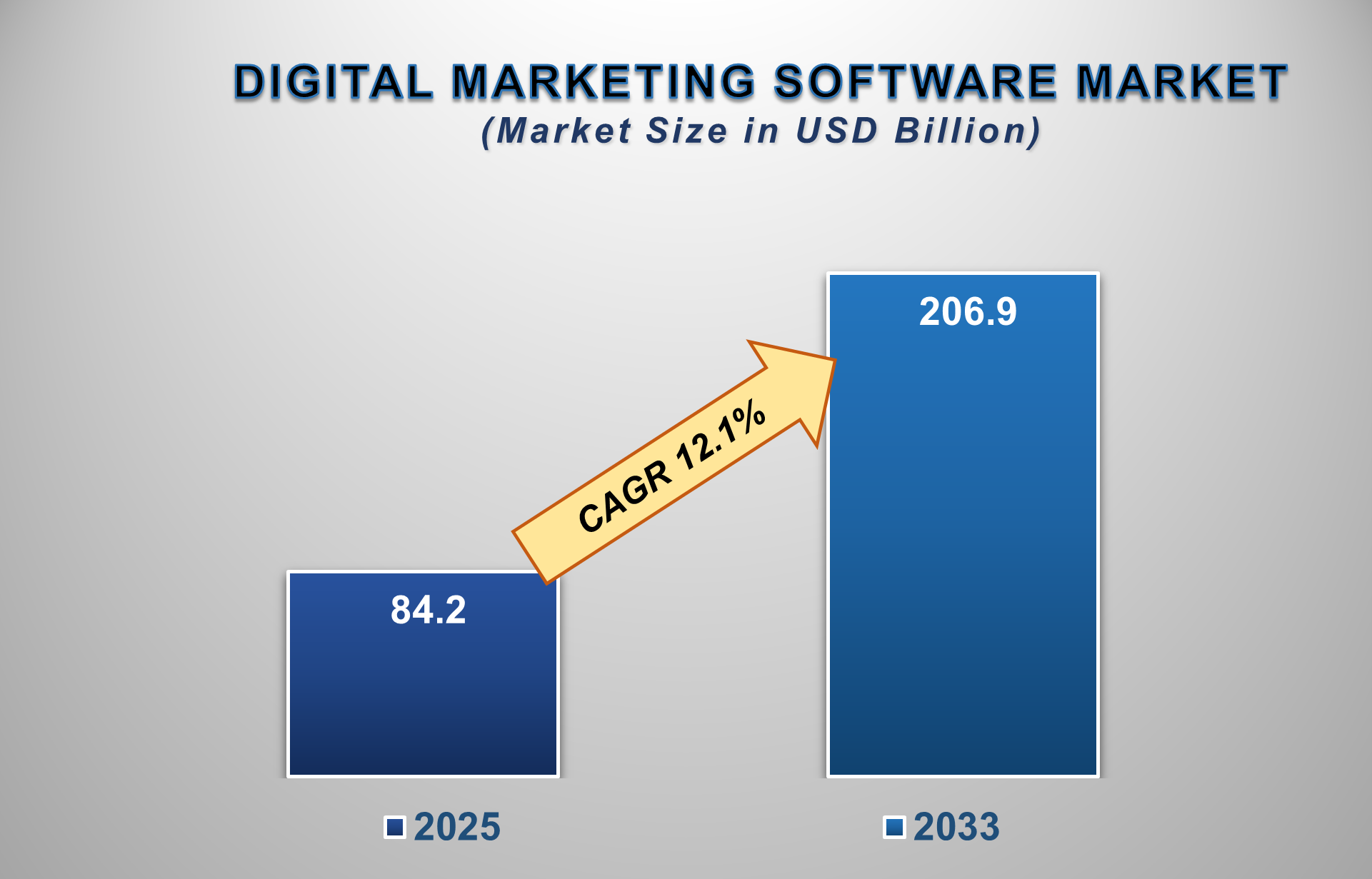
The Digital Marketing Software Market is positioned for exceptional growth from 2025 to 2033, driven by the relentless shift of business activities to digital channels, the increasing importance of data-driven customer engagement, and the continuous evolution of AI and automation technologies. The market is projected to be valued at approximately USD 84.2 billion in 2025 and is forecasted to reach nearly USD 206.9 billion by 2033, exhibiting a compound annual growth rate (CAGR) of 12.1% during this period.
Digital marketing software encompasses a suite
of tools and platforms that enable businesses to plan, execute, manage, and analyze their online marketing efforts. The market's expansion is
underpinned by the critical need for businesses of all sizes to establish a
robust digital presence, personalize customer interactions, and achieve a
measurable return on investment (ROI) from their marketing spend. Factors such
as the proliferation of social media, the dominance of mobile-first strategies,
and the increasing complexity of the customer journey are compelling
organizations to adopt integrated software solutions.
Furthermore, the rise of generative AI, the
focus on privacy-first data management, and the demand for omnichannel customer
experiences are key trends shaping product innovation. North America currently
holds the largest market share, but the Asia-Pacific region is expected to be
the fastest-growing, fueled by rapid digitalization, a booming SME sector, and
increasing internet penetration.
Digital
Marketing Software Market Drivers and Opportunities
The Imperative for Data-Driven Customer
Engagement and ROI Measurement is the Primary Market Driver
The most significant driver for the digital
marketing software market is the universal business need to understand,
attract, and retain customers in a crowded online landscape. With consumers
leaving digital footprints across numerous touchpoints, businesses require
sophisticated software to collect, unify, and analyze this data. This enables
hyper-personalized marketing, predictive analytics, and, crucially, the ability
to accurately measure campaign performance and marketing ROI. The shift from
traditional, broad-reach marketing to targeted, performance-based strategies is
forcing companies to invest in platforms that offer robust analytics,
automation, and attribution modeling.
The Proliferation of Digital Channels and the
Rise of AI-Powered Automation are Driving
Market Evolution
The ever-expanding ecosystem of digital channels, from social media and search engines to email, mobile
apps, and connected TV, makes it impossible to
manage marketing efforts manually. This complexity is a major catalyst for the
adoption of integrated marketing suites. Simultaneously, the integration of
Artificial Intelligence (AI) and Machine Learning (ML) is transforming these
tools from simple management platforms to intelligent systems. AI powers
capabilities like chatbots for customer service, predictive content scoring,
automated bid management in advertising, and generative AI for content
creation, making marketing more efficient and effective. This digital and AI
evolution is creating continuous demand for upgraded and more intelligent
software solutions.
The Adoption of Privacy-First Marketing and
Omnichannel Strategies Presents Significant
Opportunities
The phasing out of third-party cookies and
increasing global data privacy regulations (like GDPR and CCPA) are creating a
significant growth frontier for marketing software. Key opportunities lie in
developing solutions that help marketers navigate this new landscape through
first-party data collection, privacy-compliant analytics, and context-based
targeting. Furthermore, the demand for a seamless omnichannel experience is
pushing the need for unified platforms that can orchestrate customer journeys
across web, mobile, social, and in-store interactions. For software vendors,
investing in CDP (Customer Data Platform) capabilities, AI-driven
personalization that respects privacy, and integrated cross-channel campaign
management are key strategies to capture the next wave of market growth.
Digital Marketing
Software Market Scope
|
Report Attributes |
Description |
|
Market Size in 2025 |
USD 84.2 Billion |
|
Market Forecast in 2033 |
USD 206.9 Billion |
|
CAGR % 2025-2033 |
12.1% |
|
Base Year |
2024 |
|
Historic Data |
2020-2024 |
|
Forecast Period |
2025-2033 |
|
Report USP |
Product Portfolio,
Technological Analysis, Company Market Share, Company Heatmap, Pricing
Analysis, Growth Factors and more |
|
Segments Covered |
●
By Component ●
By Deployment
Mode ●
By Enterprise
Size ●
By Application ●
By End-user |
|
Regional Scope |
●
North America, ●
Europe, ●
APAC, ●
Latin America ●
Middle East and
Africa |
|
Country Scope |
1)
U.S. 2)
Canada 3)
Germany 4)
UK 5)
France 6)
Spain 7)
Italy 8)
Switzerland 9)
China 10)
Japan 11)
India 12)
Australia 13)
South Korea 14)
Brazil 15)
Mexico 16)
Argentina 17)
South Africa 18)
Saudi Arabia 19)
UAE |
Digital Marketing
Software Market Report Segmentation Analysis
The global Digital Marketing
Software Market industry analysis is segmented by Component, Deployment,
Enterprise Size, End-User, Application, and region.
The Software component segment is anticipated to command a
significant market share in 2025.
The
Component segment is categorized into Software and Services. The Software
segment, which includes platforms for various applications, holds the dominant
share as it represents the core product offering. This includes everything from
standalone SEO tools and email marketing platforms to comprehensive marketing
clouds. The demand is driven by the essential need for the technology itself to
execute digital strategies. While the Services segment (including
implementation, consulting, and support) is growing steadily, the recurring
revenue from software subscriptions (SaaS) ensures its leadership in market
share.
The
Cloud-based deployment segment is projected to be the fastest-growing.
The
Deployment segment is divided into Cloud-based and On-premise. The Cloud-based
segment is experiencing the highest growth rate due to its scalability, lower
upfront costs, ease of updates, and remote accessibility. The SaaS model is
particularly attractive to Small and Medium Enterprises (SMEs) as it
democratizes access to enterprise-grade tools without significant IT
infrastructure investment. The agility offered by cloud solutions is essential
for marketers to quickly adapt to new trends and channels, making it the
preferred deployment method for the modern business.
The
Marketing Automation application segment is projected to exhibit strong growth.
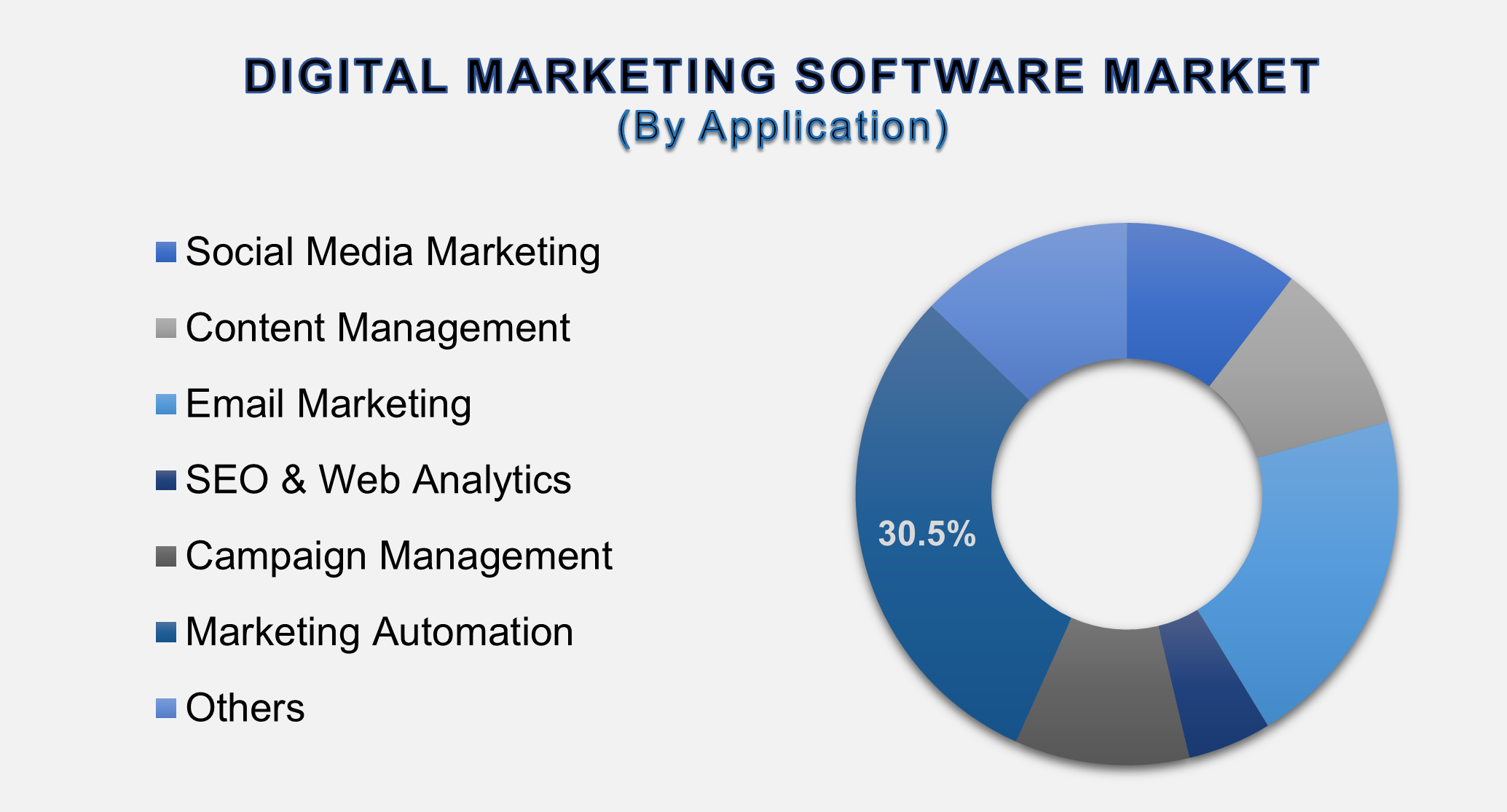
The Application segment includes Social Media Marketing, Content Management, Email Marketing, SEO & Web Analytics, Campaign Management, Marketing Automation, and others. The Marketing Automation segment is witnessing accelerated growth as businesses seek to streamline complex workflows, nurture leads efficiently, and deliver personalized customer journeys at scale. By automating repetitive tasks and triggering communications based on user behavior, companies can improve conversion rates and sales productivity, demonstrating clear and compelling ROI, which fuels further investment in this category.
The following segments are
part of an in-depth analysis of the global Digital Marketing Software Market:
|
Market
Segments |
|
|
By
Component |
●
Software ●
Services |
|
By Deployment |
●
Cloud-based ●
On-premise |
|
By Enterprise Size |
●
Large Enterprises ●
Small & Medium
Enterprises (SMEs) |
|
By Application
|
●
Social Media
Marketing ●
Content Management ●
Email Marketing ●
SEO & Web
Analytics ●
Campaign Management ●
Marketing Automation ●
Others |
|
By End-user |
●
B2B ●
B2C |
Digital Marketing
Software Market Share Analysis by Region
The
North America region is anticipated to hold the largest portion of the digital
marketing software market globally throughout the forecast period.
North
America's dominance is attributed to its early adoption of advanced
technologies, the high concentration of major software vendors (like Adobe, Salesforce,
and Oracle), and a mature digital advertising
ecosystem. The region has a highly competitive business landscape where
data-driven marketing is considered a standard practice. Strict data privacy
laws also drive the demand for sophisticated, compliant marketing tools.
However, the high growth rate is increasingly shifting towards the Asia-Pacific.
The
U.S. digital marketing software market is booming because the country is
undergoing a massive digital shift. With nearly everyone using the internet and
smartphones, businesses of all sizes, from
large corporations to small startups, are
moving their advertising money away from traditional media like TV and into
digital channels to reach customers online. This is especially true in
competitive fields like e-commerce and fintech, where companies are investing
in automated and AI-powered tools to attract customers more efficiently and
cost-effectively. A key driver of this growth is the widespread availability of
affordable, cloud-based software, which has democratized advanced marketing by
giving smaller businesses access to tools that were once only available to
large enterprises.
Digital Marketing
Software Market Competition Landscape Analysis
The global digital marketing
software market is highly competitive and fragmented, featuring a diverse mix
of large technology conglomerates offering integrated "marketing
clouds," best-of-breed point solution providers, and a vibrant ecosystem
of agile startups. Competition is intense and based on technological
innovation, platform integration capabilities, scalability, pricing, and brand
reputation. Key strategies include heavy investment in AI and generative AI
features, strategic acquisitions to fill portfolio gaps, forming partnerships
to create integrated ecosystems, and developing industry-specific solutions to
cater to vertical markets like retail, healthcare, and financial services.
Global Digital Marketing
Software Market Recent Developments News:
- In January 2025, Adobe Inc. integrated a new suite of generative AI
features into its Experience Cloud, enabling the automated creation of
personalized marketing copy and images.
- In November 2024, HubSpot, Inc.,
announced the acquisition of a leading ABM (Account-Based Marketing)
platform to strengthen its offerings for B2B marketers.
- In September 2024, Salesforce launched a new AI-powered journey
orchestration tool within Marketing Cloud, allowing for more predictive
customer engagement.
- In July 2024, Microsoft Corporation enhanced the AI capabilities of
its LinkedIn Marketing Solutions, providing better audience targeting and
performance insights for B2B advertisers.
The Global Digital
Marketing Software Market Is Dominated by a Few Large Companies, such as
●
Adobe Inc.
●
Salesforce, Inc.
●
Oracle Corporation
●
Google LLC (Alphabet
Inc.)
●
Microsoft Corporation
●
SAP SE
●
IBM Corporation
●
HubSpot, Inc.
●
Meta Platforms, Inc.
●
SAS Institute Inc.
●
Hootsuite Inc.
●
ActiveCampaign, LLC
●
Marketo, Inc. (an Adobe Company)
●
Twilio Inc.
●
Zoho Corporation Pvt.
Ltd.
● Other Prominent Players
Frequently Asked Questions
Ekta Chaurasia (Team Lead)
Ekta Chaurasia is a highly experienced Team Lead at M2Square Consultancy with over 7 years of expertise in market research, strategic consulting, competitive benchmarking, and business intelligence solutions. She specializes in ICT, semiconductors & electronics, automotive & transportation, and industrial machinery markets.
She leads end-to-end global research projects focused on market trends, industry analysis, growth forecasting, customer insights, and strategic decision-making. Known for her analytical leadership and industry expertise, Ekta helps businesses uncover growth opportunities, evaluate competitive landscapes, and stay ahead in rapidly evolving markets through accurate and insight-driven research.
1. Global Digital Marketing
Software Market Introduction and Market Overview
1.1.
Objectives
of the Study
1.2.
Global
Digital Marketing Software Market Scope and Market Estimation
1.2.1.Global Electronic Toll
Collection Overall Market Size (US$ Bn), Market CAGR (%), Market forecast (2025
- 2033)
1.2.2.Global Digital Marketing
Software Market Revenue Share (%) and Growth Rate (Y-o-Y) from 2020 - 2033
1.3.
Market
Segmentation
1.3.1.Component of Global Digital
Marketing Software Market
1.3.2.Deployment of Global Digital
Marketing Software Market
1.3.3.Enterprise Size of Global Digital
Marketing Software Market
1.3.4.Application of Global Digital
Marketing Software Market
1.3.5.End-user of Global Digital
Marketing Software Market
1.3.6.Region of Global Digital
Marketing Software Market
2.
Executive Summary
2.1.
Demand
Side Trends
2.2.
Key
Market Trends
2.3.
Market
Demand (US$ Bn) Analysis 2020 – 2024 and forecast, 2025 – 2033
2.4.
Demand
and Opportunity Assessment
2.5.
Technological
Advancements
2.6.
Key
Developments
2.7.
Market
Entry Strategies
2.8.
Market
Dynamics
2.8.1.Drivers
2.8.2.Limitations
2.8.3.Opportunities
2.8.4.Impact Analysis of Drivers
and Restraints
2.9.
Porter’s
Five Forces Analysis
2.10.
PEST
Analysis
3. Global
Digital Marketing Software Market
Estimates & Historical Trend Analysis (2020 - 2024)
4. Global
Digital Marketing Software Market
Estimates & Forecast Trend Analysis, by Component
4.1.
Global
Digital Marketing Software Market Revenue (US$ Bn) Estimates and Forecasts, by Component,
2020 - 2033
4.1.1.Software
4.1.2.Services
5. Global
Digital Marketing Software Market
Estimates & Forecast Trend Analysis, by Deployment
5.1.
Global
Digital Marketing Software Market Revenue (US$ Bn) Estimates and Forecasts, by Deployment,
2020 - 2033
5.1.1.Cloud-based
5.1.2.On-premise
6. Global
Digital Marketing Software Market
Estimates & Forecast Trend Analysis, by Enterprise
Size
6.1.
Global
Digital Marketing Software Market Revenue (US$ Bn) Estimates and Forecasts, by Enterprise
Size 2020 - 2033
6.1.1.Large Enterprises
6.1.2.Small & Medium
Enterprises (SMEs)
7. Global
Digital Marketing Software Market
Estimates & Forecast Trend Analysis, by Application
7.1.
Global
Digital Marketing Software Market Revenue (US$ Bn) Estimates and Forecasts, by
Enterprise Size 2020 - 2033
7.1.1.Social Media Marketing
7.1.2.Content Management
7.1.3.Email Marketing
7.1.4.SEO & Web Analytics
7.1.5.Campaign Management
7.1.6.Marketing Automation
7.1.7.Others
8. Global
Digital Marketing Software Market
Estimates & Forecast Trend Analysis, by End-user
8.1.
Global
Digital Marketing Software Market Revenue (US$ Bn) Estimates and Forecasts, by
End-user 2020 - 2033
8.1.1.B2B
8.1.2.B2C
9. Global
Digital Marketing Software Market
Estimates & Forecast Trend Analysis, by region
9.1.
Global
Digital Marketing Software Market Revenue (US$ Bn) Estimates and Forecasts, by region,
2020 - 2033
9.1.1.North America
9.1.2.Europe
9.1.3.Asia Pacific
9.1.4.Middle East & Africa
9.1.5.Latin America
10. North America Digital
Marketing Software Market: Estimates
& Forecast Trend Analysis
10.1. North America Digital
Marketing Software Market Assessments & Key Findings
10.1.1.
North
America Digital Marketing Software Market Introduction
10.1.2.
North
America Digital Marketing Software Market Size Estimates and Forecast (US$ Billion)
(2020 - 2033)
10.1.2.1.
By Component
10.1.2.2.
By Deployment
10.1.2.3.
By Enterprise Size
10.1.2.4.
By Application
10.1.2.5.
By End-user
10.1.2.6. By Country
10.1.2.6.1. The U.S.
10.1.2.6.2. Canada
11. Europe Digital
Marketing Software Market: Estimates
& Forecast Trend Analysis
11.1. Europe Digital Marketing
Software Market Assessments & Key Findings
11.1.1. Europe Digital Marketing
Software Market Introduction
11.1.2. Europe Digital Marketing
Software Market Size Estimates and Forecast (US$ Billion) (2020 - 2033)
11.1.2.1.
By Component
11.1.2.2.
By Deployment
11.1.2.3.
By Enterprise Size
11.1.2.4.
By Application
11.1.2.5.
By End-user
11.1.2.6. By Country
11.1.2.6.1.
Germany
11.1.2.6.2.
Italy
11.1.2.6.3.
U.K.
11.1.2.6.4.
France
11.1.2.6.5.
Spain
11.1.2.6.6.
Switzerland
11.1.2.6.7. Rest
of Europe
12. Asia Pacific Digital
Marketing Software Market: Estimates
& Forecast Trend Analysis
12.1. Asia Pacific Market
Assessments & Key Findings
12.1.1.
Asia
Pacific Digital Marketing Software Market Introduction
12.1.2.
Asia
Pacific Digital Marketing Software Market Size Estimates and Forecast (US$ Billion)
(2020 - 2033)
12.1.2.1.
By Component
12.1.2.2.
By Deployment
12.1.2.3.
By Enterprise Size
12.1.2.4.
By Application
12.1.2.5.
By End-user
12.1.2.6. By Country
12.1.2.6.1. China
12.1.2.6.2. Japan
12.1.2.6.3. India
12.1.2.6.4. Australia
12.1.2.6.5. South Korea
12.1.2.6.6. Rest of Asia Pacific
13. Middle East & Africa Digital
Marketing Software Market: Estimates
& Forecast Trend Analysis
13.1. Middle East & Africa
Market Assessments & Key Findings
13.1.1. Middle
East & Africa
Digital Marketing Software Market Introduction
13.1.2. Middle
East & Africa
Digital Marketing Software Market Size Estimates and Forecast (US$ Billion) (2020
- 2033)
13.1.2.1.
By Component
13.1.2.2.
By Deployment
13.1.2.3.
By Enterprise Size
13.1.2.4.
By Application
13.1.2.5.
By End-user
13.1.2.6. By Country
13.1.2.6.1. UAE
13.1.2.6.2. Saudi
Arabia
13.1.2.6.3. South
Africa
13.1.2.6.4. Rest
of MEA
14. Latin America
Digital Marketing Software Market:
Estimates & Forecast Trend Analysis
14.1. Latin America Market
Assessments & Key Findings
14.1.1. Latin America Digital
Marketing Software Market Introduction
14.1.2. Latin America Digital
Marketing Software Market Size Estimates and Forecast (US$ Billion) (2020 - 2033)
14.1.2.1.
By Component
14.1.2.2.
By Deployment
14.1.2.3.
By Enterprise Size
14.1.2.4.
By Application
14.1.2.5.
By End-user
14.1.2.6. By Country
14.1.2.6.1. Brazil
14.1.2.6.2. Argentina
14.1.2.6.3. Mexico
14.1.2.6.4. Rest
of LATAM
15.
Country
Wise Market: Introduction
16.
Competition
Landscape
16.1. Global Digital Marketing
Software Market Product Mapping
16.2. Global Digital Marketing
Software Market Concentration Analysis, by Leading Players / Innovators /
Emerging Players / New Entrants
16.3. Global Digital Marketing
Software Market Tier Structure Analysis
16.4. Global Digital Marketing
Software Market Concentration & Company Market Shares (%) Analysis, 2024
17.
Company
Profiles
17.1.
Adobe Inc.
17.1.1.
Company
Overview & Key Stats
17.1.2.
Financial
Performance & KPIs
17.1.3.
Product
Portfolio
17.1.4.
SWOT
Analysis
17.1.5.
Business
Strategy & Recent Developments
* Similar details would be provided for all the players
mentioned below
17.2.
Salesforce, Inc.
17.3.
Oracle Corporation
17.4.
Google LLC (Alphabet Inc.)
17.5.
Microsoft Corporation
17.6.
SAP SE
17.7.
IBM Corporation
17.8.
HubSpot, Inc.
17.9.
Meta Platforms, Inc.
17.10.
SAS Institute Inc.
17.11.
Hootsuite Inc.
17.12.
ActiveCampaign, LLC
17.13.
Marketo, Inc.
17.14.
Twilio Inc.
17.15.
Zoho Corporation Pvt. Ltd.
17.16.
Other Prominent Players
18. Research
Methodology
18.1. External Transportations /
Databases
18.2. Internal Proprietary
Database
18.3. Primary Research
18.4. Secondary Research
18.5. Assumptions
18.6. Limitations
18.7. Report FAQs
19. Research
Findings & Conclusion
Our Research Methodology
"Insight without rigor is just noise."
We follow a comprehensive, multi-phase research framework designed to deliver accurate, strategic, and decision-ready intelligence. Our process integrates primary and secondary research , both quantitative and qualitative , along with dual modeling techniques ( top-down and bottom-up) and a final layer of validation through our proprietary in-house repository.
PRIMARY RESEARCH
Primary research captures real-time, firsthand insights from the market to understand behaviors, motivations, and emerging trends.
1. Quantitative Primary Research
Objective: Generate statistically significant data directly from market participants.
Approaches:- Structured surveys with customers, distributors, and field agents
- Mobile-based data collection for point-of-sale audits and usage behavior
- Phone-based interviews (CATI) for market sizing and product feedback
- Online polling around industry events and digital campaigns
- Purchase frequency by customer type
- Channel performance across geographies
- Feature demand by application or demographic
2. Qualitative Primary Research
Objective: Explore decision-making drivers, pain points, and market readiness.
Approaches:- In-depth interviews (IDIs) with executives, product managers, and key decision-makers
- Focus groups among end users and early adopters
- Site visits and observational research for consumer products
- Informal field-level discussions for regional and cultural nuances
SECONDARY RESEARCH
This phase helps establish a macro-to-micro understanding of market trends, size, regulation, and competitive dynamics, sourced from credible and public domain information.
1. Quantitative Secondary Research
Objective: Model market value and segment-level forecasts based on published data.
Sources include:- Financial reports and investor summaries
- Government trade data, customs records, and regulatory statistics
- Industry association publications and economic databases
- Channel performance and pricing data from marketplace listings
- Revenue splits, pricing trends, and CAGR estimates
- Supply-side capacity and volume tracking
- Investment analysis and funding benchmarks
2. Qualitative Secondary Research
Objective: Capture strategic direction, innovation signals, and behavioral trends.
Sources include:- Company announcements, roadmaps, and product pipelines
- Publicly available whitepapers, conference abstracts, and academic research
- Regulatory body publications and policy briefs
- Social and media sentiment scanning for early-stage shifts
- Strategic shifts in market positioning
- Unmet needs and white spaces
- Regulatory triggers and compliance impact
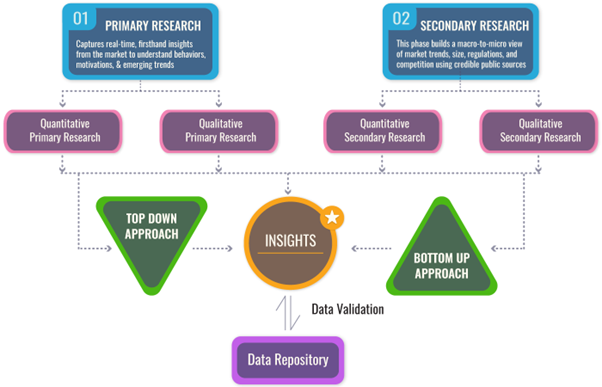
DUAL MODELING: TOP-DOWN + BOTTOM-UP
To ensure robust market estimation, we apply two complementary sizing approaches:
Top-Down Modeling:- Start with broader industry value (e.g., global or regional TAM)
- Apply filters by segment, geography, end-user, or use case
- Adjust with primary insights and validation benchmarks
- Ideal for investor-grade market scans and opportunity mapping
- Aggregate from the ground up using sales volumes, pricing, and unit economics
- Use internal modeling templates aligned with stakeholder data
- Incorporate distributor-level or region-specific inputs
- Most accurate for emerging segments and granular sub-markets
DATA VALIDATION: IN-HOUSE REPOSITORY
We close the loop with proprietary data intelligence built from ongoing projects, industry monitoring, and historical benchmarking. This repository includes:
- Multi-sector market and pricing models
- Key trendlines from past interviews and forecasts
- Benchmarked adoption rates, churn patterns, and ROI indicators
- Industry-specific deviation flags and cross-check logic
- Catches inconsistencies early
- Aligns projections across studies
- Enables consistent, high-trust deliverables