

Digital Spoon Market Size and Forecast (2026–2034): Global and Regional Growth, Trends, Market Share, and Industry Analysis Report; by Product Type (Salt-Reducing Digital Spoon, Measuring Digital Spoon, Health Monitoring Digital Spoon, and Smart Feeding Spoon); by Connectivity (Bluetooth-Enabled and Non-Connected Devices); by Application (Health Management, Cooking & Food Measurement, Medical & Dietary Monitoring, and Infant Feeding); by End Use (Households, Healthcare Facilities, Restaurants & Food Service Providers, and Others); and by Geography
2026-03-12
Consumer Products
Jaya Bundele (Research Analyst)
Description
Digital Spoon Market Overview
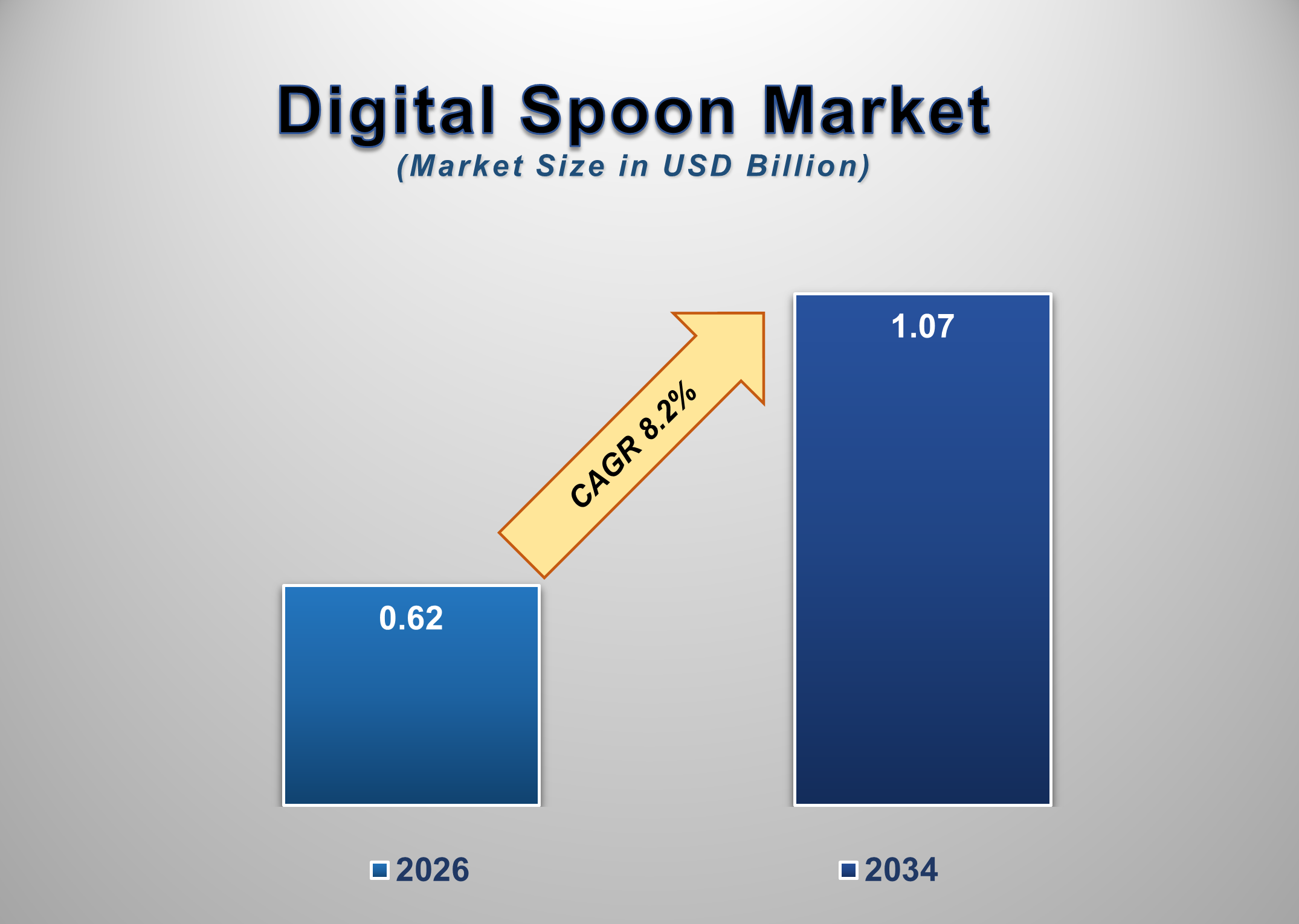
The global Digital Spoon Market is emerging as an innovative segment within the smart kitchen and digital health technology industry, driven by growing consumer interest in connected kitchen appliances and health-focused eating habits. The market is valued at USD 0.62 billion in 2026 and is projected to reach USD 1.07 billion by 2034, growing at a CAGR of 8.2% during the forecast period.
A digital spoon is an intelligent kitchen utensil embedded with sensors, microcontrollers, and display or connectivity features that enable users to measure food quantities, monitor dietary intake, or modify taste perception. These devices can provide accurate measurements of ingredients, track nutritional intake, and even simulate saltiness or flavor intensity using electronic signals. The integration of digital technology into everyday kitchen tools reflects the broader trend toward smart homes and connected lifestyle products.
Digital spoons are gaining attention in the healthcare and wellness sector because they can help individuals regulate their dietary habits, particularly those managing conditions such as hypertension, diabetes, or obesity. Some advanced models incorporate Bluetooth connectivity and companion mobile applications that allow users to track calorie intake, sodium consumption, and portion sizes over time. These features provide consumers with valuable insights into their eating patterns, enabling them to adopt healthier dietary behaviors.
Furthermore, the rise of smart kitchens and IoT-enabled appliances is expanding the role of connected utensils such as digital spoons. Consumers are increasingly interested in kitchen tools that enhance convenience, accuracy, and health awareness. As technology continues to evolve and consumer awareness about nutrition grows, digital spoons are expected to become an integral component of next-generation kitchen ecosystems.
Digital Spoon Market Drivers and Opportunities
Rising Health Awareness and Demand for Sodium Reduction Technologies are anticipated to drive the Digital Spoon market growth
Increasing awareness of diet-related health issues is a major factor contributing to the growth of the digital spoon market. Health organizations worldwide continue to emphasize the importance of reducing excessive salt intake, which is strongly linked to hypertension, cardiovascular diseases, and kidney disorders. According to the World Health Organization, excessive sodium consumption remains one of the most significant dietary risk factors, contributing to millions of deaths annually.
Digital spoons equipped with taste-modulation technologies are designed to address this challenge by altering the perception of saltiness without requiring additional sodium. By using mild electrical stimulation or sensory enhancement techniques, these spoons can enhance flavor perception, allowing users to enjoy food while maintaining lower sodium intake. This innovation is particularly valuable for individuals who must follow strict dietary restrictions due to medical conditions.
Moreover, consumers are becoming increasingly proactive in monitoring their nutritional intake through wearable devices, health apps, and connected kitchen appliances. Digital spoons align with this broader health-monitoring ecosystem by providing real-time feedback on food quantities and dietary composition. As individuals continue to prioritize healthier eating habits and preventive healthcare, the demand for intelligent kitchen utensils that support dietary management is expected to grow significantly.
Expansion of Smart Kitchen Ecosystems and IoT-Enabled Appliances is accelerating the market growth
The rapid evolution of smart homes and connected kitchen technologies is creating favorable conditions for the expansion of the digital spoon market. Modern households are increasingly adopting IoT-enabled appliances such as smart refrigerators, connected cooking devices, and automated food preparation systems. These technologies aim to simplify meal preparation while providing greater control over nutrition and ingredient usage.
Digital spoons are emerging as complementary devices within these smart kitchen ecosystems. By integrating with mobile applications and other connected appliances, digital spoons can synchronize nutritional data with health tracking platforms, enabling users to maintain comprehensive records of their dietary habits. For example, a digital spoon that measures ingredient quantities can automatically transmit data to a nutrition tracking application, helping users monitor calorie intake and portion sizes more accurately.
Furthermore, the popularity of home cooking and personalized meal planning has grown substantially in recent years, particularly following global lifestyle shifts toward healthier and home-prepared food options. Consumers increasingly seek kitchen tools that provide convenience while improving precision in cooking and nutrition management. As smart kitchen ecosystems continue to evolve, digital spoons are likely to become more sophisticated and widely adopted among health-conscious consumers.
Integration of Artificial Intelligence and Nutritional Analytics Creates Emerging Opportunities
The integration of artificial intelligence, data analytics, and sensor technology is creating new opportunities for innovation in the digital spoon market. Future digital spoons are expected to incorporate advanced sensing capabilities that can identify ingredients, estimate nutritional content, and provide personalized dietary recommendations.
For instance, AI-enabled digital spoons could analyze food composition by detecting weight, texture, and temperature, enabling them to estimate calorie counts or macronutrient levels. This information could then be synchronized with smartphone applications or wearable health devices to generate personalized nutrition insights. Such capabilities would allow users to maintain precise dietary control without requiring manual data entry.
Additionally, digital spoons designed for healthcare applications could assist medical professionals in monitoring patients with specific dietary requirements. Hospitals and elderly care facilities may use these devices to track food intake among patients who require carefully controlled nutrition plans. As technology continues to evolve and the convergence between digital health and consumer electronics intensifies, the digital spoon market is expected to witness significant innovation and expansion.
Digital Spoon Market Scope
Digital Spoon Market Report Segmentation Analysis
The global Digital Spoon Market industry analysis is segmented by product type, connectivity, application, end-use, and region.
Salt-Reducing Digital Spoons dominate the Product Type Segment
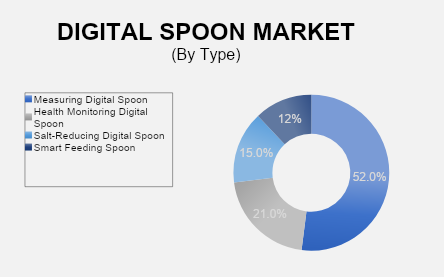
By product type, the market is segmented into salt-reducing digital spoons, measuring digital spoons, health-monitoring digital spoons, and smart feeding spoons. Salt-reducing digital spoons currently dominate the segment due to their unique capability of modifying taste perception to reduce sodium consumption without compromising flavor. These devices have attracted attention from health-conscious consumers and individuals managing hypertension or cardiovascular conditions.
Bluetooth-enabled Devices lead the Connectivity Segment
Based on connectivity, the market is segmented into Bluetooth-enabled devices and non-connected devices. Bluetooth-enabled digital spoons hold the largest market share because they allow seamless integration with smartphone applications and health monitoring platforms. These connected devices enable users to track dietary intake, monitor nutritional data, and maintain personalized diet records.
Health Management represents the largest Application Segment
In terms of application, the market is segmented into health management, cooking & food measurement, medical & dietary monitoring, and infant feeding. Health management dominates the segment as consumers increasingly rely on digital devices to monitor their nutrition and maintain healthier lifestyles.
Households hold the largest share of the End-use Segment
Based on end-use, the market is segmented into households, healthcare facilities, restaurants & food service providers, and others. Households account for the largest share because digital spoons are primarily used by individuals seeking convenient ways to monitor portion sizes and improve dietary habits.
The following segments are part of an in-depth analysis of the global Digital Spoon Market:
Digital Spoon Market Share Analysis by Region
North America is expected to dominate the global Digital Spoon Market during the forecast period due to high adoption of smart home technologies and strong consumer awareness regarding digital health solutions. The region has a well-developed consumer electronics ecosystem and a large population actively using health tracking devices, which encourages the adoption of connected kitchen tools.
Europe holds a significant share of the market as consumers increasingly focus on healthy dietary habits and technological innovation in kitchen appliances. Countries such as Germany, the United Kingdom, and France have witnessed rising demand for smart cooking tools that enhance nutritional awareness.
Asia-Pacific is projected to be the fastest-growing region in the market due to rapid urbanization, increasing disposable incomes, and expanding adoption of smart home technologies. Countries such as Japan, South Korea, and China are particularly active in developing innovative consumer electronics products, including smart kitchen utensils.
Global Digital Spoon Market Recent Developments News:
o In August 2025, a Japanese technology company introduced an upgraded smart spoon designed to enhance saltiness perception while reducing sodium consumption.
o In May 2025, a consumer electronics manufacturer launched a Bluetooth-enabled digital measuring spoon integrated with a nutrition tracking mobile application.
o In February 2025, a healthcare technology startup unveiled a smart feeding spoon capable of monitoring infant feeding patterns and portion sizes.
The Global Digital Spoon Market is dominated by a few large companies, such as
● Panasonic Corporation
● OMRON Corporation
● Xiaomi Corporation
● Philips Electronics
● KitchenAid
● Sony Corporation
● Samsung Electronics
● TDK Corporation
● Withings
● Fitbit (Google)
● Other Prominent Players
Frequently Asked Questions
Jaya Bundele (Research Analyst)
Jaya Bundele is a skilled Research Analyst with 4+ years of experience in market intelligence, consumer insights, competitive analysis, and industry forecasting across the consumer goods, agriculture, and food & beverage sectors. She specializes in market sizing, trend analysis, growth opportunity mapping, and strategic secondary research for global and regional markets.
Her expertise lies in transforming complex industry data into actionable business strategies that help organizations identify emerging trends, understand customer behavior, and gain a competitive edge. With a strong focus on data-driven insights, business intelligence, and future market trends, Jaya delivers high-quality research solutions aligned with evolving industry demands and market dynamics.
Digital Spoon Market
Our Research Methodology
"Insight without rigor is just noise."
We follow a comprehensive, multi-phase research framework designed to deliver accurate, strategic, and decision-ready intelligence. Our process integrates primary and secondary research , both quantitative and qualitative , along with dual modeling techniques ( top-down and bottom-up) and a final layer of validation through our proprietary in-house repository.
PRIMARY RESEARCH
Primary research captures real-time, firsthand insights from the market to understand behaviors, motivations, and emerging trends.
1. Quantitative Primary Research
Objective: Generate statistically significant data directly from market participants.
Approaches:- Structured surveys with customers, distributors, and field agents
- Mobile-based data collection for point-of-sale audits and usage behavior
- Phone-based interviews (CATI) for market sizing and product feedback
- Online polling around industry events and digital campaigns
- Purchase frequency by customer type
- Channel performance across geographies
- Feature demand by application or demographic
2. Qualitative Primary Research
Objective: Explore decision-making drivers, pain points, and market readiness.
Approaches:- In-depth interviews (IDIs) with executives, product managers, and key decision-makers
- Focus groups among end users and early adopters
- Site visits and observational research for consumer products
- Informal field-level discussions for regional and cultural nuances
SECONDARY RESEARCH
This phase helps establish a macro-to-micro understanding of market trends, size, regulation, and competitive dynamics, sourced from credible and public domain information.
1. Quantitative Secondary Research
Objective: Model market value and segment-level forecasts based on published data.
Sources include:- Financial reports and investor summaries
- Government trade data, customs records, and regulatory statistics
- Industry association publications and economic databases
- Channel performance and pricing data from marketplace listings
- Revenue splits, pricing trends, and CAGR estimates
- Supply-side capacity and volume tracking
- Investment analysis and funding benchmarks
2. Qualitative Secondary Research
Objective: Capture strategic direction, innovation signals, and behavioral trends.
Sources include:- Company announcements, roadmaps, and product pipelines
- Publicly available whitepapers, conference abstracts, and academic research
- Regulatory body publications and policy briefs
- Social and media sentiment scanning for early-stage shifts
- Strategic shifts in market positioning
- Unmet needs and white spaces
- Regulatory triggers and compliance impact
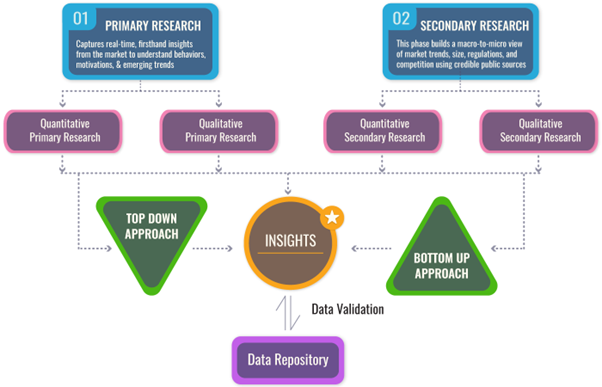
DUAL MODELING: TOP-DOWN + BOTTOM-UP
To ensure robust market estimation, we apply two complementary sizing approaches:
Top-Down Modeling:- Start with broader industry value (e.g., global or regional TAM)
- Apply filters by segment, geography, end-user, or use case
- Adjust with primary insights and validation benchmarks
- Ideal for investor-grade market scans and opportunity mapping
- Aggregate from the ground up using sales volumes, pricing, and unit economics
- Use internal modeling templates aligned with stakeholder data
- Incorporate distributor-level or region-specific inputs
- Most accurate for emerging segments and granular sub-markets
DATA VALIDATION: IN-HOUSE REPOSITORY
We close the loop with proprietary data intelligence built from ongoing projects, industry monitoring, and historical benchmarking. This repository includes:
- Multi-sector market and pricing models
- Key trendlines from past interviews and forecasts
- Benchmarked adoption rates, churn patterns, and ROI indicators
- Industry-specific deviation flags and cross-check logic
- Catches inconsistencies early
- Aligns projections across studies
- Enables consistent, high-trust deliverables