

Disposable Toilet Seat Covers Market Size and Forecast (2020–2033), Global and Regional Growth, Trend, Share, and Industry Analysis Report Coverage: By Product Type (Single-Layer, Multi-Layer/Bacterial Barrier, Flushable), By Material (Non-Woven, Tissue Paper, Plastic Films), By End-User (Commercial, Institutional, Household/Individual, Travel & Tourism), By Distribution Channel (B2B/Institutional Supply, Retail/Consumer Sales, Online E-commerce), and Geography
2025-12-19
Consumer Products
Jaya Bundele (Research Analyst)
Description
Disposable
Toilet Seat Covers Market Overview
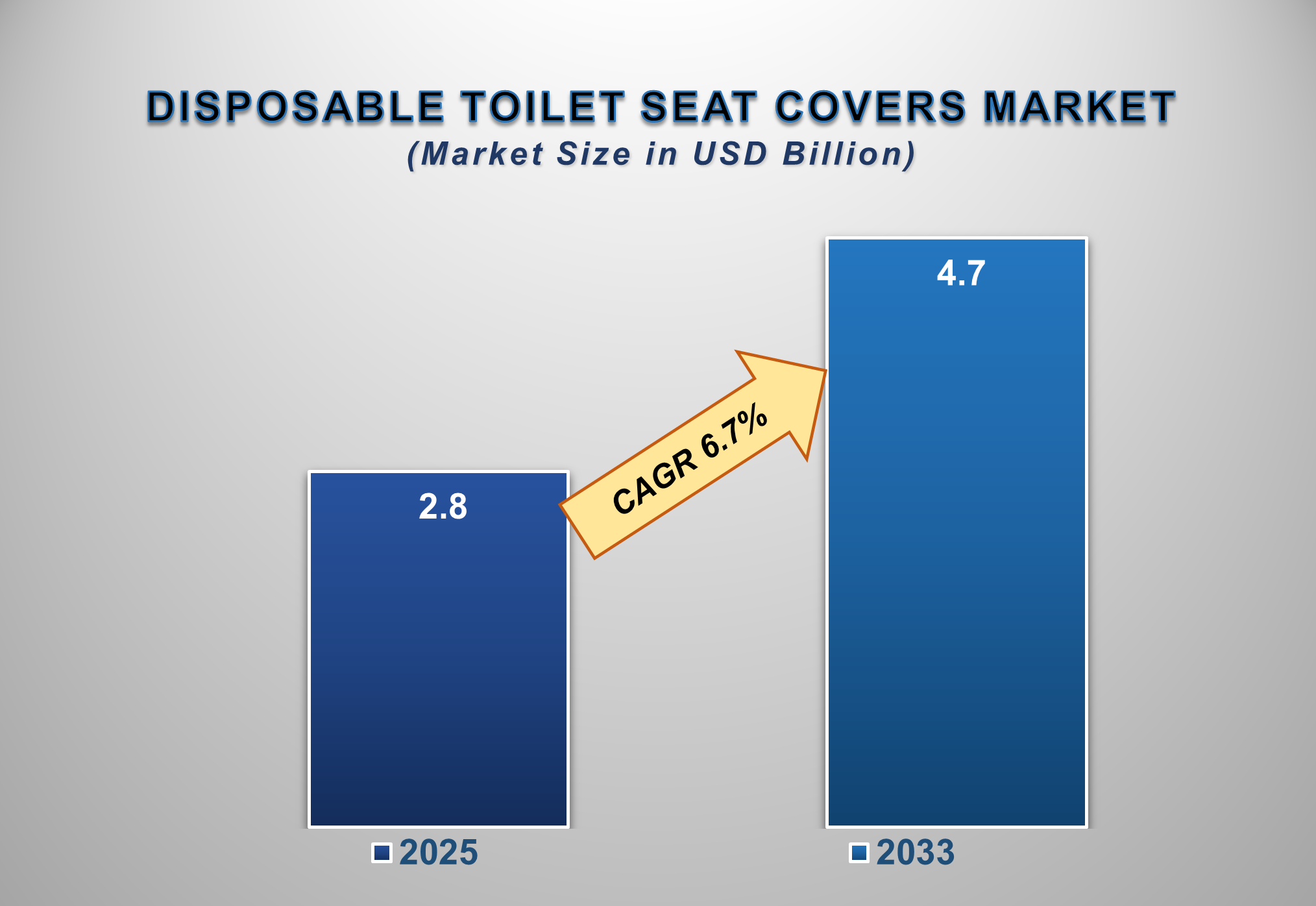
The Disposable Toilet Seat Covers Market is set for steady growth between 2025 and 2033, driven by heightened global awareness of hygiene and sanitation, rising travel and tourism activities, and increasing adoption in public and commercial facilities. The market is expected to be valued at USD 2.8 billion in 2025 and is projected to reach USD 4.7 billion by 2033, registering a CAGR of 6.7% during the forecast period.
Disposable toilet seat covers act as a protective barrier
between the user and the toilet seat, reducing the perceived and actual risk of
contact with germs, bacteria, and viruses. Originally a niche product, they
have become a mainstream hygiene staple in airports, offices, healthcare
facilities, hotels, and educational institutions. The market has evolved from
basic paper sheets to advanced multi-layer covers with antimicrobial
properties, splash guards, and flushable materials. Growth is primarily fuelled
by a post-pandemic shift in public health consciousness, where consumers and
facility managers prioritize touchpoint hygiene. Government regulations and
industry standards promoting sanitation in public spaces further bolster
adoption. North America leads the market due to established hygiene habits and
high commercial penetration, while the Asia-Pacific region exhibits the fastest
growth, propelled by urbanization, rising disposable income, and growing
tourism infrastructure.
Disposable Toilet Seat Covers Market Drivers and
Opportunities
Heightened Hygiene
Consciousness Post-Pandemic and Increasing Health Awareness Is the Primary
Market Driver
The COVID-19 pandemic permanently altered global attitudes
toward public hygiene, making sanitary products like disposable seat covers
essential in shared restroom environments. Consumers are now more vigilant
about avoiding contact with high-touch surfaces in public spaces. This behavioral shift extends beyond healthcare settings to offices,
malls, restaurants, and transportation hubs. The driver is compounded by
increased awareness of infections like MRSA, E. coli, and norovirus, which can
be transmitted via contaminated surfaces. Facility managers are proactively
installing seat cover dispensers as a standard amenity to enhance user comfort,
demonstrate duty of care, and improve facility ratings. This sustained focus on
preventive health measures ensures continuous demand growth across both
commercial and institutional sectors.
Growth in Travel, Tourism, and Commercial Real Estate
Presents Significant Expansion Opportunities
The resurgence of global travel and tourism directly
correlates with increased usage of disposable seat covers in airports, hotels,
cruise ships, and tourist attractions. The hospitality industry, in particular,
views these products as a low-cost, high-impact amenity that elevates guest
experience and safety perceptions. Furthermore, the expansion of commercial
office spaces, shopping complexes, and entertainment venues in emerging
economies creates a vast new installed base for seat cover dispensers. Opportunities
exist for manufacturers to develop compact, travel-friendly packaging for
individual consumers and to offer custom-branded solutions for hotels and
premium facilities. The trend towards smart restrooms with automated, touchless
dispensers also opens avenues for integrated hygiene system providers.
Sustainability, Innovation, and Material Science Advancements
Are Creating New Market Segments
Environmental concerns regarding single-use plastics and
paper waste present both a challenge and a significant opportunity. This drives
innovation in biodegradable, compostable, and flushable seat covers made from
sustainable materials like bamboo pulp, recycled paper, or water-dispersible
non-wovens. The development of ultra-thin yet strong barrier technologies that
use less material without compromising protection is a key R&D focus. There
is also growing demand for multi-functional products, such as covers combined
with toilet surface disinfectant sprays or pre-moistened wipes. For B2B
channels, subscription-based models and bulk supply contracts with facility
management companies offer stable, recurring revenue streams. The untapped
potential in household adoption, especially in regions with high multi-family
housing, represents a further growth frontier.
Disposable Toilet Seat Covers Market Scope
|
Report Attributes |
Description |
|
Market Size in 2025 |
USD 2.8 Billion |
|
Market Forecast in 2033 |
USD 4.7 Billion |
|
CAGR % 2025-2033 |
6.7% |
|
Base Year |
2024 |
|
Historic Data |
2020-2024 |
|
Forecast Period |
2025-2033 |
|
Report USP |
Service Portfolio,
Technological Analysis, Company Market Share, Company Heatmap, Pricing
Analysis, Growth Factors and more |
|
Segments Covered |
●
By Product Type ●
By Material ●
By End-user ●
By Distribution
Channel |
|
Regional Scope |
●
North America, ●
Europe, ●
APAC, ●
Latin America ●
Middle East and
Africa |
|
Country Scope |
1)
U.S. 2)
Canada 3)
Germany 4)
UK 5)
France 6)
Spain 7)
Italy 8)
Switzerland 9)
China 10)
Japan 11)
India 12)
Australia 13)
South Korea 14)
Brazil 15)
Mexico 16)
Argentina 17)
South Africa 18)
Saudi Arabia 19)
UAE |
Disposable Toilet Seat Covers Market Report
Segmentation Analysis
The
global Medica Spa Market is segmented by Product Type, Material, End-user,
Distribution Channel, and Region.
Non-Woven Material
Segment Is Anticipated to Command the Largest Market Share in 2025
Non-woven
fabrics dominate the material segment due to their superior strength, softness,
and effective barrier properties compared to traditional tissue paper. They are
less likely to tear or slip, providing reliable protection and user confidence.
Advancements in spunlace and meltblown nonwoven
technologies have enabled thinner, more cost-effective, and highly absorbent
covers. Their compatibility with adding antimicrobial treatments makes them the
preferred choice for healthcare and premium commercial settings. While tissue
paper remains popular for its low cost and flushability, and plastic films
offer waterproof certainty, non-wovens strike the best balance of performance,
comfort, and perceived value, securing their leading position.
The Commercial End-User
Segment Holds the Largest Share
Commercial
facilities, including offices, shopping malls,
restaurants, hotels, and airports, constitute
the largest end-user segment. This dominance is driven by high foot traffic, a
legal and social imperative to maintain hygiene standards, and the desire to
project a clean, customer-centric image. The commercial sector operates on a
B2B procurement model, involving large-volume contracts for dispensers and
refills, which ensures steady market revenue. While institutional users
(hospitals, schools, and government buildings)
are significant, the sheer volume and growth of commercial real estate and the
service economy cement this segment's leadership.
B2B/Institutional Supply
Channels Lead the Distribution Channel Segment
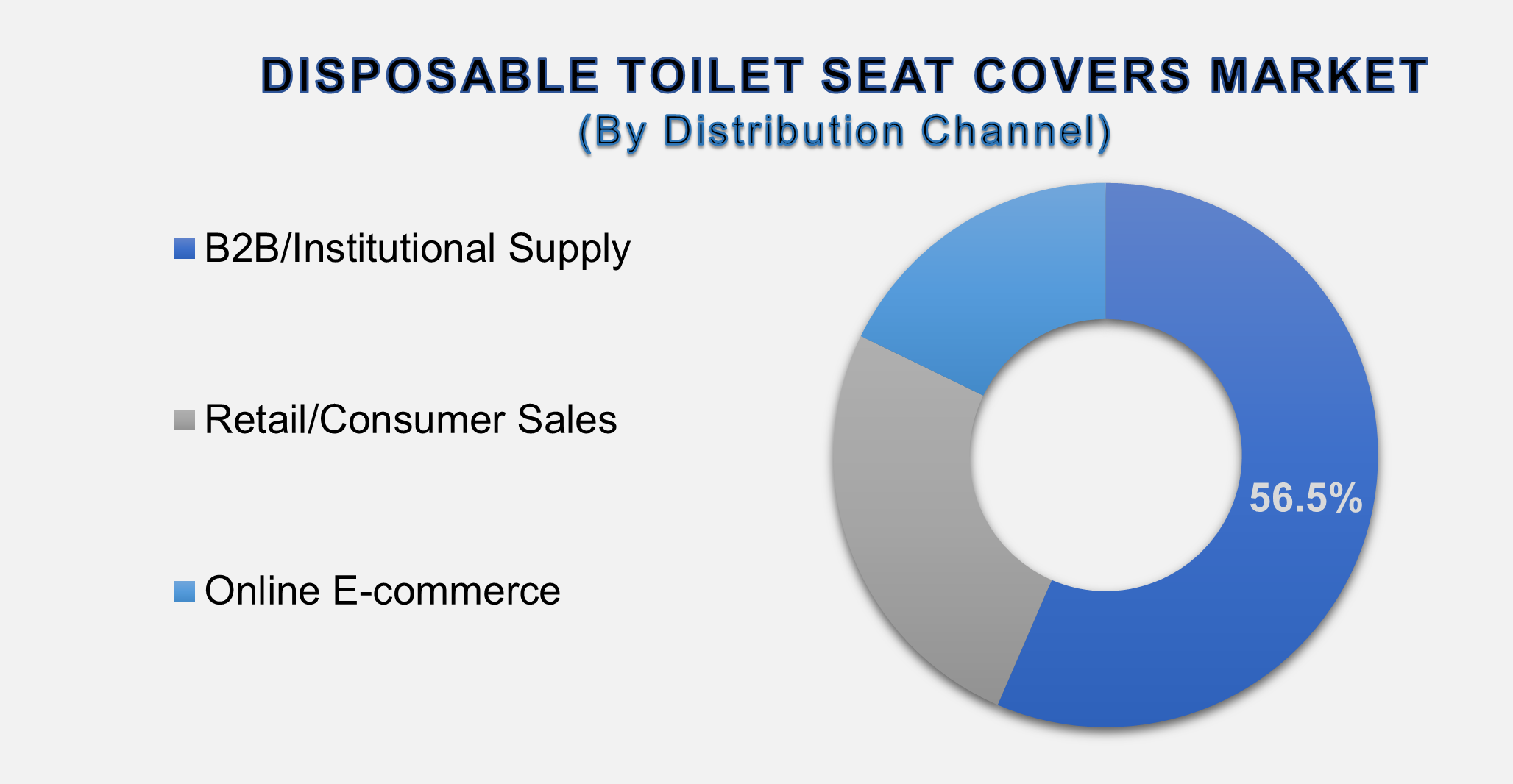
The B2B/institutional supply channel is the primary distribution route, as most seat covers are purchased in bulk by facility management companies, janitorial supply distributors, and hospitality procurement groups. This channel focuses on cost-effectiveness, reliable supply chains, and customized solutions (like branded covers for hotel chains). While retail/consumer sales in supermarkets and pharmacies are growing, and online e-commerce is rising rapidly for individual packs, the bulk of the volume and market value flows through established B2B networks that serve the core commercial and institutional customer base.
The following segments are part of an in-depth analysis of the global Disposable Toilet Seat Covers Market:
|
Market
Segments |
|
|
By Product
Type |
●
Single-Layer ●
Multi-Layer/Bacterial
Barrier ●
Flushable |
|
By Material |
●
Non-Woven ●
Tissue Paper ●
Plastic Films |
|
By Distribution Channel |
●
B2B/Institutional
Supply ●
Retail/Consumer
Sales ●
Online E-commerce |
|
By End-user |
●
Commercial ●
Institutional ●
Household/Individual ●
Travel & Tourism |
Disposable
Toilet Seat Covers Market Share Analysis by Region
North America is
anticipated to hold the largest portion of the Disposable Toilet Seat Cover
Market globally throughout the forecast period.
North
America's leadership stems from deeply ingrained hygiene practices, high
consumer awareness, stringent public health regulations, and a mature
commercial infrastructure where seat cover dispensers are nearly ubiquitous.
The United States is the epicenter, with a well-established supply chain and
major domestic manufacturers. Europe follows closely, with strong adoption in
Western European countries driven by tourism and high hygiene standards.
However, the Asia-Pacific region is poised to be the fastest-growing market.
Rapid urbanization, massive investments in tourism and transportation
infrastructure, growing middle-class populations, and increasing health
consciousness in countries like China, India, and Japan are driving explosive
demand. Despite this rapid growth, North America will maintain dominance due to
its established market size and recurring procurement cycles.
Disposable Toilet Seat Covers Market Competition
Landscape Analysis
The global market is
moderately fragmented, featuring a mix of large paper and hygiene product
conglomerates, specialized sanitary product manufacturers, and regional
players. Competition is based on price, product quality (strength, absorbency),
material innovation (sustainability), and distribution network reach. Leading
players invest in R&D for eco-friendly materials and convenient dispensing
systems. Private-label manufacturing for retail chains and hospitality groups
is a significant part of the business. Strategic focus includes consolidating
regional markets and expanding product portfolios to include related hygiene
items (toilet paper, hand towels, and soap).
Global Disposable Toilet Seat Covers Market Recent
Developments News:
- In January 2025, Kimberly-Clark Professional launched a new line of
100% recycled, flushable toilet seat covers for the European commercial
market.
- In October 2024, Georgia-Pacific acquired a regional manufacturer of
bamboo-based sanitary products to expand its sustainable seat cover
offerings.
- In August 2024, Sani-Mate Inc. introduced a touchless,
smart-dispensing system integrated with IoT sensors for inventory
management in high-traffic venues.
- In May 2024, Procter & Gamble's Charmin brand expanded into the
consumer seat cover segment in North America, leveraging its strong
bathroom tissue brand equity.
The Global Disposable Toilet Seat Covers Market
Is Dominated by a Few Large Companies, such as
●
Kimberly-Clark
Corporation
●
Georgia-Pacific LLC
●
Procter & Gamble
Co.
●
Sani-Mate Inc.
●
Bemis Manufacturing
Company
●
TST Inc. (Toilet Seat
Tops)
●
Seat Shields Inc.
●
Nice-Pak Products,
Inc.
●
Cascades Inc.
●
Metropac Paperbox Inc.
● Other Prominent Players
Frequently Asked Questions
Jaya Bundele (Research Analyst)
Jaya Bundele is a skilled Research Analyst with 4+ years of experience in market intelligence, consumer insights, competitive analysis, and industry forecasting across the consumer goods, agriculture, and food & beverage sectors. She specializes in market sizing, trend analysis, growth opportunity mapping, and strategic secondary research for global and regional markets.
Her expertise lies in transforming complex industry data into actionable business strategies that help organizations identify emerging trends, understand customer behavior, and gain a competitive edge. With a strong focus on data-driven insights, business intelligence, and future market trends, Jaya delivers high-quality research solutions aligned with evolving industry demands and market dynamics.
1. Global Disposable Toilet
Seat Covers Market Introduction and Market Overview
1.1.
Objectives
of the Study
1.2.
Global
Disposable Toilet Seat Covers Market Scope and Market Estimation
1.2.1.Global Electronic Toll
Collection Overall Market Size (US$ Bn), Market CAGR (%), Market forecast (2025
- 2033)
1.2.2.Global Disposable Toilet
Seat Covers Market Revenue Share (%) and Growth Rate (Y-o-Y) from 2020 - 2033
1.3.
Market
Segmentation
1.3.1.Product Type of Global Disposable
Toilet Seat Covers Market
1.3.2.Material of Global Disposable
Toilet Seat Covers Market
1.3.3.End-user of Global Disposable
Toilet Seat Covers Market
1.3.4.Distribution Channel of Global
Disposable Toilet Seat Covers Market
1.3.5.Region of Global Disposable
Toilet Seat Covers Market
2. Executive
Summary
2.1.
Demand
Side Trends
2.2.
Key
Market Trends
2.3.
Market
Demand (US$ Bn) Analysis 2020 – 2024 and forecast, 2025 – 2033
2.4.
Demand
and Opportunity Assessment
2.5.
Key
Developments
2.6.
Market
Entry Strategies
2.7.
Market
Dynamics
2.7.1.Drivers
2.7.2.Limitations
2.7.3.Opportunities
2.7.4.Impact Analysis of Drivers
and Restraints
2.8.
Porter’s
Five Forces Analysis
2.9.
Pricing
Analysis
2.10.
PEST
Analysis
3. Global
Disposable Toilet Seat Covers Market
Estimates & Historical Trend Analysis (2020 - 2024)
4. Global
Disposable Toilet Seat Covers Market
Estimates & Forecast Trend Analysis, by Product
Type
4.1.
Global
Disposable Toilet Seat Covers Market Revenue (US$ Bn) Estimates and Forecasts,
by Product Type, 2020 - 2033
4.1.1.Single-Layer
4.1.2.Multi-Layer/Bacterial
Barrier
4.1.3.Flushable
5. Global
Disposable Toilet Seat Covers Market
Estimates & Forecast Trend Analysis, by Material
5.1.
Global
Disposable Toilet Seat Covers Market Revenue (US$ Bn) Estimates and Forecasts,
by Material, 2020 - 2033
5.1.1.Non-Woven
5.1.2.Tissue Paper
5.1.3.Plastic Films
6. Global
Disposable Toilet Seat Covers Market
Estimates & Forecast Trend Analysis, by End-user
6.1.
Global
Disposable Toilet Seat Covers Market Revenue (US$ Bn) Estimates and Forecasts,
by End-user 2020 - 2033
6.1.1.Commercial
6.1.2.Institutional
6.1.3.Household/Individual
6.1.4.Travel & Tourism
7. Global
Disposable Toilet Seat Covers Market
Estimates & Forecast Trend Analysis, by Distribution
Channel
7.1.
Global
Disposable Toilet Seat Covers Market Revenue (US$ Bn) Estimates and Forecasts,
by Distribution Channel 2020 - 2033
7.1.1.B2B/Institutional Supply
7.1.2.Retail/Consumer Sales
7.1.3.Online E-commerce
8. Global
Disposable Toilet Seat Covers Market
Estimates & Forecast Trend Analysis, by region
8.1.
Global
Disposable Toilet Seat Covers Market Revenue (US$ Bn) Estimates and Forecasts,
by region, 2020 - 2033
8.1.1.North America
8.1.2.Europe
8.1.3.Asia Pacific
8.1.4.Middle East & Africa
8.1.5.Latin America
9. North America Disposable
Toilet Seat Covers Market: Estimates
& Forecast Trend Analysis
9.1.
North
America Disposable Toilet Seat Covers Market Assessments & Key Findings
9.1.1.North America Disposable
Toilet Seat Covers Market Introduction
9.1.2.North America Disposable
Toilet Seat Covers Market Size Estimates and Forecast (US$ Billion) (2020 - 2033)
9.1.2.1. By Product
Type
9.1.2.2. By Material
9.1.2.3. By Distribution
Channel
9.1.2.4. By End-user
9.1.2.5.
By
Country
9.1.2.5.1. The U.S.
9.1.2.5.2. Canada
10. Europe Disposable
Toilet Seat Covers Market: Estimates
& Forecast Trend Analysis
10.1.
Europe
Disposable Toilet Seat Covers Market Assessments & Key Findings
10.1.1.
Europe
Disposable Toilet Seat Covers Market Introduction
10.1.2.
Europe
Disposable Toilet Seat Covers Market Size Estimates and Forecast (US$ Billion)
(2020 - 2033)
10.1.2.1. By Product
Type
10.1.2.2. By Material
10.1.2.3. By Distribution
Channel
10.1.2.4. By End-user
10.1.2.5.
By
Country
10.1.2.5.1.
Germany
10.1.2.5.2.
Italy
10.1.2.5.3.
U.K.
10.1.2.5.4.
France
10.1.2.5.5.
Spain
10.1.2.5.6.
Switzerland
10.1.2.5.7. Rest
of Europe
11. Asia Pacific Disposable
Toilet Seat Covers Market: Estimates
& Forecast Trend Analysis
11.1.
Asia
Pacific Market Assessments & Key Findings
11.1.1.
Asia
Pacific Disposable Toilet Seat Covers Market Introduction
11.1.2.
Asia
Pacific Disposable Toilet Seat Covers Market Size Estimates and Forecast (US$ Billion)
(2020 - 2033)
11.1.2.1. By Product
Type
11.1.2.2. By Material
11.1.2.3. By Distribution
Channel
11.1.2.4. By End-user
11.1.2.5.
By
Country
11.1.2.5.1. China
11.1.2.5.2. Japan
11.1.2.5.3. India
11.1.2.5.4. Australia
11.1.2.5.5. South Korea
11.1.2.5.6. Rest of Asia Pacific
12. Middle East & Africa Disposable
Toilet Seat Covers Market: Estimates
& Forecast Trend Analysis
12.1.
Middle
East & Africa Market Assessments & Key Findings
12.1.1.
Middle East & Africa Disposable Toilet Seat Covers Market
Introduction
12.1.2.
Middle East & Africa Disposable Toilet Seat Covers Market
Size Estimates and Forecast (US$ Billion) (2020 - 2033)
12.1.2.1. By Product
Type
12.1.2.2. By Material
12.1.2.3. By Distribution
Channel
12.1.2.4. By End User
12.1.2.5.
By
Country
12.1.2.5.1. UAE
12.1.2.5.2. Saudi
Arabia
12.1.2.5.3. South
Africa
12.1.2.5.4. Rest
of MEA
13. Latin America
Disposable Toilet Seat Covers Market:
Estimates & Forecast Trend Analysis
13.1.
Latin
America Market Assessments & Key Findings
13.1.1.
Latin
America Disposable Toilet Seat Covers Market Introduction
13.1.2.
Latin
America Disposable Toilet Seat Covers Market Size Estimates and Forecast (US$ Billion)
(2020 - 2033)
13.1.2.1. By Product
Type
13.1.2.2. By Material
13.1.2.3. By Distribution
Channel
13.1.2.4. By End-user
13.1.2.5.
By
Country
13.1.2.5.1. Brazil
13.1.2.5.2. Argentina
13.1.2.5.3. Mexico
13.1.2.5.4. Rest
of LATAM
14. Country Wise Market:
Introduction
15.
Competition
Landscape
15.1.
Global
Disposable Toilet Seat Covers Market Product Mapping
15.2.
Global
Disposable Toilet Seat Covers Market Concentration Analysis, by Leading Players
/ Innovators / Emerging Players / New Entrants
15.3.
Global
Disposable Toilet Seat Covers Market Tier Structure Analysis
15.4.
Global
Disposable Toilet Seat Covers Market Concentration & Company Market Shares
(%) Analysis, 2024
16.
Company
Profiles
16.1.
Kimberly-Clark Corporation
16.1.1.
Company
Overview & Key Stats
16.1.2.
Financial
Performance & KPIs
16.1.3.
Product
Portfolio
16.1.4.
SWOT
Analysis
16.1.5.
Business
Strategy & Recent Developments
* Similar details would be provided for all the players
mentioned below
16.2. Georgia-Pacific
LLC
16.3. Procter &
Gamble Co.
16.4. Sani-Mate
Inc.
16.5. Bemis
Manufacturing Company
16.6. TST Inc.
(Toilet Seat Tops)
16.7. Seat Shields
Inc.
16.8. Nice-Pak
Products, Inc.
16.9. Cascades Inc.
16.10. Metropac
Paperbox Inc.
16.11. Other
Prominent Players
17. Research
Methodology
17.1.
External
Transportations / Databases
17.2.
Internal
Proprietary Database
17.3.
Primary
Research
17.4.
Secondary
Research
17.5.
Assumptions
17.6.
Limitations
17.7.
Report
FAQs
18. Research
Findings & Conclusion
Our Research Methodology
"Insight without rigor is just noise."
We follow a comprehensive, multi-phase research framework designed to deliver accurate, strategic, and decision-ready intelligence. Our process integrates primary and secondary research , both quantitative and qualitative , along with dual modeling techniques ( top-down and bottom-up) and a final layer of validation through our proprietary in-house repository.
PRIMARY RESEARCH
Primary research captures real-time, firsthand insights from the market to understand behaviors, motivations, and emerging trends.
1. Quantitative Primary Research
Objective: Generate statistically significant data directly from market participants.
Approaches:- Structured surveys with customers, distributors, and field agents
- Mobile-based data collection for point-of-sale audits and usage behavior
- Phone-based interviews (CATI) for market sizing and product feedback
- Online polling around industry events and digital campaigns
- Purchase frequency by customer type
- Channel performance across geographies
- Feature demand by application or demographic
2. Qualitative Primary Research
Objective: Explore decision-making drivers, pain points, and market readiness.
Approaches:- In-depth interviews (IDIs) with executives, product managers, and key decision-makers
- Focus groups among end users and early adopters
- Site visits and observational research for consumer products
- Informal field-level discussions for regional and cultural nuances
SECONDARY RESEARCH
This phase helps establish a macro-to-micro understanding of market trends, size, regulation, and competitive dynamics, sourced from credible and public domain information.
1. Quantitative Secondary Research
Objective: Model market value and segment-level forecasts based on published data.
Sources include:- Financial reports and investor summaries
- Government trade data, customs records, and regulatory statistics
- Industry association publications and economic databases
- Channel performance and pricing data from marketplace listings
- Revenue splits, pricing trends, and CAGR estimates
- Supply-side capacity and volume tracking
- Investment analysis and funding benchmarks
2. Qualitative Secondary Research
Objective: Capture strategic direction, innovation signals, and behavioral trends.
Sources include:- Company announcements, roadmaps, and product pipelines
- Publicly available whitepapers, conference abstracts, and academic research
- Regulatory body publications and policy briefs
- Social and media sentiment scanning for early-stage shifts
- Strategic shifts in market positioning
- Unmet needs and white spaces
- Regulatory triggers and compliance impact
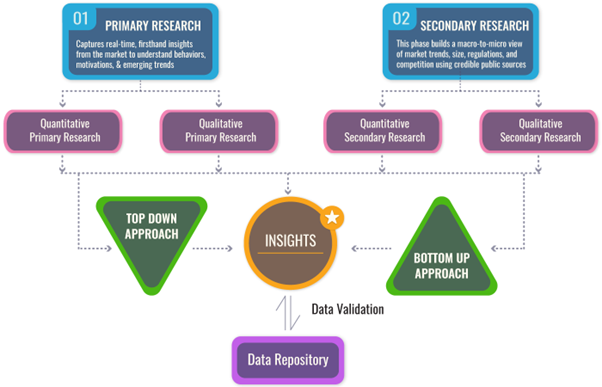
DUAL MODELING: TOP-DOWN + BOTTOM-UP
To ensure robust market estimation, we apply two complementary sizing approaches:
Top-Down Modeling:- Start with broader industry value (e.g., global or regional TAM)
- Apply filters by segment, geography, end-user, or use case
- Adjust with primary insights and validation benchmarks
- Ideal for investor-grade market scans and opportunity mapping
- Aggregate from the ground up using sales volumes, pricing, and unit economics
- Use internal modeling templates aligned with stakeholder data
- Incorporate distributor-level or region-specific inputs
- Most accurate for emerging segments and granular sub-markets
DATA VALIDATION: IN-HOUSE REPOSITORY
We close the loop with proprietary data intelligence built from ongoing projects, industry monitoring, and historical benchmarking. This repository includes:
- Multi-sector market and pricing models
- Key trendlines from past interviews and forecasts
- Benchmarked adoption rates, churn patterns, and ROI indicators
- Industry-specific deviation flags and cross-check logic
- Catches inconsistencies early
- Aligns projections across studies
- Enables consistent, high-trust deliverables