

Dog Food and Snacks Market Size and Forecast (2020–2033), Global and Regional Growth, Trend, Share, and Industry Analysis Report Coverage: By Product Type (Dry Food, Wet Food, Treats & Snacks, Frozen/Freeze-Dried, Veterinary Diets), By Distribution Channel (Specialty Stores, Supermarkets/Hypermarkets, Online Retail, Veterinary Clinics), By Life Stage (Puppy, Adult, Senior), By Source (Animal-Derived, Plant-Derived, Insect-Based), and Geography
2025-12-19
Consumer Products
Jaya Bundele (Research Analyst)
Description
Dog Food and
Snacks Market Overview
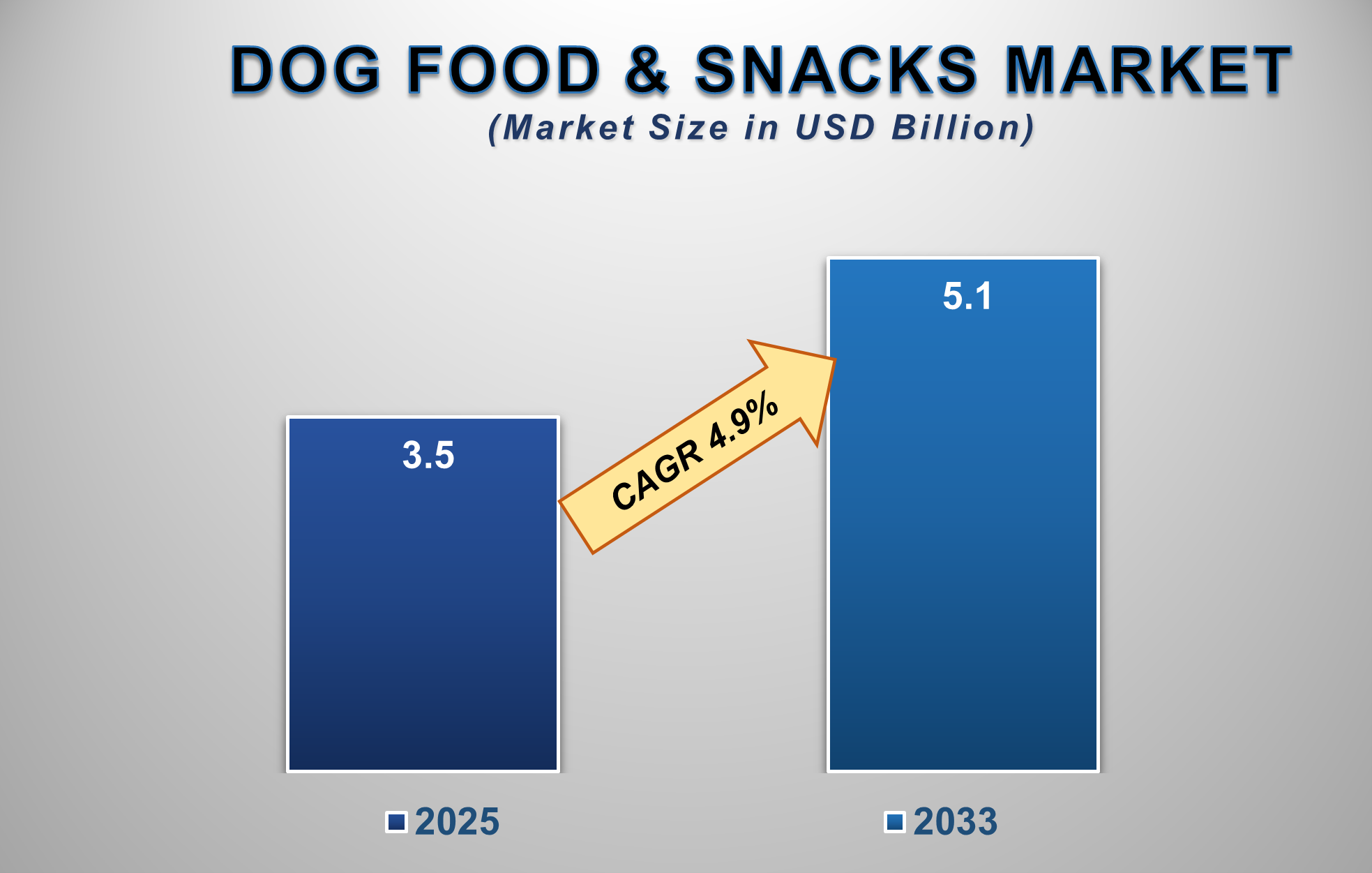
The Dog Food and Snacks Market is poised for robust growth between 2025 and 2033, fueled by the global rise in pet humanization, increasing pet ownership, and growing consumer focus on pet health and nutrition. The market is expected to be valued at USD 3.5 billion in 2025 and is projected to reach USD 5.1 billion by 2033, registering a CAGR of 4.9% during the forecast period.
The market has evolved from basic sustenance to a
sophisticated industry centered on health, wellness, and premiumization. Dog
owners are increasingly seeking out products with high-quality, natural
ingredients, functional benefits (such as joint support, skin & coat
health, and weight management), and tailored formulations. The trend of
"humanization" drives demand for gourmet snacks, subscription boxes,
and fresh/refrigerated meals. Innovations in alternative proteins (like insect,
plant-based, and lab-cultured) and sustainable packaging are reshaping the
landscape. North America remains the largest market due to high pet spending
and premiumization trends, while the Asia-Pacific region is witnessing explosive growth driven by rising disposable
incomes, urbanization, and a growing middle-class pet-owning population.
Dog Food and Snacks Market Drivers and
Opportunities
The Humanization of Pets
and Premiumization of Diets Is the Primary Market Driver
The most influential driver is the trend of pet
humanization, where pets are considered integral family members. This shift in
perception leads owners to prioritize high-quality nutrition, mirroring their
own health and wellness concerns. Demand is soaring for premium and
super-premium products featuring human-grade ingredients, grain-free recipes,
limited-ingredient diets (LID), and functional ingredients like probiotics,
omega fatty acids, and glucosamine. The rising incidence of pet obesity and
allergies is also pushing demand for specialized therapeutic and weight
management foods, often recommended by veterinarians. Furthermore, the desire
for convenience and personalized care is fueling growth in subscription-based
and direct-to-consumer (DTC) meal delivery services for pets.
The number of dog owners in the United States has seen a
significant and sustained increase over the past decade, solidifying the
nation's status as a pet-loving society. Following a notable surge during the
COVID-19 pandemic, growth has stabilized at a high level. According to the
American Pet Products Association (APPA), an estimated 65.1 million U.S.
households owned a dog in 2023-2024, representing approximately 50% of all
households. This marks a steady climb from roughly 63 million households in
2018. The total population of pet dogs is estimated at 77 million. This
growth is propelled by several key demographic shifts, including rising
millennial and Gen Z ownership groups that often prioritize pet parenting
before having children. Furthermore, increased adoption from shelters and
rescues, greater acceptance of pets in rental housing and workplaces, and the
continued cultural trend of pet humanization have all contributed to expanding
the base of dog owners. The financial commitment mirrors this rise, with total
U.S. pet industry expenditure soaring to over US$147 billion in 2023, a
substantial portion dedicated to dog food, treats, healthcare, and services,
underscoring the profound economic impact of this growing owner population.
E-commerce Expansion and Digital Influence Are Accelerating
Market Adoption
The rapid growth of online retail is fundamentally changing
how pet food is purchased. The convenience of home delivery, access to a wider
variety of niche brands, subscription models, and detailed product information
online are major growth catalysts. Social media platforms and "pet
influencers" on Instagram, TikTok, and YouTube play a significant role in
product discovery, reviews, and shaping consumer preferences. Digital
marketing, including targeted ads and influencer partnerships, is crucial for
brand building. Online platforms also facilitate the growth of
direct-to-consumer (DTC) brands that bypass traditional retail, offering
personalized nutrition plans and building strong community engagement with pet
owners.
Innovation in Ingredients, Sustainability, and Personalized
Nutrition Presents Significant Opportunities
Continuous innovation in product formulations and sourcing
is a major opportunity for market differentiation. The advent of novel protein
sources such as insect-based protein
(sustainable and hypoallergenic), plant-based options, and cultured meat
caters to environmental concerns and specific dietary
needs. Sustainability is a key differentiator, with opportunities in
eco-friendly packaging, carbon-neutral production, and ethically sourced
ingredients. The integration of technology, such as AI-driven nutritional apps,
DNA-based diet plans, and smart feeders that monitor intake, allows for
hyper-personalized pet nutrition. The growing focus on pet mental well-being
and longevity also opens avenues for products containing nootropics,
adaptogens, and advanced life-stage-specific
formulations. For manufacturers, opportunities lie in expanding into veterinary
therapeutic diets, creating functional treats
for training and dental health, and creating integrated pet wellness
ecosystems.
Dog Food and Snacks Market Scope
|
Report Attributes |
Description |
|
Market Size in 2025 |
USD 3.5 Billion |
|
Market Forecast in 2033 |
USD 5.1 Billion |
|
CAGR % 2025-2033 |
4.9% |
|
Base Year |
2024 |
|
Historic Data |
2020-2024 |
|
Forecast Period |
2025-2033 |
|
Report USP |
Service Portfolio,
Technological Analysis, Company Market Share, Company Heatmap, Pricing
Analysis, Growth Factors and more |
|
Segments Covered |
●
By Product Type ●
By Life Stage ●
By Source ●
By Distribution
Channel |
|
Regional Scope |
●
North America, ●
Europe, ●
APAC, ●
Latin America ●
Middle East and
Africa |
|
Country Scope |
1)
U.S. 2)
Canada 3)
Germany 4)
UK 5)
France 6)
Spain 7)
Italy 8)
Switzerland 9)
China 10)
Japan 11)
India 12)
Australia 13)
South Korea 14)
Brazil 15)
Mexico 16)
Argentina 17)
South Africa 18)
Saudi Arabia 19)
UAE |
Dog Food and Snacks Market Report Segmentation
Analysis
The
global Medica Spa Market is segmented by Product Type, Life Stage, Source,
Distribution Channel, and Region.
Dry Food Is Anticipated
to Command the Largest Market Share in 2025
Dry food (kibble) dominates the Product Type segment due to its convenience, cost-effectiveness, long shelf life, and dental health benefits. Its market leadership is anchored in high household penetration and being the staple diet for most dogs globally. Continuous innovation, such as the inclusion of freeze-dried raw coatings, functional kibble shapes, and breed-specific formulas, keeps this segment dynamic. The strong presence of global giants and private-label offerings in supermarkets ensures wide availability. While wet food and fresh options are growing faster in terms of premiumization, dry food's unbeatable value and versatility secure its leading position, especially in price-sensitive and emerging markets.

The Online Retail Segment
Is the Fastest-Growing Distribution Channel
Online
retail is the fastest-growing distribution channel, revolutionizing market
access. The convenience of subscription models, access to niche and premium
brands not available in local stores, competitive pricing, and
auto-replenishment features are key growth drivers. The COVID-19 pandemic
accelerated this shift, establishing online purchasing as a habitual channel
for pet owners. Direct-to-consumer (DTC) brands leverage this channel to build
direct relationships, offer personalized nutrition, and gather valuable
consumer data. While specialty pet stores and supermarkets remain significant
for immediate needs and in-person consultation, the growth trajectory of online
retail is unmatched, making it the most disruptive and opportunistic channel.
The following segments are
part of an in-depth analysis of the global Dog Food and Snacks Market:
|
Market
Segments |
|
|
By Product
Type |
●
Dry Food ●
Wet Food ●
Treats & Snacks ●
Frozen/Freeze-Dried ●
Veterinary Diets |
|
By Life Stage |
●
Puppy ●
Adult ●
Senior |
|
By Distribution Channel |
●
Specialty Stores ●
Supermarkets/Hypermarkets ●
Online Retail ●
Veterinary Clinics |
|
By Source |
●
Animal-Derived ●
Plant-Derived ●
Insect-Based |
Dog Food and
Snacks Market Share Analysis by Region
North America is
anticipated to hold the largest portion of the Dog Food and Snacks Market
globally throughout the forecast period.
North
America's leadership is driven by the highest rate of pet ownership, extreme
pet humanization trends, strong consumer spending power, and a mature retail
landscape. The United States is the single largest market, characterized by a
high willingness to spend on premium, natural, and functional products. The
region is a hub for innovation, with numerous startups and established players
constantly launching new products. Europe follows closely, with a strong
emphasis on regulatory standards, organic ingredients, and sustainability.
However, the Asia-Pacific region is the fastest-growing, fueled by rapid
urbanization, a growing middle class, declining birth rates leading to
increased pet adoption ("pet parenting"), and the Westernization of
pet care trends in countries like China, Japan, and India.
Dog Food and Snacks Market Competition Landscape
Analysis
The global market is
semi-consolidated, with a mix of multinational conglomerates, large
private-label manufacturers, and a rapidly growing number of niche,
direct-to-consumer startups. Competition centers on brand trust, ingredient
quality, scientific backing (veterinary endorsements), price, and marketing
reach. Leading players are actively acquiring niche brands to tap into premium
segments and gain innovation capabilities. Investment in sustainable practices
and transparent supply chains is becoming a key competitive differentiator.
Digital marketing, influencer partnerships, and robust e-commerce strategies
are critical for success. Private-label offerings from major retailers are also
intensifying price competition in the mass-market segment.
Global Dog Food and Snacks Market Recent Developments News:
- In January 2025, Mars Petcare launched a new line of
veterinary-prescription wellness diets available through a
direct-to-consumer platform with telehealth vet consultations.
- In October 2024, Nestlé Purina PetCare expanded its Beyond Nature's
Protein line into Europe, featuring insect-based protein as a primary
ingredient.
- In August 2024, Freshpet announced a major capacity expansion of its
kitchens to meet soaring demand for fresh, refrigerated pet food across
North America.
- In May 2024, The Honest Company entered the pet care space with a
line of organic, sustainably packaged dog treats and supplements.
The Global Dog Food and Snacks Market Is
Dominated by a Few Large Companies, such as
●
Mars, Incorporated
●
Nestlé Purina
●
Hill’s Pet Nutrition
●
The J.M. Smucker
Company
●
General Mills
●
Diamond Pet Foods
●
Spectrum Brands
●
Lupus Alimentos
●
Heristo AG
●
Total Alimentos
●
Unicharm Corporation
●
Mogina Alimentos
●
Bridge Petcare
●
Yantai China Pet Foods
Co., Ltd.
●
Freshpet
●
Other Prominent
Players
FAQs
Frequently Asked Questions
Jaya Bundele (Research Analyst)
Jaya Bundele is a skilled Research Analyst with 4+ years of experience in market intelligence, consumer insights, competitive analysis, and industry forecasting across the consumer goods, agriculture, and food & beverage sectors. She specializes in market sizing, trend analysis, growth opportunity mapping, and strategic secondary research for global and regional markets.
Her expertise lies in transforming complex industry data into actionable business strategies that help organizations identify emerging trends, understand customer behavior, and gain a competitive edge. With a strong focus on data-driven insights, business intelligence, and future market trends, Jaya delivers high-quality research solutions aligned with evolving industry demands and market dynamics.
1. Global Dog Food and Snacks
Market Introduction and Market Overview
1.1.
Objectives
of the Study
1.2.
Global
Dog Food and Snacks Market Scope and Market Estimation
1.2.1.Global Electronic Toll
Collection Overall Market Size (US$ Bn), Market CAGR (%), Market forecast (2025
- 2033)
1.2.2.Global Dog Food and Snacks
Market Revenue Share (%) and Growth Rate (Y-o-Y) from 2020 - 2033
1.3.
Market
Segmentation
1.3.1.Product Type of Global Dog
Food and Snacks Market
1.3.2.Life Stage of Global Dog
Food and Snacks Market
1.3.3.Source of Global Dog Food
and Snacks Market
1.3.4.Distribution Channel of Global
Dog Food and Snacks Market
1.3.5.Region of Global Dog Food
and Snacks Market
2. Executive
Summary
2.1.
Demand
Side Trends
2.2.
Key
Market Trends
2.3.
Market
Demand (US$ Bn) Analysis 2020 – 2024 and forecast, 2025 – 2033
2.4.
Demand
and Opportunity Assessment
2.5.
Key
Developments
2.6.
Market
Entry Strategies
2.7.
Market
Dynamics
2.7.1.Drivers
2.7.2.Limitations
2.7.3.Opportunities
2.7.4.Impact Analysis of Drivers
and Restraints
2.8.
Porter’s
Five Forces Analysis
2.9.
Pricing
Analysis
2.10.
PEST
Analysis
3. Global
Dog Food and Snacks Market Estimates
& Historical Trend Analysis (2020 - 2024)
4. Global
Dog Food and Snacks Market Estimates
& Forecast Trend Analysis, by Product Type
4.1.
Global
Dog Food and Snacks Market Revenue (US$ Bn) Estimates and Forecasts, by Product
Type, 2020 - 2033
4.1.1.Dry Food
4.1.2.Wet Food
4.1.3.Treats & Snacks
4.1.4.Frozen/Freeze-Dried
4.1.5.Veterinary Diets
5. Global
Dog Food and Snacks Market Estimates
& Forecast Trend Analysis, by Life Stage
5.1.
Global
Dog Food and Snacks Market Revenue (US$ Bn) Estimates and Forecasts, by Life
Stage, 2020 - 2033
5.1.1.Puppy
5.1.2.Adult
5.1.3.Senior
6. Global
Dog Food and Snacks Market Estimates
& Forecast Trend Analysis, by Source
6.1.
Global
Dog Food and Snacks Market Revenue (US$ Bn) Estimates and Forecasts, by Source
2020 - 2033
6.1.1.Animal-Derived
6.1.2.Plant-Derived
6.1.3.Insect-Based
7. Global
Dog Food and Snacks Market Estimates
& Forecast Trend Analysis, by Distribution Channel
7.1.
Global
Dog Food and Snacks Market Revenue (US$ Bn) Estimates and Forecasts, by Distribution
Channel 2020 - 2033
7.1.1.Specialty Stores
7.1.2.Supermarkets/Hypermarkets
7.1.3.Online Retail
7.1.4.Veterinary Clinics
8. Global
Dog Food and Snacks Market Estimates
& Forecast Trend Analysis, by region
8.1.
Global
Dog Food and Snacks Market Revenue (US$ Bn) Estimates and Forecasts, by region,
2020 - 2033
8.1.1.North America
8.1.2.Europe
8.1.3.Asia Pacific
8.1.4.Middle East & Africa
8.1.5.Latin America
9. North America Dog
Food and Snacks Market: Estimates &
Forecast Trend Analysis
9.1.
North
America Dog Food and Snacks Market Assessments & Key Findings
9.1.1.North America Dog Food and
Snacks Market Introduction
9.1.2.North America Dog Food and
Snacks Market Size Estimates and Forecast (US$ Billion) (2020 - 2033)
9.1.2.1. By Product
Type
9.1.2.2. By Life Stage
9.1.2.3. By Distribution
Channel
9.1.2.4. By Source
9.1.2.5.
By
Country
9.1.2.5.1. The U.S.
9.1.2.5.2. Canada
10. Europe Dog
Food and Snacks Market: Estimates &
Forecast Trend Analysis
10.1.
Europe
Dog Food and Snacks Market Assessments & Key Findings
10.1.1.
Europe
Dog Food and Snacks Market Introduction
10.1.2.
Europe
Dog Food and Snacks Market Size Estimates and Forecast (US$ Billion) (2020 - 2033)
10.1.2.1. By Product
Type
10.1.2.2. By Life Stage
10.1.2.3. By Distribution
Channel
10.1.2.4. By Source
10.1.2.5.
By
Country
10.1.2.5.1.
Germany
10.1.2.5.2.
Italy
10.1.2.5.3.
U.K.
10.1.2.5.4.
France
10.1.2.5.5.
Spain
10.1.2.5.6.
Switzerland
10.1.2.5.7. Rest
of Europe
11. Asia Pacific Dog
Food and Snacks Market: Estimates &
Forecast Trend Analysis
11.1.
Asia
Pacific Market Assessments & Key Findings
11.1.1.
Asia
Pacific Dog Food and Snacks Market Introduction
11.1.2.
Asia
Pacific Dog Food and Snacks Market Size Estimates and Forecast (US$ Billion) (2020
- 2033)
11.1.2.1. By Product
Type
11.1.2.2. By Life Stage
11.1.2.3. By Distribution
Channel
11.1.2.4. By Source
11.1.2.5.
By
Country
11.1.2.5.1. China
11.1.2.5.2. Japan
11.1.2.5.3. India
11.1.2.5.4. Australia
11.1.2.5.5. South Korea
11.1.2.5.6. Rest of Asia Pacific
12. Middle East & Africa Dog
Food and Snacks Market: Estimates &
Forecast Trend Analysis
12.1.
Middle
East & Africa Market Assessments & Key Findings
12.1.1.
Middle East & Africa Dog Food and Snacks Market
Introduction
12.1.2.
Middle East & Africa Dog Food and Snacks Market Size Estimates
and Forecast (US$ Billion) (2020 - 2033)
12.1.2.1. By Product
Type
12.1.2.2. By Life Stage
12.1.2.3. By Distribution
Channel
12.1.2.4. By End User
12.1.2.5.
By
Country
12.1.2.5.1. UAE
12.1.2.5.2. Saudi
Arabia
12.1.2.5.3. South
Africa
12.1.2.5.4. Rest
of MEA
13. Latin America
Dog Food and Snacks Market: Estimates
& Forecast Trend Analysis
13.1.
Latin
America Market Assessments & Key Findings
13.1.1.
Latin
America Dog Food and Snacks Market Introduction
13.1.2.
Latin
America Dog Food and Snacks Market Size Estimates and Forecast (US$ Billion) (2020
- 2033)
13.1.2.1. By Product
Type
13.1.2.2. By Life Stage
13.1.2.3. By Distribution
Channel
13.1.2.4. By Source
13.1.2.5.
By
Country
13.1.2.5.1. Brazil
13.1.2.5.2. Argentina
13.1.2.5.3. Mexico
13.1.2.5.4. Rest
of LATAM
14. Country Wise Market:
Introduction
15.
Competition
Landscape
15.1.
Global
Dog Food and Snacks Market Product Mapping
15.2.
Global
Dog Food and Snacks Market Concentration Analysis, by Leading Players /
Innovators / Emerging Players / New Entrants
15.3.
Global
Dog Food and Snacks Market Tier Structure Analysis
15.4.
Global
Dog Food and Snacks Market Concentration & Company Market Shares (%)
Analysis, 2024
16.
Company
Profiles
16.1.
Mars, Incorporated
16.1.1.
Company
Overview & Key Stats
16.1.2.
Financial
Performance & KPIs
16.1.3.
Product
Portfolio
16.1.4.
SWOT
Analysis
16.1.5.
Business
Strategy & Recent Developments
* Similar details would be provided for all the players
mentioned below
16.2. Nestlé Purina
16.3. Hill’s Pet
Nutrition
16.4. The J.M.
Smucker Company
16.5. General Mills
16.6. Diamond Pet
Foods
16.7. Spectrum
Brands
16.8. Lupus
Alimentos
16.9. Heristo AG
16.10. Total
Alimentos
16.11. Unicharm
Corporation
16.12. Mogina
Alimentos
16.13. Bridge
Petcare
16.14. Yantai China
Pet Foods Co., Ltd.
16.15. Freshpet
16.16. Other
Prominent Players
17. Research
Methodology
17.1.
External
Transportations / Databases
17.2.
Internal
Proprietary Database
17.3.
Primary
Research
17.4.
Secondary
Research
17.5.
Assumptions
17.6.
Limitations
17.7.
Report
FAQs
18. Research
Findings & Conclusion
Our Research Methodology
"Insight without rigor is just noise."
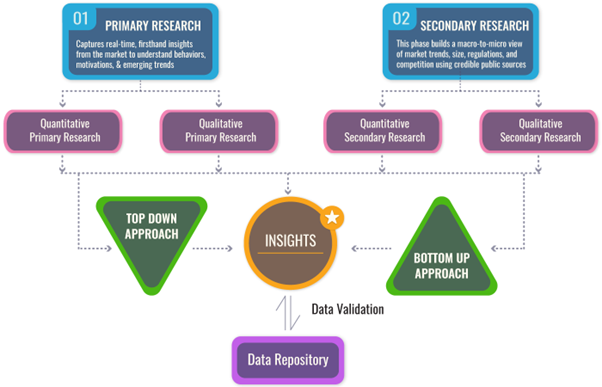
We follow a comprehensive, multi-phase research framework designed to deliver accurate, strategic, and decision-ready intelligence. Our process integrates primary and secondary research , both quantitative and qualitative , along with dual modeling techniques ( top-down and bottom-up) and a final layer of validation through our proprietary in-house repository.
PRIMARY RESEARCH
Primary research captures real-time, firsthand insights from the market to understand behaviors, motivations, and emerging trends.
1. Quantitative Primary Research
Objective: Generate statistically significant data directly from market participants.
Approaches:- Structured surveys with customers, distributors, and field agents
- Mobile-based data collection for point-of-sale audits and usage behavior
- Phone-based interviews (CATI) for market sizing and product feedback
- Online polling around industry events and digital campaigns
- Purchase frequency by customer type
- Channel performance across geographies
- Feature demand by application or demographic
2. Qualitative Primary Research
Objective: Explore decision-making drivers, pain points, and market readiness.
Approaches:- In-depth interviews (IDIs) with executives, product managers, and key decision-makers
- Focus groups among end users and early adopters
- Site visits and observational research for consumer products
- Informal field-level discussions for regional and cultural nuances
SECONDARY RESEARCH
This phase helps establish a macro-to-micro understanding of market trends, size, regulation, and competitive dynamics, sourced from credible and public domain information.
1. Quantitative Secondary Research
Objective: Model market value and segment-level forecasts based on published data.
Sources include:- Financial reports and investor summaries
- Government trade data, customs records, and regulatory statistics
- Industry association publications and economic databases
- Channel performance and pricing data from marketplace listings
- Revenue splits, pricing trends, and CAGR estimates
- Supply-side capacity and volume tracking
- Investment analysis and funding benchmarks
2. Qualitative Secondary Research
Objective: Capture strategic direction, innovation signals, and behavioral trends.
Sources include:- Company announcements, roadmaps, and product pipelines
- Publicly available whitepapers, conference abstracts, and academic research
- Regulatory body publications and policy briefs
- Social and media sentiment scanning for early-stage shifts
- Strategic shifts in market positioning
- Unmet needs and white spaces
- Regulatory triggers and compliance impact
DUAL MODELING: TOP-DOWN + BOTTOM-UP
To ensure robust market estimation, we apply two complementary sizing approaches:
Top-Down Modeling:- Start with broader industry value (e.g., global or regional TAM)
- Apply filters by segment, geography, end-user, or use case
- Adjust with primary insights and validation benchmarks
- Ideal for investor-grade market scans and opportunity mapping
- Aggregate from the ground up using sales volumes, pricing, and unit economics
- Use internal modeling templates aligned with stakeholder data
- Incorporate distributor-level or region-specific inputs
- Most accurate for emerging segments and granular sub-markets
DATA VALIDATION: IN-HOUSE REPOSITORY
We close the loop with proprietary data intelligence built from ongoing projects, industry monitoring, and historical benchmarking. This repository includes:
- Multi-sector market and pricing models
- Key trendlines from past interviews and forecasts
- Benchmarked adoption rates, churn patterns, and ROI indicators
- Industry-specific deviation flags and cross-check logic
- Catches inconsistencies early
- Aligns projections across studies
- Enables consistent, high-trust deliverables