

Drip Irrigation Market Size and Forecast (2025–2033), Global and Regional Growth, Trend, Share and Industry Analysis Report Coverage: By Component (Drip Tubing/Drip Lines, Emitters/Drippers, Valves, Fertigation Systems, Filters, Others), By Method (Surface, Subsurface), By Crop (Field Crops, Fruits & Nuts, Vegetable Crops, Others), and Geography
2026-01-02
Agriculture Industry
Jaya Bundele (Research Analyst)
Description
Drip Irrigation Market Overview
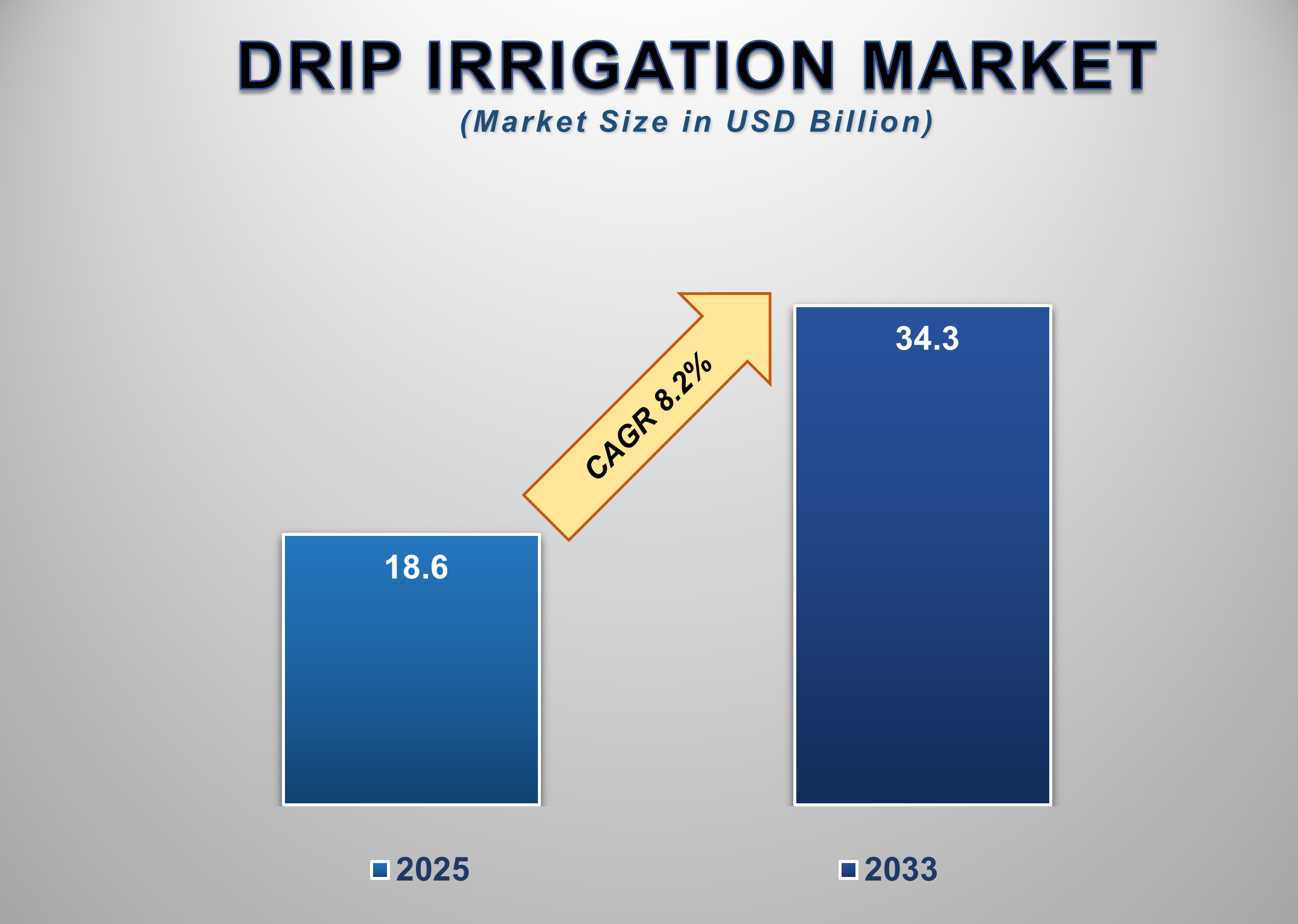
The Global Drip Irrigation Market is witnessing significant expansion as water scarcity, climate variability, and sustainable farming practices accelerate the global shift toward precision agriculture. Valued at USD 18.6 billion in 2025, the market is projected to reach USD 34.3 billion by 2033, registering a strong CAGR of 8.2%. Drip irrigation systems offer substantial water savings—up to 60%—compared with traditional flood irrigation while improving nutrient efficiency, crop yield, and soil health across diverse crop bases such as field crops, fruits, nuts, vegetables, and horticultural plantations. Rising pressure to increase agricultural productivity from shrinking arable land and escalating global food demand further strengthens adoption.
Government irrigation modernization schemes, especially across India, China, Israel, and the United States, play a vital role in subsidizing drip systems for small and large farms alike. Manufacturers are focusing on automation, smart irrigation controllers, and IoT-enabled fertigation to elevate system efficiency. As climate challenges intensify, drip irrigation is no longer limited to high-value crops but is rapidly penetrating broadacre farms, making it one of the most essential components of precision agriculture worldwide.
Drip Irrigation Market
Drivers and Opportunities
Rising Global Water
Stress and Sustainable Farming Needs Are Driving Growth in the Drip Irrigation
Market
Increasing global water
scarcity is one of the central forces propelling the adoption of drip
irrigation systems across developed and emerging economies. Many regions,
particularly Asia and the Middle East, face severe groundwater depletion,
irregular rainfall, and rising competition for water across residential,
industrial, and agricultural sectors. Because agriculture accounts for nearly
70% of total freshwater withdrawals globally, governments and farmers are under
growing pressure to adopt techniques that minimize wastage while sustaining
crop productivity. Drip irrigation’s ability to deliver water directly to the
root zone with minimal losses due to runoff or evaporation makes it the
preferred solution for resource-stressed agricultural regions. The efficiency
gains, often exceeding 90%, are far superior to traditional furrow or sprinkler
systems, enabling farmers to achieve higher yields per drop of water. Water-use
regulations and subsidy programs are expanding rapidly. Large-scale initiatives
such as India’s Per Drop More Crop scheme, Israel’s precision irrigation
programs, and U.S. NRCS incentives strongly encourage farmers to transition to
drip systems. With climate change intensifying drought cycles, irrigation
modernization has become a strategic global priority, making drip systems
indispensable for long-term agricultural resilience and food security.
Growing Demand for High-Value Crops and Precision Farming
Technologies Is Accelerating Market Expansion
The increasing cultivation of fruits, nuts, vegetables, and other
high-value crops is significantly boosting the demand for drip irrigation,
which ensures precise nutrient delivery and maximized yield quality. Modern
consumers are demanding premium produce, organic farm output, and consistent
supply throughout the year—factors that incentivize farmers to adopt controlled
irrigation technologies. Drip systems provide uniform moisture distribution,
resulting in improved crop size, reduced disease incidence, and optimized input
usage. These advantages make them ideal for horticultural crops, vineyards,
orchards, and greenhouse cultivation, where quality and consistency are
critical. Simultaneously, the rapid adoption of precision agriculture
technologies such as IoT-based field monitoring, soil moisture sensors,
automated fertigation controllers, and AI-based irrigation scheduling is
elevating the performance and attractiveness of drip irrigation systems.
Integrating sensors and smart valves ensures that water is applied only when
necessary, reducing labor dependency and operational costs. Market leaders are
increasingly designing modular, plug-and-play drip systems tailored to
smallholders as well as large commercial farms. As global agriculture
transitions toward data-driven production, drip irrigation is becoming a
foundational pillar supporting the modernization of farming practices
worldwide.
Government Subsidies and Expanding Adoption Across Emerging
Economies Are Creating Robust Growth Opportunities
Emerging economies, especially across Asia-Pacific, Latin America,
and Africa, represent substantial growth opportunities due to rapid
agricultural expansion, rising food demand, and increasing acceptance of
micro-irrigation. Governments in India, China, Indonesia, Brazil, and Mexico
are aggressively promoting drip irrigation through financial incentives, tax
benefits, and public–private partnerships that lower upfront installation
costs. As small- and medium-scale farmers gain access to affordable micro-irrigation
systems, penetration rates across field crops traditionally considered less
suitable for drip are rising sharply. Technological advancements are opening
new opportunities as low-cost drip lines, gravity-fed systems, solar-powered
pumps, and portable fertigation units become widely available. These
innovations make drip irrigation feasible even in remote areas without stable
electricity access. Furthermore, climate adaptation programs by global
organizations, including the World Bank, FAO, and UNDP, are increasingly
funding drip irrigation projects as part of climate-smart agriculture
initiatives. With APAC projected to grow at the highest CAGR through 2033 and
Africa showing early acceleration, the market is positioned for the long term.
Drip Irrigation Market
Scope
|
Report Attributes |
Description |
|
Market Size in 2025 |
USD 18.6 Billion |
|
Market Forecast in 2033 |
USD 34.3 Billion |
|
CAGR % 2025-2033 |
8.2% |
|
Base Year |
2024 |
|
Historic Data |
2020-2024 |
|
Forecast Period |
2025-2033 |
|
Report USP |
Production, Consumption,
Company Share, Company Heatmap, Company Production Capacity, Growth Factors,
and more |
|
Segments Covered |
●
by Component,
Method, and Crop |
|
Regional Scope |
●
North America ●
Europe ●
APAC ●
Latin America ●
Middle East and
Africa |
|
Country Scope |
1)
U.S. 2)
Canada 3)
Germany 4)
UK 5)
France 6)
Spain 7)
Italy 8)
Switzerland 9)
China 10)
Japan 11)
India 12)
Australia 13)
South Korea 14)
Brazil 15)
Mexico 16)
Argentina 17)
South Africa 18)
Saudi Arabia 19)
UAE |
Drip Irrigation Market
Report Segmentation Analysis
The Drip Irrigation Market is segmented based on Component,
Method, Crop, and Geography.
Drip Tubing/Drip Lines
Segment Accounted for the Largest Market Share in the Global Drip Irrigation
Market
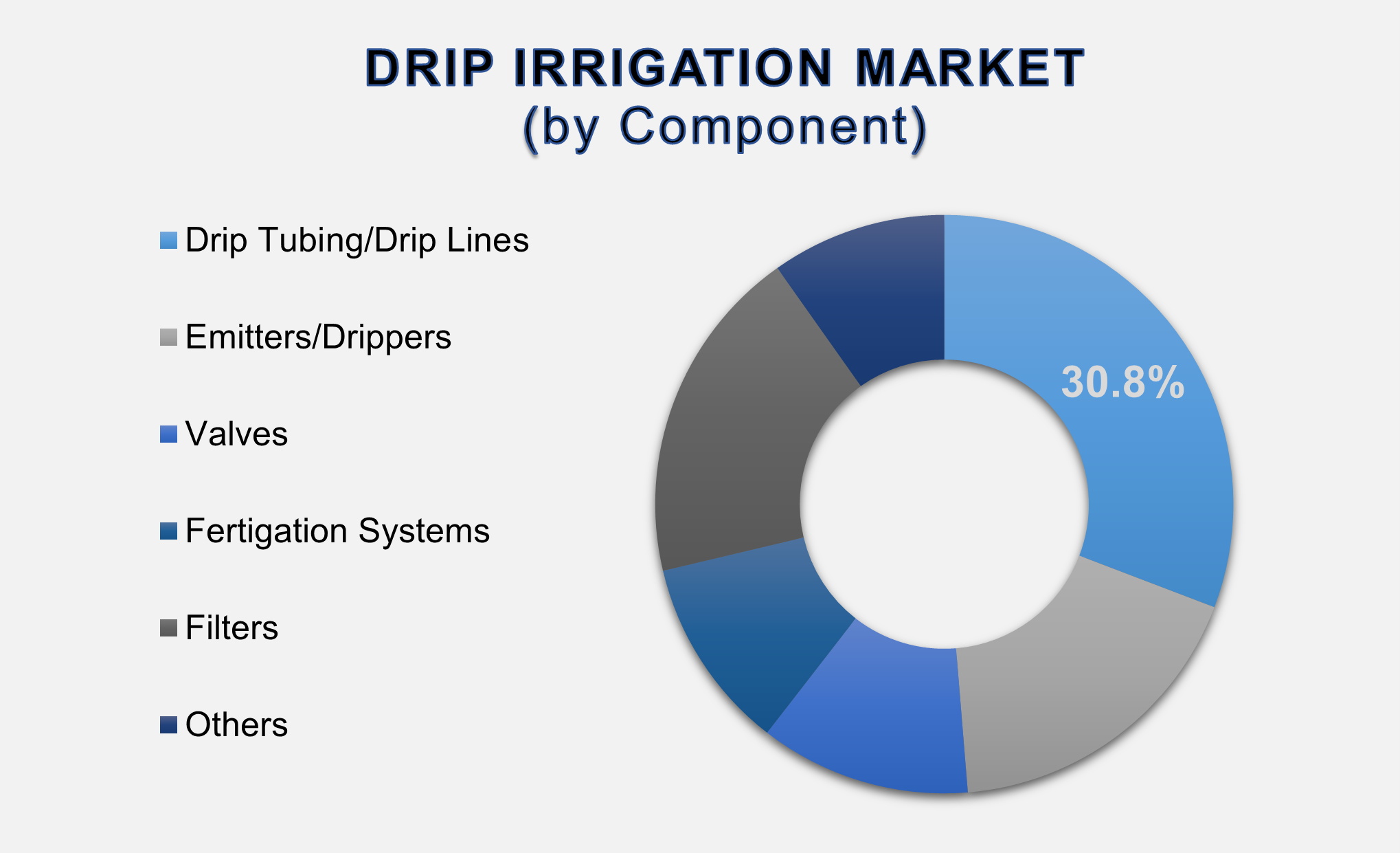
The Drip Tubing/Drip Lines segment, accounting for 30.8% of the global market, represents the largest share due to its core role in water delivery within irrigation systems. Drip lines form the backbone of system infrastructure, enabling precise water discharge directly to plant roots. Their high usage across field crops, orchards, vineyards, and vegetable cultivation makes them indispensable in both surface and subsurface applications. Advancements in durable polyethylene tubing, pressure-compensated drip lines, and multi-season reusable systems have significantly enhanced product performance and longevity. Drip lines are particularly important in large-scale farming operations where uniform water distribution is critical to achieving consistent crop quality. Moreover, farmers increasingly prefer advanced drip tubing due to its compatibility with automation technologies and fertigation systems, allowing efficient nutrient delivery and improved crop management. As demand for high-efficiency irrigation grows, the drip tubing/drip lines segment will continue to dominate the market.
Surface Method Segment
Accounted for the Largest Market Share in the Global Drip Irrigation Market
The Surface drip irrigation
method holds the largest market share due to its widespread adoption across a
variety of crops and farming conditions. Surface systems are easier to install,
require lower initial investment, and offer high versatility, making them ideal
for smallholder farmers as well as large commercial operations. This method is
commonly used for vegetable crops, field crops, and horticulture applications
where above-ground placement enables easy maintenance, inspection, and seasonal
adjustments. Surface drip systems are particularly valuable in regions with
labor constraints and limited technical training, as they are simpler to manage
compared to subsurface alternatives. Additionally, the method supports
flexibility in crop rotation, a key requirement in diversified agriculture.
With expanding government support programs encouraging micro-irrigation
adoption and growing awareness of water-saving technologies, the surface method
is expected to maintain its dominant position in the market over the forecast
period.
The Field Crops Segment
Accounted for the Largest Market Share in the Global Drip Irrigation Market
The Field Crops segment leads the
market, driven by the increasing use of drip irrigation in crops such as
cotton, sugarcane, maize, soybean, and pulses. Traditionally reliant on flood
irrigation, field crop cultivation is now shifting toward drip systems due to
mounting water scarcity concerns and rising pressure to improve yield
efficiency. Drip irrigation helps farmers achieve significant water savings
while enhancing fertilizer uptake, translating into higher productivity and
profitability. Governments worldwide are actively promoting micro-irrigation
adoption in field crops through subsidies, especially in regions where crop
production contributes significantly to GDP. In India, China, the U.S., and
Brazil, drip adoption in large-acreage crops is expanding rapidly due to
mechanized installation technologies and improved affordability. As global
demand for food increases and arable land expansion becomes limited, the need
to maximize output per hectare will continue to propel drip irrigation adoption
in field crops.
The following segments are
part of an in-depth analysis of the global Drip Irrigation market:
|
Market Segments |
|
|
By Component |
●
Drip Tubing/Drip
Lines ●
Emitters/Drippers ●
Valves ●
Fertigation Systems ●
Filters ●
Others |
|
By Method |
●
Surface ●
Subsurface |
|
By Crop |
●
Field Crops ●
Fruits and Nuts ●
Vegetable Crops ●
Others |
Drip Irrigation Market
Share Analysis by Region
North America is
anticipated to hold the biggest portion of the Drip Irrigation Market globally
throughout the forecast period.
North America dominates the
Global Drip Irrigation Market, holding 41.1% of total revenue in 2025. The
region benefits from advanced agricultural practices, early adoption of
precision irrigation technologies, and significant investment in farm modernization.
U.S. growers increasingly rely on drip systems for high-value fruit, nut, and
vegetable crops, driven by stringent water-use regulations and the ongoing
megadrought affecting major agricultural states such as California. The strong
presence of leading irrigation companies, extensive R&D activities, and
favorable government programs are further strengthening market penetration.
Canada and Mexico also contribute significantly, with expanding horticulture
industries and rising demand for export-quality produce.
Meanwhile, the Asia-Pacific is
expected to be the fastest-growing region during the forecast period. Rapid
population growth, increasing food demand, and severe water scarcity are
fueling accelerated adoption of drip irrigation in India, China, and Southeast
Asia. Massive government subsidy programs and rising mechanization in emerging
economies are catalyzing large-scale adoption. Europe, Latin America, and the
Middle East are also important contributors, driven by greenhouse expansion and
water conservation initiatives. Overall, regional trends reflect strong global
momentum toward high-efficiency irrigation technologies.
Drip Irrigation Market
Competition Landscape Analysis
The Global Drip Irrigation Market
is highly competitive, with companies focusing on product innovation,
automation technologies, distribution expansion, and strategic partnerships.
Leading players such as NETAFIM, Rain Bird Corporation, Rivulis, The Toro
Company, Jain Irrigation Systems Ltd., Irritec S.p.A., Antelco, and others
continue to invest heavily in advanced filtration systems, smart controllers,
and precision fertigation units.
Global Drip Irrigation
Market Recent Developments News:
- In November 2024,
Netafim Italia acquired Tecnir S.r.l., a Faenza-based specialist in
irrigation system design and installation. This acquisition strengthens
Netafim's precision irrigation portfolio in Italy, combining local
expertise with global innovation to advance sustainable water management
for agricultural customers.
- In March 2024,
Hunter Industries Inc. launched updated HE and HEB Point-Source Emitters
in earth-tone colors for discreet landscape integration. The emitters
offer multiple flow rates and connection options, featuring color-coded
identification, coined edges for easy installation, and an optional
anti-clogging diffuser cap to prevent soil erosion.
The Global Drip Irrigation Market Is Dominated by a Few Large Companies, such as
●
ARKA
●
Antelco
●
Amiad Water Systems
Ltd.
●
AZUD
●
Chinadrip Irrigation
Equipment (Xiamen) Co., Ltd.
●
HUNTER INDUSTRIES INC.
●
Irritec S.p.A
●
Jain Irrigation
Systems Ltd.
●
Metzer
●
STF
●
NETAFIM
●
Rain Bird Corporation
●
Rivulis
●
The Toro Company
● Others
Frequently Asked Questions
Jaya Bundele (Research Analyst)
Jaya Bundele is a skilled Research Analyst with 4+ years of experience in market intelligence, consumer insights, competitive analysis, and industry forecasting across the consumer goods, agriculture, and food & beverage sectors. She specializes in market sizing, trend analysis, growth opportunity mapping, and strategic secondary research for global and regional markets.
Her expertise lies in transforming complex industry data into actionable business strategies that help organizations identify emerging trends, understand customer behavior, and gain a competitive edge. With a strong focus on data-driven insights, business intelligence, and future market trends, Jaya delivers high-quality research solutions aligned with evolving industry demands and market dynamics.
1. Global Drip Irrigation
Market Introduction and Market Overview
1.1.
Objectives
of the Study
1.2.
Global
Drip Irrigation Market Scope and Market Estimation
1.2.1.Global Drip Irrigation Overall
Market Size (US$ Bn), Market CAGR (%), Market forecast (2025 - 2033)
1.2.2.Global Drip Irrigation
Market Revenue Share (%) and Growth Rate (Y-o-Y) from 2020 - 2033
1.3.
Market
Segmentation
1.3.1.Material of Global Drip
Irrigation Market
1.3.2.Method of Global Drip
Irrigation Market
1.3.3.Crop of Global Drip
Irrigation Market
1.3.4.Region of Global Drip
Irrigation Market
2. Executive
Summary
2.1.
Demand
Side Trends
2.2.
Key
Market Trends
2.3.
Market
Demand (US$ Bn) Analysis 2020 – 2024 and Forecast, 2025 – 2033
2.4.
Demand
and Opportunity Assessment
2.5.
Key
Developments
2.6.
Overview
of Tariff, Regulatory Landscape and Standards
2.7.
Market
Entry Strategies
2.8.
Market
Dynamics
2.8.1.Drivers
2.8.2.Limitations
2.8.3.Opportunities
2.8.4.Impact Analysis of Drivers
and Restraints
2.9.
Porter’s
Five Forces Analysis
2.10.
PEST
Analysis
3. Global
Drip Irrigation Market Estimates
& Historical Trend Analysis (2020 - 2024)
4. Global
Drip Irrigation Market Estimates
& Forecast Trend Analysis, by Material
4.1.
Global
Drip Irrigation Market Revenue (US$ Bn) Estimates and Forecasts, by Material, 2020
- 2033
4.1.1.Drip Tubing/Drip Lines
4.1.2.Emitters/Drippers
4.1.3.Valves
4.1.4.Fertigation Systems
4.1.5.Filters
4.1.6.Others
5. Global
Drip Irrigation Market Estimates
& Forecast Trend Analysis, by Method
5.1.
Global
Drip Irrigation Market Revenue (US$ Bn) Estimates and Forecasts, by Method,
2020 - 2033
5.1.1.Surface
5.1.2.Subsurface
6. Global
Drip Irrigation Market Estimates
& Forecast Trend Analysis, by Crop
6.1.
Global
Drip Irrigation Market Revenue (US$ Bn) Estimates and Forecasts, by Crop, 2020
- 2033
6.1.1.Field Crops
6.1.2.Fruits and Nuts
6.1.3.Vegetable Crops
6.1.4.Others
7. Global
Drip Irrigation Market Estimates
& Forecast Trend Analysis, by Region
7.1.
Global
Drip Irrigation Market Revenue (US$ Bn) Estimates and Forecasts, by Region, 2020
- 2033
7.1.1.North America
7.1.2.Europe
7.1.3.Asia Pacific
7.1.4.Middle East & Africa
7.1.5.Latin America
8. North America Drip
Irrigation Market: Estimates &
Forecast Trend Analysis
8.1.
North
America Drip Irrigation Market Assessments & Key Findings
8.1.1.North America Drip
Irrigation Market Introduction
8.1.2.North America Drip
Irrigation Market Size Estimates and Forecast (US$ Billion) (2020 - 2033)
8.1.2.1. By Material
8.1.2.2. By Method
8.1.2.3. By Crop
8.1.2.4.
By
Country
8.1.2.4.1. The U.S.
8.1.2.4.2. Canada
9. Europe Drip
Irrigation Market: Estimates &
Forecast Trend Analysis
9.1.
Europe
Drip Irrigation Market Assessments & Key Findings
9.1.1.Europe Drip Irrigation
Market Introduction
9.1.2.Europe Drip Irrigation
Market Size Estimates and Forecast (US$ Billion) (2020 - 2033)
9.1.2.1. By Material
9.1.2.2. By Method
9.1.2.3. By Crop
9.1.2.4.
By
Country
9.1.2.4.1.
Germany
9.1.2.4.2.
Italy
9.1.2.4.3.
U.K.
9.1.2.4.4.
France
9.1.2.4.5.
Spain
9.1.2.4.6.
Switzerland
9.1.2.4.7. Rest
of Europe
10. Asia Pacific Drip
Irrigation Market: Estimates &
Forecast Trend Analysis
10.1.
Asia
Pacific Market Assessments & Key Findings
10.1.1.
Asia
Pacific Drip Irrigation Market Introduction
10.1.2.
Asia
Pacific Drip Irrigation Market Size Estimates and Forecast (US$ Billion) (2020
- 2033)
10.1.2.1. By Material
10.1.2.2. By Method
10.1.2.3. By Crop
10.1.2.4.
By
Country
10.1.2.4.1. China
10.1.2.4.2. Japan
10.1.2.4.3. India
10.1.2.4.4. Australia
10.1.2.4.5. South Korea
10.1.2.4.6. Rest of Asia Pacific
11. Middle East & Africa Drip
Irrigation Market: Estimates &
Forecast Trend Analysis
11.1.
Middle
East & Africa Market Assessments & Key Findings
11.1.1.
Middle East & Africa Drip Irrigation Market Introduction
11.1.2.
Middle East & Africa Drip Irrigation Market Size Estimates
and Forecast (US$ Billion) (2020 - 2033)
11.1.2.1. By Material
11.1.2.2. By Method
11.1.2.3. By Crop
11.1.2.4.
By
Country
11.1.2.4.1. UAE
11.1.2.4.2. Saudi
Arabia
11.1.2.4.3. South
Africa
11.1.2.4.4. Rest
of MEA
12. Latin America
Drip Irrigation Market: Estimates &
Forecast Trend Analysis
12.1.
Latin
America Market Assessments & Key Findings
12.1.1.
Latin
America Drip Irrigation Market Introduction
12.1.2.
Latin
America Drip Irrigation Market Size Estimates and Forecast (US$ Billion) (2020
- 2033)
12.1.2.1. By Material
12.1.2.2. By Method
12.1.2.3. By Crop
12.1.2.4.
By
Country
12.1.2.4.1. Brazil
12.1.2.4.2. Argentina
12.1.2.4.3. Mexico
12.1.2.4.4. Rest
of LATAM
13. Country Wise Market:
Introduction
14.
Competition
Landscape
14.1.
Global
Drip Irrigation Market Product Mapping
14.2.
Global
Drip Irrigation Market Concentration Analysis, by Leading Players / Innovators
/ Emerging Players / New Entrants
14.3.
Global
Drip Irrigation Market Tier Structure Analysis
14.4.
Global
Drip Irrigation Market Concentration & Company Market Shares (%) Analysis,
2024
15.
Company
Profiles
15.1.
ARKA
15.1.1.
Company
Overview & Key Stats
15.1.2.
Financial
Performance & KPIs
15.1.3.
Product
Portfolio
15.1.4.
SWOT
Analysis
15.1.5.
Business
Strategy & Recent Developments
* Similar details would be provided for all the players
mentioned below
15.2. Antelco
15.3. Amiad
Water Systems Ltd.
15.4. AZUD
15.5. Chinadrip
Irrigation Equipment (Xiamen) Co., Ltd.
15.6. HUNTER
INDUSTRIES INC.
15.7. Irritec
S.p.A
15.8. Jain
Irrigation Systems Ltd.
15.9. Metzer
15.10. STF
15.11. NETAFIM
15.12. Rain
Bird Corporation
15.13. Rivulis
15.14. The Toro
Company
15.15. Others
16. Research
Methodology
16.1.
External
Transportations / Databases
16.2.
Internal
Proprietary Database
16.3.
Primary
Research
16.4.
Secondary
Research
16.5.
Assumptions
16.6.
Limitations
16.7.
Report
FAQs
17. Research
Findings & Conclusion
Our Research Methodology
"Insight without rigor is just noise."
We follow a comprehensive, multi-phase research framework designed to deliver accurate, strategic, and decision-ready intelligence. Our process integrates primary and secondary research , both quantitative and qualitative , along with dual modeling techniques ( top-down and bottom-up) and a final layer of validation through our proprietary in-house repository.
PRIMARY RESEARCH
Primary research captures real-time, firsthand insights from the market to understand behaviors, motivations, and emerging trends.
1. Quantitative Primary Research
Objective: Generate statistically significant data directly from market participants.
Approaches:- Structured surveys with customers, distributors, and field agents
- Mobile-based data collection for point-of-sale audits and usage behavior
- Phone-based interviews (CATI) for market sizing and product feedback
- Online polling around industry events and digital campaigns
- Purchase frequency by customer type
- Channel performance across geographies
- Feature demand by application or demographic
2. Qualitative Primary Research
Objective: Explore decision-making drivers, pain points, and market readiness.
Approaches:- In-depth interviews (IDIs) with executives, product managers, and key decision-makers
- Focus groups among end users and early adopters
- Site visits and observational research for consumer products
- Informal field-level discussions for regional and cultural nuances
SECONDARY RESEARCH
This phase helps establish a macro-to-micro understanding of market trends, size, regulation, and competitive dynamics, sourced from credible and public domain information.
1. Quantitative Secondary Research
Objective: Model market value and segment-level forecasts based on published data.
Sources include:- Financial reports and investor summaries
- Government trade data, customs records, and regulatory statistics
- Industry association publications and economic databases
- Channel performance and pricing data from marketplace listings
- Revenue splits, pricing trends, and CAGR estimates
- Supply-side capacity and volume tracking
- Investment analysis and funding benchmarks
2. Qualitative Secondary Research
Objective: Capture strategic direction, innovation signals, and behavioral trends.
Sources include:- Company announcements, roadmaps, and product pipelines
- Publicly available whitepapers, conference abstracts, and academic research
- Regulatory body publications and policy briefs
- Social and media sentiment scanning for early-stage shifts
- Strategic shifts in market positioning
- Unmet needs and white spaces
- Regulatory triggers and compliance impact
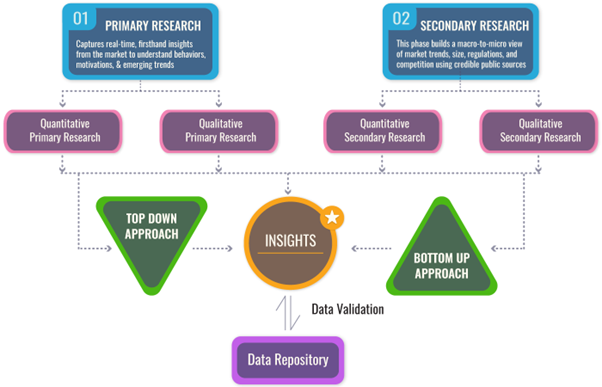
DUAL MODELING: TOP-DOWN + BOTTOM-UP
To ensure robust market estimation, we apply two complementary sizing approaches:
Top-Down Modeling:- Start with broader industry value (e.g., global or regional TAM)
- Apply filters by segment, geography, end-user, or use case
- Adjust with primary insights and validation benchmarks
- Ideal for investor-grade market scans and opportunity mapping
- Aggregate from the ground up using sales volumes, pricing, and unit economics
- Use internal modeling templates aligned with stakeholder data
- Incorporate distributor-level or region-specific inputs
- Most accurate for emerging segments and granular sub-markets
DATA VALIDATION: IN-HOUSE REPOSITORY
We close the loop with proprietary data intelligence built from ongoing projects, industry monitoring, and historical benchmarking. This repository includes:
- Multi-sector market and pricing models
- Key trendlines from past interviews and forecasts
- Benchmarked adoption rates, churn patterns, and ROI indicators
- Industry-specific deviation flags and cross-check logic
- Catches inconsistencies early
- Aligns projections across studies
- Enables consistent, high-trust deliverables