
Global Drug of Abuse Testing Services Market Size and Forecast (2025 - 2033), With Regional Share and Segment Analysis Report Coverage: By Product Type (Analyzers, Immunoassay Analyzers, Chromatographic Devices, Breath Analyzers, Rapid Testing Devices, etc.), By Sample Type (Saliva, Breath, Urine, Blood, Hair & Sweat), By Testing Type (Pain Management Testing, Criminal Justice Testing, Workplace Screening), By End-user (Hospitals, Diagnostic Laboratories, On-the-spot Testing Centers, Forensic Laboratories), and Geography
2025-11-27
Healthcare
Swetal (Research Analyst)
Description
Drug of Abuse Testing Services Market Overview
The Global Drug of Abuse Testing Services Market is projected to reach USD 6.2 billion by 2033, up from USD 4.3 billion in 2025, reflecting a CAGR of 4.8% during 2025–2033. The rising prevalence of substance use disorders, increasing emphasis on workplace safety, and expanding legal and regulatory oversight in developed and developing economies are key factors bolstering the market growth. Drug of abuse (DOA) testing services play a crucial role in detecting the presence of illegal or controlled drugs in biological samples such as urine, saliva, blood, hair, and breath.

Market evolution is being shaped
by advanced testing technologies such as chromatographic devices, immunoassay
analyzers, and rapid oral fluid testing. Furthermore, service providers are
increasingly adopting laboratory automation and digital health integration to
improve robustness and accuracy in both laboratory-based and on-site testing
environments. The rise in opioid misuse and prescription drug monitoring
initiatives in regions like North America and Europe has paved the way for
consistent demand from hospitals, criminal justice systems, and workplace
screening programs.
Drug of Abuse Testing Services Market Drivers and
Opportunities
Rising Incidence of Substance Use Disorders Is Fueling the
Demand for Drug Abuse Testing
The
increasing incidence of drug misuse and dependency globally is a major driver
behind the growth of the drug abuse testing services market. According to the
United Nations Office on Drugs and Crime (UNODC), over 296 million people
worldwide used drugs in 2021, and nearly 39.5 million suffered from drug use
disorders. Rising opioid and stimulant abuse in both developed and emerging
economies has amplified the need for accurate, reliable, and accessible drug
testing services across clinical, criminal justice, and occupational safety
sectors. The greater availability of synthetic drugs, prescription medications,
and illicit substances like cannabis, cocaine, and opioids has made DOA testing
essential not only for medical assessments but also for legal and public safety
compliance. Pain management testing, in particular, has surged due to increased
opioid prescriptions, requiring regular toxicology screening to monitor patient
adherence and detect potential misuse. Furthermore, government-funded awareness
campaigns and legal policies aiming to reduce drug-related harm have
incentivized investments in both laboratory-based and rapid testing models.
Hospitals, rehabilitation centers, law enforcement agencies, and corporate
employers are prioritizing toxicological testing protocols, often in
partnership with third-party laboratories, to mitigate liability and uphold
safety standards. These factors collectively contribute to sustained demand for
drug abuse testing services globally.
Stringent Workplace and Public Safety Regulations Are
Accelerating the Adoption of Drug Testing Services
Across key sectors such as transportation, logistics, mining, healthcare, and aviation, mandatory drug testing policies are being implemented to minimize workplace accidents and enhance productivity. The adoption of drug testing services is no longer limited to law enforcement or healthcare facilities. It has expanded into corporate workplaces driven by OSHA-guided safety protocols and industry-specific regulations like the U.S. Department of Transportation (DOT) drug testing mandates.
In regions such as North America and Western Europe, workplace drug testing is compulsory in industries where impairment can lead to fatal incidents, such as in aviation, oil and gas, and construction. Employers are also using drug screening as part of pre-employment selection, periodic testing, and post-incident investigations. With the increase in remote work and gig economies, virtual and mobile-based drug testing services have gained traction, enabling compliance through flexible and tech-enabled platforms. Public safety initiatives, especially concerning DUI and crime control, have further accelerated the use of chromatographic and rapid breath or saliva analyzers by law enforcement authorities. Additionally, drug courts and community corrections conduct regular substance testing to monitor offenders, fueling demand across forensic labs. This tightening regulatory network and its ripple effect on testing adoption are expected to continue as governments upgrade surveillance around drug misuse.
Emerging
Markets' Expansion of Rapid and Mobile Testing Solutions Is Poised to Create
Significant Opportunities in The Drug Abuse Testing Market Worldwide
The expansion of rapid, cost-effective, and mobile drug testing technologies in emerging economies presents a substantial growth opportunity for market players. Regions like Asia Pacific, Latin America, and the Middle East are witnessing a surge in drug abuse cases, driven by socioeconomic transitions, urban drug trafficking networks, and high youth unemployment. As government bodies and private employers in these regions begin to adopt more structured drug testing protocols, the demand for quick and portable solutions is expected to escalate. Rapid tests such as point-of-care urine cups, oral swab devices, and handheld breath analyzers eliminate the need for laboratory infrastructure, making them particularly viable in rural or remote settings. Companies focusing on producing affordable test kits with high specificity and sensitivity can capture large market shares in low- and middle-income countries. Additionally, smartphone-based testing kits and digital reporting platforms are gaining popularity, enabling instant results and cloud-based record-keeping for employers and clinicians. Collaborations with local distributors, investments in diagnostic centers, and strategic marketing to public health authorities will open new revenue channels for market entrants. With government-backed anti-drug campaigns on the rise, especially in China, India, Brazil, and South Africa, rapid testing manufacturers and service providers are positioned for accelerated growth in the coming decade.
Drug of Abuse Testing
Services Market Scope
|
Report Attributes |
Description |
|
Market Size in 2025 |
USD 4.3 Billion |
|
Market Forecast in 2033 |
USD 6.2 Billion |
|
CAGR % 2025-2033 |
4.8% |
|
Base Year |
2024 |
|
Historic Data |
2020-2024 |
|
Forecast Period |
2025-2033 |
|
Report USP |
Production, Consumption,
Company Share, Company Heatmap, Company Production Capacity, Growth Factors,
and more |
|
Segments Covered |
●
By Product Type ●
By Sample Type ●
By Testing Type ●
By End-user |
|
Regional Scope |
●
North America, ●
Europe, ●
APAC, ●
Latin America ●
Middle East and
Africa |
|
Country Scope |
1)
U.S. 2)
Canada 3)
Germany 4)
UK 5)
France 6)
Spain 7)
Italy 8)
Switzerland 9)
China 10)
Japan 11)
India 12)
Australia 13)
South Korea 14)
Brazil 15)
Mexico 16)
Argentina 17)
South Africa 18)
Saudi Arabia 19)
UAE |
Drug of Abuse Testing
Services Market Report Segmentation Analysis
The global drug abuse testing
services market industry analysis is segmented by product type, by sample type,
by testing type, by end-user, and by region.
The
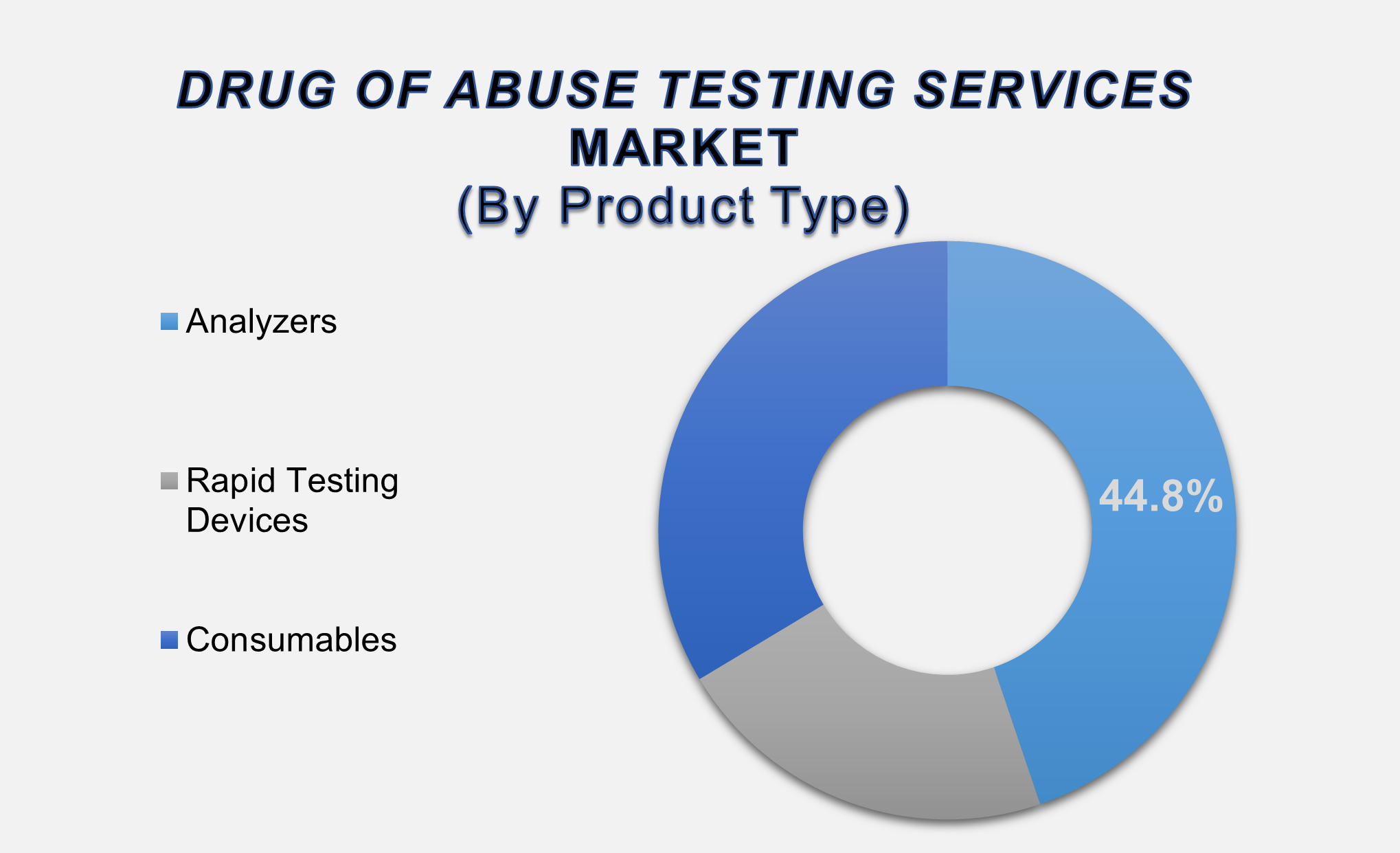
Analyzers Segment Accounted for the Largest Market
Share in the Global Drug of Abuse Testing Services Market
By
Product Type, the market is segmented into Analyzers, Immunoassays Analyzers,
Chromatographic Devices, Breath Analyzers, Rapid Testing Devices, Urine Testing
Devices, Oral Fluid Testing Devices, Consumables, Fluid Collection Devices, and
Others. The Analyzers segment dominates the global market, holding the largest
share in 2025. These analyzers are widely used in diagnostic laboratories and
forensic toxicology centers due to their high precision, rapid throughput, and
capability to process multiple drug panels at once. The growing focus on
accurate detection of poly-drug use, especially in criminal justice and
clinical pain management, is bolstering demand for advanced analyzers such as
LC-MS/MS and GC-MS devices. Continuous upgrades offering automated sampling,
real-time analytics, and cloud connectivity are also driving preferences for
these systems. Moreover, the rising adoption of evidence-based diagnostics in
hospital settings, fueled by increasing cases
of opioid overdose and recreational drug use,
is expected to sustain growth in this segment through 2033.
Urine
Sample Segment Held the Largest Share in the Global Drug of Abuse Testing
Services Market
By
Sample Type, the market is divided into Saliva, Breath, Urine, Blood, and Hair
& Sweat. The Urine segment accounted for the largest share of the global
market in 2025. Urine testing is considered the gold standard in drug screening
due to its ease of collection, low cost, and ability to detect a wide range of
substances and metabolites for longer durations. Commonly utilized in workplace
screenings, medical diagnostics, and post-accident investigations, urine
samples provide clear insights into both recent
and chronic drug use. Advancements in rapid urine-based test strips and
portable analyzers are enhancing result accuracy and turnaround time. Its
non-invasive nature and suitability for verifying compliance in pain management
or rehabilitation programs further support its dominance. Additionally,
organizations such as DOT and SAMHSA mandate urine-based drug testing for
federal and safety-sensitive positions, ensuring continued global demand in
this segment.
Criminal
Justice Testing Segment Accounted for the Largest Market Share in the Global
Drug Abuse Testing Services Market
By
Testing Type, the market is segmented into Pain Management Testing, Criminal
Justice Testing, Workplace Screening, and On-the-spot Testing. The Criminal
Justice Testing segment held the dominant position in 2025, driven by
increasing drug-related crimes, mandated testing by law enforcement agencies,
and parole/probation assessments. Government-led initiatives to identify
impaired driving, drug trafficking, and narcotics-fueled violence have
intensified the use of laboratory and rapid testing methods across correctional
facilities and legal frameworks. The segment benefits from established testing
protocols, long-term contracts with forensic labs, and multidisciplinary
toxicology research that supports court-admissible evidence. Investments in
high-throughput analyzers for narcotics profiling and integration of laboratory
information systems (LIS) are also contributing to the segment's growth. With
proactive drug legislation in advanced and emerging economies alike, the
criminal justice testing segment is projected to maintain market leadership
throughout the forecast period.
The following segments are
part of an in-depth analysis of the global Drug of Abuse Testing Services
market:
|
Market Segments |
|
|
By Product
Type |
●
Analyzers o
Immunoassays
Analyzers o
Chromatographic
Devices o
Breath Analyzers ●
Rapid Testing
Devices o
Urine Testing
Devices o
Oral Fluid Testing
Devices ●
Consumables o
Fluid Collection
Devices o
Others |
|
By Sample Type |
●
Saliva ●
Breath ●
Urine ●
Blood ●
Hair & Sweat |
|
By Testing
Type |
●
Pain Management
Testing ●
Criminal Justice
Testing ●
Workplace Screening |
|
By End-user |
●
Hospitals ●
Diagnostics
Laboratories ●
On-the-spot Testing ●
Forensic
Laboratories |
Drug of Abuse Testing
Services Market Share Analysis by Region
North America is
anticipated to hold the largest portion of the Drug Abuse Testing Services
Market globally throughout the forecast period.
North America accounted for the
largest share of the global drug abuse testing services market in 2025,
capturing approximately 39.9% of total revenue. The region's dominance is
primarily attributed to its structured regulatory environment, widespread substance
use issues, and well-established healthcare infrastructure. The U.S., in
particular, drives a significant portion of the market due to mandatory drug
testing programs across federal workplaces, DOT compliance, and an advanced
network of diagnostic laboratories. The opioid epidemic and rising incidence of
fentanyl-related overdoses have spurred federal and state governments to invest
in toxicology services and drug monitoring initiatives. Moreover, corporations
in North America are increasingly implementing pre-employment and random drug
screenings to reduce workplace accidents and liabilities.
Asia Pacific, on the other hand,
is anticipated to record the highest CAGR during 2025–2033 owing to growing
drug trafficking, increasing awareness of drug-related health risks, and
stricter enforcement of drug laws. Countries like China, India, and Indonesia
are witnessing an uptick in synthetic drug use, prompting governments to invest
in rapid testing services at transportation hubs, schools, and corporate
sectors. Improved access to healthcare and growing awareness among employers in
APAC's urban centers further support market expansion. Additionally, APAC holds
a cost advantage in manufacturing test devices, attracting multinational
companies to set up localized production units.
Drug of Abuse Testing
Services Market Competition Landscape Analysis
The drug abuse testing services
market is moderately fragmented, with leading players such as Quest
Diagnostics, Laboratory Corporation of America, Abbott Laboratories, and
Siemens Healthineers holding significant market shares. These companies focus
on developing advanced chromatographic devices, automated analyzers, and
digital toxicology platforms.
Global Drug of Abuse
Testing Services Market Recent Developments News:
- In September 2024,
Quest Diagnostics acquired select laboratory assets from Allina
Health, enhancing access to affordable, high-quality laboratory services
for patients and providers across Minnesota and western Wisconsin.
- In August 2024,
Quest Diagnostics signed an agreement with University Hospitals to
purchase select assets of its outreach laboratory services business,
expanding Quest’s diagnostic service footprint and strengthening its
collaboration with a leading academic health system.
- In May 2024,
Omega Laboratories partnered with Cannabix Technologies Inc. to
integrate the FAST™ THC Breathalyzer into its drug testing portfolio. This
collaboration established Omega as the exclusive laboratory service
provider for Cannabix, improving the accuracy and efficiency of cannabis
impairment testing.
The Global Drug of Abuse Testing
Services Market Is Dominated by a Few Large Companies, such as
●
Quest Diagnostics
●
Laboratory Corporation
of America
●
Abbott Laboratories
●
Siemens Healthineers
●
Roche Diagnostics
●
Thermo Fisher
Scientific
●
Danaher Corporation
●
Bio-Rad Laboratories
●
Merck KGaA
●
Synergy Health
●
Clinical Reference
Laboratory
●
Cordant Health
Solutions
●
Millennium Health
●
Precision Diagnostics
●
American Bio Medica
Corporation
●
Randox Laboratories
●
OraSure Technologies
●
Alere
●
LGC Limited
●
Psychemedics
Corporation
● Others
Frequently Asked Questions
Swetal (Research Analyst)
Swetal is a Research Analyst with 4+ years of experience specializing in healthcare market research, medical devices, healthcare IT, and medical technology industry analysis. Her expertise includes competitive intelligence, secondary research, market trend forecasting, and healthcare business insights across global healthcare ecosystems.
She contributes to advanced market research reports by analyzing regulatory frameworks, emerging healthcare technologies, competitive landscapes, and innovation trends shaping the medical industry. With a strong focus on accurate market intelligence, strategic insights, and healthcare industry trends, Swetal supports businesses in making informed, data-backed decisions in a rapidly transforming healthcare environment.
1. Global Drug of Abuse
Testing Services Market Introduction and Market Overview
1.1.
Objectives
of the Study
1.2.
Global
Drug of Abuse Testing Services Market Scope and Market Estimation
1.2.1.Global Drug of Abuse
Testing Services Overall Market Size (US$ Bn), Market CAGR (%), Market forecast
(2025 - 2033)
1.2.2.Global Drug of Abuse
Testing Services Market Revenue Share (%) and Growth Rate (Y-o-Y) from 2020 - 2033
1.3.
Market
Segmentation
1.3.1.Product Type of Global Drug
of Abuse Testing Services Market
1.3.2.Sample Type of Global Drug
of Abuse Testing Services Market
1.3.3.Testing Type of Global Drug
of Abuse Testing Services Market
1.3.4.End-user of Global Drug of
Abuse Testing Services Market
1.3.5.Region of Global Drug of
Abuse Testing Services Market
2.
Executive Summary
2.1.
Demand
Side Trends
2.2.
Key
Market Trends
2.3.
Market
Demand (US$ Bn) Analysis 2020 – 2024 and Forecast, 2025 – 2033
2.4.
Demand
and Opportunity Assessment
2.5.
Key
Developments
2.6.
Overview
of Tariff, Regulatory Landscape and Standards
2.7.
Market
Entry Strategies
2.8.
Market
Dynamics
2.8.1.Drivers
2.8.2.Limitations
2.8.3.Opportunities
2.8.4.Impact Analysis of Drivers
and Restraints
2.9.
Porter’s
Five Forces Analysis
2.10.
PEST
Analysis
3. Global
Drug of Abuse Testing Services Market
Estimates & Historical Trend Analysis (2020 - 2024)
4. Global
Drug of Abuse Testing Services Market
Estimates & Forecast Trend Analysis, by Product
Type
4.1.
Global
Drug of Abuse Testing Services Market Revenue (US$ Bn) Estimates and Forecasts,
by Product Type, 2020 - 2033
4.1.1.Analyzers
4.1.1.1.
Immunoassays
Analyzers
4.1.1.2.
Chromatographic
Devices
4.1.1.3.
Breath
Analyzers
4.1.2.Rapid Testing Devices
4.1.2.1.
Urine
Testing Devices
4.1.2.2.
Oral
Fluid Testing Devices
4.1.3.Consumables
4.1.3.1.
Fluid
Collection Devices
4.1.3.2.
Others
5. Global
Drug of Abuse Testing Services Market
Estimates & Forecast Trend Analysis, by Sample
Type
5.1.
Global
Drug of Abuse Testing Services Market Revenue (US$ Bn) Estimates and Forecasts,
by Sample Type, 2020 - 2033
5.1.1.Saliva
5.1.2.Breath
5.1.3.Urine
5.1.4.Blood
5.1.5.Hair & Sweat
6. Global
Drug of Abuse Testing Services Market
Estimates & Forecast Trend Analysis, by Testing
Type
6.1.
Global
Drug of Abuse Testing Services Market Revenue (US$ Bn) Estimates and Forecasts,
by Testing Type, 2020 - 2033
6.1.1.Pain Management Testing
6.1.2.Criminal Justice Testing
6.1.3.Workplace Screening
7. Global
Drug of Abuse Testing Services Market
Estimates & Forecast Trend Analysis, by End-user
7.1.
Global
Drug of Abuse Testing Services Market Revenue (US$ Bn) Estimates and Forecasts,
by End-user, 2020 - 2033
7.1.1.Hospitals
7.1.2.Diagnostics Laboratories
7.1.3.On-the-spot Testing
7.1.4.Forensic Laboratories
8. Global
Drug of Abuse Testing Services Market
Estimates & Forecast Trend Analysis, by Region
8.1.
Global
Drug of Abuse Testing Services Market Revenue (US$ Bn) Estimates and Forecasts,
by Region, 2020 - 2033
8.1.1.North America
8.1.2.Europe
8.1.3.Asia Pacific
8.1.4.Middle East & Africa
8.1.5.Latin America
9. North America Drug
of Abuse Testing Services Market:
Estimates & Forecast Trend Analysis
9.1. North America Drug of
Abuse Testing Services Market Assessments & Key Findings
9.1.1.North America Drug of
Abuse Testing Services Market Introduction
9.1.2.North America Drug of
Abuse Testing Services Market Size Estimates and Forecast (US$ Billion) (2020 -
2033)
9.1.2.1.
By Product Type
9.1.2.2.
By Sample Type
9.1.2.3.
By Testing Type
9.1.2.4.
By End-user
9.1.2.5. By Country
9.1.2.5.1. The U.S.
9.1.2.5.2. Canada
10. Europe Drug
of Abuse Testing Services Market:
Estimates & Forecast Trend Analysis
10.1. Europe Drug of Abuse
Testing Services Market Assessments & Key Findings
10.1.1. Europe Drug of Abuse
Testing Services Market Introduction
10.1.2. Europe Drug of Abuse
Testing Services Market Size Estimates and Forecast (US$ Billion) (2020 - 2033)
10.1.2.1.
By Product Type
10.1.2.2.
By Sample Type
10.1.2.3.
By Testing Type
10.1.2.4.
By End-user
10.1.2.5. By Country
10.1.2.5.1.
Germany
10.1.2.5.2.
Italy
10.1.2.5.3.
U.K.
10.1.2.5.4.
France
10.1.2.5.5.
Spain
10.1.2.5.6.
Switzerland
10.1.2.5.7. Rest
of Europe
11. Asia Pacific Drug
of Abuse Testing Services Market:
Estimates & Forecast Trend Analysis
11.1. Asia Pacific Market
Assessments & Key Findings
11.1.1.
Asia
Pacific Drug of Abuse Testing Services Market Introduction
11.1.2.
Asia
Pacific Drug of Abuse Testing Services Market Size Estimates and Forecast (US$ Billion)
(2020 - 2033)
11.1.2.1.
By Product Type
11.1.2.2.
By Sample Type
11.1.2.3.
By Testing Type
11.1.2.4.
By End-user
11.1.2.5. By Country
11.1.2.5.1. China
11.1.2.5.2. Japan
11.1.2.5.3. India
11.1.2.5.4. Australia
11.1.2.5.5. South Korea
11.1.2.5.6. Rest of Asia Pacific
12. Middle East & Africa Drug
of Abuse Testing Services Market:
Estimates & Forecast Trend Analysis
12.1. Middle East & Africa
Market Assessments & Key Findings
12.1.1. Middle
East & Africa
Drug of Abuse Testing Services Market Introduction
12.1.2. Middle
East & Africa
Drug of Abuse Testing Services Market Size Estimates and Forecast (US$ Billion)
(2020 - 2033)
12.1.2.1.
By Product Type
12.1.2.2.
By Sample Type
12.1.2.3.
By Testing Type
12.1.2.4.
By End-user
12.1.2.5. By Country
12.1.2.5.1. UAE
12.1.2.5.2. Saudi
Arabia
12.1.2.5.3. South
Africa
12.1.2.5.4. Rest
of MEA
13. Latin America
Drug of Abuse Testing Services Market:
Estimates & Forecast Trend Analysis
13.1. Latin America Market
Assessments & Key Findings
13.1.1. Latin America Drug of
Abuse Testing Services Market Introduction
13.1.2. Latin America Drug of
Abuse Testing Services Market Size Estimates and Forecast (US$ Billion) (2020 -
2033)
13.1.2.1.
By Product Type
13.1.2.2.
By Sample Type
13.1.2.3.
By Testing Type
13.1.2.4.
By End-user
13.1.2.5. By Country
13.1.2.5.1. Brazil
13.1.2.5.2. Argentina
13.1.2.5.3. Mexico
13.1.2.5.4. Rest
of LATAM
14.
Country
Wise Market: Introduction
15.
Competition
Landscape
15.1. Global Drug of Abuse
Testing Services Market Product Mapping
15.2. Global Drug of Abuse
Testing Services Market Concentration Analysis, by Leading Players / Innovators
/ Emerging Players / New Entrants
15.3. Global Drug of Abuse
Testing Services Market Tier Structure Analysis
15.4. Global Drug of Abuse
Testing Services Market Concentration & Company Market Shares (%) Analysis,
2024
16.
Company
Profiles
16.1.
Quest Diagnostics
16.1.1.
Company
Overview & Key Stats
16.1.2.
Financial
Performance & KPIs
16.1.3.
Product
Portfolio
16.1.4.
SWOT
Analysis
16.1.5.
Business
Strategy & Recent Developments
* Similar details would be provided for all the players
mentioned below
16.2.
Laboratory Corporation of America
16.3.
Abbott Laboratories
16.4.
Siemens Healthineers
16.5.
Roche Diagnostics
16.6.
Thermo Fisher Scientific
16.7.
Danaher Corporation
16.8.
Bio-Rad Laboratories
16.9.
Merck KGaA
16.10.
Synergy Health
16.11.
Clinical Reference Laboratory
16.12.
Cordant Health Solutions
16.13.
Millennium Health
16.14.
Precision Diagnostics
16.15.
American Bio Medica Corporation
16.16.
Randox Laboratories
16.17.
OraSure Technologies
16.18.
Alere
16.19.
LGC Limited
16.20.
Psychemedics Corporation
16.21.
Others
17. Research
Methodology
17.1. External Transportations /
Databases
17.2. Internal Proprietary
Database
17.3. Primary Research
17.4. Secondary Research
17.5. Assumptions
17.6. Limitations
17.7. Report FAQs
18. Research
Findings & Conclusion
Our Research Methodology
"Insight without rigor is just noise."
We follow a comprehensive, multi-phase research framework designed to deliver accurate, strategic, and decision-ready intelligence. Our process integrates primary and secondary research , both quantitative and qualitative , along with dual modeling techniques ( top-down and bottom-up) and a final layer of validation through our proprietary in-house repository.
PRIMARY RESEARCH
Primary research captures real-time, firsthand insights from the market to understand behaviors, motivations, and emerging trends.
1. Quantitative Primary Research
Objective: Generate statistically significant data directly from market participants.
Approaches:- Structured surveys with customers, distributors, and field agents
- Mobile-based data collection for point-of-sale audits and usage behavior
- Phone-based interviews (CATI) for market sizing and product feedback
- Online polling around industry events and digital campaigns
- Purchase frequency by customer type
- Channel performance across geographies
- Feature demand by application or demographic
2. Qualitative Primary Research
Objective: Explore decision-making drivers, pain points, and market readiness.
Approaches:- In-depth interviews (IDIs) with executives, product managers, and key decision-makers
- Focus groups among end users and early adopters
- Site visits and observational research for consumer products
- Informal field-level discussions for regional and cultural nuances
SECONDARY RESEARCH
This phase helps establish a macro-to-micro understanding of market trends, size, regulation, and competitive dynamics, sourced from credible and public domain information.
1. Quantitative Secondary Research
Objective: Model market value and segment-level forecasts based on published data.
Sources include:- Financial reports and investor summaries
- Government trade data, customs records, and regulatory statistics
- Industry association publications and economic databases
- Channel performance and pricing data from marketplace listings
- Revenue splits, pricing trends, and CAGR estimates
- Supply-side capacity and volume tracking
- Investment analysis and funding benchmarks
2. Qualitative Secondary Research
Objective: Capture strategic direction, innovation signals, and behavioral trends.
Sources include:- Company announcements, roadmaps, and product pipelines
- Publicly available whitepapers, conference abstracts, and academic research
- Regulatory body publications and policy briefs
- Social and media sentiment scanning for early-stage shifts
- Strategic shifts in market positioning
- Unmet needs and white spaces
- Regulatory triggers and compliance impact
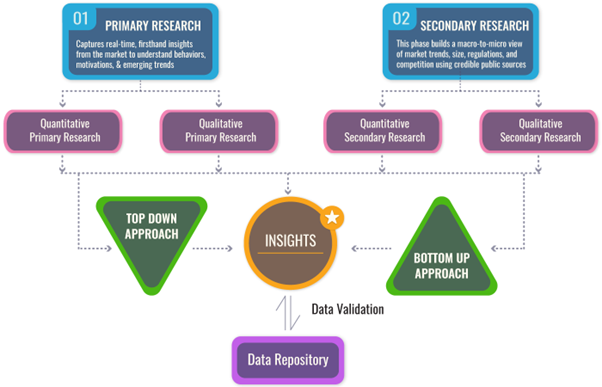
DUAL MODELING: TOP-DOWN + BOTTOM-UP
To ensure robust market estimation, we apply two complementary sizing approaches:
Top-Down Modeling:- Start with broader industry value (e.g., global or regional TAM)
- Apply filters by segment, geography, end-user, or use case
- Adjust with primary insights and validation benchmarks
- Ideal for investor-grade market scans and opportunity mapping
- Aggregate from the ground up using sales volumes, pricing, and unit economics
- Use internal modeling templates aligned with stakeholder data
- Incorporate distributor-level or region-specific inputs
- Most accurate for emerging segments and granular sub-markets
DATA VALIDATION: IN-HOUSE REPOSITORY
We close the loop with proprietary data intelligence built from ongoing projects, industry monitoring, and historical benchmarking. This repository includes:
- Multi-sector market and pricing models
- Key trendlines from past interviews and forecasts
- Benchmarked adoption rates, churn patterns, and ROI indicators
- Industry-specific deviation flags and cross-check logic
- Catches inconsistencies early
- Aligns projections across studies
- Enables consistent, high-trust deliverables