

Dry Eye Syndrome Treatment Market Size and Forecast (2025 - 2033), Global and Regional Growth, Trend, Share and Industry Analysis Report Coverage: By Product (Anti-inflammatory Products, Cyclosporine, Corticosteroids, Artificial Tears and Lubricants, Others); By Distribution Channel (Hospital Pharmacies, Retail Pharmacies, Online Pharmacies, Others); and Geography
2025-12-16
Healthcare
Swetal (Research Analyst)
Description
Dry Eye
Syndrome Treatment Market Overview
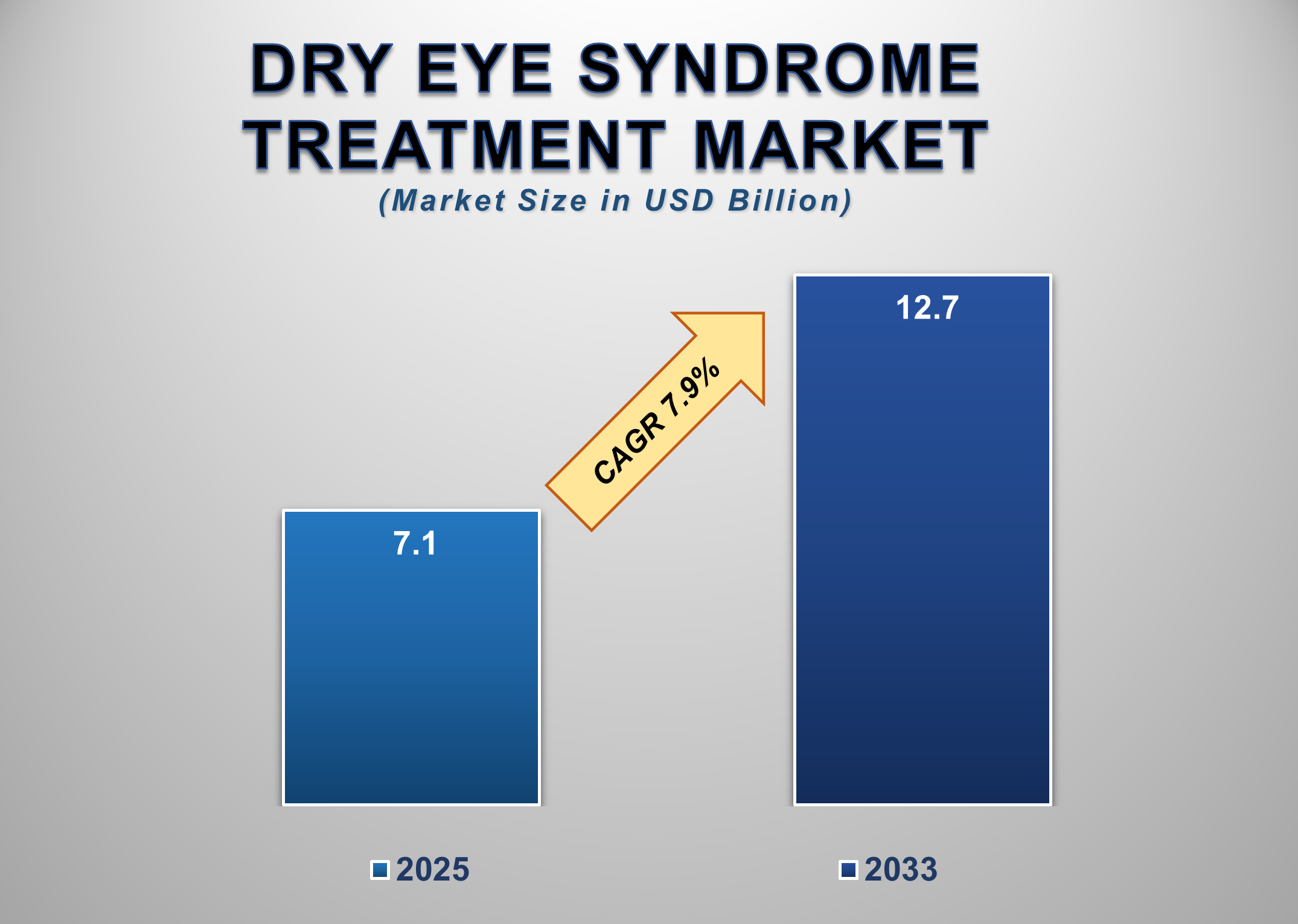
The Global Dry Eye Syndrome Treatment Market is gaining traction due to the increasing incidence of ocular surface diseases and growing awareness about eye health among the aging and digitally active population. Valued at USD 7.1 billion in 2025, the market is projected to expand to USD 12.7 billion by 2033, exhibiting a robust CAGR of 7.9% during the forecast period. Dry eye syndrome, a condition caused by insufficient lubrication or poor-quality tears, affects millions globally and is associated with lifestyle changes, including prolonged exposure to screens, air-conditioned environments, and environmental pollution.
Product innovation, evolving
regulatory frameworks, and the introduction of targeted biologics such as
cyclosporine and lifitegrast are driving market growth. Additionally, the
rising adoption of e-commerce platforms and personalized treatment regimes is
enhancing patient access to specialized therapies. With continuous advancements
in drug delivery platforms and regenerative medicine, the dry eye treatment
landscape is poised for significant expansion across developed and emerging
markets.
Dry Eye Syndrome Treatment Market Drivers and
Opportunities
The
Growing Prevalence of Digital Eye Strain Among All
Age Groups Is Driving the Dry Eye Syndrome Treatment Market Growth
The
widespread use of digital devices such as smartphones, laptops, and tablets has
led to a surge in digital eye strain, a primary contributor to dry eye
syndrome. As screen time increases across all age demographics, especially among working professionals and students, ocular surface disorders have become more prevalent. The
COVID-19 pandemic magnified this trend, with remote working and online learning
accelerating prolonged exposure to screens.
Digital
devices reduce blink rate and increase tear film evaporation, triggering
symptoms such as irritation, burning, and blurred vision. As a result, the
demand for artificial tears, lubricants, and anti-inflammatory medications has
increased substantially. Both over-the-counter (OTC) and prescription
treatments are in high demand, with ophthalmologists now prioritizing early
detection and management to prevent chronic ocular damage. Manufacturers are
focusing on formulating preservative-free products, long-acting gels, and
combination therapies to improve treatment compliance and long-term efficacy.
OTC product lines are expanding to cater to the growing self-care trend among
consumers, fueling segment growth. With continued technological integration and
consumer education, digital eye strain is set to remain a dominant growth
driver in the global dry eye syndrome treatment market.
Rising
Geriatric Population and Age-Associated Ocular Diseases Are Fueling Demand for
Dry Eye Treatments
Aging
is a well-established risk factor for developing dry eye syndrome, with the
condition more prevalent among people aged 50 and above. The global geriatric
population (aged 60 and above) is growing rapidly, particularly in the Asia Pacific, Europe, and North America. Age-related
changes, such as reduced tear secretion,
hormonal fluctuations in postmenopausal women, and increased incidence of
chronic diseases like diabetes, make elderly
individuals more susceptible to severe dry eye symptoms. As longevity
increases, the number of patients seeking medical intervention for ocular
health is expanding. This trend has led to greater demand for
prescription-based treatments, including
cyclosporine, corticosteroids, and novel biologic agents. Moreover,
age-associated comorbidities often require polypharmacy, further exacerbating
ocular surface drying and inflammation.
The
healthcare ecosystem is responding with specialized geriatric eye care
programs, awareness initiatives, and accessible reimbursement frameworks in
countries like Japan, Germany, and the U.S. Innovations in tear film modulators
and sustained-release inserts also align with the needs of elderly patients,
enhancing convenience and adherence. Therefore, the demographic shift toward an
aging population is a major growth catalyst for the market.
Opportunity for the Dry
Eye Syndrome Treatment Market
Advancements in Regenerative and Biologic Therapies Are
Creating High-Value Opportunities in the Global Market
The
emergence of regenerative and biologic therapies presents lucrative
opportunities for players in the dry eye syndrome treatment market. Novel drug
candidates, such as nerve growth factor (NGF) analogs and gene-modulating
formulations, are under development to address the root cause of tear film
dysfunction rather than providing temporary symptomatic relief. These therapies
aim to repair ocular nerve damage, promote corneal healing, and stimulate
natural tear production.
Biologic
agents such as cyclosporine and lifitegrast have already demonstrated success
in reducing inflammation associated with chronic dry eye. Additionally,
innovations in drug delivery systems like nanocarriers, micellar gels, and
dissolvable inserts improve bioavailability and extend the duration of action,
reducing treatment burden. Companies are investing in targeted breastmilk-based
drops, stem cell-derived exosomes, and autologous serum-based formulations,
signaling a shift toward personalized ocular care. Moreover, increasing
clinical trial activity and supportive regulatory pathways, particularly in
regions like the U.S., Japan, and South Korea, are accelerating product
approvals and market entry timelines. As R&D pipelines expand and real-world
evidence supports clinical efficacy, advanced biologics and regenerative
products are expected to transform the treatment landscape over the next
decade.
Dry Eye Syndrome
Treatment Market Scope
|
Report Attributes |
Description |
|
Market Size in 2025 |
USD 7.1 Billion |
|
Market Forecast in 2033 |
USD 12.7 Billion |
|
CAGR % 2025-2033 |
7.9% |
|
Base Year |
2024 |
|
Historic Data |
2020-2024 |
|
Forecast Period |
2025-2033 |
|
Report USP |
Production, Consumption,
Company Share, Company Heatmap, Company Production Capacity, Growth Factors,
and more |
|
Segments Covered |
●
By Product ●
By Distribution
Channel |
|
Regional Scope |
●
North America ●
Europe ●
APAC ●
Latin America ●
Middle East and
Africa |
|
Country Scope |
1)
U.S. 2)
Canada 3)
Germany 4)
UK 5)
France 6)
Spain 7)
Italy 8)
Switzerland 9)
China 10)
Japan 11)
India 12)
Australia 13)
South Korea 14)
Brazil 15)
Mexico 16)
Argentina 17)
South Africa 18)
Saudi Arabia 19)
UAE |
Dry Eye Syndrome
Treatment Market Report Segmentation Analysis
The global Dry Eye Syndrome
Treatment market industry analysis is segmented by product, by distribution
channel, and by region.
The
Anti-Inflammatory Products segment accounted for the
largest market share in the global Dry Eye Syndrome Treatment market
By
Product, the market is segmented into Anti-inflammatory Products, Cyclosporine,
Corticosteroids, Artificial Tears & Lubricants, and Others. The
Anti-inflammatory Products segment accounted for the largest share of the
global dry eye syndrome treatment market in 2025. This dominance is attributed
to the widespread adoption of anti-inflammatory formulations, particularly corticosteroids, cyclosporine ophthalmic
emulsions, and lifitegrast for managing moderate to severe dry eye conditions.
These products address the root cause of inflammation in the ocular surface,
making them preferred options among ophthalmologists for both acute and chronic
cases. Their ability to improve tear quality and reduce corneal damage has
cemented their role in clinical practice. Furthermore, ongoing research into
novel anti-inflammatory mechanisms and drug delivery systems is enhancing
treatment efficacy and safety profiles. The introduction of biodegradable
inserts and nanodispersion-based eye drops reinforces this segment’s strong
growth trajectory.

The Hospital
Pharmacies segment is segmented into Hospital Pharmacies, Retail Pharmacies,
Online Pharmacies, and Others
By
Distribution Channel, the market includes Hospital Pharmacies, Retail
Pharmacies, Online Pharmacies, and Others. The Hospital Pharmacies segment
holds the largest share due to the high volume of prescriptions dispensed
through integrated hospital networks, particularly for immunomodulatory dry eye
treatments that require specialist consultation. The presence of in-house
ophthalmologists and the availability of
advanced diagnostics make hospitals the
preferred settings for treating severe or chronic cases.
The following segments are
part of an in-depth analysis of the global Dry Eye Syndrome Treatment Market:
|
Market
Segments |
|
|
By Product |
●
Anti-inflammatory
Products o
Cyclosporine o
Corticosteroids o
Others ●
Artificial Tears and
Lubricants ●
Others |
|
By
Distribution Channel |
●
Hospital Pharmacies ●
Retail Pharmacies ●
Online Pharmacies ●
Others |
Dry Eye Syndrome Treatment Market Share Analysis
by Region
The
Asia Pacific region is projected to hold the largest
share of the global Dry Eye Syndrome Treatment market over the forecast period
The Asia Pacific (APAC) region is expected to dominate the
global dry eye syndrome treatment market in 2025, accounting for 38.9% of total
revenue. This leadership is attributed to the region’s large aging population,
rising diabetes prevalence, and increased exposure to digital screens among
young adults and working professionals. Countries like Japan, South Korea,
China, and India are experiencing a surge in market penetration due to growing
ophthalmic disease awareness, rising disposable incomes, and the expansion of specialty eye care facilities. The
pharmaceutical landscape in APAC is also benefiting from localized drug
manufacturing, government-backed initiatives for eye care accessibility, and
innovations in biologics and biosimilar eye drops. Strategic partnerships
between global innovators and regional players further support distribution and
regulatory compliance.
Dry Eye Syndrome Treatment Market Competition
Landscape Analysis
The global dry
eye syndrome treatment market is moderately competitive, with the presence of
established players focused on innovating treatment modalities and enhancing
drug delivery methods. Key companies are investing in clinical trials,
strategic partnerships, and regional market expansion to strengthen their
portfolio.
Global Dry Eye Syndrome Treatment Market Recent
Developments News:
- In October 2024, Novaliq and
Laboratoires Théa announced that Vevizye®, a water-free 0.1% ciclosporin
eye drop, received marketing approval from the European Commission for the
treatment of dry eye disease in adults. It is the first and only
formulation of its kind approved in Europe.
- In June 2024, Oculis reported
positive Phase 2b results for licaminlimab, an anti-TNFα eye drop for dry
eye disease. The trial demonstrated significant improvement in DED signs,
particularly in patients with a specific TNFR1 biomarker, showing rapid
reduction in corneal inflammation and a favorable safety profile.
- In May 2024, Nordic Pharma, Inc., launched LACRIFILL® Canalicular Gel,
an FDA-cleared, cross-linked hyaluronic acid gel that temporarily blocks
tear drainage to improve natural tear retention. Administered in-office,
it provides six months of effect, is reimbursed under CPT code 68761, and
was featured at Kiawah Eye 2024 to support adoption by ophthalmic
practices.
The Global Dry Eye Syndrome Treatment Market is
dominated by a few large companies, such as
●
Allergan
●
Novartis
●
Johnson & Johnson
●
Bausch + Lomb
●
Santen Pharmaceutical
●
Sun Pharmaceutical
●
Otsuka Pharmaceutical
●
Regeneron
Pharmaceuticals
●
Aldeyra Therapeutics
●
Kala Pharmaceuticals
●
Novaliq GmbH
●
Sylentis
●
Mitotech
●
HanAll Biopharma
●
Aerie Pharmaceuticals
●
Akorn
●
Thea Pharma
●
Ursapharm
●
Alcon
●
RxSight
● Other Prominent Players
Frequently Asked Questions
Swetal (Research Analyst)
Swetal is a Research Analyst with 4+ years of experience specializing in healthcare market research, medical devices, healthcare IT, and medical technology industry analysis. Her expertise includes competitive intelligence, secondary research, market trend forecasting, and healthcare business insights across global healthcare ecosystems.
She contributes to advanced market research reports by analyzing regulatory frameworks, emerging healthcare technologies, competitive landscapes, and innovation trends shaping the medical industry. With a strong focus on accurate market intelligence, strategic insights, and healthcare industry trends, Swetal supports businesses in making informed, data-backed decisions in a rapidly transforming healthcare environment.
1. Global Dry Eye Syndrome
Treatment Market Introduction and Market Overview
1.1.
Objectives
of the Study
1.2.
Global
Dry Eye Syndrome Treatment Market Scope and Market Estimation
1.2.1.Global Dry Eye Syndrome
Treatment Overall Market Size (US$ Bn), Market CAGR (%), Market forecast (2025
- 2033)
1.2.2.Global Dry Eye Syndrome
Treatment Market Revenue Share (%) and Growth Rate (Y-o-Y) from 2020 - 2033
1.3.
Market
Segmentation
1.3.1.Product of Global Dry Eye
Syndrome Treatment Market
1.3.2.Distribution Channel of
Global Dry Eye Syndrome Treatment Market
1.3.3.Region of Global Dry Eye
Syndrome Treatment Market
2. Executive
Summary
2.1.
Demand
Side Trends
2.2.
Key
Market Trends
2.3.
Market
Demand (US$ Bn) Analysis 2020 – 2024 and Forecast, 2025 – 2033
2.4.
Demand
and Opportunity Assessment
2.5.
Demand
Supply Scenario
2.6.
Market
Dynamics
2.6.1.Drivers
2.6.2.Limitations
2.6.3.Opportunities
2.6.4.Impact Analysis of Drivers
and Restraints
2.7.
Emerging
Trends for Dry Eye Syndrome Treatment Market
2.8.
Porter’s
Five Forces Analysis
2.9.
PEST
Analysis
2.10.
Key
Regulation
3. Global
Dry Eye Syndrome Treatment Market
Estimates & Historical Trend Analysis (2020 - 2024)
4. Global
Dry Eye Syndrome Treatment Market
Estimates & Forecast Trend Analysis, by Product
4.1.
Global
Dry Eye Syndrome Treatment Market Revenue (US$ Bn) Estimates and Forecasts, by Product,
2020 - 2033
4.1.1.Anti-inflammatory Products
4.1.1.1.
Cyclosporine
4.1.1.2.
Corticosteroids
4.1.1.3.
Others
4.1.2.Artificial Tears and
Lubricants
4.1.3.Others
5. Global
Dry Eye Syndrome Treatment Market
Estimates & Forecast Trend Analysis, by Distribution
Channel
5.1.
Global
Dry Eye Syndrome Treatment Market Revenue (US$ Bn) Estimates and Forecasts, by Distribution
Channel, 2020 - 2033
5.1.1.Hospital Pharmacies
5.1.2.Retail Pharmacies
5.1.3.Online Pharmacies
5.1.4.Others
6. Global
Dry Eye Syndrome Treatment Market
Estimates & Forecast Trend Analysis, by Region
6.1.
Global
Dry Eye Syndrome Treatment Market Revenue (US$ Bn) Estimates and Forecasts, by Region,
2020 - 2033
6.1.1.North America
6.1.2.Europe
6.1.3.Asia Pacific
6.1.4.Middle East & Africa
6.1.5.Latin America
7. North America Dry
Eye Syndrome Treatment Market:
Estimates & Forecast Trend Analysis
7.1.
North
America Dry Eye Syndrome Treatment Market Assessments & Key Findings
7.1.1.North America Dry Eye
Syndrome Treatment Market Introduction
7.1.2.North America Dry Eye
Syndrome Treatment Market Size Estimates and Forecast (US$ Billion) (2020 - 2033)
7.1.2.1. By Product
7.1.2.2. By Distribution
Channel
7.1.2.3.
By
Country
7.1.2.3.1. The U.S.
7.1.2.3.2. Canada
8. Europe Dry
Eye Syndrome Treatment Market:
Estimates & Forecast Trend Analysis
8.1.
Europe
Dry Eye Syndrome Treatment Market Assessments & Key Findings
8.1.1.Europe Dry Eye Syndrome
Treatment Market Introduction
8.1.2.Europe Dry Eye Syndrome
Treatment Market Size Estimates and Forecast (US$ Billion) (2020 - 2033)
8.1.2.1. By Product
8.1.2.2. By Distribution
Channel
8.1.2.3.
By
Country
8.1.2.3.1.
Germany
8.1.2.3.2.
Italy
8.1.2.3.3.
U.K.
8.1.2.3.4.
France
8.1.2.3.5.
Spain
8.1.2.3.6.
Switzerland
8.1.2.3.7. Rest
of Europe
9. Asia Pacific Dry
Eye Syndrome Treatment Market:
Estimates & Forecast Trend Analysis
9.1.
Asia
Pacific Market Assessments & Key Findings
9.1.1.Asia Pacific Dry Eye
Syndrome Treatment Market Introduction
9.1.2.Asia Pacific Dry Eye
Syndrome Treatment Market Size Estimates and Forecast (US$ Billion) (2020 - 2033)
9.1.2.1. By Product
9.1.2.2. By Distribution
Channel
9.1.2.3.
By
Country
9.1.2.3.1.
China
9.1.2.3.2.
Japan
9.1.2.3.3.
India
9.1.2.3.4.
Australia
9.1.2.3.5.
South
Korea
9.1.2.3.6. Rest of Asia Pacific
10. Middle East & Africa Dry
Eye Syndrome Treatment Market:
Estimates & Forecast Trend Analysis
10.1.
Middle
East & Africa Market Assessments & Key Findings
10.1.1.
Middle East & Africa Dry Eye Syndrome Treatment Market
Introduction
10.1.2.
Middle East & Africa Dry Eye Syndrome Treatment Market
Size Estimates and Forecast (US$ Billion) (2020 - 2033)
10.1.2.1. By Product
10.1.2.2. By Distribution
Channel
10.1.2.3.
By
Country
10.1.2.3.1. UAE
10.1.2.3.2. Saudi
Arabia
10.1.2.3.3. South
Africa
10.1.2.3.4. Rest
of MEA
11. Latin America
Dry Eye Syndrome Treatment Market:
Estimates & Forecast Trend Analysis
11.1.
Latin
America Market Assessments & Key Findings
11.1.1.
Latin
America Dry Eye Syndrome Treatment Market Introduction
11.1.2.
Latin
America Dry Eye Syndrome Treatment Market Size Estimates and Forecast (US$ Billion)
(2020 - 2033)
11.1.2.1. By Product
11.1.2.2. By Distribution
Channel
11.1.2.3.
By
Country
11.1.2.3.1. Brazil
11.1.2.3.2. Argentina
11.1.2.3.3. Mexico
11.1.2.3.4. Rest
of LATAM
12. Country Wise Market:
Introduction
13.
Competition
Landscape
13.1.
Global
Dry Eye Syndrome Treatment Market Product Mapping
13.2.
Global
Dry Eye Syndrome Treatment Market Concentration Analysis, by Leading Players /
Innovators / Emerging Players / New Entrants
13.3.
Global
Dry Eye Syndrome Treatment Market Tier Structure Analysis
13.4.
Global
Dry Eye Syndrome Treatment Market Concentration & Company Market Shares (%)
Analysis, 2024
14.
Company
Profiles
14.1.
Allergan
14.1.1.
Company
Overview & Key Stats
14.1.2.
Financial
Performance & KPIs
14.1.3.
Product
Portfolio
14.1.4.
SWOT
Analysis
14.1.5.
Business
Strategy & Recent Developments
* Similar details would be provided for all the players
mentioned below
14.2. Novartis
14.3. Johnson
& Johnson
14.4. Bausch +
Lomb
14.5. Santen
Pharmaceutical
14.6. Sun
Pharmaceutical
14.7. Otsuka
Pharmaceutical
14.8. Regeneron
Pharmaceuticals
14.9. Aldeyra
Therapeutics
14.10. Kala
Pharmaceuticals
14.11. Novaliq
GmbH
14.12. Sylentis
14.13. Mitotech
14.14. HanAll
Biopharma
14.15. Aerie
Pharmaceuticals
14.16. Akorn
14.17. Thea
Pharma
14.18. Ursapharm
14.19. Alcon
14.20. RxSight
14.21. Others
15. Research
Methodology
15.1.
External
Transportations / Databases
15.2.
Internal
Proprietary Database
15.3.
Primary
Research
15.4.
Secondary
Research
15.5.
Assumptions
15.6.
Limitations
15.7.
Report
FAQs
16. Research
Findings & Conclusion
Our Research Methodology
"Insight without rigor is just noise."
We follow a comprehensive, multi-phase research framework designed to deliver accurate, strategic, and decision-ready intelligence. Our process integrates primary and secondary research , both quantitative and qualitative , along with dual modeling techniques ( top-down and bottom-up) and a final layer of validation through our proprietary in-house repository.
PRIMARY RESEARCH
Primary research captures real-time, firsthand insights from the market to understand behaviors, motivations, and emerging trends.
1. Quantitative Primary Research
Objective: Generate statistically significant data directly from market participants.
Approaches:- Structured surveys with customers, distributors, and field agents
- Mobile-based data collection for point-of-sale audits and usage behavior
- Phone-based interviews (CATI) for market sizing and product feedback
- Online polling around industry events and digital campaigns
- Purchase frequency by customer type
- Channel performance across geographies
- Feature demand by application or demographic
2. Qualitative Primary Research
Objective: Explore decision-making drivers, pain points, and market readiness.
Approaches:- In-depth interviews (IDIs) with executives, product managers, and key decision-makers
- Focus groups among end users and early adopters
- Site visits and observational research for consumer products
- Informal field-level discussions for regional and cultural nuances
SECONDARY RESEARCH
This phase helps establish a macro-to-micro understanding of market trends, size, regulation, and competitive dynamics, sourced from credible and public domain information.
1. Quantitative Secondary Research
Objective: Model market value and segment-level forecasts based on published data.
Sources include:- Financial reports and investor summaries
- Government trade data, customs records, and regulatory statistics
- Industry association publications and economic databases
- Channel performance and pricing data from marketplace listings
- Revenue splits, pricing trends, and CAGR estimates
- Supply-side capacity and volume tracking
- Investment analysis and funding benchmarks
2. Qualitative Secondary Research
Objective: Capture strategic direction, innovation signals, and behavioral trends.
Sources include:- Company announcements, roadmaps, and product pipelines
- Publicly available whitepapers, conference abstracts, and academic research
- Regulatory body publications and policy briefs
- Social and media sentiment scanning for early-stage shifts
- Strategic shifts in market positioning
- Unmet needs and white spaces
- Regulatory triggers and compliance impact
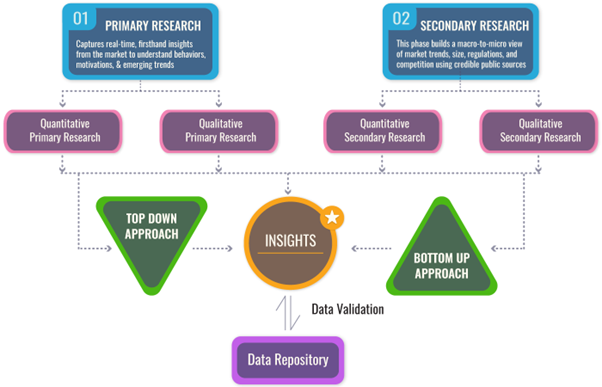
DUAL MODELING: TOP-DOWN + BOTTOM-UP
To ensure robust market estimation, we apply two complementary sizing approaches:
Top-Down Modeling:- Start with broader industry value (e.g., global or regional TAM)
- Apply filters by segment, geography, end-user, or use case
- Adjust with primary insights and validation benchmarks
- Ideal for investor-grade market scans and opportunity mapping
- Aggregate from the ground up using sales volumes, pricing, and unit economics
- Use internal modeling templates aligned with stakeholder data
- Incorporate distributor-level or region-specific inputs
- Most accurate for emerging segments and granular sub-markets
DATA VALIDATION: IN-HOUSE REPOSITORY
We close the loop with proprietary data intelligence built from ongoing projects, industry monitoring, and historical benchmarking. This repository includes:
- Multi-sector market and pricing models
- Key trendlines from past interviews and forecasts
- Benchmarked adoption rates, churn patterns, and ROI indicators
- Industry-specific deviation flags and cross-check logic
- Catches inconsistencies early
- Aligns projections across studies
- Enables consistent, high-trust deliverables