

eClinical Solutions Market Size and Forecast (2020 - 2033), Global and Regional Growth, Trend, Share, and Industry Analysis Report Coverage: By Product (Electronic Data Capture (EDC) & Clinical Data Management Systems (CDMS), Clinical Trial Management Systems (CTMS), Clinical Analytics Platforms, Randomization and Trial Supply Management (RTSM), Electronic Clinical Outcome Assessment (eCOA), Safety Solutions, and Others), By Delivery Mode (Web-hosted, Licensed Enterprise, Cloud-based), By End-User (Pharmaceutical & Biotech Companies, Contract Research Organizations (CROs), Medical Device Manufacturers, and Others) And Geography
2025-12-03
Healthcare
Swetal (Research Analyst)
Description
eClinical Solutions Market Overview
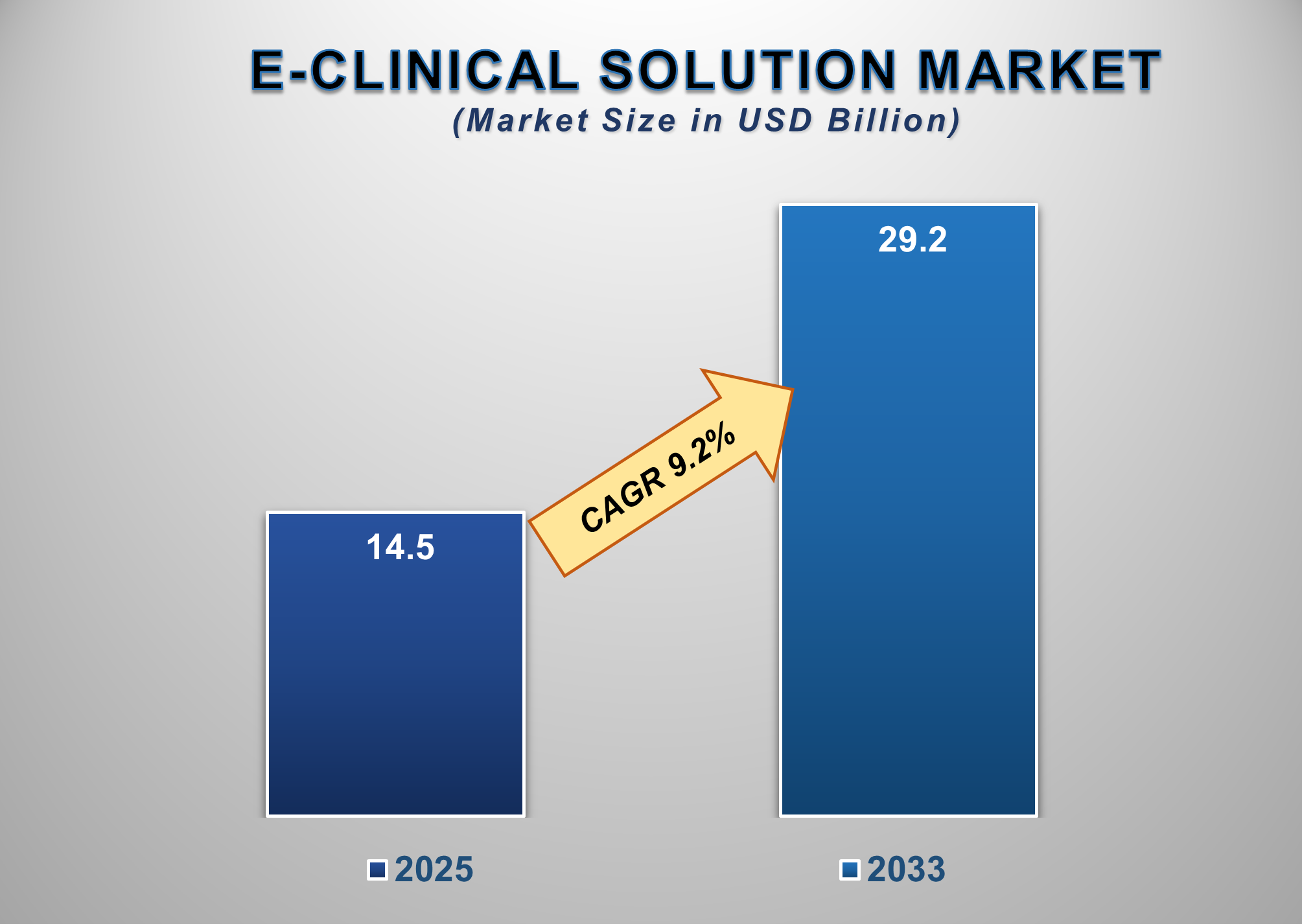
The eClinical Solutions Market is positioned for a period of dynamic and technologically driven growth from 2025 to 2033, fueled by the increasing complexity of clinical trials, a strong pipeline of new therapies, the global shift towards decentralized trials, and the imperative for greater efficiency and data quality in drug development. The market is projected to be valued at approximately USD 14.5 billion in 2025 and is forecasted to reach nearly USD 29.2 billion by 2033, exhibiting a compound annual growth rate (CAGR) of 9.2% during this period.
eClinical solutions encompass a suite of
software technologies used to plan, manage, collect, and analyze data in clinical trials. This includes systems for data
capture (EDC), trial management (CTMS), patient-reported outcomes (eCOA), and
randomization (RTSM), among others. The market's significant expansion is
primarily driven by the pharmaceutical and biotechnology industry's relentless
pursuit of R&D efficiency and faster time-to-market for new drugs.
The adoption of novel trial designs, such as
decentralized clinical trials (DCTs), which rely heavily on digital tools, is a
major growth catalyst. Furthermore, stringent regulatory requirements for data
integrity and the growing volume of complex data from novel therapies are
compelling sponsors and CROs to invest in integrated and advanced eClinical
platforms. North America currently holds the largest market share due to its
high concentration of pharmaceutical companies and early technology adoption,
while the Asia-Pacific region is expected to witness the fastest growth, driven
by increasing clinical trial activity and cost advantages.
eClinical Solutions Market Drivers and Opportunities
The Rising Complexity of Clinical Trials and
the Imperative for R&D Efficiency is the Primary Market Driver
The increasing complexity of clinical trials,
driven by novel therapies (e.g., cell & gene, targeted oncology), adaptive
trial designs, and the need for real-world evidence, is the most powerful force
propelling the eClinical solutions market. Traditional paper-based methods are
incapable of handling the vast, diverse, and complex data generated by modern
trials. eClinical solutions streamline the entire trial lifecycle, from site
selection and patient recruitment to data collection, cleaning, and regulatory
submission. By automating workflows and providing centralized, real-time data
access, these systems significantly reduce trial cycle times, minimize errors,
and lower overall costs. In an industry where delays can cost millions per day,
the efficiency gains offered by integrated eClinical platforms are not just an
advantage but a necessity for maintaining a competitive R&D pipeline.
The global pharmaceutical R&D spending
continues to grow, underscoring the scale of the clinical trials ecosystem. In
2024, global R&D spending is estimated to have exceeded US$250 billion,
with thousands of clinical trials active worldwide. The pipeline of new drugs
is increasingly complex, with a significant portion focused on precision
medicine and biologics, which require more sophisticated data management. This
data highlights the immense operational challenge and the corresponding
opportunity for eClinical solutions to bring order and efficiency to a highly
complex and costly process.
The Paradigm Shift Towards Decentralized
Clinical Trials (DCTs) is Driving Strategic Adoption
The accelerated adoption of decentralized and
hybrid clinical trial models is a powerful catalyst for the eClinical solutions
market. The COVID-19 pandemic acted as a forcing function, demonstrating the
viability of using digital tools to conduct trial activities remotely. DCTs
leverage technologies like eCOA, eConsent, and telehealth to engage patients in
their homes, reducing the burden of site visits and expanding the potential
patient pool. eClinical solutions form the digital backbone of DCTs, enabling
the seamless integration of data from various sources, including wearables and
mobile apps, into the main clinical database. This shift not only enhances
patient centricity and recruitment/retention rates but also improves data
quality through more frequent and real-world data collection. Investing in a flexible and integrated eClinical suite is a strategic priority for sponsors and CROs.
The Integration of Advanced Analytics and the
Push for Interoperability Present Significant Opportunities
The strategic integration of advanced
technologies and the move towards unified platforms are creating significant
growth frontiers for the eClinical solutions market. Key opportunities lie in
the application of Artificial Intelligence (AI) and Machine Learning (ML) to
clinical data. AI-powered tools can automate data cleaning, identify potential
site or patient issues proactively, and even predict clinical outcomes, thereby
enhancing trial quality and speed. Furthermore, there is a strong market push for
interoperable platforms that can break down data silos between different
eClinical systems (e.g., EDC, CTMS, eCOA). For solution providers, investing in
AI-driven analytics modules, developing flexible cloud-native platforms that
can easily integrate with other systems, and offering comprehensive suites that
cover the entire trial continuum are key strategies to capture market share and
deliver greater value to clients.
eClinical Solutions
Market Scope
|
Report Attributes |
Description |
|
Market Size in 2025 |
USD 14.5 Billion |
|
Market Forecast in 2033 |
USD 29.2 Billion |
|
CAGR % 2025-2033 |
9.2% |
|
Base Year |
2024 |
|
Historic Data |
2020-2024 |
|
Forecast Period |
2025-2033 |
|
Report USP |
Product Portfolio,
Technological Analysis, Company Market Share, Company Heatmap, Pricing
Analysis, Growth Factors, and more |
|
Segments Covered |
●
By Product ●
By Delivery Mode ●
By End-user |
|
Regional Scope |
●
North America, ●
Europe, ●
APAC, ●
Latin America ●
Middle East and
Africa |
|
Country Scope |
1)
U.S. 2)
Canada 3)
Germany 4)
UK 5)
France 6)
Spain 7)
Italy 8)
Switzerland 9)
China 10)
Japan 11)
India 12)
Australia 13)
South Korea 14)
Brazil 15)
Mexico 16)
Argentina 17)
South Africa 18)
Saudi Arabia 19)
UAE |
eClinical Solutions
Market Report Segmentation Analysis
The global eClinical Solutions
Market industry analysis is segmented by Product, by Delivery Mode, by
End-User, and by Region.
The Electronic Data Capture (EDC) & CDMS
segment is anticipated to command a significant market share in 2025
The Product segment is categorised into EDC &
CDMS, CTMS, Clinical Analytics Platforms, RTSM, eCOA, Safety Solutions, and
Others. The EDC & CDMS segment holds a substantial and foundational share
of the market, as it represents the core system for collecting,
validating, and managing clinical trial data. The shift from paper Case Report
Forms (CRFs) to EDC has been largely completed in developed regions and is
accelerating globally. The critical importance of high-quality, audit-ready
data for regulatory submissions makes EDC/CDMS an indispensable and
non-negotiable component of virtually every clinical trial. Continuous
innovations, such as user-friendly interfaces, built-in compliance checks, and
integration capabilities with other systems, ensure that this segment remains
the cornerstone of the eClinical ecosystem.
The Cloud-based Delivery Mode segment is
projected to grow at a significant CAGR.
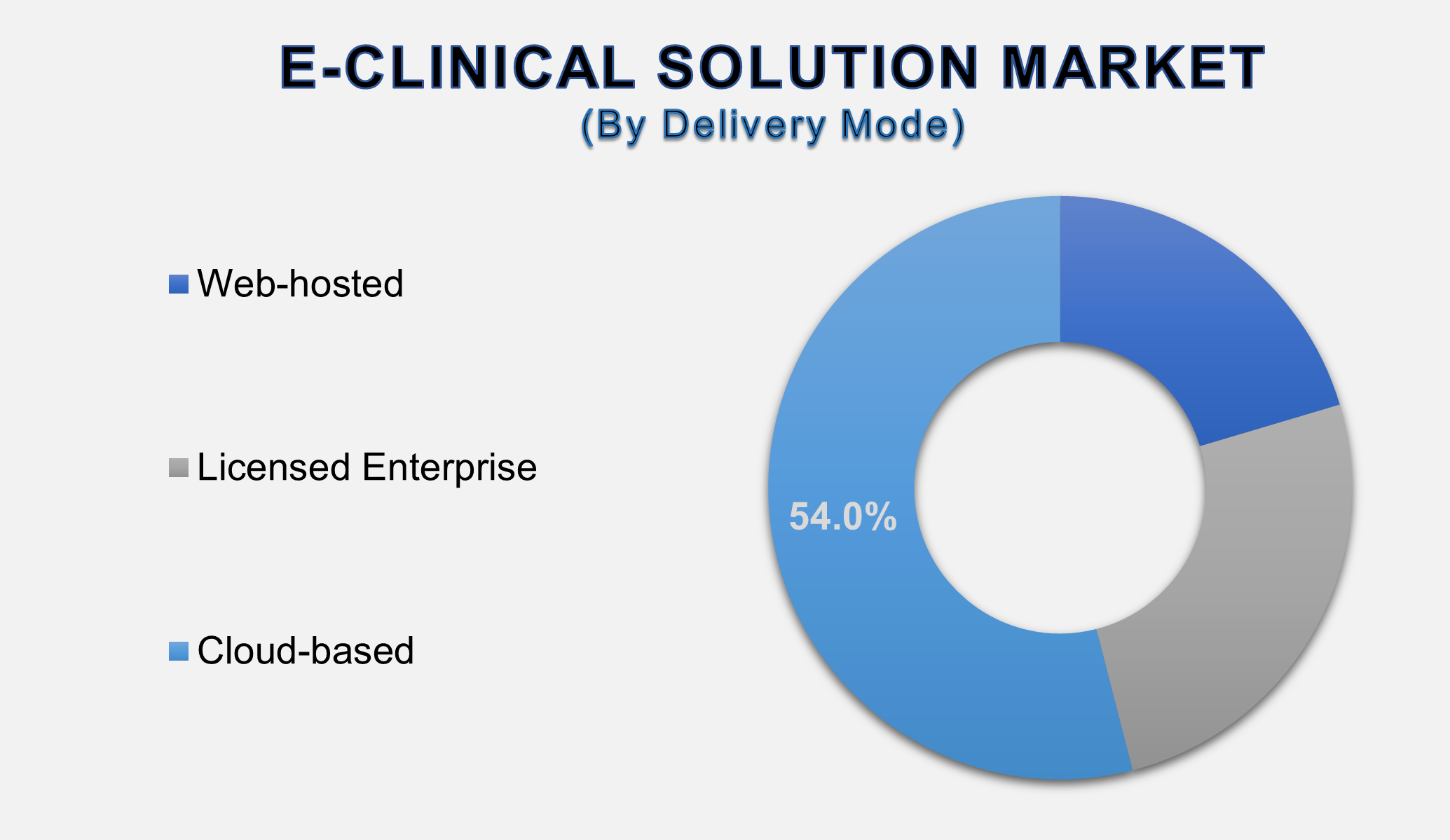
The Delivery Mode segment includes Web-hosted,
Licensed Enterprise, and Cloud-based. The Cloud-based segment's projected
significant growth is driven by its superior scalability, flexibility, and
cost-effectiveness compared to on-premise licensed models. Cloud-based
eClinical solutions eliminate the need for expensive IT infrastructure and
maintenance, allowing even small biotech firms to access enterprise-level
technology. They enable real-time collaboration between globally dispersed
teams and sites, which is crucial for modern trials. The inherent agility of
the cloud also supports the rapid deployment and scaling required for
decentralized trial components. With robust security measures now standard, the
cloud-based SaaS (Software-as-a-Service) model is becoming the preferred
delivery mode for its operational and economic advantages.
The Contract Research Organizations (CROs) end-user
segment is projected to witness the highest growth rate.
The End-User segment is divided into
Pharmaceutical & Biotech Companies, Contract Research Organizations (CROs),
Medical Device Manufacturers, and Others. The CRO segment's position as the
fastest-growing channel is a direct result of the increasing outsourcing of
clinical trial activities by pharmaceutical sponsors. To manage multiple trials
for various clients efficiently and profitably, CROs are heavily investing in
integrated and scalable eClinical platforms that can standardize processes and
improve operational visibility. The competitive landscape among CROs also
drives technology adoption, as the ability to offer sophisticated,
technology-enabled trial execution becomes a key differentiator for winning
contracts. This makes CROs a primary and rapidly expanding customer base for
eClinical solution providers.
The following segments are part of an in-depth analysis of
the global eClinical Solutions Market:
|
Market
Segments |
|
|
By Product |
●
Electronic Data
Capture (EDC) & (CDMS) ●
Clinical Trial
Management Systems (CTMS) ●
Clinical Analytics
Platforms ●
Randomization and
Trial Supply Management (RTSM) ●
Electronic Clinical
Outcome Assessment (eCOA) ●
Safety Solutions ●
Others |
|
By Service |
●
Web-hosted ●
Licensed Enterprise ●
Cloud-based |
|
By End-user |
●
Pharmaceutical &
Biotech Companies ●
Contract Research
Organizations (CROs) ●
Medical Device
Manufacturers ●
Others |
eClinical Solutions
Market Share Analysis by Region
The North America region
is anticipated to hold the largest portion of the eClinical Solutions Market
globally throughout the forecast period.
North America's dominance is attributed to the
presence of a large number of global pharmaceutical and biotechnology
companies, a highly developed healthcare IT infrastructure, and stringent
regulatory standards from the U.S. FDA that encourage digital data submission.
The region is also an early adopter of advanced clinical technologies,
including decentralized trial models and AI-enabled platforms. High R&D
expenditure and a strong presence of leading eClinical solution vendors create
a mature and competitive market, solidifying North America's leading position.
The United States, in particular, is the world's
largest single market for eClinical solutions. The country's robust clinical
trial activity, favorable government initiatives promoting innovation in drug
development, and the high concentration of top-tier CROs and academic research
centers drive continuous demand for advanced and integrated eClinical software.
Major technological advancements and product launches are often first pioneered
in the U.S. market.
eClinical Solutions
Market Competition Landscape Analysis
The global eClinical solutions
market is competitive and features a mix of large, diversified software
companies, specialized best-of-breed providers, and CROs with proprietary
technology platforms. Competition is intensifying and centers on technological
innovation, product integration, regulatory compliance, and global customer
support. Key strategies include heavy investment in R&D for AI and
analytics capabilities, strategic acquisitions to broaden product portfolios,
and a focus on developing unified platforms to offer a seamless user
experience. Partnerships between technology providers and pharmaceutical
companies to co-develop solutions are also common.
Global eClinical
Solutions Market Recent Developments News:
- In February 2025, Medidata Solutions (a Dassault
Systèmes company) launched a new AI-powered module for its clinical cloud
designed to predict patient dropout risk in real-time, allowing for
proactive intervention.
- In December 2024, Veeva Systems announced a
strategic partnership with a global top-10 pharmaceutical company to
implement its unified Veeva Vault Clinical Suite across all its
development programs.
- In October 2024, IQVIA Holdings Inc. reported
strong growth in its technology solutions segment, driven by increased
adoption of its decentralized trial tools and AI-driven trial design
software.
- In August 2024, BioClinica (a subsidiary of LabCorp) received
regulatory clearance for its updated eCOA platform, which includes
enhanced language localization features for global trials.
The Global EClinical Solutions Market Is Dominated by a Few
Large Companies, such as
●
IQVIA Holdings Inc.
●
Medidata Solutions
●
Veeva Systems
●
Oracle Corporation
●
Bio-Optronics
●
Bioclinica (A LabCorp
Company)
●
Parexel International
Corporation (MAAS)
●
ERT (A Clario Company)
●
Datatrak
International, Inc.
●
ArisGlobal LLC
●
CRF Health
●
Signant Health
●
Castor
●
YPrime, LLC
●
Clinical Ink
● Other Prominent Players
Frequently Asked Questions
Swetal (Research Analyst)
Swetal is a Research Analyst with 4+ years of experience specializing in healthcare market research, medical devices, healthcare IT, and medical technology industry analysis. Her expertise includes competitive intelligence, secondary research, market trend forecasting, and healthcare business insights across global healthcare ecosystems.
She contributes to advanced market research reports by analyzing regulatory frameworks, emerging healthcare technologies, competitive landscapes, and innovation trends shaping the medical industry. With a strong focus on accurate market intelligence, strategic insights, and healthcare industry trends, Swetal supports businesses in making informed, data-backed decisions in a rapidly transforming healthcare environment.
1. Global E-Clinical
solutions Market Introduction and Market Overview
1.1.
Objectives
of the Study
1.2.
Global
E-Clinical solutions Market Scope and Market Estimation
1.2.1.Global Electronic Toll
Collection Overall Market Size (US$ Bn), Market CAGR (%), Market forecast (2025
- 2033)
1.2.2.Global E-Clinical
solutions Market Revenue Share (%) and Growth Rate (Y-o-Y) from 2020 - 2033
1.3.
Market
Segmentation
1.3.1.Product Type of Global E-Clinical
solutions Market
1.3.2.Delivery Mode of Global E-Clinical
solutions Market
1.3.3.End-user of Global E-Clinical
solutions Market
1.3.4.Region of Global E-Clinical
solutions Market
2.
Executive Summary
2.1.
Demand
Side Trends
2.2.
Key
Market Trends
2.3.
Market
Demand (US$ Bn) Analysis 2020 – 2024 and forecast, 2025 – 2033
2.4.
Demand
and Opportunity Assessment
2.5.
Key
Developments
2.6.
Market
Entry Strategies
2.7.
Market
Dynamics
2.7.1.Drivers
2.7.2.Limitations
2.7.3.Opportunities
2.7.4.Impact Analysis of Drivers
and Restraints
2.8.
Porter’s
Five Forces Analysis
2.9.
PEST
Analysis
3. Global
E-Clinical solutions Market Estimates
& Historical Trend Analysis (2020 - 2024)
4. Global
E-Clinical solutions Market Estimates
& Forecast Trend Analysis, by Product Type
4.1.
Global
E-Clinical solutions Market Revenue (US$ Bn) Estimates and Forecasts, by Product
Type, 2020 - 2033
4.1.1.Repairs & Returns
4.1.2.Commercial Returns
4.1.3.End-of-Life Returns
4.1.4.Recalls
5. Global
E-Clinical solutions Market Estimates
& Forecast Trend Analysis, by Delivery Mode
5.1.
Global
E-Clinical solutions Market Revenue (US$ Bn) Estimates and Forecasts, by Delivery
Mode, 2020 - 2033
5.1.1.Returns Management
5.1.2.Refurbishment
5.1.3.Remanufacturing
5.1.4.Packaging
5.1.5.Others
6. Global
E-Clinical solutions Market Estimates
& Forecast Trend Analysis, by End-user
6.1.
Global
E-Clinical solutions Market Revenue (US$ Bn) Estimates and Forecasts, by End-user
2020 - 2033
6.1.1.E-commerce
6.1.2.Automotive
6.1.3.Pharmaceutical
6.1.4.Consumer Electronics
6.1.5.Retail
6.1.6.Others
7. Global
E-Clinical solutions Market Estimates
& Forecast Trend Analysis, by region
7.1.
Global
E-Clinical solutions Market Revenue (US$ Bn) Estimates and Forecasts, by region,
2020 - 2033
7.1.1.North America
7.1.2.Europe
7.1.3.Asia Pacific
7.1.4.Middle East & Africa
7.1.5.Latin America
8. North America E-Clinical
solutions Market: Estimates &
Forecast Trend Analysis
8.1. North America E-Clinical
solutions Market Assessments & Key Findings
8.1.1.North America E-Clinical
solutions Market Introduction
8.1.2.North America E-Clinical
solutions Market Size Estimates and Forecast (US$ Billion) (2020 - 2033)
8.1.2.1.
By Product Type
8.1.2.2.
By Delivery Mode
8.1.2.3.
By End-user
8.1.2.4. By Country
8.1.2.4.1. The U.S.
8.1.2.4.2. Canada
9. Europe E-Clinical
solutions Market: Estimates &
Forecast Trend Analysis
9.1. Europe E-Clinical
solutions Market Assessments & Key Findings
9.1.1.Europe E-Clinical
solutions Market Introduction
9.1.2.Europe E-Clinical
solutions Market Size Estimates and Forecast (US$ Billion) (2020 - 2033)
9.1.2.1.
By Product Type
9.1.2.2.
By Delivery Mode
9.1.2.3.
By End-user
9.1.2.4. By Country
9.1.2.4.1.
Germany
9.1.2.4.2.
Italy
9.1.2.4.3.
U.K.
9.1.2.4.4.
France
9.1.2.4.5.
Spain
9.1.2.4.6.
Switzerland
9.1.2.4.7. Rest
of Europe
10. Asia Pacific E-Clinical
solutions Market: Estimates &
Forecast Trend Analysis
10.1. Asia Pacific Market
Assessments & Key Findings
10.1.1.
Asia
Pacific E-Clinical solutions Market Introduction
10.1.2.
Asia
Pacific E-Clinical solutions Market Size Estimates and Forecast (US$ Billion) (2020
- 2033)
10.1.2.1.
By Product Type
10.1.2.2.
By Delivery Mode
10.1.2.3.
By End-user
10.1.2.4. By Country
10.1.2.4.1. China
10.1.2.4.2. Japan
10.1.2.4.3. India
10.1.2.4.4. Australia
10.1.2.4.5. South Korea
10.1.2.4.6. Rest of Asia Pacific
11. Middle East & Africa E-Clinical
solutions Market: Estimates &
Forecast Trend Analysis
11.1. Middle East & Africa
Market Assessments & Key Findings
11.1.1. Middle
East & Africa
E-Clinical solutions Market Introduction
11.1.2. Middle
East & Africa
E-Clinical solutions Market Size Estimates and Forecast (US$ Billion) (2020 - 2033)
11.1.2.1.
By Product Type
11.1.2.2.
By Delivery Mode
11.1.2.3.
By End-user
11.1.2.4. By Country
11.1.2.4.1. UAE
11.1.2.4.2. Saudi
Arabia
11.1.2.4.3. South
Africa
11.1.2.4.4. Rest
of MEA
12. Latin America
E-Clinical solutions Market: Estimates
& Forecast Trend Analysis
12.1. Latin America Market
Assessments & Key Findings
12.1.1. Latin America E-Clinical
solutions Market Introduction
12.1.2. Latin America E-Clinical
solutions Market Size Estimates and Forecast (US$ Billion) (2020 - 2033)
12.1.2.1.
By Product Type
12.1.2.2.
By Delivery Mode
12.1.2.3.
By End-user
12.1.2.4. By Country
12.1.2.4.1. Brazil
12.1.2.4.2. Argentina
12.1.2.4.3. Mexico
12.1.2.4.4. Rest
of LATAM
13.
Country
Wise Market: Introduction
14.
Competition
Landscape
14.1. Global E-Clinical
solutions Market Product Mapping
14.2. Global E-Clinical
solutions Market Concentration Analysis, by Leading Players / Innovators /
Emerging Players / New Entrants
14.3. Global E-Clinical
solutions Market Tier Structure Analysis
14.4. Global E-Clinical
solutions Market Concentration & Company Market Shares (%) Analysis, 2024
15.
Company
Profiles
15.1.
IQVIA Holdings Inc.
15.1.1.
Company
Overview & Key Stats
15.1.2.
Financial
Performance & KPIs
15.1.3.
Product
Portfolio
15.1.4.
SWOT
Analysis
15.1.5.
Business
Strategy & Recent Developments
* Similar details would be provided for all the players
mentioned below
15.2.
Medidata Solutions
15.3.
Veeva Systems
15.4.
Oracle Corporation
15.5.
Bio-Optronics
15.6.
Bioclinica (A LabCorp Company)
15.7.
Parexel International Corporation (MAAS)
15.8.
ERT (A Clario Company)
15.9.
Datatrak International, Inc.
15.10.
ArisGlobal LLC
15.11.
CRF Health
15.12.
Signant Health
15.13.
Castor
15.14.
YPrime, LLC
15.15.
Clinical Ink
15.16.
Other Prominent Players
16. Research
Methodology
16.1. External Transportations /
Databases
16.2. Internal Proprietary
Database
16.3. Primary Research
16.4. Secondary Research
16.5. Assumptions
16.6. Limitations
16.7. Report FAQs
17. Research
Findings & Conclusion
Our Research Methodology
"Insight without rigor is just noise."
We follow a comprehensive, multi-phase research framework designed to deliver accurate, strategic, and decision-ready intelligence. Our process integrates primary and secondary research , both quantitative and qualitative , along with dual modeling techniques ( top-down and bottom-up) and a final layer of validation through our proprietary in-house repository.
PRIMARY RESEARCH
Primary research captures real-time, firsthand insights from the market to understand behaviors, motivations, and emerging trends.
1. Quantitative Primary Research
Objective: Generate statistically significant data directly from market participants.
Approaches:- Structured surveys with customers, distributors, and field agents
- Mobile-based data collection for point-of-sale audits and usage behavior
- Phone-based interviews (CATI) for market sizing and product feedback
- Online polling around industry events and digital campaigns
- Purchase frequency by customer type
- Channel performance across geographies
- Feature demand by application or demographic
2. Qualitative Primary Research
Objective: Explore decision-making drivers, pain points, and market readiness.
Approaches:- In-depth interviews (IDIs) with executives, product managers, and key decision-makers
- Focus groups among end users and early adopters
- Site visits and observational research for consumer products
- Informal field-level discussions for regional and cultural nuances
SECONDARY RESEARCH
This phase helps establish a macro-to-micro understanding of market trends, size, regulation, and competitive dynamics, sourced from credible and public domain information.
1. Quantitative Secondary Research
Objective: Model market value and segment-level forecasts based on published data.
Sources include:- Financial reports and investor summaries
- Government trade data, customs records, and regulatory statistics
- Industry association publications and economic databases
- Channel performance and pricing data from marketplace listings
- Revenue splits, pricing trends, and CAGR estimates
- Supply-side capacity and volume tracking
- Investment analysis and funding benchmarks
2. Qualitative Secondary Research
Objective: Capture strategic direction, innovation signals, and behavioral trends.
Sources include:- Company announcements, roadmaps, and product pipelines
- Publicly available whitepapers, conference abstracts, and academic research
- Regulatory body publications and policy briefs
- Social and media sentiment scanning for early-stage shifts
- Strategic shifts in market positioning
- Unmet needs and white spaces
- Regulatory triggers and compliance impact
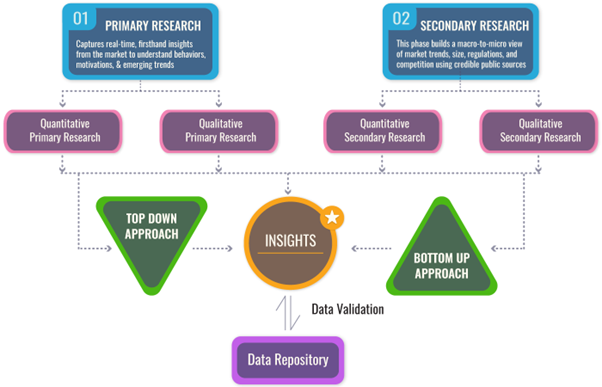
DUAL MODELING: TOP-DOWN + BOTTOM-UP
To ensure robust market estimation, we apply two complementary sizing approaches:
Top-Down Modeling:- Start with broader industry value (e.g., global or regional TAM)
- Apply filters by segment, geography, end-user, or use case
- Adjust with primary insights and validation benchmarks
- Ideal for investor-grade market scans and opportunity mapping
- Aggregate from the ground up using sales volumes, pricing, and unit economics
- Use internal modeling templates aligned with stakeholder data
- Incorporate distributor-level or region-specific inputs
- Most accurate for emerging segments and granular sub-markets
DATA VALIDATION: IN-HOUSE REPOSITORY
We close the loop with proprietary data intelligence built from ongoing projects, industry monitoring, and historical benchmarking. This repository includes:
- Multi-sector market and pricing models
- Key trendlines from past interviews and forecasts
- Benchmarked adoption rates, churn patterns, and ROI indicators
- Industry-specific deviation flags and cross-check logic
- Catches inconsistencies early
- Aligns projections across studies
- Enables consistent, high-trust deliverables