

Electronic Cigarette Market Size and Forecast (2020 - 2033), Global and Regional Growth, Trend, Share, and Industry Analysis Report Coverage: By Product (Modular, Rechargeable, Disposable), By Distribution Channel (Online, Retail [Specialty E-Cig Stores, Supermarkets/Hypermarkets, Convenience Stores]), By Battery Mode (Automatic, Manual), And Geography
2025-11-28
Consumer Products
Jaya Bundele (Research Analyst)
Description
Electronic Cigarette Market Overview
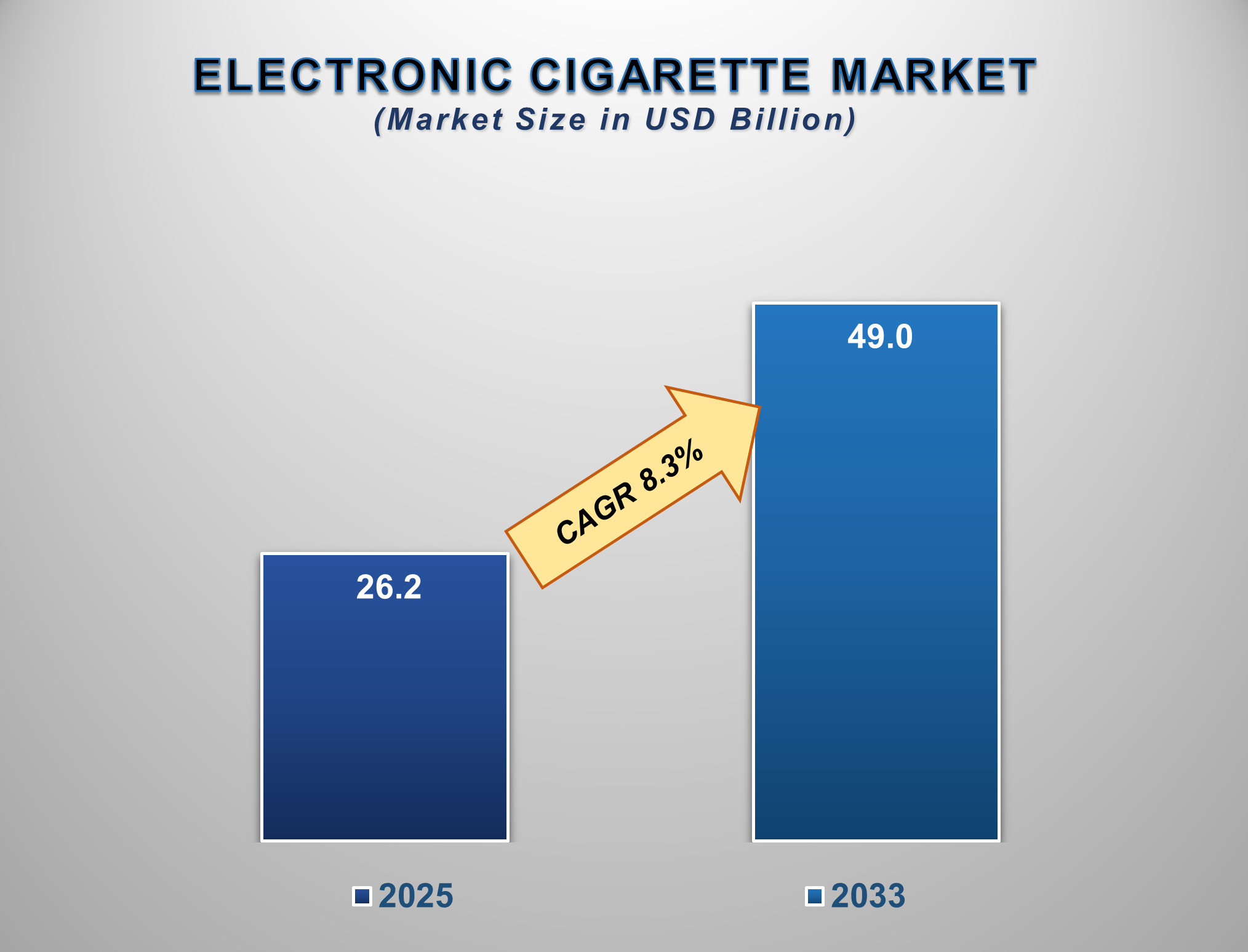
The Electronic Cigarette Market is poised for dynamic growth from 2025 to 2033, driven by the global shift away from traditional tobacco, continuous product innovation, and the perception of e-cigarettes as a less harmful alternative for adult smokers. The market is projected to be valued at approximately USD 26.2 billion in 2025 and is forecasted to reach nearly USD 49.0 billion by 2033, exhibiting a compound annual growth rate (CAGR) of 8.3% during this period.
Electronic cigarettes, or e-cigarettes, are
battery-operated devices that heat a liquid (e-liquid) to create an aerosol,
which is inhaled by the user. The market's expansion is primarily fueled by
increasing health consciousness among smokers, supportive government
initiatives in some regions aimed at tobacco harm reduction, and the widespread
availability of a vast array of flavors and device types.
Technological advancements leading to improved
battery life, enhanced vapor production, and more efficient nicotine delivery
systems are also significant contributors. However, the market faces challenges
from stringent regulatory frameworks, increasing health concerns regarding
long-term use, and a ban on certain flavored products in key markets like the
United States. Despite this, North America and Europe currently hold
significant market shares, while the Asia-Pacific region is expected to witness
the fastest growth due to its massive smoking population and evolving
regulatory landscape.
Electronic
Cigarette Market Drivers and Opportunities
The Shift Towards Harm Reduction and Smoking
Cessation is the Primary Market Driver
The most powerful driver for the electronic
cigarette market is the growing global movement towards tobacco harm reduction.
As public awareness of the severe health risks associated with combustible
cigarettes intensifies, a substantial number of adult smokers are seeking
alternatives. E-cigarettes, which do not involve combustion and thus eliminate
tar and many of the carcinogens found in tobacco smoke, are widely perceived as
a less harmful option. This perception is bolstered by public health endorsements
in certain countries, such as the UK, where e-cigarettes are promoted as a
smoking cessation tool. The desire to reduce or quit traditional smoking,
coupled with the ability to control nicotine intake, creates a sustained and
powerful demand driver for the e-cigarette market.
Product Innovation and Flavor Diversity are
Driving Consumer Adoption
Continuous and rapid product innovation is a key
catalyst propelling the e-cigarette market. The evolution from early
cig-a-likes to advanced personal vaporizers (mods) and the recent explosion in
popularity of convenient, pre-filled disposable e-cigarettes have significantly
broadened the market's appeal. Manufacturers are constantly innovating in areas
of design, battery technology, and e-liquid formulations. The availability of
an extensive range of flavors, from traditional tobacco and menthol to fruits,
desserts, and beverages, plays a crucial role in attracting and retaining
users, particularly among younger demographics. This constant cycle of
innovation keeps the market dynamic and stimulates repeat purchases.
The Expansion into Emerging Markets and the
Development of Next-Generation Products Present
Significant Opportunities
The electronic cigarette market holds
substantial untapped potential, primarily in emerging economies across
Asia-Pacific, Latin America, and the Middle East. These regions have high
smoking prevalence and, in many cases, less restrictive regulatory environments,
offering fertile ground for market expansion.
Furthermore, significant opportunities lie in the development and
commercialization of next-generation products. This includes the advancement of
nicotine salt e-liquids for a smoother experience, temperature control devices
for improved safety, and the exploration of cannabis/CBD-infused vaping
products in regions where they are legal. For companies, investing in clinical
research to substantiate harm reduction claims, developing sustainable and
recyclable products to address environmental concerns, and leveraging digital
marketing and e-commerce channels are key strategies to capture future growth.
Electronic Cigarette
Market Scope
|
Report Attributes |
Description |
|
Market Size in 2025 |
USD 26.2 Billion |
|
Market Forecast in 2033 |
USD 49.0 Billion |
|
CAGR % 2025-2033 |
8.3% |
|
Base Year |
2024 |
|
Historic Data |
2020-2024 |
|
Forecast Period |
2025-2033 |
|
Report USP |
Product Portfolio,
Technological Analysis, Company Market Share, Company Heatmap, Pricing
Analysis, Growth Factors and more |
|
Segments Covered |
●
By Product ●
By Distribution
Channel ●
By Battery Mode |
|
Regional Scope |
●
North America, ●
Europe, ●
APAC, ●
Latin America ●
Middle East and
Africa |
|
Country Scope |
1)
U.S. 2)
Canada 3)
Germany 4)
UK 5)
France 6)
Spain 7)
Italy 8)
Switzerland 9)
China 10)
Japan 11)
India 12)
Australia 13)
South Korea 14)
Brazil 15)
Mexico 16)
Argentina 17)
South Africa 18)
Saudi Arabia 19)
UAE |
Electronic Cigarette
Market Report Segmentation Analysis
The global Electronic Cigarette
Market industry analysis is segmented by Product, by Distribution Channel, by
Battery Mode, and by Region.
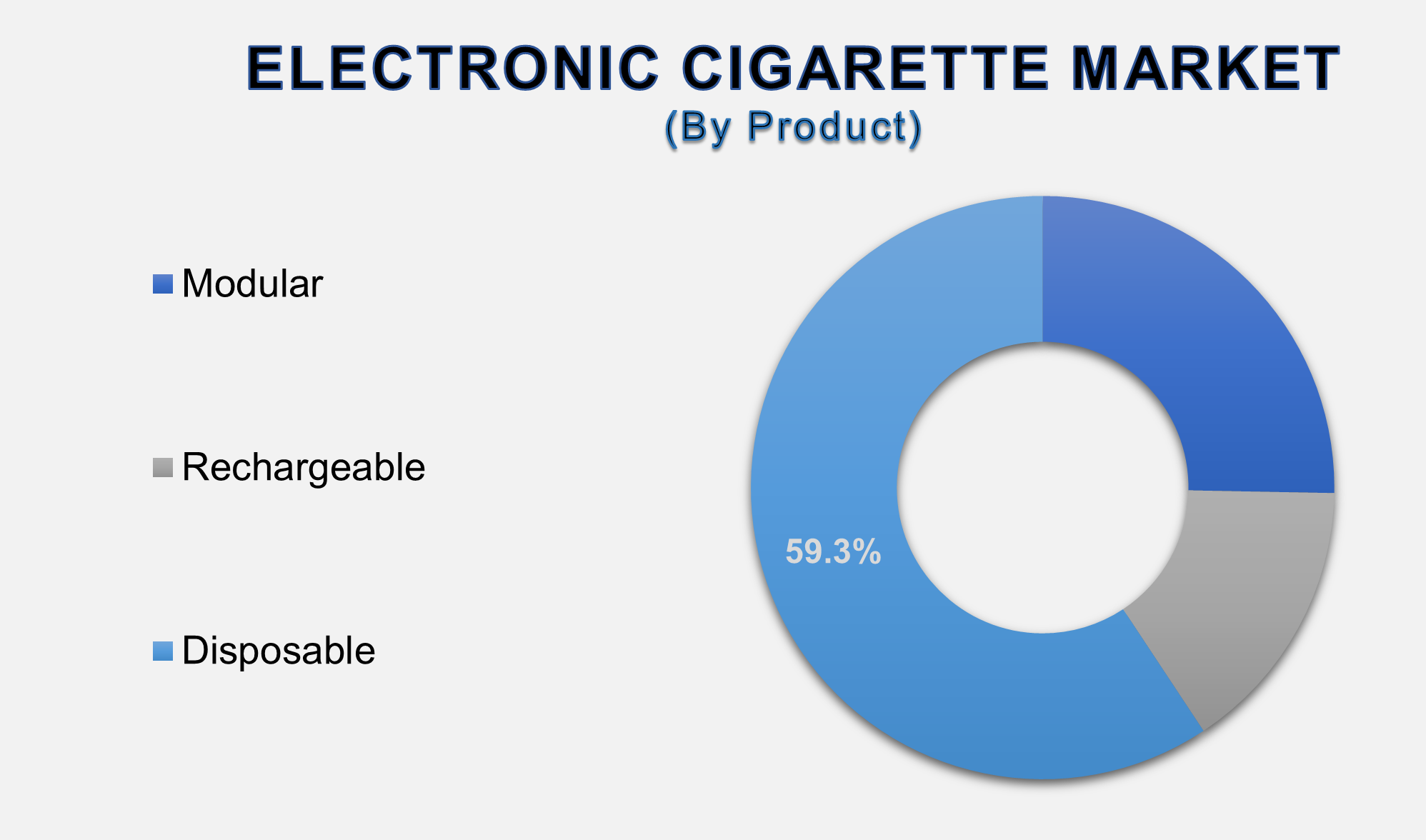
The Disposable product
segment is anticipated to command the largest market share in 2025
The Product segment is categorized
into Modular, Rechargeable, and Disposable. The dominance of the disposable
segment is attributed to its unparalleled convenience and user-friendliness.
Disposable e-cigarettes are pre-filled, pre-charged, and require no maintenance
or refilling, making them an ideal entry point for new users and a convenient
option for experienced vapers. Their compact design, wide availability in
numerous flavors, and affordable upfront cost have driven their explosive
growth, particularly through convenience stores and gas stations. This ease of
use has allowed disposable devices to capture a significant portion of the
market from more complex, modular, and rechargeable systems.
The Online distribution channel segment is
projected to grow at a significant CAGR.
The Distribution Channel segment includes Online
and Retail (Specialty E-Cig Stores, Supermarkets/Hypermarkets, Convenience
Stores). The online segment's projected high growth is driven by several key
advantages. E-commerce platforms offer a broader selection of products,
flavors, and accessories than most physical stores, along with competitive
pricing and discreet home delivery. They also serve as a vital channel for
information, with user reviews and detailed product specifications aiding the
purchase decision. While retail remains crucial for impulse buys, the
convenience, variety, and often lower prices available online are fueling this
channel's rapid expansion, especially among tech-savvy consumers.
The Retail end-use segment is projected to
witness the highest growth rate.
The Retail segment is divided into Specialty
E-Cig Stores, Supermarkets/Hypermarkets, and Convenience Stores. The
convenience store sub-segment, in particular, is witnessing the highest growth
rate due to its critical role in the distribution of disposable e-cigarettes.
These outlets offer immediate accessibility and impulse purchase opportunities,
capitalizing on high foot traffic. The placement of e-cigarettes alongside
traditional tobacco products makes them highly visible to the target
demographic of current smokers. The extensive, established distribution network
of convenience stores and gas stations is a primary driver of volume sales,
making this retail channel a powerhouse for market growth.
The following segments are part of an in-depth analysis of
the global Electronic Cigarette Market:
|
Market
Segments |
|
|
By
Product |
●
Modular ●
Rechargeable ●
Disposable |
|
By
Distribution Channel |
●
Online Channel ●
Retail Store |
|
By Battery Mode |
●
Automatic ●
Manual |
Electronic Cigarette
Market Share Analysis by Region
The North America region
is anticipated to hold the largest portion of the Electronic Cigarette Market
globally throughout the forecast period.
North America's dominance is anchored by the
United States, which has one of the most mature and sophisticated e-cigarette
markets in the world. High consumer spending power, early adoption of vaping
culture, and intense marketing and product innovation from major companies have
solidified the region's leading position. While stringent FDA regulations pose
challenges, the well-established retail and online distribution networks and a
large base of adult users seeking alternatives to smoking continue to drive the
market. The presence of industry giants like Juul Labs and RJ Reynolds Vapor
Company further cements North America's influence on global trends, product
development, and market size.
The U.S. is the epicenter of the e-cigarette
market within North America, characterized by a constant stream of product
launches, fierce brand competition, and a complex regulatory environment. The
market has seen a significant shift towards disposable devices following
federal restrictions on flavored cartridge-based pods. American consumers
demonstrate high brand awareness and are quick to adopt new technologies and
flavors. This dynamic, albeit challenging, environment makes the U.S. the most
significant single-country market, dictating global strategies for major
players and attracting substantial investment in marketing and regulatory
compliance.
Electronic Cigarette
Market Competition Landscape Analysis
The global electronic
cigarette market is highly competitive and consolidated, dominated by a few
large tobacco and vaping-focused companies. Competition is intense and revolves
around brand strength, product innovation, marketing reach, and distribution
network dominance. Key strategies include heavy investment in research and
development to create new devices and e-liquid formulations, strategic mergers
and acquisitions to gain market share and technology, and navigating the
complex global regulatory landscape to ensure product compliance. The market
also features a large number of smaller players and vape shops that compete on
customization, niche flavors, and community engagement.
Global Electronic
Cigarette Market Recent Developments News:
- In February 2025, Juul Labs announced the launch of
a new Bluetooth-enabled device in international markets, featuring
age-verification technology and usage controls.
- In December 2024, British American Tobacco (BAT)
unveiled a new line of "potentially reduced-risk" heated tobacco
products in Japan, diversifying its smoke-free portfolio beyond e-vapor.
- In October 2024, SMOK, a leading manufacturer of
advanced vaping devices, introduced a new pod system with adjustable
wattage and a leak-resistant design, targeting experienced vapers.
- In August 2024, the FDA issued
its first marketing granted orders for a set of tobacco-flavored e-liquid
products, signaling a potential pathway for legal sales of certain vape
products in the U.S.
The Global Electronic
Cigarette Market Is Dominated by a Few Large Companies, such as
●
Juul Labs, Inc.
●
British American
Tobacco PLC (BAT)
●
Imperial Brands PLC
●
Japan Tobacco
International (JTI)
●
Altria Group, Inc.
●
(SMOK)
●
Vaporesso
●
Geekvape
●
Fontem Ventures (blu)
●
Logic Technology
●
NJOY
●
Shenzhen Eigate
Technology Co., Ltd (VOOPOO)
●
Suorin
●
RELX Technology
●
Philip Morris
International (IQOS)
● Other Prominent Players
Frequently Asked Questions
Jaya Bundele (Research Analyst)
Jaya Bundele is a skilled Research Analyst with 4+ years of experience in market intelligence, consumer insights, competitive analysis, and industry forecasting across the consumer goods, agriculture, and food & beverage sectors. She specializes in market sizing, trend analysis, growth opportunity mapping, and strategic secondary research for global and regional markets.
Her expertise lies in transforming complex industry data into actionable business strategies that help organizations identify emerging trends, understand customer behavior, and gain a competitive edge. With a strong focus on data-driven insights, business intelligence, and future market trends, Jaya delivers high-quality research solutions aligned with evolving industry demands and market dynamics.
1. Global Electronic
Cigarette Market Introduction and Market Overview
1.1.
Objectives
of the Study
1.2.
Global
Electronic Cigarette Market Scope and Market Estimation
1.2.1.Global Electronic Toll
Collection Overall Market Size (US$ Bn), Market CAGR (%), Market forecast (2025
- 2033)
1.2.2.Global Electronic
Cigarette Market Revenue Share (%) and Growth Rate (Y-o-Y) from 2020 - 2033
1.3.
Market
Segmentation
1.3.1.Product of Global Electronic
Cigarette Market
1.3.2.Distribution Channel of
Global Electronic Cigarette Market
1.3.3.Battery Mode of Global Electronic
Cigarette Market
1.3.4.Region of Global Electronic
Cigarette Market
2.
Executive Summary
2.1.
Demand
Side Trends
2.2.
Key
Market Trends
2.3.
Market
Demand (US$ Bn) Analysis 2020 – 2024 and forecast, 2025 – 2033
2.4.
Demand
and Opportunity Assessment
2.5.
Pricing
Analysis
2.6.
Key
Developments
2.7.
Market
Entry Strategies
2.8.
Market
Dynamics
2.8.1.Drivers
2.8.2.Limitations
2.8.3.Opportunities
2.8.4.Impact Analysis of Drivers
and Restraints
2.9.
Porter’s
Five Forces Analysis
2.10.
PEST
Analysis
3. Global
Electronic Cigarette Market Estimates
& Historical Trend Analysis (2020 - 2024)
4. Global
Electronic Cigarette Market Estimates
& Forecast Trend Analysis, by Product
4.1.
Global
Electronic Cigarette Market Revenue (US$ Bn) Estimates and Forecasts, by Product,
2020 - 2033
4.1.1.Modular
4.1.2.Rechargeable
4.1.3.Disposable
5. Global
Electronic Cigarette Market Estimates
& Forecast Trend Analysis, by Distribution Channel
5.1.
Global
Electronic Cigarette Market Revenue (US$ Bn) Estimates and Forecasts, by Distribution
Channel, 2020 - 2033
5.1.1.Online Channel
5.1.2.Retail Store
6. Global
Electronic Cigarette Market Estimates
& Forecast Trend Analysis, by Battery Mode
6.1.
Global
Electronic Cigarette Market Revenue (US$ Bn) Estimates and Forecasts, by Battery
Mode 2020 - 2033
6.1.1.Automatic
6.1.2.Manual
7. Global
Electronic Cigarette Market Estimates
& Forecast Trend Analysis, by region
7.1.
Global
Electronic Cigarette Market Revenue (US$ Bn) Estimates and Forecasts, by region,
2020 - 2033
7.1.1.North America
7.1.2.Europe
7.1.3.Asia Pacific
7.1.4.Middle East & Africa
7.1.5.Latin America
8. North America Electronic
Cigarette Market: Estimates &
Forecast Trend Analysis
8.1. North America Electronic
Cigarette Market Assessments & Key Findings
8.1.1.North America Electronic
Cigarette Market Introduction
8.1.2.North America Electronic
Cigarette Market Size Estimates and Forecast (US$ Billion) (2020 - 2033)
8.1.2.1.
By Product
8.1.2.2.
By Distribution Channel
8.1.2.3.
By Battery Mode
8.1.2.4. By Country
8.1.2.4.1. The U.S.
8.1.2.4.2. Canada
9. Europe Electronic
Cigarette Market: Estimates &
Forecast Trend Analysis
9.1. Europe Electronic
Cigarette Market Assessments & Key Findings
9.1.1.Europe Electronic
Cigarette Market Introduction
9.1.2.Europe Electronic
Cigarette Market Size Estimates and Forecast (US$ Billion) (2020 - 2033)
9.1.2.1.
By Product
9.1.2.2.
By Distribution Channel
9.1.2.3.
By Battery Mode
9.1.2.4. By Country
9.1.2.4.1.
Germany
9.1.2.4.2.
Italy
9.1.2.4.3.
U.K.
9.1.2.4.4.
France
9.1.2.4.5.
Spain
9.1.2.4.6.
Switzerland
9.1.2.4.7. Rest
of Europe
10. Asia Pacific Electronic
Cigarette Market: Estimates &
Forecast Trend Analysis
10.1. Asia Pacific Market
Assessments & Key Findings
10.1.1.
Asia
Pacific Electronic Cigarette Market Introduction
10.1.2.
Asia
Pacific Electronic Cigarette Market Size Estimates and Forecast (US$ Billion) (2020
- 2033)
10.1.2.1.
By Product
10.1.2.2.
By Distribution Channel
10.1.2.3.
By Battery Mode
10.1.2.4. By Country
10.1.2.4.1. China
10.1.2.4.2. Japan
10.1.2.4.3. India
10.1.2.4.4. Australia
10.1.2.4.5. South Korea
10.1.2.4.6. Rest of Asia Pacific
11. Middle East & Africa Electronic
Cigarette Market: Estimates &
Forecast Trend Analysis
11.1. Middle East & Africa
Market Assessments & Key Findings
11.1.1. Middle
East & Africa
Electronic Cigarette Market Introduction
11.1.2. Middle
East & Africa
Electronic Cigarette Market Size Estimates and Forecast (US$ Billion) (2020 - 2033)
11.1.2.1.
By Product
11.1.2.2.
By Distribution Channel
11.1.2.3.
By Battery Mode
11.1.2.4. By Country
11.1.2.4.1. UAE
11.1.2.4.2. Saudi
Arabia
11.1.2.4.3. South
Africa
11.1.2.4.4. Rest
of MEA
12. Latin America
Electronic Cigarette Market: Estimates
& Forecast Trend Analysis
12.1. Latin America Market
Assessments & Key Findings
12.1.1. Latin America Electronic
Cigarette Market Introduction
12.1.2. Latin America Electronic
Cigarette Market Size Estimates and Forecast (US$ Billion) (2020 - 2033)
12.1.2.1.
By Product
12.1.2.2.
By Distribution Channel
12.1.2.3.
By Battery Mode
12.1.2.4. By Country
12.1.2.4.1. Brazil
12.1.2.4.2. Argentina
12.1.2.4.3. Mexico
12.1.2.4.4. Rest
of LATAM
13.
Country
Wise Market: Introduction
14.
Competition
Landscape
14.1. Global Electronic
Cigarette Market Product Mapping
14.2. Global Electronic
Cigarette Market Concentration Analysis, by Leading Players / Innovators /
Emerging Players / New Entrants
14.3. Global Electronic
Cigarette Market Tier Structure Analysis
14.4. Global Electronic
Cigarette Market Concentration & Company Market Shares (%) Analysis, 2024
15.
Company
Profiles
15.1.
Juul Labs, Inc.
15.1.1.
Company
Overview & Key Stats
15.1.2.
Financial
Performance & KPIs
15.1.3.
Product
Portfolio
15.1.4.
SWOT
Analysis
15.1.5.
Business
Strategy & Recent Developments
* Similar details would be provided for all the players
mentioned below
15.2.
British American Tobacco PLC (BAT)
15.3.
Imperial Brands PLC
15.4.
Japan Tobacco International (JTI)
15.5.
Altria Group, Inc.
15.6.
(SMOK)
15.7.
Vaporesso
15.8.
Geekvape
15.9.
Fontem Ventures (blu)
15.10.
Logic Technology
15.11.
NJOY
15.12.
Shenzhen Eigate Technology Co., Ltd (VOOPOO)
15.13.
Suorin
15.14.
RELX Technology
15.15.
Philip Morris International (IQOS)
15.16.
Other Prominent Players
16. Research
Methodology
16.1. External Transportations /
Databases
16.2. Internal Proprietary
Database
16.3. Primary Research
16.4. Secondary Research
16.5. Assumptions
16.6. Limitations
16.7. Report FAQs
17. Research
Findings & Conclusion
Our Research Methodology
"Insight without rigor is just noise."
We follow a comprehensive, multi-phase research framework designed to deliver accurate, strategic, and decision-ready intelligence. Our process integrates primary and secondary research , both quantitative and qualitative , along with dual modeling techniques ( top-down and bottom-up) and a final layer of validation through our proprietary in-house repository.
PRIMARY RESEARCH
Primary research captures real-time, firsthand insights from the market to understand behaviors, motivations, and emerging trends.
1. Quantitative Primary Research
Objective: Generate statistically significant data directly from market participants.
Approaches:- Structured surveys with customers, distributors, and field agents
- Mobile-based data collection for point-of-sale audits and usage behavior
- Phone-based interviews (CATI) for market sizing and product feedback
- Online polling around industry events and digital campaigns
- Purchase frequency by customer type
- Channel performance across geographies
- Feature demand by application or demographic
2. Qualitative Primary Research
Objective: Explore decision-making drivers, pain points, and market readiness.
Approaches:- In-depth interviews (IDIs) with executives, product managers, and key decision-makers
- Focus groups among end users and early adopters
- Site visits and observational research for consumer products
- Informal field-level discussions for regional and cultural nuances
SECONDARY RESEARCH
This phase helps establish a macro-to-micro understanding of market trends, size, regulation, and competitive dynamics, sourced from credible and public domain information.
1. Quantitative Secondary Research
Objective: Model market value and segment-level forecasts based on published data.
Sources include:- Financial reports and investor summaries
- Government trade data, customs records, and regulatory statistics
- Industry association publications and economic databases
- Channel performance and pricing data from marketplace listings
- Revenue splits, pricing trends, and CAGR estimates
- Supply-side capacity and volume tracking
- Investment analysis and funding benchmarks
2. Qualitative Secondary Research
Objective: Capture strategic direction, innovation signals, and behavioral trends.
Sources include:- Company announcements, roadmaps, and product pipelines
- Publicly available whitepapers, conference abstracts, and academic research
- Regulatory body publications and policy briefs
- Social and media sentiment scanning for early-stage shifts
- Strategic shifts in market positioning
- Unmet needs and white spaces
- Regulatory triggers and compliance impact
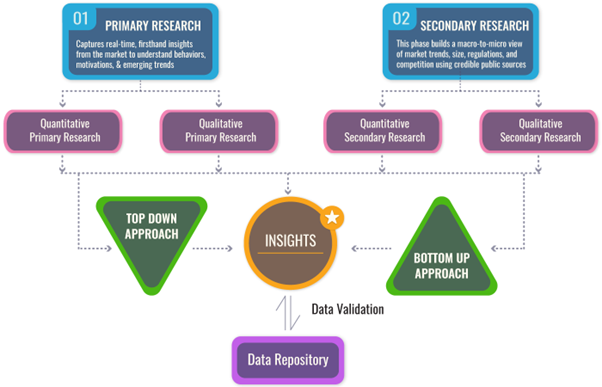
DUAL MODELING: TOP-DOWN + BOTTOM-UP
To ensure robust market estimation, we apply two complementary sizing approaches:
Top-Down Modeling:- Start with broader industry value (e.g., global or regional TAM)
- Apply filters by segment, geography, end-user, or use case
- Adjust with primary insights and validation benchmarks
- Ideal for investor-grade market scans and opportunity mapping
- Aggregate from the ground up using sales volumes, pricing, and unit economics
- Use internal modeling templates aligned with stakeholder data
- Incorporate distributor-level or region-specific inputs
- Most accurate for emerging segments and granular sub-markets
DATA VALIDATION: IN-HOUSE REPOSITORY
We close the loop with proprietary data intelligence built from ongoing projects, industry monitoring, and historical benchmarking. This repository includes:
- Multi-sector market and pricing models
- Key trendlines from past interviews and forecasts
- Benchmarked adoption rates, churn patterns, and ROI indicators
- Industry-specific deviation flags and cross-check logic
- Catches inconsistencies early
- Aligns projections across studies
- Enables consistent, high-trust deliverables