

Epoxy Curing Agents Market Size and Forecast (2020 - 2033), Global and Regional Growth, Trend, Share and Industry Analysis Report Coverage; Curing Agent (Amine-based curing agents, Anhydride-based Curing Agents, and Others), Application (Paints and Coatings, Adhesives, Composites, Electronic encapsulation, and Others), End User (Building and construction, Transportation, General Industrial, Wind Power, Aerospace, Marine, and Others), Raw Material (Organic Compounds and Inorganic Compounds) and Geography
2026-02-04
Chemicals & Materials
Jaya Bundele (Research Analyst)
Description
Epoxy Curing
Agents Market Overview
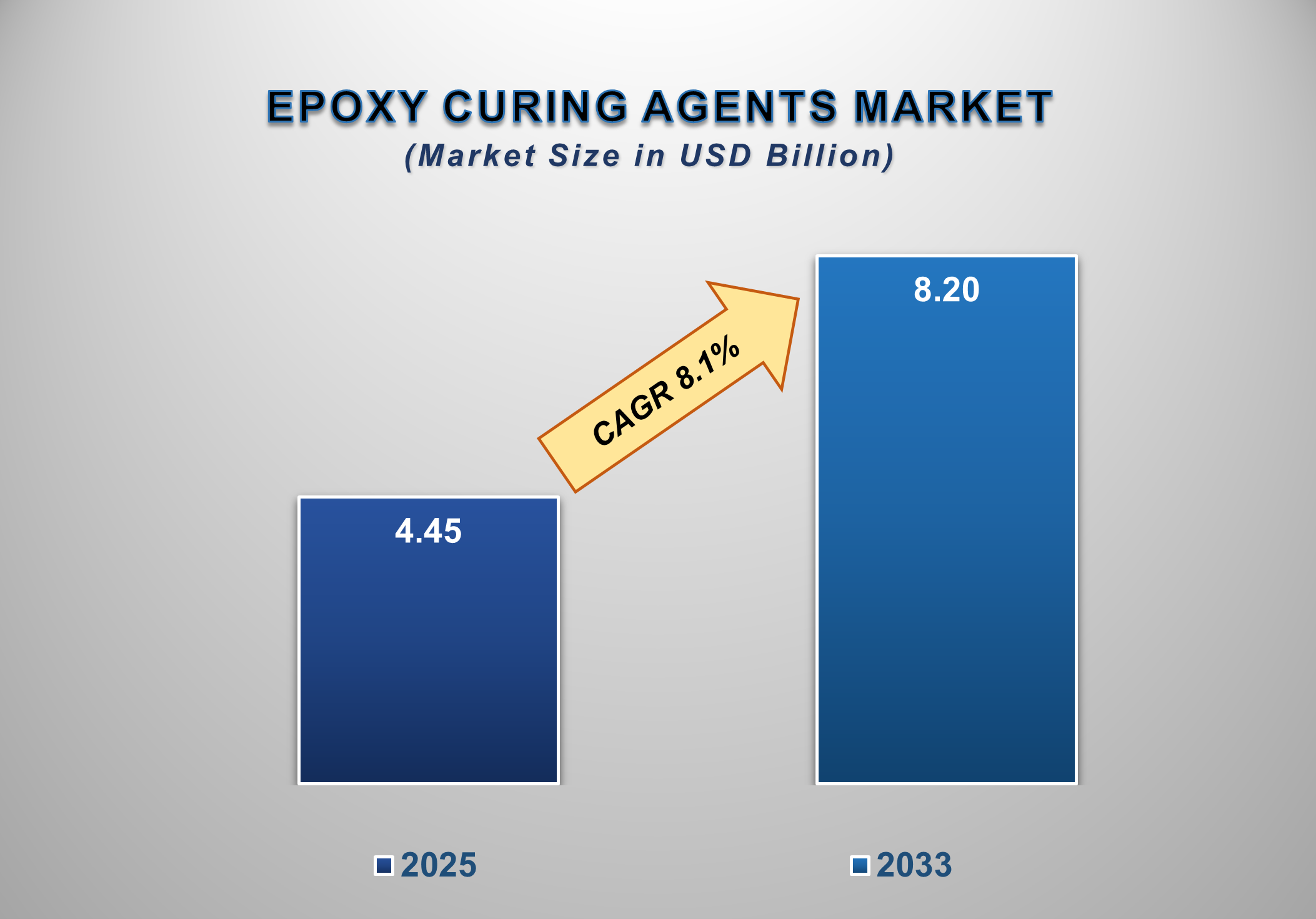
The Global Epoxy Curing Agents Market is experiencing strong growth, driven by the expanding use of epoxy resins across construction, automotive, aerospace, electronics, wind energy, and industrial coatings. Valued at USD 4.45 billion in 2025, the market is projected to reach USD 8.20 billion by 2033, growing at a CAGR of 8.1% during the forecast period.
Epoxy resin use in construction, coatings, adhesives,
composites, and electrical and electronics applications is steadily increasing,
propelling the market for epoxy curing agents. The demand for epoxy-based
protective coatings and flooring systems is rising due to rapid urbanization
and infrastructure development, especially in the Asia-Pacific and the Middle
East. This directly supports the need for curing agents. Demand is further
increased by the expansion of wind energy, automotive lightweighting, and aerospace
composites, as epoxy systems are frequently used to produce strong,
long-lasting composite materials.
The versatility of epoxy curing agents, particularly
amine-based systems, which provide fast curing, robust mechanical qualities,
and compatibility with a variety of epoxy resins, is a major factor driving
demand. Because of their superior thermal and dielectric qualities,
anhydride-based curing agents are still in steady demand in high-temperature
and electrical insulation applications. In addition, specialist curing agents
like polyamides, phenolics, and bio-based solutions are becoming more popular in
performance-driven and specialized applications.
The availability and cost of raw materials, including
amines, petrochemical derivatives, and bio-based feedstocks, have an impact on
the market on the supply side. Production costs and profits may be impacted by
disruptions to the supply chain and fluctuations in the price of crude oil. Top
producers concentrate on backward integration, long-term supplier agreements,
and regional industrial growth to reduce these risks.
Market dynamics are being shaped by regulatory and environmental constraints.
Innovation in low-toxicity, low-VOC, and sustainable curing agents is being
driven by stricter laws on volatile organic compounds (VOCs), toxic amines, and
workplace exposure. This includes increasing R&D spending on bio-based
substitutes made from renewable resources, latent curing agents, and
water-borne systems.
Large, international chemical corporations and local experts
coexist amid competitive dynamics. Pricing, customization, application support,
and product performance are the main factors that drive competition. Strategic
alliances with manufacturers of epoxy resin and end-use formulators are
becoming more crucial for preserving market share. Thus, industrialization,
infrastructure development, and continuous innovation in high-performance and
sustainable curing technologies are likely to support the market's steady
growth for epoxy curing agents.
Epoxy Curing
Agents Market Drivers and Opportunities
Growing Demand from
Construction and Infrastructure
The market for epoxy curing agents
is mostly driven by the building and infrastructure industries. Epoxy systems'
exceptional mechanical strength, chemical resistance, and longevity make them useful in flooring, adhesives, repair mortars, and protective
coatings. The need for curing agents is being driven by the rapid urbanization,
extensive infrastructure projects, and rehabilitation activities, particularly
in emerging nations, which are increasing the consumption of epoxy-based
materials.
Expansion of Coatings and Industrial Applications
Epoxy curing agents are widely
used in protective and industrial coatings. The market is expanding due to the
growing need for corrosion-resistant coatings in the oil and gas, marine, power
generation, and industrial manufacturing sectors. Curing agents based on amines
and polyamides are especially preferred because of their high adhesive
qualities and rapid curing times, which facilitate effective industrial
processes.
Growth in Composites and Lightweight Materials
Another significant growth driver
is the growing application of epoxy composites in wind energy, automotive,
aerospace, and sporting goods. High-performance composites with superior
strength-to-weight ratios and thermal stability are made possible by epoxy
curing agents. Epoxy curing agents are still in high demand due to the
expansion of renewable energy, especially wind turbine installations.
Development of Sustainable and Bio-Based Curing Agents
Sustainability objectives present
strong potential for innovation and environmental regulations. Bio-based,
low-toxicity, and low-VOC curing agents made from renewable feedstocks are
being invested in by manufacturers. These products are being used more and more
in environmentally friendly industrial applications, green structures, and
eco-friendly coatings.
Advancements in Specialty and High-Performance Systems
Specialty curing agents with
improved qualities, like rapid cure times, greater thermal resistance, and
better electrical performance, are in greater demand. Latent curing agents,
anhydride systems for electronics, and specialized formulations for advanced
composites and electrical insulation are all areas with potential.
Emerging Markets and Regional Expansion
Emerging economies in Latin
America, the Middle East, and the Asia-Pacific
present substantial development prospects due to growing manufacturing bases
and infrastructural investments. Strategic alliances, local manufacturing, and
customized product offers can all help suppliers take advantage of these
rapidly expanding markets.
Epoxy Curing Agents Market Scope
|
Report Attributes |
Description |
|
Market Size in 2025 |
USD 4.45 Billion |
|
Market Forecast in 2033 |
USD 8.20 Billion |
|
CAGR % 2025-2033 |
8.1% |
|
Base Year |
2024 |
|
Historic Data |
2020-2024 |
|
Forecast Period |
2025-2033 |
|
Report USP |
Comprehensive global Epoxy
Curing Agents Market size and forecast analysis, product type and
distribution channel assessment, end-user consumption trends, industrial and
direct sales performance evaluation, regional and country-level market
insights, competitive landscape and market share analysis, technological
advancements in curing chemistries and formulations, digital transformation
and e-procurement impact, growth drivers, challenges, opportunities, and
strategic insights for epoxy resin manufacturers, formulators, distributors,
and investors. |
|
Segments Covered |
●
By Curing Agent ●
By Application ●
By End User ●
By Raw Material |
|
Regional Scope |
●
North America ●
Europe ●
APAC ●
Latin America ●
Middle East and
Africa |
|
Country Scope |
1)
U.S. 2)
Canada 3)
U.K. 4)
Germany 5)
France 6)
Italy 7)
Spain 8)
Switzerland 9)
China 10)
India 11)
Japan 12)
South Korea 13)
Australia 14)
Mexico 15)
Brazil 16)
Argentina 17)
Saudi Arabia 18)
UAE 19)
South Africa |
Epoxy Curing Agents
Market Report Segmentation Analysis
The global Epoxy Curing Agents
Market analysis is segmented by Curing Agent, Application, End User, Raw
Material, and Region.
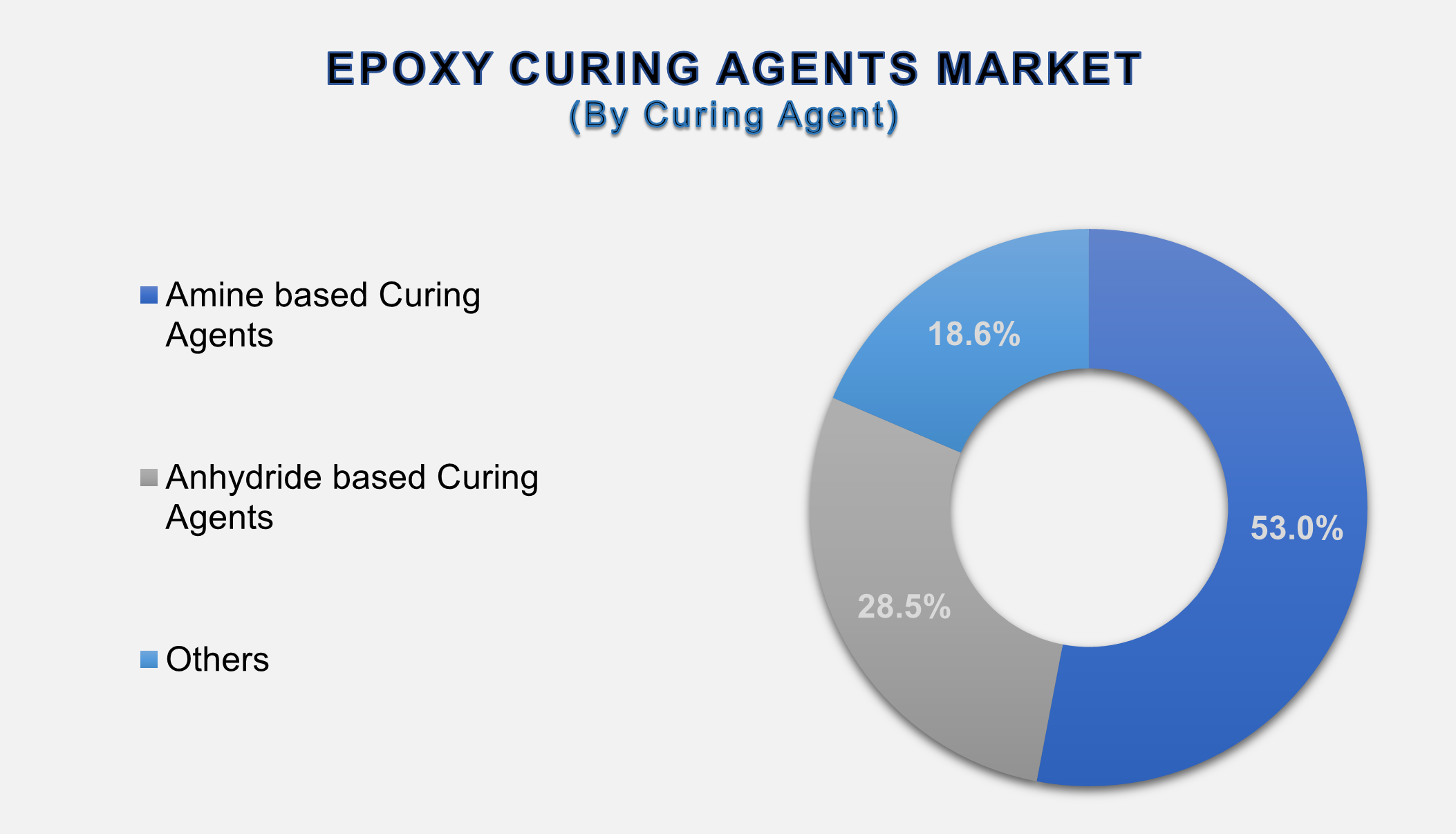
The Amine based Curing
Agents segment dominated the market in 2025 and is projected to grow at the
highest CAGR during the forecast period.
By curing agent, the Epoxy Curing
Agents Market is segmented into amine-based curing agents, anhydride-based
curing agents, and others. The amine-based curing agents segment accounts for
the largest share of the global Epoxy Curing Agents Market. Amine-based curing
agents represent the largest and most widely used category. They are prized for
their extensive compatibility with epoxy resins, superior mechanical strength,
high adhesion, and quick cure rates. Coatings, adhesives, flooring,
construction, maritime, and composite applications all frequently employ amine
curing agents. Formulators can customize performance attributes, including cure
speed, chemical resistance, and temperature tolerance, by using variants like
aliphatic, cycloaliphatic, and aromatic amines. Low-toxicity, low-VOC, and
modified amine systems are the main areas of ongoing innovation to satisfy
sustainability and legal criteria.
The paints and coatings
segment holds the highest share of the Application Segment over the forecast
period
Based
on application, the market is bifurcated into paints and coatings, adhesives,
composites, electronic encapsulation, and others. The paints and coatings
segment accounts for the largest share of the market. Epoxy curing agents are
widely used in paints and coatings due to the demand for high-performance,
long-lasting protective surfaces. Epoxy systems' superior adhesion, chemical
resistance, corrosion protection, and mechanical strength make them popular in
industrial, marine, automotive, and protective coatings. In order to determine
coating characteristics like hardness, cure time, and environmental resistance,
curing agents are essential. Curing agents based on amines and polyamides are
frequently chosen because of their adaptability and quick curing. The market is
still expanding due to increased infrastructure development and the need for
corrosion-resistant coatings.
Building and construction hold the highest share of the end-user
segment over the forecast period
Based on the end user, the market
is bifurcated into building & construction, transportation, general
industrial, wind power, aerospace, marine & others. The building and
construction segment accounts for the largest share of the market. A
significant end-use market for epoxy curing agents is building and
construction, which is motivated by the demand for materials that are strong,
long-lasting, and durable. Epoxy solutions are frequently utilized in grouts,
protective coatings, structural adhesives, flooring, and concrete restoration.
Crucial performance attributes, including durability, chemical resistance,
load-bearing strength, and curing speed, are all determined by curing
chemicals. Amine-based curing agents are widely employed because of their
excellent adherence to steel and concrete and their adaptability. Globally, the
need for epoxy curing agents in construction applications is being driven by
increased urbanization, infrastructure development, and renovation operations.
The Organic Compounds Segment will
probably dominate the market during the forecast period
In terms of raw material, the
Epoxy Curing Agents Market is segmented into organic compounds and inorganic
compounds. The organic compounds segment holds the largest share of the Epoxy
Curing Agents Market. Since the majority of curing systems are produced from
organic amines, anhydrides, polyamides, and similar chemistries, organic
compounds serve as the chemical basis for epoxy curing agents. The regulated
crosslinking of epoxy resins made possible by these organic compounds produces
materials with excellent mechanical strength, chemical resistance, and thermal
stability. Their molecular structure can be modified to change their
performance, flexibility, and rate of cure under different environmental
circumstances. For epoxy formulations to achieve application-specific qualities
in coatings, adhesives, construction, and composite materials, organic
chemicals are crucial. Safer, less toxic, and bio-based organic curative
chemicals are the subject of ongoing innovation.
The following segments are
part of an in-depth analysis of the global Epoxy Curing Agents Market:
|
Market
Segments |
|
|
By Curing
Agent |
●
Amine-based curing
agents ▪
Aliphatic Amines ▪
Cycloaliphatic
Amines ▪
Aromatic Amines ▪
Polyamides ▪
Others ●
Anhydride-based
Curing Agents ●
Others |
|
By Application |
●
Paints and Coatings ●
Adhesives ●
Composites ●
Electronic
encapsulation ●
Others |
|
By End User |
●
Building and
construction ●
Transportation ●
General Industrial ●
Wind Power ●
Aerospace ●
Marine ●
Others |
|
By Raw
Material |
●
Organic Compounds ●
Inorganic
Compounds |
Epoxy Curing Agents Market Share Analysis by
Region
The Asia-Pacific region
is projected to hold the largest share of the global Epoxy Curing Agents Market
over the forecast period.
The
Asia-Pacific region is projected to hold the largest share of the global Epoxy
Curing Agents Market over the forecast period and is also expected to be the
fastest-growing region. Rapid urbanization, industrialization, and
infrastructure development are the main drivers of market expansion. Market
expansion is supported by robust demand from the automotive, wind energy,
construction, coatings, and electronics sectors. Nations like South Korea,
China, India, and Japan are important contributors due to their significant
manufacturing bases and rising investments in infrastructure and industrial
projects. Asia-Pacific is a crucial growth hub for market players due to its
cost-effective production, growing capacity for epoxy resin, and increasing use
of sustainable and high-performance curing agents.
Global Epoxy
Curing Agents Market Recent Developments News:
●
In March 2025,
Baxxodur® EC 151, a novel amine-based epoxy curing agent with low volatile
organic compound emissions and improved performance, was introduced
commercially by BASF and Sika for use in environmentally friendly flooring
applications.
●
In June 2025, Aditya
Birla Group stated that it had acquired a
specialty chemical manufacturing facility in Dalton, Georgia, USA, in order to
greatly increase its yearly capacity for producing innovative materials and
epoxy curing agents.
●
In July 2025, Evonik
Industries AG advanced sustainability activities by converting its global epoxy
curing agent production plants in Germany, the UK, Japan, the US, and Singapore
to run entirely on renewable electricity.
The Global
Epoxy Curing Agents Market is dominated by a few large companies, such as
●
Huntsman Corporation
●
Hexion Inc.
●
BASF SE
●
Evonik Industries AG
●
Olin Corporation
●
Cardolite Corporation
●
Atul Ltd.
●
Aditya Birla Chemicals
●
KUKDO Chemical Co.,
Ltd.
●
Mitsubishi Chemical
Corporation
●
Gabriel Performance
Products
●
Air Products and
Chemicals, Inc.
●
DIC Corporation
●
Shandong Deyuan Epoxy
Resin Co., Ltd.
●
Toray Industries, Inc.
●
Kumho P&B
Chemicals Inc.
●
Momentive Specialty
Chemicals, Inc.
●
Grasim Industries Ltd.
●
RAMPF Group
● Cargill Incorporated
Frequently Asked Questions
Jaya Bundele (Research Analyst)
Jaya Bundele is a skilled Research Analyst with 4+ years of experience in market intelligence, consumer insights, competitive analysis, and industry forecasting across the consumer goods, agriculture, and food & beverage sectors. She specializes in market sizing, trend analysis, growth opportunity mapping, and strategic secondary research for global and regional markets.
Her expertise lies in transforming complex industry data into actionable business strategies that help organizations identify emerging trends, understand customer behavior, and gain a competitive edge. With a strong focus on data-driven insights, business intelligence, and future market trends, Jaya delivers high-quality research solutions aligned with evolving industry demands and market dynamics.
1.
Global Epoxy Curing Agents Market Introduction and Market Overview
1.1.
Objectives of the Study
1.2.
Global Epoxy Curing Agents Market Scope and Market Estimation
1.2.1.Global Epoxy
Curing Agents Overall Market Size (US$ Bn), Market CAGR (%), Market forecast (2025
- 2033)
1.2.2.Global Epoxy
Curing Agents Market Revenue Share (%) and Growth Rate (Y-o-Y) from 2020 - 2033
1.3.
Market Segmentation
1.3.1.Curing Agent
of Global Epoxy Curing Agents Market
1.3.2.Application
of Global Epoxy Curing Agents Market
1.3.3.End User of
Global Epoxy Curing Agents Market
1.3.4.Raw Material of
Global Epoxy Curing Agents Market
1.3.5.Region of
Global Epoxy Curing Agents Market
2.
Executive
Summary
2.1.
Demand Side Trends
2.2.
Key Market Trends
2.3.
Market Demand (US$ Bn) Analysis 2020 – 2024 and Forecast, 2025 – 2033
2.4.
Demand and Opportunity Assessment
2.5.
Market Dynamics
2.5.1.Drivers
2.5.2.Limitations
2.5.3.Opportunities
2.5.4.Impact
Analysis of Drivers and Restraints
2.6.
Porter’s Five Forces Analysis
2.7.
PEST Analysis
2.8.
Key Regulation
2.9.
Key Developments
2.10. Value
Chain / Ecosystem Analysis
3.
Global
Epoxy Curing Agents Market Estimates & Historical Trend Analysis (2020 - 2024)
4. Global Epoxy Curing Agents Market Estimates & Forecast Trend Analysis, by Curing Agent
4.1.
Global Epoxy Curing Agents Market Revenue (US$ Bn) Estimates and
Forecasts, by Curing Agent, 2020 - 2033
4.1.1.Amine based
curing agents
4.1.1.1.
Aliphatic Amines
4.1.1.2.
Cycloaliphatic Amines
4.1.1.3.
Aromatic Amines
4.1.1.4.
Polyamides
4.1.1.5.
Others
4.1.2.Anhydride
based Curing Agents
4.1.3.Others
5. Global Epoxy Curing Agents Market Estimates & Forecast Trend Analysis, by Application
5.1.
Global Epoxy Curing Agents Market Revenue (US$ Bn) Estimates and
Forecasts, by Application, 2020 - 2033
5.1.1.Paints and
Coating
5.1.2.Adhesives
5.1.3.Composites
5.1.4.Electronic
encapsulation
5.1.5.Others
6. Global Epoxy Curing Agents Market Estimates & Forecast Trend Analysis, by End User
6.1.
Global Epoxy Curing Agents Market Revenue (US$ Bn) Estimates and
Forecasts, by End User, 2020 - 2033
6.1.1.Building and
construction
6.1.2.Transportation
6.1.3.General
Industrial
6.1.4.Wind Power
6.1.5.Aerospace
6.1.6.Marine
6.1.7.Others
7. Global Epoxy Curing Agents Market Estimates & Forecast Trend Analysis, by Raw Material
7.1.
Global Epoxy Curing Agents Market Revenue (US$ Bn) Estimates and
Forecasts, by Raw Material, 2020 - 2033
7.1.1.Organic
Compounds
7.1.2.Inorganic
Compounds
8.
Global
Epoxy Curing Agents Market Estimates & Forecast Trend Analysis, by Region
8.1.
Global Epoxy Curing Agents Market Revenue (US$ Bn) Estimates and
Forecasts, by Region, 2020 - 2033
8.1.1.North America
8.1.2.Europe
8.1.3.Asia Pacific
8.1.4.Middle East
& Africa
8.1.5.Latin America
9.
North America Epoxy
Curing Agents Market: Estimates &
Forecast Trend Analysis
9.1.
North America Epoxy Curing Agents Market Assessments & Key
Findings
9.1.1.North America
Epoxy Curing Agents Market Introduction
9.1.2.North America
Epoxy Curing Agents Market Size Estimates and Forecast (US$ Billion) (2020 - 2033)
9.1.2.1. By Curing Agent
9.1.2.2. By Application
9.1.2.3. By End User
9.1.2.4. By Raw Material
9.1.2.5.
By Country
9.1.2.5.1.
The U.S.
9.1.2.5.2.
Canada
10.
Europe Epoxy
Curing Agents Market: Estimates &
Forecast Trend Analysis
10.1. Europe
Epoxy Curing Agents Market Assessments & Key Findings
10.1.1.
Europe Epoxy Curing Agents Market Introduction
10.1.2.
Europe Epoxy Curing Agents Market Size Estimates and Forecast (US$
Billion) (2020 - 2033)
10.1.2.1. By Curing Agent
10.1.2.2. By Application
10.1.2.3. By End User
10.1.2.4. By Raw Material
10.1.2.5. By
Country
10.1.2.5.1.
Germany
10.1.2.5.2.
Italy
10.1.2.5.3.
U.K.
10.1.2.5.4.
France
10.1.2.5.5.
Spain
10.1.2.5.6.
Russia
10.1.2.5.7. Rest of Europe
11.
Asia Pacific Epoxy
Curing Agents Market: Estimates &
Forecast Trend Analysis
11.1. Asia
Pacific Epoxy Curing Agents Market Assessments & Key Findings
11.1.1.
Asia Pacific Epoxy Curing Agents Market Introduction
11.1.2.
Asia Pacific Epoxy Curing Agents Market Size Estimates and Forecast
(US$ Billion) (2020 - 2033)
11.1.2.1. By Curing Agent
11.1.2.2. By Application
11.1.2.3. By End User
11.1.2.4. By Raw Material
11.1.2.5.
By Country
11.1.2.5.1.
China
11.1.2.5.2.
Japan
11.1.2.5.3.
India
11.1.2.5.4.
Australia
11.1.2.5.5.
South Korea
11.1.2.5.6. Rest
of Asia Pacific
12.
Middle East & Africa Epoxy Curing Agents Market:
Estimates & Forecast Trend Analysis
12.1. Middle
East & Africa Epoxy Curing Agents Market Assessments & Key Findings
12.1.1.
Middle East & Africa Epoxy
Curing Agents Market Introduction
12.1.2.
Middle East & Africa Epoxy
Curing Agents Market Size Estimates and Forecast (US$ Billion) (2020 - 2033)
12.1.2.1. By Curing Agent
12.1.2.2. By Application
12.1.2.3. By End User
12.1.2.4. By Raw Material
12.1.2.5.
By Country
12.1.2.5.1.
UAE
12.1.2.5.2.
Saudi Arabia
12.1.2.5.3.
South Africa
12.1.2.5.4. Rest of MEA
13.
Latin America Epoxy
Curing Agents Market: Estimates &
Forecast Trend Analysis
13.1. Latin
America Event Industry Assessments & Key Findings
13.1.1.
Latin America Epoxy Curing Agents Market Introduction
13.1.2.
Latin America Epoxy Curing Agents Market Size Estimates and Forecast
(US$ Billion) (2020 - 2033)
13.1.2.1. By Curing Agent
13.1.2.2. By Application
13.1.2.3. By End User
13.1.2.4. By Raw Material
13.1.2.5.
By Country
13.1.2.5.1.
Brazil
13.1.2.5.2.
Mexico
13.1.2.5.3.
Argentina
13.1.2.5.4. Rest of LATAM
14.
Country Wise Market: Introduction
15. Competition
Landscape
15.1. Global
Epoxy Curing Agents Market Product Mapping
15.2. Global
Epoxy Curing Agents Market Concentration Analysis, by Leading Players /
Innovators / Emerging Players / New Entrants
15.3. Global
Epoxy Curing Agents Market Tier Structure Analysis
15.4. Global
Epoxy Curing Agents Market Concentration & Company Market Shares (%)
Analysis, 2024
16. Company
Profiles
16.1.
Huntsman Corporation
16.1.1.
Company Overview & Key Stats
16.1.2.
Financial Performance & KPIs
16.1.3.
Product Portfolio
16.1.4.
SWOT Analysis
16.1.5.
Business Strategy & Recent Developments
*
Similar details would be provided for all the players mentioned below
16.2.
Hexion Inc.
16.3.
BASF SE
16.4.
Evonik Industries AG
16.5.
Olin Corporation
16.6.
Cardolite Corporation
16.7.
Atul Ltd.
16.8.
Aditya Birla Chemicals
16.9.
KUKDO Chemical Co., Ltd.
16.10.
Mitsubishi Chemical Corporation
16.11.
Gabriel Performance Products
16.12.
Air Products and Chemicals, Inc.
16.13.
DIC Corporation
16.14.
Shandong Deyuan Epoxy Resin Co., Ltd.
16.15.
Toray Industries, Inc.
16.16.
Kumho P&B Chemicals Inc.
16.17.
Momentive Specialty Chemicals, Inc.
16.18.
Grasim Industries Ltd.
16.19.
RAMPF Group
16.20.
Other Prominent Players
17.
Research
Methodology
17.1. External
Transportations / Databases
17.2. Internal
Proprietary Database
17.3. Primary
Research
17.4. Secondary
Research
17.5. Assumptions
17.6. Limitations
17.7. Report
FAQs
18.
Research
Findings & Conclusion
Our Research Methodology
"Insight without rigor is just noise."
We follow a comprehensive, multi-phase research framework designed to deliver accurate, strategic, and decision-ready intelligence. Our process integrates primary and secondary research , both quantitative and qualitative , along with dual modeling techniques ( top-down and bottom-up) and a final layer of validation through our proprietary in-house repository.
PRIMARY RESEARCH
Primary research captures real-time, firsthand insights from the market to understand behaviors, motivations, and emerging trends.
1. Quantitative Primary Research
Objective: Generate statistically significant data directly from market participants.
Approaches:- Structured surveys with customers, distributors, and field agents
- Mobile-based data collection for point-of-sale audits and usage behavior
- Phone-based interviews (CATI) for market sizing and product feedback
- Online polling around industry events and digital campaigns
- Purchase frequency by customer type
- Channel performance across geographies
- Feature demand by application or demographic
2. Qualitative Primary Research
Objective: Explore decision-making drivers, pain points, and market readiness.
Approaches:- In-depth interviews (IDIs) with executives, product managers, and key decision-makers
- Focus groups among end users and early adopters
- Site visits and observational research for consumer products
- Informal field-level discussions for regional and cultural nuances
SECONDARY RESEARCH
This phase helps establish a macro-to-micro understanding of market trends, size, regulation, and competitive dynamics, sourced from credible and public domain information.
1. Quantitative Secondary Research
Objective: Model market value and segment-level forecasts based on published data.
Sources include:- Financial reports and investor summaries
- Government trade data, customs records, and regulatory statistics
- Industry association publications and economic databases
- Channel performance and pricing data from marketplace listings
- Revenue splits, pricing trends, and CAGR estimates
- Supply-side capacity and volume tracking
- Investment analysis and funding benchmarks
2. Qualitative Secondary Research
Objective: Capture strategic direction, innovation signals, and behavioral trends.
Sources include:- Company announcements, roadmaps, and product pipelines
- Publicly available whitepapers, conference abstracts, and academic research
- Regulatory body publications and policy briefs
- Social and media sentiment scanning for early-stage shifts
- Strategic shifts in market positioning
- Unmet needs and white spaces
- Regulatory triggers and compliance impact
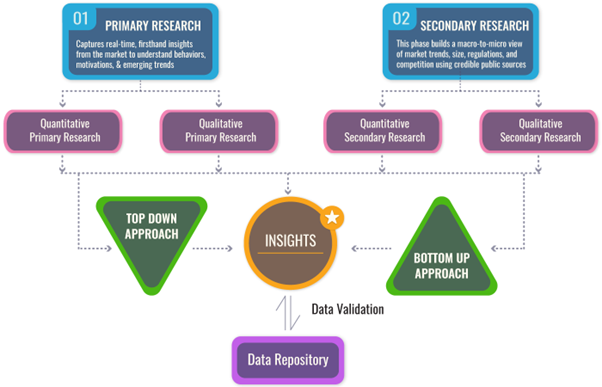
DUAL MODELING: TOP-DOWN + BOTTOM-UP
To ensure robust market estimation, we apply two complementary sizing approaches:
Top-Down Modeling:- Start with broader industry value (e.g., global or regional TAM)
- Apply filters by segment, geography, end-user, or use case
- Adjust with primary insights and validation benchmarks
- Ideal for investor-grade market scans and opportunity mapping
- Aggregate from the ground up using sales volumes, pricing, and unit economics
- Use internal modeling templates aligned with stakeholder data
- Incorporate distributor-level or region-specific inputs
- Most accurate for emerging segments and granular sub-markets
DATA VALIDATION: IN-HOUSE REPOSITORY
We close the loop with proprietary data intelligence built from ongoing projects, industry monitoring, and historical benchmarking. This repository includes:
- Multi-sector market and pricing models
- Key trendlines from past interviews and forecasts
- Benchmarked adoption rates, churn patterns, and ROI indicators
- Industry-specific deviation flags and cross-check logic
- Catches inconsistencies early
- Aligns projections across studies
- Enables consistent, high-trust deliverables