

Europe Roofing Market Size and Forecast (2026 - 2034), Growth, Trend, Share and Industry Analysis Report Coverage; By Product (Metal Roofing, Asphalt / Bituminous Roofing, Clay & Concrete Roofing, Plastic & Polymer Roofing, Green Roofing System, Slate Roofing, and Others); By Roof Design (Flat Roof, Pitched / Sloped Roofing, Curved Roofing, Others); By Application (Residential, Commercial, Industrial, Agricultural, Infrastructure); By Sales Channel (Direct, Indirect) and Geography
2026-10-23
Consumer Products
Aishwarya Panbude (Research Analyst)
Description
The Europe
Roofing Market revenue was 46,241.9 Million
USD in 2025, and will reach 64,906.5 Million
USD in 2034, with a CAGR of 3.9% during 2026-2034.
Roofing Market Introduction
The Europe Roofing Market comprises the demand, production, distribution, and consumption of roofing systems used to protect buildings from rain, snow, wind, heat, UV exposure, and other environmental conditions. The market covers both new-build roofing and replacement/re-roofing activity across residential, commercial, industrial, institutional, and infrastructure applications. Europe represents a relatively mature roofing market, with demand increasingly influenced by renovation of aging building stock, energy-efficiency requirements, sustainability objectives, extreme-weather resilience, and replacement of existing roofs
Roofing Market Size & Highlights
·
The Europe roofing market reached USD 46,241.9 Million in 2025.
·
The market is expected to reach USD 64,906.5 Million by 2034.
·
The roofing industry is anticipated to expand at a CAGR of 3.9% from
2026 to 2034.
· Top companies in the
market include BMI Group, Wienerberger AG, Kingspan Group, Soprema, Sika
AG, and Holcim / Holcim Building Envelope Solutions.
·
Spain dominated the Europe roofing market in 2025.
|
Attribute |
Detail |
|
Market
Drivers |
·
Accelerating
Building Renovation and Energy-Efficiency Upgrades Is Expanding Roofing Replacement
Demand ·
Rapid
Rooftop Solar Deployment Is Increasing Demand for Solar-Ready Roofing Systems |
|
Market Opportunity |
·
Expansion of Circular, Low-Carbon and Traceable Roofing
Products ·
Development
of Smart, Multifunctional and Climate-Resilient Roofing Systems |
Accelerating Building Renovation and Energy-Efficiency Upgrades
Is Expanding Roofing Replacement Demand
The aging building stock
in Europe, coupled with the importance of boosting energy efficiency in
buildings, is driving roof replacement, refurbishment and the use of integrated
roof systems. According to estimates from the European Commission, about 75% of
buildings in the EU are in poor condition in terms of energy efficiency, while
the annual energy renovation rate stands at roughly 1%, indicating that there
is room for considerable improvement among existing buildings. The revised
Energy Performance of Buildings Directive (EPBD) has a transposition deadline
of 29 May 2026 and provides a framework for speeding up the renovation process,
especially for the underperforming buildings. For non-residential buildings,
minimum energy performance standards call for Member States to do something
about the worst-performing 16% of the building stock by 2030 and 26% by 2033,
whereas residential buildings are subject to national roadmaps for decreasing
average primary energy consumption. Implementation of the standards and the
speed of renovation will depend on various factors, such as national policies,
financing systems, and building characteristics in individual countries. The
requirements also promote the importance of roofs with the functions of
weatherproofing, insulating the buildings from heat, managing moisture,
ventilating the roofs and providing long-lasting durability. To achieve this
goal, owners of buildings could decide not only to replace the visible part of
the roof but also to carry out some major renovation works including new
insulation, new underlayers, vapor-control layers, waterproofing membranes,
drainage and other roof components. This creates opportunities for producers
who can provide full final roof solutions as well as separate compatible
materials. Roofing with flat and low-sloped surfaces is highly utilized in
commercial, industrial, logistics, healthcare and public structures. The
considerable area of these roofs gives an opportunity to modernize them with
multisystem waterproofing membranes, bitumen or synthetic membranes, PIR or
mineral wool insulation, vapor barriers and reflective coatings. Pitched roofing
is essential in residential construction, where tiles (clay, concrete), slates,
metal sheets and composite elements can be used along with insulation,
underlayment, ventilation and relevant solar systems. Renovation also results
in demand for those products which can tackle moisture ingress, temperature
fluctuations and highly variable climatic conditions. Durable coatings, better
waterproofing technologies, resistant metals and similarly designed roofs make
it easier for building owners to use buildings for a long time. The European
Commission guidance dated March 2026, stresses that emissions and use of
materials must be taken into account from the moment of construction and up to
renovation and end of life. Although it is not a roofing product requirement in
itself, it gives additional weight to durability, efficiency, reuse and
recycling. Thus, building renovation is increasing not only the potential
volume of roofs’ replacement but also tech requirements.
Expansion of Circular,
Low-Carbon and Traceable Roofing Products Is Creating New Growth Opportunities
The transition towards low
carbon and circular construction in Europe opens up avenues for roofing
suppliers to differentiate their offering with features such as recycling, long
life, repairability and verified environmental performance. The updated Construction
Products Regulation (CPR), Regulation (EU) 2024/3110, came into force on 7
January 2025, with the main stipulations entering into force on 8 January 2026.
This regulation entails amendments in construction products performance
information, environmental properties and digital product data, with
implementation of changes occurring gradually for specific product categories
as relevant technical specifications and implementing acts become available. For
roofing manufacturers, circularity may be applied to product design by using
extremely durable coatings, weatherproof metal coverings, systems that may be
repaired, and replaceable parts, as well as components that allow for
separation of the materials at the end of use. While metal roofing can take
advantage of already developed metal recovery paths, membrane and composite
producers can find ways of improving recyclability and identification of
materials and technologies to recover some of them. The results depend on many
factors, among them the composition of products, the level of contamination,
local recycling facilities, and the existence of proper recovery methods and
processes. The opportunity stretches into more than just material selection; it
reaches into the realm of lifecycle services. Manufacturers can create joint
ventures in roof inspection, refurbishment, component replacement, take-back,
and recycling so that the relationship does not end with the sale of the
solution. The service can assist asset managers in planning for the upkeep, and
replacement of any aspect of the large commercial or industrial property they
manage as well as give them a clearer picture of what their expenses will be in
the future. Repairing or replacing just certain components rather than the
entire system may also help to minimize the amount of material utilized,
provided that this is technically and economically viable. Information about
digital products represents a potential business opportunity. CPR creates a
legal framework for construction companies to prepare Digital Product Passports
but subsequent legislative regulations are still being prepared. According to
the schedule published by the European Commission, the delegated act covering
Digital Product Passports in respect of construction materials is planned to be
issued in Q2 2027. In order to get ready, manufacturers should start working on
the information about their products, including their composition, technical
performance, environmental characteristics, installation, maintenance and
recycling aspects.
Segment Outlook of Europe Roofing Market
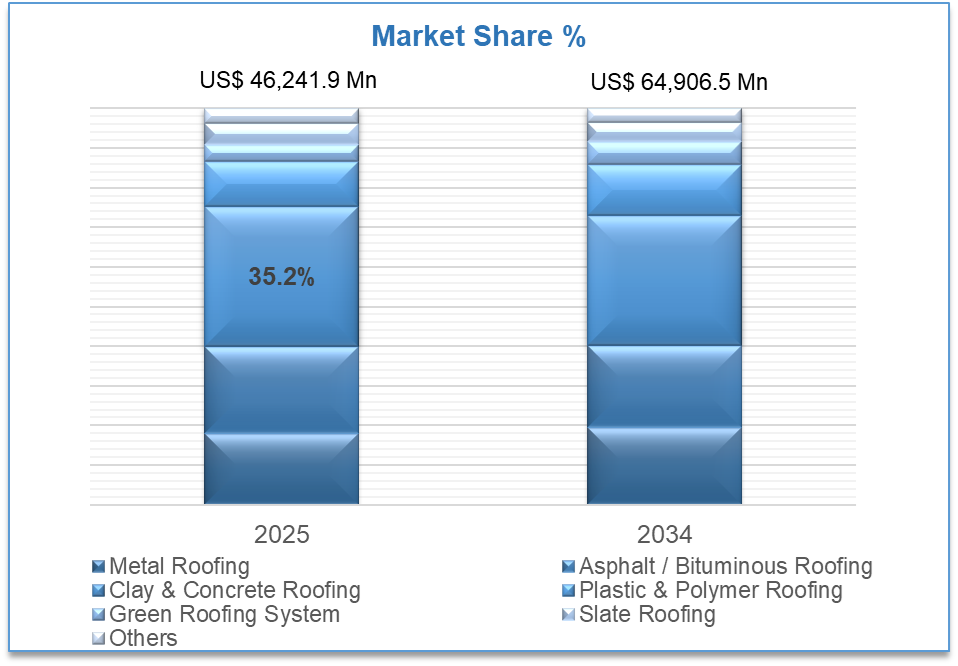
The Europe roofing market is segmented by product into Metal Roofing, Asphalt /
Bituminous Roofing, Clay & Concrete Roofing, Plastic & Polymer Roofing,
Green Roofing System, Slate Roofing, and Others. The product landscape reflects
a mature European roofing industry, where established roofing materials
continue to account for a substantial share of demand while higher-performance,
lightweight, energy-efficient, and multifunctional roofing solutions are
gaining adoption. Clay & Concrete Roofing represents the largest product
category based on the study's market estimates, supported by the extensive use
of roof tiles across residential construction, reroofing, and refurbishment
activities, particularly in markets with established tile-based building
traditions. Asphalt / Bituminous Roofing also represents a substantial product
category, supported by its established use in flat and low-slope roofing across
commercial, industrial, residential, and refurbishment applications.
Country Outlook of Europe Roofing Market
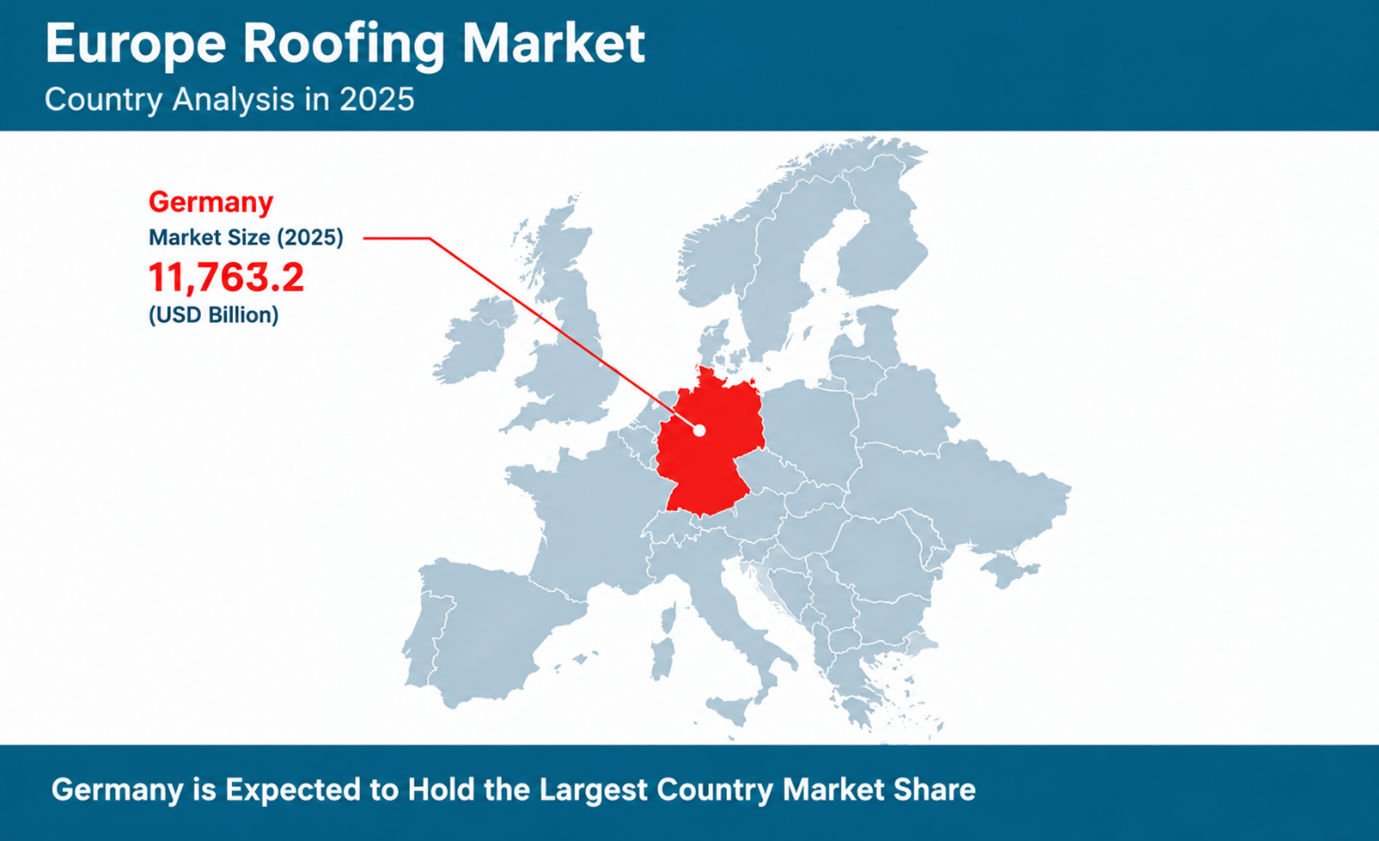
The Europe roofing market can
be analysed across Italy, U.K., France, Spain, Switzerland, Portugal, and Rest
of Europe. Regional demand in the Europe roofing market is fueled by factors
such as building renovation, energy-efficiency regulations, infrastructure
investment, along with demand for long-lasting, durable roofs. Italy is
receiving support due to reconstruction and industrial construction, while the
U.K. is boosted by housing demand and commercial reconstruction. France has
opportunities for roofing replacements and insulation improvement while Spain
is facing demand for heat-resistant roofs, as well as energy-efficient
materials. In Switzerland, there is a strong demand for high-performance
roofing solutions due to tight building standards, whereas Portugal benefits
from its construction activities and the demand for thermal insulation
materials and waterproofing. In the Rest of Europe, the aging stock of
buildings, climate adaptation processes, as well as energy efficiency
initiatives are playing a role in demand for the advanced roofing materials.
Meanwhile, different construction activities, cash limitations, together with
regulatory situations are affecting regional growth.
Analysis of Key Players in Europe Roofing Market
The competitive ecosystem
of the European roofing market consists of firms producing roofing materials,
insulation, waterproofing, and specialized roofing systems catering to the
needs of residential, commercial, and industrial sectors in construction. The
customers drive the competition for durable, energy-efficient,
weather-resistant, and eco-friendly roofing solutions. Some of the keys to
differentiate producers in this market are product quality, thermal efficiency,
durability of the material, installation efficiency, compliance with the
building regulations in Europe, sustainability record, pricing, and ability to
offer tailored roofing systems for construction projects.
Competitive Analysis by
Solution Category
|
Solution Category |
Major Players |
Basis of Competition |
|
Metal Roofing |
ArcelorMittal
Construction, ROVA Group, Pruszynski, BP2, Roofit.Solar, PREFA
Aluminiumprodukte, Ruukki Construction, Lindab, Kingspan Group |
Corrosion resistance,
durability, lightweight construction, installation efficiency, design
flexibility, and compatibility with solar roofing systems. |
|
Asphalt / Bituminous Roofing |
swisspor,
Onduline Group, BMI Group, IKO Europe, Soprema, Bauder, Sika AG |
Waterproofing
performance, weather resistance, product lifespan, ease of installation,
insulation compatibility, and cost competitiveness. |
|
Clay & Concrete
Roofing |
Nelskamp, Terrán,
Wienerberger, BMI Group |
Product durability,
aesthetic variety, thermal performance, weather resistance, and regional
distribution networks. |
|
Plastic & Polymer Roofing |
Holcim
Building Envelope Solutions, Onduline Group, Kingspan Group, IKO Europe,
Soprema, Bauder |
Lightweight
construction, chemical and weather resistance, waterproofing, flexibility,
and lifecycle cost. |
|
Green Roofing
System |
Holcim Building
Envelope Solutions, BMI Group, IKO Europe, Soprema, Bauder |
Vegetation support,
drainage and waterproofing performance, stormwater management, thermal
insulation, and compliance with sustainable building requirements. |
|
Slate Roofing |
BMI Group,
Wienerberger, Nelskamp, Terrán |
Material
longevity, appearance, weather resistance, installation quality, and
availability of regionally suitable roofing products. |
|
Others |
ArcelorMittal
Construction, ROVA Group, Nelskamp, Terrán, swisspor, Pruszynski, BP2,
Kingspan Group, Onduline Group, BMI Group, Wienerberger, IKO Europe, Soprema,
Bauder, Sika AG, PREFA Aluminiumprodukte, Ruukki Construction, Lindab |
Product
specialization, energy efficiency, material innovation, compliance with
building standards, customization, sustainability, and pricing. |
Key Developments in Europe Roofing Market
·
Paul Bauder GmbH & Co.
KG — Drusenheim Production: In January 2026, Bauder officially opened its new production
facility in Drusenheim, Alsace, after approximately two and a half years of
construction. The company invested approximately USD 114 million in the
facility, strengthening its European manufacturing footprint and capacity for
roofing-system production.
· Ruukki Construction — Expansion of Roofing: In September 2026 Ruukki launches Grid15 three-dimensional surface profile for SPA
sandwich panels, enabling innovative new design opportunities for buildings
requiring distinctive architectural identity; Jan Samec (VP Building Envelopes)
highlights design flexibility.
The roofing market can be
split based on product, roof design, application, sales channel,
and country
as follows:
On the basis of product,
the roofing market from 2021 to 2034 is primarily split into:
·
Metal Roofing
·
Asphalt / Bituminous Roofing
·
Clay & Concrete Roofing
·
Plastic & Polymer Roofing
·
Green Roofing System
·
Slate Roofing
·
Others
On the basis of roof
design, the roofing market from 2021 to 2034 covers:
· Flat Roof
· Pitched / Sloped Roofing
· Curved Roofing
· Others
On the basis of application,
the roofing market from 2021 to 2034 covers:
· Residential
· Commercial
· Industrial
· Agricultural
· Infrastructure
On the basis of sales
channel, the roofing market from 2021 to 2034 covers:
· Direct
· Indirect
Geographically, the
detailed analysis of consumption, revenue, market share and growth rate, historic
and forecast (2021-2034) of the following regions are covered
·
Germany
·
Italy
·
U.K.
·
France
·
Spain
·
Switzerland
·
Portugal
·
Rest of Europe
Key players in the Europe Roofing market covered:
·
BMI Group
· Wienerberger
· Onduline SAS
· IKO Ltd.
· Kingspan Group
·
Soprema
· Paul Bauder GmbH & Co. KG
· Sika AG
· PREFA Aluminiumprodukte GmbH
· Ruukki Construction
· Lindab AB
· ArcelorMittal
· ROVA-Group
· Dachziegelwerke Nelskamp GmbH
· Terran Roof Tile Manufacturer Ltd.
· Swisspor AG
· Pruszynski
· BP2 sp. z o.o.
· Holcim
· Roofit.Solar
Aishwarya Panbude (Research Analyst)
Aishwarya Panbude is a skilled Research Analyst with 4+ years of experience in market intelligence, consumer insights, competitive analysis, and industry forecasting across the consumer goods, agriculture, and food & beverage sectors. She specializes in market sizing, trend analysis, growth opportunity mapping, and strategic secondary research for global and regional markets.
Her expertise lies in transforming complex industry data into actionable business strategies that help organizations identify emerging trends, understand customer behavior, and gain a competitive edge. With a strong focus on data-driven insights, business intelligence, and future market trends, Jaya delivers high-quality research solutions aligned with evolving industry demands and market dynamics.
1.
Europe Roofing Market Introduction and Market
Overview
1.1. Objectives
of the Study
1.2. Market
Segmentation
1.2.1.Product
of the European Roofing Market
1.2.2.Roof
Design of Europe Roofing Market
1.2.3.Application
of Europe Roofing Market
1.2.4.Sales
Channel of Europe Roofing Market
1.2.5.Country
of Europe Roofing Market
1.3. Competition
Coverage List of Market Participants
1.4. Market
Definition: Roofing Market
2.
Executive
Summary
2.1. Europe
Roofing Market Estimation & Forecast
2.1.1.Europe
Roofing Market Size (US$ Million) Estimates & Historical Trend Analysis
(2021 - 2025)
2.1.2.Europe
Roofing Overall Market Size (US$ Million), Growth Rate (Y-o-Y), Market CAGR
(%), Market forecast (2026 - 2034)
2.2. Snapshot
of Europe Roofing Market
2.3. Europe
Roofing Market Revenue Share (%) 2025
2.4. Key
Competitors & Key Insights
3.
Market
Overview (Qualitative Analysis)
3.1. Demand
Side Trends
3.2. Supply
Side Trends / Manufacturing Trends
3.3. Demand
and Opportunity Assessment, 2026 - 2034
3.4. Market
Dynamics
3.4.1.Drivers
3.4.2.Limitations
3.4.3.Opportunities
3.4.4.Impact
Analysis of Drivers and Restraints
3.5. Europe
Roofing Demand by Product Category
3.6. Roofing
Innovation Trends
3.7. Roofing
Material Substitution Analysis
3.8. New
Construction vs. Renovation Demand
3.9. Reroofing
/ Over-Roofing Opportunity
3.10. Consumer
& Contractor Preference Analysis
3.11. Installation
& Labor-Saving Analysis
3.12. Roofing
Distribution Channel Analysis
3.13. Product
Gap & White-Space Analysis
3.14. Regulatory
& Building-Code Impact
3.15. Pricing
Analysis
3.16. Value
Chain Analysis
4.
Europe
Roofing Market Estimates & Forecast Trend Analysis, by Product
4.1. Europe
Roofing Market Assessments & Key Findings, by Product
4.2. Europe
Roofing Market Revenue (US$ Million) Estimates and Forecasts, by Product, 2021
- 2034
4.2.1.Metal
Roofing
4.2.2.Asphalt
/ Bituminous Roofing
4.2.3.Clay
& Concrete Roofing
4.2.4.Plastic
& Polymer Roofing
4.2.5.Green
Roofing System
4.2.6.Slate
Roofing
4.2.7.Others
5.
Europe
Roofing Market Estimates & Forecast Trend Analysis, by Roof Design
5.1. Europe
Roofing Market Assessments & Key Findings, by Roof Design
5.2. Europe
Roofing Market Revenue (US$ Million) Estimates and Forecasts, by Roof Design, 2021
- 2034
5.2.1.Flat
Roof
5.2.2.Pitched
/ Sloped Roofing
5.2.3.Curved
Roofing
5.2.4.Others
6.
Europe
Roofing Market Estimates & Forecast Trend Analysis, by Application
6.1. Europe
Roofing Market Assessments & Key Findings, by Application
6.2. Europe
Roofing Market Revenue (US$ Million) Estimates and Forecasts, by Application, 2021
- 2034
6.2.1.Residential
6.2.2.Commercial
6.2.3.Industrial
6.2.4.Agricultural
6.2.5.Infrastructure
7.
Europe
Roofing Market Estimates & Forecast Trend Analysis, by Sales Channel
7.1. Europe
Roofing Market Assessments & Key Findings, by Sales Channel
7.2. Europe
Roofing Market Revenue (US$ Million) Estimates and Forecasts, by Sales Channel,
2021 - 2034
7.2.1.Direct
7.2.2.Indirect
8.
Europe
Roofing Market Estimates & Forecast Trend Analysis, by Country
8.1. Europe
Roofing Market Assessments & Key Findings, by Country
8.2. Europe
Roofing Market Revenue (US$ Million) Estimates and Forecasts, by Country, 2021
- 2034
8.2.1.Germany
8.2.2.Italy
8.2.3.U.K.
8.2.4.France
8.2.5.Spain
8.2.6.Switzerland
8.2.7.Portugal
8.2.8.Rest
of Europe
9.
Germany Roofing Market: Estimates
& Forecast Trend Analysis
9.1.
Germany Roofing Market Assessments & Key
Findings
9.1.1.Germany
Roofing Market Introduction
9.1.2.Germany
Roofing Market Size Estimates and Forecast (US$ Million) (2021 - 2034)
9.1.2.1. By Product
9.1.2.2. By Roof
Design
9.1.2.3. By
Application
9.1.2.4. By Sales
Channel
10. Italy
Roofing Market: Estimates & Forecast Trend Analysis
10.1. Italy
Roofing Market Assessments & Key Findings
10.1.1. Italy
Roofing Market Introduction
10.1.2. Italy
Roofing Market Size Estimates and Forecast (US$ Million) (2021 - 2034)
10.1.2.1. By
Product
10.1.2.2. By
Roof Design
10.1.2.3. By
Application
10.1.2.4. By
Sales Channel
11. U.K.
Roofing Market: Estimates & Forecast Trend Analysis
11.1. U.K.
Market Assessments & Key Findings
11.1.1. U.K.
Roofing Market Introduction
11.1.2. U.K.
Roofing Market Size Estimates and Forecast (US$ Million) (2021 - 2034)
11.1.2.1. By
Product
11.1.2.2. By
Roof Design
11.1.2.3. By
Application
11.1.2.4. By
Sales Channel
12. France
Roofing Market: Estimates & Forecast Trend Analysis
12.1. France
Market Assessments & Key Findings
12.1.1. France Roofing Market Introduction
12.1.2. France Roofing Market Size Estimates and
Forecast (US$ Million) (2021 - 2034)
12.1.2.1. By
Product
12.1.2.2. By
Roof Design
12.1.2.3. By
Application
12.1.2.4. By
Sales Channel
13. Spain
Roofing Market: Estimates & Forecast Trend Analysis
13.1. Spain
Market Assessments & Key Findings
13.1.1. Spain
Roofing Market Introduction
13.1.2. Spain
Roofing Market Size Estimates and Forecast (US$ Million) (2021 - 2034)
13.1.2.1. By
Product
13.1.2.2. By
Roof Design
13.1.2.3. By
Application
13.1.2.4. By
Sales Channel
14. Switzerland
Roofing Market: Estimates & Forecast Trend Analysis
14.1. Switzerland
Market Assessments & Key Findings
14.1.1. Switzerland
Roofing Market Introduction
14.1.2. Switzerland
Roofing Market Size Estimates and Forecast (US$ Million) (2021 - 2034)
14.1.2.1. By
Product
14.1.2.2. By
Roof Design
14.1.2.3. By
Application
14.1.2.4. By
Sales Channel
15. Portugal
Roofing Market: Estimates & Forecast Trend Analysis
15.1. Portugal
Market Assessments & Key Findings
15.1.1. Portugal
Roofing Market Introduction
15.1.2. Portugal
Roofing Market Size Estimates and Forecast (US$ Million) (2021 - 2034)
15.1.2.1. By
Product
15.1.2.2. By
Roof Design
15.1.2.3. By
Application
15.1.2.4. By
Sales Channel
16. Rest
of Europe Roofing Market: Estimates & Forecast Trend Analysis
16.1. Rest
of Europe Market Assessments & Key Findings
16.1.1. Rest
of Europe Roofing Market Introduction
16.1.2. Rest
of Europe Roofing Market Size Estimates and Forecast (US$ Million) (2021 -
2034)
16.1.2.1. By
Product
16.1.2.2. By
Roof Design
16.1.2.3. By
Application
16.1.2.4. By
Sales Channel
17. Competition
Landscape
17.1. Europe
Roofing Market Product Mapping
17.2. Europe
Roofing Market Concentration Analysis, by Leading Players / Innovators /
Emerging Players / New Entrants
17.3. Europe
Roofing Market Tier Structure Analysis
17.4. Europe
Roofing Market Concentration & Company Market Shares (%) Analysis, 2025
18. Company
Profiles
18.1. BMI
Group
18.1.1. Company
Overview & Key Stats
18.1.2. Financial
Performance & KPIs
18.1.3. Product
Portfolio
18.1.4. SWOT
Analysis
18.1.5. Business
Strategy & Recent Developments
* Similar details would be provided
for all the players mentioned below
18.2. Wienerberger
18.3. Onduline
SAS
18.4. IKO
Ltd.
18.5. Kingspan
Group
18.6. Soprema
18.7. Paul
Bauder GmbH & Co. KG
18.8. Sika
AG
18.9. PREFA
Aluminiumprodukte GmbH
18.10. Ruukki
Construction
18.11. Lindab
AB
18.12. ArcelorMittal
18.13. ROVA-Group
18.14. Dachziegelwerke
Nelskamp GmbH
18.15. Terran
Roof Tile Manufacturer Ltd.
18.16. swisspor
AG
18.17. Pruszynski
18.18. BP2
sp. z o.o.
18.19. Roofit.Solar
18.20. Holcim
18.21. Other
Prominent Players
19. Research Findings & Conclusion
20. Assumptions
& Acronyms Used
21. Research Methodology
21.1. External
Transportation / Databases
21.2. Internal
Proprietary Database
21.3. Primary
Research
21.4. Secondary
Research
21.5. Assumptions
21.6. Limitations
21.7. Report FAQs
Our Research Methodology
"Insight without rigor is just noise."
We follow a comprehensive, multi-phase research framework designed to deliver accurate, strategic, and decision-ready intelligence. Our process integrates primary and secondary research , both quantitative and qualitative , along with dual modeling techniques ( top-down and bottom-up) and a final layer of validation through our proprietary in-house repository.
PRIMARY RESEARCH
Primary research captures real-time, firsthand insights from the market to understand behaviors, motivations, and emerging trends.
1. Quantitative Primary Research
Objective: Generate statistically significant data directly from market participants.
Approaches:- Structured surveys with customers, distributors, and field agents
- Mobile-based data collection for point-of-sale audits and usage behavior
- Phone-based interviews (CATI) for market sizing and product feedback
- Online polling around industry events and digital campaigns
- Purchase frequency by customer type
- Channel performance across geographies
- Feature demand by application or demographic
2. Qualitative Primary Research
Objective: Explore decision-making drivers, pain points, and market readiness.
Approaches:- In-depth interviews (IDIs) with executives, product managers, and key decision-makers
- Focus groups among end users and early adopters
- Site visits and observational research for consumer products
- Informal field-level discussions for regional and cultural nuances
SECONDARY RESEARCH
This phase helps establish a macro-to-micro understanding of market trends, size, regulation, and competitive dynamics, sourced from credible and public domain information.
1. Quantitative Secondary Research
Objective: Model market value and segment-level forecasts based on published data.
Sources include:- Financial reports and investor summaries
- Government trade data, customs records, and regulatory statistics
- Industry association publications and economic databases
- Channel performance and pricing data from marketplace listings
- Revenue splits, pricing trends, and CAGR estimates
- Supply-side capacity and volume tracking
- Investment analysis and funding benchmarks
2. Qualitative Secondary Research
Objective: Capture strategic direction, innovation signals, and behavioral trends.
Sources include:- Company announcements, roadmaps, and product pipelines
- Publicly available whitepapers, conference abstracts, and academic research
- Regulatory body publications and policy briefs
- Social and media sentiment scanning for early-stage shifts
- Strategic shifts in market positioning
- Unmet needs and white spaces
- Regulatory triggers and compliance impact
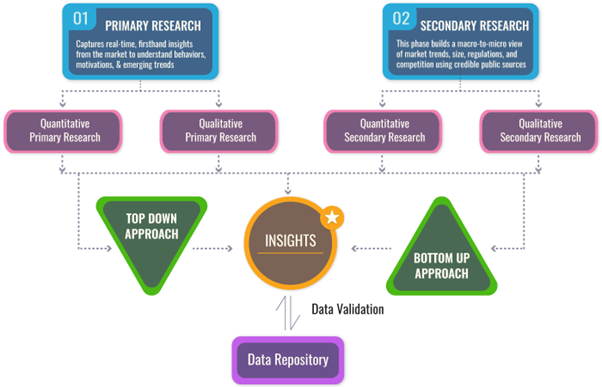
DUAL MODELING: TOP-DOWN + BOTTOM-UP
To ensure robust market estimation, we apply two complementary sizing approaches:
Top-Down Modeling:- Start with broader industry value (e.g., global or regional TAM)
- Apply filters by segment, geography, end-user, or use case
- Adjust with primary insights and validation benchmarks
- Ideal for investor-grade market scans and opportunity mapping
- Aggregate from the ground up using sales volumes, pricing, and unit economics
- Use internal modeling templates aligned with stakeholder data
- Incorporate distributor-level or region-specific inputs
- Most accurate for emerging segments and granular sub-markets
DATA VALIDATION: IN-HOUSE REPOSITORY
We close the loop with proprietary data intelligence built from ongoing projects, industry monitoring, and historical benchmarking. This repository includes:
- Multi-sector market and pricing models
- Key trendlines from past interviews and forecasts
- Benchmarked adoption rates, churn patterns, and ROI indicators
- Industry-specific deviation flags and cross-check logic
- Catches inconsistencies early
- Aligns projections across studies
- Enables consistent, high-trust deliverables