

Fabric Softener and Conditioner Market Size and Forecast (2026–2034), Global and Regional Growth, Trend, Share and Industry Analysis Report Coverage; By Product (Liquid Fabric Softeners, Dryer Sheets, Dryer Bars, Tablets and Pods, Fabric Softener Sprays, Others); By Type (Conventional, Organic and Plant-Based); By Application (Household, Commercial); By Distribution Channel (Supermarkets and Hypermarkets, Convenience Stores, Specialty Stores, Online Retail, Others); and Geography
2026-11-04
Consumer Products
Aishwarya Panbude (Research Analyst)
Description
Fabric Softener and Conditioner Market Overview
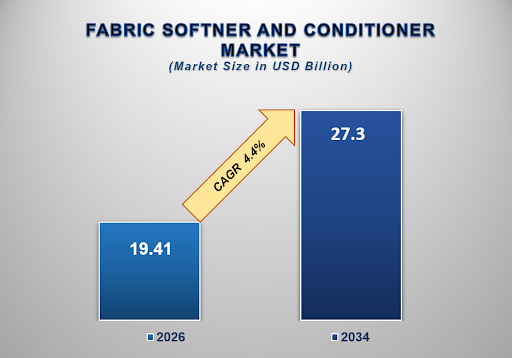
The global Fabric Softener and Conditioner Market is valued at USD 19.41 billion in 2026 and is projected to reach USD 27.3 billion by 2034, expanding at a CAGR of 4.4% during the forecast period. Market growth is supported by increasing consumer attention to clothing care, rising demand for comfortable and pleasant-smelling fabrics, changing household laundry habits, the expansion of organized retail, and continuous innovation in fabric-conditioning formulations. Fabric softeners and conditioners have become established components of many laundry routines because they improve the tactile quality of textiles, reduce static electricity, support easier ironing, and provide fragrance that remains on garments after washing.
Fabric softeners and conditioners are laundry-care products formulated to improve the softness, feel, fragrance, and handling characteristics of washed textiles. They are available in different formats, including liquid formulations added during the rinse cycle, dryer sheets used during machine drying, concentrated products, fabric-conditioning tablets, pods, and other specialized preparations. Depending on their formulation, these products can help reduce static cling, minimize friction between textile fibers, make garments feel smoother, and improve the overall laundry experience.
The market serves a broad consumer base, ranging from households seeking everyday fabric-care products to commercial establishments responsible for processing substantial volumes of linen, uniforms, towels, bedding, and other washable textiles. Household consumption is influenced by laundry frequency, family size, washing-machine ownership, consumer purchasing power, and preferences regarding fragrance and fabric feel. Commercial demand is associated with operational requirements in hospitality, healthcare, laundry services, and other businesses where the condition and presentation of textiles are important.
One of the major characteristics of the market is the gradual expansion of fabric care beyond basic cleaning. Consumers increasingly distinguish between detergents, which primarily remove soil and stains, and conditioners, which serve additional functions related to softness, fragrance, and fabric handling. This distinction has encouraged manufacturers to develop complementary laundry-care ranges designed to provide a more complete washing experience.
Product performance remains a central consideration in purchasing decisions. Consumers evaluate how effectively a conditioner softens different fabrics, how long its fragrance remains noticeable, whether it leaves residue, how easily it dissolves or disperses during washing, and whether it is compatible with their preferred laundry equipment. Manufacturers therefore compete through formulation quality, fragrance development, product concentration, packaging convenience, and compatibility with different washing routines.
Fragrance is an important product-differentiation factor. Fresh, floral, citrus, botanical, and long-lasting fragrance variants allow brands to address different preferences and usage occasions. Some consumers prefer subtle scents suitable for everyday clothing, while others select more pronounced fragrances intended to remain noticeable after garments have dried and been stored. Fragrance-led product positioning also enables manufacturers to introduce multiple variants within a single brand portfolio.
The growing availability of washing machines and tumble dryers influences the range of formats purchased by consumers. Liquid conditioners are commonly incorporated into washing routines, while dryer sheets and other dryer-compatible products address households using machine-drying equipment. Products designed for different laundry systems enable manufacturers to reach consumers with varying infrastructure, climate conditions, and household practices.
Convenience is another factor shaping product development. Concentrated liquid formulations, smaller-dose products, easy-pour bottles, measured-dose formats, and refill packaging can simplify product handling and storage. These developments are particularly relevant for consumers seeking to reduce the space occupied by household cleaning products or limit the frequency of replenishment purchases.
Environmental considerations are becoming increasingly relevant to fabric-care purchasing decisions. Consumers are paying greater attention to ingredient selection, packaging waste, product concentration, biodegradability claims, and the responsible use of resources. This is creating opportunities for manufacturers to explore plant-derived conditioning ingredients, concentrated formulas, recyclable packaging, refill systems, and formulations designed to reduce unnecessary material consumption. However, the environmental performance of individual products depends on their ingredients, manufacturing processes, packaging, and disposal conditions.
The growth of e-commerce has also changed how consumers discover and purchase fabric softeners and conditioners. Online marketplaces and brand websites allow shoppers to compare fragrances, product sizes, formulations, prices, customer reviews, and multipack offers. Digital channels can make specialized products accessible in markets where physical retailers offer a narrower selection. Subscription services and recurring household-product orders may further support repeat purchases.
Price sensitivity continues to influence purchasing patterns, particularly in markets where consumers balance fabric-care preferences against the cost of other household necessities. Economy products serve value-conscious households, while premium formulations appeal to consumers seeking differentiated fragrances, concentrated performance, specialized ingredients, or more sophisticated packaging. Manufacturers must therefore balance product innovation with affordability to maintain broad consumer reach.
The competitive landscape includes multinational consumer-goods companies, established home-care brands, regional manufacturers, and emerging businesses specializing in concentrated or environmentally positioned products. Companies compete through distribution strength, brand recognition, product availability, fragrance portfolios, promotional pricing, packaging innovation, and the ability to adapt formulations to local consumer preferences.
As fabric-care awareness, household laundry activity, product innovation, and modern retail access continue to influence purchasing behaviour, the global fabric softener and conditioner market is expected to experience steady expansion through 2034.
Fabric Softener and Conditioner Market Drivers and Opportunities
Increasing Consumer Attention to Fabric Care, Garment Comfort and Long-Lasting Fragrance Is Driving Market Growth
The increasing emphasis on clothing comfort and fabric maintenance is an important factor supporting demand for fabric softeners and conditioners. Consumers are becoming more selective about the way their garments feel after washing, particularly for clothing worn for extended periods, bedding used daily, towels, children's garments, and other frequently washed textiles. Fabric conditioners address these preferences by improving softness and providing a finishing benefit beyond the cleaning function of laundry detergents.
Repeated washing can alter the feel and handling characteristics of certain fabrics. Depending on the textile composition, washing conditions, detergent selection, and drying method, garments may develop a rougher texture or increased static cling. Fabric-conditioning products are designed to address some of these concerns by reducing friction between fibers and improving the perceived smoothness of washed materials.
Fragrance is another important influence on repeat purchasing. Many consumers associate freshly laundered clothing with cleanliness and comfort, making fragrance a meaningful element of the product experience. Manufacturers offer multiple scent profiles to appeal to different age groups, household preferences, and purchasing segments. Products with distinctive or longer-lasting fragrance positioning can also help brands differentiate themselves in a category where consumers may perceive basic conditioning benefits as similar.
The increasing use of specialized laundry products is supporting the development of more differentiated fabric-care portfolios. Consumers may select separate products for everyday clothing, delicate textiles, towels, bedding, sportswear, and other laundry categories. Although fabric softeners are not appropriate for every textile or performance garment, product-specific guidance and clearer usage instructions can help consumers identify formulations suited to their laundry needs.
Higher household spending capacity can further support demand for branded, premium, and specialized fabric-care products. Consumers who prioritize convenience, fragrance, and the overall quality of their laundry routine may be willing to purchase products that offer additional perceived benefits. At the same time, economy and mid-priced formulations remain important for households seeking consistent performance without significantly increasing their laundry expenditure.
Growing awareness of complete laundry-care routines is therefore encouraging manufacturers to strengthen their product portfolios, improve formulation performance, and communicate the benefits of fabric conditioning more effectively. These factors are expected to support recurring demand throughout the forecast period.
Expansion of Modern Retail, Urban Households, and Convenient Laundry Solutions Is Supporting Market Expansion
The expansion of organized retail and digital commerce is increasing product accessibility across developed and emerging economies. Supermarkets, hypermarkets, convenience stores, neighborhood retailers, specialty household-product outlets, and online marketplaces provide multiple purchasing options for consumers. Broader retail availability helps manufacturers reach different income groups while improving product visibility and supporting repeat purchases.
Urbanization and changes in household routines are also influencing the market. Consumers managing busy schedules may prefer laundry products that simplify washing, reduce additional garment-care effort, and provide consistent results. Fabric conditioners are positioned as convenient additions to routine laundry activities because they can be incorporated into existing washing practices without requiring a separate garment-treatment process.
The growing use of automatic washing machines supports demand for products designed for machine-based laundry. Liquid fabric conditioners are commonly formulated for addition to the rinse stage, while compatible dosing compartments and measured-dose products can simplify usage. Manufacturers are also developing packaging that makes dispensing easier and helps consumers manage product quantities more accurately.
Commercial laundry operations create another source of demand. Hotels, serviced apartments, healthcare facilities, professional laundries, and hospitality businesses handle substantial volumes of towels, bedding, uniforms, and other textiles. These establishments may use fabric-conditioning products to achieve preferred softness, improve textile handling, and maintain consistent presentation. Their purchasing decisions, however, also depend on cost per wash, equipment compatibility, processing requirements, and the suitability of the product for the fabrics being treated.
Retail promotions, multipack offers, bulk packaging, and product bundles can encourage consumers to purchase fabric conditioners alongside detergents and other household-cleaning products. These strategies can improve product visibility and encourage trial among consumers who have not previously used a dedicated conditioner.
Digital shopping is strengthening these distribution opportunities by allowing consumers to compare product variants, read usage instructions, and purchase products without visiting physical stores. Online channels are particularly useful for concentrated products, specialty formulations, and larger packs that may not be available at every local retailer.
The combined influence of retail expansion, changing household routines, washing-machine adoption, and convenient purchasing options is creating a broader consumer base for fabric softeners and conditioners. Manufacturers that maintain reliable distribution and offer products suited to local preferences are positioned to benefit from these developments.
Eco-Conscious Formulations, Concentrated Products and Premium Fabric-Care Innovation Create Significant Opportunities
Product innovation represents an important opportunity for companies seeking to differentiate their offerings in an established consumer-products category. Manufacturers can develop formulations that address specific consumer requirements, including fragrance preferences, reduced packaging weight, convenient dosing, sensitive-skin considerations, and the use of selected plant-derived ingredients.
Growing interest in environmental responsibility is encouraging exploration of concentrated formulations and alternative packaging systems. Concentrated products can provide more conditioning agent per unit of packaged volume, potentially reducing the amount of packaging and transportation required per wash when compared with an otherwise equivalent conventional product. Refill formats and appropriately designed recyclable packaging may provide additional opportunities to reduce material use, although their actual environmental benefits depend on consumer behavior, local recycling infrastructure, and product composition.
Plant-based and bio-derived ingredients offer another area for product development. Manufacturers can investigate conditioning agents sourced from renewable feedstocks and formulations designed to meet defined biodegradability or environmental-performance criteria. Clear substantiation of product claims will be essential because the presence of plant-derived ingredients alone does not establish that an entire formulation is environmentally preferable.
Premiumization also creates opportunities in fragrance development, specialized conditioning performance, and product presentation. Consumers seeking distinctive scent experiences or more convenient laundry routines may be attracted to premium variants, fragrance collections, concentrated formulas, and products designed for particular household requirements. Manufacturers can use differentiated packaging, targeted marketing, and product bundles to strengthen brand positioning within this segment.
Emerging markets offer further opportunities as modern retail infrastructure expands and consumers gain access to a wider variety of branded home-care products. Localized fragrance portfolios, affordable pack sizes, region-specific distribution strategies, and pricing suited to household budgets can help companies reach new customer groups.
Commercial customers represent an additional area for product development. Large laundry operators and hospitality businesses may value concentrated products, bulk containers, controlled-dosing systems, and formulations designed for repeated use under specified processing conditions. Products that help simplify handling and provide consistent results may be attractive when supported by appropriate cost and performance evaluations.
E-commerce, social media, and direct-to-consumer channels can support these strategies by helping manufacturers communicate product differences, educate consumers about correct usage, and introduce new formulations to targeted audiences. Companies that combine credible product claims with practical innovation and accessible pricing are likely to find opportunities for differentiation through 2034.
Fabric Softener and Conditioner Market Scope
Fabric Softener and Conditioner Market Report Segmentation Analysis
The global fabric softener and conditioner market is segmented by product, type, application, distribution channel, and region. Product segmentation reflects the different formats through which conditioning agents are delivered to textiles. Type segmentation distinguishes conventional formulations from organic and plant-based alternatives. Application segmentation covers household and commercial usage, while distribution-channel segmentation considers the retail and commercial routes through which products reach customers.
Liquid Fabric Softeners Segment Is Expected to Dominate the Market by Product
The Liquid Fabric Softeners segment represents a major product category because liquid formulations are widely incorporated into household laundry routines. These products can be added during the rinse cycle or dispensed through compatible washing-machine compartments, allowing consumers to combine fabric conditioning with their regular washing process. Liquid products are available in different concentrations, pack sizes, fragrances, and price categories.
Liquid fabric softeners can be developed for different consumer priorities, including everyday softness, fragrance retention, concentrated performance, and convenient dispensing. Their established presence in supermarkets and household-product retail outlets also supports accessibility across a wide range of markets.
Manufacturers continue to introduce variations in fragrance, formulation, and packaging to distinguish their liquid products. Concentrated variants may appeal to consumers seeking smaller bottles or reduced storage requirements, while larger containers and multipacks can address households with frequent laundry needs.
Liquid formulations also offer flexibility in product positioning. Economy products can focus on basic conditioning benefits and affordability, whereas premium variants can emphasize fragrance complexity, specialized ingredients, and differentiated user experiences.
Nevertheless, the performance of liquid softeners depends on correct dosage, washing-machine compatibility, and the textile being treated. Certain technical fabrics, moisture-wicking garments, towels, and other specialized textiles may require particular care because conventional conditioners can affect their intended performance.
Liquid Fabric Softeners
Liquid fabric softeners are formulated to condition fabrics during the washing process. Their formulations typically contain conditioning agents, fragrance components, and other ingredients selected to provide the intended product characteristics.
These products are available in standard and concentrated forms, with differences in dosage requirements, viscosity, fragrance intensity, and packaging. Consumers can choose among floral, fresh, citrus, botanical, and other fragrance profiles according to personal preferences.
Liquid conditioners are sold through supermarkets, hypermarkets, convenience stores, specialty retailers, and online platforms. Their wide availability and compatibility with common laundry routines make them a central product format for many fabric-care brands.
Dryer Sheets
Dryer sheets are thin sheets treated with fabric-conditioning ingredients and designed for use in compatible tumble-drying processes. They can help reduce static cling and improve the feel of certain textiles during drying.
Their premeasured format provides convenience because consumers do not need to pour or measure a liquid product. Dryer sheets are particularly relevant in markets where tumble dryers are commonly used in residential laundry routines.
Manufacturers can differentiate dryer sheets through fragrance, sheet quantity, packaging design, and formulation characteristics. However, consumers must follow product instructions because dryer sheets are not suitable for every fabric or drying application.
Dryer Bars
Dryer bars are solid or semi-solid conditioning products designed for use in compatible dryer systems. They offer an alternative to liquid conditioners and disposable dryer sheets by delivering conditioning ingredients during the drying process.
The segment appeals to consumers seeking alternative dispensing formats and products that can be used across multiple drying cycles, depending on the product design. Manufacturers may focus on convenience, fragrance, durability, and ease of installation.
Market adoption depends on consumer familiarity, the availability of compatible equipment, and the relative convenience and cost of competing dryer-care products.
Tablets and Pods
Tablets and pods represent measured-dose formats intended to simplify the delivery of fabric-conditioning ingredients. Their preportioned design can help reduce manual measuring and provide a convenient option for consumers who prefer standardized dosing.
Product development in this category focuses on ease of handling, dissolution behavior, packaging protection, and compatibility with the intended washing or conditioning process.
Manufacturers must ensure that these formats include clear usage instructions and appropriate packaging, particularly where concentrated ingredients require careful handling.
Fabric Softener Sprays
Fabric softener sprays and related fabric-refreshing products serve more specialized applications. Depending on the formulation, they may be used to refresh certain textiles, improve their feel, or provide fragrance between washes.
These products can appeal to consumers seeking quick fabric-care solutions for garments, upholstery, or other suitable textile surfaces. Their use differs from conventional rinse-cycle conditioners, and their suitability depends on the manufacturer's instructions and the type of material being treated.
Others
Other product formats include fabric-conditioning concentrates, crystals, specialized conditioning preparations, and emerging delivery systems that do not fit neatly into the principal categories.
Innovation in these formats may focus on improved convenience, reduced packaging volume, fragrance delivery, or compatibility with specific laundry routines. Their future development will depend on demonstrated performance, consumer acceptance, and competitive pricing.
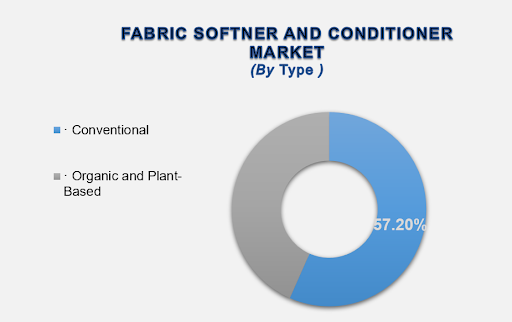
Conventional Segment Is Expected to Maintain a Significant Share of the Market by Type
The Conventional segment includes fabric softeners and conditioners manufactured using established conditioning ingredients and formulation approaches. These products serve a broad consumer base and are available across economy, mid-range, and premium price categories.
Conventional formulations benefit from established manufacturing capabilities, widespread retail distribution, consumer familiarity, and extensive fragrance portfolios. They are commonly positioned around softness, static reduction, fragrance, and convenience.
Manufacturers continue to adjust conventional formulations to improve product stability, dosing characteristics, fragrance delivery, and packaging efficiency. Formulation changes may also be required to meet evolving regulatory requirements and retailer expectations in different markets.
Despite the development of alternative formulations, conventional products remain relevant because many consumers prioritize affordability, familiar performance, and ease of availability. Their market position is influenced by the relative price of alternatives, brand loyalty, and consumer understanding of product claims.
Organic and Plant-Based Segment Is Creating New Product Opportunities
The Organic and Plant-Based segment includes products positioned around plant-derived conditioning ingredients or selected formulations marketed toward consumers seeking alternatives to conventional products. The exact meaning of organic, natural, and plant-based claims varies, so product composition and certification should be evaluated individually.
Demand for these products is influenced by growing interest in ingredient transparency, environmental responsibility, and household products perceived as more aligned with personal sustainability preferences.
Manufacturers in this category may emphasize selected renewable ingredients, fragrance choices, refill packaging, and clearly communicated formulation information. These features can help products appeal to environmentally conscious shoppers and consumers seeking specific ingredient profiles.
However, plant-derived ingredients do not automatically make a formulation safer, biodegradable, or environmentally superior. Companies must support relevant claims with suitable evidence and comply with applicable labeling requirements.
The segment's future development will depend on product performance, affordability, availability, transparent claims, and consumer confidence.
Household Segment Is Expected to Represent a Major Share of the Market by Application
The Household segment covers fabric softeners and conditioners purchased for routine domestic laundry. Household consumers use these products for suitable garments, bedding, towels, and other textiles where additional softness or fragrance is desired.
Purchasing behavior is influenced by laundry frequency, family size, washing-machine ownership, household income, fragrance preferences, and brand familiarity. Pack sizes and price points are important because consumers often purchase fabric conditioners as recurring household necessities.
Manufacturers use product variants to address different household preferences. These include everyday formulations, concentrated products, fragrance-focused ranges, sensitive-skin-oriented offerings, and economical larger packs.
Household demand also benefits from product bundling and cross-category marketing alongside detergents, stain removers, and other laundry-care products. E-commerce and subscription-style purchasing can further simplify repeat orders.
Consumers must still consider textile-care instructions because fabric conditioners may not be appropriate for all materials, including some technical and performance fabrics.
Commercial Segment Is Supported by Professional Laundry and Hospitality Requirements
The Commercial segment includes fabric-conditioning products used by businesses that process textiles regularly or in large volumes. Examples include hotels, laundries, hospitality operators, healthcare facilities, and other institutions handling uniforms, bedding, towels, and washable fabrics.
Commercial customers generally evaluate products according to cost per load, dosing efficiency, performance consistency, equipment compatibility, packaging size, and operational requirements. Large-volume users may prefer concentrated formulations and bulk containers that reduce replenishment frequency.
Hotels and hospitality establishments may use fabric conditioners as part of their linen-care processes, while professional laundry providers may evaluate conditioning products according to their compatibility with specific textile types and washing systems.
Healthcare and specialized institutional environments may impose additional requirements concerning hygiene procedures, fragrance sensitivity, textile performance, and chemical handling. Fabric conditioners are not substitutes for cleaning, disinfection, or other required hygiene processes.
Suppliers that provide reliable product availability, technical guidance, appropriate bulk packaging, and consistent performance can strengthen their position in the commercial segment.
Supermarkets and Hypermarkets Segment Is Expected to Remain an Important Distribution Channel
The Supermarkets and Hypermarkets segment is an important route to market because consumers can purchase fabric conditioners alongside detergents, cleaning products, and other household necessities.
Physical retail allows shoppers to compare brands, pack sizes, fragrance variants, and promotional offers directly. Shelf visibility, product placement, discounts, multipack pricing, and retailer promotions can influence purchasing decisions.
Large retail outlets can accommodate broad product portfolios, including economy, mid-range, and premium offerings. This enables manufacturers to serve shoppers with different budgets and product preferences within the same retail environment.
Retailers may also use seasonal promotions and household-product bundles to encourage trial and increase basket size. Maintaining sufficient inventory and consistent shelf availability is important for products purchased on a recurring basis.
Online Retail Segment Is Expected to Gain Importance During the Forecast Period
The Online Retail segment provides consumers with convenient access to fabric softeners and conditioners through digital marketplaces, retailer websites, and brand-owned platforms.
Online channels allow shoppers to compare prices, fragrances, product specifications, pack sizes, customer reviews, and delivery options. Product descriptions and usage guidance can also help consumers distinguish between conventional liquid conditioners, concentrated products, dryer sheets, and specialized formulations.
Digital platforms are useful for multipacks and larger containers that consumers may prefer to order for home delivery. Subscription services and recurring purchases can help households replenish regularly used products.
For manufacturers, e-commerce supports geographic reach, targeted promotions, digital product launches, and direct engagement with consumers. However, online competition can place pressure on pricing and increase the importance of product ratings, delivery reliability, and promotional efficiency.
Convenience Stores, Specialty Stores, and Other Channels Continue to Support Market Reach
Convenience stores provide access to smaller packs and commonly purchased household products, particularly where consumers prioritize proximity and quick replenishment.
Specialty retailers and selected home-care outlets can offer a more focused assortment, including premium fragrances, alternative formulations, and products designed for particular laundry requirements.
Other distribution channels may include independent grocery retailers, wholesalers, direct-selling businesses, institutional suppliers, and commercial distributors. These routes remain important in markets where organized retail or e-commerce has limited penetration.
The relative importance of each channel depends on local retail infrastructure, consumer shopping habits, purchasing power, product availability, and the distribution strategies adopted by manufacturers.
The Following Segments Are Part of an In-Depth Analysis of the Global Fabric Softener and Conditioner Market:
Fabric Softener and Conditioner Market Share Analysis by Region
North America represents an important regional market for fabric softeners and conditioners, supported by established laundry-care practices, extensive household-product retail networks, and consumer familiarity with branded fabric-conditioning products. Demand is influenced by preferences for long-lasting fragrance, reduced static cling, convenient laundry formats, and premium household-care products. The United States is a key country market, supported by widespread access to supermarkets, hypermarkets, online retailers, and established consumer-goods brands. Dryer sheets and liquid conditioners are relevant product formats, although preferences differ according to household equipment, laundry habits, and regional conditions. Canada also contributes to regional demand through household laundry consumption and organized retail distribution.
Europe represents an established market characterized by a broad selection of fabric-care brands, diverse consumer preferences, and growing attention to product formulation and packaging. Consumers purchase products across economy, mid-range, and premium categories, with fragrance, softness, convenience, and value for money influencing selection. Environmental considerations are creating opportunities for concentrated formulations, refillable packaging, and products featuring substantiated biodegradability or responsible-sourcing claims. Regulatory requirements concerning chemical ingredients, product information, and environmental claims also influence manufacturers operating in the region. The U.K., Germany, France, Italy, Spain, and the Netherlands are important country markets, with demand shaped by household purchasing patterns, retail availability, and local product preferences.
Asia Pacific is expected to offer substantial growth opportunities during the forecast period, supported by its large population, expanding consumer markets, urbanization, and the increasing availability of branded household-care products. The region includes markets with different levels of washing-machine adoption, disposable income, retail development, and consumer familiarity with fabric conditioners. These differences create opportunities for manufacturers to offer affordable products, concentrated variants, premium fragrances, and packaging suited to local purchasing habits.
China represents an important market because of its large consumer base, developed consumer-goods manufacturing ecosystem, and broad retail and e-commerce networks. India offers opportunities as organized retail expands, household consumption patterns evolve, and consumers gain access to a wider range of branded laundry products. Fabric softeners and conditioners can benefit from improved product awareness, although affordability, local laundry practices, and the availability of suitable products remain important considerations. Japan and South Korea offer opportunities for differentiated formulations and convenient product formats, while Australia provides demand from established household laundry-care markets.
Latin America is expected to experience continued demand as consumers seek greater variety in household laundry products and branded fabric-care solutions become more accessible. Market performance depends on household purchasing power, retail distribution, product affordability, and the relative cost of premium formulations. Manufacturers can address different consumer groups through economical pack sizes, multipacks, locally relevant fragrance portfolios, and products distributed through both physical and digital channels. Brazil, Mexico, and Argentina are important markets within the region, with opportunities linked to consumer-goods distribution, urban household demand, and the expansion of online shopping.
Middle East and Africa represent a diverse market with opportunities arising from household consumption, urban development, organized retail expansion, and demand for fragranced laundry products. Purchasing patterns vary considerably across countries because of differences in income, climate, retail infrastructure, laundry practices, and consumer preferences. Manufacturers may benefit from offering products that balance fragrance, conditioning performance, and affordability while maintaining reliable distribution. The availability of imported and locally manufactured products also influences competition. Saudi Arabia, the UAE, Egypt, and South Africa are important country markets to consider when evaluating regional demand.
Fabric Softener and Conditioner Market Competition Landscape Analysis
The global fabric softener and conditioner market includes multinational consumer-goods manufacturers, established home-care companies, regional brands, and businesses developing specialized fabric-conditioning products. Competition is influenced by brand recognition, product performance, fragrance selection, price positioning, retail relationships, manufacturing capabilities, and distribution reach.
Established companies benefit from broad consumer-goods portfolios and access to multiple sales channels. Their product ranges can include liquid fabric conditioners, concentrated formulations, dryer sheets, fragrance boosters, and other laundry-care products. Cross-category marketing alongside laundry detergents and related household products can strengthen brand visibility and encourage repeat purchasing.
Product differentiation remains a central competitive strategy. Manufacturers develop fragrance collections, specialized conditioning formulations, convenient dispensing systems, and different product concentrations to appeal to distinct consumer groups. Premium products may emphasize distinctive fragrance experiences, specialized ingredients, or packaging design, while economy products compete through affordability and availability.
Sustainability-related innovation is also influencing competition. Companies are exploring concentrated formulations, reduced-plastic packaging, refill systems, and alternative conditioning ingredients. These developments can create differentiation opportunities, but manufacturers must balance environmental objectives with softness performance, fragrance retention, product stability, affordability, and consumer convenience.
Distribution capabilities are another important competitive factor. Companies with strong supermarket, hypermarket, convenience store, and e-commerce relationships can reach a broad consumer base. Online channels also provide opportunities for emerging brands to introduce specialized products without immediately establishing extensive physical distribution networks.
Regional adaptation is particularly important in markets where fragrance preferences, purchasing power, washing practices, and product awareness differ. Manufacturers may adjust their fragrance portfolios, pack sizes, formulations, and pricing strategies to meet local requirements. Companies serving commercial laundry customers must additionally consider bulk packaging, cost per wash, equipment compatibility, and consistent product performance.
Competition is expected to continue around formulation development, fragrance innovation, pricing, retail visibility, and packaging efficiency. Businesses that can maintain product quality while responding to changing consumer preferences and regulatory expectations are positioned to strengthen their market presence through 2034.
Global Fabric Softener and Conditioner Market Recent Developments News
· In January 2026 – Lion Corporation announced the nationwide release of an upgraded SOFLAN Premium Deodorizing Fabric Softener featuring enhanced deodorizing and antibacterial performance for laundry dried indoors. The product addresses consumer concerns about unpleasant odours that can develop when clothes dry slowly or in enclosed spaces. The development reflects the growing interest in fabric conditioners that provide benefits beyond softness and fragrance alone.
· In October 2025 – Syensqo introduced Easysoft PA, a bio-based polymer additive designed to improve fragrance deposition and softness delivery in fabric-softener formulations. The innovation illustrates how ingredient suppliers are developing technologies intended to improve conditioning performance while providing manufacturers with additional formulation options.
· In August 2023 – Colgate-Palmolive introduced Soupline Hearts Concentrates, a concentrated fabric-conditioner range designed to deliver conditioning and fragrance benefits using a smaller product format. Concentrated products can help manufacturers explore packaging-efficiency opportunities while providing consumers with convenient fabric-care solutions.
The Global Fabric Softener and Conditioner Market Is Characterized by the Presence of Major Companies, Such As
· The Procter & Gamble Company
· Unilever PLC
· Henkel AG & Co. KGaA
· Reckitt Benckiser Group PLC
· Colgate-Palmolive Company
· Church & Dwight Co., Inc.
· Kao Corporation
· The Clorox Company
· S. C. Johnson & Son, Inc.
· LG Household & Health Care Ltd.
· Amway Corporation
· Lion Corporation
· Godrej Consumer Products Limited
· Marico Limited
· Melaleuca, Inc.
· Pigeon Corporation
· Blue Moon Group Holdings Limited
· Nirma Limited
· RSPL Limited
· McBride plc
· Others
Frequently Asked Questions
Aishwarya Panbude (Research Analyst)
Aishwarya Panbude is a skilled Research Analyst with 4+ years of experience in market intelligence, consumer insights, competitive analysis, and industry forecasting across the consumer goods, agriculture, and food & beverage sectors. She specializes in market sizing, trend analysis, growth opportunity mapping, and strategic secondary research for global and regional markets.
Her expertise lies in transforming complex industry data into actionable business strategies that help organizations identify emerging trends, understand customer behavior, and gain a competitive edge. With a strong focus on data-driven insights, business intelligence, and future market trends, Aishwarya delivers high-quality research solutions aligned with evolving industry demands and market dynamics.
Global Fabric Softener and Conditioner Market Introduction and Market Overview
Objectives of the Study
Global Fabric Softener and Conditioner Market Scope and Market Estimation
Global Fabric Softener and Conditioner Market Size (US$ Million), Market CAGR (%), Market Forecast (2026 - 2034)
Global Fabric Softener and Conditioner Market Revenue Share (%) and Growth Rate (Y-o-Y) Analysis (2021 - 2034)
Market Segmentation
By Product
Liquid Fabric Softeners
Dryer Sheets
Dryer Bars
Tablets and Pods
Fabric Softener Sprays
Others
By Type
Conventional
Organic and Plant-Based
By Application
Household
Commercial
By Distribution Channel
Supermarkets and Hypermarkets
Convenience Stores
Specialty Stores
Online Retail
Others
By Region
North America
Europe
Asia Pacific
Middle East & Africa
Latin America
Competition Coverage List of Market Participants
Market Definition: Fabric Softener and Conditioner Market
Executive Summary
Demand Side Trends
Key Market Trends
Market Demand (US$ Million) Analysis 2021 – 2025 and Forecast, 2026 – 2034
Demand and Opportunity Assessment
Key Developments
Overview of Regulatory Landscape, Compliance Framework, and Industry Standards
Market Entry Strategies
Market Dynamics
Drivers
Limitations
Opportunities
Impact Analysis of Drivers and Restraints
Porter's Five Forces Analysis
PEST Analysis
Global Fabric Softener and Conditioner Market Estimates & Historical Trend Analysis (2021 – 2025)
Global Fabric Softener and Conditioner Market Estimates & Forecast Trend Analysis, by Product
Global Fabric Softener and Conditioner Market Revenue (US$ Million) Estimates and Forecasts, by Product, 2021 - 2034
Liquid Fabric Softeners
Dryer Sheets
Dryer Bars
Tablets and Pods
Fabric Softener Sprays
Others
Global Fabric Softener and Conditioner Market Estimates & Forecast Trend Analysis, by Type
Global Fabric Softener and Conditioner Market Revenue (US$ Million) Estimates and Forecasts, by Type, 2021 - 2034
Conventional
Organic and Plant-Based
Global Fabric Softener and Conditioner Market Estimates & Forecast Trend Analysis, by Application
Global Fabric Softener and Conditioner Market Revenue (US$ Million) Estimates and Forecasts, by Application, 2021 - 2034
Household
Commercial
Global Fabric Softener and Conditioner Market Estimates & Forecast Trend Analysis, by Distribution Channel
Global Fabric Softener and Conditioner Market Revenue (US$ Million) Estimates and Forecasts, by Distribution Channel, 2021 - 2034
Supermarkets and Hypermarkets
Convenience Stores
Specialty Stores
Online Retail
Others
Global Fabric Softener and Conditioner Market Estimates & Forecast Trend Analysis, by Region
Global Fabric Softener and Conditioner Market Revenue (US$ Million) Estimates and Forecasts, by Region, 2021 - 2034
North America
Europe
Asia Pacific
Middle East & Africa
Latin America
North America Fabric Softener and Conditioner Market Estimates & Forecast Trend Analysis
Assessments & Key Findings
Introduction
North America Fabric Softener and Conditioner Market Size (US$ Million) Estimates and Forecasts, 2021 - 2034
North America Fabric Softener and Conditioner Market, by Product
North America Fabric Softener and Conditioner Market, by Type
North America Fabric Softener and Conditioner Market, by Application
North America Fabric Softener and Conditioner Market, by Distribution Channel
North America Fabric Softener and Conditioner Market, by Country
The U.S.
Canada
Europe Fabric Softener and Conditioner Market Estimates & Forecast Trend Analysis
Assessments & Key Findings
Introduction
Europe Fabric Softener and Conditioner Market Size (US$ Million) Estimates and Forecasts, 2021 - 2034
Europe Fabric Softener and Conditioner Market, by Product
Europe Fabric Softener and Conditioner Market, by Type
Europe Fabric Softener and Conditioner Market, by Application
Europe Fabric Softener and Conditioner Market, by Distribution Channel
Europe Fabric Softener and Conditioner Market, by Country
Germany
Italy
The U.K.
France
Spain
Switzerland
Rest of Europe
Asia Pacific Fabric Softener and Conditioner Market Estimates & Forecast Trend Analysis
Assessments & Key Findings
Introduction
Asia Pacific Fabric Softener and Conditioner Market Size (US$ Million) Estimates and Forecasts, 2021 - 2034
Asia Pacific Fabric Softener and Conditioner Market, by Product
Asia Pacific Fabric Softener and Conditioner Market, by Type
Asia Pacific Fabric Softener and Conditioner Market, by Application
Asia Pacific Fabric Softener and Conditioner Market, by Distribution Channel
Asia Pacific Fabric Softener and Conditioner Market, by Country
China
Japan
India
Australia
South Korea
Rest of Asia Pacific
Middle East & Africa Fabric Softener and Conditioner Market Estimates & Forecast Trend Analysis
Assessments & Key Findings
Introduction
Middle East & Africa Fabric Softener and Conditioner Market Size (US$ Million) Estimates and Forecasts, 2021 - 2034
Middle East & Africa Fabric Softener and Conditioner Market, by Product
Middle East & Africa Fabric Softener and Conditioner Market, by Type
Middle East & Africa Fabric Softener and Conditioner Market, by Application
Middle East & Africa Fabric Softener and Conditioner Market, by Distribution Channel
Middle East & Africa Fabric Softener and Conditioner Market, by Country
UAE
Saudi Arabia
South Africa
Rest of Middle East & Africa
Latin America Fabric Softener and Conditioner Market Estimates & Forecast Trend Analysis
Assessments & Key Findings
Introduction
Latin America Fabric Softener and Conditioner Market Size (US$ Million) Estimates and Forecasts, 2021 - 2034
Latin America Fabric Softener and Conditioner Market, by Product
Latin America Fabric Softener and Conditioner Market, by Type
Latin America Fabric Softener and Conditioner Market, by Application
Latin America Fabric Softener and Conditioner Market, by Distribution Channel
Latin America Fabric Softener and Conditioner Market, by Country
Brazil
Mexico
Argentina
Rest of Latin America
Global Fabric Softener and Conditioner Market Competition Landscape Analysis
Global Fabric Softener and Conditioner Market Product Mapping
Global Fabric Softener and Conditioner Market Concentration by Leading Players
Global Fabric Softener and Conditioner Market Concentration by Innovators
Global Fabric Softener and Conditioner Market Concentration by Emerging Players
Global Fabric Softener and Conditioner Market Concentration by New Entrants
Global Fabric Softener and Conditioner Market Tier Structure Analysis
Global Fabric Softener and Conditioner Market Concentration & Company Market Shares (%) Analysis, 2026
Global Fabric Softener and Conditioner Market Company Profiles
The Procter & Gamble Company
Company Overview & Key Stats
Financial Performance & KPIs
Product Portfolio
SWOT Analysis
Business Strategy & Recent Developments
Unilever PLC
Henkel AG & Co. KGaA
Reckitt Benckiser Group PLC
Colgate-Palmolive Company
Church & Dwight Co., Inc.
Kao Corporation
The Clorox Company
S. C. Johnson & Son, Inc.
LG Household & Health Care Ltd.
Amway Corporation
Lion Corporation
Godrej Consumer Products Limited
Marico Limited
Melaleuca, Inc.
Pigeon Corporation
Blue Moon Group Holdings Limited
Nirma Limited
RSPL Limited
McBride plc
Others
Research Findings & Conclusion
Assumptions & Acronyms Used
Research Methodology
External Databases
Internal Proprietary Database
Primary Research
Secondary Research
Assumptions
Limitations
Report FAQ
Our Research Methodology
"Insight without rigor is just noise."
We follow a comprehensive, multi-phase research framework designed to deliver accurate, strategic, and decision-ready intelligence. Our process integrates primary and secondary research , both quantitative and qualitative , along with dual modeling techniques ( top-down and bottom-up) and a final layer of validation through our proprietary in-house repository.
PRIMARY RESEARCH
Primary research captures real-time, firsthand insights from the market to understand behaviors, motivations, and emerging trends.
1. Quantitative Primary Research
Objective: Generate statistically significant data directly from market participants.
Approaches:- Structured surveys with customers, distributors, and field agents
- Mobile-based data collection for point-of-sale audits and usage behavior
- Phone-based interviews (CATI) for market sizing and product feedback
- Online polling around industry events and digital campaigns
- Purchase frequency by customer type
- Channel performance across geographies
- Feature demand by application or demographic
2. Qualitative Primary Research
Objective: Explore decision-making drivers, pain points, and market readiness.
Approaches:- In-depth interviews (IDIs) with executives, product managers, and key decision-makers
- Focus groups among end users and early adopters
- Site visits and observational research for consumer products
- Informal field-level discussions for regional and cultural nuances
SECONDARY RESEARCH
This phase helps establish a macro-to-micro understanding of market trends, size, regulation, and competitive dynamics, sourced from credible and public domain information.
1. Quantitative Secondary Research
Objective: Model market value and segment-level forecasts based on published data.
Sources include:- Financial reports and investor summaries
- Government trade data, customs records, and regulatory statistics
- Industry association publications and economic databases
- Channel performance and pricing data from marketplace listings
- Revenue splits, pricing trends, and CAGR estimates
- Supply-side capacity and volume tracking
- Investment analysis and funding benchmarks
2. Qualitative Secondary Research
Objective: Capture strategic direction, innovation signals, and behavioral trends.
Sources include:- Company announcements, roadmaps, and product pipelines
- Publicly available whitepapers, conference abstracts, and academic research
- Regulatory body publications and policy briefs
- Social and media sentiment scanning for early-stage shifts
- Strategic shifts in market positioning
- Unmet needs and white spaces
- Regulatory triggers and compliance impact
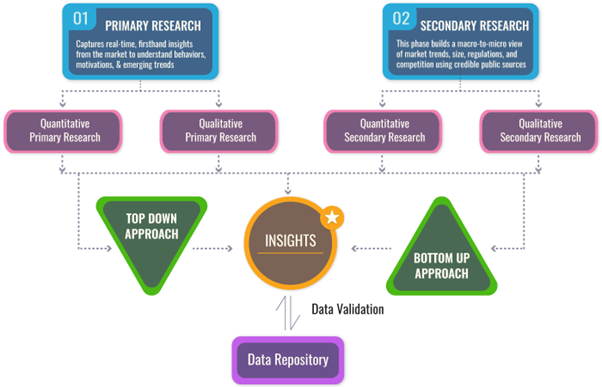
DUAL MODELING: TOP-DOWN + BOTTOM-UP
To ensure robust market estimation, we apply two complementary sizing approaches:
Top-Down Modeling:- Start with broader industry value (e.g., global or regional TAM)
- Apply filters by segment, geography, end-user, or use case
- Adjust with primary insights and validation benchmarks
- Ideal for investor-grade market scans and opportunity mapping
- Aggregate from the ground up using sales volumes, pricing, and unit economics
- Use internal modeling templates aligned with stakeholder data
- Incorporate distributor-level or region-specific inputs
- Most accurate for emerging segments and granular sub-markets
DATA VALIDATION: IN-HOUSE REPOSITORY
We close the loop with proprietary data intelligence built from ongoing projects, industry monitoring, and historical benchmarking. This repository includes:
- Multi-sector market and pricing models
- Key trendlines from past interviews and forecasts
- Benchmarked adoption rates, churn patterns, and ROI indicators
- Industry-specific deviation flags and cross-check logic
- Catches inconsistencies early
- Aligns projections across studies
- Enables consistent, high-trust deliverables