
Facial Injectables Market Size and Forecast (2026–2034), Global and Regional Growth, Trend, Share and Industry Analysis Report Coverage: By Product Type (Botulinum Toxin, Hyaluronic Acid (HA), Calcium Hydroxylapatite (CaHA), Poly-L-Lactic Acid (PLLA), PMMA Microspheres, Collagen Fillers, and Others), By Gender (Female and Male), By Application (Wrinkle Reduction & Anti-aging, Lip Augmentation, Facial Contouring & Volume Restoration, Scar & Acne Scar Treatment, Lipoatrophy Treatment, and Others), By End User (Hospitals & Ambulatory Surgical Centers, Aesthetic & Cosmetic Surgery Centers, and Medical Spas & Others) and Geography
2026-08-11
Healthcare
Swetal (Research Analyst)
Description
Facial Injectables Market
Overview
The global facial
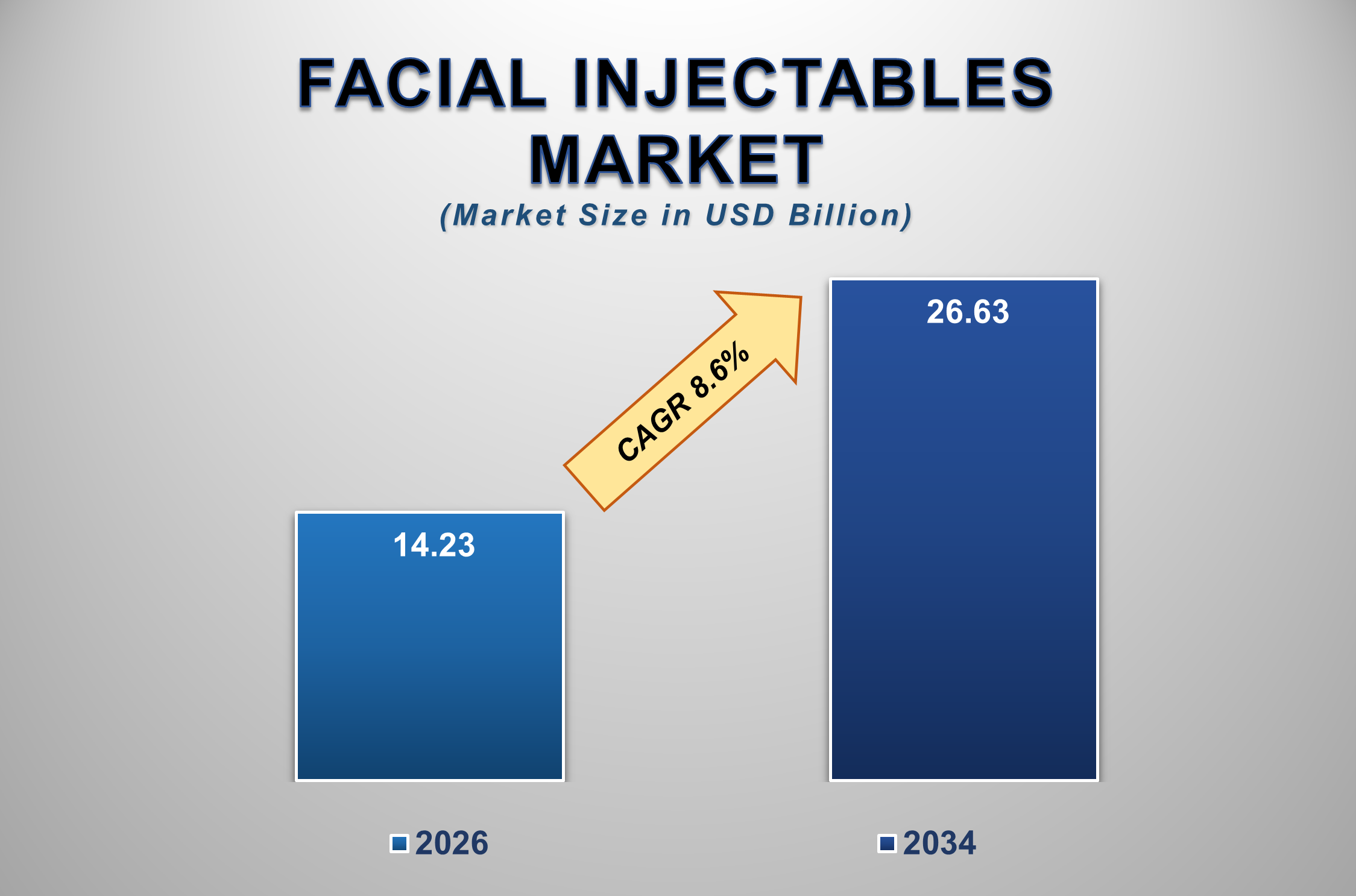
injectables market was valued at USD 14.23 billion in 2026 and is projected to
reach USD 26.63 billion by 2034, expanding at a CAGR of 8.6% during the
forecast period. The Facial Injectables Market comprises various injectable
aesthetic products that help treat facial aging signs, improve facial features,
and provide volume restoration through non-invasive processes. The market
comprises botulinum toxin to treat dynamic facial wrinkles along with various
dermal fillers, including hyaluronic acid (HA), calcium hydroxylapatite (CaHA),
poly-L-lactic acid (PLLA), PMMA microspheres, and collagen fillers, which are
most widely used for facial contouring, lip enhancement, wrinkle correction,
and scar treatment. The market growth is driven by increasing popularity of
non-surgical procedures, higher consumer knowledge of aesthetic procedures, a
larger elderly population, and ongoing improvements in injectable products over
time that enable greater safety and efficiency. Furthermore, growth of the number
of aesthetic clinics and medical spas, an increase in product approvals, and
rising adoption of products by both genders also promote market growth.
Nonetheless, despite the existence of various challenges such as the high price
of the procedure, the need for skilled operators, and the risk of
complications, the continuous progress and emergence of new products can
provide positive opportunities for market development.
Facial Injectables Market Drivers and
Opportunities
Rising Demand for
Minimally Invasive Aesthetic Procedures Driving Market Growth
The preference for
non-invasive aesthetic procedures is one of the primary drivers of the facial
injectables market. Consumers are leaning towards using non-surgical methods
like Botox and dermal fillers instead of surgical procedures due to their
shorter length, lack of severe recovery time, and lower risks of complications,
along with impressive outcomes. This trend is also facilitated by the changing
aesthetic tastes of patients, who favor minor changes to their appearance or
preventive methods in their procedures instead of transformation. The 2025
Annual Survey performed by the American Academy of Facial Plastic and
Reconstructive Surgery (AAFPRS) states that facial aesthetics are undergoing a
considerable transition, becoming more proactive and having more emphasis on
preserving facial characteristics and reaching genuine results. The report
states that facial procedures will rise by 19%, which will amount to the
overall number of operations reaching almost 1.6 million. This fact proves that
the use of minimally invasive techniques is getting more popular. Patients now
prefer subtle changes rather than drastic procedures. The modern feeling of
patients is turning toward naturally looking surgical modifications, and they
will continue to apply that trend in the future because of the development in
the sphere of injectable forms and treatment techniques.
Growing Aging
Population and Rising Focus on Anti-Aging Treatments Fueling Market Expansion
With the prevalence
of older adults and growing awareness about signs of aging, there has been a
surge in demand for facial injectables all over the world. Consumers today take
more initiative towards looking young in the future, hence the increase in the
use of both preventive and corrective procedures that utilize botulinum toxins
and fillers to treat wrinkles, rejuvenate the face, and improve skin quality.
This growing trend is also encouraged by an increasing disposable income of
people, acceptance of beauty treatments by both men and women, and continued
innovations in the injectable industry that produce long-lasting and natural
results. The globally recognized company Galderma made public its results from
a ground-breaking worldwide survey, which was conducted in June 2026 in four
countries, including the USA, Brazil, the UK, and China, regarding the changing
expectations of healthcare experts and patients regarding products for
injectable anti-wrinkle treatments. According to the survey, 73% of experts
classified long-lasting effects of more than six months as one of their top
three most important purchasing factors, while 64% specified active and pure
formulations as important. 60% of healthcare practitioners claimed that fast
clinical action is a significant factor (efficacy is visible on the first day).
These astonishing survey findings clearly show that there is a growing need for
sophisticated injectables that provide duration, efficiency, and fast clinical
action at the same time.
Advancements in
Biostimulatory Injectables and Regenerative Aesthetic Treatments Create
Significant Growth Opportunities
The latest
developments in biostimulation injectables and regenerative technologies offer
great potential for the facial injectables market. Unlike traditional fillers
that fulfill the purpose of only replacing lost volume, the next-generation
biostimulation product triggers the natural collagen production in the body,
resulting in more gradual and sustainable effects as well as improved
aesthetics. The drive towards treatments aimed at enhancing skin quality,
elasticity, and facial structure with fewer follow-up procedures contributed to
the growing popularity of injectables made from poly-L-lactic acid (PLLA) and
calcium hydroxyl apatite (CaHA). Increasingly, these new products are being
used not only for wrinkle filling and facial volumization but also for complete
facial rejuvenation techniques. At the same time, the emergence of regenerative
cosmetic therapies, including combination treatment protocols that include
dermal fillers with plasma (PRP), exosomes, polynucleotides, and other
regenerative technologies, is expanding the use of facial injections.
Manufacturers are increasingly investing in research and development to create
injectable formulations with long-lasting effects, improved rheological
properties, and better safety profiles. Increased approval by regulatory
bodies, as well as the emergence of more medical training programs for
specialists in this field, are likely to result in increased acceptance of such
products on the market. As long as regenerative medicine is developing in the
field of beauty dermatology, companies that innovate in terms of lesions
causing collagen production through injections and have scientific evidence to
prove their effectiveness in terms of regenerative remedies will be at a
competitive advantage in the global market for injectable preparations for
facial revitalization.
Facial Injectables Market Scope
|
Report Attributes |
Description |
|
Market Size in 2026 |
USD 14.23 Billion |
|
Market Forecast in 2034 |
USD 26.63 Billion |
|
CAGR % 2026-2034 |
8.6% |
|
Base Year |
2025 |
|
Historic Data |
2021-2025 |
|
Forecast Period |
2026-2034 |
|
Report USP |
Pricing and Cost Structure Analysis, Product
Innovation Benchmarking, Whitespace Assessment, Company Share, Company
Heatmap, Growth Factors, and more |
|
Segments Covered |
●
By
Product Type ●
By Gender ●
By
Application ●
By End
User |
|
Regional Scope |
●
North
America ●
Europe ●
APAC ●
Latin
America ●
Middle
East and Africa |
|
Country Scope |
●
U.S. ●
Canada ●
U.K. ●
Germany ●
France ●
Italy ●
Spain ●
Russia ●
China ●
India ●
Japan ●
South
Korea ●
Australia
●
Mexico ●
Brazil ●
Saudi
Arabia ●
UAE ●
South
Africa
|
Facial Injectables Market Report
Segmentation Analysis
The global facial
injectables market industry analysis is segmented by product type, by gender,
by application, by end user, and by region.
Hyaluronic Acid
(HA) Segment Is Expected to Dominate the Facial Injectables Market During the
Forecast Period
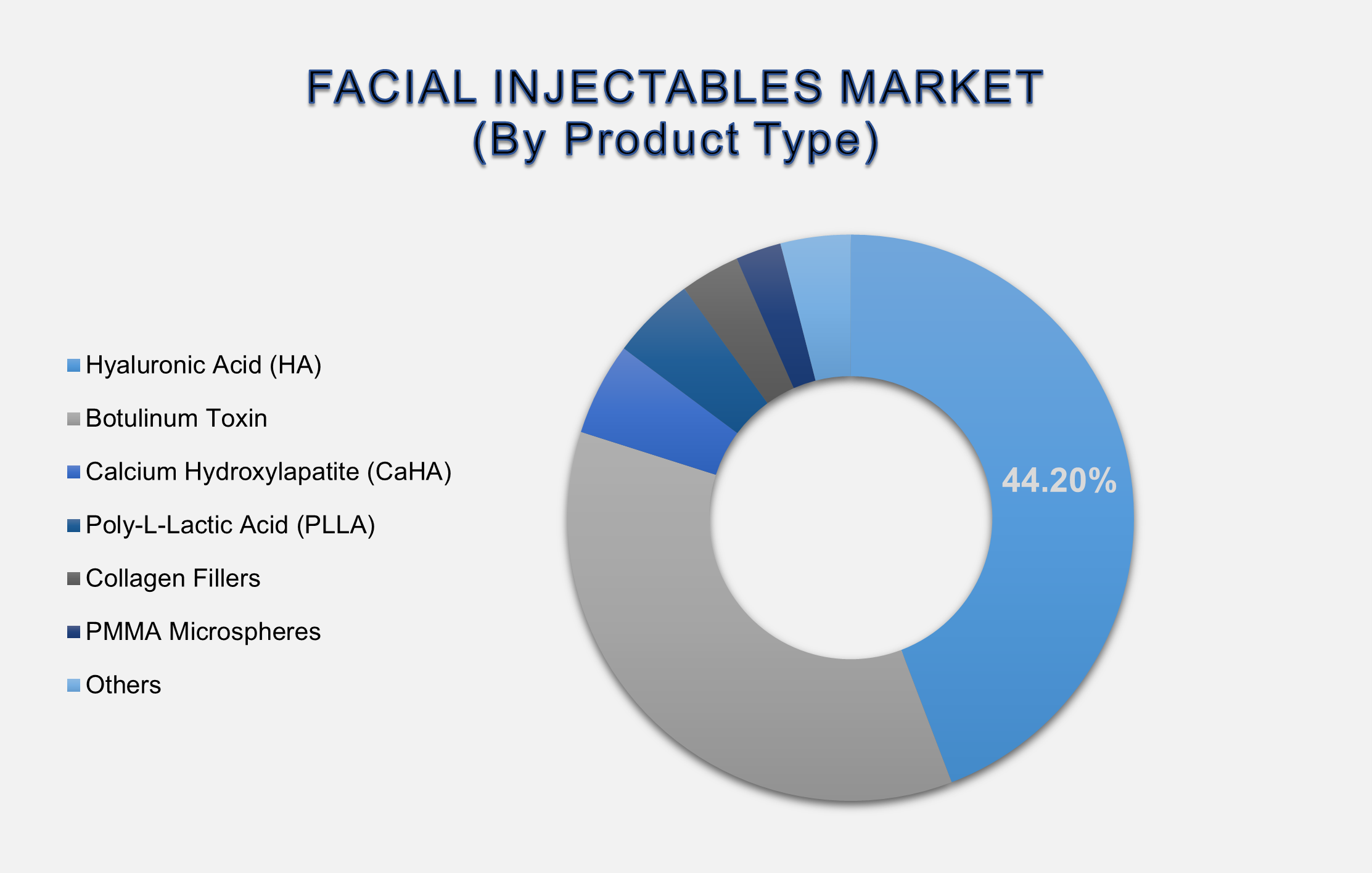
Hyaluronic Acid
(HA) is anticipated to hold the top position in the facial injectables market
throughout the projected timeframe owing to its remarkable safety profile,
biocompatibility, flexibility, and reversibility across many aesthetic uses. HA
injections are widely used for correction of wrinkles, lip enhancement,
creating facial contours, volumizing, and skin renewal, and provide instant and
natural-looking results with little downtime. Thanks to its ability to dissolve
with the help of hyaluronidase and continuous innovations in cross-linking
technology designed to enhance product performance and persistence, HA products
are preferred by both consumers and specialists. One of the factors in the
growth of the HA segment is the increasing popularity of minimally invasive
aesthetic methods and preventive cosmetic treatments. In addition, new uses of
HA fillers are being approved. The ongoing investments by top manufacturers
further solidify the growth prospects of this sector. For example, Evolus, Inc.
announced the debut of Estyme, its injectable hyaluronic acid (HA) gel range,
in May 2026, which signifies its entry into the international dermal filler
market. The launch widens Evolus' aesthetics portfolio beyond the botulinum
toxin products and indicates the ever-rising strategic interest of the
companies in the rapidly developing HA filler sector. The occurrence of such
product introductions, alongside the untiring innovation taking place in the
filler compositions, rising geographical commercialization, and increasing
acceptance of products by doctors, will facilitate market entry for HA fillers,
thus securing their status as the leading product group in the global facial
injectables market.
Female Segment
Is Expected to Lead the Facial Injectables Market by Gender
During the
predicted period, females are likely to be the largest investors in facial
injections. This comes as a result of a greater preference towards aesthetic
treatments and increased knowledge regarding facial rejuvenation and demand for
non-invasive solutions in cosmetology. Women are still the major consumers of
botulinum and dermal fillers for purposes like wrinkle elimination, lip
enhancement, facial shaping, skin rejuvenation, and volume increase. Increasing
attention paid to youthfulness factors, along with increases in disposable
income, better access to beauty and medical services, and social networks and
trends’ impact have gained enormous support among female consumers in advanced
and developing markets. The growth of the cosmetic market is also contributed
to by the rising willingness of prevention-oriented aesthetic procedures among
young women. In place of turning to corrective procedures later in life, young
women are increasingly turning to earlier interventions with botulinum toxin and
hyaluronic acid, which help to prevent fine lines from forming. The rise of
innovative injectables, which provide longer-lasting effects for patients and
help enhance their belief in efficacy, was another factor. What is also very
significant is the possibility of creating individual treatment plans for
patients of different ages and with different facial features. Although the
demand of male consumers has also increased, women are likely to be the leading
consumer segment within the considered timeframe owing to higher system
utilization frequency and wider range of services available.
Wrinkle
Reduction & Anti-aging Segment Is Expected to Lead the Facial Injectables
Market by Application
The facial
injectables market is likely to be dominated by the Wrinkle Reduction &
Anti-Aging segment during the planned period as a result of an increase in
consumer demand for minimally invasive cosmetic procedures and the growing
preference for cosmetic procedures that help achieve a youthful facial
appearance. The most popular types of injectable products that are used for the
purpose of improving the appearance of the face are botulinum toxins and dermal
fillers. The companies focused on developing the newest formulations will
benefit from the rise in the adoption of preventive aesthetics, especially by
the youth. The trend seems to be confirmed by a report from LaserAway dated
April 2026, which indicates that neuromodulators are among the fastest-growing
categories in aesthetics. The company also pointed out that the growing
popularity of Xeomin, which is an injectable botulinum toxin that relaxes
particular facial muscles that create dynamic wrinkles like forehead creases,
frown lines, and crow’s feet, has contributed to its widespread use in recent
times. The increasing number of appointments for Xeomin injection demonstrates
increasing consumer awareness and acceptance of various neuromodulators for the
treatment of wrinkles and highlights the strong need for anti-aging
injectables.
The following
segments are part of an in-depth analysis of the global facial injectables
market:
|
Market Segments |
|
|
By Product Type |
●
Botulinum
Toxin ●
Hyaluronic
Acid (HA) ●
Calcium
Hydroxylapatite (CaHA) ●
Poly-L-Lactic
Acid (PLLA) ●
PMMA
Microspheres ●
Collagen
Fillers ●
Others |
|
By Gender |
●
Female ●
Male |
|
By Application |
●
Wrinkle
Reduction & Anti-aging ●
Lip
Augmentation ●
Facial
Contouring & Volume Restoration ●
Scar &
Acne Scar Treatment ●
Lipoatrophy
Treatment ●
Others |
|
By End User |
●
Hospitals
& Ambulatory Surgical Centers ●
Aesthetic
& Cosmetic Surgery Centers ●
Medical Spas
& Others |
Facial Injectables Market Share
Analysis by Region
North America is
projected to hold the largest share of the global facial injectables market
over the forecast period
North America will
dominate the global market for facial injectables throughout the projected
timeframe. The region’s supremacy is bolstered by the high public knowledge
about minimally invasive aesthetic treatments, elevated disposable incomes, the
abundance of qualified professionals in the industry, and the widespread
application of cutting-edge injectable practices. The U.S. is still the largest
contributor, with the demand for skin rejuvenation and anti-aging services
constantly growing, strong product development, and a favorable regulatory
atmosphere. A perfect illustration of successful product development was the
announcement by AbbVie (through Allergan Aesthetics) concerning the approval of
SKINVIVE by JUVÉDERM by the FDA in June 2026. This was considered a landmark
approval because SKINVIVE became not only the first injectable hyaluronic acid
product but also one intended specifically to diminish neck wrinkles while
maintaining the hydration of the skin. All these regulatory approvals contribute
to the local product range, prompt physicians to utilize new injectables, and
bring the market further.
Facial
Injectables Market Competition Landscape Analysis
Facial Injectables
Market is an extremely competitive space characterized by the
presence/formation of leading global pharmaceutical firms, makers of products
of aesthetic medicine, and biotechnology companies focusing on building
innovative solutions in the form of injectable alternatives for purposes of
rejuvenation and cosmetic enhancement. Players in the market keep expanding
their product portfolios by introducing improved alternatives in terms of
botulinum toxin formulations, hyaluronic acid fillers, stimulators of collagen,
fillers based on calcium hydroxylapatite, and other innovative injectable
alternatives. The companies in the market make large investments in research
studies in order to obtain new formulations, to expand the applicability of their
products, and to achieve a broader spectrum of aesthetic goals from reducing
wrinkles to facial contouring, skin hydration, and restoring model volume. The
competition on the market becomes even stronger due to frequent launches of new
preparations, approvals received by drugs from regulatory authorities,
partnerships, licensing agreements, mergers and acquisitions, expansion
initiatives, and physician training programs.
Global Facial
Injectables Market Recent Developments News:
●
In July 2026 –
Croma-Pharma announced the FDA approval of Obagi saypha ChIQ in the United
States. Obagi saypha ChIQ injectable hyaluronic acid gel is approved for cheek
augmentation and correction of midface contour deficiencies in adults over the
age of 21.
●
In June 2026 -
Allergan Aesthetics, an AbbVie company, announced that Health Canada has
approved Boey (trenibotulinumtoxinE) for the temporary improvement in the
appearance of moderate to severe lines between the eyebrows (glabellar lines)
in adult patients.
●
In February
2026 - Galderma announced that regulatory authorities in Europe, the United
States, and Canada have approved a new state-of-the-art syringe for use with
its NASHA lidocaine range of Restylane products in multiple facial indications
including the cheeks, nose, chin, jawline, tear troughs, nasolabial folds,
marionette lines, as well as in the hands.
●
In June 2026 -
Allergan Aesthetics, an AbbVie company, announced the 2026 cohort of
entrepreneurs selected to participate in The Confidence Collective: Empowering
Women Entrepreneurs, an ongoing initiative from BOTOX Cosmetic dedicated to
uplifting and investing in women business owners.
●
In April 2026 -
Merz Aesthetics, the world’s largest dedicated medical aesthetics business,
announced the FDA approval for RADIESSE for the treatment of wrinkles in the
décolleté area in patients 22 years of age and older.
The global
facial injectables market is dominated by a few large companies, such as
●
AbbVie (Allergan Aesthetics)
●
Bloomage Biotechnology
●
Croma-Pharma
●
Daewoong Pharmaceutical
●
Evolus
●
Galderma
●
Huadong Medicine
●
Hugel Inc.
●
Huons Global
●
IBSA Farmaceutici
●
Ipsen Pharma
●
Laboratoires VIVACY
●
LG Chem Life Sciences
●
Medytox
●
Merz Pharma
●
Prollenium Medical
●
Revance Therapeutics
●
Sinclair Pharma
●
Suneva Medical
●
Teoxane Laboratories
● Other Prominent Players
Frequently Asked Questions
Swetal (Research Analyst)
Swetal is a Research Analyst with 4+ years of experience specializing in healthcare market research, medical devices, healthcare IT, and medical technology industry analysis. Her expertise includes competitive intelligence, secondary research, market trend forecasting, and healthcare business insights across global healthcare ecosystems.
She contributes to advanced market research reports by analyzing regulatory frameworks, emerging healthcare technologies, competitive landscapes, and innovation trends shaping the medical industry. With a strong focus on accurate market intelligence, strategic insights, and healthcare industry trends, Swetal supports businesses in making informed, data-backed decisions in a rapidly transforming healthcare environment.
1.
Global
Facial Injectables Market Introduction and Market Overview
1.1. Objectives of the Study
1.2. Market Segmentation
1.2.1.Product Type of the Global Facial
Injectables Market
1.2.2.Gender of the Global Facial
Injectables Market
1.2.3.Application of the Global Facial
Injectables Market
1.2.4.End User of the Global Facial
Injectables Market
1.2.5.Region of the Global Facial
Injectables Market
1.3. Competition Coverage List of
Market Participants
1.4. Market Definition: Facial
Injectables Market
2.
Executive Summary
2.1. Global Facial Injectables Market
Estimation & Forecast
2.1.1.Global Facial Injectables Market
Size (US$ Million) Estimates & Historical Trend Analysis (2021 - 2025)
2.1.2.Global Facial Injectables Overall
Market Size (US$ Million), Growth Rate (Y-o-Y), Market CAGR (%), Market
Forecast (2026 - 2034)
2.2. Snapshot of Global Facial
Injectables Market
2.3. Global Facial Injectables Market
Revenue Share (%) 2025
2.4. REGIONAL OUTLINE: Revenue CAGR,
by Region
2.5. Key Competitors & Key
Insights
3.
Market Overview (Qualitative
Analysis)
3.1. Demand Side Trends
3.2. Supply Side Trends /
Manufacturing Trends
3.3. Demand and Opportunity
Assessment, 2026 - 2034
3.4. Market Dynamics
3.4.1.Drivers
3.4.2.Limitations
3.4.3.Opportunities
3.4.4.Impact Analysis of Drivers and
Restraints
3.5. Key Developments
3.6. Regulatory Landscape
3.7. Pricing Analysis
3.8. Supply Chain Analysis
3.9. Porter’s Five Forces Analysis
3.9.1.Bargaining Power of Suppliers
3.9.2.Bargaining Power of Buyers
3.9.3.Threat of Substitutes
3.9.4.Threat of New Entrants
3.9.5.Competitive Rivalry
3.10. PEST Analysis
3.10.1. Political Factors
3.10.2. Economic Factors
3.10.3. Social Factors
3.10.4. Technology Factors
4.
Global Facial Injectables Market
Estimates & Forecast Trend Analysis, by Product Type
4.1. Global Facial Injectables Market
Assessments & Key Findings, by Product Type
4.2. Global Facial Injectables Market
Revenue (US$ Million) Estimates and Forecasts, by Product Type, 2021 - 2034
4.2.1.Botulinum Toxin
4.2.2.Hyaluronic Acid (HA)
4.2.3.Calcium Hydroxylapatite (CaHA)
4.2.4.Poly-L-Lactic Acid (PLLA)
4.2.5.PMMA Microspheres
4.2.6.Collagen Fillers
4.2.7.Others
5.
Global Facial Injectables Market
Estimates & Forecast Trend Analysis, by Gender
5.1. Global Facial Injectables Market
Assessments & Key Findings, by Gender
5.2. Global Facial Injectables Market
Revenue (US$ Million) Estimates and Forecasts, by Gender, 2021 - 2034
5.2.1.Female
5.2.2.Male
6.
Global Facial Injectables Market
Estimates & Forecast Trend Analysis, by Application
6.1. Global Facial Injectables Market
Assessments & Key Findings, by Application
6.2. Global Facial Injectables Market
Revenue (US$ Million) Estimates and Forecasts, by Application, 2021 - 2034
6.2.1.Wrinkle Reduction &
Anti-aging
6.2.2.Lip Augmentation
6.2.3.Facial Contouring & Volume
Restoration
6.2.4.Scar & Acne Scar Treatment
6.2.5.Lipoatrophy Treatment
6.2.6.Others
7.
Global Facial Injectables Market
Estimates & Forecast Trend Analysis, by End User
7.1. Global Facial Injectables Market
Assessments & Key Findings, by End User
7.2. Global Facial Injectables Market
Revenue (US$ Million) Estimates and Forecasts, by End User, 2021 - 2034
7.2.1.Hospitals & Ambulatory
Surgical Centers
7.2.2.Aesthetic & Cosmetic Surgery
Centers
7.2.3.Medical Spas & Others
8.
Global Facial Injectables Market
Estimates & Forecast Trend Analysis, by Region
8.1.
Global
Facial Injectables Market Assessments & Key Findings, by Region
8.2.
Global
Facial Injectables Market Revenue (US$ Million) Estimates and Forecasts, by
Region, 2021 - 2034
8.2.1.North America
8.2.2.Europe
8.2.3.Asia Pacific
8.2.4.Middle East & Africa
8.2.5.Latin America
9.
North
America Facial Injectables Market: Estimates & Forecast Trend Analysis
9.1. North America Facial Injectables
Market Assessments & Key Findings
9.1.1.North America Facial Injectables
Market Introduction
9.1.2.North America Facial Injectables
Market Size Estimates and Forecast (US$ Million) (2021 - 2034)
9.1.2.2. By Gender
9.1.2.3. By Application
9.1.2.4. By End User
9.1.2.5. By Country
9.1.2.5.1. The U.S.
9.1.2.5.2. Canada
10. Europe Facial
Injectables Market: Estimates &
Forecast Trend Analysis
10.1. Europe Facial Injectables Market
Assessments & Key Findings
10.1.1. Europe Facial Injectables Market
Introduction
10.1.2. Europe Facial Injectables Market
Size Estimates and Forecast (US$ Million) (2021 - 2034)
10.1.2.1. By Product Type
10.1.2.2. By Gender
10.1.2.3. By Application
10.1.2.4. By End User
10.1.2.5. By Country
10.1.2.5.1.
Germany
10.1.2.5.2.
Italy
10.1.2.5.3.
U.K.
10.1.2.5.4.
France
10.1.2.5.5.
Spain
10.1.2.5.6.
Switzerland
10.1.2.5.7. Rest
of Europe
11. Asia Pacific Facial
Injectables Market: Estimates &
Forecast Trend Analysis
11.1. Asia Pacific Market Assessments
& Key Findings
11.1.1. Asia Pacific Facial Injectables
Market Introduction
11.1.2. Asia Pacific Facial Injectables
Market Size Estimates and Forecast (US$ Million) (2021 - 2034)
11.1.2.1. By Product Type
11.1.2.2. By Gender
11.1.2.3. By Application
11.1.2.4. By End User
11.1.2.5. By Country
11.1.2.5.1. China
11.1.2.5.2. Japan
11.1.2.5.3. India
11.1.2.5.4. Australia
11.1.2.5.5. South Korea
11.1.2.5.6. Rest of Asia Pacific
12. Middle East & Africa Facial
Injectables Market: Estimates & Forecast
Trend Analysis
12.1. Middle East & Africa Market
Assessments & Key Findings
12.1.1. Middle
East & Africa Facial
Injectables Market Introduction
12.1.2. Middle
East & Africa Facial
Injectables Market Size Estimates and Forecast (US$ Million) (2021 - 2034)
12.1.2.1. By Product Type
12.1.2.2. By Gender
12.1.2.3. By Application
12.1.2.4. By End User
12.1.2.5. By Country
12.1.2.5.1. South Africa
12.1.2.5.2. UAE
12.1.2.5.3. Saudi Arabia
12.1.2.5.4. Rest of MEA
13. Latin America
Facial Injectables Market: Estimates
& Forecast Trend Analysis
13.1. Latin America Market Assessments
& Key Findings
13.1.1. Latin America Facial Injectables
Market Introduction
13.1.2. Latin America Facial Injectables
Market Size Estimates and Forecast (US$ Million) (2021 - 2034)
13.1.2.1. By Product Type
13.1.2.2. By Gender
13.1.2.3. By Application
13.1.2.4. By End User
13.1.2.5. By Country
13.1.2.5.1. Brazil
13.1.2.5.2. Mexico
13.1.2.5.3. Argentina
13.1.2.5.4. Rest of LATAM
14. Competition Landscape
14.1. Global Facial Injectables Market
Product Mapping
14.2. Global Facial Injectables Market
Concentration Analysis, by Leading Players / Innovators / Emerging Players /
New Entrants
14.3. Global Facial Injectables Market
Tier Structure Analysis
14.4. Global Facial Injectables Market
Concentration & Company Market Shares (%) Analysis, 2025
15. Company Profiles
15.1. AbbVie (Allergan Aesthetics)
15.1.1. Company Overview & Key Stats
15.1.2. Financial Performance & KPIs
15.1.3. Product Portfolio
15.1.4. SWOT Analysis
15.1.5. Business Strategy & Recent Developments
* Similar details would be provided
for all the players mentioned below
15.2. Bloomage Biotechnology
15.3. Croma-Pharma
15.4. Daewoong Pharmaceutical
15.5. Evolus
15.6. Galderma
15.7. Huadong Medicine
15.8. Hugel Inc.
15.9. Huons Global
15.10. IBSA Farmaceutici
15.11. Ipsen Pharma
15.12. Laboratoires VIVACY
15.13. LG Chem Life Sciences
15.14. Medytox
15.15. Merz Pharma
15.16. Prollenium Medical
15.17. Revance Therapeutics
15.18. Sinclair Pharma
15.19. Suneva Medical
15.20. Teoxane Laboratories
15.21. Other Prominent Players
16. Research
Findings & Conclusion
17. Assumptions & Acronyms Used
18. Research
Methodology
18.1. External Transportation /
Databases
18.2. Internal Proprietary Database
18.3. Primary Research
18.4. Secondary Research
18.5. Assumptions
18.6. Limitations
18.7. Report FAQs
Our Research Methodology
"Insight without rigor is just noise."
We follow a comprehensive, multi-phase research framework designed to deliver accurate, strategic, and decision-ready intelligence. Our process integrates primary and secondary research , both quantitative and qualitative , along with dual modeling techniques ( top-down and bottom-up) and a final layer of validation through our proprietary in-house repository.
PRIMARY RESEARCH
Primary research captures real-time, firsthand insights from the market to understand behaviors, motivations, and emerging trends.
1. Quantitative Primary Research
Objective: Generate statistically significant data directly from market participants.
Approaches:- Structured surveys with customers, distributors, and field agents
- Mobile-based data collection for point-of-sale audits and usage behavior
- Phone-based interviews (CATI) for market sizing and product feedback
- Online polling around industry events and digital campaigns
- Purchase frequency by customer type
- Channel performance across geographies
- Feature demand by application or demographic
2. Qualitative Primary Research
Objective: Explore decision-making drivers, pain points, and market readiness.
Approaches:- In-depth interviews (IDIs) with executives, product managers, and key decision-makers
- Focus groups among end users and early adopters
- Site visits and observational research for consumer products
- Informal field-level discussions for regional and cultural nuances
SECONDARY RESEARCH
This phase helps establish a macro-to-micro understanding of market trends, size, regulation, and competitive dynamics, sourced from credible and public domain information.
1. Quantitative Secondary Research
Objective: Model market value and segment-level forecasts based on published data.
Sources include:- Financial reports and investor summaries
- Government trade data, customs records, and regulatory statistics
- Industry association publications and economic databases
- Channel performance and pricing data from marketplace listings
- Revenue splits, pricing trends, and CAGR estimates
- Supply-side capacity and volume tracking
- Investment analysis and funding benchmarks
2. Qualitative Secondary Research
Objective: Capture strategic direction, innovation signals, and behavioral trends.
Sources include:- Company announcements, roadmaps, and product pipelines
- Publicly available whitepapers, conference abstracts, and academic research
- Regulatory body publications and policy briefs
- Social and media sentiment scanning for early-stage shifts
- Strategic shifts in market positioning
- Unmet needs and white spaces
- Regulatory triggers and compliance impact
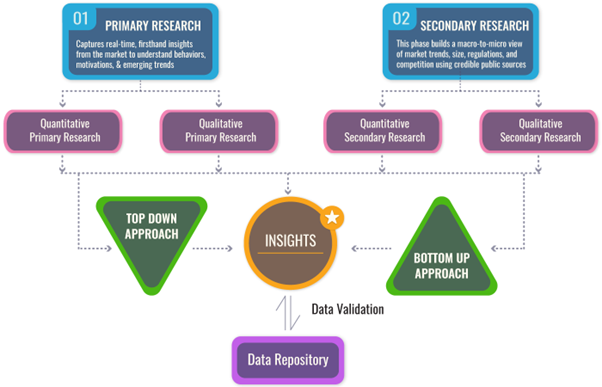
DUAL MODELING: TOP-DOWN + BOTTOM-UP
To ensure robust market estimation, we apply two complementary sizing approaches:
Top-Down Modeling:- Start with broader industry value (e.g., global or regional TAM)
- Apply filters by segment, geography, end-user, or use case
- Adjust with primary insights and validation benchmarks
- Ideal for investor-grade market scans and opportunity mapping
- Aggregate from the ground up using sales volumes, pricing, and unit economics
- Use internal modeling templates aligned with stakeholder data
- Incorporate distributor-level or region-specific inputs
- Most accurate for emerging segments and granular sub-markets
DATA VALIDATION: IN-HOUSE REPOSITORY
We close the loop with proprietary data intelligence built from ongoing projects, industry monitoring, and historical benchmarking. This repository includes:
- Multi-sector market and pricing models
- Key trendlines from past interviews and forecasts
- Benchmarked adoption rates, churn patterns, and ROI indicators
- Industry-specific deviation flags and cross-check logic
- Catches inconsistencies early
- Aligns projections across studies
- Enables consistent, high-trust deliverables