

Fast Fashion Market Size and Forecast (2025–2033), Global and Regional Growth, Trend, Share, and Industry Analysis Report Coverage: By Type (Casual Wear, Formal Wear, Others), By End User (Women, Men), By Distribution Channel (Offline Stores, Online Stores/E-commerce), and Geography
2026-02-17
Consumer Products
Jaya Bundele (Research Analyst)
Description
Fast Fashion Market Overview
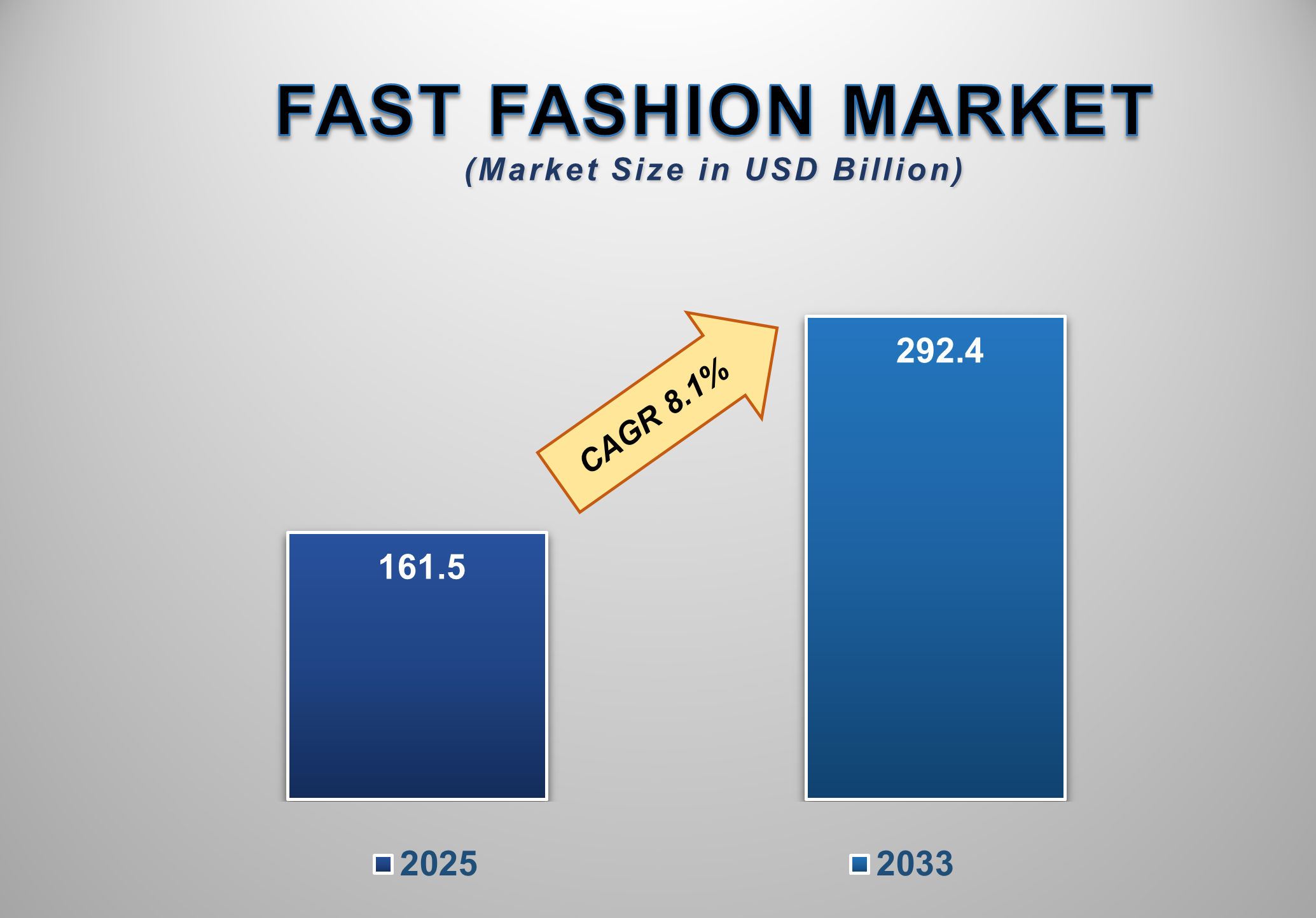
The global Fast Fashion Market has emerged as one of the most dynamic and rapidly evolving segments within the apparel and lifestyle industry. Fast fashion refers to the rapid design, production, and distribution of trendy clothing that mirrors the latest runway and celebrity styles at affordable price points. In 2025, the fast fashion market is valued at USD 161.5 billion and is projected to reach USD 292.4 billion by 2033, expanding at a robust CAGR of 8.1% during the forecast period.
The market’s growth is driven by
shifting consumer preferences toward trend-driven, low-cost apparel, increasing
fashion consciousness across age groups, and the accelerated influence of
social media, influencers, and digital marketing platforms. Fast fashion brands
have mastered agile supply chains, allowing them to introduce new collections
within weeks, enabling rapid response to evolving consumer tastes. The
availability of diverse product assortments, frequent new launches, and
aggressive pricing strategies continues to strengthen market penetration
globally.
Fast Fashion Market
Drivers and Opportunities
Rising Fashion
Consciousness and Demand for Affordable Trendy Apparel Is Driving Market Growth
The increasing fashion consciousness among global consumers,
particularly millennials and Gen Z, is a primary driver of growth in the fast
fashion market. Consumers today seek frequent wardrobe updates that align with
the latest trends showcased on social media platforms such as Instagram,
TikTok, and YouTube. Fast fashion brands leverage these platforms to identify
emerging styles and quickly translate them into mass-market apparel at
accessible price points.
Affordability plays a critical role in expanding the fast fashion
consumer base. By optimizing sourcing, production, and logistics, fast fashion
retailers are able to offer stylish clothing at significantly lower prices
compared to traditional apparel brands. This pricing advantage encourages
impulse buying and repeat purchases, especially among younger consumers with
limited discretionary income. Additionally, the rise of casualization in global
dress codes has further boosted demand. Consumers increasingly prioritize
comfort and versatility, favoring casual wear for daily use, social outings,
and even professional environments. This shift directly supports the dominance
of the casual wear segment and continues to fuel overall market expansion.
Expansion of E-commerce and Omnichannel Retailing Is
Accelerating Market Penetration
The rapid expansion of e-commerce and omnichannel retail
strategies has significantly accelerated the growth of the fast fashion market.
Online platforms allow brands to reach a global audience, showcase extensive
product portfolios, and launch new collections with minimal lead times.
Digital-first brands and established retailers alike are investing heavily in
mobile apps, personalized recommendations, and data-driven marketing to enhance
customer engagement. Online stores and e-commerce channels provide consumers
with convenience, broader product selection, and competitive pricing, which are
critical factors driving online apparel purchases. Flash sales, influencer
collaborations, and limited-edition drops further stimulate demand and create
urgency among shoppers. At the same time, offline stores continue to play an
important role by offering tactile shopping experiences, instant product
availability, and brand immersion. Many fast fashion players are adopting
omnichannel models, integrating physical stores with online platforms to offer
services such as click-and-collect, easy returns, and in-store digital
experiences. This seamless integration strengthens customer loyalty and
supports sustained market growth.
Growth in Emerging Economies and Digital-First Consumers Is
Creating Significant Opportunities
Emerging economies present significant growth opportunities for the global fast fashion market, particularly in the Asia Pacific region. Rising urbanization, increasing disposable incomes, and a growing youth population are transforming fashion consumption patterns in countries such as China, India, Indonesia, and Vietnam. Consumers in these markets are increasingly exposed to global fashion trends through social media and international brands. Asia Pacific is expected to witness the highest CAGR during the forecast period, supported by rapid expansion of online retail infrastructure and increasing smartphone penetration. Local and international fast fashion brands are aggressively expanding their presence through digital platforms, affordable pricing strategies, and localized product offerings. Furthermore, the growing influence of digital-native consumers who value speed, variety, and affordability aligns perfectly with the fast fashion value proposition. As brands continue to invest in supply chain efficiency and digital engagement, emerging markets are expected to contribute substantially to global revenue growth
Fast Fashion Market Scope
|
Report Attributes |
Description |
|
Market Size in 2025 |
USD 161.5 Billion |
|
Market Forecast in 2035 |
USD 292.4 Billion |
|
CAGR % 2025-2035 |
8.1% |
|
Base Year |
2024 |
|
Historic Data |
2020-2024 |
|
Forecast Period |
2025-2035 |
|
Report USP |
Production, Consumption,
Company Share, Company Heatmap, Company Production Capacity, Growth Factors,
and more |
|
Segments Covered |
●
Type, End User,
Distribution Channel |
|
Regional Scope |
●
North America, ●
Europe, ●
APAC, ●
Latin America ●
Middle East and
Africa |
|
Country Scope |
1)
U.S. 2)
Canada 3)
Germany 4)
UK 5)
France 6)
Spain 7)
Italy 8)
Switzerland 9)
China 10)
Japan 11)
India 12)
Australia 13)
South Korea 14)
Brazil 15)
Mexico 16)
Argentina 17)
South Africa 18)
Saudi Arabia 19)
UAE |
Fast Fashion Market
Report Segmentation Analysis
The Global Fast Fashion Market
Industry Analysis Is Segmented By Type, End User, Distribution Channel, and by
Region.
Lead-acid Battery Segment Accounted for the Largest Market
Share in the Global Fast Fashion Market
Casual
Wear Segment Accounted for the Largest Market Share in the Global Fast Fashion
Market
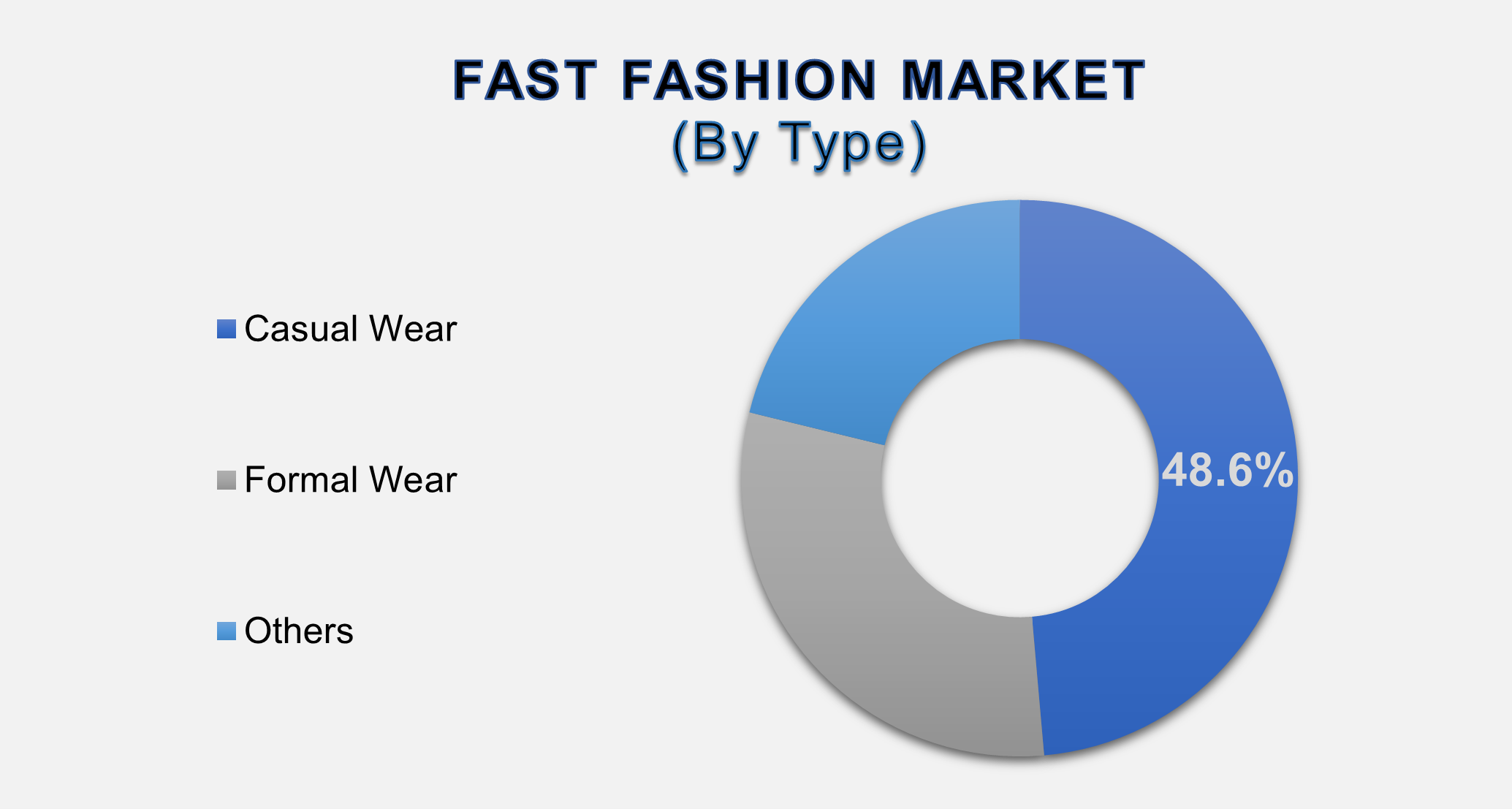
The casual wear segment accounted for the largest share of the global fast fashion market, contributing 48.6% of total revenue. This dominance is driven by the growing demand for comfortable, stylish, and multifunctional apparel suitable for everyday use. Casual wear includes t-shirts, jeans, dresses, hoodies, and athleisure products that appeal across age groups and lifestyles. The shift toward remote work, flexible office environments, and informal social settings has further strengthened demand for casual apparel. Fast fashion brands continuously refresh casual wear collections, offering new designs at frequent intervals to maintain consumer interest. As comfort-driven fashion trends continue to evolve, the casual wear segment is expected to retain its leading position throughout the forecast period.
Women
Segment Dominated the Fast Fashion Market
The
women segment dominates the global fast fashion market by end user, driven by
higher purchasing frequency, greater fashion awareness, and a wider variety of
product offerings. Fast fashion brands focus heavily on women’s apparel,
launching new collections at rapid intervals to capture evolving trends. Women
consumers are highly influenced by social media, celebrity endorsements, and
influencer marketing, which directly boosts demand for trendy and affordable
clothing. Seasonal launches, occasion wear adaptations, and fast turnaround
cycles further reinforce the dominance of this segment in the global market.
Offline
Stores Segment Continued to Hold a Significant Market Share
The
offline stores segment continues to hold a significant share of the fast
fashion market, supported by the tactile shopping experience, immediate product
availability, and brand engagement opportunities. Physical stores allow
consumers to try products, assess quality, and make instant purchases, which
remains important in apparel retail. Major fast fashion brands operate
extensive global store networks in high-traffic urban locations and shopping
malls. While online channels are growing rapidly, offline stores remain a
critical component of omnichannel strategies, contributing substantially to
overall market revenue.
The following segments are
part of an in-depth analysis of the global Fast Fashion market:
|
Market Segments |
|
|
By Type |
●
Casual Wear ●
Formal Wear ●
Others |
|
By End User |
●
Women ●
Men |
|
By
Distribution Channel |
●
Offline Stores ●
Online
Stores/E-commerce |
Fast Fashion Market Share
Analysis by Region
North America is expected
to account for the largest share of the global Fast Fashion Market throughout
the forecast period.
North America accounted for 43.1%
of the global fast fashion market, making it the largest regional market. High
consumer spending on apparel, strong presence of leading fast fashion brands,
and rapid adoption of online shopping platforms support regional dominance. The
U.S. remains the primary contributor, driven by fashion-conscious consumers and
frequent trend adoption.
Asia Pacific is expected to
register the highest CAGR during the forecast period, driven by rapid
urbanization, expanding middle-class populations, and the proliferation of
e-commerce platforms. Countries such as China and India are emerging as key
growth engines, with international and regional brands aggressively expanding
their digital and physical retail presence.
Fast Fashion Market
Competition Landscape Analysis
The global fast fashion market is
highly competitive and fragmented, characterized by the presence of
multinational brands and digital-native players. Companies compete on pricing,
speed-to-market, design agility, and omnichannel capabilities. Continuous
product launches, influencer collaborations, and global expansion strategies
define the competitive environment.
Global Fast Fashion
Market Recent Developments News:
- In August 2025 – SHEIN established a strategic
partnership with Lufthansa Cargo to explore opportunities for more
sustainable air freight solutions for distributing its products. The
collaboration aims to help SHEIN reduce the environmental impact of its
combined international air and maritime shipping operations.
- In March 2025 – Fast Retailing announced expansion
plans for its Uniqlo brand, including the opening of new large-format
stores in North America and other key growth markets.
- In March 2025 – Inditex invested USD 1,042.46
million to enhance its global product distribution capabilities. The
investment funded the development of a new Zara logistics center in
Zaragoza, Spain, and capacity upgrades at its Bershka and Tempe facilities.
The Global Fast Fashion Market Is
Dominated by a Few Large Companies, such as
●
Zara
●
H&M
●
Uniqlo
●
Gap
●
Forever 21
●
Primark
●
Mango
●
Boohoo
●
ASOS
●
Shein
●
Fashion Nova
●
PrettyLittleThing
●
Missguided
●
Urban Outfitters
●
Topshop
●
Old Navy
●
New Look
●
C&A
●
M&Co
●
Target
● Others
Frequently Asked Questions
Jaya Bundele (Research Analyst)
Jaya Bundele is a skilled Research Analyst with 4+ years of experience in market intelligence, consumer insights, competitive analysis, and industry forecasting across the consumer goods, agriculture, and food & beverage sectors. She specializes in market sizing, trend analysis, growth opportunity mapping, and strategic secondary research for global and regional markets.
Her expertise lies in transforming complex industry data into actionable business strategies that help organizations identify emerging trends, understand customer behavior, and gain a competitive edge. With a strong focus on data-driven insights, business intelligence, and future market trends, Jaya delivers high-quality research solutions aligned with evolving industry demands and market dynamics.
1. Global Fast Fashion Market
Introduction and Market Overview
1.1.
Objectives
of the Study
1.2.
Global
Fast Fashion Market Scope and Market Estimation
1.2.1.Global Fast Fashion Overall
Market Size (US$ Bn), Market CAGR (%), Market forecast (2025 - 2033)
1.2.2.Global Fast Fashion Market
Revenue Share (%) and Growth Rate (Y-o-Y) from 2020 - 2033
1.3.
Market
Segmentation
1.3.1.Type of Global Fast
Fashion Market
1.3.2.End User of Global Fast
Fashion Market
1.3.3.Distribution Channel of
Global Fast Fashion Market
1.3.4.Region of Global Fast
Fashion Market
2. Executive
Summary
2.1.
Demand
Side Trends
2.2.
Key
Market Trends
2.3.
Market
Demand (US$ Bn) Analysis 2020 – 2024 and Forecast, 2025 – 2033
2.4.
Demand
and Opportunity Assessment
2.5.
Key
Developments
2.6.
Overview
of Tariff, Regulatory Landscape and Standards
2.7.
Market
Entry Strategies
2.8.
Market
Dynamics
2.8.1.Drivers
2.8.2.Limitations
2.8.3.Opportunities
2.8.4.Impact Analysis of Drivers
and Restraints
2.9.
Porter’s
Five Forces Analysis
2.10.
PEST
Analysis
3. Global
Fast Fashion Market Estimates
& Historical Trend Analysis (2020 - 2024)
4. Global
Fast Fashion Market Estimates
& Forecast Trend Analysis, by Type
4.1.
Global
Fast Fashion Market Revenue (US$ Bn) Estimates and Forecasts, by Type, 2020 - 2033
4.1.1.Casual Wear
4.1.2.Formal Wear
4.1.3.Others
5. Global
Fast Fashion Market Estimates
& Forecast Trend Analysis, by End User
5.1.
Global
Fast Fashion Market Revenue (US$ Bn) Estimates and Forecasts, by End User, 2020
- 2033
5.1.1.Women
5.1.2.Men
6. Global
Fast Fashion Market Estimates
& Forecast Trend Analysis, by Distribution Channel
6.1.
Global
Fast Fashion Market Revenue (US$ Bn) Estimates and Forecasts, by Distribution
Channel, 2020 - 2033
6.1.1.Offline Stores
6.1.2.Online Stores/E-commerce
7. Global
Fast Fashion Market Estimates
& Forecast Trend Analysis, by Region
7.1.
Global
Fast Fashion Market Revenue (US$ Bn) Estimates and Forecasts, by Region, 2020 -
2033
7.1.1.North America
7.1.2.Europe
7.1.3.Asia Pacific
7.1.4.Middle East & Africa
7.1.5.Latin America
8. North America Fast
Fashion Market: Estimates &
Forecast Trend Analysis
8.1.
North
America Fast Fashion Market Assessments & Key Findings
8.1.1.North America Fast Fashion
Market Introduction
8.1.2.North America Fast Fashion
Market Size Estimates and Forecast (US$ Billion) (2020 - 2033)
8.1.2.1. By Type
8.1.2.2. By End User
8.1.2.3. By Distribution
Channel
8.1.2.4.
By
Country
8.1.2.4.1. The U.S.
8.1.2.4.2. Canada
9. Europe Fast
Fashion Market: Estimates &
Forecast Trend Analysis
9.1.
Europe
Fast Fashion Market Assessments & Key Findings
9.1.1.Europe Fast Fashion Market
Introduction
9.1.2.Europe Fast Fashion Market
Size Estimates and Forecast (US$ Billion) (2020 - 2033)
9.1.2.1. By Type
9.1.2.2. By End User
9.1.2.3. By Distribution
Channel
9.1.2.4.
By
Country
9.1.2.4.1.
Germany
9.1.2.4.2.
Italy
9.1.2.4.3.
U.K.
9.1.2.4.4.
France
9.1.2.4.5.
Spain
9.1.2.4.6.
Switzerland
9.1.2.4.7. Rest
of Europe
10. Asia Pacific Fast
Fashion Market: Estimates &
Forecast Trend Analysis
10.1.
Asia
Pacific Market Assessments & Key Findings
10.1.1.
Asia
Pacific Fast Fashion Market Introduction
10.1.2.
Asia
Pacific Fast Fashion Market Size Estimates and Forecast (US$ Billion) (2020 - 2033)
10.1.2.1. By Type
10.1.2.2. By End User
10.1.2.3. By Distribution
Channel
10.1.2.4.
By
Country
10.1.2.4.1. China
10.1.2.4.2. Japan
10.1.2.4.3. India
10.1.2.4.4. Australia
10.1.2.4.5. South Korea
10.1.2.4.6. Rest of Asia Pacific
11. Middle East & Africa Fast
Fashion Market: Estimates &
Forecast Trend Analysis
11.1.
Middle
East & Africa Market Assessments & Key Findings
11.1.1.
Middle East & Africa Fast Fashion Market Introduction
11.1.2.
Middle East & Africa Fast Fashion Market Size Estimates
and Forecast (US$ Billion) (2020 - 2033)
11.1.2.1. By Type
11.1.2.2. By End User
11.1.2.3. By Distribution
Channel
11.1.2.4.
By
Country
11.1.2.4.1. UAE
11.1.2.4.2. Saudi
Arabia
11.1.2.4.3. South
Africa
11.1.2.4.4. Rest
of MEA
12. Latin America
Fast Fashion Market: Estimates &
Forecast Trend Analysis
12.1.
Latin
America Market Assessments & Key Findings
12.1.1.
Latin
America Fast Fashion Market Introduction
12.1.2.
Latin
America Fast Fashion Market Size Estimates and Forecast (US$ Billion) (2020 - 2033)
12.1.2.1. By Type
12.1.2.2. By End User
12.1.2.3. By Distribution
Channel
12.1.2.4.
By
Country
12.1.2.4.1. Brazil
12.1.2.4.2. Argentina
12.1.2.4.3. Mexico
12.1.2.4.4. Rest
of LATAM
13. Country Wise Market:
Introduction
14.
Competition
Landscape
14.1.
Global
Fast Fashion Market Product Mapping
14.2.
Global
Fast Fashion Market Concentration Analysis, by Leading Players / Innovators /
Emerging Players / New Entrants
14.3.
Global
Fast Fashion Market Tier Structure Analysis
14.4.
Global
Fast Fashion Market Concentration & Company Market Shares (%) Analysis, 2024
15.
Company
Profiles
15.1.
ZARA
15.1.1.
Company
Overview & Key Stats
15.1.2.
Financial
Performance & KPIs
15.1.3.
Product
Portfolio
15.1.4.
SWOT
Analysis
15.1.5.
Business
Strategy & Recent Developments
* Similar details would be provided for all the players
mentioned below
15.2. H&M
15.3. Uniqlo
15.4. Gap
15.5. Forever
21
15.6. Primark
15.7. Mango
15.8. Boohoo
15.9. ASOS
15.10. Shein
15.11. Fashion
Nova
15.12. PrettyLittleThing
15.13. Missguided
15.14. Urban
Outfitters
15.15. Topshop
15.16. Old Navy
15.17. New Look
15.18. C&A
15.19. M&Co
15.20. Target
15.21. Others
16. Research
Methodology
16.1.
External
Transportations / Databases
16.2.
Internal
Proprietary Database
16.3.
Primary
Research
16.4.
Secondary
Research
16.5.
Assumptions
16.6.
Limitations
16.7.
Report
FAQs
17. Research
Findings & Conclusion
Our Research Methodology
"Insight without rigor is just noise."
We follow a comprehensive, multi-phase research framework designed to deliver accurate, strategic, and decision-ready intelligence. Our process integrates primary and secondary research , both quantitative and qualitative , along with dual modeling techniques ( top-down and bottom-up) and a final layer of validation through our proprietary in-house repository.
PRIMARY RESEARCH
Primary research captures real-time, firsthand insights from the market to understand behaviors, motivations, and emerging trends.
1. Quantitative Primary Research
Objective: Generate statistically significant data directly from market participants.
Approaches:- Structured surveys with customers, distributors, and field agents
- Mobile-based data collection for point-of-sale audits and usage behavior
- Phone-based interviews (CATI) for market sizing and product feedback
- Online polling around industry events and digital campaigns
- Purchase frequency by customer type
- Channel performance across geographies
- Feature demand by application or demographic
2. Qualitative Primary Research
Objective: Explore decision-making drivers, pain points, and market readiness.
Approaches:- In-depth interviews (IDIs) with executives, product managers, and key decision-makers
- Focus groups among end users and early adopters
- Site visits and observational research for consumer products
- Informal field-level discussions for regional and cultural nuances
SECONDARY RESEARCH
This phase helps establish a macro-to-micro understanding of market trends, size, regulation, and competitive dynamics, sourced from credible and public domain information.
1. Quantitative Secondary Research
Objective: Model market value and segment-level forecasts based on published data.
Sources include:- Financial reports and investor summaries
- Government trade data, customs records, and regulatory statistics
- Industry association publications and economic databases
- Channel performance and pricing data from marketplace listings
- Revenue splits, pricing trends, and CAGR estimates
- Supply-side capacity and volume tracking
- Investment analysis and funding benchmarks
2. Qualitative Secondary Research
Objective: Capture strategic direction, innovation signals, and behavioral trends.
Sources include:- Company announcements, roadmaps, and product pipelines
- Publicly available whitepapers, conference abstracts, and academic research
- Regulatory body publications and policy briefs
- Social and media sentiment scanning for early-stage shifts
- Strategic shifts in market positioning
- Unmet needs and white spaces
- Regulatory triggers and compliance impact
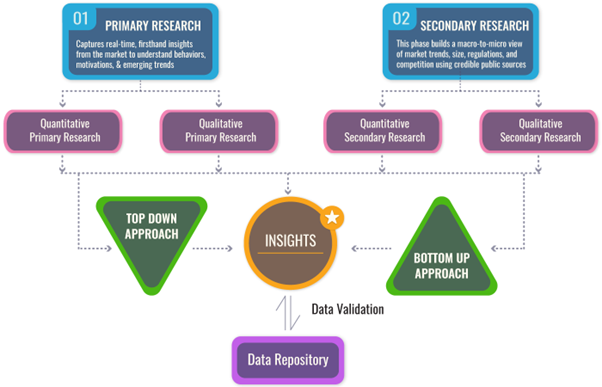
DUAL MODELING: TOP-DOWN + BOTTOM-UP
To ensure robust market estimation, we apply two complementary sizing approaches:
Top-Down Modeling:- Start with broader industry value (e.g., global or regional TAM)
- Apply filters by segment, geography, end-user, or use case
- Adjust with primary insights and validation benchmarks
- Ideal for investor-grade market scans and opportunity mapping
- Aggregate from the ground up using sales volumes, pricing, and unit economics
- Use internal modeling templates aligned with stakeholder data
- Incorporate distributor-level or region-specific inputs
- Most accurate for emerging segments and granular sub-markets
DATA VALIDATION: IN-HOUSE REPOSITORY
We close the loop with proprietary data intelligence built from ongoing projects, industry monitoring, and historical benchmarking. This repository includes:
- Multi-sector market and pricing models
- Key trendlines from past interviews and forecasts
- Benchmarked adoption rates, churn patterns, and ROI indicators
- Industry-specific deviation flags and cross-check logic
- Catches inconsistencies early
- Aligns projections across studies
- Enables consistent, high-trust deliverables