

Fe-Si Steel Market Size and Forecast (2026–2034), Global and Regional Growth, Trend, Share and Industry Analysis Report Coverage; By Product Type (Grain-Oriented, Non-Grain-Oriented); By Application (Transformers, Motors, Inductors, Others); By End-User Industry (Energy, Automotive, Manufacturing, Electronics, Others); and Geography
2026-09-07
Chemicals & Materials
Aishwarya Panbude (Research Analyst)
Description
Fe-Si Steel Market Overview
The global Fe-Si Steel Market was
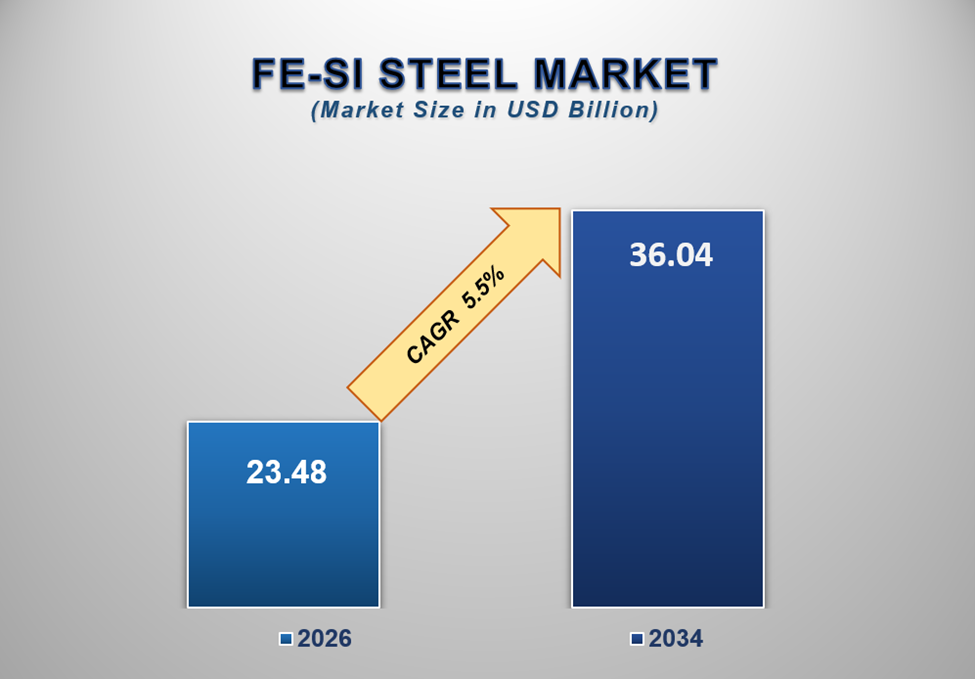
valued at approximately USD 23.48 billion in 2026 and is projected to
reach USD 36.04 billion by 2034, expanding at a CAGR of 5.5%
during the forecast period. The market is witnessing steady growth due to
increasing electricity demand, expansion and modernization of transmission and
distribution networks, rising transformer requirements, accelerating electric
vehicle adoption, growing industrial electrification, and increasing demand for
energy-efficient electrical equipment.
Fe-Si steel, commonly associated with
silicon steel or electrical steel, is an iron-based alloy containing silicon
that is engineered to provide desirable magnetic characteristics. Its ability
to reduce electrical energy losses makes it an essential material for
transformer cores, electric motors, generators, inductors, and other
electromagnetic equipment.
The growing need to improve the efficiency
of electrical infrastructure is one of the primary factors supporting demand
for Fe-Si steel. Power transformers and distribution equipment rely on
specialized electrical steel to minimize core losses during energy conversion
and transmission.
Global investments in electricity
generation, transmission, and distribution infrastructure are creating
sustained requirements for transformer-grade materials. Grid expansion is
particularly important in emerging economies where electricity networks are
being extended to support industrialization, urbanization, and renewable-energy
integration.
The transition toward renewable power
generation is also supporting market development. Solar and wind installations
require additional grid infrastructure, substations, transformers, and
electrical equipment, creating downstream demand for high-performance magnetic
materials.
Electric vehicle adoption is creating
another important source of demand. Electric motors require non-grain-oriented
electrical steel with suitable magnetic performance to improve motor efficiency
and reduce energy losses.
The expansion of industrial automation is
similarly increasing demand for motors, generators, transformers, actuators,
and other electrical equipment that incorporate silicon steel components.
Manufacturers are continuously improving
steel composition, grain structure, surface coatings, rolling processes, and
annealing technologies to achieve lower core losses and higher magnetic
permeability.
High-grade Fe-Si steel is becoming
increasingly important as equipment manufacturers seek to comply with stricter
energy-efficiency requirements while improving the performance of electrical
machines.
The industry is also experiencing
increasing emphasis on manufacturing efficiency and lower-carbon steel
production. Steel producers are investing in improved processing technologies,
energy-efficient furnaces, and advanced production lines to reduce environmental
impact while maintaining material performance.
Asia Pacific remains a major center of
Fe-Si steel consumption and production because of its large
electrical-equipment manufacturing base, extensive automotive industry, and
substantial investment in power infrastructure.
As electrification expands across
transportation, industry, buildings, and energy systems, the demand for
high-efficiency magnetic materials is expected to remain strong through 2034.
Fe-Si Steel Market Drivers and Opportunities
Power Grid Modernization and Rising
Transformer Demand Are Driving Market Growth
The modernization of electricity
infrastructure is one of the most important factors supporting the Fe-Si steel
market.
Utilities are upgrading aging transmission
and distribution networks to improve reliability, reduce energy losses,
accommodate growing electricity consumption, and connect new renewable-energy
generation.
Transformers represent a particularly
important application because their magnetic cores require electrical steel
with controlled magnetic properties and low core losses.
The expansion of substations and
high-voltage transmission networks is consequently increasing demand for
transformer-grade Fe-Si steel.
Developing economies are investing heavily
in new power infrastructure as industrialization and urbanization increase
electricity requirements.
The growing deployment of renewable-energy
projects is adding further pressure for grid expansion because wind and solar
generation requires new transmission links, substations, transformers, and
related electrical equipment.
India provides a strong example of this
trend. The country's planned grid expansion is expected to substantially
increase transformer requirements, supporting long-term demand for CRGO
electrical steel.
Electric Vehicle Adoption and Motor
Electrification Are Supporting Market Expansion
The rapid development of electric mobility
is creating additional demand for non-grain-oriented Fe-Si steel.
Electric vehicles rely on traction motors
that require magnetic materials capable of operating efficiently under rapidly
changing magnetic fields.
High-performance electrical steel can help
reduce motor losses while improving efficiency and supporting compact motor
designs.
Beyond passenger vehicles, electrification
is expanding across buses, commercial vehicles, industrial equipment, and other
mobility platforms.
The broader adoption of energy-efficient
motors in industrial facilities is also creating demand for electrical steel.
Motors account for a significant portion of industrial electricity consumption,
encouraging manufacturers to develop equipment with improved efficiency.
As electric mobility and industrial
electrification continue expanding, the requirement for high-performance
non-grain-oriented electrical steel is expected to increase.
Renewable Energy, Advanced Electrical
Equipment, and High-Efficiency Materials Present Significant Opportunities
The transition toward renewable energy is
creating long-term opportunities for Fe-Si steel producers.
Wind turbines, solar-power infrastructure,
grid-scale storage systems, substations, and transmission networks require
electrical equipment containing magnetic materials.
The replacement of older transformers with
high-efficiency units is also creating opportunities for premium grain-oriented
electrical steel.
Manufacturers are investing in advanced
processing technologies that improve magnetic properties while reducing core
losses.
The development of thinner electrical steel
sheets, improved coatings, controlled grain orientation, and
higher-permeability grades can enable manufacturers of transformers and motors
to achieve improved efficiency.
Another opportunity lies in domestic
production. Several countries are seeking to strengthen electrical-steel supply
chains because dependence on imports can expose transformer and motor
manufacturers to supply disruptions and price volatility.
India, for example, is increasing domestic
electrical-steel manufacturing capacity, including new non-grain-oriented
production facilities designed to support electric vehicles and electric-motor
manufacturing.
Fe-Si Steel Market Scope
|
Report Attributes |
Description |
|
Market Size
in 2026 |
USD
23.48 Billion |
|
Market
Forecast in 2034 |
USD 36.04 Billion |
|
CAGR %
2026-2034 |
5.5% |
|
Base Year |
2025 |
|
Historic
Data |
2021-2025 |
|
Forecast
Period |
2026-2034 |
|
Report USP |
Production, Consumption,
Company Share, Company Heatmap, Company Production, Service Type, Growth
Factors and more |
|
Segments
Covered |
• By Product Type |
|
Regional
Scope |
● North America |
|
Country
Scope |
U.S. |
Fe-Si Steel Market Report Segmentation Analysis
The global Fe-Si steel market industry
analysis is segmented by product type, application, end-user industry, and
region.
The Grain-Oriented Segment Is Expected
to Dominate the Market During the Forecast Period
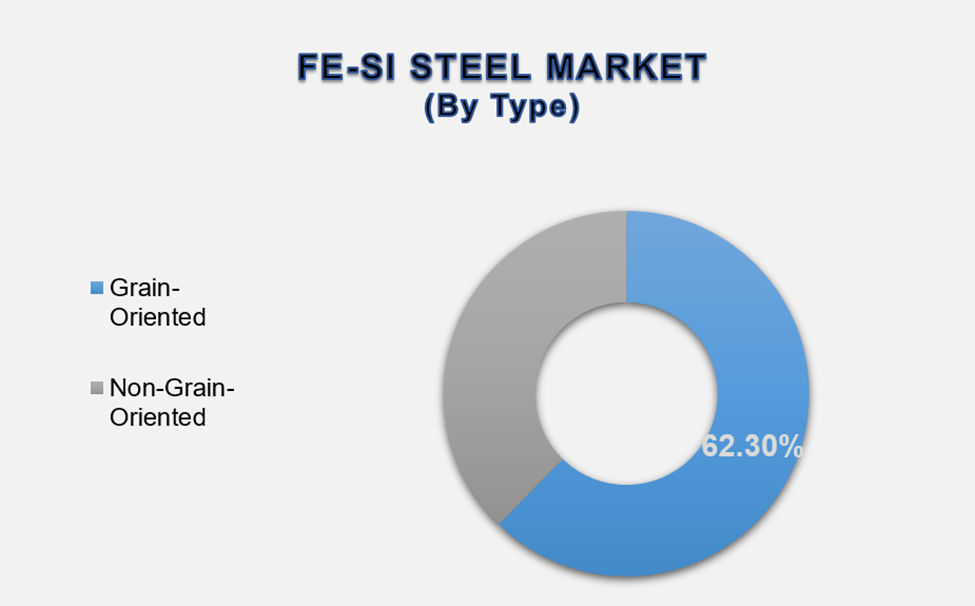
The Grain-Oriented segment accounted
for approximately 62.3% of the global Fe-Si steel market, making it the
leading product category. The segment's dominance is closely linked to the
extensive use of grain-oriented electrical steel in power and distribution
transformers, where directional magnetic properties help reduce core losses.
Grain-oriented Fe-Si steel is manufactured
with controlled crystallographic orientation to optimize magnetic performance
in a preferred direction.
This characteristic makes the material
particularly suitable for transformer cores, where magnetic flux follows a
relatively defined path.
Demand is being supported by transformer
replacement programs, new transmission infrastructure, renewable-energy
integration, and increasing requirements for energy-efficient power equipment.
Premium grades with improved permeability
and reduced core losses are increasingly being adopted by transformer
manufacturers seeking to improve overall equipment efficiency.
Non-grain-oriented Fe-Si steel, meanwhile,
is primarily used in rotating electrical machines where magnetic flux changes
direction during operation.
Its applications include electric motors,
generators, industrial machinery, and electric vehicle traction systems.
The growing electrification of
transportation and industrial equipment is therefore expected to create strong
opportunities for the non-grain-oriented segment as well.
The Transformers Segment Is Expected to
Lead the Market by Application
The Transformers segment is expected
to account for a leading share of the global Fe-Si steel market.
Transformers depend on electrical steel
cores to transfer electrical energy efficiently while limiting magnetic losses.
Growing electricity consumption,
renewable-energy deployment, transmission-network expansion, and replacement of
aging transformers are supporting demand for transformer-grade materials.
Power utilities are increasingly specifying
higher-efficiency transformer systems to reduce energy losses throughout
electricity transmission and distribution networks.
The increasing construction of
renewable-energy projects is also creating additional transformer requirements
because generation facilities need electrical equipment to connect with
transmission and distribution networks.
The Energy Segment Is Expected to
Dominate the Market by End-User Industry
The Energy segment is expected to
represent the largest share of the global Fe-Si steel market.
Power-generation, transmission, and
distribution infrastructure represents a major source of demand for
transformers and other electrical equipment incorporating Fe-Si steel.
Grid modernization projects are increasing
requirements for new substations, transformers, reactors, and other magnetic
components.
The integration of renewable-energy sources
is further increasing demand for electrical infrastructure capable of handling
changing power flows and distributed generation.
The continued expansion of electricity
networks in the Asia Pacific and other emerging regions is expected to maintain
the energy sector's importance throughout the forecast period.
The following segments are part of an
in-depth analysis of the global Fe-Si Steel Market:
|
Market
Segments |
|
|
By Type |
●
Grain-Oriented ●
Non-Grain-Oriented |
|
By Application |
●
Transformers ●
Motors ●
Inductors ●
Others |
|
By End-User Industry |
●
Energy ●
Automotive ●
Manufacturing ●
Electronics ●
Others |
Fe-Si Steel Market Share Analysis By Region
Asia Pacific
is projected to hold the largest share of the global Fe-Si steel market over
the forecast period.
The region's dominance is supported by
extensive electrical-equipment manufacturing, large automotive production
volumes, expanding electricity infrastructure, renewable-energy investment, and
strong steel manufacturing capabilities. The latest Fe-Si-specific market
research identifies Asia Pacific as the largest regional market.
China
represents a major regional market because of its extensive power-generation
and transmission infrastructure, large transformer manufacturing industry,
electric vehicle production, and substantial electrical-steel manufacturing
capacity.
The country is also investing in high-grade
electrical steel production. In June 2026, Fives announced a project with
Fujian Kunbao New Materials to supply two processing lines for grain-oriented
electrical steel, with each line designed for annual production of 100,000
tonnes.
India is
emerging as an important growth market due to power-grid expansion,
renewable-energy deployment, electric vehicle manufacturing, and increasing
domestic electrical-steel production.
India is also working to reduce dependence
on imported electrical steel. In June 2026, Fives announced a contract with JSW
Steel for three processing lines dedicated to non-grain-oriented electrical
steel, including two annealing and coating lines with 270,000-tonne annual
capacities each.
Japan and South
Korea remain important markets because of their advanced steel-processing
capabilities, automotive manufacturing industries, transformer production, and
established electrical-equipment sectors.
North America represents a significant Fe-Si steel market supported by grid
modernization, transformer replacement, renewable-energy development, electric
vehicle manufacturing, and industrial electrification.
The United States remains the
largest contributor in the region as utilities and manufacturers continue
upgrading electrical infrastructure and investing in energy-efficient
equipment.
Europe
represents another important market due to stringent energy-efficiency
requirements, renewable-energy expansion, automotive electrification, and
advanced electrical-equipment manufacturing.
Germany, the U.K., France, Italy, Spain,
and Switzerland are important markets across
transformer manufacturing, industrial machinery, automotive applications, and
electrical equipment.
Latin America is expected to witness steady development as electricity
infrastructure expands and renewable-energy investments increase. Brazil,
Mexico, and Argentina represent important regional markets.
The Middle East & Africa is an emerging market supported by electricity infrastructure
development, industrialization, renewable-energy projects, and investments in
transmission and distribution networks.
Fe-Si Steel Market Competition Landscape
Analysis
The global Fe-Si steel market is
characterized by competition among major integrated steel producers and
specialized electrical-steel manufacturers.
Companies are focusing on lower core
losses, higher magnetic permeability, improved grain orientation, thinner
gauges, advanced coatings, production efficiency, and lower-carbon
manufacturing to strengthen their positions.
Grain-oriented electrical steel remains a
key competitive area because transformer manufacturers increasingly require
high-performance grades capable of reducing energy losses.
Non-grain-oriented electrical steel is
receiving increasing attention from producers responding to electric vehicle
and industrial motor demand.
Manufacturers are also investing in new
processing lines and capacity expansions. Recent projects in China and India
demonstrate the industry's continued movement toward higher-grade electrical
steel production.
The transition toward lower-carbon
steelmaking is another competitive consideration. Producers are increasingly
evaluating energy-efficient furnaces, improved processing routes,
lower-emission production systems, and renewable-energy integration.
Strategic partnerships between steelmakers,
equipment suppliers, automotive manufacturers, and electrical-equipment
producers are also becoming important for developing specialized grades and
securing long-term supply.
Global Fe-Si Steel Market Recent
Developments News
●
In August 2026 – Xinyu Iron and Steel, part of Baowu Group, inaugurated a new
electrical-steel facility supported by Fives. The facility is designed to
produce up to 250,000 metric tons per year of non-grain-oriented electrical
steel, with a significant portion intended for electric vehicle
applications.
●
In June 2026 – Fives announced a contract with Fujian Kunbao New Materials for
two grain-oriented electrical-steel processing lines in China, each with an
annual capacity of 100,000 tonnes.
●
In June 2026 – Fives signed a major electrical-steel project with JSW Steel in
India involving three processing lines for non-grain-oriented electrical steel
used in electric vehicles and motors.
●
In June 2026 – India's Directorate General of Trade Remedies initiated an
anti-dumping investigation concerning imports of cold-rolled grain-oriented
electrical steel and amorphous metal from China, Japan, South Korea, and
Russia.
The Global Fe-Si Steel Market is
Dominated by a Few Large Companies, Such As
●
ArcelorMittal
●
POSCO Holdings Inc.
●
JFE Steel Corporation
●
Nippon Steel Corporation
●
thyssenkrupp AG
●
Baowu Steel Group
●
Cleveland-Cliffs Inc.
●
NLMK Group
●
Tata Steel Limited
●
JSW Steel Limited
●
Shougang Group
●
Ansteel Group Corporation
Limited
●
voestalpine AG
●
ATI Inc.
●
Stalprodukt S.A.
●
Arnold Magnetic Technologies
● Others
Frequently Asked Questions
Aishwarya Panbude (Research Analyst)
Aishwarya Panbude is a skilled Research Analyst with 4+ years of experience in market intelligence, consumer insights, competitive analysis, and industry forecasting across the consumer goods, agriculture, and food & beverage sectors. She specializes in market sizing, trend analysis, growth opportunity mapping, and strategic secondary research for global and regional markets.
Her expertise lies in transforming complex industry data into actionable business strategies that help organizations identify emerging trends, understand customer behavior, and gain a competitive edge. With a strong focus on data-driven insights, business intelligence, and future market trends, Jaya delivers high-quality research solutions aligned with evolving industry demands and market dynamics.
1.
Global Fe-Si Steel Market Introduction
and Market Overview
1.1.
Objectives of the Study
1.2.
Market Definition
1.2.1.Product Type of Global
Fe-Si Steel Market
1.2.2.Application of Global
Fe-Si Steel Market
1.2.3.End-User Industry of
Global Fe-Si Steel Market
1.2.4.Market Scope of Global
Fe-Si Steel Market
1.2.5.Region of Global Fe-Si
Steel Market
1.3.
Competition Overview List of Market Participants
1.4.
Market Definition: Fe-Si Steel Market
2.
Executive Summary
2.1.
Global Fe-Si Steel Market Estimation &
Forecast
2.1.1.Global Fe-Si Steel Market
Size (US$ Billion) Estimates & Historical Trend Analysis, 2021 - 2025
2.1.2.Global Fe-Si Steel Market
Size (US$ Billion), Growth Rate (Y-o-Y), Market Forecast, 2026 - 2034
2.2.
Snapshot of Global Fe-Si Steel Market
2.3.
Global Fe-Si Steel Market Revenue Share (%) 2025
2.4.
REGIONAL: Revenue Analysis
2.5.
Key Competitors & Key Insights
3.
Market Overview (Qualitative Analysis)
3.1.
Demand Side Trends
3.2.
Supply Side Trends / Manufacturing Trends
3.3.
Demand and Opportunity Assessment, 2026 - 2034
3.4.
Key Market Trends
3.5.
Key Developments
3.6.
Overview of Regulatory Landscape, Compliance
Framework, and Industry Standards
3.7.
Market Entry Strategies
3.8.
Market Dynamics
3.8.1.Drivers
3.8.2.Limitations
3.8.3.Opportunities
3.8.4.Impact Analysis of
Drivers and Restraints
3.9.
Porter's Five Forces Analysis
3.10.
PEST Analysis
4.
Global Fe-Si Steel Market Estimates &
Historical Trend Analysis, 2021 - 2025
5.
Global Fe-Si Steel Market Estimates &
Forecast Trend Analysis, by Product Type
5.1.
Global Fe-Si Steel Market Revenue (US$ Billion)
Estimates and Forecasts, by Product Type, 2021 - 2034
5.1.1.Grain-Oriented
5.1.2.Non-Grain-Oriented
6.
Global Fe-Si Steel Market Estimates &
Forecast Trend Analysis, by Application
6.1.
Global Fe-Si Steel Market Revenue (US$ Billion)
Estimates and Forecasts, by Application, 2021 - 2034
6.1.1.Transformers
6.1.2.Motors
6.1.3.Inductors
6.1.4.Others
7.
Global Fe-Si Steel Market Estimates &
Forecast Trend Analysis, by End-User Industry
7.1.
Global Fe-Si Steel Market Revenue (US$ Billion)
Estimates and Forecasts, by End-User Industry, 2021 - 2034
7.1.1.Energy
7.1.2.Automotive
7.1.3.Manufacturing
7.1.4.Electronics
7.1.5.Others
8.
Global Fe-Si Steel Market Estimates &
Forecast Trend Analysis, by Region
8.1.
Global Fe-Si Steel Market Revenue (US$ Billion)
Estimates and Forecasts, by Region, 2021 - 2034
8.1.1.North America
8.1.2.Europe
8.1.3.Asia Pacific
8.1.4.Middle East & Africa
8.1.5.Latin America
9.
North America Fe-Si Steel Market:
Estimates & Forecast Trend Analysis
9.1.
North America Fe-Si Steel Market Assessments
& Key Findings
9.1.1.North America Fe-Si Steel
Market Introduction
9.1.2.North America Fe-Si Steel
Market Size Estimates and Forecast (US$ Billion), 2021 - 2034
9.1.2.1.
By Product Type
9.1.2.2.
By Application
9.1.2.3.
By End-User Industry
9.1.2.4.
By Country
9.1.2.4.1.
The U.S.
9.1.2.4.2.
Canada
10.
Europe Fe-Si Steel Market: Estimates
& Forecast Trend Analysis
10.1.
Europe Fe-Si Steel Market Assessments & Key
Findings
10.1.1.
Europe Fe-Si Steel Market Introduction
10.1.2.
Europe Fe-Si Steel Market Size Estimates and
Forecast (US$ Billion), 2021 - 2034
10.1.2.1.
By Product Type
10.1.2.2.
By Application
10.1.2.3.
By End-User Industry
10.1.2.4.
By Country
10.1.2.4.1.
The U.K.
10.1.2.4.2.
Germany
10.1.2.4.3.
France
10.1.2.4.4.
Italy
10.1.2.4.5.
Spain
10.1.2.4.6.
Switzerland
10.1.2.4.7.
Rest of Europe
11.
Asia Pacific Fe-Si Steel Market:
Estimates & Forecast Trend Analysis
11.1.
Asia Pacific Fe-Si Steel Market Assessments
& Key Findings
11.1.1.
Asia Pacific Fe-Si Steel Market Introduction
11.1.2.
Asia Pacific Fe-Si Steel Market Size Estimates
and Forecast (US$ Billion), 2021 - 2034
11.1.2.1.
By Product Type
11.1.2.2.
By Application
11.1.2.3.
By End-User Industry
11.1.2.4.
By Country
11.1.2.4.1.
China
11.1.2.4.2.
India
11.1.2.4.3.
Japan
11.1.2.4.4.
South Korea
11.1.2.4.5.
Australia
11.1.2.4.6.
Rest of Asia Pacific
12.
Middle East & Africa Fe-Si Steel
Market: Estimates & Forecast Trend Analysis
12.1.
Middle East & Africa Fe-Si Steel Market
Assessments & Key Findings
12.1.1.
Middle East & Africa Fe-Si Steel Market
Introduction
12.1.2.
Middle East & Africa Fe-Si Steel Market Size
Estimates and Forecast (US$ Billion), 2021 - 2034
12.1.2.1.
By Product Type
12.1.2.2.
By Application
12.1.2.3.
By End-User Industry
12.1.2.4.
By Country
12.1.2.4.1.
Saudi Arabia
12.1.2.4.2.
UAE
12.1.2.4.3.
South Africa
12.1.2.4.4.
Rest of Middle East & Africa
13.
Latin America Fe-Si Steel Market:
Estimates & Forecast Trend Analysis
13.1.
Latin America Fe-Si Steel Market Assessments
& Key Findings
13.1.1.
Latin America Fe-Si Steel Market Introduction
13.1.2.
Latin America Fe-Si Steel Market Size Estimates
and Forecast (US$ Billion), 2021 - 2034
13.1.2.1.
By Product Type
13.1.2.2.
By Application
13.1.2.3.
By End-User Industry
13.1.2.4.
By Country
13.1.2.4.1.
Brazil
13.1.2.4.2.
Mexico
13.1.2.4.3.
Argentina
13.1.2.4.4.
Rest of Latin America
14.
Competition Landscape
14.1.
Global Fe-Si Steel Market Product Mapping
14.2.
Global Fe-Si Steel Market Concentration
Analysis, by Leading Players / Innovators / Emerging Players / New Entrants
14.3.
Global Fe-Si Steel Market Tier Structure
Analysis
14.4.
Global Fe-Si Steel Market Concentration &
Company Market Shares (%) Analysis, 2025
14.5.
Global Fe-Si Steel Market Recent Developments
Analysis
15.
Company Profiles
15.1.
ArcelorMittal
15.1.1.
Company Overview & Key Stats
15.1.2.
Financial Performance & KPIs
15.1.3.
Product Portfolio
15.1.4.
SWOT Analysis
15.1.5.
Business Strategy & Recent Developments
Similar details would be provided for all the players
mentioned below
15.2.
POSCO Holdings Inc.
15.3.
JFE Steel Corporation
15.4.
Nippon Steel Corporation
15.5.
thyssenkrupp AG
15.6.
Baowu Steel Group
15.7.
Cleveland-Cliffs Inc.
15.8.
NLMK Group
15.9.
Tata Steel Limited
15.10.
JSW Steel Limited
15.11.
Shougang Group
15.12.
Ansteel Group Corporation Limited
15.13.
voestalpine AG
15.14.
ATI Inc.
15.15.
Stalprodukt S.A.
15.16.
Arnold Magnetic Technologies
15.17.
Others
16.
Research Findings & Conclusion
17.
Assumptions & Acronyms Used
18.
Research Methodology
18.1.
External Databases
18.2.
Internal Proprietary Database
18.3.
Primary Research
18.4.
Secondary Research
18.5.
Assumptions
18.6.
Limitations
18.7.
Report FAQs
Our Research Methodology
"Insight without rigor is just noise."
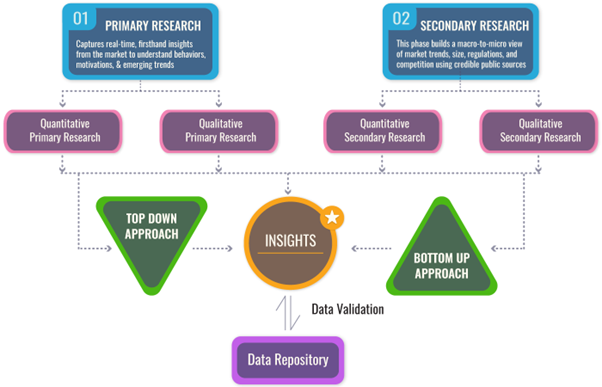
We follow a comprehensive, multi-phase research framework designed to deliver accurate, strategic, and decision-ready intelligence. Our process integrates primary and secondary research , both quantitative and qualitative , along with dual modeling techniques ( top-down and bottom-up) and a final layer of validation through our proprietary in-house repository.
PRIMARY RESEARCH
Primary research captures real-time, firsthand insights from the market to understand behaviors, motivations, and emerging trends.
1. Quantitative Primary Research
Objective: Generate statistically significant data directly from market participants.
Approaches:- Structured surveys with customers, distributors, and field agents
- Mobile-based data collection for point-of-sale audits and usage behavior
- Phone-based interviews (CATI) for market sizing and product feedback
- Online polling around industry events and digital campaigns
- Purchase frequency by customer type
- Channel performance across geographies
- Feature demand by application or demographic
2. Qualitative Primary Research
Objective: Explore decision-making drivers, pain points, and market readiness.
Approaches:- In-depth interviews (IDIs) with executives, product managers, and key decision-makers
- Focus groups among end users and early adopters
- Site visits and observational research for consumer products
- Informal field-level discussions for regional and cultural nuances
SECONDARY RESEARCH
This phase helps establish a macro-to-micro understanding of market trends, size, regulation, and competitive dynamics, sourced from credible and public domain information.
1. Quantitative Secondary Research
Objective: Model market value and segment-level forecasts based on published data.
Sources include:- Financial reports and investor summaries
- Government trade data, customs records, and regulatory statistics
- Industry association publications and economic databases
- Channel performance and pricing data from marketplace listings
- Revenue splits, pricing trends, and CAGR estimates
- Supply-side capacity and volume tracking
- Investment analysis and funding benchmarks
2. Qualitative Secondary Research
Objective: Capture strategic direction, innovation signals, and behavioral trends.
Sources include:- Company announcements, roadmaps, and product pipelines
- Publicly available whitepapers, conference abstracts, and academic research
- Regulatory body publications and policy briefs
- Social and media sentiment scanning for early-stage shifts
- Strategic shifts in market positioning
- Unmet needs and white spaces
- Regulatory triggers and compliance impact
DUAL MODELING: TOP-DOWN + BOTTOM-UP
To ensure robust market estimation, we apply two complementary sizing approaches:
Top-Down Modeling:- Start with broader industry value (e.g., global or regional TAM)
- Apply filters by segment, geography, end-user, or use case
- Adjust with primary insights and validation benchmarks
- Ideal for investor-grade market scans and opportunity mapping
- Aggregate from the ground up using sales volumes, pricing, and unit economics
- Use internal modeling templates aligned with stakeholder data
- Incorporate distributor-level or region-specific inputs
- Most accurate for emerging segments and granular sub-markets
DATA VALIDATION: IN-HOUSE REPOSITORY
We close the loop with proprietary data intelligence built from ongoing projects, industry monitoring, and historical benchmarking. This repository includes:
- Multi-sector market and pricing models
- Key trendlines from past interviews and forecasts
- Benchmarked adoption rates, churn patterns, and ROI indicators
- Industry-specific deviation flags and cross-check logic
- Catches inconsistencies early
- Aligns projections across studies
- Enables consistent, high-trust deliverables