

Fermenters and Bioreactors Market Size and Forecast (2026–2034), Global and Regional Growth, Trend, Share and Industry Analysis Report Coverage; By Product Type (Single-Use Bioreactors, Stainless Steel Bioreactors, Fermenters, Perfusion Bioreactors, Airlift Bioreactors, Others); By Scale (Laboratory Scale, Pilot Scale, Industrial Scale); By Application (Biopharmaceutical Production, Cell & Gene Therapy, Vaccine Manufacturing, Microbial Fermentation, Tissue Engineering, Research & Development, Others); By End User (Biopharmaceutical Companies, Contract Development & Manufacturing Organizations (CDMOs), Academic & Research Institutes, Food & Beverage Industry, Others), and Geography
2026-06-29
Healthcare
Swetal (Research Analyst)
Description
Fermenters and Bioreactors Market
Overview
The global Fermenters
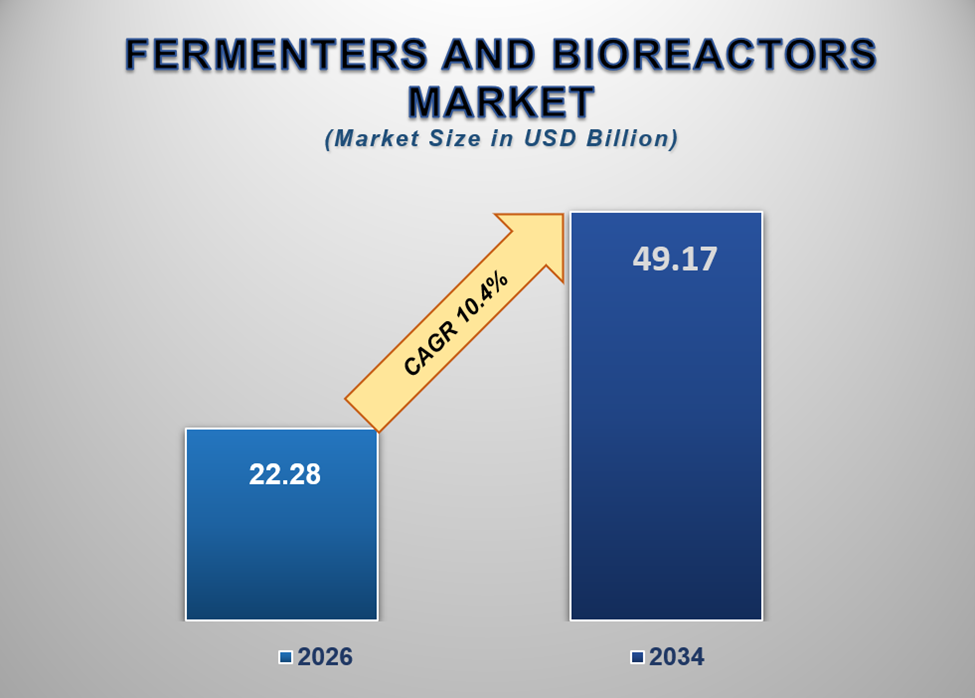
and Bioreactors Market was valued at USD 22.28 billion in 2026 and
is projected to reach USD 49.17 billion by 2034, registering a CAGR of 10.4%
during the forecast period. The market is witnessing robust growth due to
the rapid expansion of biopharmaceutical manufacturing, increasing demand for
biologics and biosimilars, rising investments in cell and gene therapy
development, growing vaccine production capacities, and continuous
technological advancements in bioprocessing systems.
Fermenters and
bioreactors have become indispensable components of modern biotechnology,
pharmaceutical manufacturing, industrial microbiology, and advanced life
sciences research. These systems provide controlled environments for
cultivating microorganisms, mammalian cells, plant cells, and other biological
entities essential for producing a broad range of commercial products,
including vaccines, therapeutic proteins, monoclonal antibodies, enzymes,
biofuels, probiotics, and specialty chemicals.
The
biotechnology industry is experiencing unprecedented growth, driven by
increasing demand for innovative therapies and personalized medicines. As
pharmaceutical companies focus on developing complex biologics, advanced
manufacturing technologies are becoming critical to ensure product quality,
consistency, and scalability. Fermenters and bioreactors serve as the
foundation of these production processes by enabling precise control of
critical parameters such as temperature, pH, oxygen levels, nutrient supply,
agitation, and sterility.
The growing
adoption of biologics represents one of the most significant drivers supporting
market expansion. Unlike conventional small-molecule drugs, biologics require
sophisticated cell culture processes that can only be achieved through advanced
bioreactor systems. Monoclonal antibodies, recombinant proteins, cell
therapies, and gene therapies increasingly rely on high-performance
bioprocessing equipment capable of supporting large-scale production.
The emergence of
cell and gene therapies is creating transformative opportunities for the
market. These next-generation treatments require highly controlled
manufacturing environments to ensure product efficacy and patient safety.
Bioreactors play a central role in cell expansion, viral vector production, and
tissue engineering applications, making them essential infrastructure for
advanced therapy manufacturing.
Vaccine
manufacturing is another critical application area driving demand. Global
healthcare systems continue emphasizing preparedness against infectious
diseases, resulting in substantial investments in vaccine research and
production capabilities. Modern bioreactor technologies enable rapid scaling of
vaccine production while maintaining stringent quality standards.
Technological
advancements are significantly improving operational efficiency and
manufacturing flexibility. Single-use bioreactors, automated monitoring
systems, real-time analytics, digital process controls, and integrated data
management platforms are transforming bioprocessing operations. These
innovations reduce contamination risks, shorten production timelines, and
improve overall process economics.
The food and
beverage industry is also contributing to market growth through increasing
adoption of fermentation technologies for probiotics, functional foods,
alternative proteins, and sustainable ingredients. Industrial biotechnology
applications involving biofuels, enzymes, and bio-based chemicals further
expand market opportunities.
As biotechnology continues evolving toward more sophisticated and large-scale production models, fermenters and bioreactors are expected to remain central to global biomanufacturing infrastructure throughout the forecast period.
Fermenters and Bioreactors Market
Drivers and Opportunities
Rapid
Expansion of Biopharmaceutical Manufacturing Is Driving Market Growth
One of the
primary factors accelerating growth in the fermenters and bioreactors market is
the increasing global demand for biopharmaceutical products.
Biopharmaceuticals
have become one of the fastest-growing segments within the healthcare industry
due to their ability to address complex diseases that are often difficult to
treat using conventional therapies. Products such as monoclonal antibodies, recombinant
proteins, vaccines, and cell-based therapies require sophisticated production
environments supported by advanced bioreactor systems.
Pharmaceutical
companies are expanding manufacturing capacities to meet growing demand for
these products. New production facilities, capacity expansion projects, and
investments in biologics manufacturing infrastructure are significantly
increasing demand for fermenters and bioreactors across global markets.
The growing
prevalence of chronic diseases, autoimmune disorders, cancer, and rare genetic
conditions is further supporting demand for biologic therapies. As healthcare
providers increasingly adopt targeted treatment approaches, production
requirements for advanced biologics continue to rise.
Moreover,
biosimilar development activities are creating additional opportunities for
bioprocess equipment manufacturers. As patents for major biologic products
expire, manufacturers are investing heavily in biosimilar production
capabilities that require reliable and scalable fermentation technologies.
The continued growth of the biopharmaceutical industry is expected to remain a major driver of market expansion throughout the forecast period.
Rising
Investments in Cell and Gene Therapy Manufacturing Are Accelerating Market
Development
Cell and gene
therapies represent one of the most dynamic areas of modern medicine and are
significantly influencing demand for advanced bioprocessing systems.
These therapies
involve complex manufacturing workflows that require precise environmental
control and scalable production platforms. Bioreactors are essential for cell
cultivation, viral vector production, stem cell expansion, and other critical
manufacturing processes associated with advanced therapies.
Governments,
biotechnology companies, pharmaceutical manufacturers, and investors are
collectively increasing funding for regenerative medicine research and
commercialization. This surge in investment is driving demand for highly
specialized bioreactor technologies capable of supporting next-generation
therapeutic development.
Unlike
traditional pharmaceutical manufacturing, cell and gene therapies often require
flexible and customized production environments. Modern single-use bioreactor
systems are particularly attractive because they enable faster setup, reduced
contamination risks, and greater manufacturing agility.
The growing
number of clinical trials and regulatory approvals for advanced therapies is
expected to create substantial long-term demand for fermenters and bioreactors.
As regenerative medicine transitions from experimental research to commercial-scale production, market growth is expected to accelerate significantly.
Adoption of
Single-Use Technologies and Digital Bioprocessing Creates Significant
Opportunities
The increasing
adoption of single-use bioprocessing technologies presents one of the most
promising opportunities within the fermenters and bioreactors market.
Traditional
stainless-steel systems require extensive cleaning, sterilization, and
validation procedures between production batches. Single-use bioreactors
eliminate many of these requirements, reducing operational complexity while
improving manufacturing efficiency.
These systems
are particularly beneficial for multiproduct facilities, clinical manufacturing
operations, and organizations seeking flexible production capabilities. The
reduced capital investment requirements associated with single-use technologies
are further encouraging adoption among emerging biotechnology companies.
Digital
transformation is creating additional opportunities for innovation. Advanced
process analytics, artificial intelligence, machine learning, predictive
maintenance systems, and real-time monitoring platforms are enhancing
bioprocess control and optimization.
Smart
bioreactors equipped with automated sensors and data analytics capabilities
enable manufacturers to improve product quality, reduce production variability,
and maximize operational efficiency. These capabilities are becoming
increasingly important as regulatory requirements and production complexities
continue evolving.
Emerging
applications such as cultured meat production, sustainable biotechnology,
precision fermentation, synthetic biology, and bio-based chemical manufacturing
also represent significant future growth opportunities.
As industries increasingly
prioritize scalability, sustainability, and process efficiency, demand for
advanced fermenters and bioreactors is expected to expand considerably.
Fermenters and Bioreactors Market
Scope
|
Report Attributes |
Description |
|
Market Size in 2026 |
USD 22.28 Billion |
|
Market Forecast in 2034 |
USD 49.17 Billion |
|
CAGR % 2026-2034 |
10.4% |
|
Base Year |
2025 |
|
Historic Data |
2021-2025 |
|
Forecast Period |
2026-2034 |
|
Report USP |
Production, Consumption,
Company Share, Company Heatmap, Company Production, Service Type, Growth
Factors and more |
|
Segments Covered |
∙ By Product Type |
|
Regional Scope |
● North America |
|
Country Scope |
U.S. |
Fermenters
and Bioreactors Market Report Segmentation Analysis
The global fermenters and bioreactors market industry analysis is segmented into product type, scale, application, end user, and region.
Single-Use
Bioreactors Segment Is Expected to Dominate the Market During the Forecast
Period
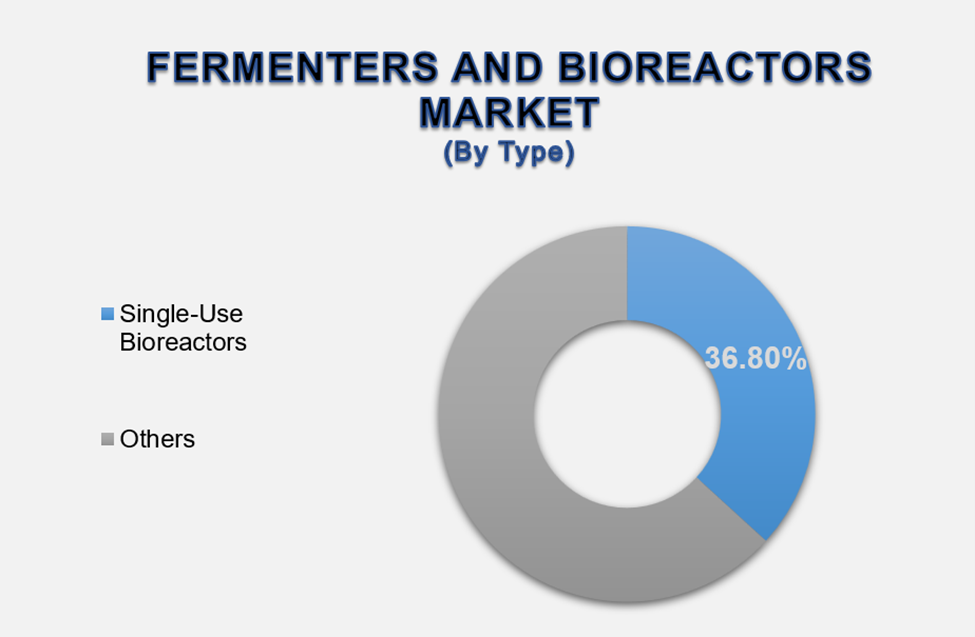
The single-use
bioreactors segment accounted for approximately 36.8% of the global market,
making it the largest product category.
Single-use
bioreactors are gaining substantial popularity due to their operational
flexibility, reduced contamination risks, lower cleaning requirements, and
cost-effective deployment. These systems are particularly valuable for
biotechnology companies involved in clinical-stage manufacturing and
multiproduct production environments.
The ability to
shorten production turnaround times while maintaining regulatory compliance has
made single-use technologies increasingly attractive across the pharmaceutical
and biotechnology sectors.
Continuous
innovation in disposable materials, sensor integration, and scalability is
further strengthening the adoption of single-use bioreactor systems.
As manufacturers prioritize efficiency and flexibility, single-use bioreactors are expected to maintain their leadership position.
The
Industrial Scale Segment Is Expected to Lead the Market by Scale
Industrial-scale
bioreactors represent the largest segment within the market.
Large-scale
manufacturing facilities require high-capacity bioreactors to support
commercial production of vaccines, biologics, enzymes, biofuels, and specialty
chemicals. These systems enable manufacturers to achieve production
efficiencies necessary for meeting global demand.
Increasing
investments in large-scale biomanufacturing facilities and contract
manufacturing organizations are significantly contributing to segment growth.
Moreover,
expanding commercial production of biologics and biosimilars is increasing
demand for industrial-scale fermentation infrastructure.
As commercial biomanufacturing activities continue expanding globally, industrial-scale systems are expected to dominate the market.
Biopharmaceutical
Production Segment Is Expected to Dominate the Market by Application
Biopharmaceutical
production accounts for the largest application share within the fermenters and
bioreactors market.
The production
of monoclonal antibodies, recombinant proteins, vaccines, and advanced
biologics requires highly controlled cultivation environments supported by
sophisticated bioreactor technologies. These products represent some of the
fastest-growing segments within the global pharmaceutical industry.
Bioreactors
facilitate consistent cell growth, optimal protein expression, and scalable
production capabilities essential for commercial success.
Increasing
approvals of biologic therapies and expanding treatment applications are
driving continued demand within this segment.
As healthcare systems increasingly adopt biologic medicines, biopharmaceutical production is expected to remain the leading application area.
The
Biopharmaceutical Companies Segment Is Expected to Lead the Market by End User
Biopharmaceutical
companies represent the largest end-user segment within the market.
These
organizations utilize fermenters and bioreactors throughout the product
development lifecycle, from research and process development to clinical
manufacturing and large-scale commercial production.
The industry's
ongoing investment in biologics, biosimilars, vaccines, and advanced therapies
is generating substantial demand for high-performance bioprocessing
infrastructure.
Furthermore,
increasing competition among pharmaceutical manufacturers is encouraging
continuous investment in advanced manufacturing technologies that improve
efficiency and product quality.
As biologics continue gaining prominence within global healthcare markets, biopharmaceutical companies are expected to remain the dominant end-user group.
The following
segments are part of an in-depth analysis of the global Fermenters and
Bioreactors market:
|
Market Segments |
|
|
By
Scale |
∙ Laboratory Scale |
|
By
Type |
∙ Single-Use Bioreactors |
|
By
Application |
∙ Biopharmaceutical
Production |
|
By End User |
∙ Biopharmaceutical Companies |
Fermenters and Bioreactors Market
Share Analysis By Region
North America is
projected to dominate the global fermenters and bioreactors market, accounting
for approximately 38.4% of total market revenue in 2026.
The region's
dominance is supported by advanced biotechnology infrastructure, substantial
pharmaceutical R&D investments, a strong presence of leading
biopharmaceutical companies, and a favorable regulatory environment. The United
States remains the primary contributor due to extensive biologics manufacturing
activities and continuous investments in advanced therapy development.
Europe
represents another significant market driven by robust pharmaceutical
manufacturing capabilities, strong academic research networks, and increasing
investments in biosimilar production.
Asia-Pacific is
expected to register the fastest growth throughout the forecast period.
Countries such as China, India, South Korea, Japan, and Singapore are investing
heavily in biotechnology infrastructure, vaccine manufacturing, and
biopharmaceutical production capacities.
Latin America and the Middle East & Africa are gradually expanding their biotechnology ecosystems, creating additional opportunities for market participants.
Fermenters and Bioreactors Market Competition Landscape Analysis
The global
fermenters and bioreactors market is characterized by rapid technological
innovation, strategic partnerships, manufacturing capacity expansion, and
increasing demand for advanced bioprocessing solutions.
Leading
companies are investing heavily in automation technologies, smart manufacturing
platforms, single-use systems, process analytical technologies, and digital
bioprocessing solutions. Organizations are also pursuing acquisitions and
collaborations to strengthen product portfolios and expand geographic presence.
The market is
witnessing growing competition among equipment manufacturers seeking to address
evolving customer requirements related to scalability, flexibility, regulatory
compliance, and sustainability.
Future competitive dynamics are expected to be influenced by advancements in artificial intelligence, real-time process monitoring, predictive analytics, and next-generation biomanufacturing technologies.
Global Fermenters and Bioreactors
Market Recent Developments News
∙ In April 2026,
biotechnology equipment manufacturers introduced advanced single-use bioreactor
platforms designed for cell and gene therapy applications.
∙ In February
2026, several pharmaceutical companies announced investments in large-scale
biologics manufacturing facilities to meet growing global demand.
∙ In November
2025, bioprocess technology providers launched intelligent monitoring systems
integrating AI-driven process optimization capabilities.
∙ In August
2025, contract manufacturing organizations expanded bioreactor capacities to
support commercial biologics and vaccine production.
∙ In June 2025, equipment manufacturers introduced next-generation perfusion bioreactor technologies designed to improve production efficiency and product yield.
The Global
Fermenters and Bioreactors Market is Dominated by a Few Large Companies, Such
As
∙ Thermo Fisher Scientific Inc.
∙ Sartorius AG
∙ Danaher Corporation (Cytiva)
∙ Merck KGaA
∙ Eppendorf SE
∙ Getinge AB
∙ PBS Biotech, Inc.
∙ Solaris Biotechnology Srl
∙ Infors HT
∙ Applikon Biotechnology B.V.
∙ Pierre Guérin SAS
∙ Bioengineering AG
∙ ABEC, Inc.
∙ Distek, Inc.
∙ BBI-Biotech GmbH
∙ Others
Frequently Asked Questions
Swetal (Research Analyst)
Swetal is a Research Analyst with 4+ years of experience specializing in healthcare market research, medical devices, healthcare IT, and medical technology industry analysis. Her expertise includes competitive intelligence, secondary research, market trend forecasting, and healthcare business insights across global healthcare ecosystems.
She contributes to advanced market research reports by analyzing regulatory frameworks, emerging healthcare technologies, competitive landscapes, and innovation trends shaping the medical industry. With a strong focus on accurate market intelligence, strategic insights, and healthcare industry trends, Swetal supports businesses in making informed, data-backed decisions in a rapidly transforming healthcare environment.
1.
Global Fermenters and
Bioreactors Market Introduction and Market Overview
1.1. Objectives of the Study
1.2. Global Fermenters and Bioreactors Market Scope and Market Estimation
1.2.1.
Global Fermenters and
Bioreactors Overall Market Size (US$ Million), Market CAGR (%), Market Forecast
(2026 - 2034)
1.2.2.
Global Fermenters and
Bioreactors Market Revenue Share (%) and Growth Rate (Y-o-Y) from 2021 - 2034
1.3. Market Segmentation
1.3.1.
Product Type of Global
Fermenters and Bioreactors Market
1.3.2.
Scale of Global Fermenters and
Bioreactors Market
1.3.3.
Application of Global
Fermenters and Bioreactors Market
1.3.4.
End User of Global Fermenters
and Bioreactors Market
1.3.5.
Region of Global Fermenters and
Bioreactors Market
2.
Executive Summary
2.1. Demand Side Trends
2.2. Key Market Trends
2.3. Market Demand (US$ Million) Analysis 2021 – 2025 and Forecast, 2026
– 2034
2.4. Demand and Opportunity Assessment
2.5. Key Developments
2.6. Overview of Tariff, Regulatory Landscape and Standards
2.7. Market Entry Strategies
2.8. Market Dynamics
2.8.1.
Drivers
2.8.2.
Limitations
2.8.3.
Opportunities
2.8.4.
Impact Analysis of Drivers and
Restraints
2.9. Porter’s Five Forces Analysis
2.10.
PEST Analysis
3.
Global Fermenters and
Bioreactors Market Estimates & Historical Trend Analysis (2021 - 2025)
4.
Global Fermenters and
Bioreactors Market Estimates & Forecast Trend Analysis, by Product Type
4.1. Global Fermenters and Bioreactors Market Revenue (US$ Million)
Estimates and Forecasts, by Product Type, 2021 - 2034
4.1.1.
Single-Use Bioreactors
4.1.2.
Stainless Steel Bioreactors
4.1.3.
Fermenters
4.1.4.
Perfusion Bioreactors
4.1.5.
Airlift Bioreactors
4.1.6.
Others
5.
Global Fermenters and
Bioreactors Market Estimates & Forecast Trend Analysis, by Scale
5.1. Global Fermenters and Bioreactors Market Revenue (US$ Million)
Estimates and Forecasts, by Scale, 2021 - 2034
5.1.1.
Laboratory Scale
5.1.2.
Pilot Scale
5.1.3.
Industrial Scale
6.
Global Fermenters and
Bioreactors Market Estimates & Forecast Trend Analysis, by Application
6.1. Global Fermenters and Bioreactors Market Revenue (US$ Million)
Estimates and Forecasts, by Application, 2021 - 2034
6.1.1.
Biopharmaceutical Production
6.1.2.
Cell & Gene Therapy
6.1.3.
Vaccine Manufacturing
6.1.4.
Microbial Fermentation
6.1.5.
Tissue Engineering
6.1.6.
Research & Development
6.1.7.
Others
7.
Global Fermenters and
Bioreactors Market Estimates & Forecast Trend Analysis, by End User
7.1. Global Fermenters and Bioreactors Market Revenue (US$ Million)
Estimates and Forecasts, by End User, 2021 - 2034
7.1.1.
Biopharmaceutical Companies
7.1.2.
Contract Development &
Manufacturing Organizations (CDMOs)
7.1.3.
Academic & Research
Institutes
7.1.4.
Food & Beverage Industry
7.1.5.
Others
8.
Global Fermenters and
Bioreactors Market Estimates & Forecast Trend Analysis, by Region
8.1. Global Fermenters and Bioreactors Market Revenue (US$ Million)
Estimates and Forecasts, by Region, 2021 - 2034
8.1.1.
North America
8.1.2.
Europe
8.1.3.
Asia Pacific
8.1.4.
Middle East & Africa
8.1.5.
Latin America
9.
North America Fermenters
and Bioreactors Market: Estimates & Forecast Trend Analysis
9.1. North America Fermenters and Bioreactors Market Assessments &
Key Findings
9.1.1.
North America Fermenters and
Bioreactors Market Introduction
9.1.2.
North America Fermenters and
Bioreactors Market Size Estimates and Forecast (US$ Million) (2021 - 2034)
9.1.2.1.
By Product Type
9.1.2.2.
By Scale
9.1.2.3.
By Application
9.1.2.4.
By End User
9.1.2.5.
By Country
9.1.2.5.1.
The U.S.
9.1.2.5.2.
Canada
10. Europe Fermenters and Bioreactors Market: Estimates & Forecast
Trend Analysis
10.1.
Europe Fermenters and
Bioreactors Market Assessments & Key Findings
10.1.1.
Europe Fermenters and
Bioreactors Market Introduction
10.1.2.
Europe Fermenters and
Bioreactors Market Size Estimates and Forecast (US$ Million) (2021 - 2034)
10.1.2.1.
By Product Type
10.1.2.2.
By Scale
10.1.2.3.
By Application
10.1.2.4.
By End User
10.1.2.5.
By Country
10.1.2.5.1.
Germany
10.1.2.5.2.
Italy
10.1.2.5.3.
U.K.
10.1.2.5.4.
France
10.1.2.5.5.
Spain
10.1.2.5.6.
Switzerland
10.1.2.5.7.
Rest of Europe
11. Asia Pacific Fermenters and Bioreactors Market: Estimates &
Forecast Trend Analysis
11.1.
Asia Pacific Market Assessments
& Key Findings
11.1.1.
Asia Pacific Fermenters and
Bioreactors Market Introduction
11.1.2.
Asia Pacific Fermenters and
Bioreactors Market Size Estimates and Forecast (US$ Million) (2021 - 2034)
11.1.2.1.
By Product Type
11.1.2.2.
By Scale
11.1.2.3.
By Application
11.1.2.4.
By End User
11.1.2.5.
By Country
11.1.2.5.1.
China
11.1.2.5.2.
Japan
11.1.2.5.3.
India
11.1.2.5.4.
Australia
11.1.2.5.5.
South Korea
11.1.2.5.6.
Rest of Asia Pacific
12. Middle East & Africa Fermenters and Bioreactors Market:
Estimates & Forecast Trend Analysis
12.1.
Middle East & Africa Market
Assessments & Key Findings
12.1.1.
Middle East & Africa
Fermenters and Bioreactors Market Introduction
12.1.2.
Middle East & Africa
Fermenters and Bioreactors Market Size Estimates and Forecast (US$ Million)
(2021 - 2034)
12.1.2.1.
By Product Type
12.1.2.2.
By Scale
12.1.2.3.
By Application
12.1.2.4.
By End User
12.1.2.5.
By Country
12.1.2.5.1.
UAE
12.1.2.5.2.
Saudi Arabia
12.1.2.5.3.
South Africa
12.1.2.5.4.
Rest of MEA
13. Latin America Fermenters and Bioreactors Market: Estimates &
Forecast Trend Analysis
13.1.
Latin America Market
Assessments & Key Findings
13.1.1.
Latin America Fermenters and
Bioreactors Market Introduction
13.1.2.
Latin America Fermenters and
Bioreactors Market Size Estimates and Forecast (US$ Million) (2021 - 2034)
13.1.2.1.
By Product Type
13.1.2.2.
By Scale
13.1.2.3.
By Application
13.1.2.4.
By End User
13.1.2.5.
By Country
13.1.2.5.1.
Brazil
13.1.2.5.2.
Mexico
13.1.2.5.3.
Argentina
13.1.2.5.4.
Rest of LATAM
14. Competition Landscape
14.1.
Global Fermenters and
Bioreactors Market Product Mapping
14.2.
Global Fermenters and
Bioreactors Market Concentration Analysis, by Leading Players / Innovators /
Emerging Players / New Entrants
14.3.
Global Fermenters and
Bioreactors Market Tier Structure Analysis
14.4.
Global Fermenters and
Bioreactors Market Concentration & Company Market Shares (%) Analysis, 2025
15. Company Profiles
15.1.
Thermo Fisher Scientific Inc.
15.1.1.
Company Overview & Key
Stats
15.1.2.
Financial Performance &
KPIs
15.1.3.
Product Portfolio
15.1.4.
SWOT Analysis
15.1.5.
Business Strategy & Recent
Developments
*Similar details would be provided for all
the players mentioned below
15.2.
Sartorius AG
15.3.
Danaher Corporation (Cytiva)
15.4.
Merck KGaA
15.5.
Eppendorf SE
15.6.
Getinge AB
15.7.
PBS Biotech, Inc.
15.8.
Solaris Biotechnology Srl
15.9.
Infors HT
15.10.
Applikon Biotechnology B.V.
15.11.
Pierre Guérin SAS
15.12.
Bioengineering AG
15.13.
ABEC, Inc.
15.14.
Distek, Inc.
15.15.
BBI-Biotech GmbH
15.16.
Others
16. Research Findings & Conclusion
17. Assumption & Acronyms Used
18. Research Methodology
18.1.
External Databases
18.2.
Internal Proprietary Database
18.3.
Primary Research
18.4.
Secondary Research
18.5.
Assumptions
18.6.
Limitations
18.7.
Report FAQs
Our Research Methodology
"Insight without rigor is just noise."
We follow a comprehensive, multi-phase research framework designed to deliver accurate, strategic, and decision-ready intelligence. Our process integrates primary and secondary research , both quantitative and qualitative , along with dual modeling techniques ( top-down and bottom-up) and a final layer of validation through our proprietary in-house repository.
PRIMARY RESEARCH
Primary research captures real-time, firsthand insights from the market to understand behaviors, motivations, and emerging trends.
1. Quantitative Primary Research
Objective: Generate statistically significant data directly from market participants.
Approaches:- Structured surveys with customers, distributors, and field agents
- Mobile-based data collection for point-of-sale audits and usage behavior
- Phone-based interviews (CATI) for market sizing and product feedback
- Online polling around industry events and digital campaigns
- Purchase frequency by customer type
- Channel performance across geographies
- Feature demand by application or demographic
2. Qualitative Primary Research
Objective: Explore decision-making drivers, pain points, and market readiness.
Approaches:- In-depth interviews (IDIs) with executives, product managers, and key decision-makers
- Focus groups among end users and early adopters
- Site visits and observational research for consumer products
- Informal field-level discussions for regional and cultural nuances
SECONDARY RESEARCH
This phase helps establish a macro-to-micro understanding of market trends, size, regulation, and competitive dynamics, sourced from credible and public domain information.
1. Quantitative Secondary Research
Objective: Model market value and segment-level forecasts based on published data.
Sources include:- Financial reports and investor summaries
- Government trade data, customs records, and regulatory statistics
- Industry association publications and economic databases
- Channel performance and pricing data from marketplace listings
- Revenue splits, pricing trends, and CAGR estimates
- Supply-side capacity and volume tracking
- Investment analysis and funding benchmarks
2. Qualitative Secondary Research
Objective: Capture strategic direction, innovation signals, and behavioral trends.
Sources include:- Company announcements, roadmaps, and product pipelines
- Publicly available whitepapers, conference abstracts, and academic research
- Regulatory body publications and policy briefs
- Social and media sentiment scanning for early-stage shifts
- Strategic shifts in market positioning
- Unmet needs and white spaces
- Regulatory triggers and compliance impact
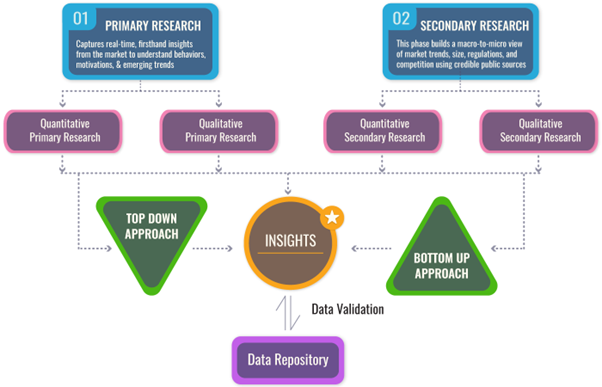
DUAL MODELING: TOP-DOWN + BOTTOM-UP
To ensure robust market estimation, we apply two complementary sizing approaches:
Top-Down Modeling:- Start with broader industry value (e.g., global or regional TAM)
- Apply filters by segment, geography, end-user, or use case
- Adjust with primary insights and validation benchmarks
- Ideal for investor-grade market scans and opportunity mapping
- Aggregate from the ground up using sales volumes, pricing, and unit economics
- Use internal modeling templates aligned with stakeholder data
- Incorporate distributor-level or region-specific inputs
- Most accurate for emerging segments and granular sub-markets
DATA VALIDATION: IN-HOUSE REPOSITORY
We close the loop with proprietary data intelligence built from ongoing projects, industry monitoring, and historical benchmarking. This repository includes:
- Multi-sector market and pricing models
- Key trendlines from past interviews and forecasts
- Benchmarked adoption rates, churn patterns, and ROI indicators
- Industry-specific deviation flags and cross-check logic
- Catches inconsistencies early
- Aligns projections across studies
- Enables consistent, high-trust deliverables