

Flexible Solar Panels Market Size and Forecast (2020 - 2033), Global and Regional Growth, Trend, Share, and Industry Analysis Report Coverage: By Type (Amorphous Silicon (a-Si), Cadmium Telluride (CdTe) and Copper Indium Gallium Selenide (CIGS)), By Application (Residential, Commercial, Automotive and Portable), By End-User (Residential, Commercial, Industrial, Automotive, Aerospace & Defense, and Others), and Geography
2025-11-28
Energy & Power
Ekta Chaurasia (Team Lead)
Description
Flexible Solar Panels Market Overview
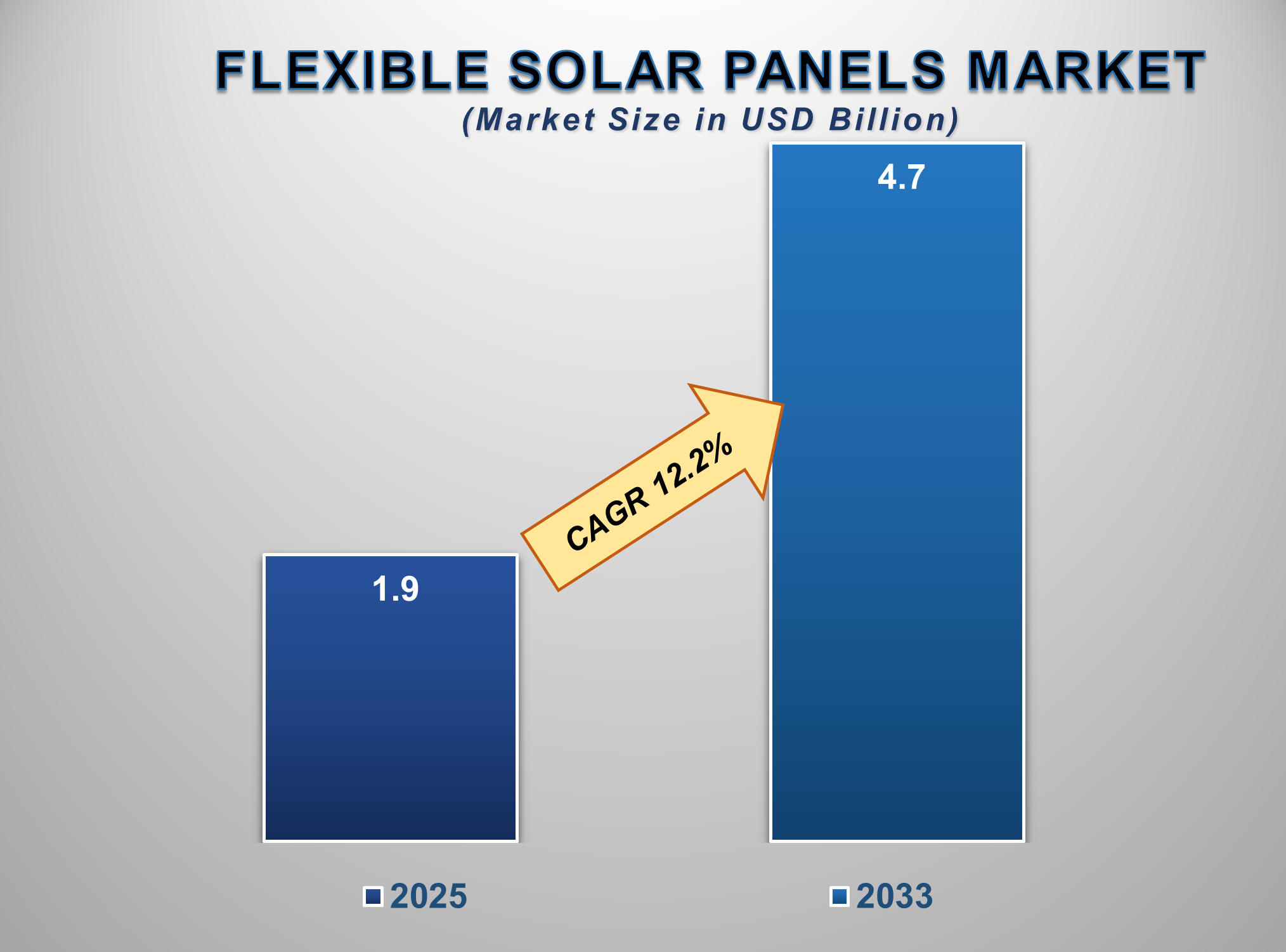
The Flexible Solar Panels Market is poised for a period of dynamic and rapid growth from 2025 to 2033, fueled by the escalating global demand for renewable energy, the unique advantages of lightweight and portable power generation, and the expansion of applications beyond traditional solar farms. The market is projected to be valued at approximately USD 1.9 billion in 2025 and is forecasted to reach nearly USD 4.7 billion by 2033, exhibiting a robust compound annual growth rate (CAGR) of 12.2% during this period.
Flexible solar panels are characterized by their
lightweight, thin-film construction, which allows them to be bent and conform
to curved surfaces. This distinguishes them from rigid, glass-based solar
panels and opens up a wide array of new applications. The market's significant
expansion is primarily driven by the global transition towards clean energy,
supported by government incentives and declining costs of photovoltaic
technology.
Furthermore, the versatility of flexible panels
enables their integration into vehicles, portable electronics, and
building-integrated photovoltaics (BIPV), creating novel use cases. The growing
demand for off-grid power solutions for recreational, military, and emergency
response applications is also a key contributor to market growth. North America
and Europe are significant markets due to high consumer awareness and
supportive policies, while the Asia-Pacific region is expected to witness the
fastest growth, driven by its massive investments in renewable energy and
strong manufacturing base for electronics.
Flexible Solar
Panels Market Drivers and Opportunities
The Global Push for Renewable Energy and
Unique Application Versatility is the Primary Market Driver
The relentless global shift towards renewable
energy sources is the most powerful force propelling the flexible solar panels
market. Governments worldwide are implementing ambitious carbon reduction
targets and offering subsidies, tax credits, and feed-in tariffs to encourage
solar adoption. While traditional panels dominate utility-scale projects,
flexible panels carve out a critical niche due to their unique physical
properties. Their lightweight and bendable nature allows for installation on
surfaces that cannot support heavy, rigid arrays, such as the curved roofs of
vehicles (RVs, boats, cars), tents, and certain architectural structures. This
versatility unlocks new markets and applications, making solar power accessible
in mobile and space-constrained environments. The demand for portable power for
outdoor recreation, remote work, and disaster relief further amplifies this
driver, establishing flexible solar panels as an essential tool for modern,
decentralized energy needs.
The global renewable energy market continues its
robust growth, with solar power leading the charge. In 2024, global solar
photovoltaic (PV) capacity additions are estimated to have reached over 350 GW,
accounting for more than half of all new renewable energy capacity. Total
installed solar PV capacity is projected to surpass 5,500 GW by 2030. This
growth is underpinned by falling technology costs, energy security concerns,
and strong policy support in major economies like the United States, China, and
the European Union. This data underscores the immense scale of the solar energy
transition and highlights the specific opportunity for flexible panels to
capture a growing segment of this market by addressing applications where
conventional panels are impractical or impossible to deploy.
The Rise of Building-Integrated Photovoltaics
(BIPV) and Electric Vehicle Integration is Driving Strategic Adoption
The convergence of solar technology with
construction and transportation is a powerful catalyst for the flexible solar
panels market. The building-integrated
Photovoltaics (BIPV) sector represents a major growth frontier, where solar
elements are incorporated directly into building materials like roofing
membranes, facades, and skylights. Flexible panels are ideally suited for this
application due to their low weight and adaptability, turning buildings into
distributed power generators without compromising aesthetics. Simultaneously,
the electric vehicle (EV) revolution is creating a new avenue for market
expansion. Flexible solar panels are being integrated into the roofs, hoods,
and trailers of EVs, trucks, and buses to extend driving range, power auxiliary
systems, and reduce reliance on charging infrastructure. This integration
transforms vehicles from mere energy consumers into mobile power harvesters,
enhancing their sustainability and functionality.
Technological Advancements and Material
Science Innovations Present Significant Opportunities
Breakthroughs in photovoltaic materials and
manufacturing processes are creating significant growth frontiers for the
flexible solar panel market. Key opportunities
lie in the development of more efficient and durable thin-film technologies,
such as CIGS (Copper Indium Gallium Selenide) and Perovskite solar cells.
Perovskite technology, in particular, holds promise for higher efficiency rates
and lower production costs in the future. Furthermore, advancements in
encapsulation materials are improving the longevity and weather resistance of
flexible panels, addressing a key concern for potential adopters. For
manufacturers, investing in R&D to boost conversion efficiency, reduce
degradation rates, and develop scalable, low-cost production methods is
a key strategy to
capture untapped market potential and make flexible solar panels a more
mainstream energy solution.
Flexible Solar Panels
Market Scope
|
Report Attributes |
Description |
|
Market Size in 2025 |
USD 1.9 Billion |
|
Market Forecast in 2033 |
USD 4.7 Billion |
|
CAGR % 2025-2033 |
12.2% |
|
Base Year |
2024 |
|
Historic Data |
2020-2024 |
|
Forecast Period |
2025-2033 |
|
Report USP |
Product Portfolio,
Technological Analysis, Company Market Share, Company Heatmap, Pricing
Analysis, Growth Factors, and more |
|
Segments Covered |
●
By Return Type ●
By Service ●
By End-user |
|
Regional Scope |
●
North America, ●
Europe, ●
APAC, ●
Latin America ●
Middle East and
Africa |
|
Country Scope |
1)
U.S. 2)
Canada 3)
Germany 4)
UK 5)
France 6)
Spain 7)
Italy 8)
Switzerland 9)
China 10)
Japan 11)
India 12)
Australia 13)
South Korea 14)
Brazil 15)
Mexico 16)
Argentina 17)
South Africa 18)
Saudi Arabia 19)
UAE |
Flexible Solar Panels
Market Report Segmentation Analysis
The global Flexible Solar Panels
Market industry analysis is segmented by Type, by Application, by End-User, and
by Region.
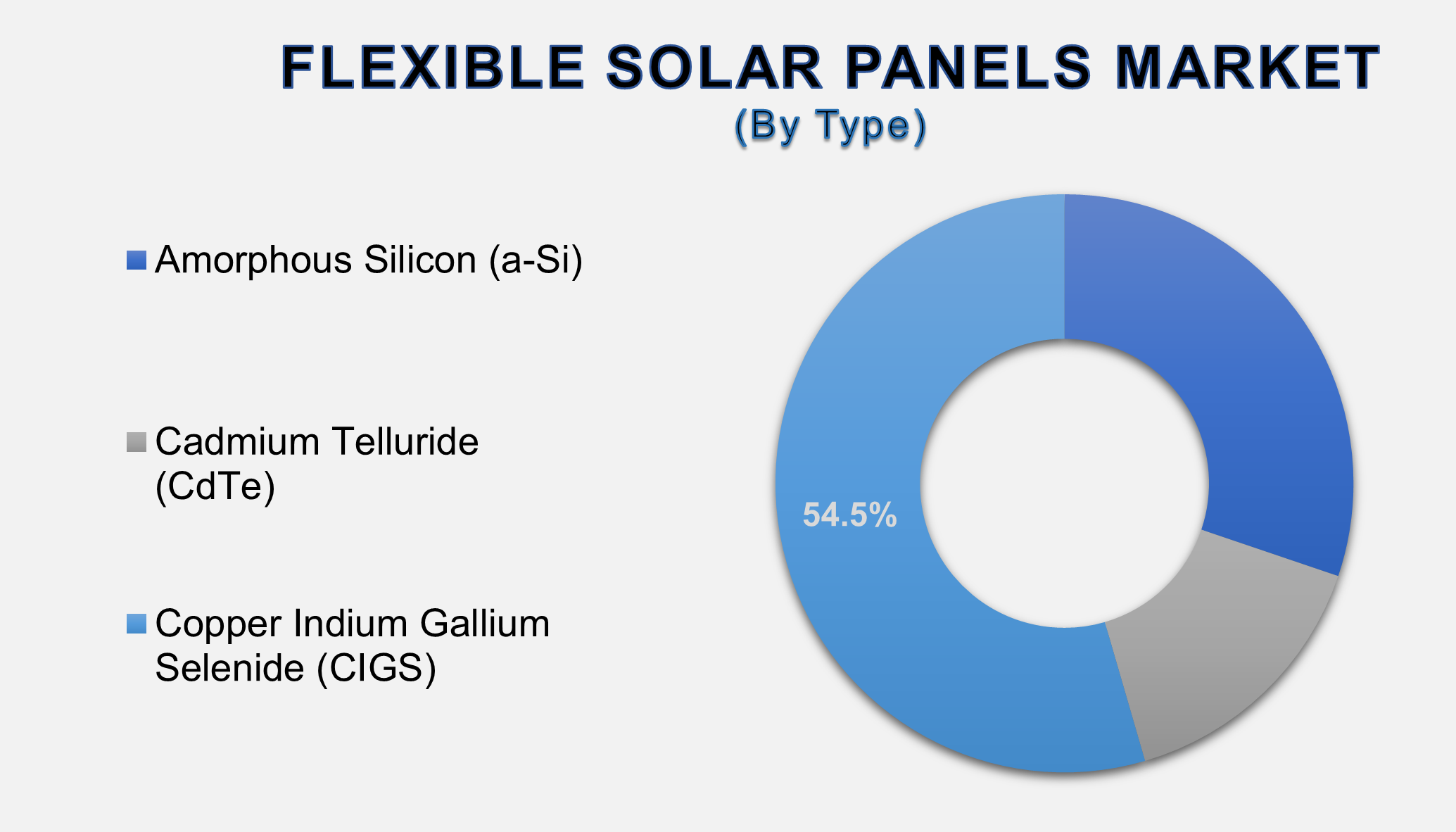
The CIGS Type segment is anticipated to command a
significant market share in 2025
The Type segment is categorized
into Amorphous Silicon (a-Si), Cadmium Telluride (CdTe), and Copper Indium
Gallium Selenide (CIGS). The CIGS segment holds a substantial and leading share
due to its superior efficiency and performance characteristics compared to
other thin-film options. CIGS panels offer the highest conversion efficiency
rates among mainstream flexible technologies, often approaching those of
polycrystalline silicon panels. They also perform better in real-world
conditions with partial shading and high temperatures. While historically more
expensive, advancements in manufacturing have been steadily reducing costs.
Their excellent flexibility, lightweight properties, and relatively high
efficiency make CIGS the preferred choice for high-performance applications in
aerospace, defense, and premium consumer products, securing its prominent
position in the market.
The Portable Application segment is projected to
grow at a significant CAGR.
The Application segment includes Residential,
Commercial, Automotive, and Portable. The portable application segment's
projected significant growth is directly linked to the increasing demand for
mobile and off-grid power solutions. This encompasses a wide range of products,
from foldable solar chargers for smartphones and laptops to larger, rollable
panels for camping, hiking, and military operations. The growth of the
"digital nomad" lifestyle, the popularity of outdoor recreational
activities, and the need for reliable power in remote locations and emergencies
are key drivers. The convenience, declining cost, and improving power output of
portable flexible panels make them an indispensable accessory for a growing
number of consumers and professionals, fueling rapid adoption and making this
the fastest-growing application segment.
The Automotive End-user segment is projected to
witness the highest growth rate.
The End-User segment is divided into Residential,
Commercial, Industrial, Automotive, and Aerospace & Defence. The Automotive
segment's position as the fastest-growing channel is a direct consequence of
the industry's electrification and the pursuit of sustainability. Automotive
manufacturers are increasingly integrating flexible solar panels into sunroofs
and body panels of electric and hybrid vehicles to provide auxiliary power, run
ventilation systems, and marginally extend the vehicle's range. This application
reduces the load on the main battery and improves overall energy efficiency.
The burgeoning markets for electric recreational vehicles (RVs) and commercial
trucks, where energy needs are high, present a particularly strong opportunity.
The continuous innovation in vehicle-integrated solar technology and
partnerships between solar companies and automakers are powerful forces
propelling the explosive growth of flexible panels within the automotive
industry.
The following segments are part of an in-depth analysis of
the global Flexible Solar Panels Market:
|
Market
Segments |
|
|
By Type |
●
Amorphous Silicon
(a-Si) ●
Cadmium Telluride
(CdTe) ●
Copper Indium
Gallium Selenide (CIGS) |
|
By Application
|
●
Residential ●
Commercial ●
Automotive ●
Portable |
|
By End-user |
●
Residential ●
Commercial ●
Industrial ●
Automotive ●
Aerospace &
Defense ●
Others |
Flexible Solar Panels
Market Share Analysis by Region
The Asia-Pacific region
is anticipated to hold the largest portion of the Flexible Solar Panels Market
globally throughout the forecast period.
Asia-Pacific's dominance is attributed to its
massive manufacturing capacity for solar PV components, strong government
support for renewable energy, and a rapidly growing consumer electronics and
automotive sector. China, in particular, is the world's largest producer and
consumer of solar panels, providing a robust foundation for the flexible
segment. Furthermore, countries like Japan, South Korea, and India are making
significant investments in solar energy and technological innovation. The
presence of a vast electronics manufacturing ecosystem allows for seamless
integration of flexible panels into a wide range of products, from portable
chargers to vehicles, solidifying the region's leading position.
China, in particular, is a critical hub for the
flexible solar panel market. The country's industrial policy, strong R&D
focus, and control over the solar supply chain from raw materials to finished
products give it a decisive competitive advantage. Chinese companies are
leaders in the production of thin-film solar technologies and are at the
forefront of developing next-generation solutions like perovskite. The large
domestic market for EVs and consumer electronics also provides a ready testing
ground and demand driver for innovative flexible solar applications, ensuring
its central role in the global market.
Flexible Solar Panels
Market Competition Landscape Analysis
The global flexible solar
panel market is fragmented and highly competitive, featuring a mix of
established solar giants, specialized thin-film manufacturers, and a growing
number of innovative startups. Competition is intensifying and centers on
product efficiency, durability, flexibility, price, and application-specific
expertise. Key strategies include heavy investment in R&D to advance
thin-film technologies, strategic partnerships with automotive and construction
companies for integrated solutions, and expansion of distribution channels for
consumer-facing portable products. The market also sees competition from
companies developing complementary technologies, such as energy storage, to
offer integrated power solutions.
Global Flexible Solar
Panels Market Recent Developments News:
- In February 2025, a European automotive
manufacturer announced a partnership with a leading CIGS producer to
integrate flexible solar roofs into its next-generation electric vehicles,
aiming to add up to 20 km of range per day.
- In December 2024, Hanergy Mobile Energy launched a
new line of ultra-lightweight, rollable perovskite solar panels for the
consumer market, boasting a record-breaking power-to-weight ratio for
portable applications.
- In August 2024, Ascent Solar Technologies, Inc.
secured a new contract to supply its flexible CIGS panels for a U.S.
Department of Defense program focused on lightweight, mobile power for
field operations.
- In October 2024, SunPower Corporation announced a strategic shift to
enter the BIPV market with a new line of flexible solar shingles designed
for residential rooftops with low weight-bearing capacity.
The Global Flexible Solar Panels Market Is Dominated by a Few
Large Companies, such as
●
Hanergy Thin Film
Power Group Ltd.
●
Ascent Solar
Technologies, Inc.
●
SunPower Corporation
●
Flisom AG
●
Global Solar Energy,
Inc. (Hanergy)
●
PowerFilm Solar Inc.
●
SoloPower Systems
●
Miasolé Hi-Tech Corp.
(Hanergy)
●
Jinko Solar Co., Ltd.
●
Canadian Solar Inc.
●
Trina Solar Co., Ltd.
●
LG Electronics Inc.
●
Sharp Corporation
●
Panasonic Corporation
●
Ricoh Company, Ltd.
● Other Prominent Players
Frequently Asked Questions
Ekta Chaurasia (Team Lead)
Ekta Chaurasia is a highly experienced Team Lead at M2Square Consultancy with over 7 years of expertise in market research, strategic consulting, competitive benchmarking, and business intelligence solutions. She specializes in ICT, semiconductors & electronics, automotive & transportation, and industrial machinery markets.
She leads end-to-end global research projects focused on market trends, industry analysis, growth forecasting, customer insights, and strategic decision-making. Known for her analytical leadership and industry expertise, Ekta helps businesses uncover growth opportunities, evaluate competitive landscapes, and stay ahead in rapidly evolving markets through accurate and insight-driven research.
1. Global Flexible Solar
Panels Market Introduction and Market Overview
1.1.
Objectives
of the Study
1.2.
Global
Flexible Solar Panels Market Scope and Market Estimation
1.2.1.Global Electronic Toll
Collection Overall Market Size (US$ Bn), Market CAGR (%), Market forecast (2025
- 2033)
1.2.2.Global Flexible Solar
Panels Market Revenue Share (%) and Growth Rate (Y-o-Y) from 2020 - 2033
1.3.
Market
Segmentation
1.3.1.Type of Global Flexible
Solar Panels Market
1.3.2.Application of Global Flexible
Solar Panels Market
1.3.3.End-user of Global Flexible
Solar Panels Market
1.3.4.Region of Global Flexible
Solar Panels Market
2.
Executive Summary
2.1.
Demand
Side Trends
2.2.
Key
Market Trends
2.3.
Market
Demand (US$ Bn) Analysis 2020 – 2024 and forecast, 2025 – 2033
2.4.
Demand
and Opportunity Assessment
2.5.
Key
Developments
2.6.
Market
Entry Strategies
2.7.
Market
Dynamics
2.7.1.Drivers
2.7.2.Limitations
2.7.3.Opportunities
2.7.4.Impact Analysis of Drivers
and Restraints
2.8.
Porter’s
Five Forces Analysis
2.9.
PEST
Analysis
3. Global
Flexible Solar Panels Market Estimates
& Historical Trend Analysis (2020 - 2024)
4. Global
Flexible Solar Panels Market Estimates
& Forecast Trend Analysis, by Type
4.1.
Global
Flexible Solar Panels Market Revenue (US$ Bn) Estimates and Forecasts, by Type,
2020 - 2033
4.1.1.Amorphous Silicon (a-Si)
4.1.2.Cadmium Telluride (CdTe)
4.1.3.Copper Indium Gallium
Selenide (CIGS)
5. Global
Flexible Solar Panels Market Estimates
& Forecast Trend Analysis, by Application
5.1.
Global
Flexible Solar Panels Market Revenue (US$ Bn) Estimates and Forecasts, by Application,
2020 - 2033
5.1.1.Residential
5.1.2.Commercial
5.1.3.Automotive
5.1.4.Portable
6. Global
Flexible Solar Panels Market Estimates
& Forecast Trend Analysis, by End-user
6.1.
Global
Flexible Solar Panels Market Revenue (US$ Bn) Estimates and Forecasts, by End-user
2020 - 2033
6.1.1.Residential
6.1.2.Commercial
6.1.3.Industrial
6.1.4.Automotive
6.1.5.Aerospace & Defense
6.1.6.Others
7. Global
Flexible Solar Panels Market Estimates
& Forecast Trend Analysis, by region
7.1.
Global
Flexible Solar Panels Market Revenue (US$ Bn) Estimates and Forecasts, by region,
2020 - 2033
7.1.1.North America
7.1.2.Europe
7.1.3.Asia Pacific
7.1.4.Middle East & Africa
7.1.5.Latin America
8. North America Flexible
Solar Panels Market: Estimates &
Forecast Trend Analysis
8.1. North America Flexible
Solar Panels Market Assessments & Key Findings
8.1.1.North America Flexible
Solar Panels Market Introduction
8.1.2.North America Flexible
Solar Panels Market Size Estimates and Forecast (US$ Billion) (2020 - 2033)
8.1.2.1.
By Type
8.1.2.2.
By Application
8.1.2.3.
By End-user
8.1.2.4. By Country
8.1.2.4.1. The U.S.
8.1.2.4.2. Canada
9. Europe Flexible
Solar Panels Market: Estimates &
Forecast Trend Analysis
9.1. Europe Flexible Solar
Panels Market Assessments & Key Findings
9.1.1.Europe Flexible Solar
Panels Market Introduction
9.1.2.Europe Flexible Solar
Panels Market Size Estimates and Forecast (US$ Billion) (2020 - 2033)
9.1.2.1.
By Type
9.1.2.2.
By Application
9.1.2.3.
By End-user
9.1.2.4. By Country
9.1.2.4.1.
Germany
9.1.2.4.2.
Italy
9.1.2.4.3.
U.K.
9.1.2.4.4.
France
9.1.2.4.5.
Spain
9.1.2.4.6.
Switzerland
9.1.2.4.7. Rest
of Europe
10. Asia Pacific Flexible
Solar Panels Market: Estimates &
Forecast Trend Analysis
10.1. Asia Pacific Market
Assessments & Key Findings
10.1.1.
Asia
Pacific Flexible Solar Panels Market Introduction
10.1.2.
Asia
Pacific Flexible Solar Panels Market Size Estimates and Forecast (US$ Billion)
(2020 - 2033)
10.1.2.1.
By Type
10.1.2.2.
By Application
10.1.2.3.
By End-user
10.1.2.4. By Country
10.1.2.4.1. China
10.1.2.4.2. Japan
10.1.2.4.3. India
10.1.2.4.4. Australia
10.1.2.4.5. South Korea
10.1.2.4.6. Rest of Asia Pacific
11. Middle East & Africa Flexible
Solar Panels Market: Estimates &
Forecast Trend Analysis
11.1. Middle East & Africa
Market Assessments & Key Findings
11.1.1. Middle
East & Africa
Flexible Solar Panels Market Introduction
11.1.2. Middle
East & Africa
Flexible Solar Panels Market Size Estimates and Forecast (US$ Billion) (2020 - 2033)
11.1.2.1.
By Type
11.1.2.2.
By Application
11.1.2.3.
By End-user
11.1.2.4. By Country
11.1.2.4.1. UAE
11.1.2.4.2. Saudi
Arabia
11.1.2.4.3. South
Africa
11.1.2.4.4. Rest
of MEA
12. Latin America
Flexible Solar Panels Market: Estimates
& Forecast Trend Analysis
12.1. Latin America Market
Assessments & Key Findings
12.1.1. Latin America Flexible
Solar Panels Market Introduction
12.1.2. Latin America Flexible
Solar Panels Market Size Estimates and Forecast (US$ Billion) (2020 - 2033)
12.1.2.1.
By Type
12.1.2.2.
By Application
12.1.2.3.
By End-user
12.1.2.4. By Country
12.1.2.4.1. Brazil
12.1.2.4.2. Argentina
12.1.2.4.3. Mexico
12.1.2.4.4. Rest
of LATAM
13.
Country
Wise Market: Introduction
14.
Competition
Landscape
14.1. Global Flexible Solar
Panels Market Product Mapping
14.2. Global Flexible Solar
Panels Market Concentration Analysis, by Leading Players / Innovators /
Emerging Players / New Entrants
14.3. Global Flexible Solar
Panels Market Tier Structure Analysis
14.4. Global Flexible Solar
Panels Market Concentration & Company Market Shares (%) Analysis, 2024
15.
Company
Profiles
15.1.
Hanergy Thin Film Power Group Ltd.
15.1.1.
Company
Overview & Key Stats
15.1.2.
Financial
Performance & KPIs
15.1.3.
Product
Portfolio
15.1.4.
SWOT
Analysis
15.1.5.
Business
Strategy & Recent Developments
* Similar details would be provided for all the players
mentioned below
15.2.
Ascent Solar Technologies, Inc.
15.3.
SunPower Corporation
15.4.
Flisom AG
15.5.
Global Solar Energy, Inc. (Hanergy)
15.6.
PowerFilm Solar Inc.
15.7.
SoloPower Systems
15.8.
Miasolé Hi-Tech Corp. (Hanergy)
15.9.
Jinko Solar Co., Ltd.
15.10.
Canadian Solar Inc.
15.11.
Trina Solar Co., Ltd.
15.12.
LG Electronics Inc.
15.13.
Sharp Corporation
15.14.
Panasonic Corporation
15.15.
Ricoh Company, Ltd.
15.16.
Other Prominent Players
16. Research
Methodology
16.1. External Transportations /
Databases
16.2. Internal Proprietary
Database
16.3. Primary Research
16.4. Secondary Research
16.5. Assumptions
16.6. Limitations
16.7. Report FAQs
17. Research
Findings & Conclusion
Our Research Methodology
"Insight without rigor is just noise."
We follow a comprehensive, multi-phase research framework designed to deliver accurate, strategic, and decision-ready intelligence. Our process integrates primary and secondary research , both quantitative and qualitative , along with dual modeling techniques ( top-down and bottom-up) and a final layer of validation through our proprietary in-house repository.
PRIMARY RESEARCH
Primary research captures real-time, firsthand insights from the market to understand behaviors, motivations, and emerging trends.
1. Quantitative Primary Research
Objective: Generate statistically significant data directly from market participants.
Approaches:- Structured surveys with customers, distributors, and field agents
- Mobile-based data collection for point-of-sale audits and usage behavior
- Phone-based interviews (CATI) for market sizing and product feedback
- Online polling around industry events and digital campaigns
- Purchase frequency by customer type
- Channel performance across geographies
- Feature demand by application or demographic
2. Qualitative Primary Research
Objective: Explore decision-making drivers, pain points, and market readiness.
Approaches:- In-depth interviews (IDIs) with executives, product managers, and key decision-makers
- Focus groups among end users and early adopters
- Site visits and observational research for consumer products
- Informal field-level discussions for regional and cultural nuances
SECONDARY RESEARCH
This phase helps establish a macro-to-micro understanding of market trends, size, regulation, and competitive dynamics, sourced from credible and public domain information.
1. Quantitative Secondary Research
Objective: Model market value and segment-level forecasts based on published data.
Sources include:- Financial reports and investor summaries
- Government trade data, customs records, and regulatory statistics
- Industry association publications and economic databases
- Channel performance and pricing data from marketplace listings
- Revenue splits, pricing trends, and CAGR estimates
- Supply-side capacity and volume tracking
- Investment analysis and funding benchmarks
2. Qualitative Secondary Research
Objective: Capture strategic direction, innovation signals, and behavioral trends.
Sources include:- Company announcements, roadmaps, and product pipelines
- Publicly available whitepapers, conference abstracts, and academic research
- Regulatory body publications and policy briefs
- Social and media sentiment scanning for early-stage shifts
- Strategic shifts in market positioning
- Unmet needs and white spaces
- Regulatory triggers and compliance impact
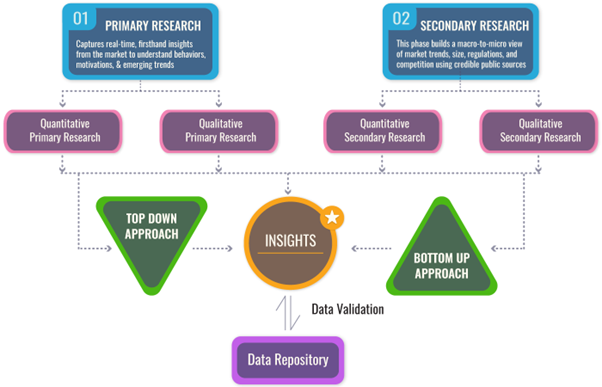
DUAL MODELING: TOP-DOWN + BOTTOM-UP
To ensure robust market estimation, we apply two complementary sizing approaches:
Top-Down Modeling:- Start with broader industry value (e.g., global or regional TAM)
- Apply filters by segment, geography, end-user, or use case
- Adjust with primary insights and validation benchmarks
- Ideal for investor-grade market scans and opportunity mapping
- Aggregate from the ground up using sales volumes, pricing, and unit economics
- Use internal modeling templates aligned with stakeholder data
- Incorporate distributor-level or region-specific inputs
- Most accurate for emerging segments and granular sub-markets
DATA VALIDATION: IN-HOUSE REPOSITORY
We close the loop with proprietary data intelligence built from ongoing projects, industry monitoring, and historical benchmarking. This repository includes:
- Multi-sector market and pricing models
- Key trendlines from past interviews and forecasts
- Benchmarked adoption rates, churn patterns, and ROI indicators
- Industry-specific deviation flags and cross-check logic
- Catches inconsistencies early
- Aligns projections across studies
- Enables consistent, high-trust deliverables