

Food Authenticity Testing Services Market Size and Forecast (2020–2033), Global and Regional Growth, Trend, Share, and Industry Analysis Report Coverage: By Target (Meat, Fish & Seafood, Dairy, Honey, Oil, Grain & Cereal, Processed Foods, Others), By Technology (PCR, LC-MS/GC-MS, Isotope Analysis, Immunoassay, NIR Spectroscopy, Others), By End-user (Government & Regulatory Bodies, Food Manufacturers, Retailers & Distributors, Third-Party Testing Labs), and Geography
2025-12-19
Consumer Products
Jaya Bundele (Research Analyst)
Description
Food
Authenticity Testing Services Market Overview
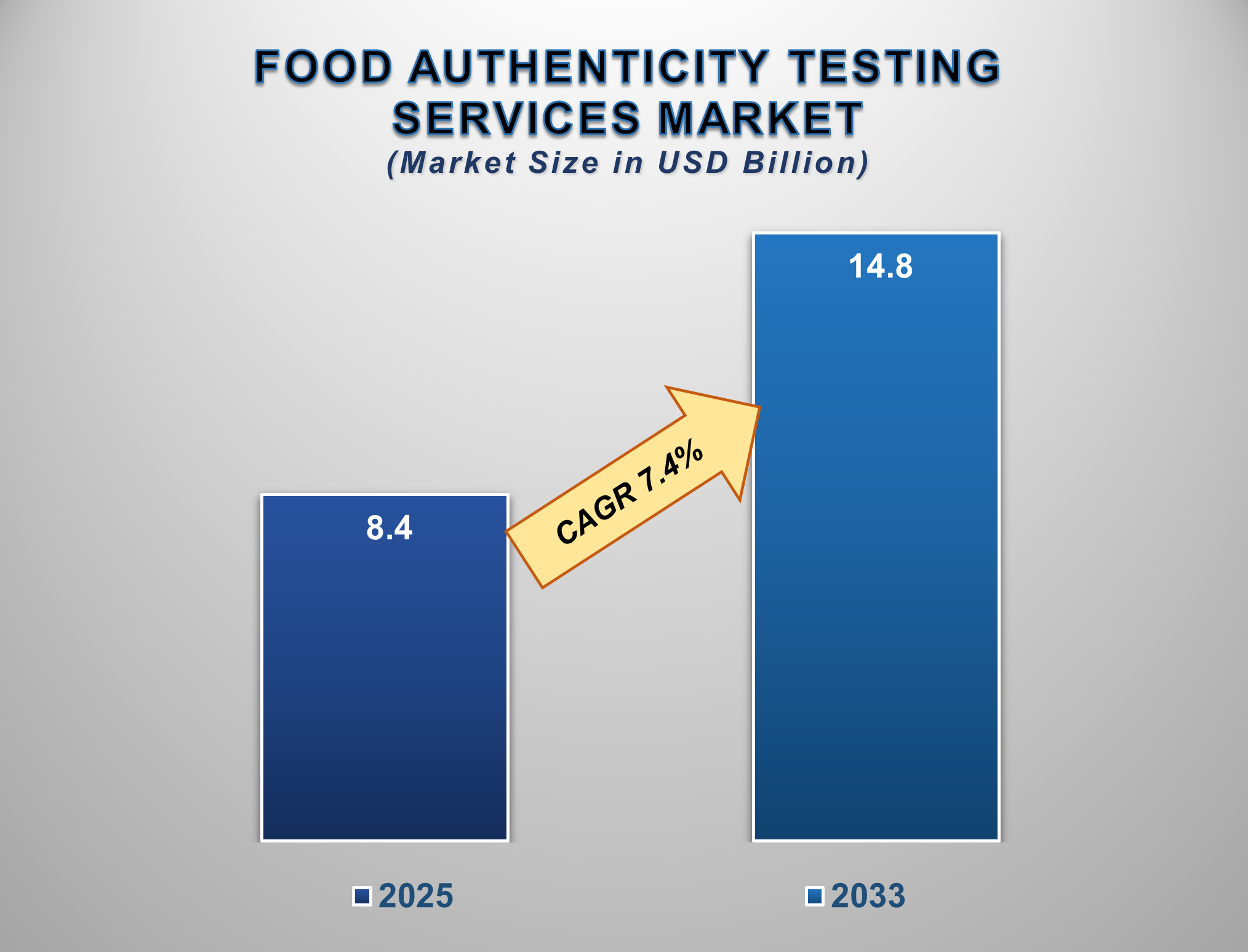
The Food Authenticity Testing Services Market is poised for robust growth from 2025 to 2033, driven by rising global food fraud incidents, stringent regulatory frameworks, and increasing consumer demand for food safety and transparency. The market is expected to be valued at USD 8.4 billion in 2025 and is projected to reach USD 14.8 billion by 2033, registering a CAGR of 7.4% during the forecast period.
Food authenticity testing services involve analytical
procedures to detect adulteration, mislabeling, and counterfeiting in food
products. These services ensure products comply with labeling laws, verify
origin and species, and protect consumers from health risks and economic
deception. High-profile food fraud scandals involving olive oil, honey, spices,
meat, and seafood have heightened regulatory scrutiny worldwide. Mandatory
labeling laws (e.g., the EU's Food Information
to Consumers Regulation and the US FSMA) and
global supply chain complexity are major growth drivers. Technological
advancements, such as rapid DNA-based testing and portable spectrometry, have
improved detection accuracy and speed. Europe and North America lead the market
due to mature regulatory environments, while the Asia-Pacific region is
experiencing the fastest growth due to expanding food trade and rising domestic
safety standards.
Food Authenticity Testing Services Market Drivers
and Opportunities
Rising Incidents of Food Fraud and Stringent Global
Regulations Are the Primary Market Drivers
Economic adulteration for unfair profit is a pervasive
issue, impacting nearly all food categories. Incidents such as horsemeat in
beef, dilution of olive oil, and mislabeling of fish species have eroded
consumer trust and prompted governments to enforce stricter testing and
traceability mandates. Regulatory bodies like the FDA (USA), EFSA (Europe), and
FSSAI (India) are increasingly mandating authenticity verification, compelling
food manufacturers and retailers to invest in routine testing. Furthermore, the
globalization of supply chains makes tracking ingredient origins more
challenging, necessitating robust testing protocols at multiple checkpoints.
This combination of economic, safety, and regulatory pressures is making
authenticity testing an integral, non-negotiable component of the modern food
industry.
Growing Consumer Awareness and Demand for Premium, Traceable
Products Are Accelerating Market Adoption
Today's consumers are more informed and concerned about
what they eat, demanding transparency regarding origin, organic status, non-GMO
claims, and ethical sourcing. This shift in consumer behavior is pushing brands
to adopt "farm-to-fork" traceability and verify premium claims
through scientific testing. Technologies like blockchain for supply chain
transparency are often integrated with physical testing results to provide
digital proof of authenticity. Retailers and foodservice providers are also
leveraging authenticity as a brand differentiator and a tool for risk
management. This consumer-led demand for integrity and quality is transforming
authenticity testing from a regulatory compliance cost into a strategic
value-add for brands.
Technological
Advancements and Untapped Potential in Emerging Markets Present Significant
Opportunities
Rapid innovation in testing technologies, such as
next-generation sequencing (NGS), hyperspectral imaging, and AI-powered data
analysis, is creating faster, cheaper, and more accurate testing solutions.
These advancements are making testing accessible to smaller producers for
high-frequency screening. Emerging markets in Asia-Pacific, Latin America, and
the Middle East present immense growth potential due to rising disposable
incomes, growing imported food consumption, and developing food safety regulations.
Strategic opportunities exist for testing service providers in establishing
localized labs, forming partnerships with agri-food exporters, and offering
cost-effective, targeted testing panels for prevalent local frauds (e.g.,
adulterated spices, milk, or saffron).
Food Authenticity Testing Services Market Scope
|
Report Attributes |
Description |
|
Market Size in 2025 |
USD 8.4 Billion |
|
Market Forecast in 2033 |
USD 14.8 Billion |
|
CAGR % 2025-2033 |
7.4% |
|
Base Year |
2024 |
|
Historic Data |
2020-2024 |
|
Forecast Period |
2025-2033 |
|
Report USP |
Product Portfolio,
Technological Analysis, Company Market Share, Company Heatmap, Pricing
Analysis, Growth Factors and more |
|
Segments Covered |
●
By Target ●
By Technology ●
By End-user |
|
Regional Scope |
●
North America, ●
Europe, ●
APAC, ●
Latin America ●
Middle East and
Africa |
|
Country Scope |
1)
U.S. 2)
Canada 3)
Germany 4)
UK 5)
France 6)
Spain 7)
Italy 8)
Switzerland 9)
China 10)
Japan 11)
India 12)
Australia 13)
South Korea 14)
Brazil 15)
Mexico 16)
Argentina 17)
South Africa 18)
Saudi Arabia 19)
UAE |
Food Authenticity Testing Services Market Report
Segmentation Analysis
The global Food Authenticity
Testing Services Market is segmented by Target, Technology, End-user, and
Region.
Meat & Meat Products
Are Anticipated to Command the Largest Market Share in 2025
The
meat segment dominates due to its high economic value and frequent history of
adulteration, including species substitution (e.g., horsemeat), undeclared
protein extension, and false origin claims. Strict Halal and Kosher
certification requirements also necessitate rigorous species and process
verification. PCR-based testing is the gold standard in this category for its
ability to identify even trace amounts of adulterant DNA. Growing global meat
consumption, coupled with complex multi-country processing chains, ensures that
meat authenticity testing remains the largest and most critical segment for
ensuring consumer safety and regulatory compliance.
The PCR Technology
Segment Holds the Largest Share by Technology
Polymerase
Chain Reaction (PCR) technology is the leading segment due to its high
specificity, sensitivity, and ability to detect genetic material from even
highly processed foods. It is the preferred method for species identification
in meat, fish, and dairy products, as well as for detecting GMOs and allergens.
Its dominance is reinforced by standardization in international methods (e.g.,
ISO), relatively lower cost per test compared to some advanced techniques, and
its widespread adoption in commercial and regulatory labs. Continuous
advancements, like digital PCR and real-time PCR, are further solidifying its
position as the workhorse technology for food authenticity testing.
Food Manufacturers Lead
the End-user Segment
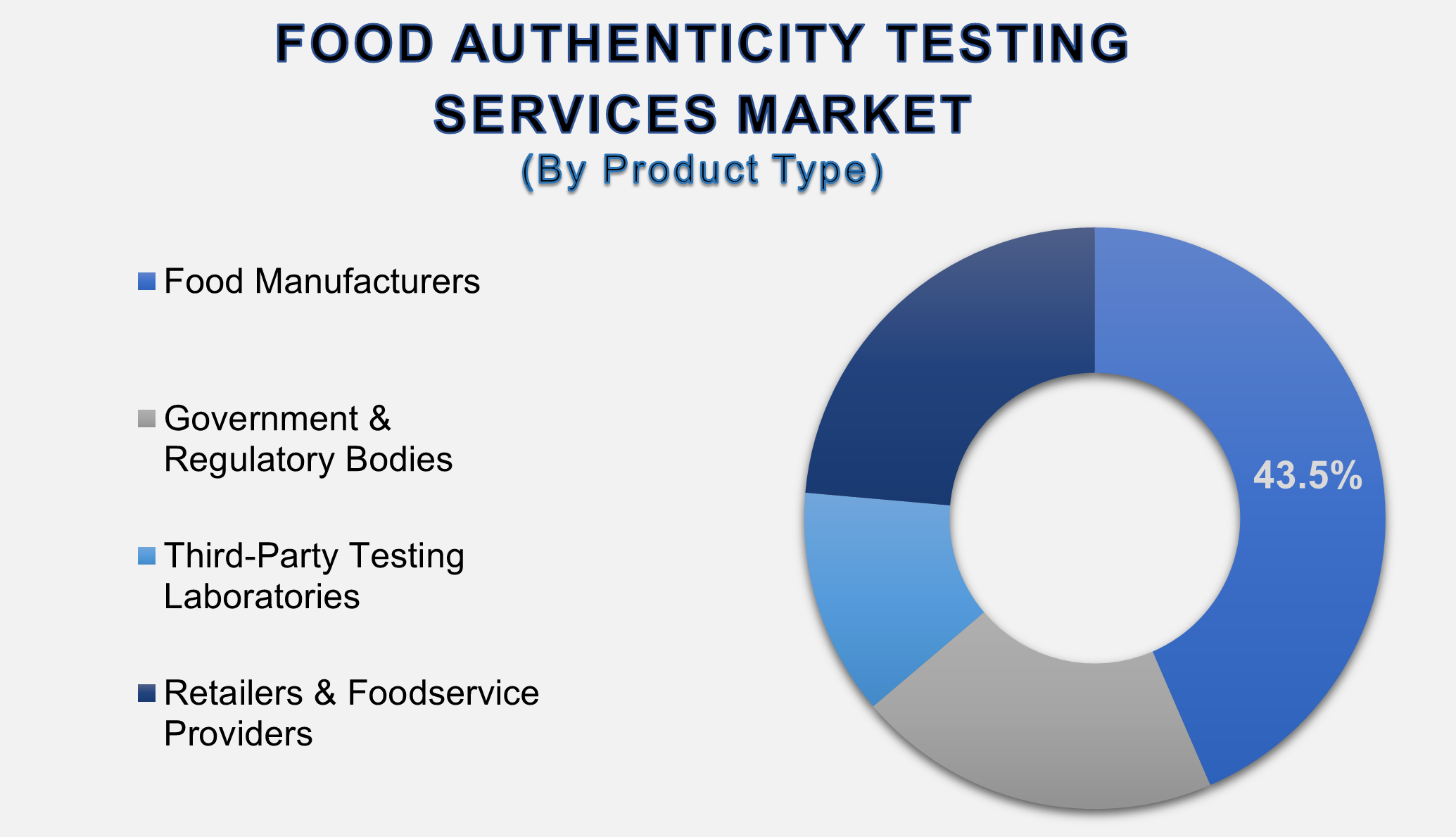
Food manufacturers are the largest end-user segment, as they bear the primary responsibility for the safety and authenticity of their products. Proactive testing is integral to their quality control (QC) and quality assurance (QA) programs to mitigate recall risks, protect brand reputation, and comply with both internal specifications and external regulations. This includes testing incoming raw materials, in-process samples, and final products. The scale of their operations generates consistent, high-volume demand for testing services, making this segment the cornerstone of the market.
The following segments are
part of an in-depth analysis of the global Food Authenticity Testing Services
Market:
|
Market
Segments |
|
|
By Target |
●
Meat & Meat
Products ●
Fish & Seafood ●
Dairy & Dairy
Products ●
Honey ●
Olive Oil &
Edible Oils ●
Grain & Cereal ●
Spices & Herbs ●
Processed Foods ●
Others |
|
By Technology |
●
PCR-based ●
Mass Spectrometry
(LC-MS/GC-MS) ●
Isotope Analysis
(IRMS) ●
Immunoassay ●
NIR &
Spectroscopy ●
Others |
|
By End-user |
●
Food Manufacturers ●
Government &
Regulatory Bodies ●
Third-Party Testing
Laboratories ●
Retailers &
Foodservice Providers |
Food
Authenticity Testing Services Market Share Analysis by Region
The Europe region is
anticipated to hold the largest portion of the Food Authenticity Testing
Services Market globally throughout the forecast period
Europe's
leadership stems from the world's most stringent food safety and labeling
regulations, a high level of consumer awareness, and a history of major food
fraud incidents that triggered regulatory overhauls. The European Commission's
coordinated control plans and the EU's robust geographical indication (GI)
system for protecting regional foods (like Parma ham and Champagne) create massive, mandated demand for origin and
authenticity testing. The strong presence of
major testing service providers and advanced food research institutes further
consolidates Europe's dominant market position.
Food Authenticity Testing Services Market
Competition Landscape Analysis
The global market is
semi-consolidated, featuring a mix of large multinational analytical
corporations, specialized food testing firms, and regional players. Competition
is based on technological expertise, accreditation scope (ISO, UKAS),
turnaround time, global laboratory network, and service portfolio. Key
strategies include mergers and acquisitions to expand geographical and
technical capabilities, development of multi-parameter testing kits, and
investments in rapid, on-site testing solutions to serve the farm and factory
gate.
Global Food Authenticity Testing Services Market Recent
Developments News:
- In February 2025, Eurofins Scientific launched a new
blockchain-integrated platform that pairs authenticity test results with
immutable digital supply chain records.
- In December 2024, SGS SA expanded its meat speciation testing
capacity in Brazil to support the growing meat export industry.
- In October 2024, Intertek Group plc introduced a rapid, portable NIR
device for on-site screening of olive oil adulteration.
- In August 2024, Bureau Veritas formed a strategic partnership with a
leading Asian retail conglomerate to provide end-to-end supply chain
auditing and testing services.
The Global Food Authenticity Testing Services
Market Is Dominated by a Few Large Companies, such as
●
Eurofins Scientific
●
SGS SA
●
Intertek Group plc
●
Bureau Veritas
●
Mérieux NutriSciences
●
ALS Limited
●
TÜV SÜD
●
Microbac Laboratories
●
ROMER Labs Division
Holding GmbH
●
Neogen Corporation
●
Thermo Fisher
Scientific Inc.
●
Waters Corporation
●
Shimadzu Corporation
● Other Prominent Players
Frequently Asked Questions
Jaya Bundele (Research Analyst)
Jaya Bundele is a skilled Research Analyst with 4+ years of experience in market intelligence, consumer insights, competitive analysis, and industry forecasting across the consumer goods, agriculture, and food & beverage sectors. She specializes in market sizing, trend analysis, growth opportunity mapping, and strategic secondary research for global and regional markets.
Her expertise lies in transforming complex industry data into actionable business strategies that help organizations identify emerging trends, understand customer behavior, and gain a competitive edge. With a strong focus on data-driven insights, business intelligence, and future market trends, Jaya delivers high-quality research solutions aligned with evolving industry demands and market dynamics.
1. Global Food Authenticity
Testing Services Market Introduction and Market Overview
1.1.
Objectives
of the Study
1.2.
Global
Food Authenticity Testing Services Market Scope and Market Estimation
1.2.1.Global Electronic Toll
Collection Overall Market Size (US$ Bn), Market CAGR (%), Market forecast (2025
- 2033)
1.2.2.Global Food Authenticity
Testing Services Market Revenue Share (%) and Growth Rate (Y-o-Y) from 2020 - 2033
1.3.
Market
Segmentation
1.3.1.Target of Global Food
Authenticity Testing Services Market
1.3.2.Technology of Global Food
Authenticity Testing Services Market
1.3.3.End-user of Global Food
Authenticity Testing Services Market
1.3.4.Region of Global Food
Authenticity Testing Services Market
2. Executive
Summary
2.1.
Demand
Side Trends
2.2.
Key
Market Trends
2.3.
Market
Demand (US$ Bn) Analysis 2020 – 2024 and forecast, 2025 – 2033
2.4.
Demand
and Opportunity Assessment
2.5.
Key
Developments
2.6.
Market
Entry Strategies
2.7.
Market
Dynamics
2.7.1.Drivers
2.7.2.Limitations
2.7.3.Opportunities
2.7.4.Impact Analysis of Drivers
and Restraints
2.8.
Porter’s
Five Forces Analysis
2.9.
Pricing
Analysis
2.10.
PEST
Analysis
3. Global
Food Authenticity Testing Services Market
Estimates & Historical Trend Analysis (2020 - 2024)
4. Global
Food Authenticity Testing Services Market
Estimates & Forecast Trend Analysis, by Target
4.1.
Global
Food Authenticity Testing Services Market Revenue (US$ Bn) Estimates and
Forecasts, by Target, 2020 - 2033
4.1.1.Meat & Meat Products
4.1.2.Fish & Seafood
4.1.3.Dairy & Dairy Products
4.1.4.Honey
4.1.5.Olive Oil & Edible
Oils
4.1.6.Grain & Cereal
4.1.7.Spices & Herbs
4.1.8.Processed Foods
4.1.9.Others
5. Global
Food Authenticity Testing Services Market
Estimates & Forecast Trend Analysis, by Technology
5.1.
Global
Food Authenticity Testing Services Market Revenue (US$ Bn) Estimates and
Forecasts, by Technology, 2020 - 2033
5.1.1.PCR-based
5.1.2.Mass Spectrometry
(LC-MS/GC-MS)
5.1.3.Isotope Analysis (IRMS)
5.1.4.Immunoassay
5.1.5.NIR & Spectroscopy
5.1.6.Others
6. Global
Food Authenticity Testing Services Market
Estimates & Forecast Trend Analysis, by End-user
6.1.
Global
Food Authenticity Testing Services Market Revenue (US$ Bn) Estimates and
Forecasts, by End-user 2020 - 2033
6.1.1.Food Manufacturers
6.1.2.Government &
Regulatory Bodies
6.1.3.Third-Party Testing
Laboratories
6.1.4.Retailers &
Foodservice Providers
7. Global
Food Authenticity Testing Services Market
Estimates & Forecast Trend Analysis, by region
7.1.
Global
Food Authenticity Testing Services Market Revenue (US$ Bn) Estimates and
Forecasts, by region, 2020 - 2033
7.1.1.North America
7.1.2.Europe
7.1.3.Asia Pacific
7.1.4.Middle East & Africa
7.1.5.Latin America
8. North America Food
Authenticity Testing Services Market:
Estimates & Forecast Trend Analysis
8.1.
North
America Food Authenticity Testing Services Market Assessments & Key
Findings
8.1.1.North America Food
Authenticity Testing Services Market Introduction
8.1.2.North America Food
Authenticity Testing Services Market Size Estimates and Forecast (US$ Billion)
(2020 - 2033)
8.1.2.1. By Target
8.1.2.2. By Technology
8.1.2.3. By Distribution
Channel
8.1.2.4.
By
Country
8.1.2.4.1. The U.S.
8.1.2.4.2. Canada
9. Europe Food
Authenticity Testing Services Market:
Estimates & Forecast Trend Analysis
9.1.
Europe
Food Authenticity Testing Services Market Assessments & Key Findings
9.1.1.Europe Food Authenticity
Testing Services Market Introduction
9.1.2.Europe Food Authenticity
Testing Services Market Size Estimates and Forecast (US$ Billion) (2020 - 2033)
9.1.2.1. By Target
9.1.2.2. By Technology
9.1.2.3. By Distribution
Channel
9.1.2.4.
By
Country
9.1.2.4.1.
Germany
9.1.2.4.2.
Italy
9.1.2.4.3.
U.K.
9.1.2.4.4.
France
9.1.2.4.5.
Spain
9.1.2.4.6.
Switzerland
9.1.2.4.7. Rest
of Europe
10. Asia Pacific Food
Authenticity Testing Services Market:
Estimates & Forecast Trend Analysis
10.1.
Asia
Pacific Market Assessments & Key Findings
10.1.1.
Asia
Pacific Food Authenticity Testing Services Market Introduction
10.1.2.
Asia
Pacific Food Authenticity Testing Services Market Size Estimates and Forecast
(US$ Billion) (2020 - 2033)
10.1.2.1. By Target
10.1.2.2. By Technology
10.1.2.3. By Distribution
Channel
10.1.2.4.
By
Country
10.1.2.4.1. China
10.1.2.4.2. Japan
10.1.2.4.3. India
10.1.2.4.4. Australia
10.1.2.4.5. South Korea
10.1.2.4.6. Rest of Asia Pacific
11. Middle East & Africa Food
Authenticity Testing Services Market:
Estimates & Forecast Trend Analysis
11.1.
Middle
East & Africa Market Assessments & Key Findings
11.1.1.
Middle East & Africa Food Authenticity Testing Services
Market Introduction
11.1.2.
Middle East & Africa Food Authenticity Testing Services
Market Size Estimates and Forecast (US$ Billion) (2020 - 2033)
11.1.2.1. By Target
11.1.2.2. By Technology
11.1.2.3. By Distribution
Channel
11.1.2.4.
By
Country
11.1.2.4.1. UAE
11.1.2.4.2. Saudi
Arabia
11.1.2.4.3. South
Africa
11.1.2.4.4. Rest
of MEA
12. Latin America
Food Authenticity Testing Services Market: Estimates & Forecast Trend Analysis
12.1.
Latin
America Market Assessments & Key Findings
12.1.1.
Latin
America Food Authenticity Testing Services Market Introduction
12.1.2.
Latin
America Food Authenticity Testing Services Market Size Estimates and Forecast
(US$ Billion) (2020 - 2033)
12.1.2.1. By Target
12.1.2.2. By Technology
12.1.2.3. By Distribution
Channel
12.1.2.4.
By
Country
12.1.2.4.1. Brazil
12.1.2.4.2. Argentina
12.1.2.4.3. Mexico
12.1.2.4.4. Rest
of LATAM
13. Country Wise Market:
Introduction
14.
Competition
Landscape
14.1.
Global
Food Authenticity Testing Services Market Product Mapping
14.2.
Global
Food Authenticity Testing Services Market Concentration Analysis, by Leading
Players / Innovators / Emerging Players / New Entrants
14.3.
Global
Food Authenticity Testing Services Market Tier Structure Analysis
14.4.
Global
Food Authenticity Testing Services Market Concentration & Company Market
Shares (%) Analysis, 2024
15.
Company
Profiles
15.1.
Eurofins Scientific
15.1.1.
Company
Overview & Key Stats
15.1.2.
Financial
Performance & KPIs
15.1.3.
Product
Portfolio
15.1.4.
SWOT
Analysis
15.1.5.
Business
Strategy & Recent Developments
* Similar details would be provided for all the players
mentioned below
15.2. SGS SA
15.3. Intertek
Group plc
15.4. Bureau
Veritas
15.5. Mérieux
NutriSciences
15.6. ALS Limited
15.7. TÜV SÜD
15.8. Microbac
Laboratories
15.9. ROMER Labs
Division Holding GmbH
15.10. Neogen
Corporation
15.11. Thermo Fisher
Scientific Inc.
15.12. Waters
Corporation
15.13. Shimadzu
Corporation
15.14. Other
Prominent Players
16. Research
Methodology
16.1.
External
Transportations / Databases
16.2.
Internal
Proprietary Database
16.3.
Primary
Research
16.4.
Secondary
Research
16.5.
Assumptions
16.6.
Limitations
16.7.
Report
FAQs
17. Research
Findings & Conclusion
Our Research Methodology
"Insight without rigor is just noise."
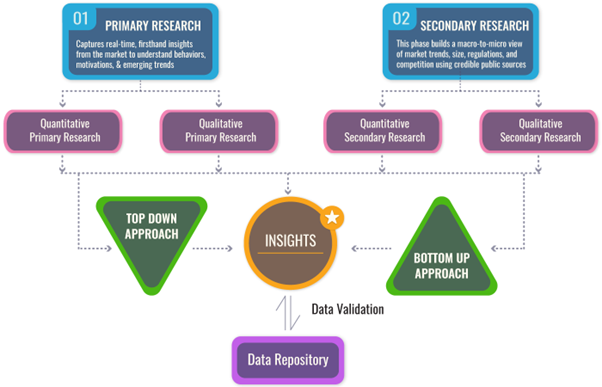
We follow a comprehensive, multi-phase research framework designed to deliver accurate, strategic, and decision-ready intelligence. Our process integrates primary and secondary research , both quantitative and qualitative , along with dual modeling techniques ( top-down and bottom-up) and a final layer of validation through our proprietary in-house repository.
PRIMARY RESEARCH
Primary research captures real-time, firsthand insights from the market to understand behaviors, motivations, and emerging trends.
1. Quantitative Primary Research
Objective: Generate statistically significant data directly from market participants.
Approaches:- Structured surveys with customers, distributors, and field agents
- Mobile-based data collection for point-of-sale audits and usage behavior
- Phone-based interviews (CATI) for market sizing and product feedback
- Online polling around industry events and digital campaigns
- Purchase frequency by customer type
- Channel performance across geographies
- Feature demand by application or demographic
2. Qualitative Primary Research
Objective: Explore decision-making drivers, pain points, and market readiness.
Approaches:- In-depth interviews (IDIs) with executives, product managers, and key decision-makers
- Focus groups among end users and early adopters
- Site visits and observational research for consumer products
- Informal field-level discussions for regional and cultural nuances
SECONDARY RESEARCH
This phase helps establish a macro-to-micro understanding of market trends, size, regulation, and competitive dynamics, sourced from credible and public domain information.
1. Quantitative Secondary Research
Objective: Model market value and segment-level forecasts based on published data.
Sources include:- Financial reports and investor summaries
- Government trade data, customs records, and regulatory statistics
- Industry association publications and economic databases
- Channel performance and pricing data from marketplace listings
- Revenue splits, pricing trends, and CAGR estimates
- Supply-side capacity and volume tracking
- Investment analysis and funding benchmarks
2. Qualitative Secondary Research
Objective: Capture strategic direction, innovation signals, and behavioral trends.
Sources include:- Company announcements, roadmaps, and product pipelines
- Publicly available whitepapers, conference abstracts, and academic research
- Regulatory body publications and policy briefs
- Social and media sentiment scanning for early-stage shifts
- Strategic shifts in market positioning
- Unmet needs and white spaces
- Regulatory triggers and compliance impact
DUAL MODELING: TOP-DOWN + BOTTOM-UP
To ensure robust market estimation, we apply two complementary sizing approaches:
Top-Down Modeling:- Start with broader industry value (e.g., global or regional TAM)
- Apply filters by segment, geography, end-user, or use case
- Adjust with primary insights and validation benchmarks
- Ideal for investor-grade market scans and opportunity mapping
- Aggregate from the ground up using sales volumes, pricing, and unit economics
- Use internal modeling templates aligned with stakeholder data
- Incorporate distributor-level or region-specific inputs
- Most accurate for emerging segments and granular sub-markets
DATA VALIDATION: IN-HOUSE REPOSITORY
We close the loop with proprietary data intelligence built from ongoing projects, industry monitoring, and historical benchmarking. This repository includes:
- Multi-sector market and pricing models
- Key trendlines from past interviews and forecasts
- Benchmarked adoption rates, churn patterns, and ROI indicators
- Industry-specific deviation flags and cross-check logic
- Catches inconsistencies early
- Aligns projections across studies
- Enables consistent, high-trust deliverables