

France Cloud Kitchen Market Size and Forecast (2026–2034), Regional Growth, Trend, Share and Industry Analysis Report Coverage: By Source of Order (Web and Mobile App), By Payment Method (Cash on Delivery, Mobile Wallet, Card Transaction and Others)
2026-09-15
ICT
Ekta Chaurasia (Team Lead)
Description
France Cloud
Kitchen Market Overview
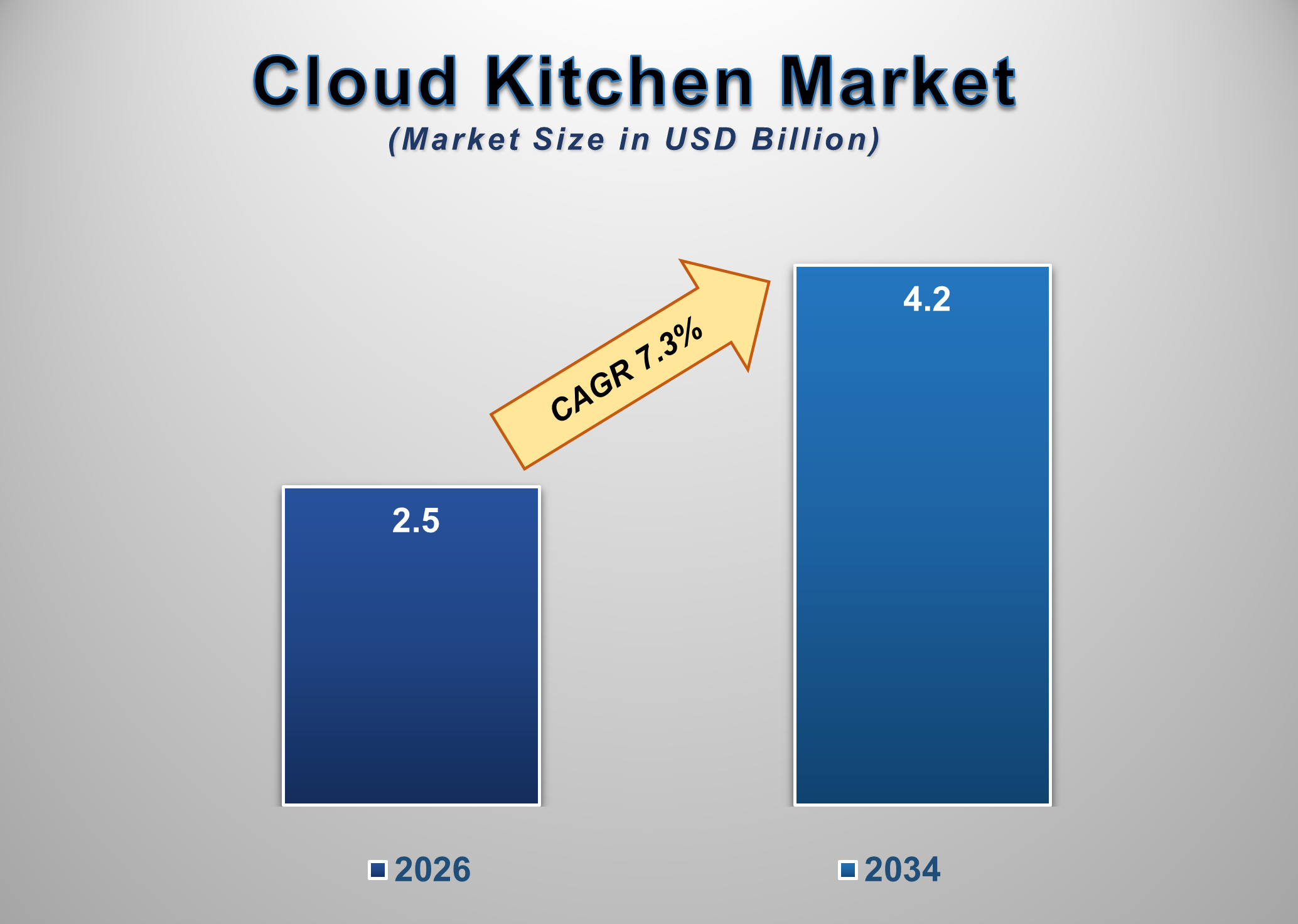
The France Cloud Kitchen Market is valued at USD 2.5 Billion in 2026 and is projected to reach USD 4.2 Billion by 2034, expanding at a CAGR of 7.3% during the forecast period. France is expected to record relatively moderate growth. This trend is influenced not only by consumer demand and the development of online food delivery but also by the country's comparatively active regulatory and urban-planning approach toward delivery-only foodservice facilities.
France has developed a more structured
legal framework for regulating businesses that operate primarily through online
ordering and delivery. Regulatory and judicial developments have strengthened
the ability of local authorities to distinguish between conventional retail
establishments, warehouses, and facilities dedicated to online commercial
activities. These developments have important implications for cloud kitchens,
particularly in densely populated urban areas where zoning regulations, land
use, traffic, and neighborhood concerns can influence the establishment and
operation of delivery-focused facilities. A significant regulatory development
occurred when French authorities introduced a dedicated planning classification
for kitchens primarily designed to prepare meals for online orders. The
category, referred to as “cuisine dédiée à la vente en ligne,” formally
recognizes facilities used for preparing meals ordered through digital or
telecommunication channels. This provides municipalities with a clearer legal
basis for determining where cloud kitchens can be established and how such
facilities should be regulated under local urban-planning frameworks.
France
Cloud Kitchen Market Growth Drivers
Defined Regulatory Framework Is
Supporting More Structured Development of Cloud Kitchen Operations
One of the important factors
supporting the development of the France cloud kitchen market is the emergence
of a more clearly defined legal and planning framework for delivery-focused
food preparation facilities. Historically, the classification of dark kitchens
and similar delivery-oriented facilities created uncertainty because
traditional planning categories were not specifically designed around
online-only food preparation models. The establishment of a dedicated framework
for kitchens focused on online food sales has created a clearer pathway for
operators seeking to develop delivery-only facilities. This is important
because cloud kitchens require substantial investment in commercial kitchen
infrastructure, food preparation equipment, technology systems, ventilation,
storage, packaging operations, and logistics coordination. Greater clarity
regarding facility classification can support more informed investment and
location decisions.
As the industry matures, regulatory
compliance is expected to become an increasingly important competitive
capability. Companies that can successfully integrate planning, foodservice
operations, technology, and delivery logistics may be better positioned to
expand sustainably. The transition toward a more structured operating
environment is therefore expected to support the long-term professionalization
and development of the France cloud kitchen market.
Expansion of Digital Food Ordering and
Titre-Restaurant Acceptance Is Supporting Delivery Demand
The continued expansion of digital
food ordering is another important driver of the France cloud kitchen market.
Consumers increasingly expect convenient access to restaurant meals through
mobile applications and web-based ordering platforms. Digital channels allow
customers to browse multiple food options, compare restaurants, customize
orders, make electronic payments, and receive real-time delivery information.
Cloud kitchens are specifically
designed to benefit from this digital environment. Unlike conventional
restaurants, delivery-focused facilities can concentrate investment on food
preparation, kitchen operations, packaging, order processing, and delivery coordination.
The absence or reduction of conventional dining infrastructure can enable
operators to allocate a greater proportion of resources toward production
efficiency and digital order fulfillment.
France Cloud Kitchen Market Restraint
Active Municipal Enforcement and
Location-Related Regulatory Requirements Can Constrain Market Expansion
A major restraint affecting the France
cloud kitchen market is the regulatory and planning complexity associated with
establishing delivery-focused kitchen facilities, particularly in major urban
markets. Municipal enforcement has increased the importance of ensuring that
commercial premises are appropriately authorized for their intended use. Paris
represents the most significant example of this challenge. As France's largest
and most densely populated urban market, the city offers substantial potential
for food delivery demand. However, it has also demonstrated an active
enforcement approach toward facilities that do not comply with applicable
planning and usage requirements.
This can create challenges for
operators seeking to establish new cloud kitchen facilities within highly
attractive central urban locations. Companies may face additional requirements
related to site authorization, property usage, local regulations, and operational
compliance. These factors can increase development timelines and limit the
availability of suitable facilities.
France Cloud Kitchen Market
Opportunities
Expansion Beyond Central Paris Can
Create New Opportunities for Compliant Delivery-Focused Facilities
Expansion into locations outside the
most heavily regulated central areas represents an important opportunity for
the France cloud kitchen market. While Paris remains one of the country's most
significant food-delivery markets, regulatory enforcement and limited
availability of suitable commercial premises can create barriers to new
facility development.
This creates opportunities in
surrounding municipalities and other metropolitan areas. Operators can evaluate
locations based on population density, food delivery demand, commercial
property availability, transportation access, delivery radius, and local
planning conditions. The Petite Couronne and other areas surrounding Paris may
become increasingly relevant for cloud kitchen development because they provide
access to the broader Paris metropolitan consumer base while potentially
offering different property and operating conditions. Strategically located
facilities can serve multiple neighborhoods and customer clusters, allowing
operators to optimize kitchen utilization and delivery coverage.
Multi-Brand Operations and Integrated
Digital Payment Systems Can Improve Revenue Generation
Multi-brand operations represent
another important opportunity for the France cloud kitchen market. A single
commercial kitchen can potentially support multiple restaurant brands, allowing
operators to utilize shared equipment, employees, infrastructure, and
production capacity across several food concepts. This model can improve
kitchen utilization and enable companies to serve different customer segments
without establishing separate physical restaurants. A single facility may
support concepts specializing in burgers, pizza, French cuisine, Asian food,
healthy meals, desserts, or other categories depending on local demand.
Virtual restaurant brands can also
provide established foodservice businesses with opportunities to generate
additional revenue. Restaurants with available production capacity may develop
digital-only concepts that target specific consumer preferences. This allows
companies to test new menus and cuisines while limiting the investment
associated with establishing an entirely new restaurant.
France Cloud Kitchen Market Scope
|
Report
Attributes |
Description |
|
Market Size |
USD 2.5 Billion (2026) |
|
Market
Forecast |
USD 4.2 Billion (2034) |
|
CAGR % |
7.3% |
|
Base Year |
2025 |
|
Historic
Data |
2020–2025 |
|
Forecast
Period |
2026–2034 |
|
Report USP |
Built exclusively from Conseil
d'État rulings, Code de l'urbanisme text, INSEE, UMIH/GHR association data,
and City of Paris enforcement records — with no syndicated market-research
vendor estimates |
|
Geography |
France |
|
By Type |
Independent/Standalone Cloud
Kitchens, Chained Cloud Kitchens |
|
By Source of
Order |
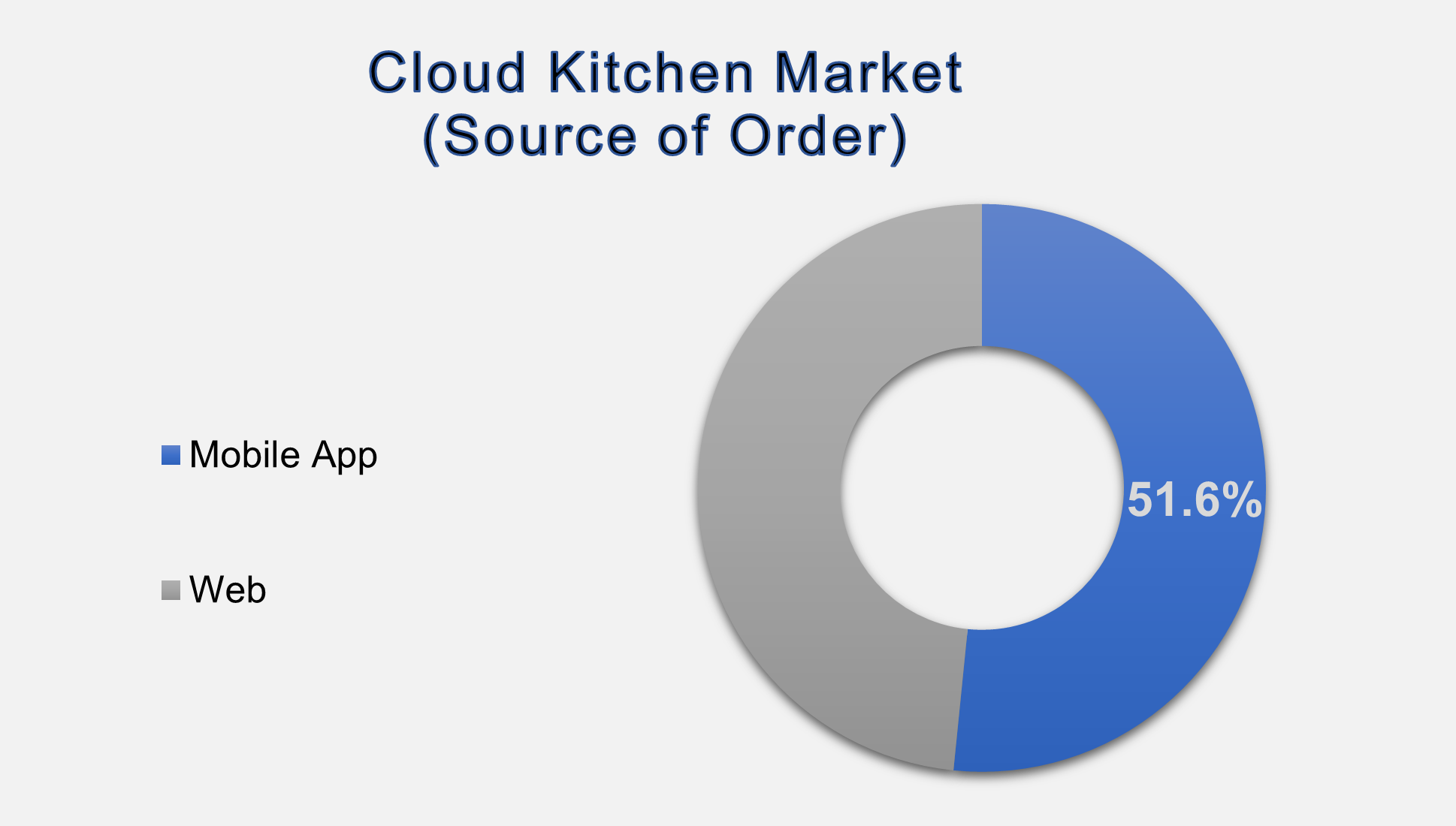
Web, Mobile App |
|
By Payment
Method |
·
Taster ·
KITCH'N BOX ·
Dark
Kitchens France ·
ProKitchens ·
Not So Dark ·
Cooklane ·
Loca
Cuisines ·
Click &
Savor ·
Karma
Kitchen France ·
FoodChéri ·
Frichti ·
Nestor |
France Cloud Kitchen Market Report Segmentation
Analysis
Mobile Wallet Segment Is Expected to
Witness Increasing Adoption
The Mobile Wallet segment is expected
to witness increasing adoption as consumers continue to use smartphone-based
payment systems. Mobile wallets can support faster checkout and greater
integration with mobile ordering applications.
As digital food ordering becomes increasingly mobile-centric, payment solutions that reduce transaction time and simplify checkout are expected to gain greater relevance. Mobile wallets may also become more integrated with loyalty programs and other digital services.
Cash on Delivery Segment Is Expected
to Have Comparatively Limited Relevance
The Cash on Delivery segment is
expected to have comparatively limited relevance within the France cloud
kitchen ecosystem because digital ordering platforms increasingly emphasize
electronic and prepaid transactions.
Cash payments can create additional
operational requirements for delivery processes and are generally less
integrated with automated digital ordering systems. Consequently,
cash-on-delivery transactions are expected to remain less significant than
card-based and other electronic payment methods.
The
following segments are part of an in-depth analysis of the France Cloud Kitchen
Market:
|
Market Segments |
|
|
By
Source of Order |
· Web
· Mobile
App |
|
By
Payment Method |
· Cash
on Delivery · Mobile
Wallet · Card
Transaction · Others |
France Cloud Kitchen Market
Competition Landscape Analysis
The France Cloud Kitchen Market
features a competitive environment comprising food delivery platforms, virtual
restaurant operators, delivery-focused foodservice companies, restaurant
chains, and independent cloud kitchen businesses. Competition is based on
digital customer access, kitchen location, restaurant and brand partnerships,
technology capabilities, order volume, delivery integration, operational
efficiency, menu differentiation, and profitability.
·
Deliveroo France and Uber Eats France
represent important components of the digital food delivery ecosystem. Their
platforms provide restaurant brands and delivery-focused operators with access
to consumers through digital ordering and delivery infrastructure.
·
Frichti has been associated with France's
delivery-focused foodservice and online meal ecosystem. The company represents
the development of digital-first food concepts within the French market.
·
Burger King France demonstrates the interest
of established restaurant chains in delivery-oriented food production and
digital ordering. Large foodservice brands can increasingly use delivery
infrastructure and centralized production strategies to support growing
off-premise demand.
·
Taster represents the development of virtual
and multi-brand restaurant concepts. The company's model reflects the potential
for digital brands to operate without relying exclusively on conventional
dine-in restaurant infrastructure.
The competitive environment is
expected to continue evolving as companies focus increasingly on sustainable
unit economics. Rapid physical expansion is likely to become less important
than efficient kitchen utilization, strong order density, effective digital
customer acquisition, and operational profitability.
France Cloud
Kitchen Market Recent Developments News:
·
France strengthened the planning framework
applicable to delivery-focused food preparation activities, increasing the
importance of regulatory compliance and appropriate facility classification.
·
Regulatory developments and municipal
enforcement increased attention on the location and authorization of dark kitchens
and related delivery-focused facilities, particularly within Paris.
·
Changes supporting the continued use of
eligible titre-restaurant payments for a broad range of food purchases,
including applicable online food ordering, reinforced the importance of digital
payment integration.
·
Digital ordering, delivery platforms, virtual
restaurant concepts, and technology-enabled foodservice operations continued to
influence the development of France's delivery-focused restaurant ecosystem.
·
Cloud kitchen operators increasingly focused
on efficient kitchen utilization, sustainable unit economics, multi-brand
operations, and carefully selected delivery locations.
·
Broader pressure on the French restaurant
sector continued to encourage foodservice businesses to evaluate
lower-fixed-cost operating models and more efficient production strategies.
The
France Cloud Kitchen Market is dominated by a few large companies, such
as
·
Taster
·
KITCH'N BOX
·
Dark Kitchens France
·
ProKitchens
·
Not So Dark
·
Cooklane
·
Loca Cuisines
·
Click & Savor
·
Karma Kitchen France
·
FoodChéri
·
Frichti
·
Nestor
· Others
Frequently Asked Questions
Ekta Chaurasia (Team Lead)
Ekta Chaurasia is a highly experienced Team Lead at M2Square Consultancy with over 7 years of expertise in market research, strategic consulting, competitive benchmarking, and business intelligence solutions. She specializes in ICT, semiconductors & electronics, automotive & transportation, and industrial machinery markets.
She leads end-to-end global research projects focused on market trends, industry analysis, growth forecasting, customer insights, and strategic decision-making. Known for her analytical leadership and industry expertise, Ekta helps businesses uncover growth opportunities, evaluate competitive landscapes, and stay ahead in rapidly evolving markets through accurate and insight-driven research.
Test
Our Research Methodology
"Insight without rigor is just noise."
We follow a comprehensive, multi-phase research framework designed to deliver accurate, strategic, and decision-ready intelligence. Our process integrates primary and secondary research , both quantitative and qualitative , along with dual modeling techniques ( top-down and bottom-up) and a final layer of validation through our proprietary in-house repository.
PRIMARY RESEARCH
Primary research captures real-time, firsthand insights from the market to understand behaviors, motivations, and emerging trends.
1. Quantitative Primary Research
Objective: Generate statistically significant data directly from market participants.
Approaches:- Structured surveys with customers, distributors, and field agents
- Mobile-based data collection for point-of-sale audits and usage behavior
- Phone-based interviews (CATI) for market sizing and product feedback
- Online polling around industry events and digital campaigns
- Purchase frequency by customer type
- Channel performance across geographies
- Feature demand by application or demographic
2. Qualitative Primary Research
Objective: Explore decision-making drivers, pain points, and market readiness.
Approaches:- In-depth interviews (IDIs) with executives, product managers, and key decision-makers
- Focus groups among end users and early adopters
- Site visits and observational research for consumer products
- Informal field-level discussions for regional and cultural nuances
SECONDARY RESEARCH
This phase helps establish a macro-to-micro understanding of market trends, size, regulation, and competitive dynamics, sourced from credible and public domain information.
1. Quantitative Secondary Research
Objective: Model market value and segment-level forecasts based on published data.
Sources include:- Financial reports and investor summaries
- Government trade data, customs records, and regulatory statistics
- Industry association publications and economic databases
- Channel performance and pricing data from marketplace listings
- Revenue splits, pricing trends, and CAGR estimates
- Supply-side capacity and volume tracking
- Investment analysis and funding benchmarks
2. Qualitative Secondary Research
Objective: Capture strategic direction, innovation signals, and behavioral trends.
Sources include:- Company announcements, roadmaps, and product pipelines
- Publicly available whitepapers, conference abstracts, and academic research
- Regulatory body publications and policy briefs
- Social and media sentiment scanning for early-stage shifts
- Strategic shifts in market positioning
- Unmet needs and white spaces
- Regulatory triggers and compliance impact
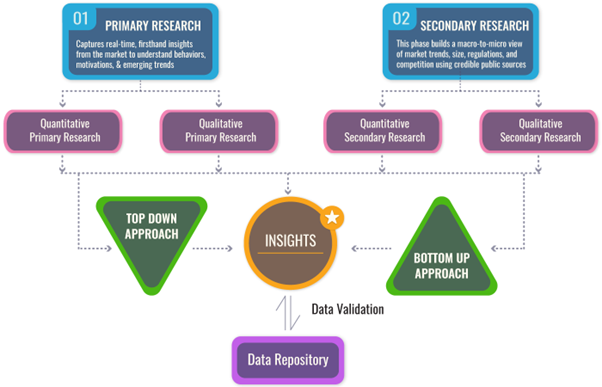
DUAL MODELING: TOP-DOWN + BOTTOM-UP
To ensure robust market estimation, we apply two complementary sizing approaches:
Top-Down Modeling:- Start with broader industry value (e.g., global or regional TAM)
- Apply filters by segment, geography, end-user, or use case
- Adjust with primary insights and validation benchmarks
- Ideal for investor-grade market scans and opportunity mapping
- Aggregate from the ground up using sales volumes, pricing, and unit economics
- Use internal modeling templates aligned with stakeholder data
- Incorporate distributor-level or region-specific inputs
- Most accurate for emerging segments and granular sub-markets
DATA VALIDATION: IN-HOUSE REPOSITORY
We close the loop with proprietary data intelligence built from ongoing projects, industry monitoring, and historical benchmarking. This repository includes:
- Multi-sector market and pricing models
- Key trendlines from past interviews and forecasts
- Benchmarked adoption rates, churn patterns, and ROI indicators
- Industry-specific deviation flags and cross-check logic
- Catches inconsistencies early
- Aligns projections across studies
- Enables consistent, high-trust deliverables