

France Flexible Solar Panels Market Size and Forecast (2026–2034), Regional Growth, Trend, Share and Industry Analysis Report Coverage: By Type (Amorphous Silicon, Cadmium Telluride, Copper Indium Gallium Selenide and Others), By Application (Commercial, Residential and Others)
2026-09-08
Energy & Power
Ekta Chaurasia (Team Lead)
Description
France
Flexible Solar Panels Market Overview
The France Flexible Solar Panels
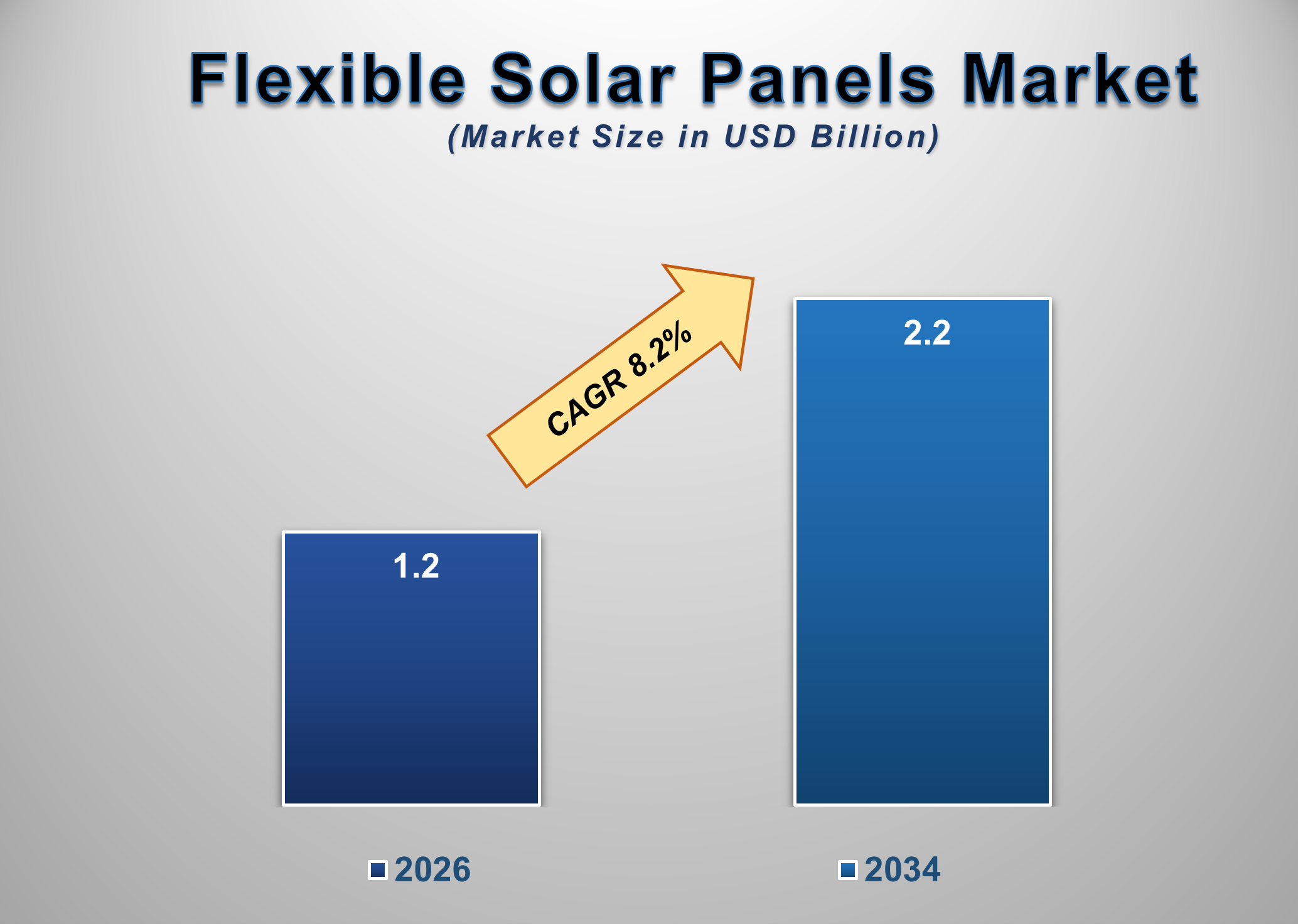
Market is expected to expand from USD 1.2 billion in 2026 to USD 2.2 billion
by 2034, registering a CAGR of 8.2% during 2026–2034. The market is
benefiting from France's continued expansion of renewable electricity,
increasing electrification of buildings and mobility, and growing interest in
solar technologies capable of being deployed beyond conventional rooftop
surfaces. ADEME reports that France reached more than 30 GW of installed
photovoltaic capacity and identifies photovoltaics as the country's leading
renewable-energy technology by installed power.
Flexible solar panels are gaining relevance where conventional rigid modules
face limitations associated with weight, curvature, aesthetics, structural
loading, or available installation area. This creates opportunities across
commercial buildings, lightweight structures, transportation applications,
temporary installations, and specialized industrial equipment. France also has
an established photovoltaic research ecosystem involving CEA-Liten/INES and
industrial companies developing advanced thin-film, organic, and perovskite
technologies. CEA research has demonstrated flexible perovskite modules and
flexible encapsulation processes, reinforcing the country's technical base for
next-generation flexible PV. The French market is also supported by increasing
emphasis on domestic photovoltaic manufacturing and technological sovereignty.
Government and industry initiatives have sought to strengthen French solar
manufacturing capabilities, including support for tandem perovskite-silicon
development involving Voltec Solar and the Institut Photovoltaïque
d'Île-de-France.
France
Flexible Solar Panels Market Growth Drivers
France's Electrification of Buildings,
Mobility and Industry Is Creating New Use Cases for Lightweight Solar
Generation
France's push toward broader
electrification is expanding the range of surfaces and assets that can
potentially incorporate photovoltaic generation. Government priorities
increasingly encompass electrification of buildings, mobility, industry,
agriculture and other energy-consuming activities, creating demand for solar
technologies that can be integrated directly into equipment rather than relying
exclusively on conventional rooftop installations.
Flexible solar panels are particularly
suited to applications where conventional glass modules are difficult to
install because of weight, geometry or structural limitations. They can be
incorporated into lightweight roofs, façades, vehicles, shelters, industrial
equipment and mobile energy systems. This application flexibility increases the
addressable market beyond conventional ground-mounted and rooftop PV. French
research institutions are actively developing integrated photovoltaic solutions
capable of adapting module size, weight, materials, design and electrical
architecture to specific applications.
As electrification expands, businesses
and infrastructure operators are increasingly interested in localized power
generation for auxiliary loads, sensors, mobility infrastructure and
distributed energy systems. Flexible PV can therefore serve as an enabling
technology for decentralized electricity generation where conventional modules
cannot be easily deployed.
France's Emphasis on Domestic Solar
Manufacturing and Low-Carbon Supply Chains Is Supporting Advanced PV
Technologies
France is increasingly focused on
strengthening its domestic and European photovoltaic industrial base while
reducing the carbon intensity and strategic dependence associated with solar
equipment supply chains. Recent ADEME research indicates that updated French
photovoltaic lifecycle data show substantially lower carbon intensity than
previously estimated, reflecting improvements in manufacturing efficiency,
material use, and production processes.
This environment creates an
opportunity for flexible PV manufacturers that can differentiate through
specialized products, local production, lower material intensity and
application-specific engineering. Unlike standardized crystalline-silicon
modules, flexible technologies can compete through characteristics such as low
weight, customized geometry, semi-transparency, aesthetic integration and
compatibility with nontraditional substrates.
France's industrial-policy initiatives
also provide a foundation for next-generation PV development. The government
has previously supported a Voltec Solar and IPVF project aimed at
industrializing perovskite/silicon tandem photovoltaic cells, demonstrating
policy interest in advanced domestic PV manufacturing.
France Flexible Solar Panels Market
Restraint
Limited Standardization and
Application-Specific Engineering Can Extend Project Development Cycles
Flexible solar projects often require
customized module dimensions, mounting systems, substrates, electrical
configurations and protection against environmental conditions. Unlike
standardized crystalline-silicon panels, these solutions may need additional
engineering and validation for individual applications. CEA notes that
integrated PV requires changes in format, materials, weight, design and
electrical architecture according to the application.
This customization can increase
engineering costs, procurement complexity and installation time, particularly
for smaller projects. The absence of standardized specifications across
emerging flexible PV applications can also make it more difficult for architects,
contractors and asset owners to compare technologies on a consistent basis.
Consequently, adoption may initially remain concentrated in applications where
lightweight or integrated solar delivers sufficient value to justify the
additional engineering requirements.
France Flexible Solar Panels Market
Opportunities
Solar Integration Into Transportation
and Mobile Assets Can Create a High-Value Specialized Market
France's transition toward electric
mobility and broader transport electrification creates an opportunity for
flexible photovoltaic technologies that can generate electricity directly on
vehicles and mobile infrastructure. The ability to conform to curved or
irregular surfaces provides flexible modules with an advantage in applications
where conventional panels are too heavy or geometrically restrictive.
Potential applications include buses,
commercial vehicles, recreational vehicles, boats, transport shelters, charging
infrastructure, and mobile power systems. Rather than competing directly with
large-scale utility PV on cost per watt, flexible solar can generate value
through additional electricity production without requiring dedicated land or
substantial structural modifications. CEA's work on integrated PV specifically
highlights mobility and other application areas where photovoltaic generation
can be incorporated directly into products and structures. As France continues
electrifying transport, flexible solar can complement grid electricity and
battery systems by providing distributed auxiliary generation.
France's Advanced Perovskite and
Flexible-PV Research Can Enable Premium High-Efficiency Products
France's research ecosystem provides a
strong foundation for commercialization of next-generation flexible solar
technologies. CEA-Liten has demonstrated flexible perovskite modules using
advanced layer optimization, laser processing and flexible encapsulation, while
its research has targeted both building and low-light applications. Further
progress in perovskite, tandem and thin-film technologies could allow French
manufacturers to develop products combining higher efficiency with low weight
and flexible form factors. These characteristics can be particularly valuable
in applications where available surface area is limited and maximizing energy
output per unit of weight or area is important.
The opportunity extends beyond
conventional electricity generation into building-integrated PV, mobility,
portable power and smart infrastructure. As manufacturing processes mature,
French companies could use their research capabilities to move from
demonstration projects toward commercially scalable specialized products.
France
Flexible Solar Panels Market Scope
|
|
France
Flexible Solar Panels Market Report Segmentation Analysis
Copper Indium Gallium Selenide (CIGS)
Segment Is Expected to Dominate the France Flexible Solar Panels Market During
the Forecast Period
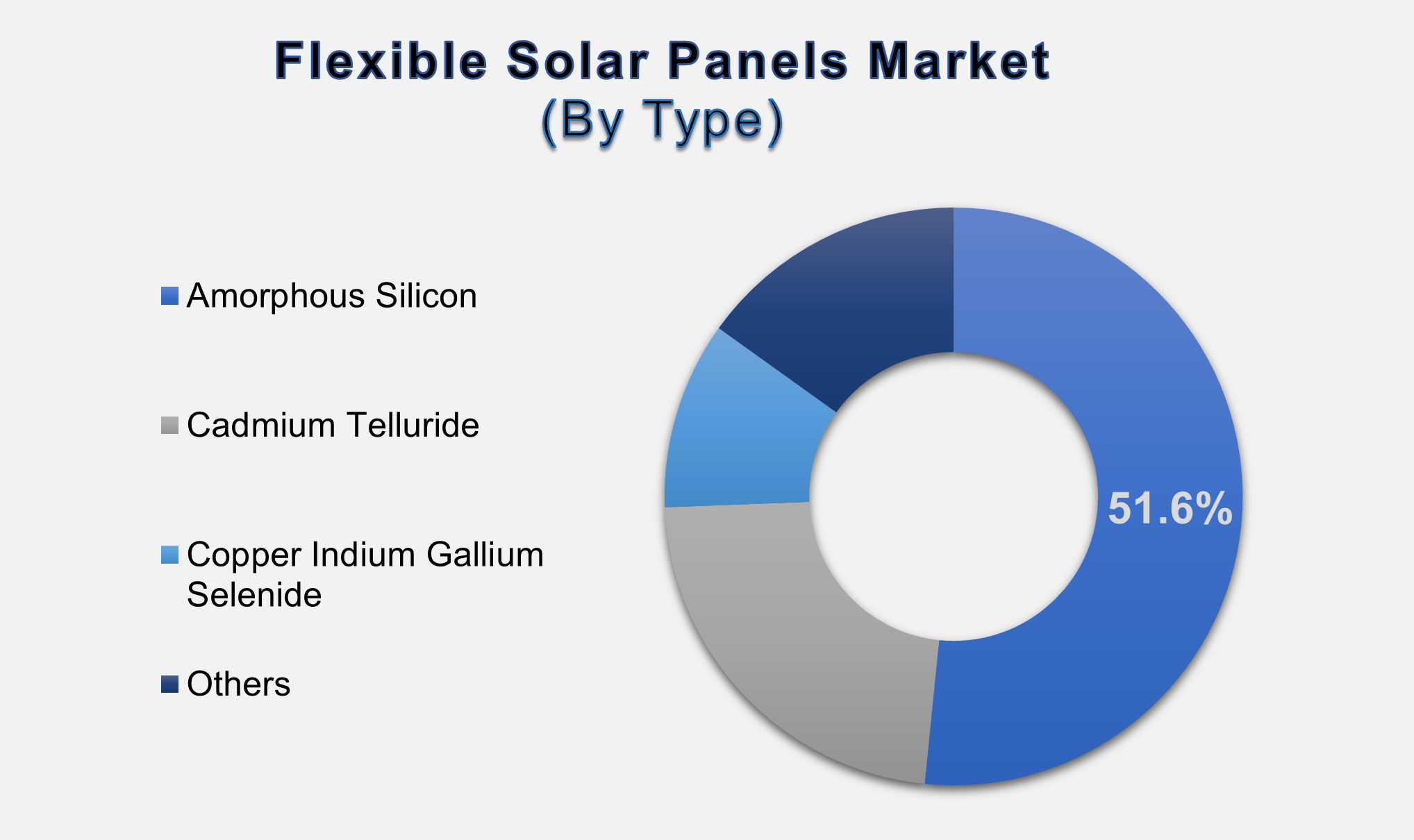
The France Flexible Solar Panels
Market is segmented into Amorphous Silicon, Cadmium Telluride, Copper Indium
Gallium Selenide, and Others. Copper Indium Gallium Selenide (CIGS) is expected
to dominate the market during the forecast period, supported by its established
relevance within thin-film photovoltaics and strong suitability for lightweight
and flexible applications. CIGS technology enables photovoltaic cells to be
produced on flexible substrates, allowing manufacturers to develop modules for
curved, textile-based and structurally constrained surfaces.
France has a particularly relevant
CIGS ecosystem, with SolarCloth developing flexible CIGS modules and SOYPV
developing ultralight CIGS cells for new applications. The technology is
therefore positioned across commercial buildings, lightweight structures,
mobile applications, façades, agricultural structures and specialized
installations. Amorphous silicon is expected to maintain demand in selected
lightweight and specialized applications where flexibility and customized
dimensions are important. Solems continues to manufacture thin-film silicon
products for low-power, connected and building-related applications. Cadmium
telluride is expected to retain relevance within specialized thin-film
applications, while Others is expected to gain importance as organic,
perovskite, and other advanced photovoltaic technologies achieve greater
commercial viability.
Commercial Segment Is Expected to
Dominate the France Flexible Solar Panels Market During the Forecast Period
The France Flexible Solar Panels
Market is segmented into Commercial, Residential, and Others. Commercial
applications are expected to dominate the market during the forecast period,
supported by France's large commercial and industrial building base, increasing
interest in building-integrated photovoltaics, renovation activity, and demand
for customized renewable-energy solutions.
Commercial buildings can utilize
flexible modules across façades, lightweight roofs, canopies, curved
structures, architectural surfaces, and other areas where conventional rigid
panels may be difficult to deploy. Flexible modules can therefore provide
additional electricity generation while reducing structural and aesthetic
constraints. Residential applications are expected to maintain demand through
lightweight rooftop systems, terraces, balconies, compact installations and
other residential deployments. Others are expected to gain importance through
automotive, transportation, marine, agricultural, portable, remote, industrial
and specialized applications where low weight, portability and surface
adaptability provide a technical advantage.
The
following segments are part of an in-depth analysis of the France Flexible
Solar Panels Market:
|
Market Segments |
|
|
By
Type |
· Amorphous
Silicon · Cadmium
Telluride · Copper
Indium Gallium Selenide · Others |
|
By
Application |
· Commercial · Residential · Others |
France Flexible Solar Panels Market Competition Landscape Analysis
The France Flexible Solar Panels
Market features competition among flexible photovoltaic manufacturers, CIGS and
thin-film technology developers, organic photovoltaic companies, customized
solar solution providers, advanced-material technology companies, and
diversified photovoltaic manufacturers. Unlike conventional PV, the French
flexible solar landscape includes a significant number of specialized companies
targeting niche applications and differentiated product formats.
Solar Cloth, Solems SA, SOYPV, Dracula
Technologies, ARMOR/ASCA, Optipus PV, S'Tile, Voltec Solar, Sunwind Energy, and
IKO Industries/IKO Excel Solar represent the key companies identified for the
France market. SolarCloth and SOYPV have a particularly relevant position in
flexible CIGS development, while Solems focuses on thin-film silicon and
customized low-power solar products.
ARMOR/ASCA and Dracula Technologies
contribute to the organic photovoltaic segment, with applications spanning
connected devices, wearable products, building integration and low-power
electronics. S'Tile focuses on customized photovoltaic modules and building-integrated
applications, while Voltec Solar represents a significant French photovoltaic
manufacturing presence and is involved in the development of tandem
perovskite-silicon technology.
Competition is expected to focus on
conversion efficiency, flexibility, weight, durability, customization, module
design, power-to-weight ratio, manufacturing scalability, application
integration, and cost competitiveness. Companies capable of combining flexible
form factors with reliable long-term performance and commercially viable
production are expected to gain an advantage. The competitive landscape is also
expected to be influenced by CIGS-perovskite, perovskite-silicon tandem,
organic PV and other next-generation technologies. French R&D initiatives
such as PRINCIPE and STaFF could strengthen domestic capabilities and create
new technology pathways for flexible and high-efficiency photovoltaic products.
France
Flexible Solar Panels Market Recent Developments News:
·
France is strengthening its domestic
photovoltaic ecosystem, with particular attention to advanced technologies,
industrial capacity and lower-carbon solar manufacturing.
·
SolarCloth and SOYPV are advancing CIGS-based
flexible photovoltaic technologies targeting ultralight, flexible and
application-specific solar solutions.
·
SolarCloth is participating in the France
2030-supported PRINCIPE project, targeting a French CIGS and CIGS-perovskite
flexible PV manufacturing ecosystem.
·
Dracula Technologies expanded its organic PV
manufacturing activities, with its Green MicroPower Factory in Valence
supporting scale-up of printed photovoltaic production.
·
Voltec Solar and IPVF are developing the STaFF
project for industrialization of four-terminal perovskite-silicon tandem
photovoltaic modules in France.
·
SolarCloth has developed CIGS-based flexible
modules for textile and complex surfaces, including applications in tourism,
agriculture, mobility and marine environments.
·
Solems continues to manufacture customized
thin-film silicon photovoltaic products for connected devices, self-powered
systems and building-related applications.
·
French photovoltaic manufacturers are
increasingly targeting niche applications, including building integration,
lightweight modules, thin-film PV and organic photovoltaic products, as
competition from low-priced conventional imported modules remains strong.
·
Building-integrated photovoltaics,
transportation, marine applications, lightweight structures and specialized
industrial systems are expected to provide important opportunities for flexible
solar technologies in France.
The
France Flexible Solar Panels Market is dominated by a few large companies, such
as
·
Solar Cloth
·
Solems SA
·
SOYPV
·
Dracula Technologies
·
ARMOR / ASCA
·
Optipus PV
·
S’Tile
·
Voltec Solar
·
Sunwind Energy
·
IKO Industries / IKO Excel Solar
· Others
Frequently Asked Questions
Ekta Chaurasia (Team Lead)
Ekta Chaurasia is a highly experienced Team Lead at M2Square Consultancy with over 7 years of expertise in market research, strategic consulting, competitive benchmarking, and business intelligence solutions. She specializes in ICT, semiconductors & electronics, automotive & transportation, and industrial machinery markets.
She leads end-to-end global research projects focused on market trends, industry analysis, growth forecasting, customer insights, and strategic decision-making. Known for her analytical leadership and industry expertise, Ekta helps businesses uncover growth opportunities, evaluate competitive landscapes, and stay ahead in rapidly evolving markets through accurate and insight-driven research.
1.
France
Flexible Solar Panels Market Introduction and Market Overview
1.1. Objectives of the Study
1.2. Market Segmentation
1.2.1.Type of France Flexible Solar
Panels Market
1.2.2.Application of France Flexible
Solar Panels Market
1.3. Competition Coverage List of
Market Participants
1.4. Market Definition: Flexible
Solar Panels Market
2.
Executive Summary
2.1. France Flexible Solar Panels
Market Estimation & Forecast
2.1.1.France Flexible Solar Panels
Market Size (US$ Million) Estimates & Historical Trend Analysis (2021 -
2025)
2.1.2.France Flexible Solar Panels
Overall Market Size (US$ Million), Growth Rate (Y-o-Y), Market CAGR (%), Market
forecast (2026 - 2034)
2.2. Snapshot of France Flexible
Solar Panels Market
2.3. France Flexible Solar Panels Market
Revenue Share (%) 2025
2.4. Key Competitors & Key
Insights
3.
Market Overview (Qualitative
Analysis)
3.1. Demand Side Trends
3.2. Supply Side Trends /
Manufacturing Trends
3.3. Demand and Opportunity
Assessment, 2026 - 2034
3.4. Market Dynamics
3.4.1.Drivers
3.4.2.Limitations
3.4.3.Opportunities
3.4.4.Impact Analysis of Drivers and
Restraints
3.5. Market Entry Strategy
3.6. Key Developments
3.7. Regulatory Landscape
3.8. Pricing Analysis
3.9. Value Chain / Ecosystem Analysis
3.10. Porter’s Five Forces Analysis
3.10.1. Bargaining Power of Suppliers
3.10.2. Bargaining Power of Buyers
3.10.3. Threat of Substitutes
3.10.4. Threat of New Entrants
3.10.5. Competitive Rivalry
3.11. PEST Analysis
3.11.1. Political Factors
3.11.2. Economic Factors
3.11.3. Social Factors
3.11.4. Technology Factors
4.
France Flexible Solar Panels
Market Estimates & Forecast Trend Analysis, by Type
4.1. France Flexible Solar Panels
Market Assessments & Key Findings, by Type
4.2. France Flexible Solar Panels
Market Revenue (US$ Million) Estimates and Forecasts, by Type, 2021 - 2034
4.2.1.Amorphous Silicon
4.2.2.Cadmium Telluride
4.2.3.Copper Indium Gallium Selenide
4.2.4.Others
5.
France Flexible Solar Panels
Market Estimates & Forecast Trend Analysis, by Application
5.1. France Flexible Solar Panels
Market Assessments & Key Findings, by Application
5.2. France Flexible Solar Panels
Market Revenue (US$ Million) Estimates and Forecasts, by Application, 2021 -
2034
5.2.1.Commercial
5.2.2.Residential
5.2.3.Others
6. Competition Landscape
6.1. France Flexible Solar Panels
Market Product Mapping
6.2. France Flexible Solar Panels
Market Concentration Analysis, by Leading Players / Innovators / Emerging
Players / New Entrants
6.3. France Flexible Solar Panels
Market Tier Structure Analysis
6.4. France Flexible Solar Panels
Market Concentration & Company Market Shares (%) Analysis, 2025
7. Company Profiles
7.1. Solar Cloth
7.1.1.Company Overview & Key Stats
7.1.2.Financial Performance & KPIs
7.1.3.Product Portfolio
7.1.4.SWOT Analysis
7.1.5.Business Strategy & Recent
Developments
* Similar details would be provided
for all the players mentioned below
7.2.
Solems SA
7.3.
SOYPV
7.4.
Dracula Technologies
7.5.
ARMOR / ASCA
7.6.
Optipus PV
7.7.
S’Tile
7.8.
Voltec Solar
7.9.
Sunwind Energy
7.10.
IKO Industries / IKO Excel
Solar
7.11.
Others
8.
Research Findings &
Conclusion
9.
Assumption
& Acronyms Used
10. Research
Methodology
10.1. External Transportations /
Databases
10.2. Internal Proprietary Database
10.3. Primary Research
10.4. Secondary Research
10.5. Assumptions
10.6. Limitations
10.7. Report FAQs
Our Research Methodology
"Insight without rigor is just noise."
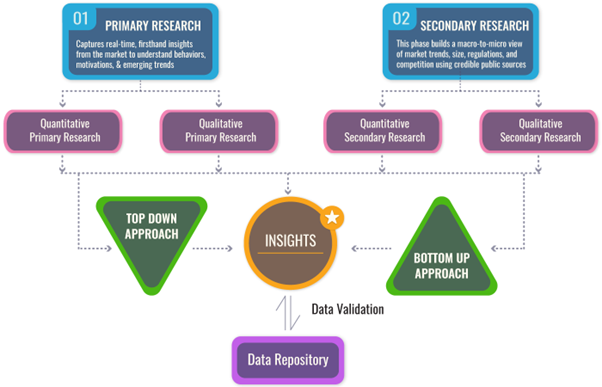
We follow a comprehensive, multi-phase research framework designed to deliver accurate, strategic, and decision-ready intelligence. Our process integrates primary and secondary research , both quantitative and qualitative , along with dual modeling techniques ( top-down and bottom-up) and a final layer of validation through our proprietary in-house repository.
PRIMARY RESEARCH
Primary research captures real-time, firsthand insights from the market to understand behaviors, motivations, and emerging trends.
1. Quantitative Primary Research
Objective: Generate statistically significant data directly from market participants.
Approaches:- Structured surveys with customers, distributors, and field agents
- Mobile-based data collection for point-of-sale audits and usage behavior
- Phone-based interviews (CATI) for market sizing and product feedback
- Online polling around industry events and digital campaigns
- Purchase frequency by customer type
- Channel performance across geographies
- Feature demand by application or demographic
2. Qualitative Primary Research
Objective: Explore decision-making drivers, pain points, and market readiness.
Approaches:- In-depth interviews (IDIs) with executives, product managers, and key decision-makers
- Focus groups among end users and early adopters
- Site visits and observational research for consumer products
- Informal field-level discussions for regional and cultural nuances
SECONDARY RESEARCH
This phase helps establish a macro-to-micro understanding of market trends, size, regulation, and competitive dynamics, sourced from credible and public domain information.
1. Quantitative Secondary Research
Objective: Model market value and segment-level forecasts based on published data.
Sources include:- Financial reports and investor summaries
- Government trade data, customs records, and regulatory statistics
- Industry association publications and economic databases
- Channel performance and pricing data from marketplace listings
- Revenue splits, pricing trends, and CAGR estimates
- Supply-side capacity and volume tracking
- Investment analysis and funding benchmarks
2. Qualitative Secondary Research
Objective: Capture strategic direction, innovation signals, and behavioral trends.
Sources include:- Company announcements, roadmaps, and product pipelines
- Publicly available whitepapers, conference abstracts, and academic research
- Regulatory body publications and policy briefs
- Social and media sentiment scanning for early-stage shifts
- Strategic shifts in market positioning
- Unmet needs and white spaces
- Regulatory triggers and compliance impact
DUAL MODELING: TOP-DOWN + BOTTOM-UP
To ensure robust market estimation, we apply two complementary sizing approaches:
Top-Down Modeling:- Start with broader industry value (e.g., global or regional TAM)
- Apply filters by segment, geography, end-user, or use case
- Adjust with primary insights and validation benchmarks
- Ideal for investor-grade market scans and opportunity mapping
- Aggregate from the ground up using sales volumes, pricing, and unit economics
- Use internal modeling templates aligned with stakeholder data
- Incorporate distributor-level or region-specific inputs
- Most accurate for emerging segments and granular sub-markets
DATA VALIDATION: IN-HOUSE REPOSITORY
We close the loop with proprietary data intelligence built from ongoing projects, industry monitoring, and historical benchmarking. This repository includes:
- Multi-sector market and pricing models
- Key trendlines from past interviews and forecasts
- Benchmarked adoption rates, churn patterns, and ROI indicators
- Industry-specific deviation flags and cross-check logic
- Catches inconsistencies early
- Aligns projections across studies
- Enables consistent, high-trust deliverables