

France Peptide Cancer Vaccine Market Size and Forecast (2026–2034), Regional Growth, Trend, Share and Industry Analysis Report Coverage: By Type (Personalized Peptide Vaccines, Multivalent Peptide Vaccines, and Others); By Application (Melanoma, Lung Cancer, Breast Cancer, Prostate Cancer, and Others); By End User (Hospitals, Cancer Research Institutes, Specialty Clinics, and Others)
2026-11-13
Healthcare
Swetal (Research Analyst)
Description
France Peptide Cancer Vaccine Market Overview
The France peptide cancer vaccine market is projected to expand from USD 0.30 billion in 2026 to USD 1.49 billion by 2034, registering a CAGR of 23.2% during 2026–2034. France peptide cancer vaccine market is a relatively new area within cancer immunotherapy. It involves developments in personalized medicine, cancer antigen discovery, and therapeutic vaccine creation. The market concerns itself with peptide vaccines that provoke an immune reaction toward tumor-associated antigens or neoantigens of individual patients. Various cancers and combinations with immune checkpoint inhibitors are studied. France has all the necessary infrastructure for oncology research, cancer centers, biotechnological industry, and clinical trial capabilities, which facilitate the development and testing of these drugs. OSE Immunotherapeutic SA and VAXON Biotech SA are some of the companies working in the field of French research. Other foreign companies provide competition. The market is highly dependent on the clinical research and development of products, as clinical effectiveness, variability of the reaction of patients, manufacturing difficulties, approval, and reimbursement will determine the pace of commercialization.

France Peptide Cancer Vaccine Market Growth Drivers
Growing Focus on Personalized Cancer Immunotherapy
This momentum is driven by France’s clinical research facilities and scientific interest in tumor immunology, neoantigen prediction, and personalized cancer immunotherapies. In May 2024, Toulouse Oncopole became the first site to enroll a patient in the Phase II TG4050 study, increasing the number of participants in the trial from 36 to 46 across 10 sites to explore whether vaccination can prevent cancer recurrence. The overall scientific interest in personalized immunotherapies, represented by the conference theme of Tumor Immunology & Personalized Cancer Immunotherapies, demonstrates ongoing interest in antigen engineering and combination-based therapies.
This information can potentially indicate the future need for peptide design and selection technologies and clinical development in France. However, TG4050 is an individually tailored viral vector vaccine and not a peptide vaccine.
Expansion of Clinical Research and Immunotherapy Development
The development of clinical research and immunotherapies has created growth potential in the peptide cancer vaccine market in France, owing to the continuing studies of new treatment methods for cancer. The presence of a well-established research infrastructure for oncology in France, including cancer centers, biotech firms, and clinical trials, offers an environment in which peptide vaccines can be tested for different types of cancer. Studies of tumor-associated antigens and patient-specific neoantigens are motivating companies to test peptide vaccines that induce targeted immune responses, either alone or in combination with immune checkpoint inhibitors and other cancer treatments. Such activities in clinical research are generating a demand for peptide synthesis, antigen discovery, biomarker testing, and vaccine production services. Clinical success may lead to more investments, partnerships, and commercialization in the future. However, the rate of market growth depends on clinical results, regulatory approvals, and superiority over existing treatments.
France Peptide Cancer Vaccine Market Restraint
High Clinical Development Risk and Uncertain Therapeutic Efficacy
Clinical development risks and uncertain therapeutic efficacy pose considerable limitations to the French peptide cancer vaccine market. The cancer vaccines based on peptides have to prove that they can induce an adequate immune response to identify and destroy cancer cells. This is a difficult task due to heterogeneity of tumors, immune evasion mechanisms used by cancer cells, and different immune statuses of patients. In some instances, the immune response detected in the course of clinical trials does not result in increased life expectancy or lower rates of cancer relapse. Therefore, extensive preclinical and multi-phase clinical trials should be conducted in order to determine the safety and efficacy of peptide cancer vaccines, as well as proper dosage and patients who would benefit from them. These aspects make the process of developing peptide cancer vaccines costly and lengthy, which poses a challenge to investments and pharmaceutical cooperation in France. Besides, uncertainty about the results of clinical trials makes it more difficult to discuss prices and reimbursement options because of the need to prove the clinical value of peptide cancer vaccines and their economic justification.
France Peptide Cancer Vaccine Market Opportunities
Development of Personalized Neoantigen Peptide Vaccines
There is potential for developing personalized neoantigen peptide vaccines due to innovations in tumor genomics, bioinformatics, and precision oncology in the France peptide cancer vaccine market. Personalized neoantigen peptide vaccines can be created based on neoantigens, which are new protein fragments formed due to mutations specific to tumors and can be identified by the patient's immune system. Selection of appropriate neoantigens and their incorporation into peptide vaccines can help to create an immune response against cancerous cells without causing harm to healthy tissue. Opportunities for collaboration between vaccine developers, genomic testing companies, academic research institutions, and pharmaceutical companies can be found due to the presence of oncology research centers and a biotechnology ecosystem in France. Investment in antigen prediction and personalized peptide synthesis can improve the selection process of candidates and help to develop personalized treatment options for patients suffering from tumors with high unmet medical needs. The clinical validation of such vaccines can result in business opportunities in the field of specialized peptide production, genomic analysis, and personalized vaccine development. However, it will be necessary to demonstrate clinical efficacy, reduce production time, ensure manufacturing quality, and find ways of reimbursement for personalized treatments.
Combination Therapies and Collaborative Clinical Development
Increasing research on combination therapies and collaboration in clinical development provides an opportunity for the French peptide cancer vaccine market. Cancer vaccines based on peptides are being studied in combination with immune checkpoint inhibitors, chemotherapy, and other immunotherapy methods to enhance antitumor immunity and overcome treatment resistance. A combination of these treatment modalities may be helpful in stimulating cancer-specific T cells as well as decreasing the tumor's ability to escape from immune recognition. The oncological research centers, clinical trial networks, and biotech and pharmaceutical industries in France can provide opportunities for developing partnerships in order to evaluate these treatment approaches. Collaborations between vaccine manufacturers, hospitals, universities, and pharmaceutical companies will be useful in recruiting patients for clinical trials, studying biomarkers, and assessing treatment efficacy in different cancers. These collaborations can help to share the costs of research, advance candidate development, and gain access to production and clinical expertise. Positive results of clinical trials will provide opportunities for licensing agreements, co-development agreements, and commercialization. However, the commercial success will be determined by the clinical benefits and safety as well as cost-effectiveness of the treatment compared to alternative treatments.
France Peptide Cancer Vaccine Market Scope
France Peptide Cancer Vaccine Market Report Segmentation Analysis
The Personalized Peptide Vaccine Segment Is Expected to Dominate the France Peptide Cancer Vaccine Market During the Forecast Period
The personalized peptide vaccine sub-segment is anticipated to grow in significance in the France peptide cancer vaccine market over the forecast period, driven by the progress made in the field of precision oncology, tumor genome sequencing, and neoantigen discovery. Such vaccines are intended to target the mutations or antigens specific to the patient in question to stimulate the immune response against the cancer cells. The existing infrastructure for oncology research and the biotech industry in France creates favorable conditions for research into personalized vaccines for various cancers. The increasing interest in the combination of therapeutic vaccines with immune checkpoint inhibitors and other immunotherapies is another factor that can facilitate the expansion of development opportunities for the segment in question. At the same time, progress in bioinformatics, antigen prediction, and peptide synthesis can contribute to the selection of better candidates for the vaccines. Nevertheless, the dominance of the personalized peptide vaccines segment should be seen as a market outlook rather than an existing market reality.

Melanoma Segment Is Expected to Dominate the France Peptide Cancer Vaccine Market During the Forecast Period
The melanoma segment is expected to become one of the most dominant segments of the France peptide cancer vaccine market during the forecast period. This will be driven by the continuous research into tumor-specific antigens, neoantigen-based vaccines, and combination therapies. It is one of the cancers relevant for the development of therapeutic cancer vaccines because it has a high mutational burden that creates tumor-specific neoantigens that can be researched for their possible use as a target. Increasing clinical interest in the combination of peptide-based vaccines with immune checkpoint inhibitors, including PD-1 inhibitors, is stimulating research into therapies that would enhance the antitumor immune response and decrease the risk of disease relapse. Research in such therapies is encouraged by the presence of research institutions and clinical trials infrastructure in France; however, the dominance of the segment will be dependent on the results of clinical trials and regulatory approval of the therapy's benefits over the existing melanoma treatment options.
The Hospital Segment Is Expected to Dominate the France Peptide Cancer Vaccine Market During the Forecast Period
Hospitals will make up a considerable portion of the France peptide cancer vaccine market in the coming years due to the essential role that hospitals play in cancer diagnostics, specialized treatment, and clinical research. Many peptide vaccines require tumor profiling, patient selection, specialist supervision, and immune response evaluation, and thus, hospitals can be crucial venues for the evaluation of such vaccines. The extensive network of oncology hospitals and specialized cancer institutes in France creates the necessary conditions for conducting clinical trials and evaluation of new immunotherapy options. Moreover, hospitals provide an environment for collaboration between oncologists, researchers, diagnostic laboratories, and pharmaceutical companies developing vaccines, which helps recruit suitable patients for clinical trials of investigational vaccines. Nevertheless, the segment may still dominate the market depending on the results of clinical trials, approvals, and reimbursement schemes.
The following segments are part of an in-depth analysis of the France Peptide Cancer Vaccine Market:
France Peptide Cancer Vaccine Market Competition Landscape Analysis
The France peptide cancer vaccine market will be fueled mainly by the pharmaceutical and biotech companies that develop therapeutic peptide vaccines, neoantigen vaccines, and tumor-based immunotherapy treatments. The competition will revolve around the success of clinical trials, vaccine efficiency, company technology, and partnerships with scientific institutions and hospitals. For example, Transgene is working on developing its personalized cancer vaccine candidates, in addition to combining them with immune-checkpoint inhibitors. Since most of the products are still under development, the competition will depend mainly on the ability to innovate.
France Peptide Cancer Vaccine Market Recent Developments News:
In September 2024, Sanofi announced an exclusive licensing agreement with RadioMedix and Orano Med to advance AlphaMedix, a peptide-based radioligand therapy for neuroendocrine tumors. The collaboration combines Sanofi’s global commercialization capabilities with Orano Med’s manufacturing expertise, highlighting growing strategic investment in peptide-targeted cancer therapies. However, AlphaMedix is a radioligand therapy, not a peptide cancer vaccine.
The France Peptide Cancer Vaccine Market is dominated by a few large companies, such as
OSE Immunotherapeutics SA
Enterome SA
VAXON Biotech SA
IO Biotech, Inc.
ISA Therapeutics B.V.
SELLAS Life Sciences Group, Inc.
Greenwich LifeSciences, Inc.
Evaxion A/S
Scancell Holdings plc
Ultimovacs ASA
Elicio Therapeutics, Inc.
Imugene Limited
MimiVax, Inc.
TREOS Bio Ltd.
Genovax S.r.l.
cecava GmbH
IMMUNEO Therapeutics GmbH
Other Prominent Players
Frequently Asked Questions
Swetal (Research Analyst)
Swetal is a Research Analyst with 4+ years of experience specializing in healthcare market research, medical devices, healthcare IT, and medical technology industry analysis. Her expertise includes competitive intelligence, secondary research, market trend forecasting, and healthcare business insights across global healthcare ecosystems.
She contributes to advanced market research reports by analyzing regulatory frameworks, emerging healthcare technologies, competitive landscapes, and innovation trends shaping the medical industry. With a strong focus on accurate market intelligence, strategic insights, and healthcare industry trends, Swetal supports businesses in making informed, data-backed decisions in a rapidly transforming healthcare environment.
France Peptide Cancer Vaccine Market Introduction and Market Overview
Objectives of the Study
Market Segmentation
Type of the France Peptide Cancer Vaccine Market
Application of the France Peptide Cancer Vaccine Market
End User of France Peptide Cancer Vaccine Market
Competition Coverage List of Market Participants
Market Definition: Peptide Cancer Vaccine Market
Executive Summary
France Peptide Cancer Vaccine Market Estimation & Forecast
France Peptide Cancer Vaccine Market Size (US$ Million) Estimates & Historical Trend Analysis (2021 - 2025)
France Peptide Cancer Vaccine Overall Market Size (US$ Million), Growth Rate (Y-o-Y), Market CAGR (%), Market Forecast (2026 - 2034)
Snapshot of France Peptide Cancer Vaccine Market
France Peptide Cancer Vaccine Market Revenue Share (%) 2025
Key Competitors & Key Insights
Market Overview (Qualitative Analysis)
Demand Side Trends
Supply Side Trends / Manufacturing Trends
Demand and Opportunity Assessment, 2026 - 2034
Market Dynamics
Drivers
Limitations
Opportunities
Impact Analysis of Drivers and Restraints
Key Developments
Regulatory Landscape
Pricing Analysis
Supply Chain Analysis
Porter’s Five Forces Analysis
Bargaining Power of Suppliers
Bargaining Power of Buyers
Threat of Substitutes
Threat of New Entrants
Competitive Rivalry
PEST Analysis
Political Factors
Economic Factors
Social Factors
Technology Factors
France Peptide Cancer Vaccine Market Estimates & Forecast Trend Analysis, by Type
France Peptide Cancer Vaccine Market Assessments & Key Findings, by Type
France Peptide Cancer Vaccine Market Revenue (US$ Million) Estimates and Forecasts, by Type, 2021 - 2034
Personalized Peptide Vaccines
Multivalent Peptide Vaccines
Others
France Peptide Cancer Vaccine Market Estimates & Forecast Trend Analysis, by Application
France Peptide Cancer Vaccine Market Assessments & Key Findings, by Application
France Peptide Cancer Vaccine Market Revenue (US$ Million) Estimates and Forecasts, by Application, 2021 - 2034
Melanoma
Lung Cancer
Breast Cancer
Prostate Cancer
Others
France Peptide Cancer Vaccine Market Estimates & Forecast Trend Analysis, by End User
France Peptide Cancer Vaccine Market Assessments & Key Findings, by End User
France Peptide Cancer Vaccine Market Revenue (US$ Million) Estimates and Forecasts, by End User, 2021 - 2034
Hospitals
Cancer Research Institutes
Specialty Clinics
Others
Competition Landscape
France Peptide Cancer Vaccine Market Product Mapping
France Peptide Cancer Vaccine Market Concentration Analysis, by Leading Players / Innovators / Emerging Players / New Entrants
France Peptide Cancer Vaccine Market Tier Structure Analysis
France Peptide Cancer Vaccine Market Concentration & Company Market Shares (%) Analysis, 2025
Company Profiles
OSE Immunotherapeutics SA
Company Overview & Key Stats
Financial Performance & KPIs
Product Portfolio
SWOT Analysis
Business Strategy & Recent Developments
* Similar details would be provided for all the players mentioned below
Enterome SA
VAXON Biotech SA
IO Biotech, Inc.
ISA Therapeutics B.V.
SELLAS Life Sciences Group, Inc.
Greenwich LifeSciences, Inc.
Evaxion A/S
Scancell Holdings plc
Ultimovacs ASA
Elicio Therapeutics, Inc.
Imugene Limited
MimiVax, Inc.
TREOS Bio Ltd.
Genovax S.r.l.
cecava GmbH
IMMUNEO Therapeutics GmbH
Other Prominent Players
Research Findings & Conclusion
Assumption & Acronyms Used
Research Methodology
External Transportations / Databases
Internal Proprietary Database
Primary Research
Secondary Research
Assumptions
Limitations
Report FAQs
Our Research Methodology
"Insight without rigor is just noise."
We follow a comprehensive, multi-phase research framework designed to deliver accurate, strategic, and decision-ready intelligence. Our process integrates primary and secondary research , both quantitative and qualitative , along with dual modeling techniques ( top-down and bottom-up) and a final layer of validation through our proprietary in-house repository.
PRIMARY RESEARCH
Primary research captures real-time, firsthand insights from the market to understand behaviors, motivations, and emerging trends.
1. Quantitative Primary Research
Objective: Generate statistically significant data directly from market participants.
Approaches:- Structured surveys with customers, distributors, and field agents
- Mobile-based data collection for point-of-sale audits and usage behavior
- Phone-based interviews (CATI) for market sizing and product feedback
- Online polling around industry events and digital campaigns
- Purchase frequency by customer type
- Channel performance across geographies
- Feature demand by application or demographic
2. Qualitative Primary Research
Objective: Explore decision-making drivers, pain points, and market readiness.
Approaches:- In-depth interviews (IDIs) with executives, product managers, and key decision-makers
- Focus groups among end users and early adopters
- Site visits and observational research for consumer products
- Informal field-level discussions for regional and cultural nuances
SECONDARY RESEARCH
This phase helps establish a macro-to-micro understanding of market trends, size, regulation, and competitive dynamics, sourced from credible and public domain information.
1. Quantitative Secondary Research
Objective: Model market value and segment-level forecasts based on published data.
Sources include:- Financial reports and investor summaries
- Government trade data, customs records, and regulatory statistics
- Industry association publications and economic databases
- Channel performance and pricing data from marketplace listings
- Revenue splits, pricing trends, and CAGR estimates
- Supply-side capacity and volume tracking
- Investment analysis and funding benchmarks
2. Qualitative Secondary Research
Objective: Capture strategic direction, innovation signals, and behavioral trends.
Sources include:- Company announcements, roadmaps, and product pipelines
- Publicly available whitepapers, conference abstracts, and academic research
- Regulatory body publications and policy briefs
- Social and media sentiment scanning for early-stage shifts
- Strategic shifts in market positioning
- Unmet needs and white spaces
- Regulatory triggers and compliance impact
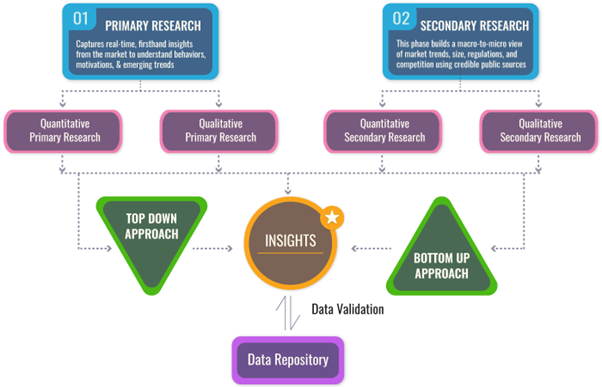
DUAL MODELING: TOP-DOWN + BOTTOM-UP
To ensure robust market estimation, we apply two complementary sizing approaches:
Top-Down Modeling:- Start with broader industry value (e.g., global or regional TAM)
- Apply filters by segment, geography, end-user, or use case
- Adjust with primary insights and validation benchmarks
- Ideal for investor-grade market scans and opportunity mapping
- Aggregate from the ground up using sales volumes, pricing, and unit economics
- Use internal modeling templates aligned with stakeholder data
- Incorporate distributor-level or region-specific inputs
- Most accurate for emerging segments and granular sub-markets
DATA VALIDATION: IN-HOUSE REPOSITORY
We close the loop with proprietary data intelligence built from ongoing projects, industry monitoring, and historical benchmarking. This repository includes:
- Multi-sector market and pricing models
- Key trendlines from past interviews and forecasts
- Benchmarked adoption rates, churn patterns, and ROI indicators
- Industry-specific deviation flags and cross-check logic
- Catches inconsistencies early
- Aligns projections across studies
- Enables consistent, high-trust deliverables