

Gaming Console Market Size and Forecast (2025–2033), Global and Regional Growth, Trend, Share, and Industry Analysis Report Coverage: By Type (Home Console, Handheld Console), By End-use (Residential, Commercial), By Application (Gaming, Non-Gaming), and Geography
2026-02-17
Media & Entertainment
Jaya Bundele (Research Analyst)
Description
Gaming Console Market
Overview
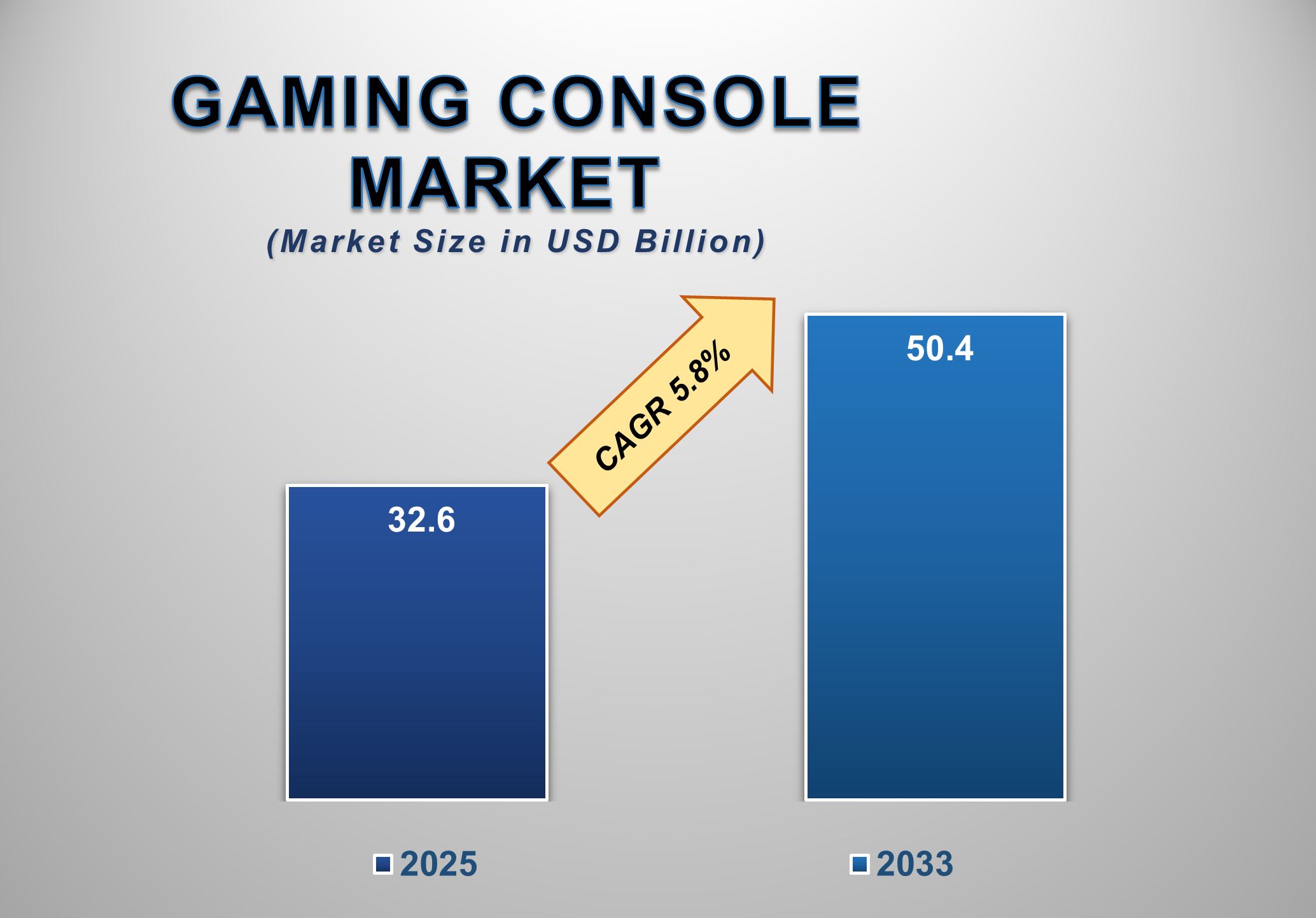
The global Gaming Console Market represents a core segment of the interactive entertainment industry, driven by rapid advancements in gaming technology, growing consumer demand for immersive experiences, and the expanding global gamer population. Gaming consoles serve as dedicated hardware platforms for video gaming, entertainment streaming, and increasingly, social interaction. In 2025, the global gaming console market is valued at USD 32.6 billion and is projected to reach USD 50.4 billion by 2033, growing at a CAGR of 5.8% during the forecast period.
Market expansion is fueled by
continuous innovation in console hardware, including enhanced graphics
processing units (GPUs), faster solid-state drives (SSDs), cloud connectivity,
and support for high-resolution gaming formats such as 4K and 8K. Leading console
manufacturers are also focusing on ecosystem development, integrating
subscription-based gaming services, digital storefronts, and cross-platform
compatibility to enhance user engagement and lifetime value.
Gaming Console Market Drivers and Opportunities
Rising Demand for Immersive and High-Performance Gaming
Experiences Is Driving Market Growth
The growing demand for immersive,
high-performance gaming experiences is a primary driver of the global gaming
console market. Modern gamers increasingly seek realistic visuals, advanced
physics engines, fast load times, and seamless multiplayer experiences. Gaming
consoles are specifically designed to deliver optimized performance for these
requirements, making them a preferred choice over general-purpose computing
devices for many users.
Next-generation consoles incorporate
cutting-edge hardware components, including custom-designed CPUs and GPUs, ray
tracing technology, and ultra-fast SSD storage. These advancements
significantly enhance gameplay realism, reduce latency, and enable expansive
open-world gaming environments. As a result, gamers are increasingly upgrading
from older console generations to access improved performance and exclusive
game titles. In addition, the integration of virtual reality (VR), augmented
reality (AR), and haptic feedback technologies is elevating the gaming
experience further. Console manufacturers are investing in proprietary
controllers, accessories, and peripherals to deepen immersion and differentiate
their platforms. As consumer expectations continue to rise, demand for advanced
gaming consoles is expected to remain strong, supporting sustained market
growth.
Expansion of Digital
Gaming Ecosystems and Subscription Services Is Accelerating Adoption
The rapid expansion of digital gaming
ecosystems and subscription-based services is another major driver propelling
the gaming console market. Console manufacturers are increasingly shifting
toward service-oriented business models that extend beyond hardware sales.
Subscription offerings such as game libraries, cloud gaming access, and online
multiplayer services provide recurring revenue streams and strengthen customer
loyalty. Digital distribution has transformed how games are purchased and
consumed. Gamers can instantly download titles, access downloadable content
(DLC), and receive regular updates without relying on physical media. This
convenience, combined with frequent promotional offers and bundled
subscriptions, enhances the overall value proposition of console ownership.
Furthermore, cloud gaming integration
allows users to stream games directly to consoles, reducing dependency on local
hardware performance and expanding access to a broader range of titles. These
ecosystem-driven strategies are not only increasing console adoption but also
extending product lifecycles, making digital services a critical growth driver
for the market.
Growth of Gaming in
Emerging Markets and Cross-Platform Integration Is Creating New Opportunities
The expanding gaming population in
emerging markets presents a significant opportunity for the global gaming
console market. Rapid urbanization, increasing internet penetration, and rising
disposable incomes are transforming gaming from a niche hobby into a mainstream
entertainment activity across Asia Pacific, Latin America, and parts of the
Middle East.
Asia Pacific is expected to witness the
highest CAGR during the forecast period, driven by a young demographic,
expanding esports culture, and growing acceptance of console gaming.
Manufacturers are increasingly tailoring pricing strategies, content localization,
and distribution models to capture demand in these markets. Additionally,
cross-platform gaming and interoperability between consoles, PCs, and mobile
devices are opening new growth avenues. Gamers now expect seamless gameplay
across devices, shared progress, and unified multiplayer experiences. Console
makers that successfully integrate cross-platform functionality and cloud-based
gaming solutions are well-positioned to capitalize on this evolving landscape.
Gaming Console Market
Scope
|
Report Attributes |
Description |
|
Market Size in 2025 |
USD 32.6 Billion |
|
Market Forecast in 2035 |
USD 50.4 Billion |
|
CAGR % 2025-2035 |
5.8% |
|
Base Year |
2024 |
|
Historic Data |
2020-2024 |
|
Forecast Period |
2025-2035 |
|
Report USP |
Production, Consumption, company share, company heatmap, company
production capacity, growth factors and more |
|
Segments Covered |
●
Type, End-use, Application |
|
Regional Scope |
●
North America, ●
Europe, ●
APAC, ●
Latin America ●
Middle East and Africa |
|
Country Scope |
1)
U.S. 2)
Canada 3)
Germany 4)
UK 5)
France 6)
Spain 7)
Italy 8)
Switzerland 9)
China 10)
Japan 11)
India 12)
Australia 13)
South Korea 14)
Brazil 15)
Mexico 16)
Argentina 17)
South Africa 18)
Saudi Arabia 19) UAE |
Gaming Console Market Report Segmentation Analysis
The Global Gaming Console Market
Industry Analysis Is Segmented By Type, End-use, Application, and by Region.
Home Console
Segment Accounted for the Largest Market Share in the Global Gaming Console
Market
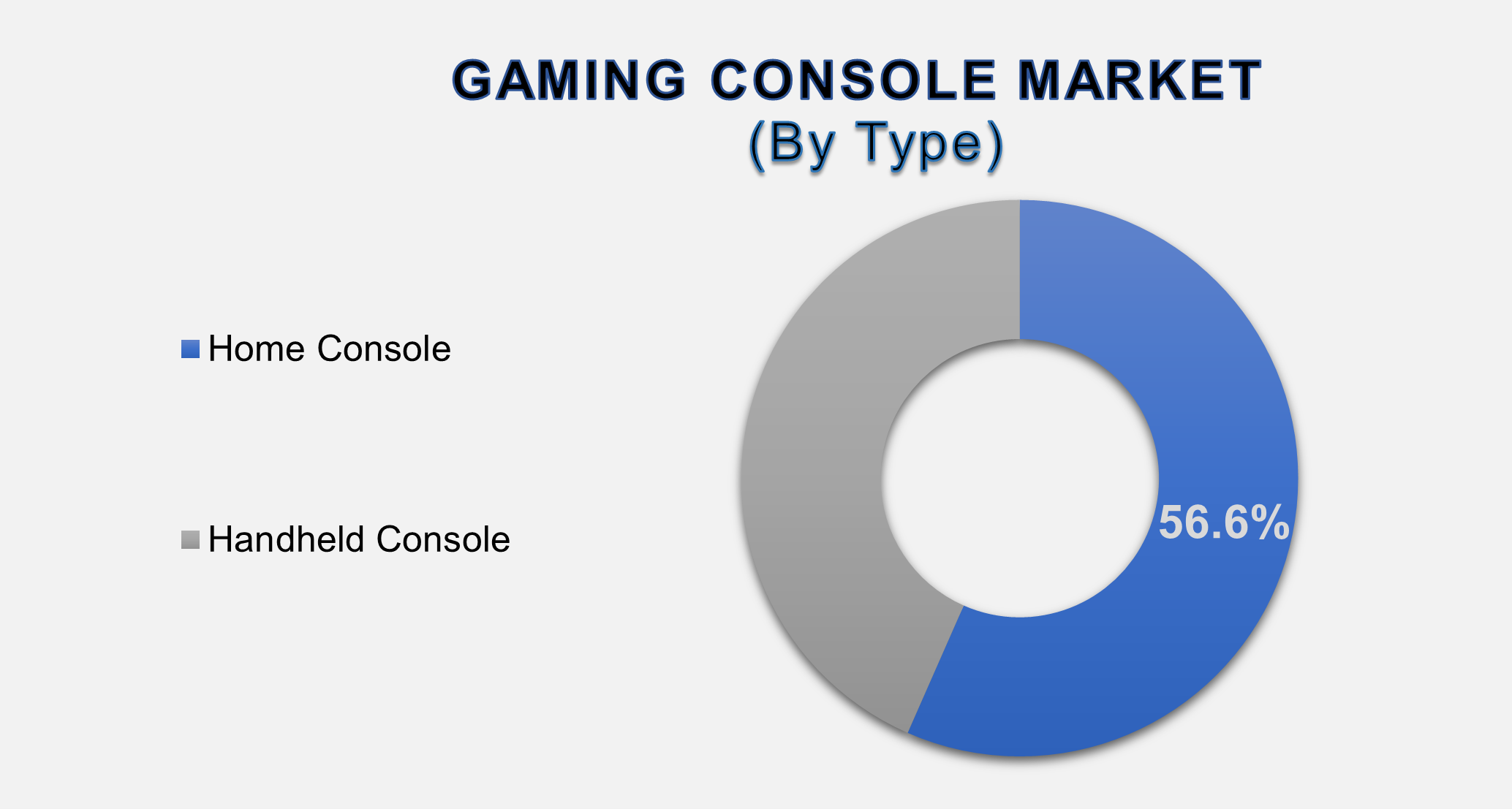
The home console segment accounted for the largest share of the global gaming console market, contributing 56.6% of total revenue. Home consoles are designed to deliver high-end gaming experiences with advanced graphics, powerful processors, and support for large-screen displays. These systems are particularly popular among core gamers and households seeking premium entertainment experiences. Home consoles benefit from exclusive game titles, strong developer support, and robust online ecosystems. Their ability to function as all-in-one entertainment hubs—supporting gaming, streaming, and multimedia applications—further enhances their appeal. As next-generation home consoles continue to evolve, this segment is expected to maintain its dominant position throughout the forecast period.
Residential End-use Segment Dominated the
Global Market
The residential segment dominates the gaming console
market by end-use, driven by widespread household adoption and increasing
leisure spending on home entertainment. Gaming consoles have become central to
family entertainment setups, offering multiplayer gaming, streaming services,
and social connectivity. The rise of stay-at-home entertainment trends and
digital content consumption has further strengthened residential demand.
Console manufacturers are increasingly targeting households with bundled offerings,
parental controls, and family-friendly content, reinforcing the dominance of
this segment.
Gaming Application Segment Held a Significant
Market Share
The gaming application segment holds a significant
share of the market, as consoles are primarily designed for interactive gaming
experiences. High-quality game libraries, exclusive franchises, and online
multiplayer features drive sustained engagement within this segment. While
non-gaming applications such as streaming and media playback contribute
additional value, gaming remains the core function and revenue driver for
console platforms. Continued innovation in game design and interactive
technologies is expected to sustain strong demand for gaming-focused consoles.
The following segments are part of an in-depth analysis of the global Gaming
Console market:
|
Market Segments |
|
|
By Type |
●
Home Console ●
Handheld Console o
Portable o
Non-Portable |
|
By End User |
●
Residential ●
Commercial |
|
By Application |
●
Gaming ●
Non-Gaming |
Gaming Console Market Share Analysis by Region
North America is anticipated to hold the biggest portion of
the Gaming Console Market globally throughout the forecast period.
North America accounted for 43.1%
of the global gaming console market, making it the largest regional market. The
region benefits from high consumer spending power, early adoption of
next-generation consoles, and a well-established gaming culture. The United
States leads regional demand, supported by strong presence of major console
manufacturers, robust esports ecosystems, and widespread broadband
connectivity.
Asia Pacific is expected to
register the highest CAGR during the forecast period, driven by rapid growth in
the gaming population, rising disposable incomes, and increasing acceptance of
console gaming. Countries such as Japan, China, South Korea, and India are
witnessing expanding demand for gaming consoles, supported by localized
content, esports popularity, and improving digital infrastructure. As console
gaming gains traction alongside mobile gaming, Asia Pacific is poised to become
a key growth engine for the global market.
Gaming Console Market Competition Landscape Analysis
The global gaming console market
is highly competitive and dominated by a mix of established multinational
corporations and emerging hardware innovators. Market competition is centered
on hardware performance, exclusive content, ecosystem strength, and service
offerings. Strategic partnerships with game developers and content creators
play a critical role in shaping competitive positioning.
Global Gaming Console Market Recent Developments News:
- In June
2025 – Microsoft announced a multi-year partnership with AMD to
co-engineer custom silicon for its next-generation Xbox consoles. The
platform is designed to deliver a unified, device-agnostic gaming
experience across living room consoles, handheld devices, and the cloud.
Microsoft is also collaborating with its Windows team to position Windows
as the leading gaming platform, reinforcing its commitment to cross-device
accessibility.
- In June
2025 – Microsoft and ASUS announced the upcoming launch of the ROG Xbox
Ally and ROG Xbox Ally X handheld gaming consoles. Developed in
collaboration, these devices support Xbox Play Anywhere, Game Pass, Xbox
Cloud Gaming (Beta), and Remote Play, enabling console-quality gaming on
the go. They are scheduled for a holiday season release in select markets.
- In June
2025 – Nintendo launched the Nintendo Switch 2, featuring enhanced
hardware performance and an expanded content library. Alongside the
release, a firmware update was rolled out, bringing system stability
improvements and expanding the Nintendo Classics catalog with legacy
GameCube titles, emphasizing innovation and backward compatibility.
The Global Gaming Console Market
Is Dominated by a Few Large Companies, such as
●
Sony Interactive
Entertainment
●
Microsoft
●
Nintendo
●
Atari
●
Sega
●
Valve Corporation
●
Nvidia
●
Razer
●
Mad Catz
●
Hyperkin
●
Analogue
●
SNK
●
Arcade1Up
●
Polymega
●
Evercade
●
Anbernic
●
Retroid
●
AYANEO
●
GPD
●
One-Netbook
● Others
Frequently Asked Questions
Jaya Bundele (Research Analyst)
Jaya Bundele is a skilled Research Analyst with 4+ years of experience in market intelligence, consumer insights, competitive analysis, and industry forecasting across the consumer goods, agriculture, and food & beverage sectors. She specializes in market sizing, trend analysis, growth opportunity mapping, and strategic secondary research for global and regional markets.
Her expertise lies in transforming complex industry data into actionable business strategies that help organizations identify emerging trends, understand customer behavior, and gain a competitive edge. With a strong focus on data-driven insights, business intelligence, and future market trends, Jaya delivers high-quality research solutions aligned with evolving industry demands and market dynamics.
1. Global Gaming Console
Market Introduction and Market Overview
1.1.
Objectives
of the Study
1.2.
Global
Gaming Console Market Scope and Market Estimation
1.2.1.Global Gaming Console Overall
Market Size (US$ Bn), Market CAGR (%), Market forecast (2025 - 2033)
1.2.2.Global Gaming Console
Market Revenue Share (%) and Growth Rate (Y-o-Y) from 2020 - 2033
1.3.
Market
Segmentation
1.3.1.Type of Global Gaming
Console Market
1.3.2.End User of Global Gaming
Console Market
1.3.3.Application of Global Gaming
Console Market
1.3.4.Region of Global Gaming
Console Market
2. Executive
Summary
2.1.
Demand
Side Trends
2.2.
Key
Market Trends
2.3.
Market
Demand (US$ Bn) Analysis 2020 – 2024 and Forecast, 2025 – 2033
2.4.
Demand
and Opportunity Assessment
2.5.
Key
Developments
2.6.
Overview
of Tariff, Regulatory Landscape and Standards
2.7.
Market
Entry Strategies
2.8.
Market
Dynamics
2.8.1.Drivers
2.8.2.Limitations
2.8.3.Opportunities
2.8.4.Impact Analysis of Drivers
and Restraints
2.9.
Porter’s
Five Forces Analysis
2.10.
PEST
Analysis
3. Global
Gaming Console Market Estimates
& Historical Trend Analysis (2020 - 2024)
4. Global
Gaming Console Market Estimates
& Forecast Trend Analysis, by Type
4.1.
Global
Gaming Console Market Revenue (US$ Bn) Estimates and Forecasts, by Type, 2020 -
2033
4.1.1.Home Console
4.1.2.Handheld Console
4.1.2.1.
Portable
4.1.2.2.
Non-Portable
5. Global
Gaming Console Market Estimates
& Forecast Trend Analysis, by End User
5.1.
Global
Gaming Console Market Revenue (US$ Bn) Estimates and Forecasts, by End User,
2020 - 2033
5.1.1.Residential
5.1.2.Commercial
6. Global
Gaming Console Market Estimates
& Forecast Trend Analysis, by Application
6.1.
Global
Gaming Console Market Revenue (US$ Bn) Estimates and Forecasts, by Application,
2020 - 2033
6.1.1.Gaming
6.1.2.Non-Gaming
7. Global
Gaming Console Market Estimates
& Forecast Trend Analysis, by Region
7.1.
Global
Gaming Console Market Revenue (US$ Bn) Estimates and Forecasts, by Region, 2020
- 2033
7.1.1.North America
7.1.2.Europe
7.1.3.Asia Pacific
7.1.4.Middle East & Africa
7.1.5.Latin America
8. North America Gaming
Console Market: Estimates &
Forecast Trend Analysis
8.1.
North
America Gaming Console Market Assessments & Key Findings
8.1.1.North America Gaming
Console Market Introduction
8.1.2.North America Gaming
Console Market Size Estimates and Forecast (US$ Billion) (2020 - 2033)
8.1.2.1. By Type
8.1.2.2. By End User
8.1.2.3. By Application
8.1.2.4.
By
Country
8.1.2.4.1. The U.S.
8.1.2.4.2. Canada
9. Europe Gaming
Console Market: Estimates &
Forecast Trend Analysis
9.1.
Europe
Gaming Console Market Assessments & Key Findings
9.1.1.Europe Gaming Console
Market Introduction
9.1.2.Europe Gaming Console
Market Size Estimates and Forecast (US$ Billion) (2020 - 2033)
9.1.2.1. By Type
9.1.2.2. By End User
9.1.2.3. By Application
9.1.2.4.
By
Country
9.1.2.4.1.
Germany
9.1.2.4.2.
Italy
9.1.2.4.3.
U.K.
9.1.2.4.4.
France
9.1.2.4.5.
Spain
9.1.2.4.6.
Switzerland
9.1.2.4.7. Rest
of Europe
10. Asia Pacific Gaming
Console Market: Estimates &
Forecast Trend Analysis
10.1.
Asia
Pacific Market Assessments & Key Findings
10.1.1.
Asia
Pacific Gaming Console Market Introduction
10.1.2.
Asia
Pacific Gaming Console Market Size Estimates and Forecast (US$ Billion) (2020 -
2033)
10.1.2.1. By Type
10.1.2.2. By End User
10.1.2.3. By Application
10.1.2.4.
By
Country
10.1.2.4.1. China
10.1.2.4.2. Japan
10.1.2.4.3. India
10.1.2.4.4. Australia
10.1.2.4.5. South Korea
10.1.2.4.6. Rest of Asia Pacific
11. Middle East & Africa Gaming
Console Market: Estimates &
Forecast Trend Analysis
11.1.
Middle
East & Africa Market Assessments & Key Findings
11.1.1.
Middle East & Africa Gaming Console Market Introduction
11.1.2.
Middle East & Africa Gaming Console Market Size Estimates
and Forecast (US$ Billion) (2020 - 2033)
11.1.2.1. By Type
11.1.2.2. By End User
11.1.2.3. By Application
11.1.2.4.
By
Country
11.1.2.4.1. UAE
11.1.2.4.2. Saudi
Arabia
11.1.2.4.3. South
Africa
11.1.2.4.4. Rest
of MEA
12. Latin America
Gaming Console Market: Estimates &
Forecast Trend Analysis
12.1.
Latin
America Market Assessments & Key Findings
12.1.1.
Latin
America Gaming Console Market Introduction
12.1.2.
Latin
America Gaming Console Market Size Estimates and Forecast (US$ Billion) (2020 -
2033)
12.1.2.1. By Type
12.1.2.2. By End User
12.1.2.3. By Application
12.1.2.4.
By
Country
12.1.2.4.1. Brazil
12.1.2.4.2. Argentina
12.1.2.4.3. Mexico
12.1.2.4.4. Rest
of LATAM
13. Country Wise Market:
Introduction
14.
Competition
Landscape
14.1.
Global
Gaming Console Market Product Mapping
14.2.
Global
Gaming Console Market Concentration Analysis, by Leading Players / Innovators /
Emerging Players / New Entrants
14.3.
Global
Gaming Console Market Tier Structure Analysis
14.4.
Global
Gaming Console Market Concentration & Company Market Shares (%) Analysis,
2024
15.
Company
Profiles
15.1.
Sony Interactive Entertainment
15.1.1.
Company
Overview & Key Stats
15.1.2.
Financial
Performance & KPIs
15.1.3.
Product
Portfolio
15.1.4.
SWOT
Analysis
15.1.5.
Business
Strategy & Recent Developments
* Similar details would be provided for all the players
mentioned below
15.2. Microsoft
15.3. Nintendo
15.4. Atari
15.5. Sega
15.6. Valve
Corporation
15.7. Nvidia
15.8. Razer
15.9. Mad Catz
15.10. Hyperkin
15.11. Analogue
15.12. SNK
15.13. Arcade1Up
15.14. Polymega
15.15. Evercade
15.16. Anbernic
15.17. Retroid
15.18. AYANEO
15.19. GPD
15.20. One-Netbook
15.21. Others
16. Research
Methodology
16.1.
External
Transportations / Databases
16.2.
Internal
Proprietary Database
16.3.
Primary
Research
16.4.
Secondary
Research
16.5.
Assumptions
16.6.
Limitations
16.7.
Report
FAQs
17. Research
Findings & Conclusion
Our Research Methodology
"Insight without rigor is just noise."
We follow a comprehensive, multi-phase research framework designed to deliver accurate, strategic, and decision-ready intelligence. Our process integrates primary and secondary research , both quantitative and qualitative , along with dual modeling techniques ( top-down and bottom-up) and a final layer of validation through our proprietary in-house repository.
PRIMARY RESEARCH
Primary research captures real-time, firsthand insights from the market to understand behaviors, motivations, and emerging trends.
1. Quantitative Primary Research
Objective: Generate statistically significant data directly from market participants.
Approaches:- Structured surveys with customers, distributors, and field agents
- Mobile-based data collection for point-of-sale audits and usage behavior
- Phone-based interviews (CATI) for market sizing and product feedback
- Online polling around industry events and digital campaigns
- Purchase frequency by customer type
- Channel performance across geographies
- Feature demand by application or demographic
2. Qualitative Primary Research
Objective: Explore decision-making drivers, pain points, and market readiness.
Approaches:- In-depth interviews (IDIs) with executives, product managers, and key decision-makers
- Focus groups among end users and early adopters
- Site visits and observational research for consumer products
- Informal field-level discussions for regional and cultural nuances
SECONDARY RESEARCH
This phase helps establish a macro-to-micro understanding of market trends, size, regulation, and competitive dynamics, sourced from credible and public domain information.
1. Quantitative Secondary Research
Objective: Model market value and segment-level forecasts based on published data.
Sources include:- Financial reports and investor summaries
- Government trade data, customs records, and regulatory statistics
- Industry association publications and economic databases
- Channel performance and pricing data from marketplace listings
- Revenue splits, pricing trends, and CAGR estimates
- Supply-side capacity and volume tracking
- Investment analysis and funding benchmarks
2. Qualitative Secondary Research
Objective: Capture strategic direction, innovation signals, and behavioral trends.
Sources include:- Company announcements, roadmaps, and product pipelines
- Publicly available whitepapers, conference abstracts, and academic research
- Regulatory body publications and policy briefs
- Social and media sentiment scanning for early-stage shifts
- Strategic shifts in market positioning
- Unmet needs and white spaces
- Regulatory triggers and compliance impact
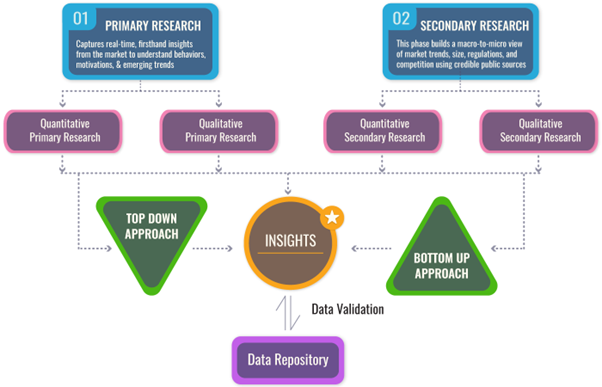
DUAL MODELING: TOP-DOWN + BOTTOM-UP
To ensure robust market estimation, we apply two complementary sizing approaches:
Top-Down Modeling:- Start with broader industry value (e.g., global or regional TAM)
- Apply filters by segment, geography, end-user, or use case
- Adjust with primary insights and validation benchmarks
- Ideal for investor-grade market scans and opportunity mapping
- Aggregate from the ground up using sales volumes, pricing, and unit economics
- Use internal modeling templates aligned with stakeholder data
- Incorporate distributor-level or region-specific inputs
- Most accurate for emerging segments and granular sub-markets
DATA VALIDATION: IN-HOUSE REPOSITORY
We close the loop with proprietary data intelligence built from ongoing projects, industry monitoring, and historical benchmarking. This repository includes:
- Multi-sector market and pricing models
- Key trendlines from past interviews and forecasts
- Benchmarked adoption rates, churn patterns, and ROI indicators
- Industry-specific deviation flags and cross-check logic
- Catches inconsistencies early
- Aligns projections across studies
- Enables consistent, high-trust deliverables