

Gaming Laptops Market Size and Forecast (2020 - 2033), Global and Regional Growth, Trend, Share, and Industry Analysis Report Coverage: By Processor Type (Intel, AMD, Others), By GPU Type (NVIDIA, AMD Radeon, Intel Arc, Others), By Display Size (Below 15 Inches, 15–17 Inches, Above 17 Inches), By End User (Professional Gamers, Casual Gamers, Game Developers, eSports Organizations), By Distribution Channel (Online, Offline) And Geography
2025-11-27
Consumer Products
Jaya Bundele (Research Analyst)
Description
Gaming Laptops Market
Overview
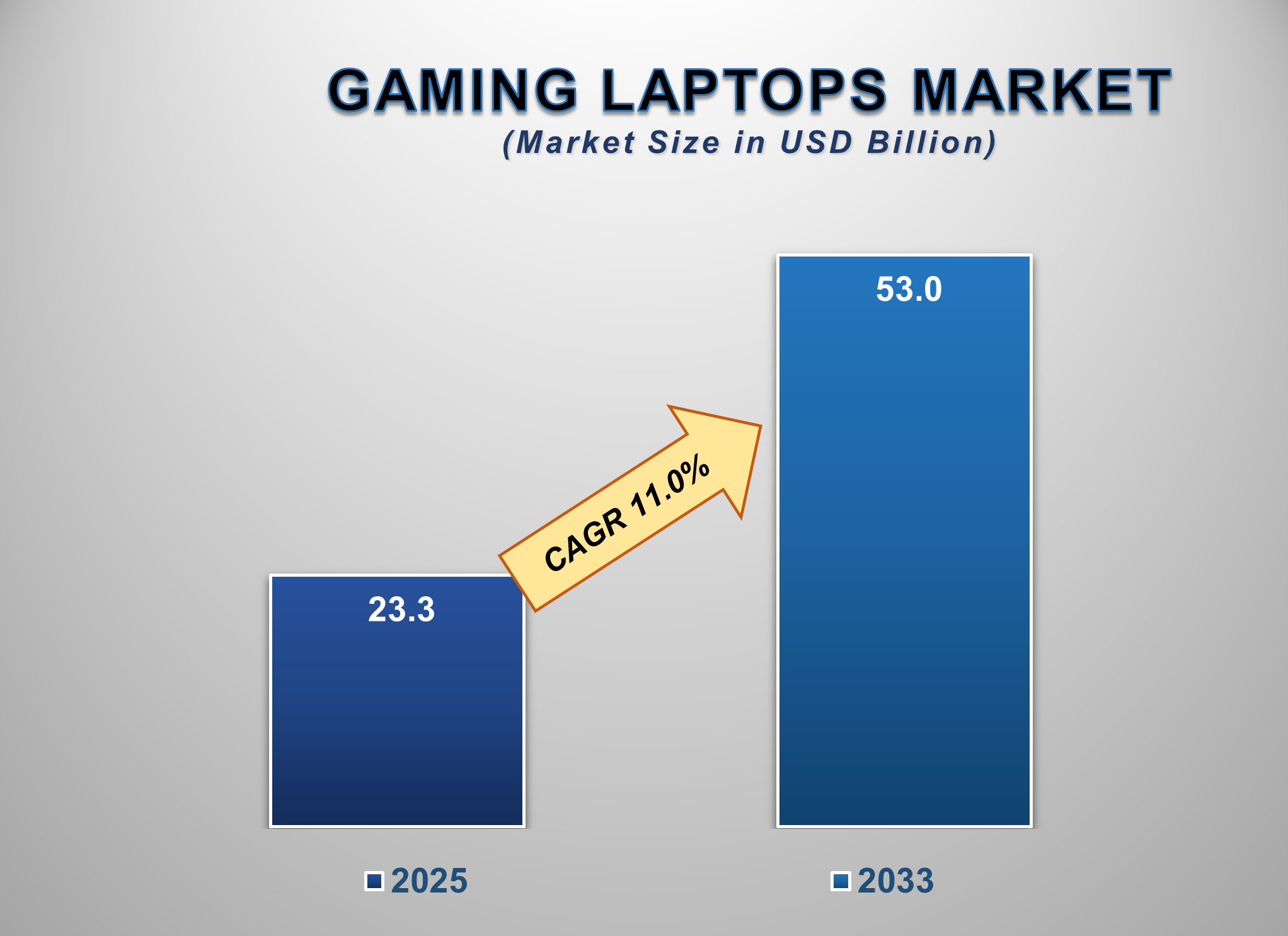
The Gaming Laptops Market is poised for a period of dynamic expansion from 2025 to 2033, fueled by relentless hardware innovation, the global ascent of esports, and the increasing demand for portable, high-performance computing. The market is projected to be valued at approximately USD 23.3 billion in 2025 and is forecasted to surge to nearly USD 53.0 billion by 2033, exhibiting a robust compound annual growth rate (CAGR) of 11.0% during this period.
Gaming laptops are specialized portable
computers engineered with high-performance components, including dedicated
graphics processing units (GPUs), advanced cooling systems, and
high-refresh-rate displays to deliver a seamless and immersive gaming experience.
Market growth is primarily driven by the continuous competition and innovation
between CPU and GPU manufacturers, the rising popularity of competitive gaming
and live streaming, and the convergence of gaming and content creation
workflows.
The increasing disposable income in emerging
economies, coupled with the growing cultural mainstreaming of video games, is
creating sustained global demand. Technological advancements such as AI-powered
performance optimization (e.g., NVIDIA DLSS, AMD FSR), the adoption of mini-LED
and OLED display technologies, and more efficient thermal management solutions
are key market enablers. The Asia-Pacific region currently leads the market due
to its massive gamer demographic and strong manufacturing base, while North
America remains a critical market for premium and high-performance models. With
the ongoing evolution of game graphics and the need for versatile, powerful
mobile workstations, the Gaming Laptops Market is set for significant growth
over the next decade.
Gaming Laptops Market Drivers and
Opportunities
The Intense Competition and Innovation in the
CPU and GPU Sectors are the Core drivers for the Gaming Laptops Market
The fierce rivalry between Intel and AMD in the
CPU space and between NVIDIA, AMD, and Intel
in the GPU arena directly fuels market growth. Each new generation of
processors and graphics cards delivers substantial performance improvements,
real-time ray tracing capabilities, and AI-enhanced features. This creates a
persistent upgrade cycle, enticing enthusiasts and professionals to seek the
latest technology for a competitive edge and superior visual fidelity. The
ability of modern gaming laptops to deliver desktop-class performance in a
portable form factor is a key value proposition, driving both new customer
acquisition and repeat purchases.
The Professionalization of Esports and the
Content Creation Boom is Catalyzing Massive Market Growth
The global esports industry's transformation
into a professional sport has created a non-negotiable demand for reliable,
high-performance, and portable gaming systems for training, competition, and
broadcasting. Simultaneously, the explosion of content creation on platforms
like Twitch, YouTube, and TikTok requires a single machine capable of playing
demanding games at maximum settings while simultaneously handling
resource-intensive video encoding and streaming. This dual-application demand
elevates the gaming laptop from a recreational device to an essential
professional tool, expanding the market's scope and driving sales of high-end
models.
Technological Convergence and Supply Chain
Diversification are Unlocking New Opportunities
The blending of gaming, streaming, and
professional creative work presents significant opportunities for market
differentiation. Key areas of development include advanced vapor chamber
cooling solutions to sustain higher clock speeds, the integration of next-generation
connectivity like Wi-Fi 7, and the use of premium, lightweight materials.
Furthermore, the entry of new processor architectures, such as Apple's M-series
and other ARM-based chips, presents a new frontier for performance-per-watt and
battery life. The growing trend of OEMs and ODMs (Original Design
Manufacturers) like Clevo and TongFang partnering with regional brands (e.g.,
Eluktronics, XPG) allows for greater product diversification and caters to
niche market segments, increasing overall market penetration.
Gaming Laptops Market Scope
|
Report Attributes |
Description |
|
Market Size in 2025 |
USD 23.3 Billion |
|
Market Forecast in 2033 |
USD 53.0 Billion |
|
CAGR % 2025-2033 |
11.0% |
|
Base Year |
2024 |
|
Historic Data |
2020-2024 |
|
Forecast Period |
2025-2033 |
|
Report USP |
Product Portfolio, Technological Analysis, Company Market Share,
Company Heatmap, Pricing Analysis, Growth Factors and more |
|
Segments Covered |
●
By Type ●
By Disease ●
By Application ●
By End-user |
|
Regional Scope |
●
North America, ●
Europe, ●
APAC, ●
Latin America ●
Middle East and Africa |
|
Country Scope |
1)
U.S. 2)
Canada 3)
Germany 4)
UK 5)
France 6)
Spain 7)
Italy 8)
Switzerland 9)
China 10)
Japan 11)
India 12)
Australia 13)
South Korea 14)
Brazil 15)
Mexico 16)
Argentina 17)
South Africa 18)
Saudi Arabia 19) UAE |
Gaming Laptops Market Report Segmentation Analysis
The global Gaming Laptops Market
industry analysis is segmented by Type, by Processor Type, by GPU Type, by
Display Size, by End-user, by Distribution Channel, and by region.
The Intel processor type segment is anticipated to command
the largest market share in 2025.
The market is divided by Processor Type into
Intel, AMD, and Others (e.g., Apple M-series, ARM-based). Intel continues to
hold a dominant share, driven by its long-established brand presence, extensive
partnerships with laptop OEMs, and strong single-core performance that is
highly valued in gaming. However, AMD has been gaining significant traction
with its Ryzen series, which offers competitive multi-core performance and
power efficiency.
The NVIDIA GPU Type segment dominated the market in 2025 and
is projected to grow at a significant CAGR.
Based on GPU Type, the market is segmented into
NVIDIA, AMD Radeon, Intel Arc, and Others. NVIDIA holds an overwhelming market
share. This dominance is attributed to its technological leadership in ray
tracing and AI-powered upscaling (DLSS), a robust software ecosystem (GeForce
Experience), and its strong brand association with high-performance gaming,
making it the preferred choice for most gamers and manufacturers.
The dominance of the NVIDIA segment is intrinsically linked to its continuous innovation in graphics technology and the software ecosystem. Features like real-time ray tracing and Deep Learning Super Sampling (DLSS) have become industry benchmarks, providing a tangible visual and performance advantage that is heavily marketed by both NVIDIA and its partners. The widespread adoption of the "GeForce RTX" branding across a vast range of laptops, from budget to flagship, creates a unified and powerful marketing message that resonates with consumers. As game developers continue to prioritize these technologies, the demand for NVIDIA GPUs is reinforced, ensuring the segment's continued leadership.
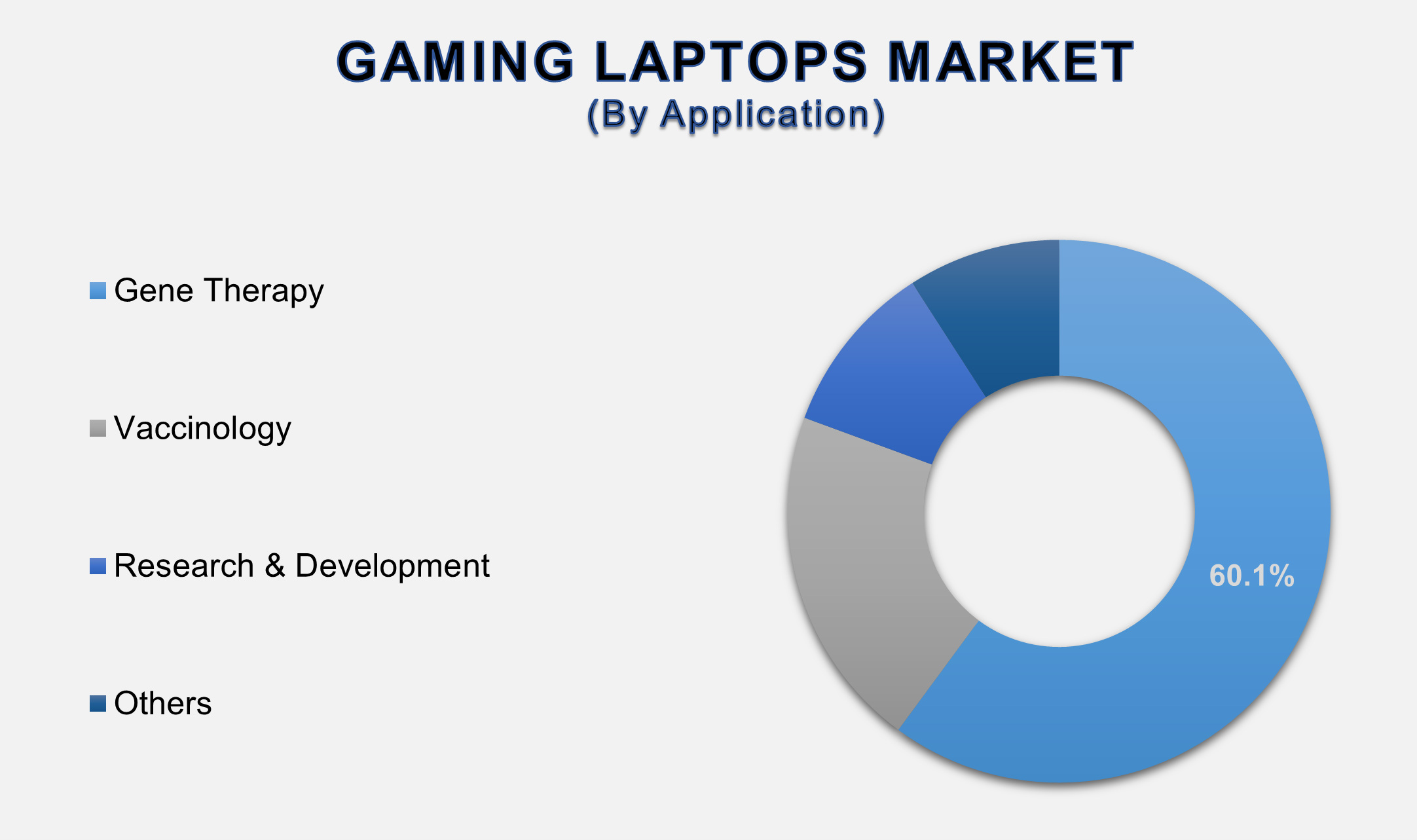
The 15–17-inch display size segment is expected to hold a
significant market share in 2025.
By Display Size, the market is categorized into below 15 inches, 15–17 inches, and above 17 inches. The 15–17 inch segment is the industry standard and largest contributor.
This size offers the ideal balance between screen immersion for gaming, a
comfortable form factor for portability, and sufficient space for a full-sized
keyboard, making it the most popular and widely available category.
The Casual Gamers end-user segment dominated the global
gaming laptops market in 2025.
Based on End User, the market is segmented into
Professional Gamers, Casual Gamers, Game Developers, and eSports Organizations.
The Casual Gamers segment holds the largest share by a wide margin. This vast
group encompasses the broad base of consumers who purchase gaming laptops for
entertainment and hobbyism, driving volume sales in the mid-range and budget
segments.
The Online distribution channel segment is projected to be
the fastest-growing channel during the forecast period.
The market is divided by Distribution Channel
into Online (E-commerce, Brand Websites) and Offline (Retail Stores, Specialty
Stores). While offline channels remain crucial for hands-on experience, the
Online segment is growing rapidly due to the convenience of direct-to-consumer
sales, frequent online discounts, wider product selection, and detailed
customer reviews available on e-commerce platforms.
The following segments
are part of an in-depth analysis of the global gaming laptops market:
|
Market Segments |
|
|
By Processor Type |
●
Intel ●
AMD ●
Others (e.g., Apple
M-series, ARM-based) |
|
By GPU Type |
●
NVIDIA ●
AMD Radeon ●
Intel Arc ●
Others |
|
By Display Size |
●
Below 15 Inches ●
15–17 Inches ●
Above 17 Inches |
|
By End-user |
●
Professional Gamers ●
Casual Gamers ●
Game Developers ●
eSports
Organizations |
|
By Distribution Channel |
●
Online Store ●
Offline Store |
Gaming Laptops Market Share Analysis by Region
The North America region is anticipated to hold the largest
portion of the Gaming Laptops Market globally throughout the forecast period.
The dominance of North America can be attributed
to its strong gaming culture, high disposable income, and early adoption of
advanced gaming technologies. The region hosts some of the world’s leading
gaming laptop manufacturers and component suppliers, such as Dell (Alienware),
HP (OMEN), and Razer, which continuously invest in product innovation and
performance enhancements.
Moreover, the widespread availability of
high-speed internet infrastructure and the growing popularity of eSports
tournaments and online multiplayer games have fueled demand for
high-performance laptops. The United States remains the largest contributor within
the region due to its extensive gaming community, strong presence of
professional gaming leagues, and high concentration of tech-savvy
consumers. Additionally, the integration of AI-driven graphics, advanced
cooling systems, and VR-ready features further strengthens the market’s growth
in North America, positioning it as the leading region in terms of both revenue
and adoption rate for gaming laptops.
Gaming Laptops Market Competition Landscape Analysis
The global gaming laptops market
is severely competitive and fragmented, characterized by the presence of major
multinational brands, dedicated gaming-focused companies, and agile boutique
builders. Competition is centered on technological leadership (first-to-market
with new GPUs/CPUs), brand identity, design aesthetics, and
performance-per-dollar. Key strategies include high-profile sponsorships of
esports teams and influencers, continuous R&D into cooling and form
factors, and strategic partnerships with key component suppliers. The market
also features a significant segment of companies that utilize chassis from ODMs
like Clevo to offer customizable, high-performance models directly to
consumers.
Global Gaming Laptops Market Recent Developments News:
- In February 2025, ASUS ROG unveiled its new
Zephyrus line featuring the latest NVIDIA GeForce RTX 50 series laptops,
emphasizing a new dual-chamber cooling system for maximized performance in
an ultra-thin design.
- In January 2025, Lenovo Legion announced a
multi-year partnership with a leading global esports league, becoming the
official gaming laptop partner and solidifying its brand in the
professional gaming scene.
- In November 2024, MSI launched its new
"Titan" series, touted as the world's first laptop to feature a
factory-overclocked GPU and a 4K 144 Hz
mini-LED display, targeting the extreme high-end enthusiast segment.
- In October 2024, Eluktronics introduced a new water-cooling accessory
for its flagship laptops, demonstrating the trend of boutique
manufacturers pushing performance boundaries beyond standard air cooling.
The Global Gaming Laptops
Market Is Dominated by a Few Large Companies, such as
●
ASUSTeK Computer Inc.
(ASUS)
●
Acer Inc.
●
Dell Technologies Inc.
●
HP Inc.
●
Lenovo Group Limited
●
MSI (Micro-Star
International Co., Ltd.)
●
Razer Inc.
●
Gigabyte Technology
Co., Ltd.
●
Samsung Electronics
Co., Ltd.
●
Origin PC Corporation
●
Eluktronics, Inc.
●
Clevo (Hasee Computer
Co., Ltd.)
●
EVGA Corporation
●
CyberPowerPC
●
XPG (ADATA Technology
Co., Ltd.)
● Other Prominent Players
Frequently Asked Questions
Jaya Bundele (Research Analyst)
Jaya Bundele is a skilled Research Analyst with 4+ years of experience in market intelligence, consumer insights, competitive analysis, and industry forecasting across the consumer goods, agriculture, and food & beverage sectors. She specializes in market sizing, trend analysis, growth opportunity mapping, and strategic secondary research for global and regional markets.
Her expertise lies in transforming complex industry data into actionable business strategies that help organizations identify emerging trends, understand customer behavior, and gain a competitive edge. With a strong focus on data-driven insights, business intelligence, and future market trends, Jaya delivers high-quality research solutions aligned with evolving industry demands and market dynamics.
1. Global Gaming Laptops
Market Introduction and Market Overview
1.1.
Objectives
of the Study
1.2.
Global
Gaming Laptops Market Scope and Market Estimation
1.2.1.Global Electronic Toll
Collection Overall Market Size (US$ Bn), Market CAGR (%), Market forecast (2025
- 2033)
1.2.2.Global Gaming Laptops
Market Revenue Share (%) and Growth Rate (Y-o-Y) from 2020 - 2033
1.3.
Market
Segmentation
1.3.1.Processor Type of Global Gaming
Laptops Market
1.3.2.GPU Type of Global Gaming
Laptops Market
1.3.3.Display Size of Global Gaming
Laptops Market
1.3.4.End-user of Global Gaming
Laptops Market
1.3.5.Distribution Channel of
Global Gaming Laptops Market
1.3.6.Region of Global Gaming
Laptops Market
2.
Executive Summary
2.1.
Demand
Side Trends
2.2.
Key
Market Trends
2.3.
Market
Demand (US$ Bn) Analysis 2020 – 2024 and Forecast, 2025 – 2033
2.4.
Demand
and Opportunity Assessment
2.5.
Pricing
Analysis
2.6.
Technological
Advancements
2.7.
Key
Developments
2.8.
Market
Entry Strategies
2.9.
Market
Dynamics
2.9.1.Drivers
2.9.2.Limitations
2.9.3.Opportunities
2.9.4.Impact Analysis of Drivers
and Restraints
2.10.
Porter’s
Five Forces Analysis
2.11.
PEST
Analysis
3. Global
Gaming Laptops Market Estimates
& Historical Trend Analysis (2020 - 2024)
4. Global
Gaming Laptops Market Estimates
& Forecast Trend Analysis, by Processor Type
4.1.
Global
Gaming Laptops Market Revenue (US$ Bn) Estimates and Forecasts, by Processor
Type, 2020 - 2033
4.1.1.Intel
4.1.2.AMD
4.1.3.Others (e.g., Apple
M-series, ARM-based)
5. Global
Gaming Laptops Market Estimates
& Forecast Trend Analysis, by GPU Type
5.1.
Global
Gaming Laptops Market Revenue (US$ Bn) Estimates and Forecasts, by GPU Type, 2020
- 2033
5.1.1.NVIDIA
5.1.2.AMD Radeon
5.1.3.Intel Arc
5.1.4.Others
6. Global
Gaming Laptops Market Estimates
& Forecast Trend Analysis, by Display Size
6.1.
Global
Gaming Laptops Market Revenue (US$ Bn) Estimates and Forecasts, by Display Size,
2020 - 2033
6.1.1.Below 15 Inches
6.1.2.15–17 Inches
6.1.3.Above 17 Inches
7. Global
Gaming Laptops Market Estimates
& Forecast Trend Analysis, by End-user
7.1.
Global
Gaming Laptops Market Revenue (US$ Bn) Estimates and Forecasts, by End-user,
2020 - 2033
7.1.1.Professional Gamers
7.1.2.Casual Gamers
7.1.3.Game Developers
7.1.4.eSports Organizations
8. Global
Gaming Laptops Market Estimates
& Forecast Trend Analysis, by Distribution Channel
8.1.
Global
Gaming Laptops Market Revenue (US$ Bn) Estimates and Forecasts, by Distribution
Channel, 2020 - 2033
8.1.1.Online Store
8.1.2.Offline Store
9. Global
Gaming Laptops Market Estimates
& Forecast Trend Analysis, by region
9.1.
Global
Gaming Laptops Market Revenue (US$ Bn) Estimates and Forecasts, by region, 2020
- 2033
9.1.1.North America
9.1.2.Europe
9.1.3.Asia Pacific
9.1.4.Middle East & Africa
9.1.5.Latin America
10. North America Gaming
Laptops Market: Estimates &
Forecast Trend Analysis
10.1. North America Gaming
Laptops Market Assessments & Key Findings
10.1.1.
North
America Gaming Laptops Market Introduction
10.1.2.
North
America Gaming Laptops Market Size Estimates and Forecast (US$ Billion) (2020 -
2033)
10.1.2.1.
By Processor Type
10.1.2.2.
By GPU Type
10.1.2.3.
By Display Size
10.1.2.4.
By End-user
10.1.2.5.
By Distribution Channel
10.1.2.6. By Country
10.1.2.6.1. The U.S.
10.1.2.6.2. Canada
11. Europe Gaming
Laptops Market: Estimates &
Forecast Trend Analysis
11.1. Europe Gaming Laptops
Market Assessments & Key Findings
11.1.1. Europe Gaming Laptops
Market Introduction
11.1.2. Europe Gaming Laptops
Market Size Estimates and Forecast (US$ Billion) (2020 - 2033)
11.1.2.1.
By Processor Type
11.1.2.2.
By GPU Type
11.1.2.3.
By Display Size
11.1.2.4.
By End-user
11.1.2.5.
By Distribution Channel
11.1.2.6. By Country
11.1.2.6.1.
Germany
11.1.2.6.2.
Italy
11.1.2.6.3.
U.K.
11.1.2.6.4.
France
11.1.2.6.5.
Spain
11.1.2.6.6.
Switzerland
11.1.2.6.7. Rest
of Europe
12. Asia Pacific Gaming
Laptops Market: Estimates &
Forecast Trend Analysis
12.1. Asia Pacific Market
Assessments & Key Findings
12.1.1.
Asia
Pacific Gaming Laptops Market Introduction
12.1.2.
Asia
Pacific Gaming Laptops Market Size Estimates and Forecast (US$ Billion) (2020 -
2033)
12.1.2.1.
By Processor Type
12.1.2.2.
By GPU Type
12.1.2.3.
By Display Size
12.1.2.4.
By End-user
12.1.2.5. By Country
12.1.2.5.1. China
12.1.2.5.2. Japan
12.1.2.5.3. India
12.1.2.5.4. Australia
12.1.2.5.5. South Korea
12.1.2.5.6. Rest of Asia Pacific
13. Middle East & Africa Gaming
Laptops Market: Estimates &
Forecast Trend Analysis
13.1. Middle East & Africa
Market Assessments & Key Findings
13.1.1. Middle
East & Africa
Gaming Laptops Market Introduction
13.1.2. Middle
East & Africa
Gaming Laptops Market Size Estimates and Forecast (US$ Billion) (2020 - 2033)
13.1.2.1.
By Processor Type
13.1.2.2.
By GPU Type
13.1.2.3.
By Display Size
13.1.2.4.
By End-user
13.1.2.5. By Country
13.1.2.5.1. UAE
13.1.2.5.2. Saudi
Arabia
13.1.2.5.3. South
Africa
13.1.2.5.4. Rest
of MEA
14. Latin America
Gaming Laptops Market: Estimates &
Forecast Trend Analysis
14.1. Latin America Market
Assessments & Key Findings
14.1.1. Latin America Gaming
Laptops Market Introduction
14.1.2. Latin America Gaming
Laptops Market Size Estimates and Forecast (US$ Billion) (2020 - 2033)
14.1.2.1.
By Processor Type
14.1.2.2.
By GPU Type
14.1.2.3.
By Display Size
14.1.2.4.
By End-user
14.1.2.5. By Country
14.1.2.5.1. Brazil
14.1.2.5.2. Argentina
14.1.2.5.3. Mexico
14.1.2.5.4. Rest
of LATAM
15.
Country
Wise Market: Introduction
16.
Competition
Landscape
16.1. Global Gaming Laptops
Market Product Mapping
16.2. Global Gaming Laptops
Market Concentration Analysis, by Leading Players / Innovators / Emerging
Players / New Entrants
16.3. Global Gaming Laptops
Market Tier Structure Analysis
16.4. Global Gaming Laptops
Market Concentration & Company Market Shares (%) Analysis, 2024
17.
Company
Profiles
17.1.
ASUSTeK Computer Inc. (ASUS)
17.1.1.
Company
Overview & Key Stats
17.1.2.
Financial
Performance & KPIs
17.1.3.
Product
Portfolio
17.1.4.
SWOT
Analysis
17.1.5.
Business
Strategy & Recent Developments
* Similar details would be provided for all the players
mentioned below
17.2.
Acer Inc.
17.3.
Dell Technologies Inc.
17.4.
HP Inc.
17.5.
Lenovo Group Limited
17.6.
MSI (Micro-Star International Co., Ltd.)
17.7.
Razer Inc.
17.8.
Gigabyte Technology Co., Ltd.
17.9.
Samsung Electronics Co., Ltd.
17.10.
Origin PC Corporation
17.11.
Eluktronics, Inc.
17.12.
Clevo (Hasee Computer Co., Ltd.)
17.13.
EVGA Corporation
17.14.
CyberPowerPC
17.15.
XPG (ADATA Technology Co., Ltd.)
17.16.
Other Prominent Players
18. Research
Methodology
18.1. External Transportations /
Databases
18.2. Internal Proprietary
Database
18.3. Primary Research
18.4. Secondary Research
18.5. Assumptions
18.6. Limitations
18.7. Report FAQs
19. Research
Findings & Conclusion
Our Research Methodology
"Insight without rigor is just noise."
We follow a comprehensive, multi-phase research framework designed to deliver accurate, strategic, and decision-ready intelligence. Our process integrates primary and secondary research , both quantitative and qualitative , along with dual modeling techniques ( top-down and bottom-up) and a final layer of validation through our proprietary in-house repository.
PRIMARY RESEARCH
Primary research captures real-time, firsthand insights from the market to understand behaviors, motivations, and emerging trends.
1. Quantitative Primary Research
Objective: Generate statistically significant data directly from market participants.
Approaches:- Structured surveys with customers, distributors, and field agents
- Mobile-based data collection for point-of-sale audits and usage behavior
- Phone-based interviews (CATI) for market sizing and product feedback
- Online polling around industry events and digital campaigns
- Purchase frequency by customer type
- Channel performance across geographies
- Feature demand by application or demographic
2. Qualitative Primary Research
Objective: Explore decision-making drivers, pain points, and market readiness.
Approaches:- In-depth interviews (IDIs) with executives, product managers, and key decision-makers
- Focus groups among end users and early adopters
- Site visits and observational research for consumer products
- Informal field-level discussions for regional and cultural nuances
SECONDARY RESEARCH
This phase helps establish a macro-to-micro understanding of market trends, size, regulation, and competitive dynamics, sourced from credible and public domain information.
1. Quantitative Secondary Research
Objective: Model market value and segment-level forecasts based on published data.
Sources include:- Financial reports and investor summaries
- Government trade data, customs records, and regulatory statistics
- Industry association publications and economic databases
- Channel performance and pricing data from marketplace listings
- Revenue splits, pricing trends, and CAGR estimates
- Supply-side capacity and volume tracking
- Investment analysis and funding benchmarks
2. Qualitative Secondary Research
Objective: Capture strategic direction, innovation signals, and behavioral trends.
Sources include:- Company announcements, roadmaps, and product pipelines
- Publicly available whitepapers, conference abstracts, and academic research
- Regulatory body publications and policy briefs
- Social and media sentiment scanning for early-stage shifts
- Strategic shifts in market positioning
- Unmet needs and white spaces
- Regulatory triggers and compliance impact
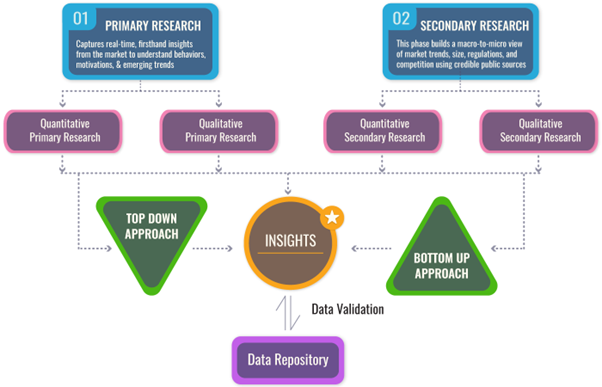
DUAL MODELING: TOP-DOWN + BOTTOM-UP
To ensure robust market estimation, we apply two complementary sizing approaches:
Top-Down Modeling:- Start with broader industry value (e.g., global or regional TAM)
- Apply filters by segment, geography, end-user, or use case
- Adjust with primary insights and validation benchmarks
- Ideal for investor-grade market scans and opportunity mapping
- Aggregate from the ground up using sales volumes, pricing, and unit economics
- Use internal modeling templates aligned with stakeholder data
- Incorporate distributor-level or region-specific inputs
- Most accurate for emerging segments and granular sub-markets
DATA VALIDATION: IN-HOUSE REPOSITORY
We close the loop with proprietary data intelligence built from ongoing projects, industry monitoring, and historical benchmarking. This repository includes:
- Multi-sector market and pricing models
- Key trendlines from past interviews and forecasts
- Benchmarked adoption rates, churn patterns, and ROI indicators
- Industry-specific deviation flags and cross-check logic
- Catches inconsistencies early
- Aligns projections across studies
- Enables consistent, high-trust deliverables