

Germany Peptide Cancer Vaccine Market Size and Forecast (2026–2034), Regional Growth, Trend, Share and Industry Analysis Report Coverage: By Type (Personalized Peptide Vaccines, Multivalent Peptide Vaccines, and Others); By Application (Melanoma, Lung Cancer, Breast Cancer, Prostate Cancer, and Others); By End User (Hospitals, Cancer Research Institutes, Specialty Clinics, and Others)
2026-11-13
Healthcare
Swetal (Research Analyst)
Description
Germany Peptide Cancer Vaccine Market Overview
The Germany peptide cancer vaccine market is projected to expand from USD 0.39 billion in 2026 to USD 2.06 billion by 2034, registering a CAGR of 24.3% during 2026–2034. The Germany peptide cancer vaccine market is a nascent market, driven by Germany's well-developed cancer research community, genomics testing, and oncology infrastructure. The main focus of the market is on personalized neoantigen peptide vaccines, where tumor sequencing and algorithms are used for the identification of specific targets, along with an increasing interest in off-the-shelf peptide cancer vaccines aimed at shared tumor antigens. Among the companies that demonstrate the most active involvement in the market are CECAVA GmbH and IMMUNEO Therapeutics GmbH. Some of the players in this space include Scancell, IO Biotech, and ISA Pharmaceuticals. Since most of the products are still in clinical development, the market is currently driven more by R&D activities, clinical trials, and partnerships.

Germany Peptide Cancer Vaccine Market Growth Drivers
Growing adoption of precision oncology and tumor-specific neoantigen targeting
With the increasing use of precision oncology, genomic profiling, and molecular diagnostics in Germany, there is now an ideal setting for the development of peptide cancer vaccines that specifically target patient-specific tumor neoantigens. With advances in next-generation sequencing, it is now possible to detect mutations and abnormal proteins in a particular tumor that can then be used in developing synthetic peptides that induce immune responses against the tumor cells. German developers like Cecava and IMMUNEO Therapeutics are utilizing sequencing technology and bioinformatics to develop patient-specific peptide immunotherapy products. With the increasing trend towards targeting biomarker-defined patient populations in oncology therapy, there will be increased need for therapies that can be matched to the molecular profile of a tumor. The presence of specialized cancer centers and molecular testing facilities makes it easy to identify patients and recruit them in clinical trials, thereby positioning Germany as an important development market for peptide cancer vaccines.
High unmet need in difficult-to-treat cancers is supporting clinical development
The ongoing demand in Germany for improved treatments of aggressive and hard-to-treat cancers, such as glioblastoma, pancreatic cancer, and specific solid tumors, is driving research efforts in peptide cancer vaccines. These types of cancer may be characterized by high recurrence rates and a lack of treatment options; hence the need for therapies that can induce a specific and sustained immune reaction against tumor-specific or tumor-associated antigens. Peptide vaccines can help to enhance the effects of surgery, chemotherapy, radiotherapy, and immune checkpoint inhibitors by focusing the T-cell response on the selected cancer antigens. German companies like Ceceva and IMMUNEO Therapeutics are developing personalized and off-the-shelf peptide approaches, and Germany's oncology centers are a well-established setting for clinical trials.
Germany Peptide Cancer Vaccine Market Restraint
Individualized manufacturing complexity and high treatment costs can limit scalability
The individualization required for a majority of the peptide-based cancer vaccines poses a major challenge in terms of scalability in Germany due to the complexity involved. The process involves a range of procedures, including, but not limited to, sampling and sequencing of tumors, identification of neoantigens, and selecting and manufacturing individual peptides. These are procedures that do not involve the same standardization in batch manufacturing as in the making of vaccines. Individual or small-batch manufacture presents itself because each patient will require a unique treatment. Because Germany requires the integration of such therapies with the oncological practice and reimbursement systems, increased costs both in terms of manufacture and treatment present themselves. This will limit their availability to specialized cancer care facilities and identified patients. This situation will encourage the development of more easily manufacturable vaccine candidates in the form of shared antigens and off-the-shelf vaccines.
Germany Peptide Cancer Vaccine Market Opportunities
Integration of Personalized Peptide Vaccines into Germany’s Precision-Oncology Ecosystem
The development of a robust market for personalized peptide vaccines represents a major market opportunity for the German Peptide Cancer Vaccine Market. The presence of advanced facilities such as precision oncology centers, molecular diagnosis, tumor sequencing, and multidisciplinary services is a prerequisite for the identification of patients with actionable neoantigens. Personalized peptide vaccines can be used in conjunction with the current treatment regimen that includes surgery, chemotherapy, radiotherapy, and immune-checkpoint inhibitors, where the selection of personalized vaccines will be based on the tumor mutation and immune profile of individual patients. The growing number of genomic profiling tests is likely to help in the process of patient stratification and recruitment for clinical trials of personalized vaccines. The development of precision medicine in oncology is expected to result in collaboration between the stakeholders, namely the vaccine developers, cancer centers, tumor sequencing companies, and clinical research networks, to develop a workflow for personalized treatment, involving tumor sampling, neoantigen prediction, peptide synthesis, and therapy administration.
Combination of Peptide Vaccines with Immune Checkpoint Inhibitors
An important growth area for the German Peptide Cancer Vaccine Market includes the combinations of peptide vaccines with immune checkpoint inhibitors (ICIs) for boosting and maintaining anti-tumor immune responses. Peptide vaccines aim to activate T cells for target tumor-associated or tumor-specific antigens, whereas checkpoint inhibitors such as PD-1/PD-L1 or CTLA-4 drugs will help ensure that the activated T cells do not get deactivated in the tumor microenvironment. This combination method holds promise in cancers wherein checkpoint inhibitors alone have shown limited responses or short-lived responses. Germany’s oncology ecosystem, with access to immunotherapies and clinical trial abilities, presents an ideal setting for testing out combinations in difficult-to-treat solid tumors. Vaccine makers will find opportunities to collaborate with pharmaceutical firms developing checkpoint inhibitors to speed up clinical development, widen indications, and differentiate their therapy approaches in the country.
Germany Peptide Cancer Vaccine Market Scope
Germany Peptide Cancer Vaccine Market Report Segmentation Analysis
The Personalized Peptide Vaccines Segment Is Expected to Dominate the Germany Peptide Cancer Vaccine Market During the Forecast Period
The increasing importance of precision oncology, tumor genomic profiling, and personalized cancer treatments in Germany. Personalized peptide vaccines can be developed based on the mutations found in a particular patient’s tumor, allowing the selection of personalized neoantigens that could potentially trigger a more specific T cell response. The high-level cancer center network, molecular diagnostics capabilities, and clinical research infrastructure in Germany make it a good environment for the development and testing of such products. Moreover, rising interest in biomarker-based and combination therapy with immune checkpoint inhibitors is fueling the development of personalized cancer vaccines. While manufacturing challenges, long lead times, and high costs of treatment are still important barriers, ongoing progress in sequencing, bioinformatics, neoantigen identification, and peptide manufacturing should make personalized approaches increasingly feasible. Therefore, personalized peptide vaccines are expected to become more prominent in clinical development and future market uptake in Germany compared to standardized or off-the-shelf peptide vaccines.

Melanoma Segment Is Expected to Dominate the German Peptide Cancer Vaccine Market During the Forecast Period
The melanoma segment is projected to lead the German peptide cancer vaccine market over the forecast period, due to the high immunogenicity of melanoma and the proven effectiveness of immune-based treatments for the disease. Many melanomas are characterized by large numbers of genetic mutations that may lead to the development of neoantigens, which makes the disease an ideal candidate for developing a personalized peptide vaccine. With the availability of genomic sequencing and molecular diagnostics in Germany, it is possible for scientists and healthcare professionals to identify mutations specific to patients and to choose peptides for a vaccine. Furthermore, it is possible to use peptide vaccines together with immune checkpoint inhibitors to boost T-cell activation and to counteract the suppression of the immune response caused by the tumor. There are specialized cancer treatment facilities in Germany that conduct clinical trials on new approaches in melanoma treatment. As a result, it is expected that future research will ensure the continued prevalence of melanoma in the field of development of peptide cancer vaccines.
Hospitals Segment Is Expected to Dominate the Germany Peptide Cancer Vaccine Market During the Forecast Period
The hospitals segment will lead in the Germany peptide cancer vaccine market in the coming years due to the presence of dedicated infrastructure for diagnosis, development, administration, and monitoring of peptide cancer vaccines. The hospitals, especially the comprehensive cancer centers as well as the university-associated hospitals for oncology, offer facilities such as tumor biopsy, genomic sequencing, molecular diagnosis, and a multidisciplinary team of oncologists, as well as immunotherapy facilities that are necessary for personalized treatment using peptide vaccines. These facilities have the capacity to handle the individualized nature of the workflow that entails patient identification, neoantigen identification, and production of the vaccine, as well as immune response monitoring. Moreover, the hospitals are key locations for clinical trials related to peptide vaccines in terms of both monotherapy and combination with immune checkpoint inhibitors or other cancer therapies. With peptide cancer vaccines moving from clinical research to clinical adoption, oncology-related expertise and associated diagnostic facilities available in German hospitals are expected to be the key end-users for these vaccines.
The following segments are part of an in-depth analysis of the Germany Peptide Cancer Vaccine Market:
Germany Peptide Cancer Vaccine Market Competition Landscape Analysis
The market in Germany for the Peptide Cancer Vaccine Market is still evolving as a clinically oriented competitive space, with competition being based largely on platforms for personalized neoantigen vaccines, shared-antigen peptide vaccines, clinical-stage pipelines, and the ability to combine vaccines with existing immuno-oncology products. The domestic players, such as CECAVA GmbH and IMMUNEO Therapeutics GmbH, have special relevance to the market given their specialization in personalized peptide-based cancer immunotherapy solutions, while international companies, such as Scancell Holdings plc, ISA Pharmaceuticals B.V., IO Biotech, Inc., and Elicio Therapeutics, Inc., are contributing to the European and international competitive environment. Currently, competition is more likely to be shaped by factors such as clinical development, target selection, personalization, manufacturing scalability, combination strategies, and strategic partnerships rather than commercial sales since most peptide cancer vaccine candidates are still undergoing clinical trials. Scalability issues of personalized vaccines are being overcome by companies through developing shared-antigen vaccines and off-the-shelf solutions, as well as by implementing combination strategies that involve immune checkpoint inhibitors. With increasing maturity of clinical data, competition within Germany is likely to become based largely on efficacy, patient selection, manufacturing times, and treatment economics, among other factors.
Germany Peptide Cancer Vaccine Market Recent Developments News:
In August 2025, IMMUNEO Therapeutics GmbH secured a ProFIT Brandenburg innovation grant to advance its BITAP (BioInformatic Therapy Address Peptides) project, an AI-driven platform for developing personalized and group-specific peptide cancer immunotherapies. The project combines machine learning, tumor genomics, and peptide design to identify tumor-specific neoantigens and develop individualized BITAP immunizations as well as standardized Pan-BITAP vaccines, initially targeting cancers such as pancreatic cancer. The funding is supporting expanded R&D activities, new scientific positions, and laboratory infrastructure in Brandenburg, strengthening Germany’s capabilities in AI-enabled personalized peptide cancer vaccine development.
In August 2026, BioNTech SE agreed to divest JPT Peptide Technologies GmbH to a fund advised by DUBAG Group as part of its planned global manufacturing footprint consolidation. The transaction, expected to close in 2026 subject to closing conditions, will allow JPT to continue operating as an independent company focused on custom peptide synthesis and peptide-based research and development solutions. JPT plans to continue investing in its peptide technology platform and expanding its activities across Europe and North America, marking a significant ownership change within Germany’s peptide technology ecosystem.
The Germany Peptide Cancer Vaccine Market is dominated by a few large companies, such as
cecava GmbH
IMMUNEO Therapeutics GmbH
Immatics N.V.
BioNTech SE
Scancell Holdings plc
ISA Pharmaceuticals B.V.
IO Biotech, Inc.
Elicio Therapeutics, Inc.
Ultimovacs ASA
Imugene Limited
Nouscom S.p.A.
Nous-2 / Nouscom platform
Genentech / Roche
Merck & Co.
Moderna, Inc.
Other Prominent Players
Frequently Asked Questions
Swetal (Research Analyst)
Germany Peptide Cancer Vaccine Market Introduction and Market Overview
Objectives of the Study
Market Segmentation
Type of the Germany Peptide Cancer Vaccine Market
Application of the Germany Peptide Cancer Vaccine Market
End User of Germany Peptide Cancer Vaccine Market
Competition Coverage List of Market Participants
Market Definition: Peptide Cancer Vaccine Market
Executive Summary
Germany Peptide Cancer Vaccine Market Estimation & Forecast
Germany Peptide Cancer Vaccine Market Size (US$ Million) Estimates & Historical Trend Analysis (2021 - 2025)
Germany Peptide Cancer Vaccine Overall Market Size (US$ Million), Growth Rate (Y-o-Y), Market CAGR (%), Market Forecast (2026 - 2034)
Snapshot of Germany Peptide Cancer Vaccine Market
Germany Peptide Cancer Vaccine Market Revenue Share (%) 2025
Key Competitors & Key Insights
Market Overview (Qualitative Analysis)
Demand Side Trends
Supply Side Trends / Manufacturing Trends
Demand and Opportunity Assessment, 2026 - 2034
Market Dynamics
Drivers
Limitations
Opportunities
Impact Analysis of Drivers and Restraints
Key Developments
Regulatory Landscape
Pricing Analysis
Supply Chain Analysis
Porter’s Five Forces Analysis
Bargaining Power of Suppliers
Bargaining Power of Buyers
Threat of Substitutes
Threat of New Entrants
Competitive Rivalry
PEST Analysis
Political Factors
Economic Factors
Social Factors
Technology Factors
Germany Peptide Cancer Vaccine Market Estimates & Forecast Trend Analysis, by Type
Germany Peptide Cancer Vaccine Market Assessments & Key Findings, by Type
Germany Peptide Cancer Vaccine Market Revenue (US$ Million) Estimates and Forecasts, by Type, 2021 - 2034
Personalized Peptide Vaccines
Multivalent Peptide Vaccines
Others
Germany Peptide Cancer Vaccine Market Estimates & Forecast Trend Analysis, by Application
Germany Peptide Cancer Vaccine Market Assessments & Key Findings, by Application
Germany Peptide Cancer Vaccine Market Revenue (US$ Million) Estimates and Forecasts, by Application, 2021 - 2034
Melanoma
Lung Cancer
Breast Cancer
Prostate Cancer
Others
Germany Peptide Cancer Vaccine Market Estimates & Forecast Trend Analysis, by End User
Germany Peptide Cancer Vaccine Market Assessments & Key Findings, by End User
Germany Peptide Cancer Vaccine Market Revenue (US$ Million) Estimates and Forecasts, by End User, 2021 - 2034
Hospitals
Cancer Research Institutes
Specialty Clinics
Others
Competition Landscape
Germany Peptide Cancer Vaccine Market Product Mapping
Germany Peptide Cancer Vaccine Market Concentration Analysis, by Leading Players / Innovators / Emerging Players / New Entrants
Germany Peptide Cancer Vaccine Market Tier Structure Analysis
Germany Peptide Cancer Vaccine Market Concentration & Company Market Shares (%) Analysis, 2025
Company Profiles
cecava GmbH
Company Overview & Key Stats
Financial Performance & KPIs
Product Portfolio
SWOT Analysis
Business Strategy & Recent Developments
* Similar details would be provided for all the players mentioned below
IMMUNEO Therapeutics GmbH
Immatics N.V.
BioNTech SE
Scancell Holdings plc
ISA Pharmaceuticals B.V.
IO Biotech, Inc.
Elicio Therapeutics, Inc.
Ultimovacs ASA
Imugene Limited
Nouscom S.p.A.
Nous-2 / Nouscom platform
Genentech / Roche
Merck & Co.
Moderna, Inc.
Other Prominent Players
Research Findings & Conclusion
Assumption & Acronyms Used
Research Methodology
External Transportations / Databases
Internal Proprietary Database
Primary Research
Secondary Research
Assumptions
Limitations
Report FAQs
Our Research Methodology
"Insight without rigor is just noise."
We follow a comprehensive, multi-phase research framework designed to deliver accurate, strategic, and decision-ready intelligence. Our process integrates primary and secondary research , both quantitative and qualitative , along with dual modeling techniques ( top-down and bottom-up) and a final layer of validation through our proprietary in-house repository.
PRIMARY RESEARCH
Primary research captures real-time, firsthand insights from the market to understand behaviors, motivations, and emerging trends.
1. Quantitative Primary Research
Objective: Generate statistically significant data directly from market participants.
Approaches:- Structured surveys with customers, distributors, and field agents
- Mobile-based data collection for point-of-sale audits and usage behavior
- Phone-based interviews (CATI) for market sizing and product feedback
- Online polling around industry events and digital campaigns
- Purchase frequency by customer type
- Channel performance across geographies
- Feature demand by application or demographic
2. Qualitative Primary Research
Objective: Explore decision-making drivers, pain points, and market readiness.
Approaches:- In-depth interviews (IDIs) with executives, product managers, and key decision-makers
- Focus groups among end users and early adopters
- Site visits and observational research for consumer products
- Informal field-level discussions for regional and cultural nuances
SECONDARY RESEARCH
This phase helps establish a macro-to-micro understanding of market trends, size, regulation, and competitive dynamics, sourced from credible and public domain information.
1. Quantitative Secondary Research
Objective: Model market value and segment-level forecasts based on published data.
Sources include:- Financial reports and investor summaries
- Government trade data, customs records, and regulatory statistics
- Industry association publications and economic databases
- Channel performance and pricing data from marketplace listings
- Revenue splits, pricing trends, and CAGR estimates
- Supply-side capacity and volume tracking
- Investment analysis and funding benchmarks
2. Qualitative Secondary Research
Objective: Capture strategic direction, innovation signals, and behavioral trends.
Sources include:- Company announcements, roadmaps, and product pipelines
- Publicly available whitepapers, conference abstracts, and academic research
- Regulatory body publications and policy briefs
- Social and media sentiment scanning for early-stage shifts
- Strategic shifts in market positioning
- Unmet needs and white spaces
- Regulatory triggers and compliance impact
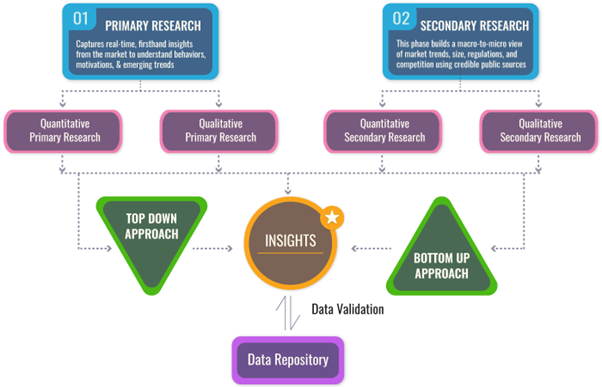
DUAL MODELING: TOP-DOWN + BOTTOM-UP
To ensure robust market estimation, we apply two complementary sizing approaches:
Top-Down Modeling:- Start with broader industry value (e.g., global or regional TAM)
- Apply filters by segment, geography, end-user, or use case
- Adjust with primary insights and validation benchmarks
- Ideal for investor-grade market scans and opportunity mapping
- Aggregate from the ground up using sales volumes, pricing, and unit economics
- Use internal modeling templates aligned with stakeholder data
- Incorporate distributor-level or region-specific inputs
- Most accurate for emerging segments and granular sub-markets
DATA VALIDATION: IN-HOUSE REPOSITORY
We close the loop with proprietary data intelligence built from ongoing projects, industry monitoring, and historical benchmarking. This repository includes:
- Multi-sector market and pricing models
- Key trendlines from past interviews and forecasts
- Benchmarked adoption rates, churn patterns, and ROI indicators
- Industry-specific deviation flags and cross-check logic
- Catches inconsistencies early
- Aligns projections across studies
- Enables consistent, high-trust deliverables