

Germany Telemedicine Market Size and Forecast (2026–2034), Regional Growth, Trend, Share and Industry Analysis Report Coverage: By Components (Product {Hardware, Software, and Others}, and Services {Tele-consulting, Tele-monitoring, Tele-education}), By Modality (Store and forward, Real-time, and Others); By Application (Teleradiology, Telepsychiatry, Telepathology, Teledermatology, Telecardiology, and Others) and By End User (Hospitals & Health Systems, Clinics & Physician Practices, Patients/Homecare, Payers, and Others)
2026-09-18
Healthcare
Swetal (Research Analyst)
Description
Germany
Telemedicine Market Overview
The Germany
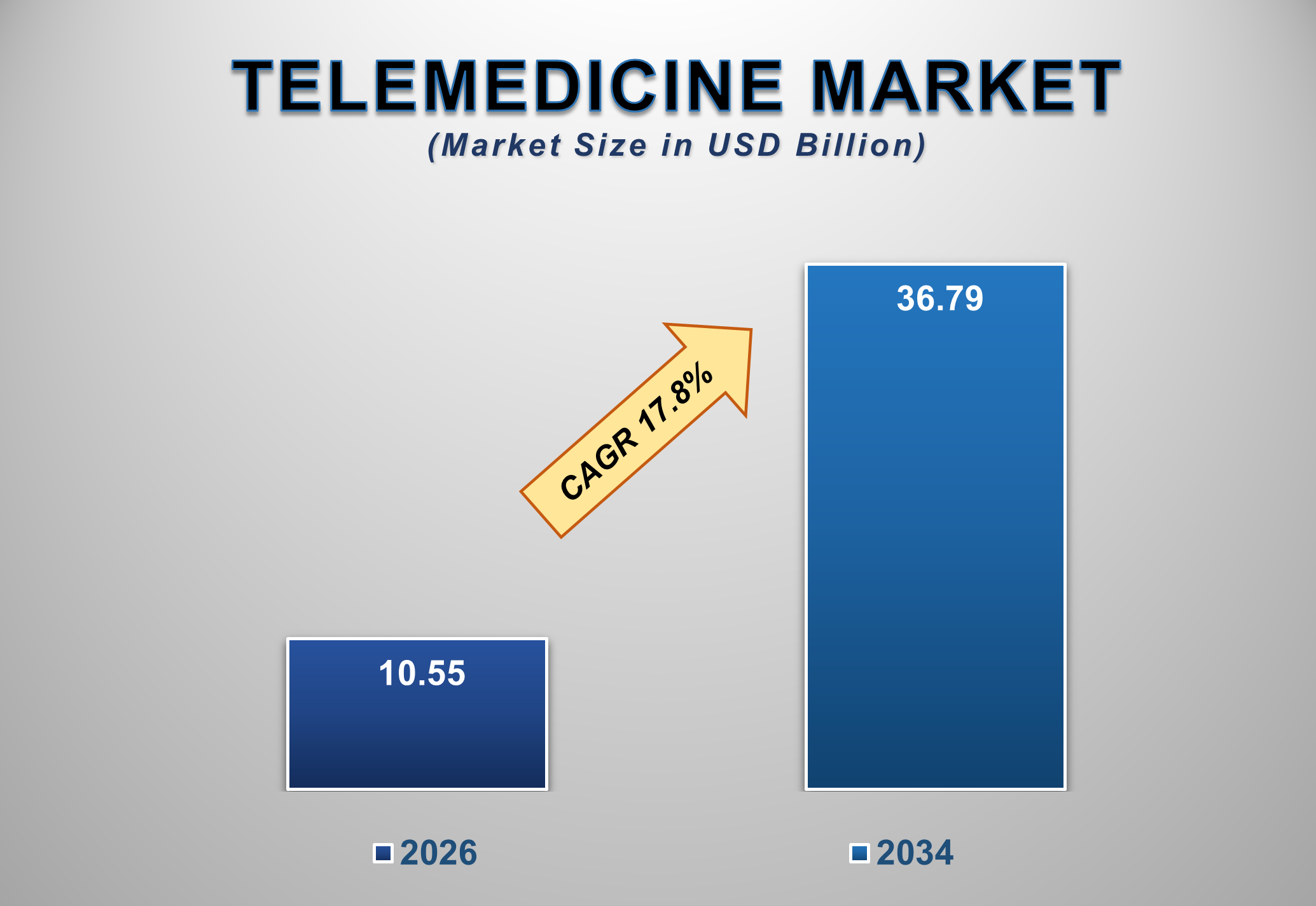
telemedicine market is projected to expand from USD 10.55 billion in 2026 to
USD 36.79 billion by 2034, registering a CAGR of 17.8% during 2026–2034.
Germany's telemedicine sector is moving away from a model based around video
consultations and more towards a digital health ecosystem that integrates
different components of remote care, remote patient monitoring, digital
therapies, connected devices, health records, and clinical workflows of
physicians. The move is facilitated by current regulatory and infrastructure
initiatives. The telematics network of Germany's telemedicine system is
connecting digital health applications with providers and patients. The
introduction of DiGA into the German healthcare system will establish
procedures for reimbursing digital healthcare solutions. The development of
remote patient monitoring becomes essential for telemedicine, especially for
treating chronic conditions like heart failure; in the case of heart failure,
telemonitoring has already been incorporated into standard reimbursed
healthcare. Finally, the digital agenda for 2026 features particular access to
machine learning and utilization of health data along the lines of the model of
digitally enabled primary care, thus allowing telemedicine services to evolve
from video consultations to continuous care. The increased focus on
interoperability, clinical integration, regulatory compliance, and other
parameters will shift the competition towards the features of telemedicine
solutions rather than the ability to provide standard telemedicine services.
Germany
Telemedicine Market Drivers and Impact Analysis
|
Key
Drivers |
Impact |
|
Rising Patient Demand for Convenient
& Flexible Healthcare Access |
Encourages
adoption of video consultations, digital appointments, asynchronous
consultations, and remote follow-ups by reducing travel and waiting-time
requirements and improving access outside conventional practice hours. |
|
Expansion of Germany’s Digital Health
& Reimbursement Framework |
The established DiGA reimbursement pathway
allows eligible digital health applications to be prescribed and reimbursed
through statutory health insurance, supporting wider adoption of digitally
delivered treatment and patient-management solutions. |
|
Increasing Adoption of Remote Patient
Monitoring & Connected Medical Devices |
Extends
telemedicine beyond episodic virtual consultations toward continuous
monitoring of parameters such as blood pressure, glucose, cardiac function,
and lung function, creating opportunities for chronic-disease management and
earlier clinical intervention. Germany's 2026 Health Device Data Transfer
specification further supports standardized transmission of data from
connected devices to DiGA platforms. |
|
Growing Integration of ePA,
E-Prescription & Telematics Infrastructure |
Strengthens the digital foundation for
telemedicine by enabling healthcare providers to access and exchange patient
information electronically, improving continuity of care and integration
between virtual and in-person services. By 2026, the ePA had become
increasingly embedded in routine care, while TI 2.0 is moving toward more
mobile and cloud-enabled infrastructure. |
|
Healthcare Workforce & Regional
Specialist-Access Gaps |
Creates
demand for remote consultations and specialist services, particularly where
patients face geographic or availability constraints. Germany's
digital-health strategy specifically identifies video consultations and
remote patient monitoring as mechanisms for improving access in underserved
and sparsely populated regions. |
|
Increasing Digitalization of Primary
& Ambulatory Care |
The planned integration of digital
appointment platforms, electronic referrals, digital initial assessment, and
ePA-based access into Germany's emerging primary-care model is expected to
embed telemedicine more deeply into routine patient journeys rather than
treating it as a standalone service. |
|
Advancement of AI, Data-Driven Care &
Interoperability |
Increasing
use of AI, standardized health-data exchange, and interoperable digital
platforms is enabling more personalized triage, clinical decision support,
patient monitoring, and preventive care. Germany's 2026 digital-health agenda
explicitly emphasizes broader and secure use of health data, AI, and
interoperability. |
Rising Patient
Demand for Convenient & Flexible Healthcare Access
The need for easy
access to healthcare services is causing a rise in the demand for telemedicine
services in Germany, as patients require health services that can be accessed
easily and without trouble. Video consultations save time spent travelling and waiting,
particularly when patients need basic consultations, follow-up appointments,
prescriptions, and treatments for chronic diseases. Such ease of use is
specifically useful for patients in rural areas and those who do not have
proper access to health services, as well as employees who are seeking medical
help in their free time. The familiarity with smartphone-enabled health
services is creating a trend of using video consultations, remote health
monitoring and sharing of medical data through video, as patients can get
better access to healthcare now.
Increasing
Digitalization of Primary & Ambulatory Care
More digitalization
of primary & ambulatory care facilitates the enhanced use of telemedicine
in Germany through the use of technology in consultation, patient management,
and care coordination. The increasing implementation of electronic patient records
(ePA), e-prescriptions, secure communication channels, and remote consultation
systems creates a digital atmosphere within primary and ambulatory care.
According to a report by Gematik GmbH in July 2026, approximately 70% of the
medical practices in Germany indicated an intensive use of ePA, as well as
increased application of digital tools such as ePA, E-Rezept, and KIM in daily
operations. The growing network of digital solutions enables remote
consultations of patients, follow-up procedures, and prescription oversight,
thus granting an opportunity for patients to avoid an in-person visit. In
addition, the transition to TI 2.0, which means more mobile solutions and
identity creation through digital formats, is expected to enhance telemedicine
delivery in Germany.
Germany Telemedicine Market Restraint
and Impact Analysis
|
Key Restraints |
Impact |
|
Reimbursement Variability & Coverage
Limitations |
Creates
uncertainty around provider economics and can limit the consistent adoption
of telemedicine services across different care settings and payer
arrangements. |
|
Regulatory & Compliance Complexity |
Increases operational and administrative
requirements related to healthcare regulations, digital health standards,
data handling, and provider compliance, potentially slowing implementation. |
|
Data Privacy, Cybersecurity & Patient
Trust Risks |
Raises
technology and compliance costs, while concerns over the security of
sensitive health information can discourage adoption among healthcare
providers and patients. |
|
Digital Divide & Uneven Digital
Infrastructure |
Restricts utilization among elderly,
digitally less experienced, and rural populations where access to reliable
connectivity, suitable devices, or digital healthcare capabilities may be
limited. |
Reimbursement
Variability & Coverage Limitations
Coverage
limitations & variability in reimbursement can inhibit the process of
development of the Germany telemedicine market because they create issues with
the financial viability of virtual healthcare for service providers.
Differences in reimbursement eligibility, billing options, and coverage
conditions of tele-consultations and other types of digitally delivered
services impede providers from forming a steady revenue model. Moreover,
services that are not uniformly reimbursed or that suggest specific eligibility
requirements and documentation processes limit providers’ willingness to offer
telemedicine services. This creates uncertainty that reduces investments in
telemedicine solutions, infrastructure, and processes, particularly in smaller
facilities, and prevents the market from greater adoption.
Regulatory &
Compliance Complexity
The complexity of
regulatory and compliance requirements may lead to limitations on the growth of
the German telemedicine market since companies and hospitals will be required
to comply with strict regulations imposed on issues of patient data protection,
digital health solutions, medical device regulations, professional guidelines,
and secure data exchange. Complying with some frameworks, like GDPR and various
requirements concerning data protection and healthcare regulations, can make it
more expensive and time-consuming to implement the services. In addition, small
healthcare practices may experience even greater difficulty in distributing
resources for compliance, cybersecurity, certification systems, and integration
with existing healthcare systems. Hence, regulatory complexity can slow down
the implementation process and increase expenses.
Germany Telemedicine Market
Opportunities and Impact Analysis
|
Key
Opportunities |
Impact |
|
AI-Enabled Telemedicine & Clinical
Decision Support |
Creates
opportunities for AI-assisted triage, clinical documentation, symptom
assessment, patient monitoring, and personalized care, while improving
healthcare-provider productivity. |
|
Integration of Telemedicine with Remote
Patient Monitoring & Virtual Diagnostics |
Enables continuous monitoring of chronic and
post-acute patients and expands telemedicine beyond virtual consultations
toward more comprehensive digital care pathways. |
|
Expansion of Hybrid Care &
Hospital-at-Home Models |
Combines
virtual consultations, remote monitoring, and selective in-person care,
creating opportunities to manage patients outside traditional healthcare
facilities and improve care accessibility. |
|
Expansion into Specialty &
Underserved Care Segments |
Creates additional demand for telemedicine
across specialties such as dermatology, psychiatry, cardiology, neurology,
oncology, and chronic disease management, particularly where specialist
availability is limited. |
AI-Enabled
Telemedicine & Clinical Decision Support
AI-based
telemedicine and clinical decision-making in Germany’s telemedicine market are
remarkable developments, as doctors are increasingly implementing artificial
intelligence to optimize virtual consultations. Some areas that AI can
revolutionize in telemedicine are symptom evaluation, patient categorization,
clinical documentation, decision-making, prioritization of appointments, and
custom diagnostic and treatment recommendations. AI implementation helps
doctors deal with bigger patient loads more effectively. At the same time, the
incorporation of AI into telemedicine solutions can help examine data submitted
by patients and enable early identification of possible health issues during
chronic disease treatment and control. Due to the infrastructure development
happening in Germany and ongoing AI implementations, the incorporation of
artificial intelligence into telemedicine and telehealth would allow the
establishment of new services.
Integration of
Telemedicine with Remote Patient Monitoring & Virtual Diagnostics
The integration of
telemedicine with remote patient monitoring and virtual diagnostics offers a
big chance for the German telemedicine market since it allows healthcare
providers to provide their services through digital channels rather than only
video consultations. By linking connected devices, wearable devices, diagnostic
tools for home use, and remote monitoring, doctors can measure metrics like
blood pressure, blood sugar levels, heart rate, and other indicators of health
conditions. This enables the identification of health deterioration earlier and
the management of chronic diseases more proactively while decreasing the need
to visit hospitals or offices regularly. The information that the
infrastructure of digital healthcare in Germany is improving suggests that the
combination of telemedicine, remote patient monitoring, and virtual diagnostics
will help to provide more comprehensive longitudinal treatment.
Germany Telemedicine Market Scope
|
Report Attributes |
Description |
|
Market Size in 2026 |
USD
10.55 Billion |
|
Market Forecast in 2034 |
USD 36.79 Billion |
|
CAGR % 2026-2034 |
17.8% |
|
Market Concentration |
Moderately Concentrated |
|
Base Year |
2025 |
|
Historic Data |
2021-2025 |
|
Forecast Period |
2026-2034 |
|
Report USP |
Production, Consumption, company share,
company heatmap, company production capacity, growth factors, and more |
|
Geography |
Germany |
|
Segments Covered |
●
By
Component ●
By
Modality ●
By
Application ●
By End
User |
|
Key Demand Side Trends |
●
Growing
Demand for Convenient & Accessible Virtual Care ●
Rising
Adoption of Digital & Connected Healthcare |
|
Key Supply Side Trends |
●
Expansion of
Integrated Telemedicine Platforms & Digital Care Ecosystems ●
Increasing
AI & Remote Monitoring Integration |
|
Major Players |
●
CompuGroup
Medical SE & Co. KGaA ●
Ada Health
GmbH ●
Siemens
Healthineers AG ●
BIOTRONIK SE
& Co. KG ●
Drägerwerk
AG & Co. KGaA ●
Löwenstein
Medical Technology GmbH & Co. KG ●
Dermanostic
GmbH |
Germany Telemedicine Market Report
Segmentation Analysis
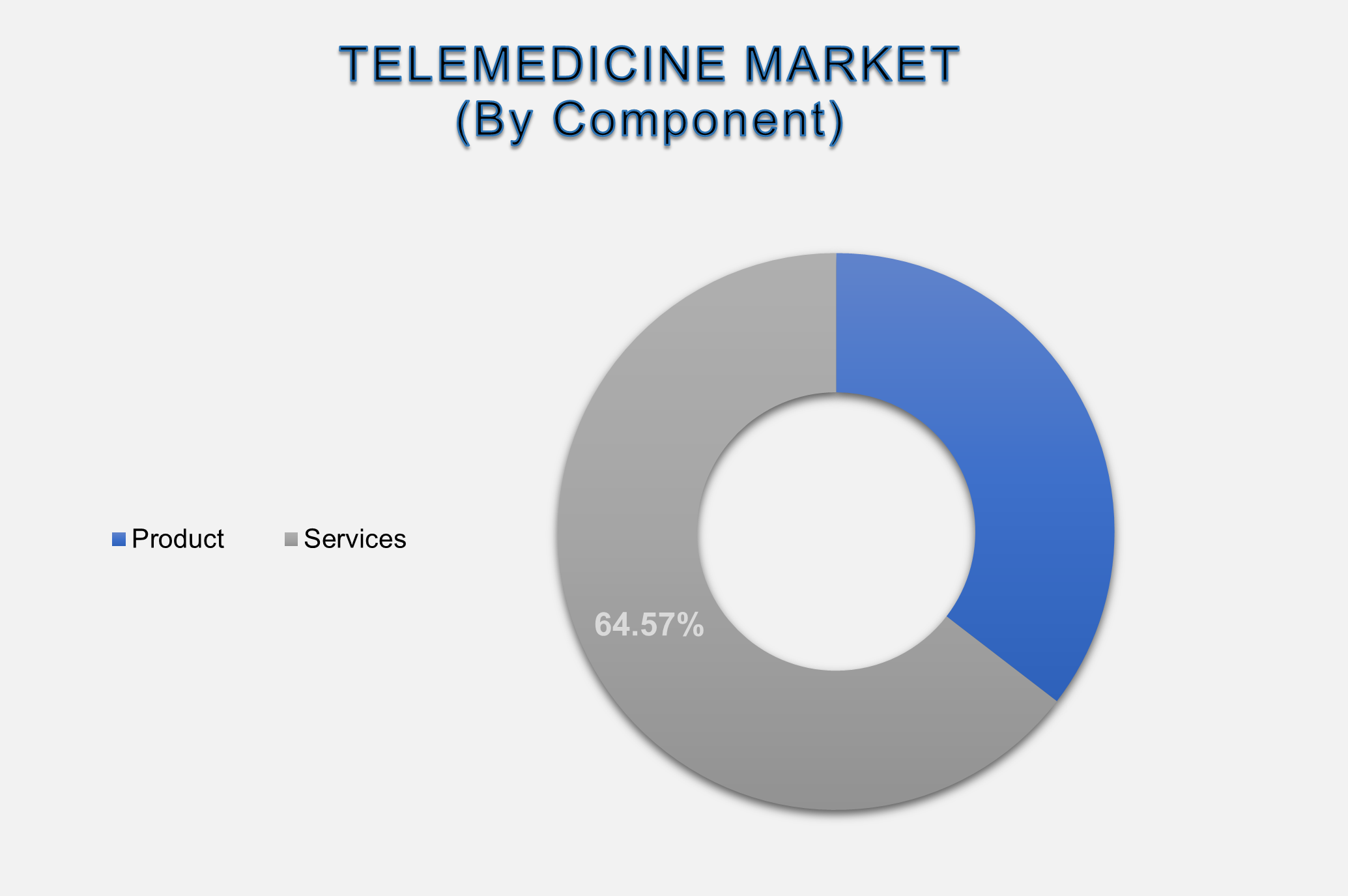
The Services
Segment Is Expected to Dominate the Germany Telemedicine Market During the
Forecast Period
The service sector is predicted to hold the main position in the Germany Telemedicine Industry during the forecast period, with the increased integration of virtual consultations, teleconsultations, remote monitoring, digital diagnostics, etc., moving towards routine medical practices. Germany has gradually built its regulations and reimbursement system for telemedicine, in which video consultations are reimbursable and increasingly permitted under the Digital-Gesetz (DigiG). In 2026, certified video service providers will continue to provide reimbursable virtual consultations, while doctors will be able to prescribe selected medications, DiGA, referrals, and other services via video consultations if this is clinically appropriate. In addition, assisted telemedicine via pharmacies from July 2026 will introduce more points of access for digital healthcare. The same role of regulations extends to the advertisement of telemedicine services; we see this with the March 2026 ruling of the BGH regarding the advertising of cannabis treatment. Taking all of this into consideration, expanding reimbursement processes, more clinical possibilities of telemedicine, digital infrastructure development, and increasing integration of telemedicine into primary and specialist care will result in solid demand for segments in the field of services becoming the leading segment in the forecast period.
The Store and
Forward Segment Is Expected to Grow in Germany Telemedicine Market
The
store-and-forward segment will experience growth in the Germany Telemedicine
Market due to the increase in popularity of asynchronous digital healthcare
models in which either patients or healthcare specialists can submit their
medical backgrounds, images, diagnostic reports, and other clinical information
safely for future interpretation. Because, unlike real-time consultations, this
approach provides patients and medical experts with more options by removing
the need for the two parties to be available simultaneously, it owes its
effectiveness to the sphere of teledermatology, tele-radiology, second
opinions, and consultations. The approach allows specialists to analyze cases
based on structured clinical data and diagnostic materials, enabling patients
to access expertise without the requirement of visiting health institutions. As
medical professionals keep integrating telecommunication, e-records, picture
sharing, and off-site diagnostics in their daily practice, the significance of
store-and-forward services in the development of telemedicine in Germany will
only grow.
The
Teleradiology Segment Is Expected to Witness Steady Growth in Germany
Telemedicine Market
The Germany telemedicine market is likely to grow steadily in the
teleradiology segment due to the increasing requirement for diagnostic imaging
services, specialist radiology expertise, and flexible interpretation of
medical images. Because radiological images and associated clinical data can be
transmitted digitally, radiologists can review tests remotely. Additionally,
Germany's fragmented radiology sector is therefore favorable for the
establishment of centralized and remote reporting systems that aim to connect
the imaging practice with specialist radiologists, which results in an increase
in the use of available expertise. According to S&P Global Ratings, the
radiology market in Germany is characterized by favorable underlying trends,
such as the shift towards outpatient practice, changes in the mix of
modalities, and increasing frequency of tests. The mentioned factors lead to an
enabling condition for teleradiology service providers, given that the level of
workload within the healthcare sector is increasing significantly, as hospitals
could apply a remote reporting option to manage their problem with specialists'
availability. The appearance of companies that offer both on-site and
teleradiology services proves that remote reporting technology is being
introduced into traditional diagnostic imaging models. Therefore, it can be
expected that continued digitization of the workflow in radiology, the lack of
specialists, an increase in the amount of imaging required, and the need for
effective utilization of radiologists will provide room for further development
of the teleradiology sector in Germany.
The Hospital and
Health System Segment Is Expected to Grow in Germany Telemedicine Market
As hospitals move
towards the adoption of digital technologies to support their clinical
processes, the Hospitals and Health Systems sector is projected to thrive in
the German telemedicine market. Hospitals are steadily shifting into digital
hospital paradigms that offer both virtual and face-to-face services where
physicians can access health information more easily. This development is also
happening due to an increasing use of electronic patient files, telemedicine
platforms, and digital health services. Germany's digitalization strategy is
focused on digital health processes and integrated use of digital and
traditional healthcare techniques, thus making the environment very conducive
for hospitals and healthcare systems to enhance their telemedicine capabilities.
Moreover, improved interoperability and data exchange between hospitals,
physicians, and other healthcare providers will contribute to better
cooperation among health specialists as well as easier provision of follow-up
care and patient management in various healthcare facilities. As hospitals keep
upgrading their IT infrastructure and introducing telemedicine into their more
extensive care processes, the sector is likely to become one of the growing
sources of demand for telemedicine services and technologies in Germany.
The following
segments are part of an in-depth analysis of the Germany telemedicine market:
|
Market Segments |
|
|
By
Components |
●
Product o
Hardware o
Software o
Others ●
Services o
Tele-consulting o
Tele-monitoring o
Tele-education |
|
By
Modality |
●
Store and forward ●
Real-time ●
Others |
|
By
Application |
●
Teleradiology ●
Telepsychiatry ●
Telepathology ●
Teledermatology ●
Telecardiology ●
Others |
|
By End
User |
●
Hospitals
& Health Systems ●
Clinics
& Physician Practices ●
Patients/Homecare ●
Payers ●
Others |
Germany Telemedicine Market Competition
Landscape Analysis
The outline of the
market for telemedicine in Germany is characterized as moderately fragmented
and increasingly competitive. The landscape consists of established technology
firms in the healthcare industry, telemedicine service providers, digital health
specialist companies, manufacturers of medical devices, and emerging healthcare
providers based on AI technologies. The degree of competition extends beyond
traditional video consultation. Companies participate in the field of remote
monitoring of patients, teleradiology, digital therapeutics, AI-enabled
clinical system service provision, virtual diagnostics, and integrated
platforms of digital services. Large companies like CompuGroup Medical, Siemens
Healthineers, and Doctolib benefit from established relationships in the
healthcare industry, technological infrastructure, and a wide range of offered
services. Companies with specialized service provision like Ada Health,
Dermanostic, Zava, Selfapy, and TeleClinic have an advantage through the use of
special skills, technologies, and knowledge. Increasing use of digital
healthcare in Germany leads to creating barriers for new entrants. Overall, the
competition on the market will remain strong as the firms expand their
operations by launching new services.
Germany Telemedicine Market Recent
Developments News:
●
In June 2026,
the International Conference on Digital Health, Telemedicine & Smart
Healthcare (ICDHTS 2026) was held in Berlin, bringing together healthcare
professionals, researchers, technology innovators, and policymakers to discuss
developments in telemedicine, remote patient monitoring, AI-driven healthcare,
digital therapeutics, wearable devices, smart hospitals, and healthcare data
interoperability.
●
In March 2026,
the Hasso Plattner Institute’s Digital Health Innovation Forum highlighted the
growing importance of AI, health-data utilization, digital therapeutics, and
secure digital infrastructure in Germany’s healthcare system, with discussions
emphasizing the need to accelerate the responsible implementation of digital
technologies into real-world care.
●
In 2026,
Germany’s telehealth reimbursement environment continued to evolve toward
broader integration of telemedicine, telemonitoring, digital therapeutics, and
digitally supported chronic-care models, while reimbursement increasingly
depends on clinical evidence, economic value, and data-protection compliance.
●
In 2026,
Germany’s telemedicine ecosystem continued to expand alongside the development
of electronic patient records, e-prescriptions, digital health applications,
and interconnected healthcare infrastructure, creating opportunities for
telemedicine providers to deliver a broader range of digitally enabled
services.
The Germany
Telemedicine Market is dominated by a few large companies, such as
●
Siemens
Healthineers AG
●
Drägerwerk AG
& Co. KGaA
●
BIOTRONIK SE
& Co. KG
●
Löwenstein
Medical Technology GmbH & Co. KG
●
Beurer GmbH
●
GETEMED
Medizin- und Informationstechnik AG
●
seca GmbH
& Co. KG
●
GS
Elektromedizinische Geräte G. Stemple GmbH
●
Fritz Stephan
GmbH
●
CompuGroup
Medical SE & Co. KGaA
●
Ada Health
GmbH
●
Wellster Healthtech Group GmbH
●
ProCarement
GmbH
●
GET.ON
Institut für Online Gesundheitstrainings GmbH
●
eCovery GmbH
●
Elona Health
GmbH
●
Selfapy GmbH
●
Sympatient
GmbH
●
CANKADO
Service GmbH
●
Dermanostic
GmbH
● Other Prominent Players
Frequently Asked Questions
Swetal (Research Analyst)
Swetal is a Research Analyst with 4+ years of experience specializing in healthcare market research, medical devices, healthcare IT, and medical technology industry analysis. Her expertise includes competitive intelligence, secondary research, market trend forecasting, and healthcare business insights across global healthcare ecosystems.
She contributes to advanced market research reports by analyzing regulatory frameworks, emerging healthcare technologies, competitive landscapes, and innovation trends shaping the medical industry. With a strong focus on accurate market intelligence, strategic insights, and healthcare industry trends, Swetal supports businesses in making informed, data-backed decisions in a rapidly transforming healthcare environment.
1.
Germany
Telemedicine Market Introduction and Market Overview
1.1. Objectives of the Study
1.2. Market Segmentation
1.2.1.Components of the Germany
Telemedicine Market
1.2.2.Modality of the Germany
Telemedicine Market
1.2.3.Application of Germany
Telemedicine Market
1.2.4.End User of Germany Telemedicine
Market
1.3. Competition Coverage List of
Market Participants
1.4. Market Definition: Telemedicine Market
2.
Executive Summary
2.1. Germany Telemedicine Market
Estimation & Forecast
2.1.1.Germany Telemedicine Market Size
(US$ Million) Estimates & Historical Trend Analysis (2021 - 2025)
2.1.2.Germany Telemedicine Overall
Market Size (US$ Million), Growth Rate (Y-o-Y), Market CAGR (%), Market
forecast (2026 - 2034)
2.2. Snapshot of Germany Telemedicine
Market
2.3. Germany Telemedicine Market
Revenue Share (%) 2025
2.4. Key Competitors & Key
Insights
3.
Market Overview (Qualitative
Analysis)
3.1. Demand Side Trends
3.2. Supply Side Trends /
Manufacturing Trends
3.3. Demand and Opportunity
Assessment, 2026 - 2034
3.4. Market Dynamics
3.4.1.Drivers
3.4.2.Limitations
3.4.3.Opportunities
3.4.4.Impact Analysis of Drivers and
Restraints
3.5. Key Developments
3.6. Regulatory Landscape
3.7. Pricing Analysis
3.8. Supply Chain Analysis
3.9. Porter’s Five Forces Analysis
3.9.1.Bargaining Power of Suppliers
3.9.2.Bargaining Power of Buyers
3.9.3.Threat of Substitutes
3.9.4.Threat of New Entrants
3.9.5.Competitive Rivalry
3.10. PEST Analysis
3.10.1. Political Factors
3.10.2. Economic Factors
3.10.3. Social Factors
3.10.4. Technology Factors
4.
Germany Telemedicine Market
Estimates & Forecast Trend Analysis, by Components
4.1. Germany Telemedicine Market
Assessments & Key Findings, by Components
4.2. Germany Telemedicine Market
Revenue (US$ Million) Estimates and Forecasts, by Components, 2021 - 2034
4.2.1. Product
4.2.1.1.
Hardware
4.2.1.2.
Software
4.2.1.3.
Others
4.2.2. Services
4.2.2.1.
Tele-consulting
4.2.2.2.
Tele-monitoring
4.2.2.3.
Tele-education
5.
Germany Telemedicine Market
Estimates & Forecast Trend Analysis, by Modality
5.1. Germany Telemedicine Market
Assessments & Key Findings, by Modality
5.2. Germany Telemedicine Market
Revenue (US$ Million) Estimates and Forecasts, by Modality, 2021 - 2034
5.2.1.Store and forward
5.2.2.Real-time
5.2.3.Others
6.
Germany Telemedicine Market
Estimates & Forecast Trend Analysis, by Application
6.1. Germany Telemedicine Market
Assessments & Key Findings, by Application
6.2. Germany Telemedicine Market
Revenue (US$ Million) Estimates and Forecasts, by Application, 2021 - 2034
6.2.1.Teleradiology
6.2.2.Telepsychiatry
6.2.3.Telepathology
6.2.4.Teledermatology
6.2.5.Telecardiology
6.2.6.Others
7.
Germany Telemedicine Market
Estimates & Forecast Trend Analysis, by End User
7.1. Germany Telemedicine Market
Assessments & Key Findings, by End User
7.2. Germany Telemedicine Market
Revenue (US$ Million) Estimates and Forecasts, by End User, 2021 - 2034
7.2.1.Hospitals & Health Systems
7.2.2.Clinics & Physician
Practices
7.2.3.Patients/Homecare
7.2.4.Payers
7.2.5.Others
8. Competition Landscape
8.1. Germany Telemedicine Market Product
Mapping
8.2. Germany Telemedicine Market
Concentration Analysis, by Leading Players / Innovators / Emerging Players /
New Entrants
8.3. Germany Telemedicine Market Tier
Structure Analysis
8.4. Germany Telemedicine Market
Concentration & Company Market Shares (%) Analysis, 2025
9. Company Profiles
9.1. Siemens Healthineers AG
9.1.1.Company Overview & Key Stats
9.1.2.Financial Performance & KPIs
9.1.3.Product Portfolio
9.1.4.SWOT Analysis
9.1.5.Business Strategy & Recent
Developments
* Similar details would be provided
for all the players mentioned below
9.2.
Drägerwerk AG & Co. KGaA
9.3.
BIOTRONIK SE & Co. KG
9.4.
Löwenstein Medical Technology
GmbH & Co. KG
9.5.
Beurer GmbH
9.6.
GETEMED Medizin- und Informationstechnik
AG
9.7.
seca GmbH & Co. KG
9.8.
GS Elektromedizinische Geräte
G. Stemple GmbH
9.9.
Fritz Stephan GmbH
9.10.
CompuGroup Medical SE & Co.
KGaA
9.11.
Ada Health GmbH
9.12.
wellster healthtech group GmbH
9.13.
ProCarement GmbH
9.14.
GET.ON Institut für Online Gesundheitstrainings
GmbH
9.15.
eCovery GmbH
9.16.
Elona Health GmbH
9.17.
Selfapy GmbH
9.18.
Sympatient GmbH
9.19.
CANKADO Service GmbH
9.20.
Dermanostic GmbH
9.21. Other Prominent Players
10. Research
Findings & Conclusion
11. Assumptions & Acronyms Used
12. Research
Methodology
12.1. External Transportation /
Databases
12.2. Internal Proprietary Database
12.3. Primary Research
12.4. Secondary Research
12.5. Assumptions
12.6. Limitations
12.7. Report FAQs
Our Research Methodology
"Insight without rigor is just noise."
We follow a comprehensive, multi-phase research framework designed to deliver accurate, strategic, and decision-ready intelligence. Our process integrates primary and secondary research , both quantitative and qualitative , along with dual modeling techniques ( top-down and bottom-up) and a final layer of validation through our proprietary in-house repository.
PRIMARY RESEARCH
Primary research captures real-time, firsthand insights from the market to understand behaviors, motivations, and emerging trends.
1. Quantitative Primary Research
Objective: Generate statistically significant data directly from market participants.
Approaches:- Structured surveys with customers, distributors, and field agents
- Mobile-based data collection for point-of-sale audits and usage behavior
- Phone-based interviews (CATI) for market sizing and product feedback
- Online polling around industry events and digital campaigns
- Purchase frequency by customer type
- Channel performance across geographies
- Feature demand by application or demographic
2. Qualitative Primary Research
Objective: Explore decision-making drivers, pain points, and market readiness.
Approaches:- In-depth interviews (IDIs) with executives, product managers, and key decision-makers
- Focus groups among end users and early adopters
- Site visits and observational research for consumer products
- Informal field-level discussions for regional and cultural nuances
SECONDARY RESEARCH
This phase helps establish a macro-to-micro understanding of market trends, size, regulation, and competitive dynamics, sourced from credible and public domain information.
1. Quantitative Secondary Research
Objective: Model market value and segment-level forecasts based on published data.
Sources include:- Financial reports and investor summaries
- Government trade data, customs records, and regulatory statistics
- Industry association publications and economic databases
- Channel performance and pricing data from marketplace listings
- Revenue splits, pricing trends, and CAGR estimates
- Supply-side capacity and volume tracking
- Investment analysis and funding benchmarks
2. Qualitative Secondary Research
Objective: Capture strategic direction, innovation signals, and behavioral trends.
Sources include:- Company announcements, roadmaps, and product pipelines
- Publicly available whitepapers, conference abstracts, and academic research
- Regulatory body publications and policy briefs
- Social and media sentiment scanning for early-stage shifts
- Strategic shifts in market positioning
- Unmet needs and white spaces
- Regulatory triggers and compliance impact
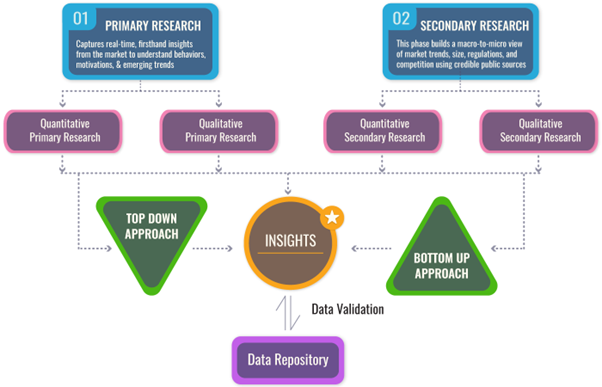
DUAL MODELING: TOP-DOWN + BOTTOM-UP
To ensure robust market estimation, we apply two complementary sizing approaches:
Top-Down Modeling:- Start with broader industry value (e.g., global or regional TAM)
- Apply filters by segment, geography, end-user, or use case
- Adjust with primary insights and validation benchmarks
- Ideal for investor-grade market scans and opportunity mapping
- Aggregate from the ground up using sales volumes, pricing, and unit economics
- Use internal modeling templates aligned with stakeholder data
- Incorporate distributor-level or region-specific inputs
- Most accurate for emerging segments and granular sub-markets
DATA VALIDATION: IN-HOUSE REPOSITORY
We close the loop with proprietary data intelligence built from ongoing projects, industry monitoring, and historical benchmarking. This repository includes:
- Multi-sector market and pricing models
- Key trendlines from past interviews and forecasts
- Benchmarked adoption rates, churn patterns, and ROI indicators
- Industry-specific deviation flags and cross-check logic
- Catches inconsistencies early
- Aligns projections across studies
- Enables consistent, high-trust deliverables