

Global DOOH Market Size and Forecast (2026–2034), Global and Regional Growth, Trend, Share and Industry Analysis Report Coverage; By Format (Billboards, Transit Displays, Street Furniture, Venue-Based Displays); By Type (Indoor, Outdoor); By Technology Platform (Programmatic DOOH, Interactive DOOH, Real-Time/Contextual DOOH); By End Use (Retail & FMCG, Entertainment, Travel & Tourism, Government, BFSI, Healthcare, Automotive, Real Estate); and Geography
2026-09-01
ICT
Ekta Chaurasia (Team Lead)
Description
Global DOOH Market Overview
The global DOOH
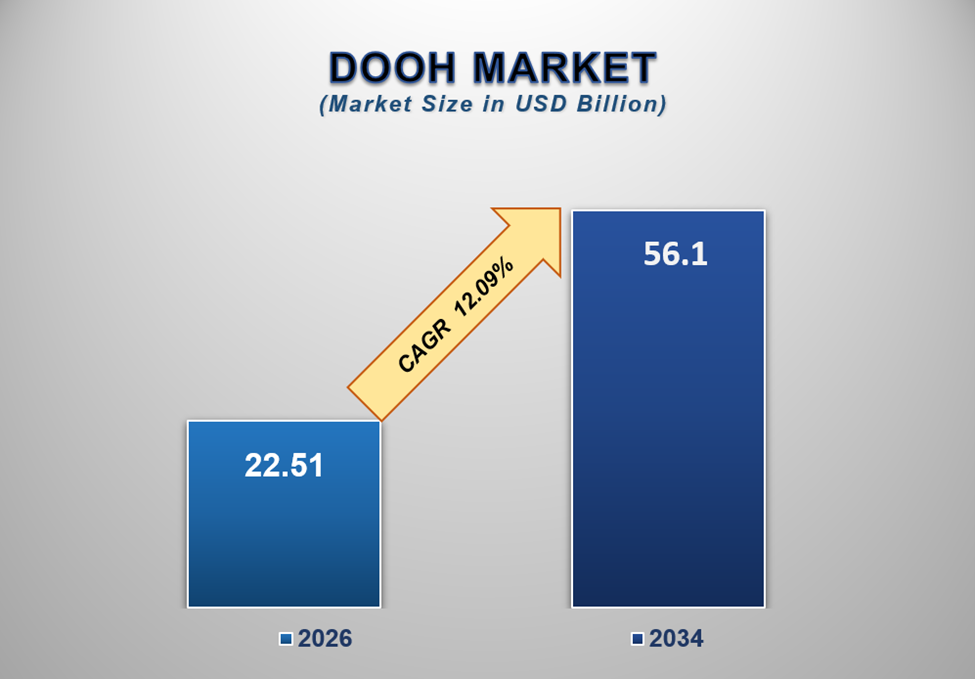
Market was valued at USD 22.51 billion in 2026 and is projected to
reach USD 56.1 billion by 2034, expanding at a CAGR of 12.09%
during the forecast period. The market is experiencing strong growth due to
increasing digitization of outdoor advertising, expansion of digital billboard
networks, growing adoption of programmatic advertising, rising urbanization,
development of smart-city infrastructure, and increasing demand for real-time
and location-based advertising.
Digital
out-of-home advertising, commonly referred to as DOOH, uses digitally connected
screens and displays installed in public environments to deliver advertising
content to audiences outside their homes. These displays include digital
billboards, transit screens, street furniture displays, retail screens, airport
displays, and venue-based digital signage.
Unlike
conventional static outdoor advertising, DOOH allows advertisers to modify
campaigns digitally, schedule multiple creatives, respond to real-time
conditions, and tailor messaging according to location, time, audience
characteristics, and other contextual factors.
The expansion of
digital display infrastructure is one of the major factors supporting market
development. Declining display costs, improvements in LED technology, better
screen resolution, and increased availability of energy-efficient displays are
enabling media owners to convert static advertising inventory into dynamic
digital assets.
Programmatic
buying is also transforming the advertising ecosystem. Advertisers can
increasingly purchase digital outdoor inventory through automated platforms,
allowing campaigns to be planned, scheduled, optimized, and measured using
data-driven systems.
The increasing
availability of audience analytics is improving the attractiveness of DOOH for
advertisers. Traffic patterns, mobility data, location intelligence, and
contextual information can help advertisers determine when and where specific
messages are likely to achieve greater visibility.
Urbanization is
creating additional opportunities. High-traffic roads, shopping districts,
transportation hubs, airports, metro stations, commercial centers, and
entertainment venues provide large audiences for digital advertising.
Retailers and
consumer brands are increasingly using DOOH to influence consumers close to
purchasing locations. Digital displays positioned near stores, shopping
centers, and commercial districts can deliver promotional messages at important
stages of the customer journey.
The expansion of
retail media networks is further increasing demand for digital screens in
physical shopping environments. Retailers are using digital displays to create
additional advertising inventory while providing brands with opportunities to
reach consumers closer to the point of purchase.
Transit
infrastructure is another important area of development. Airports, railway
stations, metro systems, bus terminals, and other transportation locations are
increasingly deploying digital screens to monetize passenger traffic while
delivering information and advertising.
DOOH is also
becoming more integrated with mobile and online advertising campaigns.
Advertisers can coordinate outdoor campaigns with social media, mobile
advertising, search, and other digital channels to create connected customer
experiences.
Artificial
intelligence is creating additional opportunities by enabling automated
creative generation, contextual content selection, audience analysis, campaign
optimization, and dynamic advertising.
As digital
screens become more widespread and advertisers increasingly demand flexible,
measurable, and context-aware media formats, the global DOOH market is expected
to maintain strong growth through 2034.
Global DOOH Market Drivers and
Opportunities
Increasing
Digitalization of Outdoor Advertising Is Driving Market Growth
The transition
from static advertising formats toward dynamic digital media is one of the most
important factors driving the DOOH market.
Digital displays
allow multiple advertisers to share the same screen inventory, increasing the
revenue potential of individual advertising assets for media owners.
Advertisers can
change messages without physically replacing printed materials, enabling faster
campaign deployment and greater creative flexibility.
Real-time
scheduling also allows advertisers to adjust content according to time of day,
location, weather, traffic conditions, events, or other contextual factors.
The ability to
deliver dynamic content is particularly attractive to brands seeking more
relevant and responsive advertising experiences.
As media owners
continue converting conventional outdoor inventory into digital formats, the
addressable DOOH advertising ecosystem is expected to expand.
Growing
Adoption of Programmatic Advertising Is Supporting Market Expansion
Programmatic
DOOH is changing how advertisers purchase and manage outdoor advertising
inventory.
Traditional
outdoor advertising typically requires booking and fixed campaign schedules.
Programmatic platforms allow advertisers to automate inventory selection,
campaign scheduling, audience targeting, and budget allocation.
Advertisers can
use data-driven systems to identify suitable screens based on location,
audience characteristics, traffic levels, campaign objectives, and other
parameters.
Programmatic
technology is also improving campaign flexibility by allowing advertisers to
adjust creative content and spending according to changing conditions.
As advertising
agencies and brands become more familiar with automated outdoor media buying,
programmatic DOOH is expected to represent an increasingly important component
of market growth.
Retail Media,
Smart Cities, and Data-Driven Advertising Create Significant Opportunities
The development
of retail media networks is creating new opportunities for DOOH providers.
Retailers are
increasingly installing digital displays inside stores, shopping centers,
parking areas, and surrounding commercial locations to provide brands with
advertising opportunities closer to purchase decisions.
Smart-city
development is another important opportunity. Municipalities and infrastructure
operators are deploying connected digital displays across transportation
networks, public spaces, and urban infrastructure.
The integration
of advertising screens with sensors, connectivity platforms, traffic
information, and audience analytics can create more intelligent and
context-sensitive advertising networks.
Artificial
intelligence is further expanding the opportunity landscape. AI-based systems
can support automated creative adaptation, content optimization, audience
prediction, campaign measurement, and real-time decision-making.
The increasing
convergence of DOOH with mobile, social, retail media, and programmatic
advertising is expected to create new revenue opportunities for media owners,
technology providers, advertisers, and agencies.
Global DOOH Market Scope
|
Report
Attributes |
Description |
|
Market Size in 2026 |
USD
22.51 Billion |
|
Market Forecast in 2034 |
USD 56.1 Billion |
|
CAGR % 2026-2034 |
12.9% |
|
Base Year |
2025 |
|
Historic Data |
2021-2025 |
|
Forecast Period |
2026-2034 |
|
Report USP |
Production, Consumption,
Company Share, Company Heatmap, Company Production, Service Type, Growth
Factors and more |
|
Segments Covered |
• By Format |
|
Regional Scope |
● North America |
|
Country Scope |
U.S. |
Global DOOH Market Report
Segmentation Analysis
The global DOOH
market industry analysis is segmented by format, type, technology platform, end
use, and region.
The
Billboards Segment Is Expected to Dominate the Market During the Forecast
Period
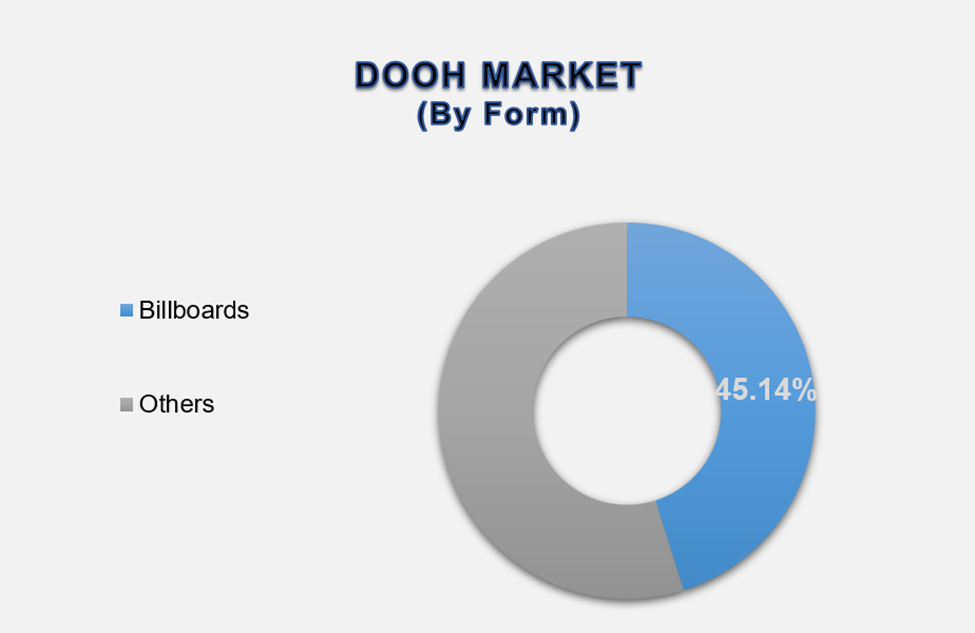
The Billboards
segment accounted for approximately 45.14% of the global market in 2026,
making it the leading format category.
Digital
billboards represent one of the most established and visible applications of
DOOH advertising.
Large-format
digital displays positioned along highways, major roads, commercial corridors,
city centers, and high-traffic intersections provide advertisers with broad
audience exposure.
Unlike static
billboards, digital displays can accommodate multiple campaigns and allow
advertising content to be changed remotely.
Advertisers can
also schedule different creatives according to time of day, audience patterns,
events, or promotional requirements.
The increasing
deployment of high-resolution LED displays is improving visual quality and
enabling brands to use video, animation, motion graphics, and other dynamic
creative formats.
The expansion of
digital billboard networks across major metropolitan areas is therefore
expected to continue supporting the segment's leading position.
The Outdoor
Segment Is Expected to Lead the Market by Type
The Outdoor
segment is expected to account for the largest share of the global DOOH market.
Outdoor digital
displays are deployed across roads, highways, city centers, transportation
corridors, commercial districts, public spaces, and other high-footfall
environments.
Their ability to
reach large mobile audiences makes outdoor DOOH particularly attractive for
mass-market advertising campaigns.
Outdoor networks
also benefit from the increasing movement of consumers through urban
environments as commuting, shopping, entertainment, and travel activities
generate repeated exposure opportunities.
The continued
expansion of digital billboard infrastructure and connected urban displays is
expected to support the segment during the forecast period.
The
Programmatic DOOH Segment Is Expected to Register Strong Growth by Technology
Platform
The Programmatic
DOOH segment is expected to experience significant growth as advertisers
increasingly seek automated and data-driven methods for purchasing outdoor
media.
Programmatic
platforms allow advertisers to access multiple digital screens through
centralized systems rather than negotiating each advertising location
separately.
Campaigns can be
optimized according to audience data, location, timing, traffic conditions, and
campaign performance.
Programmatic
buying also enables more flexible budget management and faster creative
deployment.
The increasing
integration of DOOH inventory with demand-side platforms, supply-side
platforms, and advertising exchanges is expected to accelerate adoption.
The Retail
& FMCG Segment Is Expected to Represent a Significant End-Use Category
The Retail
& FMCG segment represents an important source of DOOH advertising
demand.
Retail brands
and consumer-goods companies use digital outdoor displays to increase brand
visibility, communicate promotions, introduce products, and influence
purchasing decisions.
The proximity of
DOOH screens to stores, shopping centers, supermarkets, and commercial
districts can make the medium particularly valuable for location-based
campaigns.
The expansion of
retail media networks is also creating additional digital inventory within and
around shopping environments.
As retailers
increasingly combine physical-store data with digital advertising capabilities,
demand for DOOH solutions targeting consumers near purchase locations is
expected to increase.
The following segments are part of an in-depth analysis of the global DOOH Market:
|
Market Segments |
|
|
By
Format |
●
Billboards ●
Transit Displays ●
Street Furniture ●
Venue-Based Displays |
|
By Type |
●
Indoor ●
Outdoor |
|
By Technology
Platform |
●
Programmatic DOOH ●
Interactive DOOH ●
Real-Time/Contextual DOOH |
|
By End User |
●
Retail & FMCG ●
Entertainment ●
Travel & Tourism ●
Government ●
BFSI ●
Healthcare ●
Automotive ●
Real Estate |
Global DOOH Market Share Analysis By
Region
North America is projected to remain one of the leading regional markets for
global DOOH advertising over the forecast period. The region benefits from
mature advertising infrastructure, extensive digital billboard networks, strong
advertiser spending, and high adoption of data-driven marketing technologies.
The United States represents the dominant contributor, supported by
large-scale digital signage networks, programmatic advertising adoption, retail
media development, and high demand for measurable advertising solutions.
Europe represents an established DOOH market supported by advanced urban
infrastructure, high digitalization, extensive public transportation networks,
and a strong presence of international outdoor advertising companies. Germany,
the U.K., France, Italy, Spain, and Switzerland are important regional
markets.
Asia Pacific is expected to experience strong growth as urban populations expand
and advertisers increasingly adopt digital media formats. The region benefits
from extensive transportation networks, large consumer markets, expanding
retail infrastructure, and increasing deployment of digital screens. China,
India, Japan, South Korea, and Australia are key contributors.
China represents
a significant opportunity because of its large urban population, extensive
digital signage ecosystem, and developed technology infrastructure. India is
also emerging as an important DOOH market due to rapid urbanization, expansion
of metro and airport infrastructure, smart-city initiatives, and increasing
adoption of digital advertising.
Latin America is expected to witness steady growth as digital display
infrastructure expands and advertisers increasingly adopt modern outdoor
advertising formats. Brazil, Mexico, and Argentina represent important
markets.
Middle East
& Africa is an emerging market supported by
urban development, tourism infrastructure, smart-city projects, retail
expansion, and increasing deployment of large digital displays. Saudi Arabia
and the UAE are particularly important markets due to significant investments
in modern urban and commercial infrastructure.
Global DOOH
Market Competition Landscape Analysis
The global DOOH
market is increasingly competitive, with outdoor media companies, digital
advertising platforms, display technology providers, programmatic technology
companies, and specialized DOOH operators competing for market share.
Companies are
focusing on expanding digital screen networks, improving audience
measurement, increasing programmatic inventory, developing high-resolution
displays, enhancing targeting capabilities, and integrating data analytics.
Programmatic
buying has become an important area of competitive development. Companies are
building technology platforms that allow advertisers to purchase, schedule,
optimize, and measure DOOH campaigns across multiple screen networks.
Media owners are
also investing in audience measurement technologies to demonstrate campaign
reach and effectiveness to advertisers.
Artificial
intelligence and machine learning are becoming increasingly important for
creative optimization and contextual advertising. AI can help determine which
messages should be displayed based on location, time, environmental conditions,
audience patterns, and campaign objectives.
Strategic
partnerships between media owners, advertising technology companies, agencies,
retailers, and data providers are further strengthening the DOOH ecosystem.
The increasing
integration of DOOH with mobile advertising, retail media, social media, and
programmatic advertising is expected to intensify competition while creating
new opportunities across the value chain.
Global DOOH
Market Recent Developments News
●
In April 2026 – DOOH platforms expanded programmatic capabilities to provide
advertisers with more automated inventory purchasing, scheduling, and campaign
optimization options.
●
In February 2026 – Digital outdoor media operators increased integration of audience
analytics and location-based data to improve campaign targeting and
measurement.
●
In November 2025 – Outdoor advertising companies expanded digital billboard networks
across high-traffic urban and transportation locations.
●
In August 2025 – DOOH technology providers increased adoption of automated
campaign-management and real-time content delivery capabilities.
●
In June 2025 – Retail and media companies expanded digital-screen deployments
across shopping environments to strengthen retail media advertising
opportunities.
The Global
DOOH Market is Dominated by a Few Large Companies, Such As
●
JCDecaux SE
●
Clear Channel Outdoor Holdings,
Inc.
●
Lamar Advertising Company
●
OUTFRONT Media Inc.
●
Ströer SE & Co. KGaA
●
Ocean Outdoor
●
Focus Media Information
Technology Co., Ltd.
●
Daktronics, Inc.
●
Broadsign International LLC
●
Talon Outdoor Ltd.
●
oOh!media Limited
●
Global Outdoor Media Limited
●
Intersection Co.
●
Posterscope
●
Vistar Media
● Others
Frequently Asked Questions
Ekta Chaurasia (Team Lead)
Ekta Chaurasia is a highly experienced Team Lead at M2Square Consultancy with over 7 years of expertise in market research, strategic consulting, competitive benchmarking, and business intelligence solutions. She specializes in ICT, semiconductors & electronics, automotive & transportation, and industrial machinery markets.
She leads end-to-end global research projects focused on market trends, industry analysis, growth forecasting, customer insights, and strategic decision-making. Known for her analytical leadership and industry expertise, Ekta helps businesses uncover growth opportunities, evaluate competitive landscapes, and stay ahead in rapidly evolving markets through accurate and insight-driven research.
1.
Global DOOH Market
Introduction and Market Overview
1.1. Objectives of the Study
1.2. Market Segmentation
1.2.1.
Offering of the Global DOOH
Market
1.2.2.
Format of Global DOOH Market
1.2.3.
Type of Global DOOH Market
1.2.4.
Technology Platform of Global
DOOH Market
1.2.5.
End Use of Global DOOH Market
1.2.6.
Region of Global DOOH Market
1.3. Competition Coverage List of Market Participants
1.4. Market Definition: DOOH Market
2.
Executive Summary
2.1. Global DOOH Market Estimation & Forecast
2.1.1.
Global DOOH Market Size (US$
Million) Estimates & Historical Trend
2.1.1.1.
Analysis (2021 - 2025)
2.1.2.
Global DOOH Market Overall
Market Size (US$ Million), Growth Rate
2.1.2.1.
(Y-o-Y), Market CAGR (%),
Market Forecast (2026 - 2034)
2.2. Snapshot of Global DOOH Market
2.3. Global DOOH Market Revenue Share (%) 2025
2.4. REGIONAL OUTLINE: Revenue CAGR, by Region
2.5. Key Competitors & Key Insights
3.
Market Overview
(Qualitative Analysis)
3.1. Demand Side Trends
3.2. Supply Side Trends / Digital Advertising & Display Technology
Trends
3.3. Demand and Opportunity Assessment, 2026 - 2034
3.4. Market Dynamics
3.4.1.
Drivers
3.4.2.
Limitations
3.4.3.
Opportunities
3.4.4.
Impact Analysis of Drivers and
Restraints
3.5. Key Developments
3.6. Regulatory Landscape
3.7. Pricing Analysis
3.8. Value Chain / Ecosystem Analysis
3.9. Porter's Five Forces Analysis
3.9.1.
Bargaining Power of Suppliers
3.9.2.
Bargaining Power of Buyers
3.9.3.
Threat of Substitutes
3.9.4.
Threat of New Entrants
3.9.5.
Intensity of Competitive
Rivalry
3.10.
PEST Analysis
3.10.1.
Political Factors
3.10.2.
Economic Factors
3.10.3.
Social Factors
3.10.4.
Technology Factors
4.
Global DOOH Market
Estimates & Forecast Trend Analysis, by Format
4.1. Global DOOH Market Assessments & Key Findings, by Format
4.2. Global DOOH Market Revenue (US$ Million) Estimates and Forecasts, by
Format,
4.2.1.
2021 - 2034
4.2.2.
Billboards
4.2.3.
Transit Displays
4.2.4.
Street Furniture
4.2.5.
Venue-Based Displays
5.
Global DOOH Market
Estimates & Forecast Trend Analysis, by Type
5.1. Global DOOH Market Assessments & Key Findings, by Type
5.2. Global DOOH Market Revenue (US$ Million) Estimates and Forecasts, by
Type,
5.2.1.
2021 - 2034
5.2.2.
Indoor
5.2.3.
Outdoor
6.
Global DOOH Market
Estimates & Forecast Trend Analysis, by Technology Platform
6.1. Global DOOH Market Assessments & Key Findings, by Technology
Platform
6.2. Global DOOH Market Revenue (US$ Million) Estimates and Forecasts, by
Technology
6.2.1.
Platform, 2021 - 2034
6.2.2.
Programmatic DOOH
6.2.3.
Interactive DOOH
6.2.4.
Real-Time/Contextual DOOH
7.
Global DOOH Market
Estimates & Forecast Trend Analysis, by End Use
7.1. Global DOOH Market Assessments & Key Findings, by End Use
7.2. Global DOOH Market Revenue (US$ Million) Estimates and Forecasts, by
End Use,
7.2.1.
2021 - 2034
7.2.2.
Retail & FMCG
7.2.3.
Entertainment
7.2.4.
Travel & Tourism
7.2.5.
Government
7.2.6.
BFSI
7.2.7.
Healthcare
7.2.8.
Automotive
7.2.9.
Real Estate
8.
Global DOOH Market
Estimates & Forecast Trend Analysis, by Region
8.1. Global DOOH Market Assessments & Key Findings, by Region
8.2. Global DOOH Market Revenue (US$ Million) Estimates and Forecasts, by
Region,
8.2.1.
2021 - 2034
8.2.2.
North America
8.2.3.
Europe
8.2.4.
Asia Pacific
8.2.5.
Middle East & Africa
8.2.6.
Latin America
9.
North America DOOH
Market: Estimates & Forecast Trend Analysis
9.1. North America DOOH Market Assessments & Key Findings
9.1.1.
North America DOOH Market
Introduction
9.1.2.
North America DOOH Market Size
Estimates and Forecast
9.1.2.1.
(US$ Million) (2021 - 2034)
9.1.2.2.
By Format
9.1.2.3.
By Type
9.1.2.4.
By Technology Platform
9.1.2.5.
By End Use
9.1.2.6.
By Country
9.1.2.6.1.
The U.S.
9.1.2.6.2.
Canada
10. Europe DOOH Market: Estimates & Forecast Trend Analysis
10.1.
Europe DOOH Market Assessments
& Key Findings
10.1.1.
Europe DOOH Market Introduction
10.1.2.
Europe DOOH Market Size
Estimates and Forecast
10.1.2.1.
(US$ Million) (2021 - 2034)
10.1.2.2.
By Format
10.1.2.3.
By Type
10.1.2.4.
By Technology Platform
10.1.2.5.
By End Use
10.1.2.6.
By Country
10.1.2.6.1.
Germany
10.1.2.6.2.
The U.K.
10.1.2.6.3.
France
10.1.2.6.4.
Italy
10.1.2.6.5.
Spain
10.1.2.6.6.
Switzerland
10.1.2.6.7.
Rest of Europe
11. Asia Pacific DOOH Market: Estimates & Forecast Trend Analysis
11.1.
Asia Pacific DOOH Market Assessments
& Key Findings
11.1.1.
Asia Pacific DOOH Market
Introduction
11.1.2.
Asia Pacific DOOH Market Size
Estimates and Forecast
11.1.2.1.
(US$ Million) (2021 - 2034)
11.1.2.2.
By Format
11.1.2.3.
By Type
11.1.2.4.
By Technology Platform
11.1.2.5.
By End Use
11.1.2.6.
By Country
11.1.2.6.1.
China
11.1.2.6.2.
India
11.1.2.6.3.
Japan
11.1.2.6.4.
South Korea
11.1.2.6.5.
Australia
11.1.2.6.6.
Rest of Asia Pacific
12. Middle East & Africa DOOH Market: Estimates & Forecast Trend
Analysis
12.1.
Middle East & Africa DOOH
Market Assessments & Key Findings
12.1.1.
Middle East & Africa DOOH
Market Introduction
12.1.2.
Middle East & Africa DOOH
Market Size Estimates and Forecast
12.1.2.1.
(US$ Million) (2021 - 2034)
12.1.2.2.
By Format
12.1.2.3.
By Type
12.1.2.4.
By Technology Platform
12.1.2.5.
By End Use
12.1.2.6.
By Country
12.1.2.6.1.
Saudi Arabia
12.1.2.6.2.
UAE
12.1.2.6.3.
South Africa
12.1.2.6.4.
Rest of Middle East &
Africa
13. Latin America DOOH Market: Estimates & Forecast Trend Analysis
13.1.
Latin America DOOH Market
Assessments & Key Findings
13.1.1.
Latin America DOOH Market
Introduction
13.1.2.
Latin America DOOH Market Size
Estimates and Forecast
13.1.2.1.
(US$ Million) (2021 - 2034)
13.1.2.2.
By Format
13.1.2.3.
By Type
13.1.2.4.
By Technology Platform
13.1.2.5.
By End Use
13.1.2.6.
By Country
13.1.2.6.1.
Brazil
13.1.2.6.2.
Mexico
13.1.2.6.3.
Argentina
13.1.2.6.4.
Rest of Latin America
14. Competition Landscape
14.1.
Global DOOH Market Product /
Platform Mapping
14.2.
Global DOOH Market
Concentration Analysis, by Leading Players / Innovators /
14.2.1.
Emerging Players / New Entrants
14.3.
Global DOOH Market Tier
Structure Analysis
14.4.
Global DOOH Market
Concentration & Company Market Shares (%) Analysis, 2026
14.5.
Global DOOH Market Competitive
Positioning Analysis
15. Company Profiles
15.1.
JCDecaux SE
15.1.1.
Company Overview & Key
Stats
15.1.2.
Financial Performance &
KPIs
15.1.3.
Product / Service Portfolio
15.1.4.
SWOT Analysis
15.1.5.
Business Strategy & Recent
Developments
*Similar details would be provided for all
the players mentioned below
15.2.
Clear Channel Outdoor Holdings,
Inc.
15.3.
Lamar Advertising Company
15.4.
OUTFRONT Media Inc.
15.5.
Ströer SE & Co. KGaA
15.6.
Ocean Outdoor
15.7.
Focus Media Information
Technology Co., Ltd.
15.8.
Daktronics, Inc.
15.9.
Broadsign International LLC
15.10.
Talon Outdoor Ltd.
15.11.
oOh!media Limited
15.12.
Global Outdoor Media Limited
15.13.
Intersection Co.
15.14.
Vistar Media
15.15.
Others
16. Research Findings & Conclusion
17. Assumptions & Acronyms Used
18. Research Methodology
18.1.
External Databases
18.2.
Internal Proprietary Database
18.3.
Primary Research
18.4.
Secondary Research
18.5.
Assumptions
18.6.
Limitations
18.7.
Report FAQs
Our Research Methodology
"Insight without rigor is just noise."
We follow a comprehensive, multi-phase research framework designed to deliver accurate, strategic, and decision-ready intelligence. Our process integrates primary and secondary research , both quantitative and qualitative , along with dual modeling techniques ( top-down and bottom-up) and a final layer of validation through our proprietary in-house repository.
PRIMARY RESEARCH
Primary research captures real-time, firsthand insights from the market to understand behaviors, motivations, and emerging trends.
1. Quantitative Primary Research
Objective: Generate statistically significant data directly from market participants.
Approaches:- Structured surveys with customers, distributors, and field agents
- Mobile-based data collection for point-of-sale audits and usage behavior
- Phone-based interviews (CATI) for market sizing and product feedback
- Online polling around industry events and digital campaigns
- Purchase frequency by customer type
- Channel performance across geographies
- Feature demand by application or demographic
2. Qualitative Primary Research
Objective: Explore decision-making drivers, pain points, and market readiness.
Approaches:- In-depth interviews (IDIs) with executives, product managers, and key decision-makers
- Focus groups among end users and early adopters
- Site visits and observational research for consumer products
- Informal field-level discussions for regional and cultural nuances
SECONDARY RESEARCH
This phase helps establish a macro-to-micro understanding of market trends, size, regulation, and competitive dynamics, sourced from credible and public domain information.
1. Quantitative Secondary Research
Objective: Model market value and segment-level forecasts based on published data.
Sources include:- Financial reports and investor summaries
- Government trade data, customs records, and regulatory statistics
- Industry association publications and economic databases
- Channel performance and pricing data from marketplace listings
- Revenue splits, pricing trends, and CAGR estimates
- Supply-side capacity and volume tracking
- Investment analysis and funding benchmarks
2. Qualitative Secondary Research
Objective: Capture strategic direction, innovation signals, and behavioral trends.
Sources include:- Company announcements, roadmaps, and product pipelines
- Publicly available whitepapers, conference abstracts, and academic research
- Regulatory body publications and policy briefs
- Social and media sentiment scanning for early-stage shifts
- Strategic shifts in market positioning
- Unmet needs and white spaces
- Regulatory triggers and compliance impact
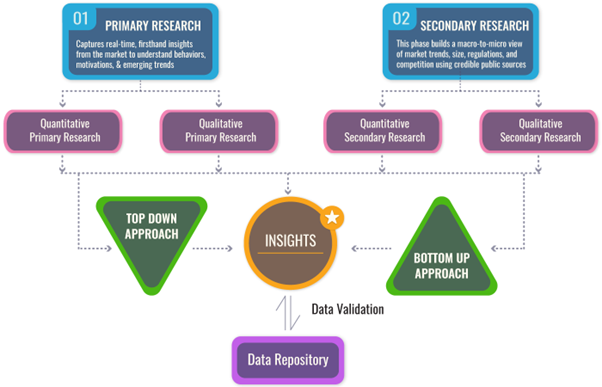
DUAL MODELING: TOP-DOWN + BOTTOM-UP
To ensure robust market estimation, we apply two complementary sizing approaches:
Top-Down Modeling:- Start with broader industry value (e.g., global or regional TAM)
- Apply filters by segment, geography, end-user, or use case
- Adjust with primary insights and validation benchmarks
- Ideal for investor-grade market scans and opportunity mapping
- Aggregate from the ground up using sales volumes, pricing, and unit economics
- Use internal modeling templates aligned with stakeholder data
- Incorporate distributor-level or region-specific inputs
- Most accurate for emerging segments and granular sub-markets
DATA VALIDATION: IN-HOUSE REPOSITORY
We close the loop with proprietary data intelligence built from ongoing projects, industry monitoring, and historical benchmarking. This repository includes:
- Multi-sector market and pricing models
- Key trendlines from past interviews and forecasts
- Benchmarked adoption rates, churn patterns, and ROI indicators
- Industry-specific deviation flags and cross-check logic
- Catches inconsistencies early
- Aligns projections across studies
- Enables consistent, high-trust deliverables