

Golf Simulator Market Size and Forecast (2020 - 2033), Global and Regional Growth, Trend, Share, and Industry Analysis Report Coverage: By Component (Hardware [Launch Monitors, Screens & Enclosures, Projectors, Sensors], Software & Services), By System (Portable, Full-Scale), By End-User (Commercial [Golf Centers, Hospitality, Corporate], Residential), and Geography
2025-12-05
Media & Entertainment
Jaya Bundele (Research Analyst)
Description
Golf Simulator Market Overview
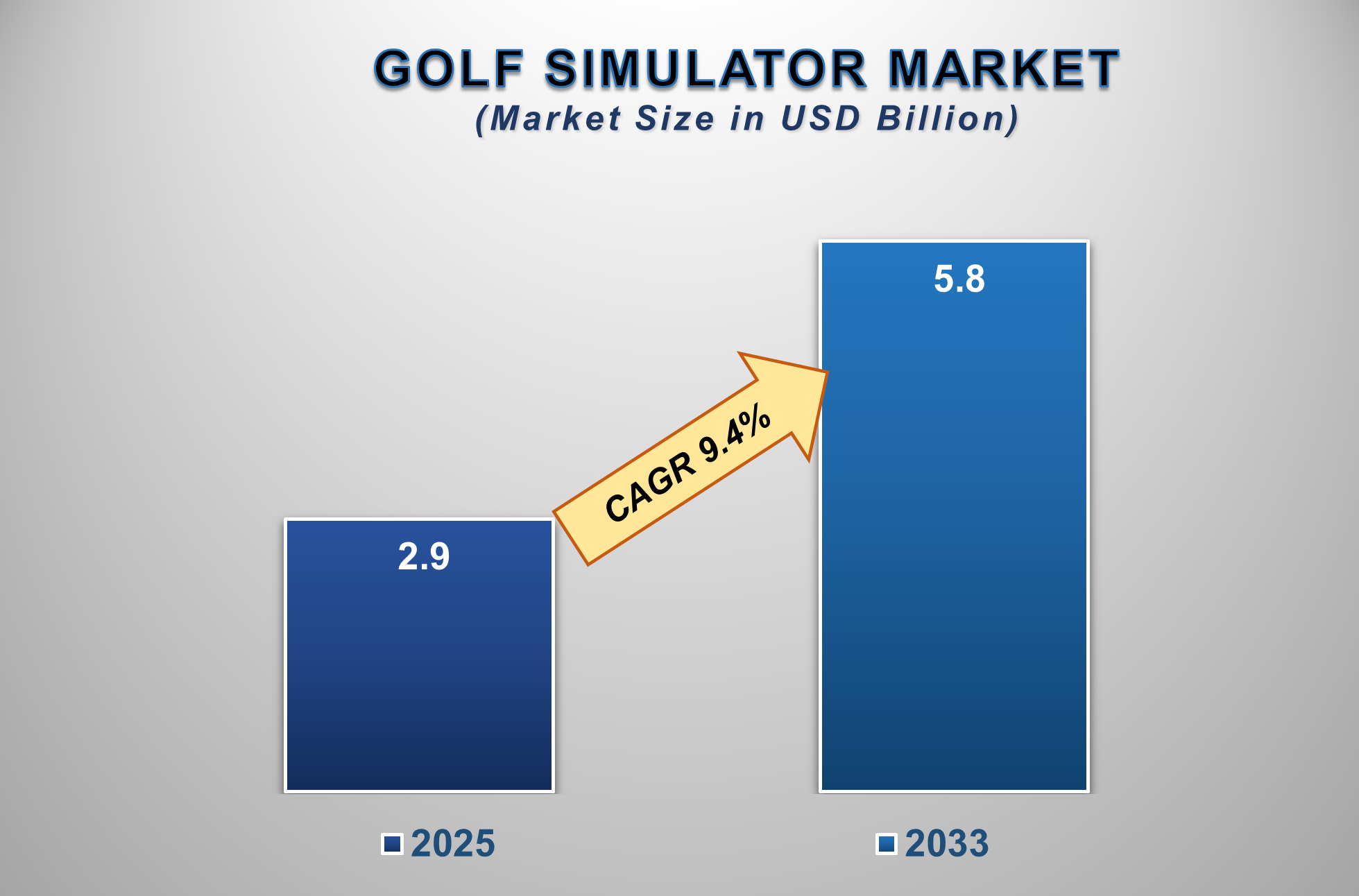
The Golf Simulator Market is positioned for a period of strong and accelerated growth from 2025 to 2033, driven by technological advancements, the rising popularity of indoor recreational sports, and increasing golf participation in non-traditional formats. The market is projected to be valued at approximately USD 2.9 billion in 2025 and is forecasted to reach nearly USD 5.8 billion by 2033, exhibiting a compound annual growth rate (CAGR) of 9.4% during this period.
A golf simulator is an indoor system that allows
users to play golf in a virtual representation of real-world golf courses,
using sophisticated sensors and software to track ball flight and swing
metrics. The market's expansion is underpinned by the convenience and
accessibility it offers, overcoming limitations of weather, time, and space
associated with traditional golf. Furthermore, the integration of advanced
technologies like 4K/8K high-definition graphics, photometric and radar-based
launch monitors and augmented reality features
are enhancing the realism and user experience.
The post-pandemic shift towards home entertainment and investment in
residential recreational spaces has also been a significant growth catalyst.
North America currently leads the market due to high golf participation rates
and disposable income, while the Asia-Pacific region is anticipated to be the
fastest-growing market, fueled by
urbanization, the development of indoor golf entertainment centers, and a
growing middle class.
Golf Simulator
Market Drivers and Opportunities
Technological Innovation and Demand for
Year-Round Practice are the Primary Market Drivers
The continuous advancement in simulator
technology is the most significant driver of the golf simulator market. Modern
systems offer highly accurate data analytics for swing and ball flight,
including launch angle, spin rate, and club path, making them valuable tools
not just for entertainment but for serious game improvement. This has broadened
their appeal from casual users to professional golfers and coaches. The ability
to practice and play regardless of external weather conditions provides a
compelling value proposition, driving adoption in both commercial and
residential settings. The demand for consistent, year-round training and the
convenience of having a golf facility at home or nearby are fundamental forces
propelling the market forward.
The rise of Golf Entertainment Venues and
Growing Residential Adoption are Fueling Market Expansion
The emergence of sophisticated golf
entertainment centers, such as Topgolf and Drive Shack, has been a major
catalyst for commercial segment growth. These venues offer a social,
technology-driven golf experience that appeals to a broader demographic, including
non-golfers, thereby expanding the overall market. Concurrently, the
residential segment is experiencing rapid growth. Factors such as the
increasing value of home amenities, the desire for private entertainment
solutions, and the availability of more compact and affordable simulator
packages are making home installations increasingly popular. This dual-track
growth across commercial entertainment and dedicated residential use is
creating a robust and diversified demand base.
Data-Driven Coaching and Integration with
E-Sports Present Significant Opportunities
The application of simulator data for advanced
coaching and the convergence of golf with e-sports are creating significant
growth frontiers for the market. Key opportunities lie in the development of
AI-powered software that provides automated swing analysis and personalized
training programs. The subscription-based model for premium software features,
virtual lessons with remote pros, and access to expanded course libraries
represents a recurring revenue stream. Furthermore, the organized play and tournament
features within simulators are fostering a competitive e-sports environment.
For manufacturers, investing in robust online platforms that host virtual
leagues and tournaments, partnering with golf governing bodies, and developing
more immersive VR/AR integrations are key strategies to capture the evolving
tech-savvy and connected consumer segment.
Golf Simulator Market
Scope
|
Report Attributes |
Description |
|
Market Size in 2025 |
USD 2.9 Billion |
|
Market Forecast in 2033 |
USD 5.8 Billion |
|
CAGR % 2025-2033 |
9.4% |
|
Base Year |
2024 |
|
Historic Data |
2020-2024 |
|
Forecast Period |
2025-2033 |
|
Report USP |
Product Portfolio,
Technological Analysis, Company Market Share, Company Heatmap, Pricing
Analysis, Growth Factors and more |
|
Segments Covered |
●
By Component ●
By System ●
By End-user |
|
Regional Scope |
●
North America, ●
Europe, ●
APAC, ●
Latin America ●
Middle East and
Africa |
|
Country Scope |
1)
U.S. 2)
Canada 3)
Germany 4)
UK 5)
France 6)
Spain 7)
Italy 8)
Switzerland 9)
China 10)
Japan 11)
India 12)
Australia 13)
South Korea 14)
Brazil 15)
Mexico 16)
Argentina 17)
South Africa 18)
Saudi Arabia 19)
UAE |
Golf Simulator Market
Report Segmentation Analysis
The global Golf Simulator Market
industry analysis is segmented by Component, by System, by End-User, and by
Region.
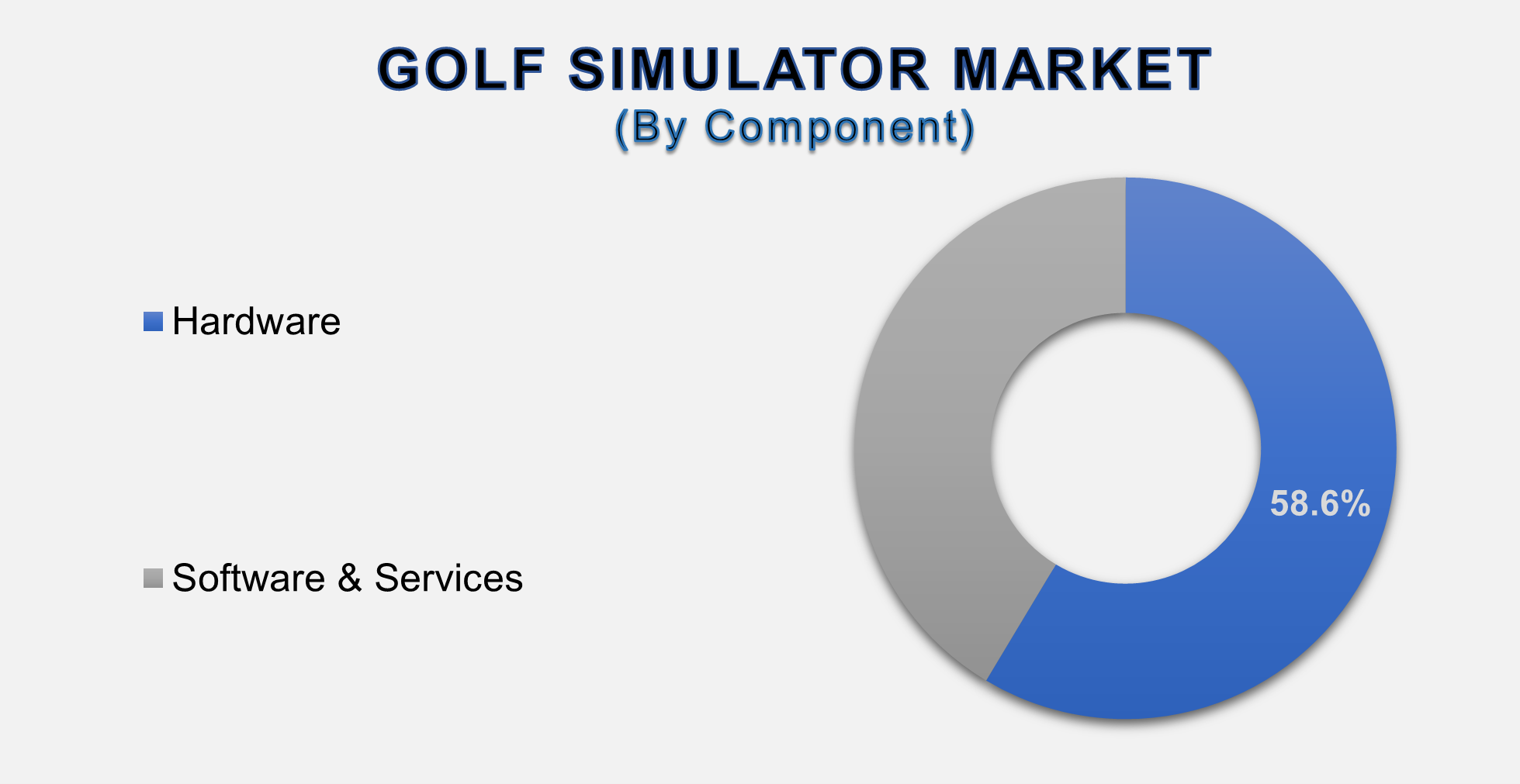
The Hardware component segment is anticipated to command a
significant market share in 2025.
The Component segment is categorized into Hardware (Launch Monitors, Screens & Enclosures, Projectors, Sensors) and Software & Services. Hardware, particularly launch monitors and high-impact screens, constitutes the core capital expenditure of a simulator setup and thus dominates the market share. The critical importance of accurate and reliable data capture drives demand for advanced launch monitors, which are the most expensive single component. The need for durable screens and enclosures that can withstand repeated ball strikes and high-quality projectors for an immersive visual experience further contributes to the hardware segment's large market share. Continuous innovation in sensor technology and materials ensures this segment's continued dominance.
The
Commercial end-user segment is projected to hold the largest market share.
The
End-User segment is divided into Commercial (Golf Centers, Hospitality,
Corporate) and Residential. The commercial segment's dominance is attributable
to the high volume of systems installed in golf entertainment centers, driving ranges, club fitting studios, and hospitality
venues (hotels and resorts).
These
entities have higher capital expenditure capacity and view simulators as
revenue-generating assets. The business model of commercial venues, which
monetizes simulator access through hourly rentals, leagues, and food &
beverage sales, supports the investment in high-end, full-scale systems. While
the residential segment is growing faster, the scale of commercial
installations in terms of unit volume and value secures its leading market
position.
The
Full-Scale system segment is projected to maintain its dominance in revenue.
The
System segment is split into Portable and Full-Scale. Full-scale systems, which
typically include a dedicated enclosure, high-definition screen, premium
projector, and integrated launch monitor, offer the most immersive and
realistic golfing experience. They are the preferred choice for commercial
installations and serious residential golfers seeking a permanent,
high-fidelity setup.
The
superior performance, durability, and comprehensive features of full-scale
systems justify their higher price point, leading to their dominance in overall
market revenue. However, portable systems are gaining traction in the
budget-conscious and space-constrained residential segment due to their
flexibility and lower cost.
The following segments are
part of an in-depth analysis of the global Golf Simulator Market:
|
Market
Segments |
|
|
By
Component |
●
Hardware o
Launch Monitors o
Screens &
Enclosures o
Projectors o
Sensors ●
Software &
Services |
|
By System |
●
Portable ●
Full-Scale |
|
By End-user |
●
Commercial o
Golf Centers o
Hospitality o
Corporate ●
Residential |
Golf Simulator Market
Share Analysis by Region
The
North America region is anticipated to hold the largest portion of the Golf
Simulator Market globally throughout the forecast period
North
America's dominance is fuelled by the high concentration of golf enthusiasts,
strong disposable income levels, and the presence of major market players like
Foresight Sports and Full Swing Golf. The region was the birthplace of the golf
entertainment concept, with Topgolf driving widespread popularity. The harsh
winters in many parts of the U.S. and Canada create a natural demand for indoor
golf solutions. Furthermore, well-established distribution networks, high
technology adoption rates, and a culture of investing in home improvement and
entertainment solidify North America's leading position. The commercial market
is mature and continues to expand with new entertainment venues, while the
residential market is being propelled by the trend of building "backyard
sanctuaries" and dedicated home golf rooms. The strong PGA Tour presence
and endorsements from professional golfers who use simulators for training also
significantly influence consumer adoption in the region.
Golf Simulator Market
Competition Landscape Analysis
The global golf simulator market
is moderately consolidated and highly competitive, with a mix of established
hardware-focused companies and software/platform specialists. Competition is
intense and based on technological accuracy, product portfolio breadth,
software features and course library, brand reputation, and price. Key
strategies include continuous R&D to improve tracking technology and
software realism, strategic partnerships with professional tours and players
for endorsements, and acquisitions to integrate complementary technologies or
expand geographic reach. The development of scalable solutions that cater to
both the high-end commercial and budget residential markets is a critical focus
for leading players.
Global Golf Simulator
Market Recent Developments News:
- In
March 2025, Foresight Sports launched a new GC3-model launch monitor with
enhanced putting analysis capabilities, specifically targeting the serious
amateur market.
- In January 2024, Full Swing Golf, a brand invested
in by Tiger Woods, announced a strategic partnership with a major hotel
chain to install its simulators in luxury resorts worldwide.
- In November 2024, TrackMan (a Vistra company)
introduced a new software update featuring five new licensed PGA Tour
courses and enhanced online tournament play features.
- In September 2024,
SkyTrak+ reported a record quarter for sales of its personal launch
monitor, highlighting the explosive growth in the mid-range, residential
segment of the market.
The Global Golf Simulator
Market Is Dominated by a Few Large Companies, such as
●
Foresight Sports
●
Full Swing Golf
●
TrackMan (Vistra)
●
SkyTrak
●
GOLFZON
●
HD Golf
●
TruGolf
●
Uneekor
●
ProTee United
●
FlightScope
● Other Prominent Players
Frequently Asked Questions
Jaya Bundele (Research Analyst)
Jaya Bundele is a skilled Research Analyst with 4+ years of experience in market intelligence, consumer insights, competitive analysis, and industry forecasting across the consumer goods, agriculture, and food & beverage sectors. She specializes in market sizing, trend analysis, growth opportunity mapping, and strategic secondary research for global and regional markets.
Her expertise lies in transforming complex industry data into actionable business strategies that help organizations identify emerging trends, understand customer behavior, and gain a competitive edge. With a strong focus on data-driven insights, business intelligence, and future market trends, Jaya delivers high-quality research solutions aligned with evolving industry demands and market dynamics.
1. Global Golf Simulator
Market Introduction and Market Overview
1.1.
Objectives
of the Study
1.2.
Global
Golf Simulator Market Scope and Market Estimation
1.2.1.Global Electronic Toll
Collection Overall Market Size (US$ Bn), Market CAGR (%), Market forecast (2025
- 2033)
1.2.2.Global Golf Simulator
Market Revenue Share (%) and Growth Rate (Y-o-Y) from 2020 - 2033
1.3.
Market
Segmentation
1.3.1.Component of Global Golf
Simulator Market
1.3.2.System of Global Golf
Simulator Market
1.3.3.End-user of Global Golf
Simulator Market
1.3.4.Region of Global Golf
Simulator Market
2.
Executive Summary
2.1.
Demand
Side Trends
2.2.
Key
Market Trends
2.3.
Market
Demand (US$ Bn) Analysis 2020 – 2024 and forecast, 2025 – 2033
2.4.
Demand
and Opportunity Assessment
2.5.
Technological
Advancements
2.6.
Key
Developments
2.7.
Market
Entry Strategies
2.8.
Market
Dynamics
2.8.1.Drivers
2.8.2.Limitations
2.8.3.Opportunities
2.8.4.Impact Analysis of Drivers
and Restraints
2.9.
Porter’s
Five Forces Analysis
2.10.
PEST
Analysis
3. Global
Golf Simulator Market Estimates
& Historical Trend Analysis (2020 - 2024)
4. Global
Golf Simulator Market Estimates
& Forecast Trend Analysis, by Component
4.1.
Global
Golf Simulator Market Revenue (US$ Bn) Estimates and Forecasts, by Component,
2020 - 2033
4.1.1.Hardware
4.1.1.1.
Launch
Monitors
4.1.1.2.
Screens
& Enclosures
4.1.1.3.
Projectors
4.1.1.4.
Sensors
4.1.2.Software & Services
5. Global
Golf Simulator Market Estimates
& Forecast Trend Analysis, by System
5.1.
Global
Golf Simulator Market Revenue (US$ Bn) Estimates and Forecasts, by System, 2020
- 2033
5.1.1.Portable
5.1.2.Full-Scale
6. Global
Golf Simulator Market Estimates
& Forecast Trend Analysis, by End-user
6.1.
Global
Golf Simulator Market Revenue (US$ Bn) Estimates and Forecasts, by End-user
2020 - 2033
6.1.1.Commercial
6.1.1.1.
Golf
Centers
6.1.1.2.
Hospitality
6.1.1.3.
Corporate
6.1.2.Residential
7. Global
Golf Simulator Market Estimates
& Forecast Trend Analysis, by region
7.1.
Global
Golf Simulator Market Revenue (US$ Bn) Estimates and Forecasts, by region, 2020
- 2033
7.1.1.North America
7.1.2.Europe
7.1.3.Asia Pacific
7.1.4.Middle East & Africa
7.1.5.Latin America
8. North America Golf
Simulator Market: Estimates &
Forecast Trend Analysis
8.1. North America Golf
Simulator Market Assessments & Key Findings
8.1.1.North America Golf
Simulator Market Introduction
8.1.2.North America Golf
Simulator Market Size Estimates and Forecast (US$ Billion) (2020 - 2033)
8.1.2.1.
By Component
8.1.2.2.
By System
8.1.2.3.
By End-user
8.1.2.4. By Country
8.1.2.4.1. The U.S.
8.1.2.4.2. Canada
9. Europe Golf
Simulator Market: Estimates &
Forecast Trend Analysis
9.1. Europe Golf Simulator
Market Assessments & Key Findings
9.1.1.Europe Golf Simulator
Market Introduction
9.1.2.Europe Golf Simulator
Market Size Estimates and Forecast (US$ Billion) (2020 - 2033)
9.1.2.1.
By Component
9.1.2.2.
By System
9.1.2.3.
By End-user
9.1.2.4. By Country
9.1.2.4.1.
Germany
9.1.2.4.2.
Italy
9.1.2.4.3.
U.K.
9.1.2.4.4.
France
9.1.2.4.5.
Spain
9.1.2.4.6.
Switzerland
9.1.2.4.7. Rest
of Europe
10. Asia Pacific Golf
Simulator Market: Estimates &
Forecast Trend Analysis
10.1. Asia Pacific Market
Assessments & Key Findings
10.1.1.
Asia
Pacific Golf Simulator Market Introduction
10.1.2.
Asia
Pacific Golf Simulator Market Size Estimates and Forecast (US$ Billion) (2020 -
2033)
10.1.2.1.
By Component
10.1.2.2.
By System
10.1.2.3.
By End-user
10.1.2.4. By Country
10.1.2.4.1. China
10.1.2.4.2. Japan
10.1.2.4.3. India
10.1.2.4.4. Australia
10.1.2.4.5. South Korea
10.1.2.4.6. Rest of Asia Pacific
11. Middle East & Africa Golf
Simulator Market: Estimates &
Forecast Trend Analysis
11.1. Middle East & Africa
Market Assessments & Key Findings
11.1.1. Middle
East & Africa
Golf Simulator Market Introduction
11.1.2. Middle
East & Africa
Golf Simulator Market Size Estimates and Forecast (US$ Billion) (2020 - 2033)
11.1.2.1.
By Component
11.1.2.2.
By System
11.1.2.3.
By End-user
11.1.2.4. By Country
11.1.2.4.1. UAE
11.1.2.4.2. Saudi
Arabia
11.1.2.4.3. South
Africa
11.1.2.4.4. Rest
of MEA
12. Latin America
Golf Simulator Market: Estimates &
Forecast Trend Analysis
12.1. Latin America Market
Assessments & Key Findings
12.1.1. Latin America Golf
Simulator Market Introduction
12.1.2. Latin America Golf
Simulator Market Size Estimates and Forecast (US$ Billion) (2020 - 2033)
12.1.2.1.
By Component
12.1.2.2.
By System
12.1.2.3.
By End-user
12.1.2.4. By Country
12.1.2.4.1. Brazil
12.1.2.4.2. Argentina
12.1.2.4.3. Mexico
12.1.2.4.4. Rest
of LATAM
13.
Country
Wise Market: Introduction
14.
Competition
Landscape
14.1. Global Golf Simulator
Market Product Mapping
14.2. Global Golf Simulator
Market Concentration Analysis, by Leading Players / Innovators / Emerging
Players / New Entrants
14.3. Global Golf Simulator
Market Tier Structure Analysis
14.4. Global Golf Simulator
Market Concentration & Company Market Shares (%) Analysis, 2024
15.
Company
Profiles
15.1.
Foresight Sports
15.1.1.
Company
Overview & Key Stats
15.1.2.
Financial
Performance & KPIs
15.1.3.
Product
Portfolio
15.1.4.
SWOT
Analysis
15.1.5.
Business
Strategy & Recent Developments
* Similar details would be provided for all the players
mentioned below
15.2.
Full Swing Golf
15.3.
TrackMan (Vistra)
15.4.
SkyTrak
15.5.
GOLFZON
15.6.
HD Golf
15.7.
TruGolf
15.8.
Uneekor
15.9.
ProTee United
15.10.
FlightScope
15.11.
Other Prominent Players
16. Research
Methodology
16.1. External Transportations /
Databases
16.2. Internal Proprietary
Database
16.3. Primary Research
16.4. Secondary Research
16.5. Assumptions
16.6. Limitations
16.7. Report FAQs
17. Research
Findings & Conclusion
Our Research Methodology
"Insight without rigor is just noise."
We follow a comprehensive, multi-phase research framework designed to deliver accurate, strategic, and decision-ready intelligence. Our process integrates primary and secondary research , both quantitative and qualitative , along with dual modeling techniques ( top-down and bottom-up) and a final layer of validation through our proprietary in-house repository.
PRIMARY RESEARCH
Primary research captures real-time, firsthand insights from the market to understand behaviors, motivations, and emerging trends.
1. Quantitative Primary Research
Objective: Generate statistically significant data directly from market participants.
Approaches:- Structured surveys with customers, distributors, and field agents
- Mobile-based data collection for point-of-sale audits and usage behavior
- Phone-based interviews (CATI) for market sizing and product feedback
- Online polling around industry events and digital campaigns
- Purchase frequency by customer type
- Channel performance across geographies
- Feature demand by application or demographic
2. Qualitative Primary Research
Objective: Explore decision-making drivers, pain points, and market readiness.
Approaches:- In-depth interviews (IDIs) with executives, product managers, and key decision-makers
- Focus groups among end users and early adopters
- Site visits and observational research for consumer products
- Informal field-level discussions for regional and cultural nuances
SECONDARY RESEARCH
This phase helps establish a macro-to-micro understanding of market trends, size, regulation, and competitive dynamics, sourced from credible and public domain information.
1. Quantitative Secondary Research
Objective: Model market value and segment-level forecasts based on published data.
Sources include:- Financial reports and investor summaries
- Government trade data, customs records, and regulatory statistics
- Industry association publications and economic databases
- Channel performance and pricing data from marketplace listings
- Revenue splits, pricing trends, and CAGR estimates
- Supply-side capacity and volume tracking
- Investment analysis and funding benchmarks
2. Qualitative Secondary Research
Objective: Capture strategic direction, innovation signals, and behavioral trends.
Sources include:- Company announcements, roadmaps, and product pipelines
- Publicly available whitepapers, conference abstracts, and academic research
- Regulatory body publications and policy briefs
- Social and media sentiment scanning for early-stage shifts
- Strategic shifts in market positioning
- Unmet needs and white spaces
- Regulatory triggers and compliance impact
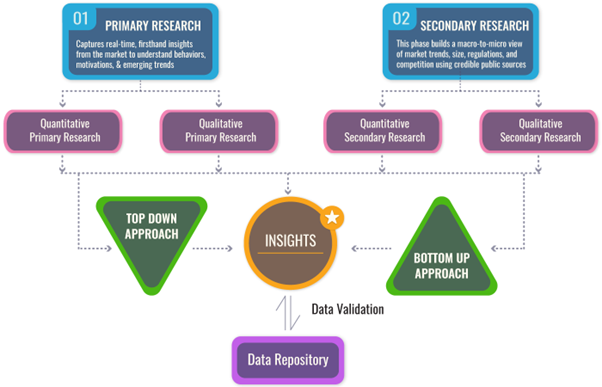
DUAL MODELING: TOP-DOWN + BOTTOM-UP
To ensure robust market estimation, we apply two complementary sizing approaches:
Top-Down Modeling:- Start with broader industry value (e.g., global or regional TAM)
- Apply filters by segment, geography, end-user, or use case
- Adjust with primary insights and validation benchmarks
- Ideal for investor-grade market scans and opportunity mapping
- Aggregate from the ground up using sales volumes, pricing, and unit economics
- Use internal modeling templates aligned with stakeholder data
- Incorporate distributor-level or region-specific inputs
- Most accurate for emerging segments and granular sub-markets
DATA VALIDATION: IN-HOUSE REPOSITORY
We close the loop with proprietary data intelligence built from ongoing projects, industry monitoring, and historical benchmarking. This repository includes:
- Multi-sector market and pricing models
- Key trendlines from past interviews and forecasts
- Benchmarked adoption rates, churn patterns, and ROI indicators
- Industry-specific deviation flags and cross-check logic
- Catches inconsistencies early
- Aligns projections across studies
- Enables consistent, high-trust deliverables