

Gynecology Lasers Market Size and Forecast (2026–2034), Global and Regional Growth, Trend, Share and Industry Analysis Report Coverage; By Laser Type (CO2 Lasers, Diode Lasers, Nd:YAG Lasers, Er:YAG Lasers, Hybrid Lasers, Others); By Application (Gynecological Surgery, Vaginal Rejuvenation, Stress Urinary Incontinence Treatment, Cervical Dysplasia Treatment, Endometriosis Surgery, Genital Lesion Removal, Hysteroscopic Procedures, Others); By Technology (Continuous Wave Lasers, Pulsed Lasers, Fractional Lasers); By End User (Hospitals, Ambulatory Surgical Centers, Specialty Gynecology Clinics, Cosmetic & Aesthetic Clinics); and Geography
2026-09-25
Healthcare
Swetal (Research Analyst)
Description
Gynecology Lasers Market Overview
The global Gynecology
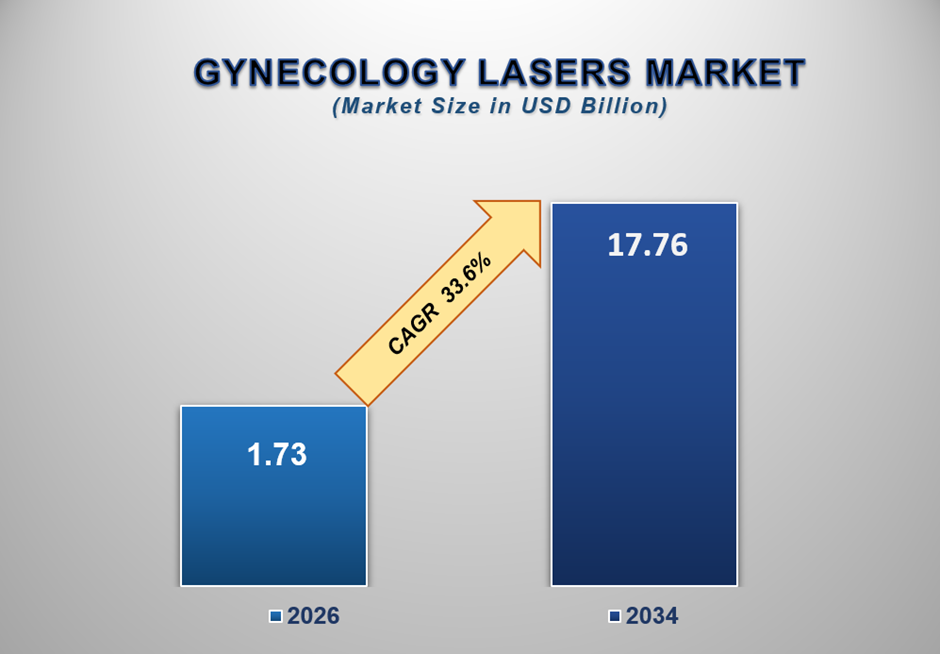
Lasers Market was valued at USD 1.73 billion in 2026 and is
projected to reach USD 17.76 billion by 2034, expanding at a CAGR of
33.6% during the forecast period. The market is experiencing strong growth
due to increasing demand for minimally invasive gynecological procedures,
rising prevalence of gynecological disorders, growing adoption of
laser-assisted surgery, expansion of specialized women's healthcare facilities,
increasing outpatient treatment volumes, and continuous advancements in laser
energy-delivery technologies.
Gynecology
lasers are specialized medical laser systems designed to deliver controlled
energy during surgical, therapeutic, and selected functional gynecological
procedures. These systems use different wavelengths and delivery mechanisms to
cut, ablate, vaporize, coagulate, or remodel targeted tissue while enabling
physicians to control the depth and extent of treatment. Current market
offerings include CO2, diode, Nd:YAG, Er:YAG, hybrid, and other specialized
laser systems.
The increasing
preference for minimally invasive treatment is creating substantial demand for
gynecological laser technologies. Laser systems can provide highly localized
tissue interaction and can support procedures where precision, controlled
ablation, coagulation, hemostasis, and limited disruption of surrounding tissue
are important clinical considerations.
Gynecological
lasers are used across a broad range of applications, including selected
cervical procedures, endometriosis surgery, lesion removal, laparoscopic
interventions, hysteroscopic procedures, and other specialized gynecological
surgeries. The technology has also expanded into functional women's health
applications involving tissue remodeling and selected treatments associated
with urinary incontinence and vaginal tissue conditions.
CO2 lasers
continue to have a strong position because of their established use in
soft-tissue surgery and ablation. Other wavelengths are gaining importance as
manufacturers develop systems designed to provide different tissue penetration,
coagulation, thermal, and ablative characteristics. The availability of
multiple wavelengths allows healthcare providers to select laser technology
according to procedure requirements.
Advancements in
laser delivery systems are further supporting market development. Manufacturers
are introducing specialized handpieces, fiber-based delivery systems, scanning
technologies, adjustable pulse modes, and multifunctional platforms designed to
support a broader range of gynecological procedures.
The expansion of
ambulatory surgical centers and specialty gynecology clinics is also increasing
the addressable market. Healthcare providers are increasingly evaluating
technologies that can support outpatient procedures and improve procedural
efficiency while reducing dependence on larger surgical infrastructures.
The market is
additionally benefiting from increasing physician education and professional
training. Laser-based gynecology requires knowledge of tissue interaction,
energy parameters, delivery techniques, patient selection, and
procedure-specific protocols. Manufacturers are therefore increasingly
combining equipment sales with clinical education and professional workshops to
encourage appropriate adoption.
At the same
time, regulatory and clinical considerations remain important, particularly for
energy-based treatments promoted for cosmetic or functional indications. Market
participants must differentiate established surgical applications from emerging
applications where evidence, regulatory status, and professional
recommendations may vary. As healthcare providers increasingly prioritize
precision, minimally invasive treatment, outpatient care, and specialized
women's health services, the gynecology lasers market is expected to maintain
strong growth through 2034.
Gynecology Lasers Market Drivers and
Opportunities
Increasing
Preference for Minimally Invasive Gynecological Procedures Is Driving Market
Growth
The increasing
preference for minimally invasive gynecological procedures is one of the
primary factors driving the gynecology lasers market.
Gynecological
conditions can require procedures ranging from localized cervical interventions
to laparoscopic, hysteroscopic, and other surgical treatments. Healthcare
providers are increasingly evaluating technologies that allow physicians to
perform these interventions with precise and controlled tissue interaction.
Laser systems
can provide cutting, ablation, vaporization, coagulation, and hemostasis
capabilities depending on the wavelength and system configuration. This
versatility enables the same technology platform to support multiple procedural
requirements across gynecological departments.
Minimally
invasive treatment can also support healthcare providers seeking shorter
procedures, controlled blood loss, reduced tissue disruption, and faster
recovery when clinically appropriate. These considerations are particularly
relevant as hospitals and ambulatory facilities seek to increase procedural
efficiency.
The expansion of
outpatient gynecological care is strengthening this trend. Laser systems that
can be deployed in ambulatory surgical centers and specialty clinics provide
manufacturers with additional opportunities beyond conventional hospital
operating rooms.
Growing
awareness of women's health conditions is also increasing demand for specialist
treatment. Conditions such as endometriosis, cervical abnormalities, genital
lesions, and pelvic-floor-related disorders require appropriate diagnostic and
therapeutic management, creating a broader clinical environment for advanced
gynecological technologies. Current industry analysis identifies minimally
invasive treatment adoption, high-precision procedures, outpatient treatment
expansion, and increasing demand for laser-based tissue ablation as important
market trends.
Advancements
in Laser Technology and Expansion of Specialized Women's Healthcare Are
Supporting Market Expansion
Technological
advancement is significantly influencing the development of the gynecology
lasers market.
Manufacturers
are developing laser platforms with improved energy control, specialized
treatment modes, ergonomic handpieces, scanning systems, and multiple
wavelength configurations. These improvements can provide physicians with
greater flexibility when treating different tissue types and performing
different procedures.
CO₂ systems
remain important for precise soft-tissue procedures, while Er:YAG and Nd:YAG
technologies are increasingly incorporated into multifunctional gynecology
platforms. Fotona, for example, offers systems combining Er:YAG and Nd:YAG
wavelengths and positions these technologies for applications ranging from
minimally invasive and ablative treatments to selected functional gynecology
procedures.
The development
of fractional and controlled-pulse technologies is also creating new
possibilities for tissue remodeling applications. Fractional treatment
approaches can deliver energy to selected microscopic treatment zones,
supporting controlled thermal effects while limiting treatment across
surrounding areas.
Specialized
women's healthcare clinics are another important source of growth. These
facilities can focus on gynecological surgery, urogynecology, functional
women's health, or aesthetic gynecology and may therefore have a greater
willingness to invest in dedicated laser systems.
Physician
training is becoming increasingly important as the technology becomes more
specialized. Manufacturers are expanding educational activities to demonstrate
appropriate treatment parameters, procedural workflows, and technology
applications. This combination of technological development and professional
education is expected to support wider adoption.
Expansion of
Functional Gynecology and Outpatient Laser Centers Presents Significant
Opportunities
The expansion of
specialized functional gynecology and outpatient women's healthcare services
presents substantial opportunities for laser manufacturers.
Specialty
clinics can provide an attractive commercial channel because they often focus
on high-volume or specialized procedures and can make equipment purchasing
decisions more rapidly than large hospital systems. Multifunctional laser
systems are particularly attractive because one platform can potentially
support several approved procedures.
Functional
gynecology represents another area of commercial opportunity. Laser
manufacturers have developed systems for applications involving stress urinary
incontinence, vaginal tissue conditions, lesion treatment, scar management, and
other specialized women's health procedures. Fotona, for example, lists
gynecological applications including HPV lesion removal, condyloma treatment,
surgical procedures, urinary incontinence-related treatments, vaginal
relaxation, and genitourinary syndrome of menopause.
However, the
opportunity is accompanied by an important regulatory requirement.
Manufacturers and clinics must ensure that product claims correspond with
authorized indications and available clinical evidence. This is particularly
important for cosmetic and energy-based vaginal treatments, where clinical
evidence and regulatory positioning can differ from established surgical
indications.
Emerging
healthcare markets also offer long-term opportunities. Expanding private
hospitals, specialist clinics, medical tourism, increasing healthcare
expenditure, and greater access to advanced women's healthcare can support
adoption across Asia Pacific, Latin America, and selected Middle Eastern
markets.
Gynecology Lasers Market Scope
|
Report Attributes |
Description |
|
Market Size in 2026 |
USD 1.73 Billion |
|
Market Forecast in 2034 |
USD 17.76 Billion |
|
CAGR % 2026-2034 |
33.6% |
|
Base Year |
2025 |
|
Historic Data |
2021-2025 |
|
Forecast Period |
2026-2034 |
|
Report USP |
Production, Consumption,
Company Share, Company Heatmap, Company Production, Service Type, Growth
Factors and more |
|
Segments Covered |
• By Laser Type • By Application • By Technology • By End User |
|
Regional Scope |
● North America |
|
Country Scope |
U.S. |
Gynecology Lasers Market Report
Segmentation Analysis
The global
gynecology laser market industry analysis is segmented by laser type, by
application, by technology, by end user, and by region.
The CO2
Lasers Segment Is Expected to Dominate the Market During the Forecast Period
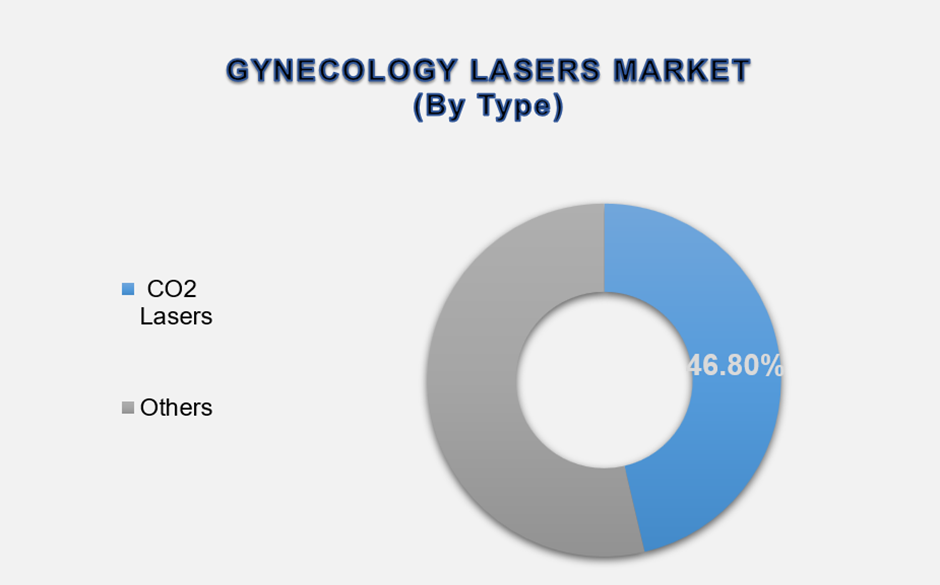
The CO2
Lasers segment accounted for approximately 46.8% of the global
gynecology lasers market, making it the dominant laser-type category.
CO₂ lasers have
an established position in gynecological surgery because their energy is
strongly absorbed by water-containing biological tissue, enabling precise
soft-tissue ablation, vaporization, cutting, and selected coagulation
applications.
The technology
has been used across gynecological procedures involving cervical tissue,
lesions, and other soft-tissue interventions. Its established clinical
familiarity provides an important advantage when hospitals and specialist
clinics evaluate capital equipment purchases.
CO2 laser
platforms are also evolving through improved delivery mechanisms, articulated
systems, scanning technologies, adjustable power controls, and specialized
handpieces. These improvements are helping manufacturers maintain the relevance
of CO2 systems while expanding procedural flexibility.
The
Gynecological Surgery Segment Is Expected to Dominate the Market by Application
The Gynecological
Surgery segment accounted for approximately 57.4% of the global
gynecology lasers market, representing the largest application category.
Gynecological
surgery encompasses a broad range of procedures where laser energy can be used
for cutting, ablation, vaporization, coagulation, and hemostasis.
The broad
procedural applicability of laser systems supports their use across hospitals,
ambulatory surgical centers, and specialty gynecology facilities. Laser
technologies can be incorporated into selected cervical, laparoscopic,
hysteroscopic, lesion-related, and other minimally invasive procedures
depending on the device and its authorized indications.
The established
nature of surgical applications also provides a stronger clinical and
regulatory foundation compared with some emerging cosmetic or functional uses.
The
Continuous Wave Lasers Segment Is Expected to Hold a Significant Share of the
Market by Technology
The Continuous
Wave Lasers segment represents a significant share of the market because
continuous energy delivery remains relevant for surgical applications requiring
sustained cutting, vaporization, or coagulation.
Continuous-wave
CO2 laser systems have a long history of use in medical and gynecological
procedures. Their established operating principles and physician familiarity
continue to support adoption in surgical environments.
At the same
time, pulsed and fractional technologies are gaining importance for procedures
where controlled energy delivery or tissue remodeling is required. The
increasing availability of multiple operating modes is allowing manufacturers
to address a broader range of clinical requirements.
The Hospitals
Segment Is Expected to Dominate the Market by End User
The Hospitals
segment is expected to account for the largest market share because hospitals
perform a wide range of gynecological surgical procedures and have established
infrastructure for advanced medical technologies.
Large hospitals
can utilize laser platforms across multiple departments and procedures,
improving equipment utilization and supporting the economics of capital
investment.
Hospitals also
benefit from access to specialist gynecologists, operating rooms, imaging
systems, anesthesia services, and multidisciplinary teams. These factors make
them important adoption centers for advanced gynecological laser systems.
Ambulatory
surgical centers and specialty gynecology clinics are expected to experience
strong growth as healthcare systems increasingly shift appropriate procedures
toward outpatient settings.
The following segments are part of an in-depth analysis of the global Gynecology Lasers Market:
|
Market Segments |
|
|
By Laser Type |
- CO2 Lasers - Diode Lasers - Nd:YAG Lasers - Er:YAG Lasers - Hybrid Lasers - Others |
|
By Application |
- Gynecological
Surgery - Vaginal
Rejuvenation - Stress Urinary
Incontinence Treatment - Cervical
Dysplasia Treatment - Endometriosis
Surgery - Genital Lesion
Removal - Hysteroscopic
Procedures - Others |
|
By Technology |
- Continuous Wave
Lasers - Pulsed Lasers - Fractional
Lasers |
|
By End User |
- Hospitals - Ambulatory
Surgical Centers - Specialty
Gynecology Clinics - Cosmetic &
Aesthetic Clinics |
Gynecology Lasers Market Share
Analysis By Region
North America is projected to hold the largest share of the global gynecology
lasers market over the forecast period.
North America
accounted for approximately 38.2% of the global market in 2026,
supported by advanced healthcare infrastructure, high adoption of minimally
invasive surgical technologies, established specialist gynecological services,
strong medical-device distribution networks, and substantial healthcare
expenditure. The United States remains the dominant contributor due to
its large hospital and ambulatory surgical center network and high adoption of
advanced medical technologies. Industry market assessments also identify North
America as the largest regional market, while Asia Pacific is among the
fastest-growing regions.
Europe represents a significant market due to its established healthcare
systems, specialist gynecology facilities, strong medical technology ecosystem,
and increasing emphasis on minimally invasive procedures. Germany, the U.K.,
France, Italy, Spain, and Switzerland are important regional markets.
European demand is influenced by clinical evidence, healthcare procurement
policies, reimbursement conditions, and regulatory requirements.
Asia Pacific is expected to register strong growth during the forecast period.
Increasing healthcare expenditure, expansion of private hospitals, growing
access to specialist women's healthcare, rising awareness of minimally invasive
treatment, and increasing availability of advanced medical devices are
supporting market expansion. China, India, Japan, South Korea, and Australia
are major contributors. Industry reports identify Asia Pacific as one of the
fastest-growing regional markets for gynecology medical lasers.
Latin America is expected to experience steady growth due to the expansion of
private healthcare facilities, increasing adoption of minimally invasive
procedures, and growing demand for advanced gynecological services. Brazil,
Mexico, and Argentina represent key markets within the region.
Middle East
& Africa represents an emerging market
supported by investment in advanced hospitals, specialist clinics, medical
tourism, and women's healthcare infrastructure. Saudi Arabia, the UAE, and
South Africa are important markets, while broader adoption across the
region will depend on capital investment, physician training, regulatory
approvals, and availability of specialized service networks.
Gynecology
Lasers Market Competition Landscape Analysis
The global
gynecology lasers market is competitive, with companies differentiating
themselves through wavelength technology, treatment precision,
multifunctionality, clinical evidence, regulatory approvals, physician
training, distribution networks, and after-sales support.
Major laser
manufacturers are increasingly developing multifunctional platforms capable of
supporting several gynecological procedures. Product portfolios span CO2,
Er:YAG, Nd:YAG, diode, hybrid, and other laser technologies, allowing companies
to address different tissue-interaction requirements. Current market reports
identify companies including Quanta System, biolitec, DEKA, Fotona, LISA Laser
Products, Lumenis, Asclepion, INTERmedic, and Cynosure among the competitive
participants.
Lumenis
maintains an important position through its established medical laser portfolio
and international presence. Fotona competes through multifunctional platforms
combining Er:YAG and Nd:YAG technologies and has developed dedicated gynecology
applications and professional education programs.
DEKA, Asclepion,
Quanta System, Biolitec, LISA Laser Products, INTERmedic, and other specialist
manufacturers compete through differentiated laser platforms, specialized
delivery systems, and regional distribution networks.
Competition is
increasingly shifting from basic laser specifications toward complete clinical
solutions. Manufacturers are focusing on ergonomic handpieces, treatment
protocols, scanning systems, multiple wavelengths, software, physician
training, and service support.
Clinical
evidence and regulatory compliance are also becoming increasingly important
competitive factors. This is particularly relevant as the market expands into
functional and aesthetic gynecology, where product claims and clinical
indications require careful positioning.
Global
Gynecology Lasers Market Recent Developments News
●
In July 2026 – Market analysis continued to identify growing adoption of
minimally invasive gynecological laser procedures, expansion of outpatient
treatment, and development of high-precision laser systems as important market
trends.
●
In June 2026 – Industry reports continued to highlight multifunctional
gynecological laser platforms incorporating CO2, diode, Nd:YAG, Er:YAG, and
hybrid technologies for specialized women's health applications.
●
In 2026 – Fotona continued promoting its gynecology laser portfolio based
on complementary Er:YAG and Nd:YAG wavelengths for surgical, ablative, and
selected minimally invasive gynecological applications.
●
In February 2026 – Updated market research on gynecology medical lasers identified
increasing adoption of minimally invasive treatments, high-precision laser
procedures, outpatient laser treatment, and tissue-ablation applications as key
market trends.
●
In 2025-2026 – Manufacturers continued expanding physician education and
clinical evidence around laser-based gynecology. Fotona reports more than 40
peer-reviewed publications related to its SMOOTH Er:YAG gynecology treatments.
The Global
Gynecology Lasers Market is Dominated by a Few Large Companies, Such As
●
Lumenis Ltd.
●
Fotona d.d.
●
DEKA Medical
●
Alma Lasers
●
Asclepion Laser Technologies
GmbH
●
biolitec AG
●
Quanta System S.p.A.
●
Boston Scientific Corporation
●
Olympus Corporation
●
Hologic, Inc.
●
BISON Medical
●
INTERmedic S.A.
●
El.En. S.p.A.
●
LISA Laser Products GmbH
●
Cynosure, LLC
● Others
Frequently Asked Questions
Swetal (Research Analyst)
Swetal is a Research Analyst with 4+ years of experience specializing in healthcare market research, medical devices, healthcare IT, and medical technology industry analysis. Her expertise includes competitive intelligence, secondary research, market trend forecasting, and healthcare business insights across global healthcare ecosystems.
She contributes to advanced market research reports by analyzing regulatory frameworks, emerging healthcare technologies, competitive landscapes, and innovation trends shaping the medical industry. With a strong focus on accurate market intelligence, strategic insights, and healthcare industry trends, Swetal supports businesses in making informed, data-backed decisions in a rapidly transforming healthcare environment.
1.
Global Gynecology Lasers
Market Introduction and Market Overview
1.1. Objectives of the Study
1.2. Global Gynecology Lasers Market Scope and Market Estimation
1.2.1.
Global Gynecology Lasers Market
Size (US$ Million), Market CAGR (%), Market Forecast (2026 - 2034)
1.2.2.
Global Gynecology Lasers Market
Revenue Share (%) and Growth Rate (Y-o-Y) Analysis (2021 - 2034)
1.3. Market Segmentation
1.3.1.
By Laser Type of Global
Gynecology Lasers Market
1.3.2.
By Application of Global
Gynecology Lasers Market
1.3.3.
By Technology of Global
Gynecology Lasers Market
1.3.4.
By End User of Global
Gynecology Lasers Market
1.3.5.
Region of Global Gynecology
Lasers Market
1.4. Competition Coverage List of Market Participants
1.5. Market Definition: Gynecology Lasers Market
2.
Executive Summary
2.1. Demand Side Trends
2.2. Key Market Trends
2.3. Market Demand (US$ Million) Analysis 2021 – 2025 and Forecast, 2026
– 2034
2.4. Demand and Opportunity Assessment
2.5. Key Developments
2.6. Overview of Regulatory Landscape, Compliance Framework, and Industry
Standards
2.7. Market Entry Strategies
2.8. Market Dynamics
2.8.1.
Drivers
2.8.2.
Limitations
2.8.3.
Opportunities
2.8.4.
Impact Analysis of Drivers and
Restraints
2.9. Porter's Five Forces Analysis
2.10.
PEST Analysis
3.
Global Gynecology Lasers
Market Estimates & Historical Trend Analysis (2021 – 2025)
4.
Global Gynecology Lasers
Market Estimates & Forecast Trend Analysis, by Laser Type
4.1. Global Gynecology Lasers Market Revenue (US$ Million) Estimates and
Forecasts, by Laser Type, 2021 - 2034
4.1.1.
CO2 Lasers
4.1.2.
Diode Lasers
4.1.3.
Nd:YAG Lasers
4.1.4.
Er:YAG Lasers
4.1.5.
Hybrid Lasers
4.1.6.
Others
5.
Global Gynecology Lasers
Market Estimates & Forecast Trend Analysis, by Application
5.1. Global Gynecology Lasers Market Revenue (US$ Million) Estimates and
Forecasts, by Application, 2021 - 2034
5.1.1.
Gynecological Surgery
5.1.2.
Vaginal Rejuvenation
5.1.3.
Stress Urinary Incontinence
Treatment
5.1.4.
Cervical Dysplasia Treatment
5.1.5.
Endometriosis Surgery
5.1.6.
Genital Lesion Removal
5.1.7.
Hysteroscopic Procedures
5.1.8.
Others
6.
Global Gynecology Lasers
Market Estimates & Forecast Trend Analysis, by Technology
6.1. Global Gynecology Lasers Market Revenue (US$ Million) Estimates and
Forecasts, by Technology, 2021 - 2034
6.1.1.
Continuous Wave Lasers
6.1.2.
Pulsed Lasers
6.1.3.
Fractional Lasers
7.
Global Gynecology Lasers
Market Estimates & Forecast Trend Analysis, by End User
7.1. Global Gynecology Lasers Market Revenue (US$ Million) Estimates and
Forecasts, by End User, 2021 - 2034
7.1.1.
Hospitals
7.1.2.
Ambulatory Surgical Centers
7.1.3.
Specialty Gynecology Clinics
7.1.4.
Cosmetic & Aesthetic
Clinics
8.
Global Gynecology Lasers
Market Estimates & Forecast Trend Analysis, by Region
8.1. Global Gynecology Lasers Market Revenue (US$ Million) Estimates and
Forecasts, by Region, 2021 - 2034
8.1.1.
North America
8.1.2.
Europe
8.1.3.
Asia Pacific
8.1.4.
Middle East & Africa
8.1.5.
Latin America
9.
North America Gynecology
Lasers Market: Estimates & Forecast Trend Analysis
9.1. North America Gynecology Lasers Market Assessments & Key
Findings
9.1.1.
North America Gynecology Lasers
Market Introduction
9.1.2.
North America Gynecology Lasers
Market Size Estimates and Forecast (US$ Million) (2021 - 2034)
9.1.2.1.
By Laser Type
9.1.2.2.
By Application
9.1.2.3.
By Technology
9.1.2.4.
By End User
9.1.2.5.
By Country
9.1.2.5.1.
The U.S.
9.1.2.5.2.
Canada
10. Europe Gynecology Lasers Market: Estimates & Forecast Trend
Analysis
10.1.
Europe Gynecology Lasers Market
Assessments & Key Findings
10.1.1.
Europe Gynecology Lasers Market
Introduction
10.1.2.
Europe Gynecology Lasers Market
Size Estimates and Forecast (US$ Million) (2021 - 2034)
10.1.2.1.
By Laser Type
10.1.2.2.
By Application
10.1.2.3.
By Technology
10.1.2.4.
By End User
10.1.2.5.
By Country
10.1.2.5.1.
Germany
10.1.2.5.2.
Italy
10.1.2.5.3.
The U.K.
10.1.2.5.4.
France
10.1.2.5.5.
Spain
10.1.2.5.6.
Switzerland
10.1.2.5.7.
Rest of Europe
11. Asia Pacific Gynecology Lasers Market: Estimates & Forecast
Trend Analysis
11.1.
Asia Pacific Gynecology Lasers
Market Assessments & Key Findings
11.1.1.
Asia Pacific Gynecology Lasers
Market Introduction
11.1.2.
Asia Pacific Gynecology Lasers
Market Size Estimates and Forecast (US$ Million) (2021 - 2034)
11.1.2.1.
By Laser Type
11.1.2.2.
By Application
11.1.2.3.
By Technology
11.1.2.4.
By End User
11.1.2.5.
By Country
11.1.2.5.1.
China
11.1.2.5.2.
Japan
11.1.2.5.3.
India
11.1.2.5.4.
Australia
11.1.2.5.5.
South Korea
11.1.2.5.6.
Rest of Asia Pacific
12. Middle East & Africa Gynecology Lasers Market: Estimates &
Forecast Trend Analysis
12.1.
Middle East & Africa
Gynecology Lasers Market Assessments & Key Findings
12.1.1.
Middle East & Africa
Gynecology Lasers Market Introduction
12.1.2.
Middle East & Africa
Gynecology Lasers Market Size Estimates and Forecast (US$ Million) (2021 -
2034)
12.1.2.1.
By Laser Type
12.1.2.2.
By Application
12.1.2.3.
By Technology
12.1.2.4.
By End User
12.1.2.5.
By Country
12.1.2.5.1.
UAE
12.1.2.5.2.
Saudi Arabia
12.1.2.5.3.
South Africa
12.1.2.5.4.
Rest of Middle East &
Africa
13. Latin America Gynecology Lasers Market: Estimates & Forecast
Trend Analysis
13.1.
Latin America Gynecology Lasers
Market Assessments & Key Findings
13.1.1.
Latin America Gynecology Lasers
Market Introduction
13.1.2.
Latin America Gynecology Lasers
Market Size Estimates and Forecast (US$ Million) (2021 - 2034)
13.1.2.1.
By Laser Type
13.1.2.2.
By Application
13.1.2.3.
By Technology
13.1.2.4.
By End User
13.1.2.5.
By Country
13.1.2.5.1.
Brazil
13.1.2.5.2.
Mexico
13.1.2.5.3.
Argentina
13.1.2.5.4.
Rest of Latin America
14. Competition Landscape
14.1.
Global Gynecology Lasers Market
Product Mapping
14.2.
Global Gynecology Lasers Market
Concentration Analysis, by Leading Players / Innovators / Emerging Players /
New Entrants
14.3.
Global Gynecology Lasers Market
Tier Structure Analysis
14.4.
Global Gynecology Lasers Market
Concentration & Company Market Shares (%) Analysis, 2026
15. Company Profiles
15.1.
Lumenis Ltd.
15.1.1.
Company Overview & Key
Stats
15.1.2.
Financial Performance &
KPIs
15.1.3.
Product Portfolio
15.1.4.
SWOT Analysis
15.1.5.
Business Strategy & Recent
Developments
*Similar details would be provided for all
the players mentioned below
15.2.
Fotona d.d.
15.3.
DEKA Medical
15.4.
Alma Lasers
15.5.
Asclepion Laser Technologies
GmbH
15.6.
biolitec AG
15.7.
Quanta System S.p.A.
15.8.
Boston Scientific Corporation
15.9.
Olympus Corporation
15.10.
Hologic, Inc.
15.11.
BISON Medical
15.12.
INTERmedic S.A.
15.13.
El.En. S.p.A.
15.14.
LISA Laser Products GmbH
15.15.
Cynosure, LLC
15.16.
Others
16. Research Findings & Conclusion
17. Assumptions & Acronyms Used
18. Research Methodology
18.1.
External Databases
18.2.
Internal Proprietary Database
18.3.
Primary Research
18.4.
Secondary Research
18.5.
Assumptions
18.6.
Limitations
18.7.
Report FAQ
Our Research Methodology
"Insight without rigor is just noise."
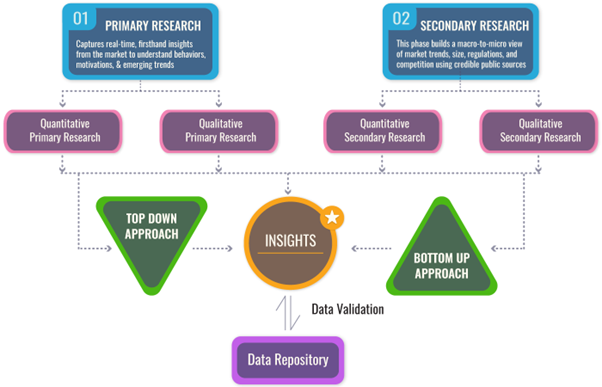
We follow a comprehensive, multi-phase research framework designed to deliver accurate, strategic, and decision-ready intelligence. Our process integrates primary and secondary research , both quantitative and qualitative , along with dual modeling techniques ( top-down and bottom-up) and a final layer of validation through our proprietary in-house repository.
PRIMARY RESEARCH
Primary research captures real-time, firsthand insights from the market to understand behaviors, motivations, and emerging trends.
1. Quantitative Primary Research
Objective: Generate statistically significant data directly from market participants.
Approaches:- Structured surveys with customers, distributors, and field agents
- Mobile-based data collection for point-of-sale audits and usage behavior
- Phone-based interviews (CATI) for market sizing and product feedback
- Online polling around industry events and digital campaigns
- Purchase frequency by customer type
- Channel performance across geographies
- Feature demand by application or demographic
2. Qualitative Primary Research
Objective: Explore decision-making drivers, pain points, and market readiness.
Approaches:- In-depth interviews (IDIs) with executives, product managers, and key decision-makers
- Focus groups among end users and early adopters
- Site visits and observational research for consumer products
- Informal field-level discussions for regional and cultural nuances
SECONDARY RESEARCH
This phase helps establish a macro-to-micro understanding of market trends, size, regulation, and competitive dynamics, sourced from credible and public domain information.
1. Quantitative Secondary Research
Objective: Model market value and segment-level forecasts based on published data.
Sources include:- Financial reports and investor summaries
- Government trade data, customs records, and regulatory statistics
- Industry association publications and economic databases
- Channel performance and pricing data from marketplace listings
- Revenue splits, pricing trends, and CAGR estimates
- Supply-side capacity and volume tracking
- Investment analysis and funding benchmarks
2. Qualitative Secondary Research
Objective: Capture strategic direction, innovation signals, and behavioral trends.
Sources include:- Company announcements, roadmaps, and product pipelines
- Publicly available whitepapers, conference abstracts, and academic research
- Regulatory body publications and policy briefs
- Social and media sentiment scanning for early-stage shifts
- Strategic shifts in market positioning
- Unmet needs and white spaces
- Regulatory triggers and compliance impact
DUAL MODELING: TOP-DOWN + BOTTOM-UP
To ensure robust market estimation, we apply two complementary sizing approaches:
Top-Down Modeling:- Start with broader industry value (e.g., global or regional TAM)
- Apply filters by segment, geography, end-user, or use case
- Adjust with primary insights and validation benchmarks
- Ideal for investor-grade market scans and opportunity mapping
- Aggregate from the ground up using sales volumes, pricing, and unit economics
- Use internal modeling templates aligned with stakeholder data
- Incorporate distributor-level or region-specific inputs
- Most accurate for emerging segments and granular sub-markets
DATA VALIDATION: IN-HOUSE REPOSITORY
We close the loop with proprietary data intelligence built from ongoing projects, industry monitoring, and historical benchmarking. This repository includes:
- Multi-sector market and pricing models
- Key trendlines from past interviews and forecasts
- Benchmarked adoption rates, churn patterns, and ROI indicators
- Industry-specific deviation flags and cross-check logic
- Catches inconsistencies early
- Aligns projections across studies
- Enables consistent, high-trust deliverables