

Hair Accessories Market Size and Forecast (2020 - 2033), Global and Regional Growth, Trend, Share and Industry Analysis Report Coverage; Product Type (Hair Bands, Scrunchies and Elastics, Claw Clips and Jaw Clips, Snap Clips, Bob Pins and Hair Pins, Hair Combs and Sticks, Tiaras and Decorative Hairpieces, Heatless Curling Tools and Styling Accessories, and Others), End User (Women, Men, and Kids), Price Range (Economy, Medium, and Premium), Distribution Channel (Hypermarkets and Supermarkets, Specialty Stores, Online Retail, and Others) and Geography
2026-02-04
Consumer Products
Jaya Bundele (Research Analyst)
Description
Hair
Accessories Market Overview
The global hair accessories market is
experiencing strong growth, driven
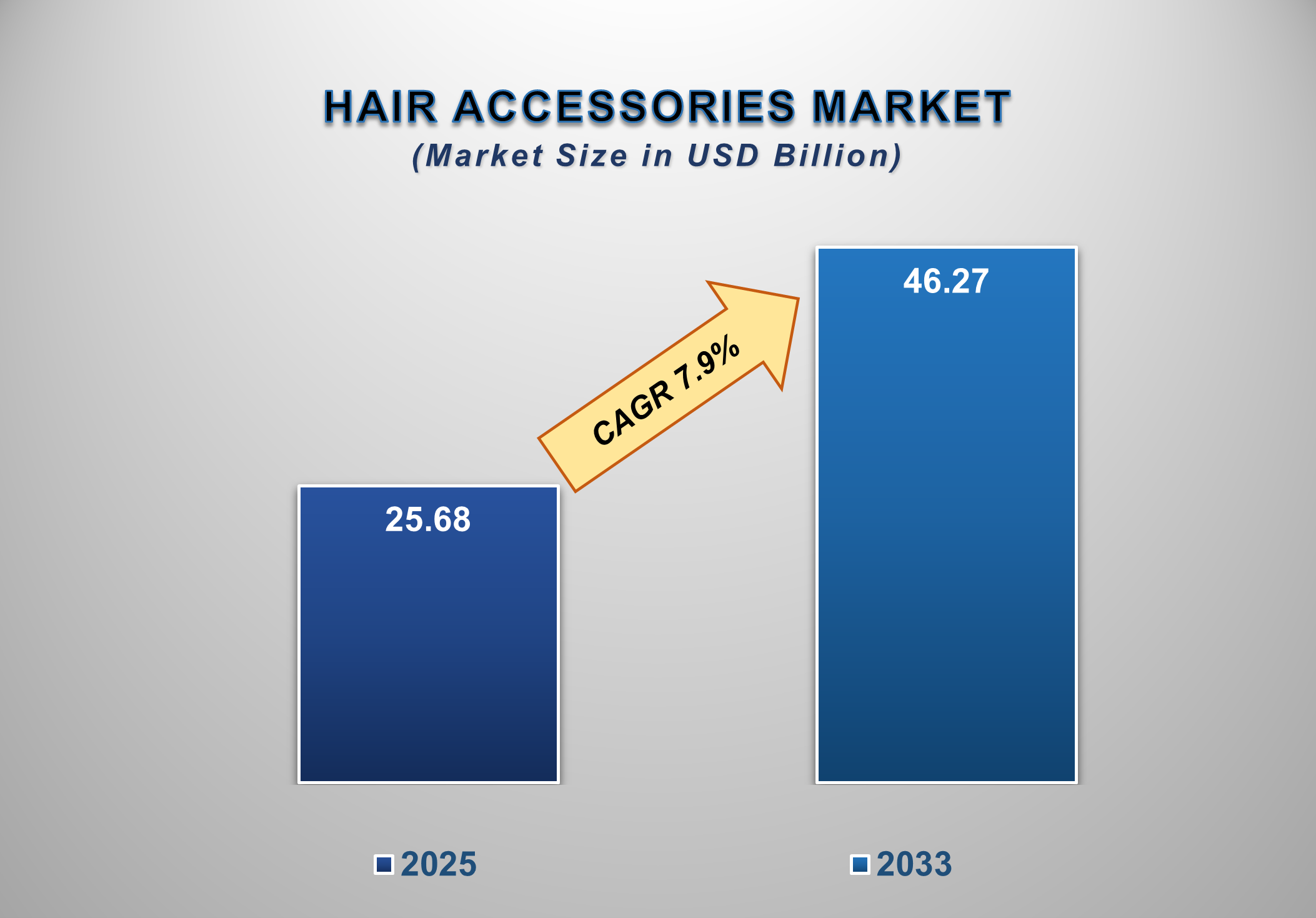
by rising fashion consciousness. Valued at USD 25.68 billion in 2025,
the market is projected to reach USD 46.27 billion by 2033, growing at a CAGR
of 7.9% during the forecast period.
The market for hair accessories is a
dynamic, fashion-driven subset of the larger personal grooming and lifestyle
sector. Hair bands, scrunchies and elastics, clips and pins, combs, ornamental
hairpieces, and styling accessories are just a few of the many items that fall
under this category. The category is both resilient and trend-sensitive, driven
by a combination of evolving fashion trends and everyday functional needs.
Convenience and adaptability are key
consumer preferences that shape the market. Elastics, scrunchies, and simple
clips are examples of everyday necessities that are in constant demand because
of their wide user base across age groups and regular replacement cycle. At the
same time, social media trends, celebrity influence, and seasonal styling
preferences help fashion-led products like tiaras, statement headbands, claw
clips, and adorned hairpieces. The popularity of minimalist aesthetics and
nostalgic trends has increased interest in traditional yet contemporary
designs.
Another important driver is product
innovation. Comfort-focused and hair-friendly materials, such satin or silk
scrunchies, snag-free elastics, and accessories that lessen hair breakage, are gaining
popularity. With the increasing usage of recycled plastics, biodegradable
materials, and environmentally friendly packaging, sustainability is becoming
more and more important. As people search for solutions that reduce hair
damage, heatless styling accessories are also becoming more popular.
Distribution methods have changed significantly, and social media and
e-commerce now play a big part in product sales and discovery. While physical
channels like supermarkets, specialty shops, salons, and fashion merchants
continue to encourage impulse and bulk purchases, online retail enables firms
to quickly debut new designs, evaluate trends, and reach global audiences.
Growing fashion consciousness,
urbanization, and higher grooming costs, especially among younger customers,
all contribute to regional demand. As a result, the market for hair accessories
is still very competitive and fragmented, with frequent product introductions,
rapidly shifting trends, and a balance between price, style, and usefulness.
Hair
Accessories Market Drivers and Opportunities
Growing Focus on Personal
Grooming and Appearance
The market for hair accessories is mostly
driven by a growing emphasis on personal grooming and self-expression.
Customers of all ages see hair accessories as fashion statements that improve
overall appearance in addition to being useful products. Growing consumer
awareness of grooming and styling, especially among younger consumers and
working professionals, keeps driving demand for hair accessories for both
everyday use and special events.
Influence of Fashion Trends and
Social Media
In this market, purchase behavior is
significantly influenced by fashion trends. Trend acceptance is accelerated by
the regular display of hairstyles paired with unique hair accessories by social
media platforms, influencers, and celebrities. Oversized claw clips, bold
headbands, and simple hair pins are examples of viral trends that can quickly
increase demand. The rapid fashion cycle promotes regular product updates,
which stimulate recurring purchases and stylistic experimentation.
Product Innovation and Material
Advancements
Another important driver is product
innovation. Comfort-focused and hair-friendly materials, such as satin or silk
scrunchies, snag-free elastics, and accessories designed to reduce hair
breakage, are gaining popularity. Sustainability is also becoming increasingly
important, with greater use of recycled plastics, biodegradable materials, and
eco-friendly packaging. Additionally, heatless styling accessories are
attracting consumers seeking solutions that minimize hair damage.
Expanding E-Commerce and
Omnichannel Retail
Distribution channels have evolved
significantly, with e-commerce and social media now playing a major role in
product discovery and sales. Online retail enables brands to quickly launch new
designs, test trends, and reach global audiences. Meanwhile, physical channels
such as supermarkets, specialty stores, salons, and fashion retailers continue
to support impulse buying and bulk purchases.
Rising Demand for
Sustainable and Eco-Friendly Products
Sustainability offers an excellent
opportunity to stand out from the competition. Hair accessories produced from
recycled, biodegradable, or ethically sourced materials are becoming more and
more popular. Brands may attract environmentally conscious consumers and foster
enduring brand loyalty by emphasizing sustainable packaging, ethical sourcing,
and reduced plastic usage.
Growth of Heatless and
Damage-Free Styling Solutions
Hair-friendly and damage-free styling
choices are becoming more and more popular. Customers looking for better hair
care regimens are catered to with heatless curling tools and mild styling
accessories. Innovation, education-driven marketing, and premium positioning
are all possible in this industry.
Customization and
Premiumization
Premium and personalized hair accessories
are becoming more popular, especially in the gift, bridal, and occasion-based
markets. Brands can target higher-margin niches while satisfying consumer
desire for distinctive, expressive products by utilizing custom colors,
monogramming, handcrafted designs, and luxury finishes.
Emerging Markets and Youth
Demographics
Opportunities for long-term growth are
created by emerging markets' growing urbanization, fashion consciousness, and
disposable income. Younger demographics also make up a significant market for
fashionable, reasonably priced, and regularly updated hair accessory
collections due to their exposure to digital media and changing fashion
standards.
Hair Accessories Market Scope
|
Report Attributes |
Description |
|
Market Size in 2025 |
USD 25.68
Billion |
|
Market Forecast in 2033 |
USD 46.27
Billion |
|
CAGR % 2025-2033 |
7.9% |
|
Base Year |
2024 |
|
Historic Data |
2020-2024 |
|
Forecast Period |
2025-2033 |
|
Report USP |
Comprehensive
global hair accessories market size and forecast analysis, product type and
distribution channel assessment, end-user consumption trends, retail and
online sales performance evaluation, regional and country-level market
insights, competitive landscape and market share analysis, design and
material innovation trends, digital transformation and e-commerce impact,
growth drivers, challenges, opportunities, and strategic insights for hair
accessory manufacturers, retailers, and investors. |
|
Segments Covered |
●
By Product Type ●
By End User ●
By Price Range ●
By Distribution Channel |
|
Regional Scope |
●
North America ●
Europe ●
APAC ●
Latin America ●
Middle East and Africa |
|
Country Scope |
1)
U.S. 2)
Canada 3)
U.K. 4)
Germany 5)
France 6)
Italy 7)
Spain 8)
Switzerland 9)
China 10) India 11) Japan 12) South Korea 13) Australia 14) Mexico 15) Brazil 16) Argentina 17) Saudi Arabia 18) UAE 19) South Africa |
Hair Accessories Market
Report Segmentation Analysis
The global Hair Accessories Market
analysis is segmented by Product Type, End User, Price Range, Distribution
Channel, and Region.
Scrunchies and elastics segment
dominated the market in 2025 and is projected to grow at the highest CAGR
during the forecast period.
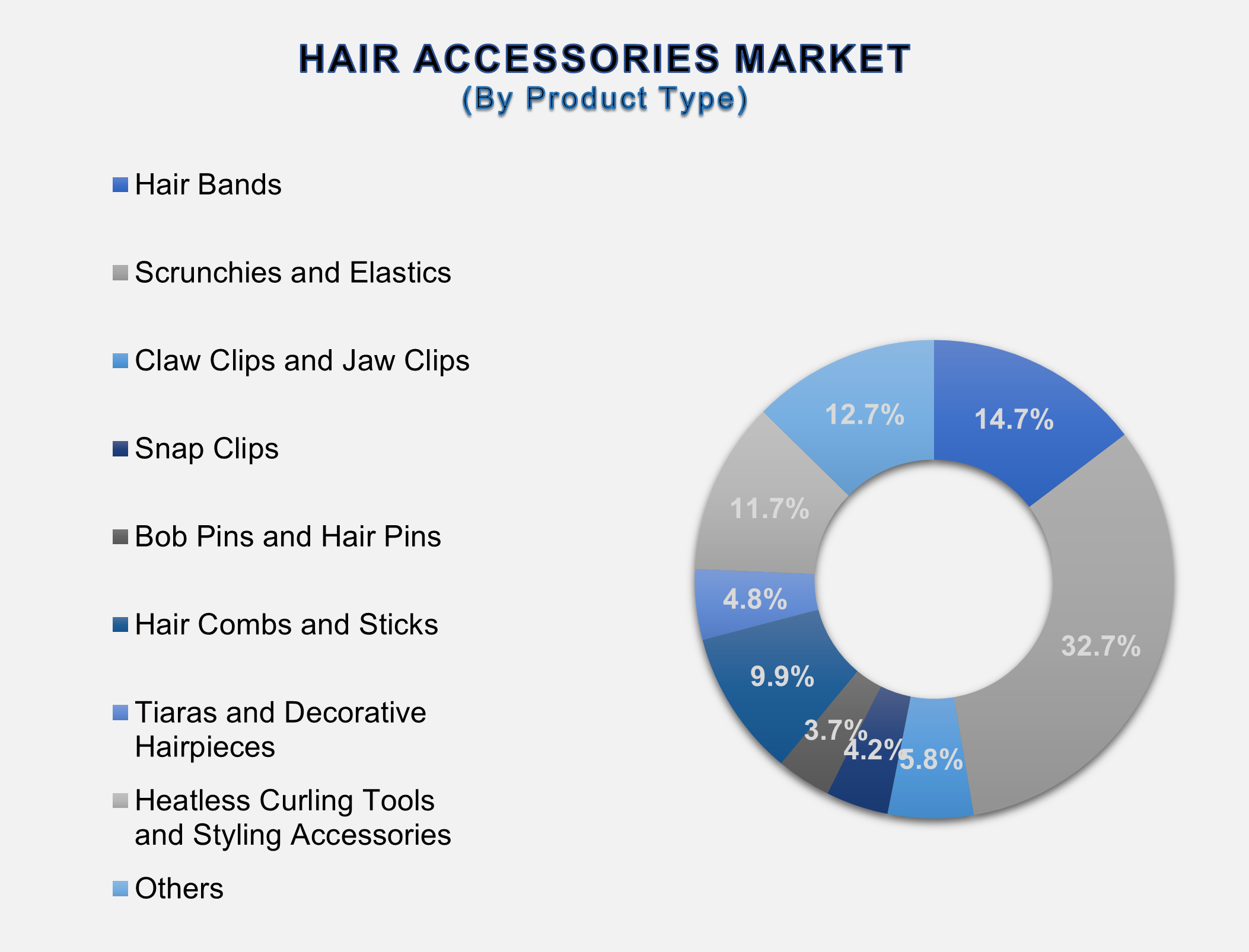
By Product Type, the hair accessories market
is segmented into hair bands, scrunchies and elastics, claw clips and jaw
clips, snap clips, bob pins and hair pins, hair combs and sticks, tiaras and
decorative hairpieces, heatless curling tools and styling accessories, and
others. The scrunchies and elastics segment accounts for the largest share of
the global hair accessories market. Essential hair accessories for daily
styling, scrunchies and elastics are useful, reasonably priced, and versatile.
They are popular for casual hairstyles, buns, and ponytails throughout all age
groups. Their ongoing appeal is bolstered by the rising need for snag-free,
fabric-based, and hair-friendly materials.
Women hold the highest
share of the End User Segment over the forecast period
Based on end user, the market is
bifurcated into women, men, and kids. The
women segment accounts for the largest share of the market. The market for hair
accessories is driven mostly by women, who make up the largest customer segment
because they place a high value on grooming, style, and individual expression.
Women of all ages, from youth experimenting with trends to professionals seeking
polished looks, purchase the bulk of hair accessories, such as scrunchies,
headbands, decorative clips, and statement hairpieces. For instance, ornate
headbands and oversized claw clips frequently take over social media fashion
feeds, increasing demand. According to surveys, more than half of female
consumers purchase new hair accessories on a seasonal basis. Many of them own
ten or more distinctive pieces for everyday use, formal events, and travel,
representing both practical and fashionable applications.
Economy holds the highest share of the Price Range Segment over
the forecast period
Based on price range, the market is
bifurcated into economy, medium, and premium. The economy segment accounts for
the largest share of the market. Since hair accessories are affordable and
frequently purchased, the market benefits from consistent economic support.
Since many things are inexpensive, they can withstand economic downturns. For
instance, commonplace items with short replacement cycles, like elastics and
clips, are frequently impulsive purchases. Growing urban employment and rising
disposable incomes have increased grooming expenditures in emerging economies.
Supermarkets/Hypermarkets Segment will probably
dominate the market during the forecast period
In terms of distribution channel, the hair
accessories market is segmented into hypermarkets and supermarkets, specialty
stores, online retail, and others. The supermarkets/hypermarkets segment holds
the largest share of the hair accessories market. As high-traffic, mass-retail
outlets that promote widespread customer access and impulsive purchases,
supermarkets and hypermarkets are crucial to the hair accessories industry.
These stores usually set up displays with hair bands, elastics, clips, and seasonal
decorative items next to cosmetics, personal care aisles, and checkout areas.
Hair accessories are frequently included among the top impulse purchase
categories by major retailers including Walmart, Target, Carrefour, Tesco, and
Big Bazaar. Accessories also frequently contribute to double-digit percent
growth in the personal care sector year over year. Brands are able to target
mainstream consumers who prefer one-stop shopping for daily styling needs due
to their vast retail networks and promotional events.
The following
segments are part of an in-depth analysis of the global Hair Accessories Market:
|
Market
Segments |
|
|
By
Product Type |
●
Hair Bands ●
Scrunchies and
Elastics ●
Claw Clips and Jaw
Clips ●
Snap Clips ●
Bob Pins and Hair Pins ●
Hair Combs and Sticks ●
Tiaras and Decorative
Hairpieces ●
Heatless Curling Tools
and Styling Accessories ●
Others |
|
By
End User |
●
Women ●
Men ●
Kids |
|
By
Price Range |
●
Economy ●
Medium ●
Premium |
|
By
Mode of Sale |
●
Hypermarkets and
Supermarkets ●
Specialty Stores ●
Online Retail ●
Others |
Hair Accessories Market Share Analysis by Region
The Asia-Pacific region is
projected to hold the largest share of the global Hair Accessories Market over
the forecast period.
The Asia-Pacific region is projected to hold the
largest share of the global hair accessories market over the forecast period
and is also expected to be the fastest-growing region. The Asia-Pacific
region is a major development driver for the hair accessories industry due to
its big and young population, growing disposable incomes, and growing fashion
consciousness. Consumer spending on fashion and personal care is growing more
rapidly than in many developed countries, and major nations like China, India,
Japan, and South Korea jointly provide a significant share of the world's GDP
and purchasing power parity. The demand for trend-driven products as well as
everyday accessories has expanded due to urbanization and internet penetration,
creating strong regional market momentum.
Global
Hair Accessories Market Recent Developments News:
· In February 2025, Goody
and the fashion brand LoveShackFancy collaborated to create a limited-edition
line of 35 accessories, such as headbands with vintage floral motifs,
scrunchies, brushes, and clips, that combine practical accessories with fashion
aesthetics.
·
In March 2024, Claire's
expanded its retail distribution base by partnering with Walgreens to launch
its apparel and hair accessories in over 4,400 U.S. store locations.
The Global Hair Accessories Market is dominated by a few large
companies, such as
·
Goody Products Inc.
·
Conair Corporation (Scünci)
·
Claire’s Inc.
·
H&M Group
·
Forever 21, Inc.
·
Invisibobble
·
PuffCuff LLC
·
Lele Sadoughi
·
Fromm International
·
Silke London Ltd.
·
Annie International, Inc.
·
Bunzee Bands
·
Jennifer Behr LLC
·
France Luxe
·
Tangle Teezer Ltd.
·
Mason Pearson Bros Ltd.
·
Kitsch LLC
·
Sta-Rite Ginnie Lou
·
Evita Peroni
· Miniso
Frequently Asked Questions
Jaya Bundele (Research Analyst)
Jaya Bundele is a skilled Research Analyst with 4+ years of experience in market intelligence, consumer insights, competitive analysis, and industry forecasting across the consumer goods, agriculture, and food & beverage sectors. She specializes in market sizing, trend analysis, growth opportunity mapping, and strategic secondary research for global and regional markets.
Her expertise lies in transforming complex industry data into actionable business strategies that help organizations identify emerging trends, understand customer behavior, and gain a competitive edge. With a strong focus on data-driven insights, business intelligence, and future market trends, Jaya delivers high-quality research solutions aligned with evolving industry demands and market dynamics.
1.
Global Hair Accessories Market Introduction and Market Overview
1.1.
Objectives of the Study
1.2.
Global Hair Accessories Market Scope and Market Estimation
1.2.1.Global Hair
Accessories Overall Market Size (US$ Bn), Market CAGR (%), Market forecast (2025
- 2033)
1.2.2.Global Hair
Accessories Market Revenue Share (%) and Growth Rate (Y-o-Y) from 2020 - 2033
1.3.
Market Segmentation
1.3.1.Product Type
of Global Hair Accessories Market
1.3.2.End User of
Global Hair Accessories Market
1.3.3.Price Range of
Global Hair Accessories Market
1.3.4.Distribution
Channel of Global Hair Accessories Market
1.3.5.Region of
Global Hair Accessories Market
2.
Executive
Summary
2.1.
Demand Side Trends
2.2.
Key Market Trends
2.3.
Market Demand (US$ Bn) Analysis 2020 – 2024 and Forecast, 2025 – 2033
2.4.
Demand and Opportunity Assessment
2.5.
Market Dynamics
2.5.1.Drivers
2.5.2.Limitations
2.5.3.Opportunities
2.5.4.Impact
Analysis of Drivers and Restraints
2.6.
Porter’s Five Forces Analysis
2.7.
PEST Analysis
2.8.
Key Regulation
2.9.
Key Developments
2.10. Value
Chain / Ecosystem Analysis
3.
Global
Hair Accessories Market Estimates & Historical Trend Analysis (2020 - 2024)
4. Global Hair Accessories Market Estimates & Forecast Trend Analysis, by Product Type
4.1.
Global Hair Accessories Market Revenue (US$ Bn) Estimates and
Forecasts, by Product Type, 2020 - 2033
4.1.1.Hair Bands
4.1.2.Scrunchies
and Elastics
4.1.3.Claw Clips
and Jaw Clips
4.1.4.Snap Clips
4.1.5.Bob Pins and
Hair Pins
4.1.6.Hair Combs
and Sticks
4.1.7.Tiaras and
Decorative Hairpieces
4.1.8.Heatless
Curling Tools and Styling Accessories
4.1.9.Others
5. Global Hair Accessories Market Estimates & Forecast Trend Analysis, by End User
5.1.
Global Hair Accessories Market Revenue (US$ Bn) Estimates and
Forecasts, by End User, 2020 - 2033
5.1.1.Women
5.1.2.Men
5.1.3.Kids
6. Global Hair Accessories Market Estimates & Forecast Trend Analysis, by Price Range
6.1.
Global Hair Accessories Market Revenue (US$ Bn) Estimates and
Forecasts, by Price Range, 2020 - 2033
6.1.1.Economy
6.1.2.Medium
6.1.3.Premium
7. Global Hair Accessories Market Estimates & Forecast Trend Analysis, by Distribution Channel
7.1.
Global Hair Accessories Market Revenue (US$ Bn) Estimates and
Forecasts, by Distribution Channel, 2020 - 2033
7.1.1.Hypermarkets
and Supermarkets
7.1.2.Specialty
Stores
7.1.3.Online Retail
7.1.4.Others
8.
Global
Hair Accessories Market Estimates & Forecast Trend Analysis, by Region
8.1.
Global Hair Accessories Market Revenue (US$ Bn) Estimates and
Forecasts, by Region, 2020 - 2033
8.1.1.North America
8.1.2.Europe
8.1.3.Asia Pacific
8.1.4.Middle East
& Africa
8.1.5.Latin America
9.
North America Hair
Accessories Market: Estimates &
Forecast Trend Analysis
9.1.
North America Hair Accessories Market Assessments & Key
Findings
9.1.1.North America
Hair Accessories Market Introduction
9.1.2.North America
Hair Accessories Market Size Estimates and Forecast (US$ Billion) (2020 - 2033)
9.1.2.1. By Product Type
9.1.2.2. By End User
9.1.2.3. By Price Range
9.1.2.4. By Distribution Channel
9.1.2.5.
By Country
9.1.2.5.1.
The U.S.
9.1.2.5.2.
Canada
10.
Europe Hair
Accessories Market: Estimates &
Forecast Trend Analysis
10.1. Europe
Hair Accessories Market Assessments & Key Findings
10.1.1.
Europe Hair Accessories Market Introduction
10.1.2.
Europe Hair Accessories Market Size Estimates and Forecast (US$ Billion)
(2020 - 2033)
10.1.2.1. By Product Type
10.1.2.2. By End User
10.1.2.3. By Price Range
10.1.2.4. By Distribution Channel
10.1.2.5. By
Country
10.1.2.5.1.
Germany
10.1.2.5.2.
Italy
10.1.2.5.3.
U.K.
10.1.2.5.4.
France
10.1.2.5.5.
Spain
10.1.2.5.6.
Russia
10.1.2.5.7. Rest of Europe
11.
Asia Pacific Hair
Accessories Market: Estimates &
Forecast Trend Analysis
11.1. Asia
Pacific Hair Accessories Market Assessments & Key Findings
11.1.1.
Asia Pacific Hair Accessories Market Introduction
11.1.2.
Asia Pacific Hair Accessories Market Size Estimates and Forecast
(US$ Billion) (2020 - 2033)
11.1.2.1. By Product Type
11.1.2.2. By End User
11.1.2.3. By Price Range
11.1.2.4. By Distribution Channel
11.1.2.5.
By Country
11.1.2.5.1.
China
11.1.2.5.2.
Japan
11.1.2.5.3.
India
11.1.2.5.4.
Australia
11.1.2.5.5.
South Korea
11.1.2.5.6. Rest
of Asia Pacific
12.
Middle East & Africa Hair Accessories Market:
Estimates & Forecast Trend Analysis
12.1. Middle
East & Africa Hair Accessories Market Assessments & Key Findings
12.1.1.
Middle East & Africa Hair
Accessories Market Introduction
12.1.2.
Middle East & Africa Hair
Accessories Market Size Estimates and Forecast (US$ Billion) (2020 - 2033)
12.1.2.1. By Product Type
12.1.2.2. By End User
12.1.2.3. By Price Range
12.1.2.4. By Distribution Channel
12.1.2.5.
By Country
12.1.2.5.1.
UAE
12.1.2.5.2.
Saudi Arabia
12.1.2.5.3.
South Africa
12.1.2.5.4. Rest of MEA
13.
Latin America Hair
Accessories Market: Estimates &
Forecast Trend Analysis
13.1. Latin
America Event Industry Assessments & Key Findings
13.1.1.
Latin America Hair Accessories Market Introduction
13.1.2.
Latin America Hair Accessories Market Size Estimates and Forecast
(US$ Billion) (2020 - 2033)
13.1.2.1. By Product Type
13.1.2.2. By End User
13.1.2.3. By Price Range
13.1.2.4. By Distribution Channel
13.1.2.5.
By Country
13.1.2.5.1.
Brazil
13.1.2.5.2.
Mexico
13.1.2.5.3.
Argentina
13.1.2.5.4. Rest of LATAM
14.
Country Wise Market: Introduction
15. Competition
Landscape
15.1. Global
Hair Accessories Market Product Mapping
15.2. Global
Hair Accessories Market Concentration Analysis, by Leading Players / Innovators
/ Emerging Players / New Entrants
15.3. Global
Hair Accessories Market Tier Structure Analysis
15.4. Global
Hair Accessories Market Concentration & Company Market Shares (%) Analysis,
2024
16. Company
Profiles
16.1.
Goody Products Inc.
16.1.1.
Company Overview & Key Stats
16.1.2.
Financial Performance & KPIs
16.1.3.
Product Portfolio
16.1.4.
SWOT Analysis
16.1.5.
Business Strategy & Recent Developments
*
Similar details would be provided for all the players mentioned below
16.2.
Conair Corporation (Scünci)
16.3.
Claire’s Inc.
16.4.
H&M Group
16.5.
Forever 21, Inc.
16.6.
Invisibobble
16.7.
PuffCuff LLC
16.8.
Lele Sadoughi
16.9.
Fromm International
16.10.
Silke London Ltd.
16.11.
Annie International, Inc.
16.12.
Bunzee Bands
16.13.
Jennifer Behr LLC
16.14.
France Luxe
16.15.
Tangle Teezer Ltd.
16.16.
Mason Pearson Bros Ltd.
16.17.
Kitsch LLC
16.18.
Sta-Rite Ginnie Lou
16.19.
Evita Peroni
16.20.
Other Prominent Players
17.
Research
Methodology
17.1. External
Transportations / Databases
17.2. Internal
Proprietary Database
17.3. Primary
Research
17.4. Secondary
Research
17.5. Assumptions
17.6. Limitations
17.7. Report
FAQs
18.
Research
Findings & Conclusion
Our Research Methodology
"Insight without rigor is just noise."
We follow a comprehensive, multi-phase research framework designed to deliver accurate, strategic, and decision-ready intelligence. Our process integrates primary and secondary research , both quantitative and qualitative , along with dual modeling techniques ( top-down and bottom-up) and a final layer of validation through our proprietary in-house repository.
PRIMARY RESEARCH
Primary research captures real-time, firsthand insights from the market to understand behaviors, motivations, and emerging trends.
1. Quantitative Primary Research
Objective: Generate statistically significant data directly from market participants.
Approaches:- Structured surveys with customers, distributors, and field agents
- Mobile-based data collection for point-of-sale audits and usage behavior
- Phone-based interviews (CATI) for market sizing and product feedback
- Online polling around industry events and digital campaigns
- Purchase frequency by customer type
- Channel performance across geographies
- Feature demand by application or demographic
2. Qualitative Primary Research
Objective: Explore decision-making drivers, pain points, and market readiness.
Approaches:- In-depth interviews (IDIs) with executives, product managers, and key decision-makers
- Focus groups among end users and early adopters
- Site visits and observational research for consumer products
- Informal field-level discussions for regional and cultural nuances
SECONDARY RESEARCH
This phase helps establish a macro-to-micro understanding of market trends, size, regulation, and competitive dynamics, sourced from credible and public domain information.
1. Quantitative Secondary Research
Objective: Model market value and segment-level forecasts based on published data.
Sources include:- Financial reports and investor summaries
- Government trade data, customs records, and regulatory statistics
- Industry association publications and economic databases
- Channel performance and pricing data from marketplace listings
- Revenue splits, pricing trends, and CAGR estimates
- Supply-side capacity and volume tracking
- Investment analysis and funding benchmarks
2. Qualitative Secondary Research
Objective: Capture strategic direction, innovation signals, and behavioral trends.
Sources include:- Company announcements, roadmaps, and product pipelines
- Publicly available whitepapers, conference abstracts, and academic research
- Regulatory body publications and policy briefs
- Social and media sentiment scanning for early-stage shifts
- Strategic shifts in market positioning
- Unmet needs and white spaces
- Regulatory triggers and compliance impact
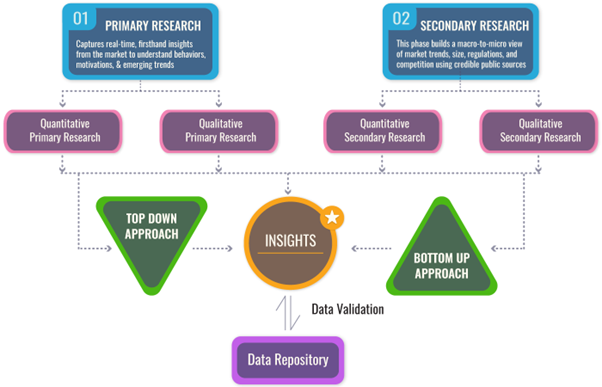
DUAL MODELING: TOP-DOWN + BOTTOM-UP
To ensure robust market estimation, we apply two complementary sizing approaches:
Top-Down Modeling:- Start with broader industry value (e.g., global or regional TAM)
- Apply filters by segment, geography, end-user, or use case
- Adjust with primary insights and validation benchmarks
- Ideal for investor-grade market scans and opportunity mapping
- Aggregate from the ground up using sales volumes, pricing, and unit economics
- Use internal modeling templates aligned with stakeholder data
- Incorporate distributor-level or region-specific inputs
- Most accurate for emerging segments and granular sub-markets
DATA VALIDATION: IN-HOUSE REPOSITORY
We close the loop with proprietary data intelligence built from ongoing projects, industry monitoring, and historical benchmarking. This repository includes:
- Multi-sector market and pricing models
- Key trendlines from past interviews and forecasts
- Benchmarked adoption rates, churn patterns, and ROI indicators
- Industry-specific deviation flags and cross-check logic
- Catches inconsistencies early
- Aligns projections across studies
- Enables consistent, high-trust deliverables