

Hair and Scalp Care Market Size and Forecast (2020-2033), Global and Regional Growth, Trend, Share, and Industry Analysis Report Coverage: By Product Type (Shampoo, Conditioner, Hair Oil, Serums & Masks, Treatment Products), By Distribution Channel (Supermarkets/Hypermarkets, Specialty Stores, Pharmacy & Drug Stores, Online Retail), By Application (Dandruff & Dryness, Hair Loss & Thinning, Damage Repair, Color Protection, and Others), and Geography
2025-12-05
Healthcare
Swetal (Research Analyst)
Description
Hair And Scalp Care Market Overview
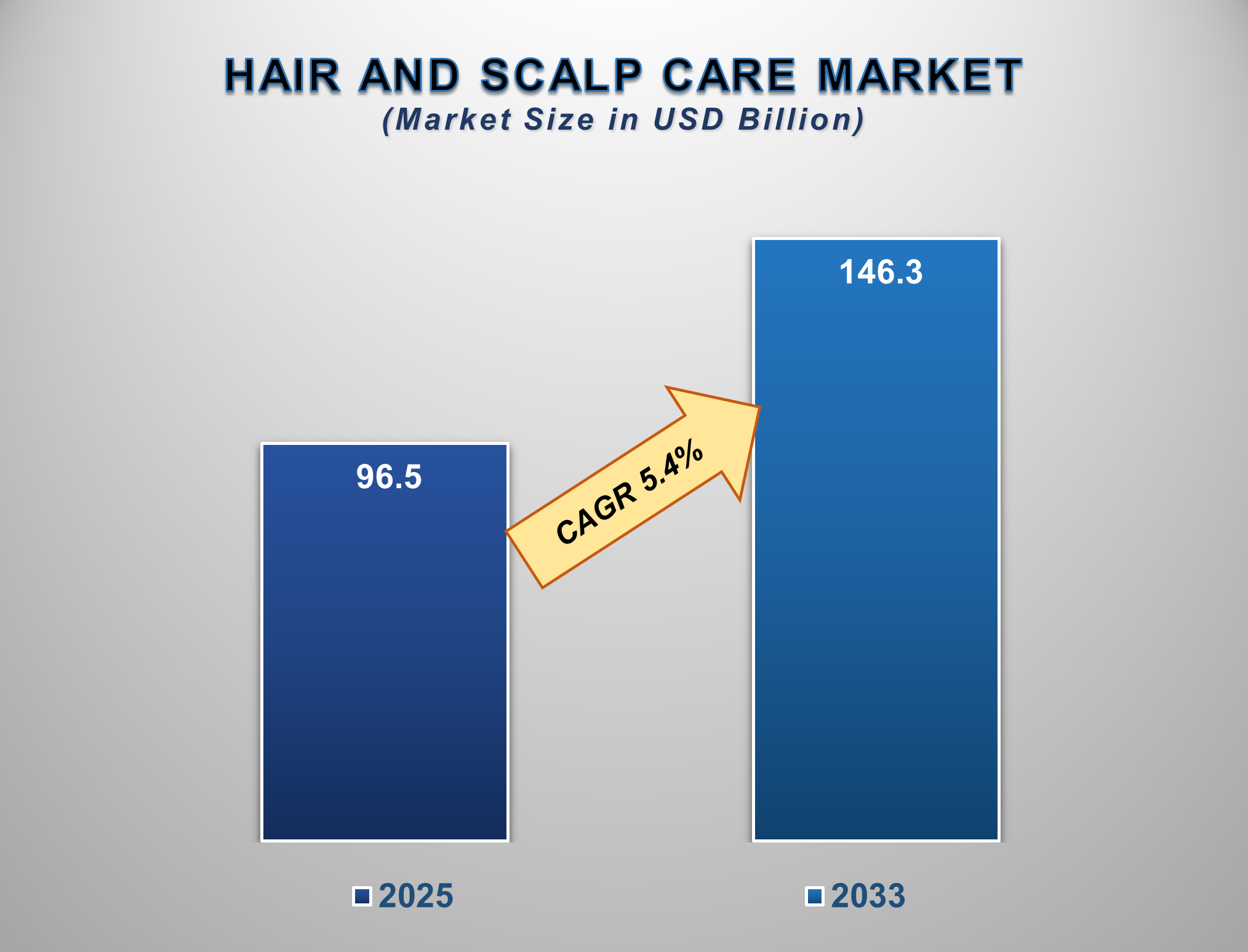
The Hair and Scalp Care Market is poised for robust growth from 2025 to 2033, fueled by rising consumer awareness of hair health, increasing prevalence of scalp disorders, and the influence of social media and beauty trends. The market is projected to be valued at approximately USD 96.5 billion in 2025 and is forecasted to reach nearly USD 146.3 billion by 2033, exhibiting a compound annual growth rate (CAGR) of 5.4% during this period.
Hair and scalp care products are essential
personal care items aimed at cleansing, conditioning, treating, and improving
the health and appearance of hair and the scalp. The market's expansion is
underpinned by a growing consumer shift from basic hair cleaning to holistic
scalp health and targeted solutions for specific concerns like hair fall,
dandruff, and damage. Factors such as pollution, stressful lifestyles, and
dietary changes are contributing to a higher incidence of scalp-related issues,
thereby driving demand for therapeutic and preventive products. Furthermore,
the rise of personalized beauty, the "clean beauty" movement, and the
integration of advanced active ingredients are key trends shaping product
innovation. North America and Asia-Pacific are the dominant regional markets,
with Asia-Pacific expected to be the fastest-growing, driven by a large
population, rising disposable incomes, and growing grooming consciousness among
both men and women.
Hair And Scalp
Care Market Drivers and Opportunities
Rising Prevalence of Scalp Disorders and Hair
Loss Concerns is the Primary Market Driver
The increasing global incidence of scalp
conditions and hair loss is the most significant driver of the hair and scalp
care market. Issues such as alopecia, seborrheic dermatitis (dandruff),
psoriasis, and general hair thinning affect a substantial portion of the global
population across all age groups and genders. Factors including genetic
predisposition, hormonal changes, pollution, and high-stress modern lifestyles
are exacerbating these problems. This has shifted consumer perception, viewing
these issues not just as cosmetic concerns but as genuine health problems
requiring effective treatment solutions. The desire to address these concerns
proactively is creating a sustained and expanding demand for clinically proven,
therapeutic, and functional hair care products.
The Influence of Social Media, E-commerce, and Evolving Beauty Standards is Driving
Market Evolution
The pervasive influence of social media
platforms, beauty influencers, and digital marketing is a major catalyst for
market growth. Platforms like Instagram, TikTok, and YouTube have become
primary sources for beauty education, product reviews, and trend discovery,
creating immediate and widespread demand for innovative and "viral"
products. This digital ecosystem, coupled with the seamless shopping experience
provided by e-commerce, allows consumers to easily access a global array of
brands. Furthermore, evolving beauty standards that celebrate diverse hair
types and textures, from natural curls to keratin-treated straight hair, are
pushing brands to develop specialized product lines, thereby fragmenting the
market and creating multiple growth niches.
The "Clean Beauty" Movement and
Technological Advancements in Active Ingredients Present Significant
Opportunities
The growing consumer demand for
"clean," natural, sustainable, and ethically produced beauty products
is creating a significant growth frontier for the hair care market. Key
opportunities lie in formulating products free from sulfates, parabens, and
silicones, using plant-based, organic, and biodegradable ingredients.
Simultaneously, technological advancements in active ingredients—such as the
use of peptides, probiotics, CBD oil, and advanced polymers for
bond-building—are creating premium, high-efficacy products that command higher
prices. For manufacturers, investing in R&D for novel bioactives, leveraging AI for personalized product recommendations,
and transparently marketing their sustainability credentials are key strategies
to capture value-conscious and ethically-driven consumers.
Hair And Scalp Care
Market Scope
|
Report Attributes |
Description |
|
Market Size in 2025 |
USD 96.5 Billion |
|
Market Forecast in 2033 |
USD 146.3 Billion |
|
CAGR % 2025-2033 |
5.4% |
|
Base Year |
2024 |
|
Historic Data |
2020-2024 |
|
Forecast Period |
2025-2033 |
|
Report USP |
Product Portfolio,
Technological Analysis, Company Market Share, Company Heatmap, Pricing
Analysis, Growth Factors and more |
|
Segments Covered |
●
By Product Type ●
By Application ●
By Distribution
Channel |
|
Regional Scope |
●
North America, ●
Europe, ●
APAC, ●
Latin America ●
Middle East and
Africa |
|
Country Scope |
1)
U.S. 2)
Canada 3)
Germany 4)
UK 5)
France 6)
Spain 7)
Italy 8)
Switzerland 9)
China 10)
Japan 11)
India 12)
Australia 13)
South Korea 14)
Brazil 15)
Mexico 16)
Argentina 17)
South Africa 18)
Saudi Arabia 19)
UAE |
Hair and Scalp Care
Market Report Segmentation Analysis
The global Hair and Scalp Care
Market industry analysis is segmented by Product Type, by Distribution Channel,
by Application, and by Region.
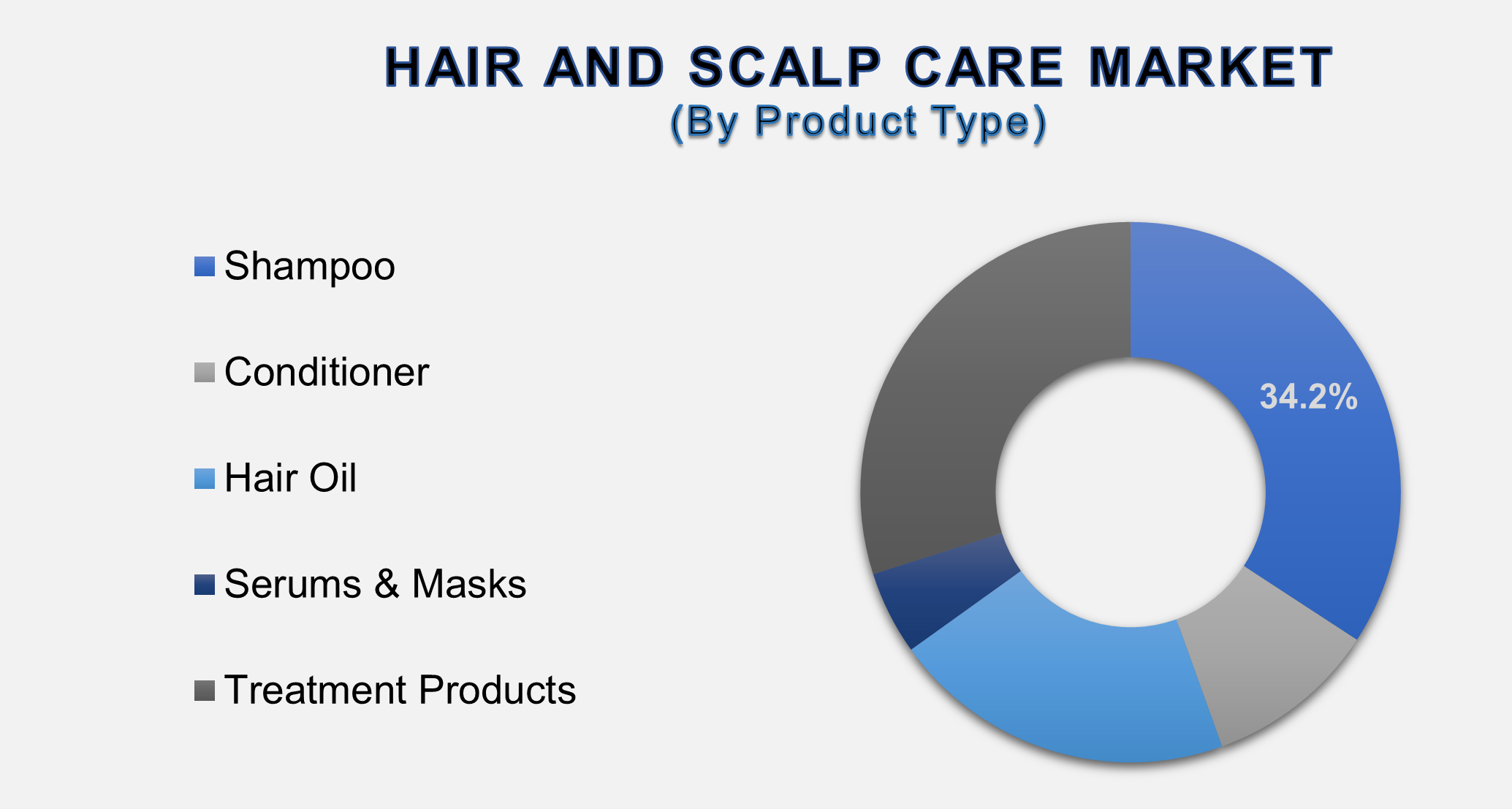
The Shampoo segment is
anticipated to command a significant market share in 2025.
The Product Type segment is categorized into
Shampoo, Conditioner, Hair Oil, Serums & Masks, and Treatment Products.
Shampoo remains the foundational and largest segment due to its status as a
non-negotiable, high-frequency use product for hygiene and basic care. Its
dominance is fueled by constant innovation in formulations targeting specific
needs (anti-dandruff, volumizing, color-safe), the introduction of 2-in-1
products, and the premiumization of the category with natural and salon-grade
ingredients. While treatment products and serums are growing faster, the
essential nature and high replacement rate of shampoo ensure its continued
leadership in market share.
The Online Retail distribution channel segment is
projected to be the fastest-growing.
The Distribution Channel segment is divided into Supermarkets/Hypermarkets, Specialty Stores, Pharmacy & Drug Stores, and Online Retail. The Online Retail segment is experiencing the highest growth rate, driven by the convenience of home delivery, access to a wider variety of brands and reviews, and the proliferation of direct-to-consumer (DTC) brands. E-commerce platforms offer personalized shopping experiences, subscription models, and detailed product information that physical stores cannot match. While supermarkets and specialty stores remain important for immediate purchases, the digital channel's ability to build communities and leverage influencer marketing is reshaping the industry's retail landscape.
The Hair Loss & Thinning application segment
is projected to exhibit strong growth.
The Application segment includes Dandruff &
Dryness, Hair Loss & Thinning, Damage Repair, and Color
Protection. The Hair Loss & Thinning segment is witnessing accelerated
growth due to the increasing prevalence of the condition and rising consumer
willingness to invest in preventive and treatment solutions. This includes not
just traditional topical treatments but also supplements, specialized shampoos,
and high-tech devices like laser combs. Growing awareness, destigmatization of hair loss, and product endorsements by dermatologists
are making this one of the most dynamic and lucrative segments within the
market.
The following segments are part of an in-depth analysis of
the global Hair and Scalp Care Market:
|
Market
Segments |
|
|
By Product
Type |
●
Shampoo ●
Conditioner ●
Hair Oil ●
Serums & Masks ●
Treatment Products |
|
By Application |
●
Dandruff &
Dryness ●
Hair Loss &
Thinning ●
Damage Repair ●
Colour Protection ●
Others |
|
By Distribution Channel |
●
Supermarkets/Hypermarkets ●
Specialty Stores ●
Pharmacies
& Drug Stores ●
Online Retail |
Hair and Scalp Care
Market Share Analysis by Region
The Asia Pacific region is anticipated to hold
the largest portion of the Hair and Scalp Care Market globally throughout the
forecast period.
Asia-Pacific's dominance is driven by its massive
population, deeply ingrained cultural emphasis on long, healthy hair, and a rapidly
growing middle class with increasing
disposable income. Countries like China, India, Japan, and South Korea are
major contributors, each with unique beauty rituals and a strong demand for
innovative and premium products. The region is a hotbed for beauty trends, from
K-beauty's multi-step routines to Ayurvedic ingredients from India. The high
concentration of manufacturing and the presence of both global giants and agile
local brands further solidify APAC's position as the largest and most dynamic
market for hair and scalp care.
The Indian hair care market is undergoing a
dramatic transformation, fueled by a powerful confluence of socio-economic and
digital factors. A significant driver is the rising disposable income of a
burgeoning middle class, which has empowered consumers to transition from
basic, utilitarian products to specialized and effective solutions. This shift
is accelerated by a growing prevalence of hair and scalp concerns, including
hair fall, dandruff, and sensitivity, exacerbated by pollution, stress, and
hard water. In response, consumers are proactively seeking targeted treatments,
a quest heavily influenced by digital media and beauty influencers on platforms
like Instagram and YouTube. These channels have educated the market on
ingredients like biotin and keratin, popularized multi-step routines, and
created demand for "clinic-grade" products. This has catalyzed the
'premiumization' or 'masstige' trend, where consumers are willing to pay a
premium for brands that offer scientific claims, natural ingredients, and
professional results. Consequently, the market's focus has evolved beyond mere
hair care to holistic scalp health, leading to the explosive growth of
specialized products like scalp scrubs and treatment serums, redefining
personal care routines across the country.
Hair and Scalp Care
Market Competition Landscape Analysis
The global hair and scalp care
market is fragmented and highly competitive, featuring a mix of global consumer
goods conglomerates, specialized professional brands, and a rapidly growing
number of indie and DTC startups. Competition is intense and based on brand
equity, marketing prowess, product innovation, pricing, and distribution
network strength. Key strategies include heavy investment in digital marketing
and influencer collaborations, continuous R&D to launch products with novel
claims (e.g., vegan, scalp microbiome-friendly), strategic acquisitions of
emerging brands, and expansion into untapped geographic and demographic
segments.
Global Hair and Scalp
Care Market Recent Developments News:
- In January 2025, L'Oréal S.A. launched a new line of customizable
hair serums powered by an AI-driven diagnostic tool on its e-commerce
platform.
- In November 2024, Procter & Gamble Co. introduced a new Head
& Shoulders formulation with prebiotics aimed at balancing the scalp
microbiome for long-lasting dandruff protection.
- In September 2024, Unilever PLC acquired a leading DTC brand
specializing in hair growth supplements to strengthen its portfolio in the
wellness-driven hair care segment.
- In July 2024, Kao Corporation expanded its premium "Kanchô"
hair care line across Southeast Asia, capitalizing on the region's demand
for Japanese luxury beauty products.
The Global Hair and Scalp
Care Market Is Dominated by a Few Large Companies, such as
●
L'Oréal S.A.
●
Procter & Gamble
Co.
●
Unilever PLC
●
Kao Corporation
●
Johnson & Johnson
Services, Inc.
●
The Estée Lauder
Companies Inc.
●
Shiseido Company,
Limited
●
Amorepacific
Corporation
●
KGaA
●
Coty Inc.
●
Beiersdorf AG (NIVEA)
●
Dabur India Ltd.
●
Marico Limited
●
Natura &Co
● Godrej Consumer Products Limited
Frequently Asked Questions
Swetal (Research Analyst)
Swetal is a Research Analyst with 4+ years of experience specializing in healthcare market research, medical devices, healthcare IT, and medical technology industry analysis. Her expertise includes competitive intelligence, secondary research, market trend forecasting, and healthcare business insights across global healthcare ecosystems.
She contributes to advanced market research reports by analyzing regulatory frameworks, emerging healthcare technologies, competitive landscapes, and innovation trends shaping the medical industry. With a strong focus on accurate market intelligence, strategic insights, and healthcare industry trends, Swetal supports businesses in making informed, data-backed decisions in a rapidly transforming healthcare environment.
1. Global Hair and Scalp Care
Market Introduction and Market Overview
1.1.
Objectives
of the Study
1.2.
Global
Hair and Scalp Care Market Scope and Market Estimation
1.2.1.Global Electronic Toll
Collection Overall Market Size (US$ Bn), Market CAGR (%), Market forecast (2025
- 2033)
1.2.2.Global Hair and Scalp Care
Market Revenue Share (%) and Growth Rate (Y-o-Y) from 2020 - 2033
1.3.
Market
Segmentation
1.3.1.Product Type of Global Hair
and Scalp Care Market
1.3.2.Application of Global Hair
and Scalp Care Market
1.3.3.Distribution Channel of Global
Hair and Scalp Care Market
1.3.4.Region of Global Hair and
Scalp Care Market
2.
Executive Summary
2.1.
Demand
Side Trends
2.2.
Key
Market Trends
2.3.
Market
Demand (US$ Bn) Analysis 2020 – 2024 and forecast, 2025 – 2033
2.4.
Demand
and Opportunity Assessment
2.5.
Technological
Advancements
2.6.
Key
Developments
2.7.
Market
Entry Strategies
2.8.
Market
Dynamics
2.8.1.Drivers
2.8.2.Limitations
2.8.3.Opportunities
2.8.4.Impact Analysis of Drivers
and Restraints
2.9.
Porter’s
Five Forces Analysis
2.10.
PEST
Analysis
3. Global
Hair and Scalp Care Market Estimates
& Historical Trend Analysis (2020 - 2024)
4. Global
Hair and Scalp Care Market Estimates
& Forecast Trend Analysis, by Product Type
4.1.
Global
Hair and Scalp Care Market Revenue (US$ Bn) Estimates and Forecasts, by Product
Type, 2020 - 2033
4.1.1.Shampoo
4.1.2.Conditioner
4.1.3.Hair Oil
4.1.4.Serums & Masks
4.1.5.Treatment Products
5. Global
Hair and Scalp Care Market Estimates
& Forecast Trend Analysis, by Application
5.1.
Global
Hair and Scalp Care Market Revenue (US$ Bn) Estimates and Forecasts, by Application,
2020 - 2033
5.1.1.Dandruff & Dryness
5.1.2.Hair Loss & Thinning
5.1.3.Damage Repair
5.1.4.Color Protection
5.1.5.Others
6. Global
Hair and Scalp Care Market Estimates
& Forecast Trend Analysis, by Distribution Channel
6.1.
Global
Hair and Scalp Care Market Revenue (US$ Bn) Estimates and Forecasts, by Distribution
Channel 2020 - 2033
6.1.1.Supermarkets/Hypermarkets
6.1.2.Specialty Stores
6.1.3.Pharmacy & Drug Stores
6.1.4.Online Retail
7. Global
Hair and Scalp Care Market Estimates
& Forecast Trend Analysis, by region
7.1.
Global
Hair and Scalp Care Market Revenue (US$ Bn) Estimates and Forecasts, by region,
2020 - 2033
7.1.1.North America
7.1.2.Europe
7.1.3.Asia Pacific
7.1.4.Middle East & Africa
7.1.5.Latin America
8. North America Hair
and Scalp Care Market: Estimates &
Forecast Trend Analysis
8.1. North America Hair and
Scalp Care Market Assessments & Key Findings
8.1.1.North America Hair and
Scalp Care Market Introduction
8.1.2.North America Hair and
Scalp Care Market Size Estimates and Forecast (US$ Billion) (2020 - 2033)
8.1.2.1.
By Product Type
8.1.2.2.
By Application
8.1.2.3.
By Distribution Channel
8.1.2.4. By Country
8.1.2.4.1. The U.S.
8.1.2.4.2. Canada
9. Europe Hair
and Scalp Care Market: Estimates &
Forecast Trend Analysis
9.1. Europe Hair and Scalp Care
Market Assessments & Key Findings
9.1.1.Europe Hair and Scalp Care
Market Introduction
9.1.2.Europe Hair and Scalp Care
Market Size Estimates and Forecast (US$ Billion) (2020 - 2033)
9.1.2.1.
By Product Type
9.1.2.2.
By Application
9.1.2.3.
By Distribution Channel
9.1.2.4. By Country
9.1.2.4.1.
Germany
9.1.2.4.2.
Italy
9.1.2.4.3.
U.K.
9.1.2.4.4.
France
9.1.2.4.5.
Spain
9.1.2.4.6.
Switzerland
9.1.2.4.7. Rest
of Europe
10. Asia Pacific Hair
and Scalp Care Market: Estimates &
Forecast Trend Analysis
10.1. Asia Pacific Market
Assessments & Key Findings
10.1.1.
Asia
Pacific Hair and Scalp Care Market Introduction
10.1.2.
Asia
Pacific Hair and Scalp Care Market Size Estimates and Forecast (US$ Billion) (2020
- 2033)
10.1.2.1.
By Product Type
10.1.2.2.
By Application
10.1.2.3.
By Distribution Channel
10.1.2.4. By Country
10.1.2.4.1. China
10.1.2.4.2. Japan
10.1.2.4.3. India
10.1.2.4.4. Australia
10.1.2.4.5. South Korea
10.1.2.4.6. Rest of Asia Pacific
11. Middle East & Africa Hair
and Scalp Care Market: Estimates &
Forecast Trend Analysis
11.1. Middle East & Africa
Market Assessments & Key Findings
11.1.1. Middle
East & Africa
Hair and Scalp Care Market Introduction
11.1.2. Middle
East & Africa
Hair and Scalp Care Market Size Estimates and Forecast (US$ Billion) (2020 - 2033)
11.1.2.1.
By Product Type
11.1.2.2.
By Application
11.1.2.3.
By Distribution Channel
11.1.2.4. By Country
11.1.2.4.1. UAE
11.1.2.4.2. Saudi
Arabia
11.1.2.4.3. South
Africa
11.1.2.4.4. Rest
of MEA
12. Latin America
Hair and Scalp Care Market: Estimates
& Forecast Trend Analysis
12.1. Latin America Market
Assessments & Key Findings
12.1.1. Latin America Hair and
Scalp Care Market Introduction
12.1.2. Latin America Hair and
Scalp Care Market Size Estimates and Forecast (US$ Billion) (2020 - 2033)
12.1.2.1.
By Product Type
12.1.2.2.
By Application
12.1.2.3.
By Distribution Channel
12.1.2.4. By Country
12.1.2.4.1. Brazil
12.1.2.4.2. Argentina
12.1.2.4.3. Mexico
12.1.2.4.4. Rest
of LATAM
13.
Country
Wise Market: Introduction
14.
Competition
Landscape
14.1. Global Hair and Scalp Care
Market Product Mapping
14.2. Global Hair and Scalp Care
Market Concentration Analysis, by Leading Players / Innovators / Emerging
Players / New Entrants
14.3. Global Hair and Scalp Care
Market Tier Structure Analysis
14.4. Global Hair and Scalp Care
Market Concentration & Company Market Shares (%) Analysis, 2024
15.
Company
Profiles
15.1.
L'Oréal S.A.
15.1.1.
Company
Overview & Key Stats
15.1.2.
Financial
Performance & KPIs
15.1.3.
Product
Portfolio
15.1.4.
SWOT
Analysis
15.1.5.
Business
Strategy & Recent Developments
* Similar details would be provided for all the players
mentioned below
15.2.
Procter & Gamble Co.
15.3.
Unilever PLC
15.4.
Kao Corporation
15.5.
Johnson & Johnson Services, Inc.
15.6.
The Estée Lauder Companies Inc.
15.7.
Shiseido Company, Limited
15.8.
Amorepacific Corporation
15.9.
KGaA
15.10.
Coty Inc.
15.11.
Beiersdorf AG (NIVEA)
15.12.
Dabur India Ltd.
15.13.
Marico Limited
15.14.
Natura &Co
15.15.
Godrej Consumer Products Limited
16. Research
Methodology
16.1. External Transportations /
Databases
16.2. Internal Proprietary
Database
16.3. Primary Research
16.4. Secondary Research
16.5. Assumptions
16.6. Limitations
16.7. Report FAQs
17. Research
Findings & Conclusion
Our Research Methodology
"Insight without rigor is just noise."
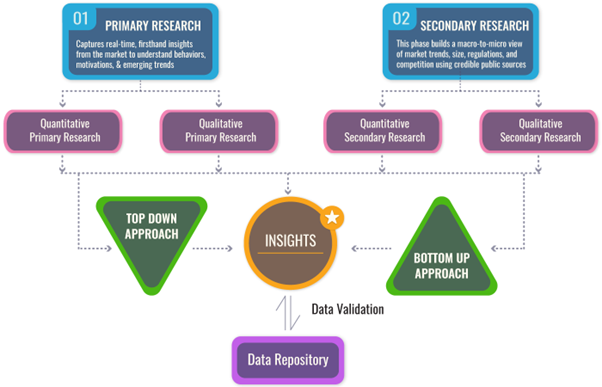
We follow a comprehensive, multi-phase research framework designed to deliver accurate, strategic, and decision-ready intelligence. Our process integrates primary and secondary research , both quantitative and qualitative , along with dual modeling techniques ( top-down and bottom-up) and a final layer of validation through our proprietary in-house repository.
PRIMARY RESEARCH
Primary research captures real-time, firsthand insights from the market to understand behaviors, motivations, and emerging trends.
1. Quantitative Primary Research
Objective: Generate statistically significant data directly from market participants.
Approaches:- Structured surveys with customers, distributors, and field agents
- Mobile-based data collection for point-of-sale audits and usage behavior
- Phone-based interviews (CATI) for market sizing and product feedback
- Online polling around industry events and digital campaigns
- Purchase frequency by customer type
- Channel performance across geographies
- Feature demand by application or demographic
2. Qualitative Primary Research
Objective: Explore decision-making drivers, pain points, and market readiness.
Approaches:- In-depth interviews (IDIs) with executives, product managers, and key decision-makers
- Focus groups among end users and early adopters
- Site visits and observational research for consumer products
- Informal field-level discussions for regional and cultural nuances
SECONDARY RESEARCH
This phase helps establish a macro-to-micro understanding of market trends, size, regulation, and competitive dynamics, sourced from credible and public domain information.
1. Quantitative Secondary Research
Objective: Model market value and segment-level forecasts based on published data.
Sources include:- Financial reports and investor summaries
- Government trade data, customs records, and regulatory statistics
- Industry association publications and economic databases
- Channel performance and pricing data from marketplace listings
- Revenue splits, pricing trends, and CAGR estimates
- Supply-side capacity and volume tracking
- Investment analysis and funding benchmarks
2. Qualitative Secondary Research
Objective: Capture strategic direction, innovation signals, and behavioral trends.
Sources include:- Company announcements, roadmaps, and product pipelines
- Publicly available whitepapers, conference abstracts, and academic research
- Regulatory body publications and policy briefs
- Social and media sentiment scanning for early-stage shifts
- Strategic shifts in market positioning
- Unmet needs and white spaces
- Regulatory triggers and compliance impact
DUAL MODELING: TOP-DOWN + BOTTOM-UP
To ensure robust market estimation, we apply two complementary sizing approaches:
Top-Down Modeling:- Start with broader industry value (e.g., global or regional TAM)
- Apply filters by segment, geography, end-user, or use case
- Adjust with primary insights and validation benchmarks
- Ideal for investor-grade market scans and opportunity mapping
- Aggregate from the ground up using sales volumes, pricing, and unit economics
- Use internal modeling templates aligned with stakeholder data
- Incorporate distributor-level or region-specific inputs
- Most accurate for emerging segments and granular sub-markets
DATA VALIDATION: IN-HOUSE REPOSITORY
We close the loop with proprietary data intelligence built from ongoing projects, industry monitoring, and historical benchmarking. This repository includes:
- Multi-sector market and pricing models
- Key trendlines from past interviews and forecasts
- Benchmarked adoption rates, churn patterns, and ROI indicators
- Industry-specific deviation flags and cross-check logic
- Catches inconsistencies early
- Aligns projections across studies
- Enables consistent, high-trust deliverables