

Herbal Tea Market Size and Forecast (2026–2034), Global and Regional Growth, Trend, Share and Industry Analysis Report Coverage; By Product Type (ChamAomile Tea, Peppermint Tea, Ginger Tea, Hibiscus Tea, Green Herbal Tea Blends, Others); By Form (Tea Bags, Loose Leaf Tea, Instant Herbal Tea, Ready-to-Drink Herbal Tea); By Distribution Channel (Supermarkets & Hypermarkets, Specialty Stores, Online Retail, Convenience Stores, Others); By Application (Health & Wellness, Relaxation & Stress Management, Digestive Health, Immunity Support, Weight Management, Others), and Geography
2026-06-30
Consumer Products
Jaya Bundele (Research Analyst)
Description
Herbal Tea Market Overview
The global Herbal Tea Market was
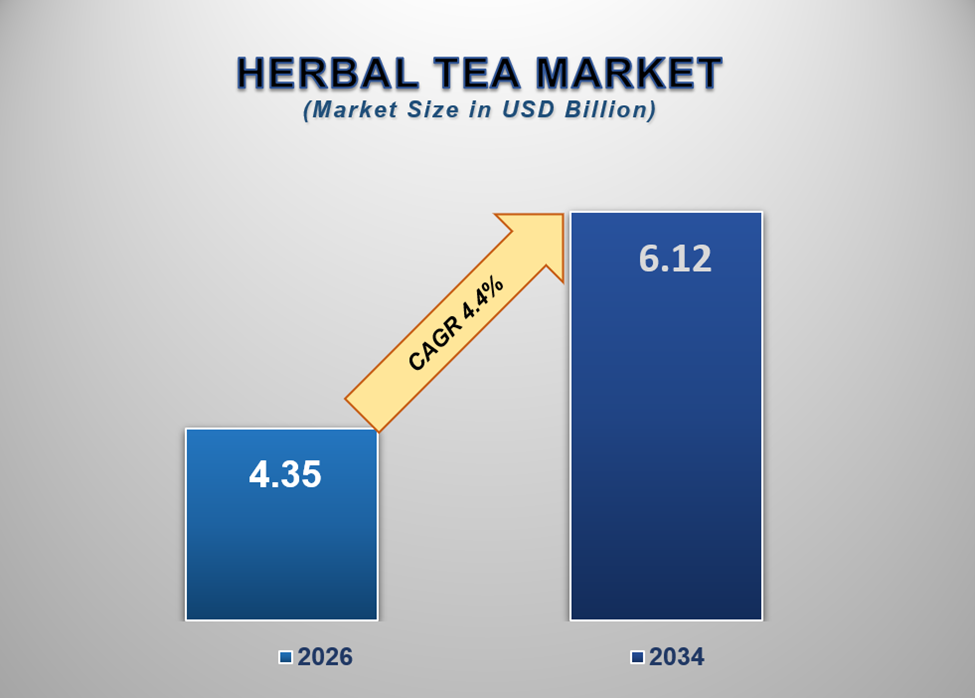
valued at USD 4.35 billion in 2026 and is projected to reach USD 6.12
billion by 2034, expanding at a CAGR of 4.4% during the forecast period.
Market growth is being driven by increasing consumer awareness regarding
preventive healthcare, rising demand for natural and plant-based beverages,
growing preference for clean-label products, expanding interest in traditional
herbal remedies, and the increasing popularity of wellness-focused lifestyles
worldwide.
Herbal tea has evolved from a traditional
home remedy consumed in specific regions into a globally recognized wellness
beverage category. Unlike conventional teas derived from the Camellia sinensis
plant, herbal teas are prepared from a variety of herbs, flowers, spices,
fruits, roots, seeds, and other botanical ingredients, offering distinctive
flavors and potential health benefits. The growing consumer shift toward
healthier beverage alternatives has significantly contributed to the expansion
of the herbal tea industry.
Modern consumers are becoming increasingly
conscious of the relationship between diet and long-term health. As a result,
demand for beverages perceived as natural, functional, and minimally processed
has increased substantially. Herbal teas are often associated with benefits
such as relaxation, digestive support, immunity enhancement, detoxification,
hydration, and overall wellness, making them attractive to health-focused
consumers.
The rising prevalence of lifestyle-related
health concerns, including obesity, stress, digestive disorders, sleep
disturbances, and weakened immunity, is encouraging consumers to seek natural
wellness solutions. Herbal teas are frequently incorporated into daily routines
as a convenient and enjoyable way to support general health and well-being
without relying heavily on synthetic supplements or sugary beverages.
Consumer preference for clean-label
products has become a major factor influencing purchasing behavior. Shoppers
increasingly examine ingredient lists and favor products containing
recognizable botanical ingredients without artificial preservatives, colors, or
additives. Herbal tea manufacturers are responding by emphasizing transparency,
organic sourcing, sustainability, and ingredient authenticity.
The growing popularity of plant-based
lifestyles is further supporting market expansion. Consumers adopting
vegetarian, vegan, and flexitarian diets often seek beverages that align with
their broader health and sustainability values. Herbal teas naturally fit
within these preferences and are increasingly marketed as part of holistic
wellness lifestyles.
Innovation within the herbal tea sector
continues to create new growth opportunities. Manufacturers are introducing
blends featuring adaptogens, functional herbs, superfoods, probiotics,
antioxidants, and region-specific botanicals to meet evolving consumer demands.
Premiumization trends are also encouraging the development of specialty herbal
teas that emphasize unique flavor profiles, artisanal sourcing, and
wellness-focused positioning.
E-commerce platforms have significantly
improved consumer access to diverse herbal tea products. Online retail channels
allow brands to reach broader customer bases while educating consumers about
ingredient benefits, brewing methods, and wellness applications. This
accessibility has accelerated product discovery and adoption across global
markets.
Furthermore, increasing interest in
traditional medicinal systems such as Ayurveda, Traditional Chinese Medicine,
and other herbal healing practices is influencing consumer preferences. Many
herbal tea products incorporate ingredients historically associated with these
traditions, further enhancing their appeal among wellness-oriented consumers.
As demand for natural health-supporting beverages continues to grow and consumers increasingly prioritize preventive wellness strategies, the herbal tea market is expected to maintain steady expansion throughout the forecast period.
Herbal Tea Market Drivers and Opportunities
Rising Consumer Focus on Health and
Wellness Is Driving Market Growth
One of the primary factors fueling growth
in the herbal tea market is the increasing emphasis on health-conscious
consumption patterns.
Consumers worldwide are actively seeking
healthier beverage alternatives that offer both enjoyable taste experiences and
perceived wellness benefits. Growing awareness regarding the adverse effects
associated with excessive sugar consumption, artificial ingredients, and highly
processed beverages has encouraged a shift toward natural drink options.
Herbal teas are widely perceived as beverages
that support hydration and overall wellness while providing functional benefits
linked to specific botanical ingredients. Ingredients such as chamomile,
peppermint, ginger, turmeric, hibiscus, lemongrass, and echinacea are commonly
associated with relaxation, digestive support, immune health, and antioxidant
properties.
The growing prevalence of stress-related
health concerns has further increased demand for herbal tea products positioned
for relaxation and emotional well-being. Many consumers incorporate herbal tea
into daily routines as part of self-care practices aimed at promoting balance
and relaxation.
Additionally, increasing public awareness
regarding preventive healthcare is encouraging individuals to adopt lifestyle
habits that may support long-term health. Herbal teas align well with these
preferences due to their natural composition and wellness-oriented image.
As health and wellness continue to influence global purchasing decisions, herbal tea consumption is expected to increase steadily.
Growing Demand for Natural and
Plant-Based Products Is Accelerating Market Expansion
The broader shift toward plant-based
consumption is another major driver supporting market growth.
Consumers increasingly favor food and
beverage products derived from natural botanical sources. This trend is driven
by growing environmental awareness, ethical considerations, and interest in
minimally processed products. Herbal teas naturally appeal to these preferences
because they are plant-derived and often contain simple ingredient
compositions.
The clean-label movement has amplified
demand for products that offer transparency and recognizable ingredients.
Herbal tea manufacturers are responding by highlighting organic certifications,
sustainable sourcing practices, non-GMO ingredients, and environmentally
responsible packaging solutions.
Plant-based lifestyles are becoming more
mainstream across both developed and developing economies. As consumers seek
alternatives to conventional beverages, herbal teas provide a versatile option
that fits within various dietary patterns and wellness goals.
Additionally, consumers increasingly
appreciate the diversity of flavors available within the herbal tea category.
Botanical blends featuring fruits, flowers, spices, and herbs allow
manufacturers to create unique taste experiences while maintaining natural
product positioning.
As demand for plant-based and clean-label products continues to expand globally, the herbal tea market is expected to benefit significantly.
Functional Herbal Formulations and
Premium Product Innovation Present Major Opportunities
Product innovation is creating substantial
opportunities for growth within the herbal tea industry.
Consumers increasingly seek beverages that
provide targeted functional benefits beyond basic hydration. This has
encouraged manufacturers to develop herbal tea blends designed to support
specific wellness objectives such as immunity enhancement, digestive comfort,
stress management, sleep support, cognitive performance, detoxification, and
metabolic health.
The incorporation of adaptogenic herbs,
superfoods, botanical extracts, probiotics, and antioxidant-rich ingredients is
enabling brands to differentiate their offerings and appeal to health-conscious
consumers. Functional positioning is becoming an increasingly important
competitive strategy across the market.
Premiumization trends are also creating
attractive opportunities. Consumers are demonstrating willingness to pay higher
prices for herbal teas featuring premium ingredients, artisanal sourcing
methods, organic certifications, and unique regional botanicals. Specialty tea
products often emphasize authenticity, craftsmanship, and superior ingredient
quality.
Ready-to-drink herbal tea products
represent another rapidly expanding opportunity area. Busy consumers
increasingly seek convenient wellness beverages that can be consumed without
preparation. Manufacturers are responding with innovative packaged herbal tea
offerings that combine convenience with health-focused positioning.
Furthermore, digital commerce platforms
enable brands to educate consumers, promote ingredient benefits, and build
direct relationships with customers. This capability supports stronger brand
loyalty and facilitates market expansion.
As innovation continues driving consumer
engagement, manufacturers are expected to benefit from expanding premium and
functional herbal tea segments.
Herbal Tea Market Scope
|
Report Attributes |
Description |
|
Market Size in 2026 |
USD 4.35 Billion |
|
Market Forecast in 2034 |
USD 6.12 Billion |
|
CAGR % 2026-2034 |
4.4% |
|
Base Year |
2025 |
|
Historic Data |
2021-2025 |
|
Forecast Period |
2026-2034 |
|
Report USP |
Production, Consumption,
Company Share, Company Heatmap, Company Production, Service Type, Growth Factors
and more |
|
Segments Covered |
∙ By Product Type |
|
Regional Scope |
● North America |
|
Country Scope |
U.S. |
Herbal Tea Market Report Segmentation Analysis
The global herbal tea market industry analysis is segmented into product type, form, distribution channel, application, and region.
Chamomile Tea Segment Is Expected to
Dominate the Market During the Forecast Period
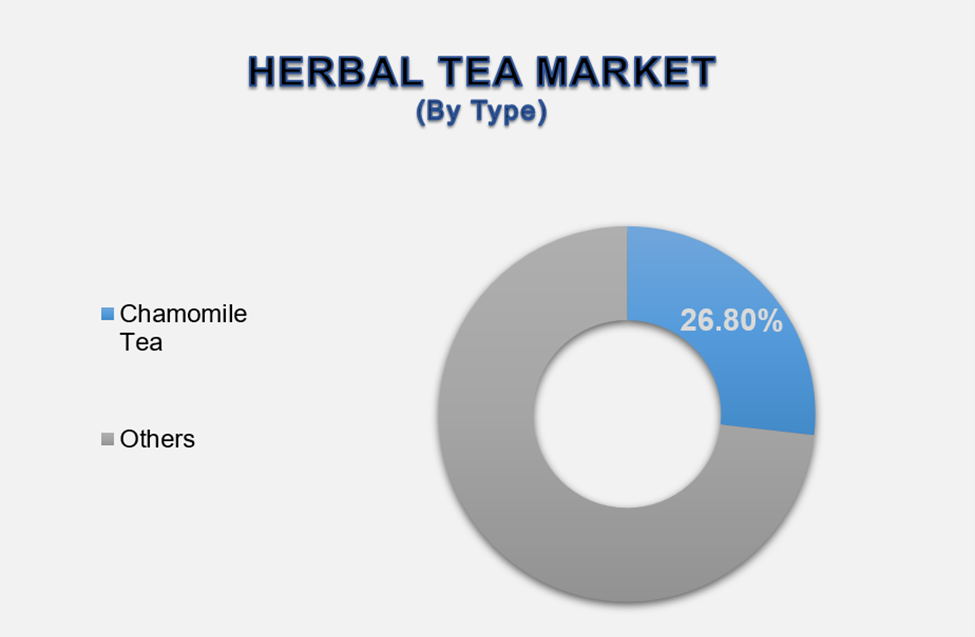
The chamomile tea segment accounted for
approximately 26.8% of the global market, making it one of the most
prominent product categories.
Chamomile tea remains highly popular among
consumers due to its longstanding association with relaxation, sleep support,
and stress reduction. Its mild flavor profile and broad consumer familiarity
contribute significantly to market demand.
The segment benefits from increasing
consumer interest in natural approaches to managing stress and improving sleep
quality. Many wellness-focused consumers regularly incorporate chamomile tea
into evening routines as part of broader self-care practices.
Manufacturers continue expanding
chamomile-based product offerings through innovative blends featuring
complementary ingredients such as lavender, lemon balm, honey, and mint. These
formulations enhance both flavor and perceived wellness benefits.
As awareness of natural wellness beverages continues growing, chamomile tea is expected to maintain its leading position within the herbal tea market.
Tea Bags Segment Is Expected to Lead the
Market by Form
Tea bags represent the largest form segment
within the herbal tea market.
Consumers highly value convenience,
consistency, portability, and ease of preparation, all of which contribute to
the widespread popularity of tea bag products. Tea bags enable consumers to
quickly prepare herbal beverages at home, at work, or while traveling.
Manufacturers have introduced a wide
variety of tea bag formats, including pyramid sachets, biodegradable materials,
and premium packaging solutions designed to enhance brewing performance and
sustainability.
The segment also benefits from strong
retail availability across supermarkets, convenience stores, specialty tea
outlets, and online platforms.
As convenience continues to influence purchasing decisions, tea bags are expected to remain the dominant product format.
Health & Wellness Segment Is
Expected to Dominate the Market by Application
Health and wellness applications account
for the largest share of herbal tea consumption globally.
Consumers increasingly view herbal tea as a
simple and enjoyable way to support broader wellness objectives. Products
positioned around immunity support, digestive health, stress management,
hydration, and antioxidant intake continue gaining popularity across diverse
demographic groups.
The growing emphasis on preventive
healthcare and self-directed wellness practices is encouraging regular herbal
tea consumption. Consumers are incorporating herbal beverages into daily
routines as part of holistic approaches to maintaining overall well-being.
Additionally, increasing educational
content regarding botanical ingredients and functional benefits is
strengthening consumer confidence in herbal tea products.
As wellness-oriented lifestyles continue
expanding globally, this application segment is expected to maintain its
leading market position.
Supermarkets & Hypermarkets Segment
Is Expected to Lead the Market by Distribution Channel
Supermarkets and hypermarkets represent the
largest distribution channel within the herbal tea market.
These retail formats provide extensive
product variety, convenient access, competitive pricing, and strong brand
visibility. Consumers frequently purchase herbal tea products during routine
grocery shopping trips, making supermarkets an important sales channel.
Retailers are increasingly expanding shelf
space dedicated to wellness beverages, organic products, and specialty teas in
response to growing consumer demand. Product promotions, sampling initiatives,
and in-store educational displays further support category growth.
The availability of both premium and mass-market herbal tea brands within these channels contributes to their continued dominance.
The following segments are part of an
in-depth analysis of the global Herbal Tea market:
|
Market Segments |
|
|
By Product Type |
∙ Chamomile Tea |
|
By
Form |
∙ Tea Bags |
|
Distribution
Channel |
∙ Supermarkets & Hypermarkets |
|
By
Application |
∙ Health &
Wellness |
Herbal Tea Market Share Analysis By Region
Europe is projected to dominate the global
herbal tea market, accounting for approximately 34.5% of total market
revenue in 2026.
The region benefits from a long-established
tea-drinking culture, strong consumer awareness regarding natural wellness
products, and increasing demand for organic and functional beverages. Countries
such as Germany, the United Kingdom, France, and Italy represent major
consumption markets.
North America remains a significant market
due to rising health consciousness, growing demand for plant-based beverages,
and increasing consumer interest in preventive wellness practices.
Asia-Pacific is expected to witness the
fastest growth during the forecast period, driven by expanding middle-class
populations, increasing disposable incomes, growing wellness awareness, and
strong cultural acceptance of herbal beverages.
Latin America and the Middle East & Africa are also experiencing growing demand as consumers increasingly embrace natural and health-focused beverage alternatives.
Herbal Tea Market Competition Landscape Analysis
The global herbal tea market is
characterized by intense competition, product innovation, brand
differentiation, and increasing emphasis on wellness-oriented marketing
strategies.
Market participants are focusing on organic
product development, sustainable sourcing practices, premium ingredient
selection, and functional formulation innovation. Companies are investing in
research and development to create unique botanical blends that address
evolving consumer wellness preferences.
Brand storytelling, ingredient
transparency, and sustainability initiatives are becoming increasingly
important competitive differentiators. Manufacturers are also leveraging
e-commerce channels and direct-to-consumer strategies to strengthen customer
engagement and brand loyalty.
As consumer demand for natural wellness beverages continues growing, competition is expected to intensify across both established and emerging market segments.
Global Herbal Tea Market Recent
Developments News:
∙ In April 2026, several beverage companies
expanded organic herbal tea product portfolios to address growing consumer
demand for clean-label wellness beverages.
∙ In January 2026, manufacturers introduced
new adaptogenic herbal tea formulations targeting stress management and
emotional wellness.
∙ In October 2025, premium tea brands
launched specialty botanical blends featuring regionally sourced herbs and
flowers.
∙ In July 2025, beverage companies expanded
ready-to-drink herbal tea offerings to capitalize on growing convenience
trends.
∙ In May 2025, major tea producers increased investments in sustainable sourcing programs and environmentally friendly packaging solutions.
The Global Herbal Tea Market is
Dominated by a Few Large Companies, Such As
∙ Unilever PLC
∙ Associated British Foods plc (Twinings)
∙ Celestial Seasonings, Inc.
∙ Traditional Medicinals, Inc.
∙ Yogi Tea GmbH
∙ The Republic of Tea, Inc.
∙ Bigelow Tea Company
∙ Tata Consumer Products Limited
∙ Dilmah Ceylon Tea Company PLC
∙ Pukka Herbs Ltd.
∙ Harney & Sons Fine Teas
∙ Numi Organic Tea
∙ Teavana Corporation
∙ Organic India Pvt. Ltd.
∙ Davidson's Organics
∙ Others
Frequently Asked Questions
Jaya Bundele (Research Analyst)
Jaya Bundele is a skilled Research Analyst with 4+ years of experience in market intelligence, consumer insights, competitive analysis, and industry forecasting across the consumer goods, agriculture, and food & beverage sectors. She specializes in market sizing, trend analysis, growth opportunity mapping, and strategic secondary research for global and regional markets.
Her expertise lies in transforming complex industry data into actionable business strategies that help organizations identify emerging trends, understand customer behavior, and gain a competitive edge. With a strong focus on data-driven insights, business intelligence, and future market trends, Jaya delivers high-quality research solutions aligned with evolving industry demands and market dynamics.
1.
Global Herbal Tea Market
Introduction and Market Overview
1.1. Objectives of the Study
1.2. Global Herbal Tea Market Scope and Market Estimation
1.2.1.
Global Herbal Tea Market
Overall Market Size (US$ Billion), Market CAGR (%), Market Forecast (2026 -
2034)
1.2.2.
Global Herbal Tea Market
Revenue Share (%) and Growth Rate (Y-o-Y) from 2021 - 2034
1.3. Market Segmentation
1.3.1.
Product Type of Global Herbal
Tea Market
1.3.2.
Form of Global Herbal Tea
Market
1.3.3.
Distribution Channel of Global
Herbal Tea Market
1.3.4.
Application of Global Herbal
Tea Market
1.3.5.
Region of Global Herbal Tea
Market
2.
Executive Summary
2.1. Demand Side Trends
2.2. Key Market Trends
2.3. Market Demand (US$ Billion) Analysis 2021 – 2025 and Forecast, 2026
– 2034
2.4. Demand and Opportunity Assessment
2.5. Key Developments
2.6. Overview of Functional Beverage Ecosystem and Herbal Wellness
Framework
2.7. Market Entry Strategies
2.8. Market Dynamics
2.8.1.
Drivers
2.8.2.
Limitations
2.8.3.
Opportunities
2.8.4.
Impact Analysis of Drivers and
Restraints
2.9. Porter’s Five Forces Analysis
2.10.
PEST Analysis
3.
Global Herbal Tea Market
Estimates & Historical Trend Analysis (2021 - 2025)
4.
Global Herbal Tea Market
Estimates & Forecast Trend Analysis, by Product Type
4.1. Global Herbal Tea Market Revenue (US$ Billion) Estimates and
Forecasts, by Product Type, 2021 - 2034
4.1.1.
Chamomile Tea
4.1.2.
Peppermint Tea
4.1.3.
Ginger Tea
4.1.4.
Hibiscus Tea
4.1.5.
Green Herbal Tea Blends
4.1.6.
Others
5.
Global Herbal Tea Market
Estimates & Forecast Trend Analysis, by Form
5.1. Global Herbal Tea Market Revenue (US$ Billion) Estimates and
Forecasts, by Form, 2021 - 2034
5.1.1.
Tea Bags
5.1.2.
Loose Leaf Tea
5.1.3.
Instant Herbal Tea
5.1.4.
Ready-to-Drink Herbal Tea
6.
Global Herbal Tea Market
Estimates & Forecast Trend Analysis, by Distribution Channel
6.1. Global Herbal Tea Market Revenue (US$ Billion) Estimates and
Forecasts, by Distribution Channel, 2021 - 2034
6.1.1.
Supermarkets & Hypermarkets
6.1.2.
Specialty Stores
6.1.3.
Online Retail
6.1.4.
Convenience Stores
6.1.5.
Others
7.
Global Herbal Tea Market
Estimates & Forecast Trend Analysis, by Application
7.1. Global Herbal Tea Market Revenue (US$ Billion) Estimates and
Forecasts, by Application, 2021 - 2034
7.1.1.
Health & Wellness
7.1.2.
Relaxation & Stress
Management
7.1.3.
Digestive Health
7.1.4.
Immunity Support
7.1.5.
Weight Management
7.1.6.
Others
8.
Global Herbal Tea Market
Estimates & Forecast Trend Analysis, by Region
8.1. Global Herbal Tea Market Revenue (US$ Billion) Estimates and
Forecasts, by Region, 2021 - 2034
8.1.1.
North America
8.1.2.
Europe
8.1.3.
Asia Pacific
8.1.4.
Middle East & Africa
8.1.5.
Latin America
9.
North America Herbal Tea
Market: Estimates & Forecast Trend Analysis
9.1. North America Herbal Tea Market Assessments & Key Findings
9.1.1.
North America Herbal Tea Market
Introduction
9.1.2.
North America Herbal Tea Market
Size Estimates and Forecast (2021 - 2034)
9.1.2.1.
By Product Type
9.1.2.2.
By Form
9.1.2.3.
By Distribution Channel
9.1.2.4.
By Application
9.1.2.5.
By Country
9.1.2.5.1.
U.S.
9.1.2.5.2.
Canada
10. Europe Herbal Tea Market: Estimates & Forecast Trend Analysis
10.1.
Europe Herbal Tea Market
Assessments & Key Findings
10.1.1.
Europe Herbal Tea Market
Introduction
10.1.2.
Europe Herbal Tea Market Size
Estimates and Forecast (2021 - 2034)
10.1.2.1.
By Product Type
10.1.2.2.
By Form
10.1.2.3.
By Distribution Channel
10.1.2.4.
By Application
10.1.2.5.
By Country
10.1.2.5.1.
Germany
10.1.2.5.2.
Italy
10.1.2.5.3.
U.K.
10.1.2.5.4.
France
10.1.2.5.5.
Spain
10.1.2.5.6.
Switzerland
10.1.2.5.7.
Rest of Europe
11. Asia Pacific Herbal Tea Market: Estimates & Forecast Trend
Analysis
11.1.
Asia Pacific Market Assessments
& Key Findings
11.1.1.
Asia Pacific Herbal Tea Market
Introduction
11.1.2.
Asia Pacific Herbal Tea Market
Size Estimates and Forecast (2021 - 2034)
11.1.2.1.
By Product Type
11.1.2.2.
By Form
11.1.2.3.
By Distribution Channel
11.1.2.4.
By Application
11.1.2.5.
By Country
11.1.2.5.1.
China
11.1.2.5.2.
Japan
11.1.2.5.3.
India
11.1.2.5.4.
Australia
11.1.2.5.5.
South Korea
11.1.2.5.6.
Rest of Asia Pacific
12. Middle East & Africa Herbal Tea Market: Estimates & Forecast
Trend Analysis
12.1.
Middle East & Africa Market
Assessments & Key Findings
12.1.1.
Middle East & Africa Herbal
Tea Market Introduction
12.1.2.
Middle East & Africa Herbal
Tea Market Size Estimates and Forecast (2021 - 2034)
12.1.2.1.
By Product Type
12.1.2.2.
By Form
12.1.2.3.
By Distribution Channel
12.1.2.4.
By Application
12.1.2.5.
By Country
12.1.2.5.1.
UAE
12.1.2.5.2.
Saudi Arabia
12.1.2.5.3.
South Africa
12.1.2.5.4.
Rest of MEA
13. Latin America Herbal Tea Market: Estimates & Forecast Trend
Analysis
13.1.
Latin America Market
Assessments & Key Findings
13.1.1.
Latin America Herbal Tea Market
Introduction
13.1.2.
Latin America Herbal Tea Market
Size Estimates and Forecast (2021 - 2034)
13.1.2.1.
By Product Type
13.1.2.2.
By Form
13.1.2.3.
By Distribution Channel
13.1.2.4.
By Application
13.1.2.5.
By Country
13.1.2.5.1.
Brazil
13.1.2.5.2.
Mexico
13.1.2.5.3.
Argentina
13.1.2.5.4.
Rest of LATAM
14. Competition Landscape
14.1.
Global Herbal Tea Market
Product Mapping
14.2.
Global Herbal Tea Market
Concentration Analysis
14.3.
Global Herbal Tea Market Tier
Structure Analysis
14.4.
Global Herbal Tea Market Share
Analysis (2025)
15. Company Profiles
15.1.
Unilever PLC
15.1.1.
Company Overview & Key
Stats
15.1.2.
Financial Performance &
KPIs
15.1.3.
Product Portfolio
15.1.4.
SWOT Analysis
15.1.5.
Business Strategy & Recent
Developments
15.2.
Associated British Foods plc
(Twinings)
15.3.
Celestial Seasonings, Inc.
15.4.
Traditional Medicinals, Inc.
15.5.
Yogi Tea GmbH
15.6.
The Republic of Tea, Inc.
15.7.
Bigelow Tea Company
15.8.
Tata Consumer Products Limited
15.9.
Dilmah Ceylon Tea Company PLC
15.10.
Pukka Herbs Ltd.
15.11.
Harney & Sons Fine Teas
15.12.
Numi Organic Tea
15.13.
Teavana Corporation
15.14.
Organic India Pvt. Ltd.
15.15.
Davidson's Organics
15.16.
Others
16. Research Findings & Conclusion
17. Assumption & Acronyms Used
18. Research Methodology
18.1.
External Databases
18.2.
Internal Proprietary Database
18.3.
Primary Research
18.4.
Secondary Research
18.5.
Assumptions
18.6.
Limitations
18.7.
Report FAQs
Our Research Methodology
"Insight without rigor is just noise."
We follow a comprehensive, multi-phase research framework designed to deliver accurate, strategic, and decision-ready intelligence. Our process integrates primary and secondary research , both quantitative and qualitative , along with dual modeling techniques ( top-down and bottom-up) and a final layer of validation through our proprietary in-house repository.
PRIMARY RESEARCH
Primary research captures real-time, firsthand insights from the market to understand behaviors, motivations, and emerging trends.
1. Quantitative Primary Research
Objective: Generate statistically significant data directly from market participants.
Approaches:- Structured surveys with customers, distributors, and field agents
- Mobile-based data collection for point-of-sale audits and usage behavior
- Phone-based interviews (CATI) for market sizing and product feedback
- Online polling around industry events and digital campaigns
- Purchase frequency by customer type
- Channel performance across geographies
- Feature demand by application or demographic
2. Qualitative Primary Research
Objective: Explore decision-making drivers, pain points, and market readiness.
Approaches:- In-depth interviews (IDIs) with executives, product managers, and key decision-makers
- Focus groups among end users and early adopters
- Site visits and observational research for consumer products
- Informal field-level discussions for regional and cultural nuances
SECONDARY RESEARCH
This phase helps establish a macro-to-micro understanding of market trends, size, regulation, and competitive dynamics, sourced from credible and public domain information.
1. Quantitative Secondary Research
Objective: Model market value and segment-level forecasts based on published data.
Sources include:- Financial reports and investor summaries
- Government trade data, customs records, and regulatory statistics
- Industry association publications and economic databases
- Channel performance and pricing data from marketplace listings
- Revenue splits, pricing trends, and CAGR estimates
- Supply-side capacity and volume tracking
- Investment analysis and funding benchmarks
2. Qualitative Secondary Research
Objective: Capture strategic direction, innovation signals, and behavioral trends.
Sources include:- Company announcements, roadmaps, and product pipelines
- Publicly available whitepapers, conference abstracts, and academic research
- Regulatory body publications and policy briefs
- Social and media sentiment scanning for early-stage shifts
- Strategic shifts in market positioning
- Unmet needs and white spaces
- Regulatory triggers and compliance impact
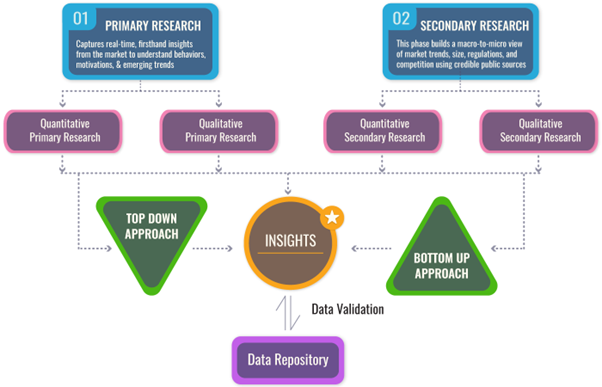
DUAL MODELING: TOP-DOWN + BOTTOM-UP
To ensure robust market estimation, we apply two complementary sizing approaches:
Top-Down Modeling:- Start with broader industry value (e.g., global or regional TAM)
- Apply filters by segment, geography, end-user, or use case
- Adjust with primary insights and validation benchmarks
- Ideal for investor-grade market scans and opportunity mapping
- Aggregate from the ground up using sales volumes, pricing, and unit economics
- Use internal modeling templates aligned with stakeholder data
- Incorporate distributor-level or region-specific inputs
- Most accurate for emerging segments and granular sub-markets
DATA VALIDATION: IN-HOUSE REPOSITORY
We close the loop with proprietary data intelligence built from ongoing projects, industry monitoring, and historical benchmarking. This repository includes:
- Multi-sector market and pricing models
- Key trendlines from past interviews and forecasts
- Benchmarked adoption rates, churn patterns, and ROI indicators
- Industry-specific deviation flags and cross-check logic
- Catches inconsistencies early
- Aligns projections across studies
- Enables consistent, high-trust deliverables