

High End Lighting Market Size and Forecast (2025 - 2033), Global and Regional Growth, Trend, Share and Industry Analysis Report Coverage: By Light Source Type (LED, HID, Fluorescent Light, Others), By Interior Design (Modern, Traditional, Transitional), By Application (Wired, Wireless), By End Use (Commercial, Industrial, Residential, Others), and Geography
2025-12-18
Semiconductor and Electronics
Ekta Chaurasia (Team Lead)
Description
High End
Lighting Market Overview
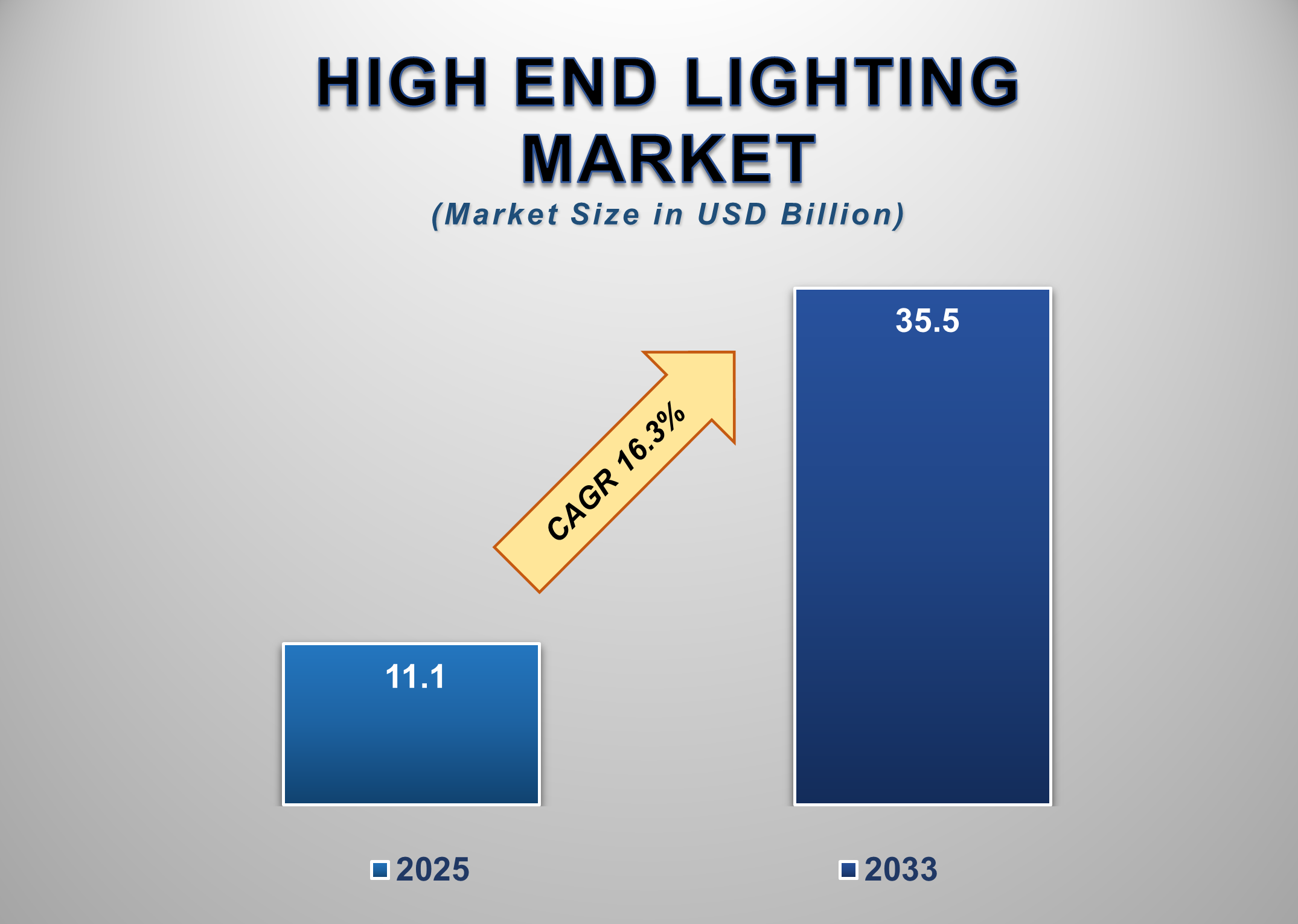
The Global High-End Lighting Market is projected to reach USD 35.5 billion by 2033 from USD 11.1 billion in 2025, growing at a CAGR of 16.3% during the forecast period (2025–2033). The market’s robust growth is driven by the rapid adoption of LED-based lighting systems, the increasing emphasis on luxury interiors, and the rising integration of smart and connected lighting technologies in both residential and commercial settings. High-end lighting enhances ambiance and aesthetic appeal while ensuring energy efficiency and long-term durability, key factors driving its adoption across hotels, offices, and premium residential complexes.
Furthermore, the proliferation of
architectural projects emphasizing sustainability and design-centric lighting
has elevated demand for advanced fixtures and intelligent illumination systems.
Manufacturers are increasingly focusing on developing customizable and
eco-efficient products that align with modern architectural aesthetics. With
Asia-Pacific leading in adoption due to large-scale urbanization and
infrastructure projects, the market is set for transformative growth supported
by the rising trend of smart cities and IoT-enabled lighting solutions.
High End Lighting Market Drivers and
Opportunities
Rising Demand for Luxury Interior Designs Is Driving Market
Growth
The
growing inclination toward luxury interior designs and premium aesthetics in
residential and commercial spaces is a significant driver for the high-end
lighting market. Consumers are increasingly investing in high-quality,
design-centric lighting fixtures that complement interior themes such as
modern, transitional, or contemporary décor. Lighting has evolved from a
functional utility to a core element of interior architecture, enhancing mood, style, and energy efficiency. The adoption
of customizable, artistic lighting solutions by high-income households, luxury
hotels, and corporate spaces is fostering strong market expansion.
Moreover,
the rapid integration of smart home technologies has fueled the demand for
sophisticated lighting systems with remote control, dimming features, and
color-tuning capabilities. Manufacturers are leveraging these trends to
introduce innovative products that blend design with digital intelligence,
catering to evolving consumer preferences. As urban lifestyles evolve and
disposable incomes increase, especially in emerging economies, the appetite for
aesthetic illumination solutions is set to surge globally.
Technological
Advancements and Smart Lighting Integration Boost Market Expansion
Technological
progress in light source design, particularly the rise of smart LEDs and
wireless lighting systems, is significantly shaping market growth. Smart
lighting, powered by IoT, enables real-time control, energy optimization, and
automation features that enhance user convenience and sustainability. Consumers
are increasingly attracted to systems that integrate seamlessly with voice
assistants and home automation platforms such as Alexa and Google Home.
Additionally, innovations in sensor-based lighting, adaptive illumination, and
AI-powered lighting management are revolutionizing the way consumers and
businesses use lighting. Commercial establishments, hospitality venues, and
premium residences are adopting these systems to achieve superior ambiance
control and energy efficiency. This convergence of aesthetics, automation, and
sustainability is transforming lighting into a dynamic design element and
positioning smart, connected lighting solutions as the future of luxury
illumination.
Rising
Urbanization and Smart City Projects Create Lucrative Growth Opportunities
Rapid
urbanization and government-backed smart city initiatives are creating vast
opportunities for high-end lighting solutions worldwide. With cities
prioritizing intelligent infrastructure and sustainable living spaces, demand
for energy-efficient, design-oriented lighting has grown exponentially. Public
and private construction projects increasingly integrate architectural
lighting, façade illumination, and landscape lighting to enhance visual appeal
and reduce energy consumption.
Emerging
economies in the Asia-Pacific, such as China, India, and Southeast Asian nations, are at the forefront of adopting smart urban designs,
where lighting plays a key role in both functionality and aesthetics.
Additionally, the hospitality and retail sectors are embracing premium lighting
installations to enhance customer experiences and brand image. As global
awareness around energy-efficient technologies rises, the expansion of smart,
sustainable lighting ecosystems presents compelling opportunities for market
stakeholders.
High End Lighting Market
Scope
|
Report Attributes |
Description |
|
Market Size in 2025 |
USD 11.1 Billion |
|
Market Forecast in 2033 |
USD 35.5 Billion |
|
CAGR % 2025-2033 |
16.3% |
|
Base Year |
2024 |
|
Historic Data |
2020-2024 |
|
Forecast Period |
2025-2033 |
|
Report USP |
Production, Consumption,
Company Share, Company Heatmap, Company Production Capacity, Growth Factors,
and more |
|
Segments Covered |
●
Light Source
Type, Interior Design, Application, End Use |
|
Regional Scope |
●
North America, ●
Europe, ●
APAC, ●
Latin America ●
Middle East and
Africa |
|
Country Scope |
1)
U.S. 2)
Canada 3)
U.K. 4)
Germany 5)
France 6)
Italy 7)
Spain 8)
Russia 9)
China 10)
India 11)
Japan 12)
South Korea 13)
Mexico 14)
Brazil 15)
Argentina 16)
Saudi Arabia 17)
UAE 18)
South Africa |
High End Lighting Market
Report Segmentation Analysis
The global High-End Lighting
Market is segmented into Light Source Type, Interior Design, Application, End
Use, and by Region.
LED Segment Accounted for the Largest Market Share in the
Global High-End Lighting Market
By
Light Source Type, the market is segmented into LED, HID, Fluorescent Light,
and Others.
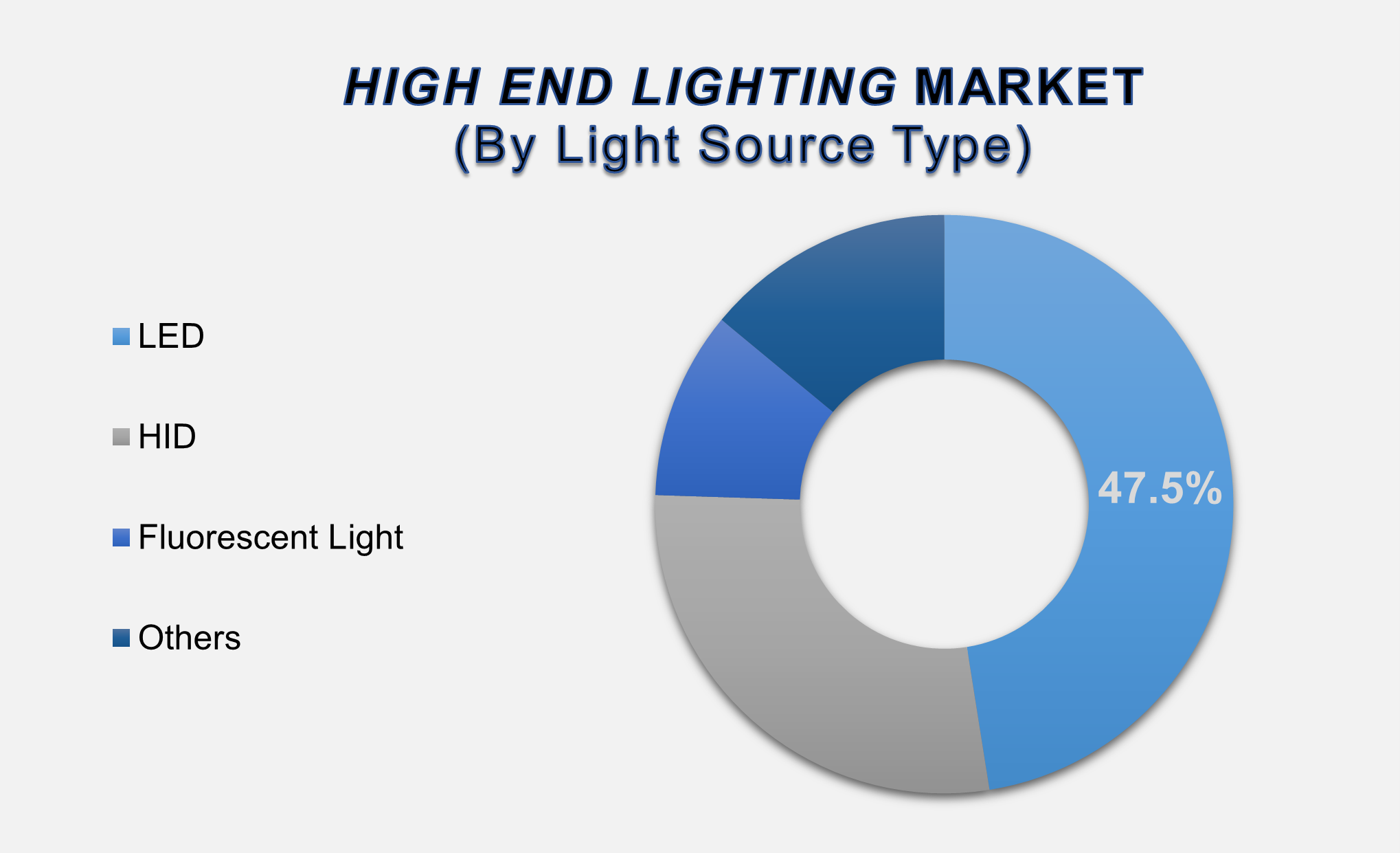
The LED segment accounted for the largest share of the global high-end lighting
market in 2025. This dominance is attributed to the superior energy efficiency,
long lifespan, and design flexibility offered by LED lighting systems. The
integration of advanced color-tuning and dimming technologies allows users to
personalize lighting environments, making LEDs a preferred choice across
commercial and residential applications.
Moreover,
LED lighting supports sustainability objectives by reducing energy consumption
and CO₂ emissions, aligning with global environmental goals. With continuous
innovations in OLEDs, mini-LEDs, and smart control integration, LED technology
remains at the forefront of premium lighting design. The segment’s scalability
across architectural, decorative, and functional applications ensures its
sustained leadership throughout the forecast period.
Modern
Segment Accounted for the Largest Market Share in the Global High-End Lighting
Market
By
Interior Design, the market is segmented into Modern, Traditional, and
Transitional.
The Modern segment accounted for the largest share of the global high-end
lighting market in 2025. Modern lighting designs emphasize minimalism,
functionality, and aesthetic clarity, making
them highly popular among urban consumers and architects. These lighting
systems often feature clean lines, geometric shapes, and neutral tones,
appealing to both residential and commercial projects seeking contemporary
appeal. Additionally, the growing number of smart homes and tech-integrated
interiors has propelled the demand for modern lighting styles compatible with
automation platforms. Premium residential complexes, offices, and retail
environments increasingly adopt sleek, energy-efficient fixtures that
complement modern architectural layouts, reinforcing the segment’s strong
market position.
Wired
Segment Accounted for the Largest Market Share in the Global High-End Lighting
Market
By
Application, the market is segmented into Wired and Wireless.
The Wired segment accounted for the largest share of the global high-end
lighting market in 2025. Wired lighting systems remain dominant due to their
reliability, stable connectivity, and widespread use in large-scale commercial
and industrial installations. High-end wired lighting ensures consistent power
delivery and supports intricate lighting designs for hospitality and
architectural projects where performance and precision are paramount. However,
the increasing adoption of wireless technologies, driven by IoT integration and
ease of installation, is expected to grow rapidly during the forecast period.
While wireless systems gain momentum, wired solutions continue to lead in
infrastructure-based projects that require robust control and scalability.
The following segments are
part of an in-depth analysis of the global High End Lighting market:
|
Market
Segments |
|
|
By Light
Source Type |
●
LED ●
HID ●
Fluorescent Light ●
Others |
|
By Interior
Design |
●
Modern ●
Traditional ●
Transitional |
|
By Application |
●
Wired ●
Wireless |
|
By End-Use |
●
Commercial ●
Industrial ●
Residential ●
Others |
High End Lighting Market Share Analysis by Region
Asia-Pacific is Projected
to Hold the Largest Share of the Global High End Lighting Market Over the
Forecast Period
Asia-Pacific accounted for the
largest share of the global high-end lighting market in 2025, holding 40.3% of
total revenue. The region’s dominance is fueled by rapid urbanization,
infrastructure development, and the proliferation of smart city projects.
Countries such as China, Japan, and India are witnessing a surge in luxury
residential construction and commercial spaces incorporating advanced lighting
designs.
Meanwhile, North America is
projected to grow at the highest CAGR during the forecast period. The region’s
growth is supported by high consumer spending on premium interior décor,
increasing adoption of smart homes, and technological innovations by key lighting
manufacturers. With strong regulatory support for energy-efficient systems and
architectural modernization, both regions are expected to drive significant
market expansion.
High End Lighting Market Competition Landscape
Analysis
The global high-end lighting
market is moderately fragmented, with leading players focusing on technological
innovations, design collaborations, and smart product development. Key
companies emphasize sustainability, digital connectivity, and aesthetic enhancement
to strengthen their brand positioning. Prominent players include Acuity Inc.,
Cree Lighting USA LLC, Samsung Electronics, Signify Holding, OSRAM GmbH, Savant
Systems, Vakkerlight, Digital Lumens, Jainsons Emporio, Hudson Valley Lighting
Group, Tom Dixon, Flos, Louis Poulsen, Bover S.L., and Vibia.
Global High End Lighting Market Recent
Developments News:
●
In May 2025, Acuity Brands, Inc.
acquired M3 Innovation, LLC, a sports lighting startup, integrating its
technologies into the Acuity Brands Lighting (ABL) portfolio. The solutions
will be distributed through Acuity’s Lithonia Lighting brand via independent
sales networks and through the Holophane brand via direct and utility channels.
●
In March 2025, Signify Holding and
Dixon Technologies (India) Ltd. established a joint venture to enhance lighting
manufacturing in India. The partnership will produce a range of LED lighting
products, including bulbs, downlights,
spotlights, and strip lights, to deliver
innovative, cost-effective solutions for the Indian market.
●
In November 2024, Samsung Electronics
debuted its Outdoor LED Signage XHB Series (P8) at Shinsegae Department Store
in South Korea. The massive 8K anamorphic display measures 71.8 meters wide and
17.9 meters high, equivalent to three
basketball courts wrapping the building’s exterior with high-resolution visual
technology.
The Global High End Lighting Market is dominated by a few large companies, such as
●
Acuity Inc.
●
Cree Lighting USA LLC.
●
Samsung Electronics
●
Signify Holding
●
OSRAM GmbH
●
Savant Systems, Inc
●
Vakkerlight
●
Digital Lumens
●
Jainsons Emporio
●
Hudson Valley Lighting Group
●
Tom Dixon
●
Flos
●
Louis Poulsen
●
Bover, S.L.
●
Vibia
● Others
Frequently Asked Questions
Ekta Chaurasia (Team Lead)
Ekta Chaurasia is a highly experienced Team Lead at M2Square Consultancy with over 7 years of expertise in market research, strategic consulting, competitive benchmarking, and business intelligence solutions. She specializes in ICT, semiconductors & electronics, automotive & transportation, and industrial machinery markets.
She leads end-to-end global research projects focused on market trends, industry analysis, growth forecasting, customer insights, and strategic decision-making. Known for her analytical leadership and industry expertise, Ekta helps businesses uncover growth opportunities, evaluate competitive landscapes, and stay ahead in rapidly evolving markets through accurate and insight-driven research.
1. Global High End Lighting
Market Introduction and Market Overview
1.1.
Objectives
of the Study
1.2.
Global
High End Lighting Market Scope and Market Estimation
1.2.1.Global High End Lighting Overall
Market Size (US$ Bn), Market CAGR (%), Market forecast (2025 - 2033)
1.2.2.Global High End Lighting
Market Revenue Share (%) and Growth Rate (Y-o-Y) from 2020 - 2033
1.3.
Market
Segmentation
1.3.1.Light Source Type of
Global High End Lighting Market
1.3.2.Interior Design of Global High
End Lighting Market
1.3.3.Application of Global High
End Lighting Market
1.3.4.End-user of Global High
End Lighting Market
1.3.5.Region of Global High End
Lighting Market
2. Executive
Summary
2.1.
Demand
Side Trends
2.2.
Key
Market Trends
2.3.
Market
Demand (US$ Bn) Analysis 2020 – 2024 and Forecast, 2025 – 2033
2.4.
Demand
and Opportunity Assessment
2.5.
Market
Dynamics
2.5.1.Drivers
2.5.2.Limitations
2.5.3.Opportunities
2.5.4.Impact Analysis of Drivers
and Restraints
2.6.
Key
Product/Brand Analysis
2.7.
Technological
Advancements
2.8.
Key
Developments
2.9.
Porter’s
Five Forces Analysis
2.9.1.Bargaining Power of
Suppliers
2.9.2.Bargaining Power of Buyers
2.9.3.Threat of Substitutes
2.9.4.Threat of New Entrants
2.9.5.Competitive Rivalry
2.10.
PEST
Analysis
2.10.1.
Political
Factors
2.10.2.
Economic
Factors
2.10.3.
Social
Factors
2.10.4.
Technology
Factors
2.11.
Insights
on Cost-effectiveness of High End Lighting
2.12.
Key
Regulation
3. Global
High End Lighting Market Estimates
& Historical Trend Analysis (2020 - 2024)
4. Global
High End Lighting Market Estimates
& Forecast Trend Analysis, by Light Source Type
4.1.
Global
High End Lighting Market Revenue (US$ Bn) Estimates and Forecasts, by Light
Source Type, 2020 - 2033
4.1.1.LED
4.1.2.HID
4.1.3.Fluorescent Light
4.1.4.Others
5. Global
High End Lighting Market Estimates
& Forecast Trend Analysis, by Interior Design
5.1.
Global
High End Lighting Market Revenue (US$ Bn) Estimates and Forecasts, by Interior
Design, 2020 - 2033
5.1.1.Modern
5.1.2.Traditional
5.1.3.Transitional
6. Global
High End Lighting Market Estimates
& Forecast Trend Analysis, by Application
6.1.
Global
High End Lighting Market Revenue (US$ Bn) Estimates and Forecasts, by Application,
2020 - 2033
6.1.1.Wired
6.1.2.Wireless
7. Global
High End Lighting Market Estimates
& Forecast Trend Analysis, by End-user
7.1.
Global
High End Lighting Market Revenue (US$ Bn) Estimates and Forecasts, by End-user,
2020 - 2033
7.1.1.Commercial
7.1.2.Industrial
7.1.3.Residential
7.1.4.Others
8. Global
High End Lighting Market Estimates
& Forecast Trend Analysis, by Region
8.1.
Global
High End Lighting Market Revenue (US$ Bn) Estimates and Forecasts, by Region, 2020
- 2033
8.1.1.North America
8.1.2.Europe
8.1.3.Asia Pacific
8.1.4.Middle East & Africa
8.1.5.Latin America
9. North America High
End Lighting Market: Estimates &
Forecast Trend Analysis
9.1.
North
America High End Lighting Market Assessments & Key Findings
9.1.1.North America High End
Lighting Market Introduction
9.1.2.North America High End
Lighting Market Size Estimates and Forecast (US$ Billion) (2020 - 2033)
9.1.2.1. By Light
Source Type
9.1.2.2. By Interior
Design
9.1.2.3. By Application
9.1.2.4. By End-user
9.1.2.5.
By
Country
9.1.2.5.1.
The
U.S.
9.1.2.5.2.
Canada
10. Europe High
End Lighting Market: Estimates &
Forecast Trend Analysis
10.1.
Europe
High End Lighting Market Assessments & Key Findings
10.1.1.
Europe
High End Lighting Market Introduction
10.1.2.
Europe
High End Lighting Market Size Estimates and Forecast (US$ Billion) (2020 - 2033)
10.1.2.1. By Light
Source Type
10.1.2.2. By Interior
Design
10.1.2.3. By Application
10.1.2.4. By End-user
10.1.2.5.
By
Country
10.1.2.5.1. Germany
10.1.2.5.2. Italy
10.1.2.5.3. U.K.
10.1.2.5.4. France
10.1.2.5.5. Spain
10.1.2.5.6.
Rest of Europe
11. Asia Pacific High
End Lighting Market: Estimates &
Forecast Trend Analysis
11.1.
Asia
Pacific Market Assessments & Key Findings
11.1.1.
Asia
Pacific High End Lighting Market Introduction
11.1.2.
Asia
Pacific High End Lighting Market Size Estimates and Forecast (US$ Billion) (2020
- 2033)
11.1.2.1. By Light
Source Type
11.1.2.2. By Interior
Design
11.1.2.3. By Application
11.1.2.4. By End-user
11.1.2.5.
By
Country
11.1.2.5.1. China
11.1.2.5.2. Japan
11.1.2.5.3. India
11.1.2.5.4. Australia
11.1.2.5.5. South Korea
11.1.2.5.6.
Rest
of Asia Pacific
12. Middle East & Africa High
End Lighting Market: Estimates &
Forecast Trend Analysis
12.1.
Middle
East & Africa Market Assessments & Key Findings
12.1.1.
Middle East & Africa High End Lighting Market
Introduction
12.1.2.
Middle East & Africa High End Lighting Market Size Estimates
and Forecast (US$ Billion) (2020 - 2033)
12.1.2.1. By Light
Source Type
12.1.2.2. By Interior
Design
12.1.2.3. By Application
12.1.2.4. By End-user
12.1.2.5.
By
Country
12.1.2.5.1. UAE
12.1.2.5.2. Saudi
Arabia
12.1.2.5.3. South
Africa
12.1.2.5.4.
Rest of MEA
13. Latin America
High End Lighting Market: Estimates
& Forecast Trend Analysis
13.1.
Latin
America Market Assessments & Key Findings
13.1.1.
Latin
America High End Lighting Market Introduction
13.1.2.
Latin
America High End Lighting Market Size Estimates and Forecast (US$ Billion) (2020
- 2033)
13.1.2.1. By Light
Source Type
13.1.2.2. By Interior
Design
13.1.2.3. By Application
13.1.2.4. By End-user
13.1.2.5.
By
Country
13.1.2.5.1. Brazil
13.1.2.5.2. Argentina
13.1.2.5.3. Mexico
13.1.2.5.4.
Rest of LATAM
14. Country Wise Market:
Introduction
15.
Competition
Landscape
15.1.
Global
High End Lighting Market Product Mapping
15.2.
Global
High End Lighting Market Concentration Analysis, by Leading Players /
Innovators / Emerging Players / New Entrants
15.3.
Global
High End Lighting Market Tier Structure Analysis
15.4.
Global
High End Lighting Market Concentration & Company Market Shares (%)
Analysis, 2024
16.
Company
Profiles
16.1.
Acuity Inc.
16.1.1.
Company
Overview & Key Stats
16.1.2.
Financial
Performance & KPIs
16.1.3.
Product
Portfolio
16.1.4.
SWOT
Analysis
16.1.5.
Business
Strategy & Recent Developments
*
Similar details would be provided for all the players mentioned below
16.2. Cree
Lighting USA LLC.
16.3. Samsung
Electronics
16.4. Signify
Holding
16.5. OSRAM
GmbH
16.6. Savant
Systems, Inc
16.7. Vakkerlight
16.8. Digital
Lumens
16.9. Jainsons
Emporio
16.10. Hudson
Valley Lighting Group
16.11. Tom
Dixon
16.12. Flos
16.13. Louis
Poulsen
16.14. Bover,
S.L.
16.15. Vibia
16.16. Others
17. Research
Methodology
17.1.
External
Transportations / Databases
17.2.
Internal
Proprietary Database
17.3.
Primary
Research
17.4.
Secondary
Research
17.5.
Assumptions
17.6.
Limitations
17.7.
Report
FAQs
18. Research
Findings & Conclusion
Our Research Methodology
"Insight without rigor is just noise."
We follow a comprehensive, multi-phase research framework designed to deliver accurate, strategic, and decision-ready intelligence. Our process integrates primary and secondary research , both quantitative and qualitative , along with dual modeling techniques ( top-down and bottom-up) and a final layer of validation through our proprietary in-house repository.
PRIMARY RESEARCH
Primary research captures real-time, firsthand insights from the market to understand behaviors, motivations, and emerging trends.
1. Quantitative Primary Research
Objective: Generate statistically significant data directly from market participants.
Approaches:- Structured surveys with customers, distributors, and field agents
- Mobile-based data collection for point-of-sale audits and usage behavior
- Phone-based interviews (CATI) for market sizing and product feedback
- Online polling around industry events and digital campaigns
- Purchase frequency by customer type
- Channel performance across geographies
- Feature demand by application or demographic
2. Qualitative Primary Research
Objective: Explore decision-making drivers, pain points, and market readiness.
Approaches:- In-depth interviews (IDIs) with executives, product managers, and key decision-makers
- Focus groups among end users and early adopters
- Site visits and observational research for consumer products
- Informal field-level discussions for regional and cultural nuances
SECONDARY RESEARCH
This phase helps establish a macro-to-micro understanding of market trends, size, regulation, and competitive dynamics, sourced from credible and public domain information.
1. Quantitative Secondary Research
Objective: Model market value and segment-level forecasts based on published data.
Sources include:- Financial reports and investor summaries
- Government trade data, customs records, and regulatory statistics
- Industry association publications and economic databases
- Channel performance and pricing data from marketplace listings
- Revenue splits, pricing trends, and CAGR estimates
- Supply-side capacity and volume tracking
- Investment analysis and funding benchmarks
2. Qualitative Secondary Research
Objective: Capture strategic direction, innovation signals, and behavioral trends.
Sources include:- Company announcements, roadmaps, and product pipelines
- Publicly available whitepapers, conference abstracts, and academic research
- Regulatory body publications and policy briefs
- Social and media sentiment scanning for early-stage shifts
- Strategic shifts in market positioning
- Unmet needs and white spaces
- Regulatory triggers and compliance impact
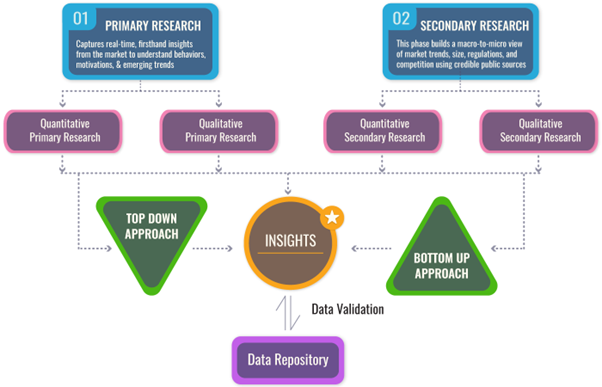
DUAL MODELING: TOP-DOWN + BOTTOM-UP
To ensure robust market estimation, we apply two complementary sizing approaches:
Top-Down Modeling:- Start with broader industry value (e.g., global or regional TAM)
- Apply filters by segment, geography, end-user, or use case
- Adjust with primary insights and validation benchmarks
- Ideal for investor-grade market scans and opportunity mapping
- Aggregate from the ground up using sales volumes, pricing, and unit economics
- Use internal modeling templates aligned with stakeholder data
- Incorporate distributor-level or region-specific inputs
- Most accurate for emerging segments and granular sub-markets
DATA VALIDATION: IN-HOUSE REPOSITORY
We close the loop with proprietary data intelligence built from ongoing projects, industry monitoring, and historical benchmarking. This repository includes:
- Multi-sector market and pricing models
- Key trendlines from past interviews and forecasts
- Benchmarked adoption rates, churn patterns, and ROI indicators
- Industry-specific deviation flags and cross-check logic
- Catches inconsistencies early
- Aligns projections across studies
- Enables consistent, high-trust deliverables