

Home Security Solutions Market Size and Forecast (2020 - 2033), Global and Regional Growth, Trend, Share, and Industry Analysis Report Coverage: By Product (Security Cameras, Alarm Systems, Smart Locks, Sensors & Detectors, and Professional Monitoring Services), By System (Professionally Installed & Monitored, Do-It-Yourself (DIY), and Self-Monitored), By Sales Channel (Retail, Online, and Direct-to-Consumer) And Geography
2025-12-02
Semiconductor and Electronics
Ekta Chaurasia (Team Lead)
Description
Home Security Solutions Market Overview
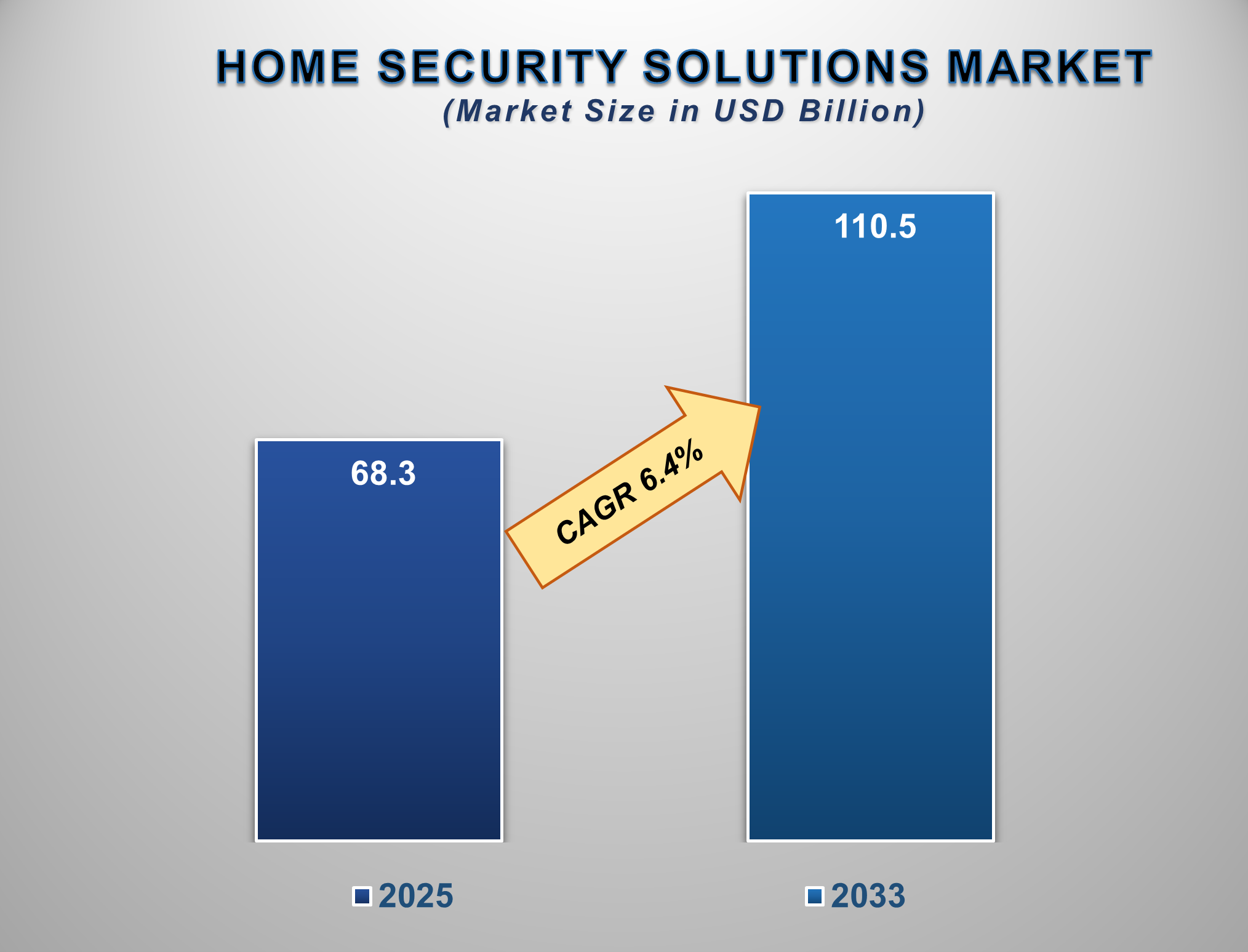
The Home Security Solutions Market is positioned for a period of dynamic and sustained growth from 2025 to 2033, fueled by rising consumer awareness regarding safety, technological advancements in smart home devices, increasing urbanization, and the growing prevalence of affordable DIY solutions. The market is projected to be valued at approximately USD 68.3 billion in 2025 and is forecasted to reach nearly USD 110.5 billion by 2033, exhibiting a compound annual growth rate (CAGR) of 6.4% during this period.
Home security solutions encompass a wide range
of products and services designed to protect residences from burglary, fire,
and other emergencies. This includes hardware such as security cameras, alarm
systems, and smart locks, as well as software platforms and professional
monitoring services that provide real-time alerts and emergency response. The
market's robust expansion is primarily driven by the global integration of
Internet of Things (IoT) technology into residential spaces, which has made
sophisticated security systems more accessible and user-friendly.
Furthermore, rising crime rates in certain urban
areas, coupled with the increasing consumer desire for remote home monitoring
and control via smartphones, are significant contributors to market growth. The
proliferation of subscription-based models and the decreasing cost of sensors
and cloud storage are also making comprehensive home security more affordable.
North America currently holds the largest market share due to high consumer
spending and early technology adoption, while the Asia-Pacific region is
expected to witness the fastest growth, driven by its rapidly expanding middle
class and increasing smart city initiatives.
Home Security
Solutions Market Drivers and Opportunities
The Proliferation of Smart Home Ecosystems
and IoT Integration is the Primary Market Driver
The relentless expansion of the smart home
ecosystem is the most powerful force propelling the home security solutions
market. The convenience, control, and connectivity offered by IoT devices have
transformed home security from a standalone alarm system into an integrated
network of intelligent devices. Consumers can now monitor live video feeds,
lock and unlock doors, receive motion alerts, and control environmental sensors
remotely from their smartphones. This seamless integration is a key purchasing
driver, as security becomes a core component of the automated home. The ability
of these systems to learn user behavior and provide customized alerts enhances
their perceived value. Compatibility with popular voice assistants like Amazon
Alexa and Google Assistant further drives adoption by placing security control
at the center of the smart home experience. The sheer variety and
interoperability of connected devices are creating a robust ecosystem where
security is no longer an isolated function but an integral part of modern
living.
The global smart home market continues its rapid
ascent, fundamentally reshaping residential living and consumer expectations.
In 2024, the number of connected smart homes worldwide is estimated to exceed
400 million, with a penetration rate of over 25% in key markets like North
America and Western Europe. This figure is projected to grow to over 600
million homes by 2027. This growth is underpinned by advancements in wireless
communication protocols (like Wi-Fi, Bluetooth, and Zigbee), the falling cost
of hardware, and increased consumer familiarity with smart technology. The
Asia-Pacific region is becoming a major growth engine, with countries like
China and South Korea leading in adoption rates. This data underscores the
immense scale of the connected home landscape and highlights the central role
that security and safety products play within it, often serving as the initial
entry point for consumers into the broader smart home ecosystem.
Rising Urbanization and Crime Awareness are Driving Strategic Adoption
The global trend of urbanization and heightened
awareness of property crime is a powerful catalyst for the home security
solutions market. As populations increasingly concentrate in cities, concerns
about burglary and property theft often rise, driving demand for protective
measures. Widespread access to information through social media and local news
apps keeps residents informed about incidents in their neighborhoods, further
amplifying security concerns. This environment pushes homeowners and renters
alike to invest in systems that offer peace of mind. Furthermore, the
availability of renter-friendly DIY solutions has unlocked a massive market
segment previously hesitant to install hardwired systems. The demand is no
longer just about deterring break-ins; it extends to comprehensive safety,
including fire, carbon monoxide, and water leak detection, making a holistic
security system a standard consideration for modern urban living.
The Emergence of AI-Powered Features and the
Expansion of DIY Models Present Significant Opportunities
The strategic integration of artificial
intelligence and the booming DIY segment is
creating significant growth frontiers for the home security market. Key
opportunities lie in the application of advanced AI and machine learning to
enhance system intelligence and usability. AI-powered cameras can now
distinguish between people, pets, and vehicles, drastically reducing false
alarms and providing more relevant notifications. Advanced analytics can
identify unusual patterns of activity, offering proactive security.
Furthermore, the burgeoning DIY market represents a massive opportunity for
growth, as it appeals to cost-conscious consumers and renters who seek
flexibility and avoid long-term contracts. For security providers, investing in
developing more sophisticated AI algorithms, creating scalable and
user-friendly DIY platforms, and offering flexible monitoring plans are key
strategies to capture new customer segments and drive recurring revenue,
turning hardware sales into long-term service relationships.
Home Security Solutions
Market Scope
|
Report Attributes |
Description |
|
Market Size in 2025 |
USD 68.3 Billion |
|
Market Forecast in 2033 |
USD 110.5 Billion |
|
CAGR % 2025-2033 |
6.4% |
|
Base Year |
2024 |
|
Historic Data |
2020-2024 |
|
Forecast Period |
2025-2033 |
|
Report USP |
Product Portfolio,
Technological Analysis, Company Market Share, Company Heatmap, Pricing
Analysis, Growth Factors and more |
|
Segments Covered |
●
By Product ●
By System ●
By Sales Channel |
|
Regional Scope |
●
North America, ●
Europe, ●
APAC, ●
Latin America ●
Middle East and
Africa |
|
Country Scope |
1)
U.S. 2)
Canada 3)
Germany 4)
UK 5)
France 6)
Spain 7)
Italy 8)
Switzerland 9)
China 10)
Japan 11)
India 12)
Australia 13)
South Korea 14)
Brazil 15)
Mexico 16)
Argentina 17)
South Africa 18)
Saudi Arabia 19)
UAE |
Home Security Solutions
Market Report Segmentation Analysis
The global Home Security
Solutions Market industry analysis is segmented by Product, by System, by Sales
Channel, and by region.
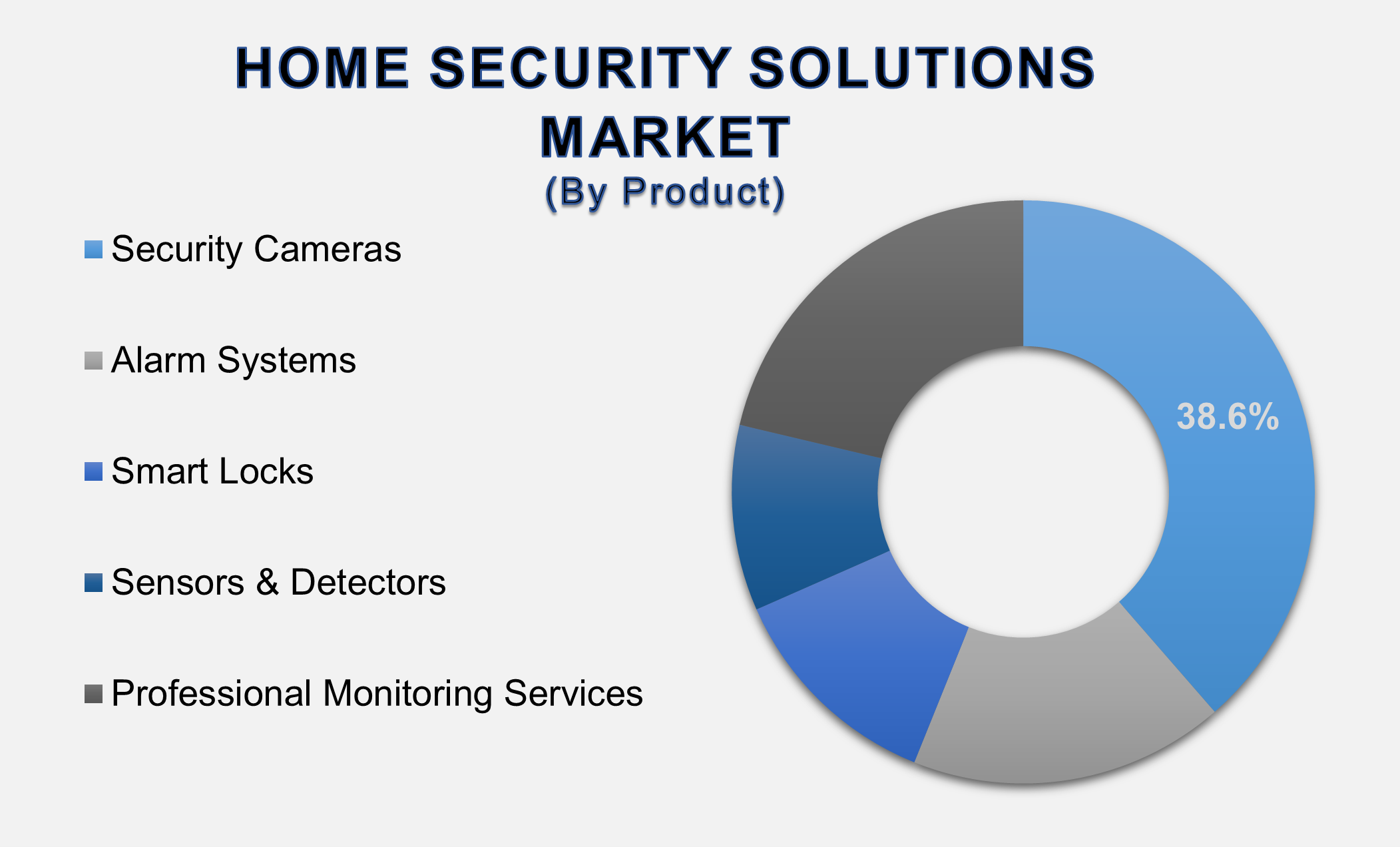
The Security Cameras Product segment is
anticipated to command a significant market share in 2025
The Product segment is categorised into Security
Cameras, Alarm Systems, Smart Locks, Sensors & Detectors, and Professional
Monitoring Services. The security cameras segment holds a substantial and
dominant share of the market due to their visual verification capabilities and
high consumer demand. Modern security cameras offer features such as
high-definition live streaming, night vision, two-way audio, and person
detection, making them one of the most visible and valued components of a home
security system.
Their utility extends beyond crime deterrence to include monitoring children, pets, and package deliveries. The ease of installation of wireless and battery-powered models, combined with the availability of low-cost cloud storage plans, has made them an accessible first purchase for many consumers. The continuous innovation in camera technology, including 4K resolution, solar power, and advanced AI analytics, ensures this segment remains a primary revenue driver and a cornerstone of the modern home security setup.
The Do-It-Yourself (DIY) System segment is
projected to grow at a significant CAGR.
The System segment includes Professionally
Installed & Monitored, Do-It-Yourself (DIY), and Self-Monitored. The DIY
system segment's projected significant growth is directly linked to its appeal
to cost-effectiveness, flexibility, and ease of installation. DIY systems
eliminate the need for scheduled appointments, professional installation fees,
and often, long-term contracts, which are common pain points of traditional
professionally installed systems.
They are designed for user-friendly self-setup,
typically using wireless components that can be configured via a smartphone app
in minutes. This model is particularly attractive to renters, tech-savvy
millennials, and budget-conscious homeowners who want control over their system
without a significant upfront investment. The ability to customize a system piece by piece and the availability of scalable monitoring options are powerful forces
propelling the DIY segment to become the fastest-growing system type in the
market.
The Online Sales Channel segment is projected to
witness the highest growth rate.
The Sales Channel segment is divided into Retail,
Online, and Direct-to-Consumer. The Online segment's position as the
fastest-growing channel is a direct consequence of shifting consumer purchasing
habits and the nature of the products. Consumers heavily rely on online
reviews, comparison tools, and detailed product specifications before making a
purchase decision for home security devices.
E-commerce platforms offer a wider selection,
competitive pricing, and the convenience of direct-to-doorstep delivery, which
is ideal for DIY products. Furthermore, many new, digitally-native brands
operate primarily or exclusively through online channels, using content
marketing and social media to reach their audience. The ability to easily
purchase individual components, sensors, or entire kits online, often with
direct access to customer support and subscription management, makes the online
channel the most dynamic and rapidly expanding sales avenue in the industry.
The following segments are part of an in-depth analysis of
the global Home Security Solutions Market:
|
Market
Segments |
|
|
By Product |
●
Security Cameras ●
Alarm Systems ●
Smart Locks ●
Sensors &
Detectors ●
Professional
Monitoring Services |
|
By System |
●
Professionally
Installed & Monitored ●
Do-It-Yourself (DIY) ●
Self-Monitored |
|
By Sales Channel |
●
Retail ●
Online ●
Direct-to-Consumer |
Home Security Solutions
Market Share Analysis by Region
The North America region
is anticipated to hold the largest portion of the Home Security Solutions
Market globally throughout the forecast period.
North America's dominance is attributed to its
high disposable income, strong technological infrastructure, and a deeply
ingrained culture of home ownership and security. The region has a mature
market with high awareness and penetration rates for both professional and DIY
security systems. The presence of major global players and tech giants, coupled
with a high adoption rate of smart home technologies, creates a sustained
demand for advanced and integrated security solutions. Furthermore, the
availability of reliable and high-speed internet across most of the region is a
critical enabler for connected security devices and cloud-based monitoring
services, solidifying North America's leading position.
The United States, in particular, is the world's
largest single market for home security solutions. The country's competitive
landscape, featuring a mix of traditional security companies, telecom
providers, and new tech entrants, drives continuous innovation and aggressive
marketing. High rates of suburban home ownership, coupled with a strong DIY
culture, fuel demand across both professional and self-installed segments. The
well-developed ecosystem of smart home devices and the consumer expectation for
seamless integration ensure a continuous cycle of upgrades and new product
adoption, maintaining the U.S. at the forefront of the global market.
Home Security Solutions
Market Competition Landscape Analysis
The global home security
solutions market is highly competitive and fragmented, featuring a diverse mix
of established security giants, telecommunications companies, specialized DIY
brands, and technology conglomerates. Competition is intensifying and centers
on product features, system reliability, brand trust, the user experience of
mobile apps, and the cost of monitoring services. Key strategies include
continuous investment in R&D for AI and new sensor technologies, strategic
partnerships with homebuilders and insurance companies, and the bundling of
security with other smart home services or internet/TV packages. The market
also sees fierce competition from tech startups offering innovative,
app-centric security solutions and low-cost monitoring alternatives.
Global Home Security
Solutions Market Recent Developments News:
- In February 2025, Google Nest announced a new
generation of its flagship indoor camera with enhanced radar-based sensing
for more accurate person and pet alerts, reducing false notifications.
- In December 2024, SimpliSafe, a leading DIY
security provider, partnered with a major national insurance company to
offer premium discounts to policyholders who install their system, driving
subscriber growth.
- In August 2024, Amazon announced that its Ring
Alarm system had surpassed 2 million active monitoring subscriptions,
highlighting the massive scale achievable through its e-commerce and
ecosystem integration.
- In October 2024, ADT Inc. launched a new integrated smart home panel
with built-in voice assistant capabilities, aiming to create a more
centralized and intuitive user experience for its customers.
The Global Home Security Solutions Market Is Dominated by a
Few Large Companies, such as
●
ADT Inc.
●
SimpliSafe, Inc.
●
Google LLC (Nest)
●
Amazon.com, Inc.
(Ring, Blink)
●
Johnson Controls
International plc (Tyco)
●
Resideo Technologies,
Inc.
●
Allegion plc
●
ASSA ABLOY
●
Comcast Corporation
(Xfinity Home)
●
Vivint Smart Home,
Inc.
●
Arlo Technologies,
Inc.
●
Axis Communications AB
●
Bosch
Sicherheitssysteme GmbH
●
Frontpoint Security
Solutions, LLC
●
Abode Systems, Inc.
● Other Prominent Players
Frequently Asked Questions
Ekta Chaurasia (Team Lead)
Ekta Chaurasia is a highly experienced Team Lead at M2Square Consultancy with over 7 years of expertise in market research, strategic consulting, competitive benchmarking, and business intelligence solutions. She specializes in ICT, semiconductors & electronics, automotive & transportation, and industrial machinery markets.
She leads end-to-end global research projects focused on market trends, industry analysis, growth forecasting, customer insights, and strategic decision-making. Known for her analytical leadership and industry expertise, Ekta helps businesses uncover growth opportunities, evaluate competitive landscapes, and stay ahead in rapidly evolving markets through accurate and insight-driven research.
1. Global Home Security
Solutions Market Introduction and Market Overview
1.1.
Objectives
of the Study
1.2.
Global
Home Security Solutions Market Scope and Market Estimation
1.2.1.Global Electronic Toll
Collection Overall Market Size (US$ Bn), Market CAGR (%), Market forecast (2025
- 2033)
1.2.2.Global Home Security
Solutions Market Revenue Share (%) and Growth Rate (Y-o-Y) from 2020 - 2033
1.3.
Market
Segmentation
1.3.1.Product of Global Home
Security Solutions Market
1.3.2.System of Global Home
Security Solutions Market
1.3.3.Sales Channel of Global Home
Security Solutions Market
1.3.4.Region of Global Home
Security Solutions Market
2.
Executive Summary
2.1.
Demand
Side Trends
2.2.
Key
Market Trends
2.3.
Market
Demand (US$ Bn) Analysis 2020 – 2024 and forecast, 2025 – 2033
2.4.
Demand
and Opportunity Assessment
2.5.
Key
Developments
2.6.
Market
Entry Strategies
2.7.
Market
Dynamics
2.7.1.Drivers
2.7.2.Limitations
2.7.3.Opportunities
2.7.4.Impact Analysis of Drivers
and Restraints
2.8.
Porter’s
Five Forces Analysis
2.9.
PEST
Analysis
3. Global
Home Security Solutions Market Estimates
& Historical Trend Analysis (2020 - 2024)
4. Global
Home Security Solutions Market Estimates
& Forecast Trend Analysis, by Product
4.1.
Global
Home Security Solutions Market Revenue (US$ Bn) Estimates and Forecasts, by Product,
2020 - 2033
4.1.1.Security Cameras
4.1.2.Alarm Systems
4.1.3.Smart Locks
4.1.4.Sensors & Detectors
4.1.5.Professional Monitoring
Services
5. Global
Home Security Solutions Market Estimates
& Forecast Trend Analysis, by System
5.1.
Global
Home Security Solutions Market Revenue (US$ Bn) Estimates and Forecasts, by System,
2020 - 2033
5.1.1.Professionally Installed
& Monitored
5.1.2.Do-It-Yourself (DIY)
5.1.3.Self-Monitored
6. Global
Home Security Solutions Market Estimates
& Forecast Trend Analysis, by Sales Channel
6.1.
Global
Home Security Solutions Market Revenue (US$ Bn) Estimates and Forecasts, by Sales
Channel 2020 - 2033
6.1.1.Retail
6.1.2.Online
6.1.3.Direct-to-Consumer
7. Global
Home Security Solutions Market Estimates
& Forecast Trend Analysis, by region
7.1.
Global
Home Security Solutions Market Revenue (US$ Bn) Estimates and Forecasts, by region,
2020 - 2033
7.1.1.North America
7.1.2.Europe
7.1.3.Asia Pacific
7.1.4.Middle East & Africa
7.1.5.Latin America
8. North America Home
Security Solutions Market: Estimates
& Forecast Trend Analysis
8.1. North America Home
Security Solutions Market Assessments & Key Findings
8.1.1.North America Home
Security Solutions Market Introduction
8.1.2.North America Home
Security Solutions Market Size Estimates and Forecast (US$ Billion) (2020 - 2033)
8.1.2.1.
By Product
8.1.2.2.
By System
8.1.2.3.
By Sales Channel
8.1.2.4. By Country
8.1.2.4.1. The U.S.
8.1.2.4.2. Canada
9. Europe Home
Security Solutions Market: Estimates
& Forecast Trend Analysis
9.1. Europe Home Security
Solutions Market Assessments & Key Findings
9.1.1.Europe Home Security
Solutions Market Introduction
9.1.2.Europe Home Security
Solutions Market Size Estimates and Forecast (US$ Billion) (2020 - 2033)
9.1.2.1.
By Product
9.1.2.2.
By System
9.1.2.3.
By Sales Channel
9.1.2.4. By Country
9.1.2.4.1.
Germany
9.1.2.4.2.
Italy
9.1.2.4.3.
U.K.
9.1.2.4.4.
France
9.1.2.4.5.
Spain
9.1.2.4.6.
Switzerland
9.1.2.4.7. Rest
of Europe
10. Asia Pacific Home
Security Solutions Market: Estimates
& Forecast Trend Analysis
10.1. Asia Pacific Market
Assessments & Key Findings
10.1.1.
Asia
Pacific Home Security Solutions Market Introduction
10.1.2.
Asia
Pacific Home Security Solutions Market Size Estimates and Forecast (US$ Billion)
(2020 - 2033)
10.1.2.1.
By Product
10.1.2.2.
By System
10.1.2.3.
By Sales Channel
10.1.2.4. By Country
10.1.2.4.1. China
10.1.2.4.2. Japan
10.1.2.4.3. India
10.1.2.4.4. Australia
10.1.2.4.5. South Korea
10.1.2.4.6. Rest of Asia Pacific
11. Middle East & Africa Home
Security Solutions Market: Estimates
& Forecast Trend Analysis
11.1. Middle East & Africa
Market Assessments & Key Findings
11.1.1. Middle
East & Africa
Home Security Solutions Market Introduction
11.1.2. Middle
East & Africa
Home Security Solutions Market Size Estimates and Forecast (US$ Billion) (2020
- 2033)
11.1.2.1.
By Product
11.1.2.2.
By System
11.1.2.3.
By Sales Channel
11.1.2.4. By Country
11.1.2.4.1. UAE
11.1.2.4.2. Saudi
Arabia
11.1.2.4.3. South
Africa
11.1.2.4.4. Rest
of MEA
12. Latin America
Home Security Solutions Market:
Estimates & Forecast Trend Analysis
12.1. Latin America Market
Assessments & Key Findings
12.1.1. Latin America Home
Security Solutions Market Introduction
12.1.2. Latin America Home
Security Solutions Market Size Estimates and Forecast (US$ Billion) (2020 - 2033)
12.1.2.1.
By Product
12.1.2.2.
By System
12.1.2.3.
By Sales Channel
12.1.2.4. By Country
12.1.2.4.1. Brazil
12.1.2.4.2. Argentina
12.1.2.4.3. Mexico
12.1.2.4.4. Rest
of LATAM
13.
Country
Wise Market: Introduction
14.
Competition
Landscape
14.1. Global Home Security
Solutions Market Product Mapping
14.2. Global Home Security
Solutions Market Concentration Analysis, by Leading Players / Innovators /
Emerging Players / New Entrants
14.3. Global Home Security
Solutions Market Tier Structure Analysis
14.4. Global Home Security
Solutions Market Concentration & Company Market Shares (%) Analysis, 2024
15.
Company
Profiles
15.1.
ADT Inc.
15.1.1.
Company
Overview & Key Stats
15.1.2.
Financial
Performance & KPIs
15.1.3.
Product
Portfolio
15.1.4.
SWOT
Analysis
15.1.5.
Business
Strategy & Recent Developments
* Similar details would be provided for all the players
mentioned below
15.2.
SimpliSafe, Inc.
15.3.
Google LLC (Nest)
15.4.
Amazon.com, Inc. (Ring, Blink)
15.5.
Johnson Controls International plc (Tyco)
15.6.
Resideo Technologies, Inc.
15.7.
Allegion plc
15.8.
ASSA ABLOY
15.9.
Comcast Corporation (Xfinity Home)
15.10.
Vivint Smart Home, Inc.
15.11.
Arlo Technologies, Inc.
15.12.
Axis Communications AB
15.13.
Bosch Sicherheitssysteme GmbH
15.14.
Frontpoint Security Solutions, LLC
15.15.
Abode Systems, Inc.
15.16.
Other Prominent Players
16. Research
Methodology
16.1. External Transportations /
Databases
16.2. Internal Proprietary
Database
16.3. Primary Research
16.4. Secondary Research
16.5. Assumptions
16.6. Limitations
16.7. Report FAQs
17. Research
Findings & Conclusion
Our Research Methodology
"Insight without rigor is just noise."
We follow a comprehensive, multi-phase research framework designed to deliver accurate, strategic, and decision-ready intelligence. Our process integrates primary and secondary research , both quantitative and qualitative , along with dual modeling techniques ( top-down and bottom-up) and a final layer of validation through our proprietary in-house repository.
PRIMARY RESEARCH
Primary research captures real-time, firsthand insights from the market to understand behaviors, motivations, and emerging trends.
1. Quantitative Primary Research
Objective: Generate statistically significant data directly from market participants.
Approaches:- Structured surveys with customers, distributors, and field agents
- Mobile-based data collection for point-of-sale audits and usage behavior
- Phone-based interviews (CATI) for market sizing and product feedback
- Online polling around industry events and digital campaigns
- Purchase frequency by customer type
- Channel performance across geographies
- Feature demand by application or demographic
2. Qualitative Primary Research
Objective: Explore decision-making drivers, pain points, and market readiness.
Approaches:- In-depth interviews (IDIs) with executives, product managers, and key decision-makers
- Focus groups among end users and early adopters
- Site visits and observational research for consumer products
- Informal field-level discussions for regional and cultural nuances
SECONDARY RESEARCH
This phase helps establish a macro-to-micro understanding of market trends, size, regulation, and competitive dynamics, sourced from credible and public domain information.
1. Quantitative Secondary Research
Objective: Model market value and segment-level forecasts based on published data.
Sources include:- Financial reports and investor summaries
- Government trade data, customs records, and regulatory statistics
- Industry association publications and economic databases
- Channel performance and pricing data from marketplace listings
- Revenue splits, pricing trends, and CAGR estimates
- Supply-side capacity and volume tracking
- Investment analysis and funding benchmarks
2. Qualitative Secondary Research
Objective: Capture strategic direction, innovation signals, and behavioral trends.
Sources include:- Company announcements, roadmaps, and product pipelines
- Publicly available whitepapers, conference abstracts, and academic research
- Regulatory body publications and policy briefs
- Social and media sentiment scanning for early-stage shifts
- Strategic shifts in market positioning
- Unmet needs and white spaces
- Regulatory triggers and compliance impact
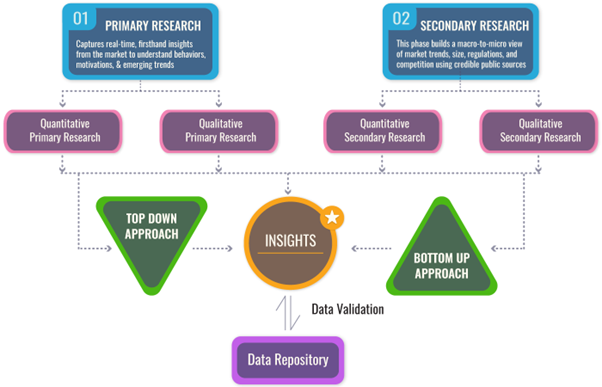
DUAL MODELING: TOP-DOWN + BOTTOM-UP
To ensure robust market estimation, we apply two complementary sizing approaches:
Top-Down Modeling:- Start with broader industry value (e.g., global or regional TAM)
- Apply filters by segment, geography, end-user, or use case
- Adjust with primary insights and validation benchmarks
- Ideal for investor-grade market scans and opportunity mapping
- Aggregate from the ground up using sales volumes, pricing, and unit economics
- Use internal modeling templates aligned with stakeholder data
- Incorporate distributor-level or region-specific inputs
- Most accurate for emerging segments and granular sub-markets
DATA VALIDATION: IN-HOUSE REPOSITORY
We close the loop with proprietary data intelligence built from ongoing projects, industry monitoring, and historical benchmarking. This repository includes:
- Multi-sector market and pricing models
- Key trendlines from past interviews and forecasts
- Benchmarked adoption rates, churn patterns, and ROI indicators
- Industry-specific deviation flags and cross-check logic
- Catches inconsistencies early
- Aligns projections across studies
- Enables consistent, high-trust deliverables