

Hospital Gowns Market Size and Forecast (2026–2034), Global and Regional Growth, Trend, Share and Industry Analysis Report Coverage: By Usability (Disposable and Reusable), By Type (Surgical Gowns, Non-surgical Gowns, and Patient Gowns), By End User (Hospitals and Clinics, Long Term Care Facilities, Ambulatory Surgical Centers, Home Healthcare, and Others (Diagnostic Centers, Emergency Care Centers, etc.)), and Geography
2026-07-30
Healthcare
Swetal (Research Analyst)
Description
Hospital Gowns Market Overview
The global hospital
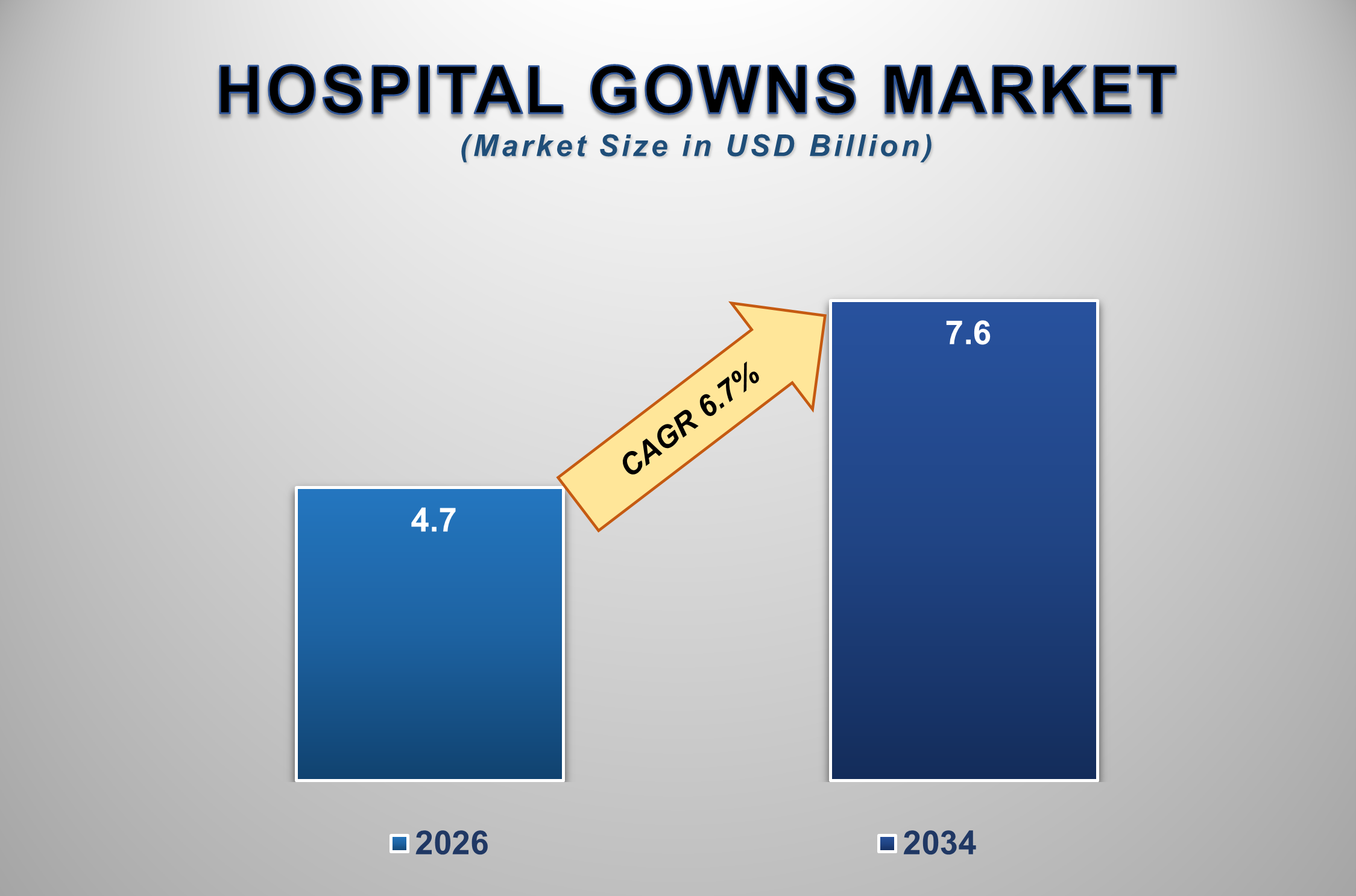
gowns market was valued at USD 4.7 billion in 2026 and is projected to reach
USD 7.6 billion by 2034, expanding at a CAGR of 6.7% during the forecast
period. Hospital gowns are an important part of the healthcare apparel sector,
driven by growing needs for infection control, patient safety, and healthcare
workers’ safety. They are commonly worn in hospitals, ambulatory surgery
centers, long-term care facilities, and other healthcare settings for surgery,
patient treatment, and diagnostic procedures. Innovations in lightweight,
breathable, fluid-resistant, and environmentally friendly materials are
enabling the production of hospital gowns that maximize wearer comfort and
safety. Increasingly, manufacturers are producing both reusable, environmentally
friendly gowns and high-performance disposable gowns. Growth in healthcare
infrastructure spending, rising surgical volumes, heightened concerns regarding
HAI, and textile innovations are further driving the market. Additionally,
expanding access to healthcare in emerging markets and the implementation of
stringent quality and safety standards present opportunities for manufacturers
to strengthen their market positions and product portfolios.
Hospital Gowns Market Drivers and
Opportunities
Increasing Focus
on Infection Prevention and Healthcare Worker Safety Is Driving Market Growth
Infection
prevention and protection for both patients and healthcare providers have
increasingly become among the most important drivers of growth in the hospital
gown industry. Incidences of healthcare-associated infections (HAIs), stringent
infection control measures, and an increasing number of surgeries have prompted
healthcare facilities to invest in quality protective clothing. Hospital gowns
help prevent cross-contamination and infection and provide protection for
patients as well as healthcare providers. In March 2026, a bipartisan group of
U.S. Congress members called on the HHS to make public a much-anticipated
federal study reviewing the merits and viability of increasing the use of
reusable healthcare textiles, such as surgical gowns, incontinence pads, and
other hospital linens intended for laundering and multiple uses. This reflects
growing interest, from a policymaking perspective, in enhancing infection
control measures and making healthcare supplies more sustainable and resilient.
As the role of reusable protective textiles is increasingly recognized, there
is a broader trend in the industry to ensure the availability of high-quality
hospital gowns. Overall, the factors discussed above are expected to increase
demand for hospital gowns owing to growing awareness of the safety of
healthcare professionals, higher investments in sophisticated fabrics, and
stricter regulatory requirements. With healthcare facilities' emphasis on
infection control and sustainable procurement practices, the hospital gown
market is expected to grow further in the future.
Rising
Healthcare Infrastructure Development and Surgical Procedures Fueling Market
Expansion
Growing investment
in health care infrastructure and an increasing number of surgeries being
performed worldwide are among the main drivers of the hospital gown market's
growth. Governments and private health care providers are establishing more
hospitals, ambulatory surgical centers, and specialty care centers to meet the
ever-growing need for health care services. These developments have led to a
growing need for higher-quality hospital gowns to ensure the safety of patients
and health care providers. According to figures released by the European Union
in February 2026, around 5.01 million cataract surgeries were conducted in the
European Union in 2023. The large number of one of the most common procedures
performed worldwide indicates the increasing use of surgical services in the
region. With surgical services on the rise due to an aging population, better
availability of health care facilities, and technological advancements in
medicine, health care facilities need a continuous supply of surgical and patient
gowns to support infection control and clinical effectiveness. In conclusion,
continued improvements in health care infrastructure, coupled with the growing
number of surgeries performed not only in developed but also in developing
countries, should lead to steady growth of the hospital gown market in the
coming years. The demand for reliable protective clothing will ensure future
success for manufacturers in the field.
Growing Demand
for Sustainable and High-Performance Hospital Gowns Presents Significant
Opportunities
The rising trend
towards sustainability in health care practices is generating many growth
opportunities for the hospital gown industry. Healthcare providers, hospitals,
and the regulating authorities are now increasingly inclined towards the use of
sustainable purchasing practices in order to reduce the environmental footprint
of disposable medical equipment while at the same time maintaining the required
standards for the safety of the patients and preventing any infections. There
is now rapid uptake of reusable hospital gowns made from highly efficient
fabrics, which can go through multiple launderings and sterilizations without
losing their effectiveness as a protective barrier. On the other hand,
producers are making huge investments in innovative fabric technologies that
are not only sustainable but also provide high levels of clinical performance.
The introduction of lightweight, breathable, fluid-resistant, antimicrobial,
and comfort-improving fabrics has helped improve the experience for both patients
and practitioners while complying with the strict infection control standards.
The use of sustainable fibers, low-impact production processes, and closed-loop
textile solutions has further enabled organizations to comply with the changing
environmental, social, and governance expectations.
In addition to that, there are huge opportunities offered by emerging markets, with the development of healthcare infrastructure and inclusion of sustainability initiatives within healthcare modernization programs being the driving forces. Organizations within the healthcare industry are looking for cost-effective ways of protective clothing that would be beneficial over time due to the longevity of use, generation of fewer waste materials, and less expense incurred during the entire lifecycle. Those companies that concentrate on innovations, regulatory compliance, quality products, and cooperation with healthcare organizations will have many opportunities.
Hospital Gowns Market Scope
|
Report Attributes |
Description |
|
Market Size in
2026 |
USD 4.7 Billion |
|
Market Forecast
in 2034 |
USD 7.6
Billion |
|
CAGR % 2026-2034 |
6.7% |
|
Base Year |
2025 |
|
Historic Data |
2021-2025 |
|
Forecast Period |
2026-2034 |
|
Report USP |
Pricing and
Cost Structure Analysis, Technology and Product Innovation Benchmarking,
Hospital Procurement and Purchasing Insights, Whitespace Assessment, Company
Share, Company Heatmap, Growth Factors and more |
|
Segments Covered |
●
By
Usability ●
By Type ●
By End
User |
|
Regional Scope |
●
North
America ●
Europe ●
APAC ●
Latin
America ●
Middle
East and Africa |
|
Country Scope |
●
U.S. ●
Canada ●
U.K. ●
Germany ●
France ●
Italy ●
Spain ●
Russia ●
China ●
India ●
Japan ●
South
Korea ●
Australia
●
Mexico ●
Brazil ●
Saudi
Arabia ●
UAE ●
South
Africa
|
Hospital Gowns Market Report
Segmentation Analysis
The global hospital
gowns market industry analysis is segmented by usability, by type, by end user,
and by region.
Disposable
Segment Is Expected to Dominate the Hospital Gowns Market During the Forecast
Period
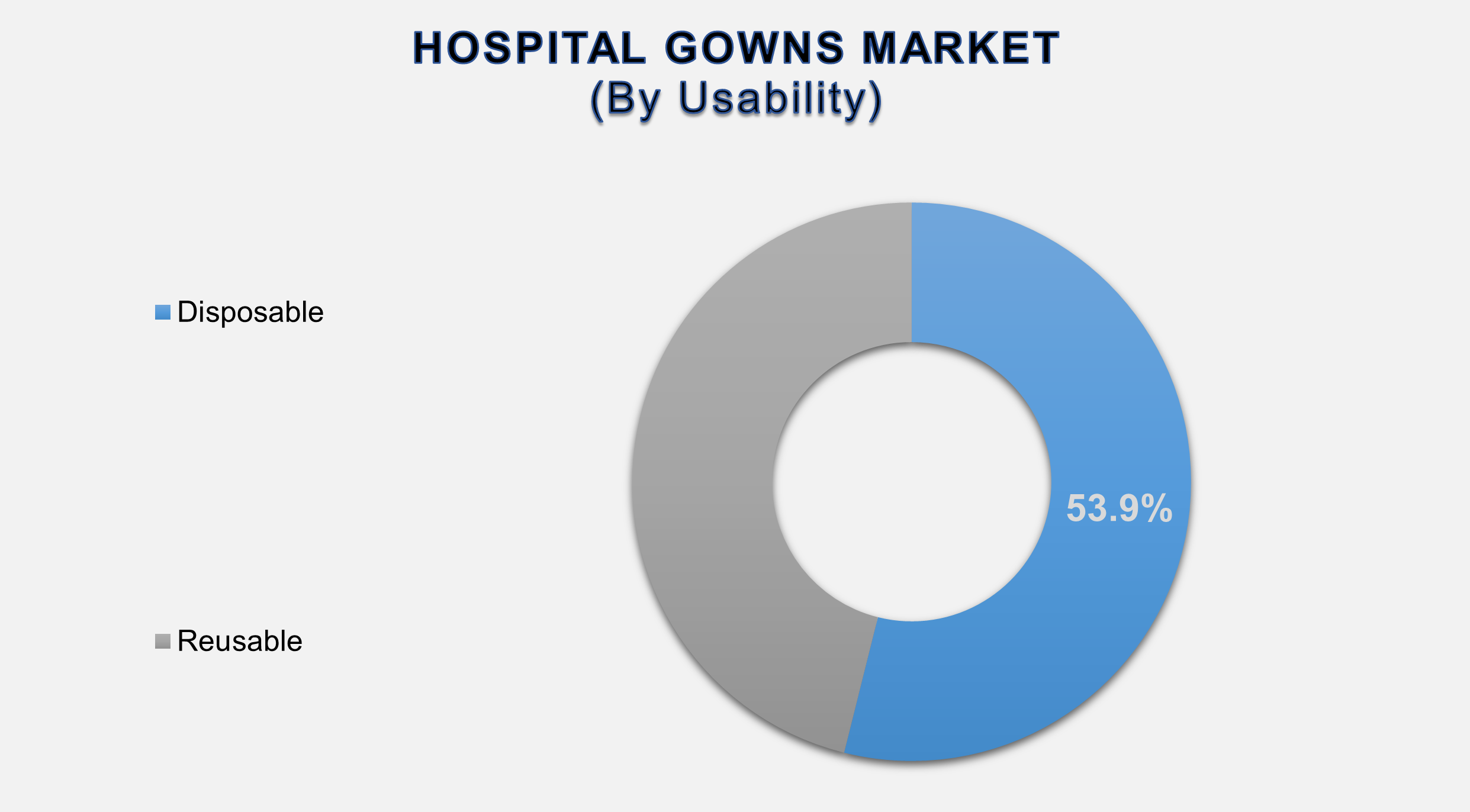
The disposable
category is anticipated to lead the hospital gown market over the forecast
period owing to the rising importance of infection prevention, patient safety,
and strict healthcare policies. Disposable hospital gowns are extensively
employed in hospitals, ASCs, EDs, and outpatient centers since these hospital
gowns offer protection against contamination and can be used only once. The
rising number of surgeries, increasing hospitalizations, and development of
healthcare infrastructure in both developed and developing countries are other
factors propelling the growth of the market. Disposable gowns are preferred by
healthcare practitioners, as these hospital gowns do not require cleaning and
sterilization.
Moreover, constant
advancements in the technology of nonwoven fabric are leading to increased
efficiency and comfort for the use of disposable hospital gowns. Manufacturers
are able to develop lightweight, water-resistant, and tear-resistant materials
that are also comfortable to wear. Such attributes as fluid resistance,
antimicrobial properties, and increased strength during use are becoming
factors for increased product use in different clinical settings. In addition,
increased preparedness for infectious disease outbreaks, government stockpiling
programs, and infection control regulations are driving market growth. At the
same time, issues related to sustainability are pushing toward the creation of
recyclable materials for disposable products; however, the convenience and
safety of disposable hospital gowns will drive the market dominance of this
segment in the coming years.
Surgical Gowns
Segment Is Expected to Lead the Hospital Gowns Market by Type
The surgical gowns
segment is expected to lead the hospital gowns market by type during the
forecast period, driven by the increasing volume of surgical procedures and the
critical need for infection prevention in operating rooms. Surgical gowns are
specifically designed to provide high-level barrier protection against blood,
bodily fluids, and microbial transmission, making them an essential component
of personal protective equipment for surgeons, nurses, and other operating room
personnel. The growing prevalence of chronic diseases, expanding aging
population, and rising demand for elective and minimally invasive surgeries are
contributing to the increased consumption of surgical gowns across healthcare
facilities. Additionally, stringent regulatory standards and infection control
guidelines are encouraging hospitals to adopt high-performance gowns that
ensure both patient and healthcare worker safety.
There have been
many innovative technologies incorporated in surgical gown materials, providing
increased fluid repellent properties, breathability, comfort, and durability.
Innovations in terms of non-woven technology, barrier technology, antimicrobial
technology, and ergonomic technology are ensuring that there is more protection
provided to the user from all sides while at the same time reducing fatigue due
to lengthy surgeries. The building up of hospitals, ambulatory surgery centers,
and other specialty centers in developing countries is expected to help the
demand for surgical gowns. Increasing investment in the development of
healthcare facilities, pandemic preparedness, and surgery capacities will help
drive the segment, giving surgical gowns the lead in the hospital gown market.
Hospitals and
Clinics Segment Is Expected to Dominate the End User Segment
The healthcare
facilities sector shall occupy the leadership position among end-users in the
hospital gown market during the forecast period due to high patient admissions,
surgeries, tests, and other healthcare procedures that occur in these
healthcare facilities. Healthcare facilities are the major users of hospital
gowns, and there shall be a continuous requirement for disposable and reusable
hospital gowns for usage by their patients, surgeons, nurses, doctors, and
other healthcare professionals. The increasing cases of chronic diseases,
increasing demand for in-patient and out-patient treatments, and growth in the
healthcare industry infrastructure have driven the demand for hospital gowns.
Moreover, the segment is profiting from the efforts put towards investing in the modernization of the hospital facilities, expansion in the provision of specialist care, and incorporation of state-of-the-art protective clothing that offers increased comfort, strength, and clinical efficacy. With an increased occurrence of complex surgeries, emphasis on prevention of infections associated with healthcare facilities, and greater preparedness in case of public health emergencies, there has been a rapid increase in the demand for hospital gowns in hospitals and clinics. It should be noted that sustainable procurement approaches, alongside the use of novel reusable or high-end disposable gowns, help to address the concerns of operational efficiency, environmental sustainability, and infection prevention at the same time.
The following
segments are part of an in-depth analysis of the global hospital gowns market:
|
Market Segments |
|
|
By
Usability |
●
Disposable ●
Reusable |
|
By
Type |
●
Surgical
Gowns ●
Non-surgical
Gowns ●
Patient Gowns |
|
By End
User |
●
Hospitals
and Clinics ●
Long Term
Care Facilities ●
Ambulatory
Surgical Centers ●
Home
Healthcare ●
Others
(Diagnostic Centers, Emergency Care Centers, etc.) |
Hospital Gowns Market Share Analysis
by Region
North America is
projected to hold the largest share of the global hospital gowns market over
the forecast period
North America is
anticipated to capture the largest share of the global hospital gowns market
during the forecast period, owing to the presence of a highly developed
healthcare system in the region, a large number of surgeries being conducted,
strict infection control laws, and huge investments in healthcare innovation in
the region. North America has an extensive hospital network, ambulatory
surgical centers, and research facilities that constantly need high-quality
hospital gowns. Effective government initiatives to innovate the healthcare
sector, rising healthcare spending, and the quick adoption of protective
medical apparel are some more factors driving the regional market growth.
Operation TrialBlazer, a departmental program that seeks to enhance the
country’s leadership in clinical research, expedite the process of developing
life-saving treatments, and improve access to advanced treatment options, was
unveiled by the HHS in June 2026. As a result of the launch of this operation,
the country is set to witness an increasing number of clinical trials and
research activities taking place in hospitals, which will boost the demand for
hospital gowns, among other types of PPE worn in clinical and surgical
settings. With the ongoing investments in healthcare facilities, strong
regulation of infection control measures, and availability of key players in
the segment of medical apparel manufacturing, it is anticipated that North
America will be able to sustain its dominance in the global market for hospital
gowns during the forecast period.
According to
reports, the Asia-Pacific region is anticipated to see the highest rate of
growth in the hospital gowns market during the forecast period owing to the
increasing health care infrastructure, rising health care expenditure, and
increased number of surgeries in various regions, including China, India,
Japan, and South Korea. Other factors fueling the demand include increased
knowledge about infection prevention, modernization of the health care sector
by governments, and the rapid increase in hospitals and ambulatory centers.
Hospital Gowns
Market Competition Landscape Analysis
The hospital gowns
industry represents a highly competitive business environment, with major
medical textile suppliers, healthcare apparel firms, and personal protective
equipment companies striving to innovate, develop their products, and expand
strategically to improve their competitive position in the marketplace. In
particular, these companies are making significant advances in developing new
fabrics used for producing modern hospital gowns, which include nonwoven
materials that are light and breathable; fluid-resistant and antimicrobial
coatings; barrier protection; and ergonomics. Besides, manufacturers are
expanding their product lines to include not only disposable but also reusable
hospital gowns to meet changing infection prevention needs and sustainability
requirements. The implementation of different strategies, such as product
launches, regulatory compliance and certification, mergers and acquisitions,
partnerships with healthcare providers, and geographical expansion, allows for
the growth of these companies' global presence and the satisfaction of rising
demands for hospital gowns from hospitals, ambulatory surgery centers, and
long-term care facilities. Additionally, the increasing attention paid to
automation in manufacturing, sustainable textiles, recycling, advanced quality
assurance systems, as well as rigorous infection control regulations, expanding
healthcare infrastructure, and pandemic preparation contribute to the emergence
of numerous opportunities for firms in the hospital gowns industry.
Global Hospital
Gowns Market Recent Developments News:
● In April 2026 – Cardinal Health received U.S. FDA 510(k) clearance for its Cardinal Health Poly Reinforced Surgical Gown, a Class II surgical apparel device intended to protect both surgical patients and operating room personnel from the transfer of microorganisms, body fluids, and particulate matter during surgical procedures. The single-use, disposable gown, available in sterile and non-sterile configurations, meets ANSI/AAMI PB70 Level 4 liquid barrier protection requirements, reinforcing Cardinal Health's portfolio of high-performance surgical protective apparel for healthcare settings.
● In July 2025 – Medline announced the launch of the ComfortTemp Patient Warming System, including disposable blankets and gowns, a product designed to improve upon similar systems on the market and provide unparalleled comfort and temperature regulation for patients. The 510K Class 2 device features an innovative lock-in hose mechanism and rotating elbow connector that securely connects the ComfortTemp blower and retractable hose to ComfortTemp blankets and gowns.
● In February 2025 – Medline Industries received U.S. FDA 510(k) clearance for its Medline Level 4 Surgical Gown with Breathable Sleeves, a sterile, single-use surgical gown designed to protect healthcare professionals and patients from the transfer of microorganisms, body fluids, and particulate matter. The gown incorporates breathable polyester film sleeves, SMS nonwoven construction, poly-fabric-reinforced chest protection, and meets ANSI/AAMI PB70:2022 Level 4 barrier protection requirements, offering enhanced comfort while maintaining the highest level of liquid barrier performance for surgical procedures.
The Global
Hospital Gowns Market is dominated by a few large companies, such as
●
Ansell Limited
●
Atlas Infiniti Limited
●
B. Braun Melsungen AG
●
Bellcross Industries Pvt. Ltd.
●
Cardinal Health, Inc.
●
Dynarex Corporation
●
Medline Industries, LP
●
Molnlycke Health Care AB
●
Owens & Minor, Inc.
●
Paul Hartmann AG
●
Sara Healthcare Pvt. Ltd.
●
Solventum Corporation
●
Standard Textile Co., Inc.
●
TIDI Products, LLC.
● Other Prominent Players
Frequently Asked Questions
Swetal (Research Analyst)
Swetal is a Research Analyst with 4+ years of experience specializing in healthcare market research, medical devices, healthcare IT, and medical technology industry analysis. Her expertise includes competitive intelligence, secondary research, market trend forecasting, and healthcare business insights across global healthcare ecosystems.
She contributes to advanced market research reports by analyzing regulatory frameworks, emerging healthcare technologies, competitive landscapes, and innovation trends shaping the medical industry. With a strong focus on accurate market intelligence, strategic insights, and healthcare industry trends, Swetal supports businesses in making informed, data-backed decisions in a rapidly transforming healthcare environment.
1.
Global
Hospital Gowns Market Introduction and Market Overview
1.1. Objectives of the Study
1.2. Market Segmentation
1.2.1.Usability of the Global Hospital
Gowns Market
1.2.2.Type of the Global Hospital
Gowns Market
1.2.3.End User of Global Hospital
Gowns Market
1.2.4.Region of Global Hospital Gowns
Market
1.3. Competition Coverage List of
Market Participants
1.4. Market Definition: Hospital
Gowns Market
2.
Executive Summary
2.1. Global Hospital Gowns Market
Estimation & Forecast
2.1.1.Global Hospital Gowns Market Size
(US$ Million) Estimates & Historical Trend Analysis (2021 - 2025)
2.1.2.Global Hospital Gowns Overall
Market Size (US$ Million), Growth Rate (Y-o-Y), Market CAGR (%), Market
forecast (2026 - 2034)
2.2. Snapshot of Global Hospital
Gowns Market
2.3. Global Hospital Gowns Market
Revenue Share (%) 2025
2.4. REGIONAL OUTLINE: Revenue CAGR,
by Region
2.5. Key Competitors & Key
Insights
3.
Market Overview (Qualitative
Analysis)
3.1. Demand Side Trends
3.2. Supply Side Trends /
Manufacturing Trends
3.3. Demand and Opportunity
Assessment, 2026 - 2034
3.4. Market Dynamics
3.4.1.Drivers
3.4.2.Limitations
3.4.3.Opportunities
3.4.4.Impact Analysis of Drivers and
Restraints
3.5. Key Developments
3.6. Regulatory Landscape
3.7. Pricing Analysis
3.8. Supply Chain Analysis
3.9. Porter’s Five Forces Analysis
3.9.1.Bargaining Power of Suppliers
3.9.2.Bargaining Power of Buyers
3.9.3.Threat of Substitutes
3.9.4.Threat of New Entrants
3.9.5.Competitive Rivalry
3.10. PEST Analysis
3.10.1. Political Factors
3.10.2. Economic Factors
3.10.3. Social Factors
3.10.4. Technology Factors
4.
Global Hospital Gowns Market
Estimates & Forecast Trend Analysis, by Usability
4.1. Global Hospital Gowns Market
Assessments & Key Findings, by Usability
4.2. Global Hospital Gowns Market
Revenue (US$ Million) Estimates and Forecasts, by Usability, 2021 - 2034
4.2.1.Disposable
4.2.2.Reusable
5.
Global Hospital Gowns Market
Estimates & Forecast Trend Analysis, by Type
5.1. Global Hospital Gowns Market
Assessments & Key Findings, by Type
5.2. Global Hospital Gowns Market
Revenue (US$ Million) Estimates and Forecasts, by Type, 2021 - 2034
5.2.1.Surgical Gowns
5.2.2.Non-surgical Gowns
5.2.3.Patient Gowns
6.
Global Hospital Gowns Market
Estimates & Forecast Trend Analysis, by End User
6.1. Global Hospital Gowns Market
Assessments & Key Findings, by End User
6.2. Global Hospital Gowns Market
Revenue (US$ Million) Estimates and Forecasts, by End User, 2021 - 2034
6.2.1.Hospitals and Clinics
6.2.2.Long Term Care Facilities
6.2.3.Ambulatory Surgical Centers
6.2.4.Home Healthcare
6.2.5.Others (Diagnostic Centers,
Emergency Care Centers, etc.)
7.
Global Hospital Gowns Market
Estimates & Forecast Trend Analysis, by Region
7.1. Global Hospital Gowns Market
Assessments & Key Findings, by Region
7.2. Global Hospital Gowns Market
Revenue (US$ Million) Estimates and Forecasts, by Region, 2021 - 2034
7.2.1.North America
7.2.2.Europe
7.2.3.Asia Pacific
7.2.4.Middle East & Africa
7.2.5.Latin America
8.
North
America Hospital Gowns Market: Estimates & Forecast Trend Analysis
8.1.
North
America Hospital Gowns Market Assessments & Key Findings
8.1.1.North America Hospital Gowns
Market Introduction
8.1.2.North America Hospital Gowns
Market Size Estimates and Forecast (US$ Million) (2021 - 2034)
8.1.2.1. By Usability
8.1.2.2. By Type
8.1.2.3. By End User
8.1.2.4. By Country
8.1.2.4.1. The U.S.
8.1.2.4.2. Canada
9.
Europe
Hospital Gowns Market: Estimates & Forecast Trend Analysis
9.1. Europe Hospital Gowns Market
Assessments & Key Findings
9.1.1.Europe Hospital Gowns Market
Introduction
9.1.2.Europe Hospital Gowns Market
Size Estimates and Forecast (US$ Million) (2021 - 2034)
9.1.2.1.
By
Usability
9.1.2.2.
By
Type
9.1.2.3.
By
End User
9.1.2.4.
By
Country
9.1.2.4.1.
Germany
9.1.2.4.2.
Italy
9.1.2.4.3.
U.K.
9.1.2.4.4.
France
9.1.2.4.5.
Spain
9.1.2.4.6.
Switzerland
9.1.2.4.7. Rest
of Europe
10. Asia Pacific Hospital
Gowns Market: Estimates & Forecast
Trend Analysis
10.1. Asia Pacific Market Assessments
& Key Findings
10.1.1. Asia Pacific Hospital Gowns
Market Introduction
10.1.2. Asia Pacific Hospital Gowns
Market Size Estimates and Forecast (US$ Million) (2021 - 2034)
10.1.2.1. By Usability
10.1.2.2. By Type
10.1.2.3. By End User
10.1.2.4. By Country
10.1.2.4.1. China
10.1.2.4.2. Japan
10.1.2.4.3. India
10.1.2.4.4. Australia
10.1.2.4.5. South Korea
10.1.2.4.6. Rest of Asia Pacific
11. Middle East & Africa Hospital
Gowns Market: Estimates & Forecast
Trend Analysis
11.1. Middle East & Africa Market
Assessments & Key Findings
11.1.1. Middle
East & Africa Hospital
Gowns Market Introduction
11.1.2. Middle
East & Africa Hospital
Gowns Market Size Estimates and Forecast (US$ Million) (2021 - 2034)
11.1.2.1. By Usability
11.1.2.2. By Type
11.1.2.3. By End User
11.1.2.4. By Country
11.1.2.4.1. South Africa
11.1.2.4.2. UAE
11.1.2.4.3. Saudi Arabia
11.1.2.4.4. Rest of MEA
12. Latin America
Hospital Gowns Market: Estimates &
Forecast Trend Analysis
12.1. Latin America Market Assessments
& Key Findings
12.1.1. Latin America Hospital Gowns
Market Introduction
12.1.2. Latin America Hospital Gowns
Market Size Estimates and Forecast (US$ Million) (2021 - 2034)
12.1.2.1. By Usability
12.1.2.2. By Type
12.1.2.3. By End User
12.1.2.4. By Country
12.1.2.4.1. Brazil
12.1.2.4.2. Mexico
12.1.2.4.3. Argentina
12.1.2.4.4. Rest of LATAM
13. Competition Landscape
13.1. Global Hospital Gowns Market Product
Mapping
13.2. Global Hospital Gowns Market
Concentration Analysis, by Leading Players / Innovators / Emerging Players /
New Entrants
13.3. Global Hospital Gowns Market Tier
Structure Analysis
13.4. Global Hospital Gowns Market
Concentration & Company Market Shares (%) Analysis, 2025
14. Company Profiles
14.1. Ansell Limited
14.1.1. Company Overview & Key Stats
14.1.2. Financial Performance & KPIs
14.1.3. Product Portfolio
14.1.4. SWOT Analysis
14.1.5. Business Strategy & Recent
Developments
* Similar details would be provided
for all the players mentioned below
14.2.
Atlas Infiniti Limited
14.3.
B. Braun Melsungen AG
14.4.
Bellcross Industries Pvt. Ltd.
14.5.
Cardinal Health, Inc.
14.6.
Dynarex Corporation
14.7.
Medline Industries, LP
14.8.
Molnlycke Health Care AB
14.9.
Owens & Minor, Inc.
14.10.
Paul Hartmann AG
14.11.
Sara Healthcare Pvt. Ltd.
14.12.
Solventum Corporation
14.13.
Standard Textile Co., Inc.
14.14. TIDI Products, LLC
14.15. Other Prominent Players
15. Research
Findings & Conclusion
16. Assumption & Acronyms Used
17. Research
Methodology
17.1. External Transportations /
Databases
17.2. Internal Proprietary Database
17.3. Primary Research
17.4. Secondary Research
17.5. Assumptions
17.6. Limitations
17.7. Report FAQs
Our Research Methodology
"Insight without rigor is just noise."
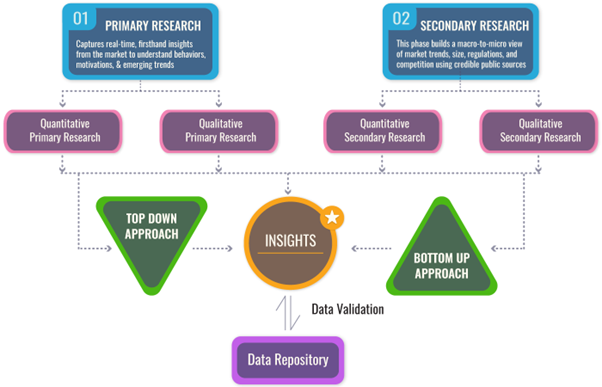
We follow a comprehensive, multi-phase research framework designed to deliver accurate, strategic, and decision-ready intelligence. Our process integrates primary and secondary research , both quantitative and qualitative , along with dual modeling techniques ( top-down and bottom-up) and a final layer of validation through our proprietary in-house repository.
PRIMARY RESEARCH
Primary research captures real-time, firsthand insights from the market to understand behaviors, motivations, and emerging trends.
1. Quantitative Primary Research
Objective: Generate statistically significant data directly from market participants.
Approaches:- Structured surveys with customers, distributors, and field agents
- Mobile-based data collection for point-of-sale audits and usage behavior
- Phone-based interviews (CATI) for market sizing and product feedback
- Online polling around industry events and digital campaigns
- Purchase frequency by customer type
- Channel performance across geographies
- Feature demand by application or demographic
2. Qualitative Primary Research
Objective: Explore decision-making drivers, pain points, and market readiness.
Approaches:- In-depth interviews (IDIs) with executives, product managers, and key decision-makers
- Focus groups among end users and early adopters
- Site visits and observational research for consumer products
- Informal field-level discussions for regional and cultural nuances
SECONDARY RESEARCH
This phase helps establish a macro-to-micro understanding of market trends, size, regulation, and competitive dynamics, sourced from credible and public domain information.
1. Quantitative Secondary Research
Objective: Model market value and segment-level forecasts based on published data.
Sources include:- Financial reports and investor summaries
- Government trade data, customs records, and regulatory statistics
- Industry association publications and economic databases
- Channel performance and pricing data from marketplace listings
- Revenue splits, pricing trends, and CAGR estimates
- Supply-side capacity and volume tracking
- Investment analysis and funding benchmarks
2. Qualitative Secondary Research
Objective: Capture strategic direction, innovation signals, and behavioral trends.
Sources include:- Company announcements, roadmaps, and product pipelines
- Publicly available whitepapers, conference abstracts, and academic research
- Regulatory body publications and policy briefs
- Social and media sentiment scanning for early-stage shifts
- Strategic shifts in market positioning
- Unmet needs and white spaces
- Regulatory triggers and compliance impact
DUAL MODELING: TOP-DOWN + BOTTOM-UP
To ensure robust market estimation, we apply two complementary sizing approaches:
Top-Down Modeling:- Start with broader industry value (e.g., global or regional TAM)
- Apply filters by segment, geography, end-user, or use case
- Adjust with primary insights and validation benchmarks
- Ideal for investor-grade market scans and opportunity mapping
- Aggregate from the ground up using sales volumes, pricing, and unit economics
- Use internal modeling templates aligned with stakeholder data
- Incorporate distributor-level or region-specific inputs
- Most accurate for emerging segments and granular sub-markets
DATA VALIDATION: IN-HOUSE REPOSITORY
We close the loop with proprietary data intelligence built from ongoing projects, industry monitoring, and historical benchmarking. This repository includes:
- Multi-sector market and pricing models
- Key trendlines from past interviews and forecasts
- Benchmarked adoption rates, churn patterns, and ROI indicators
- Industry-specific deviation flags and cross-check logic
- Catches inconsistencies early
- Aligns projections across studies
- Enables consistent, high-trust deliverables