

Hyaluronic Acid Products Market Size and Forecast (2026 - 2034), Global and Regional Growth, Trend, Share and Industry Analysis Report Coverage; Product Type (Hyaluronic Acid Injections, Hyaluronic Acid Eye Drops, and Others), Application (Aesthetics and Dermatology, Orthopedics, Ophthalmology, and Others), End User (Hospitals, Specialty clinics, and Others), and Geography
2026-07-13
Healthcare
Swetal (Research Analyst)
Description
Hyaluronic
Acid Products Market Overview
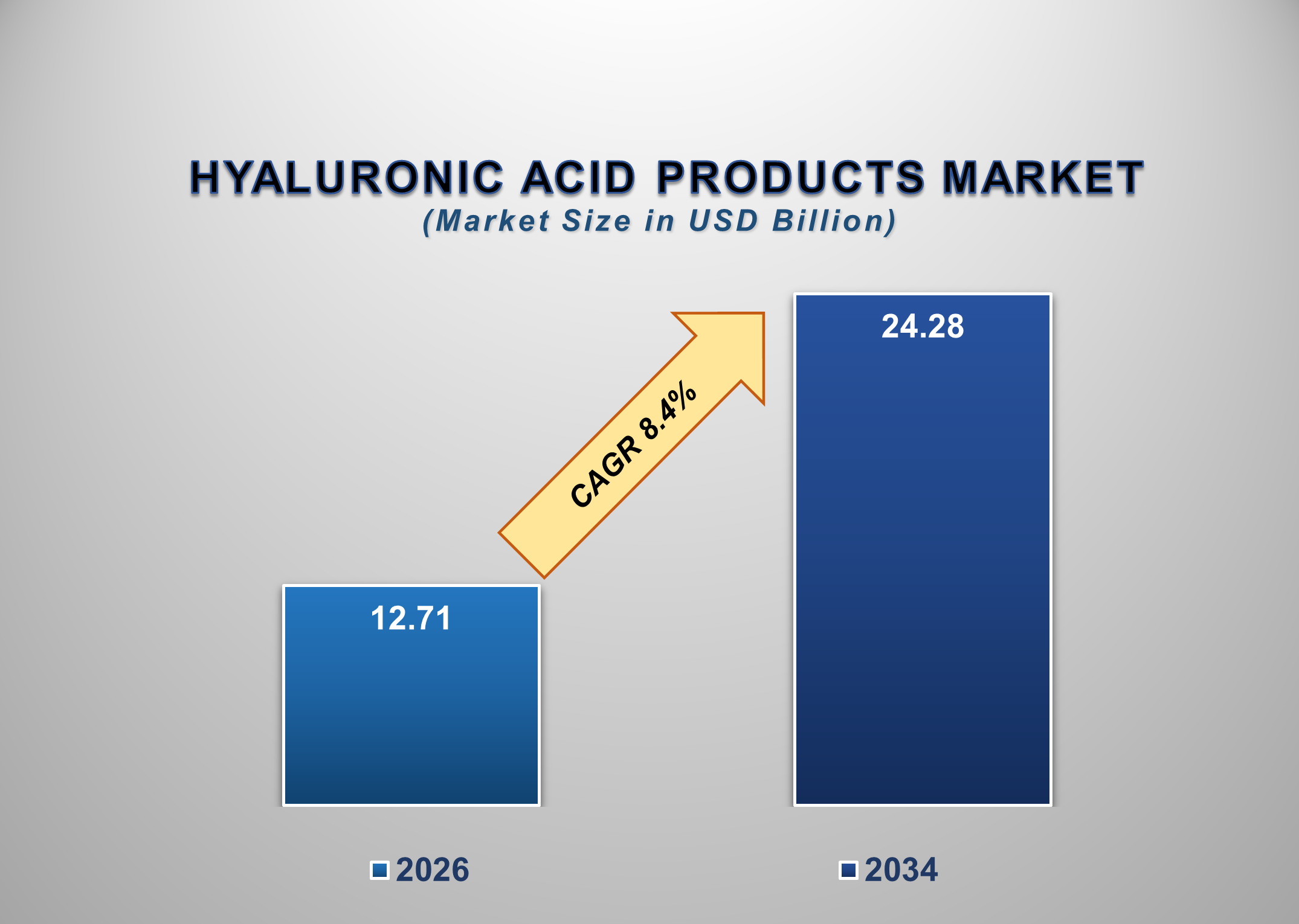
The Global Hyaluronic Acid Products Market Size is experiencing strong growth, driven by increasing demand across pharmaceutical, cosmetic, and medical applications. Valued at USD 12.71 billion in 2026, the market is projected to reach USD 24.28 billion by 2034, growing at a CAGR of 8.4% during the forecast period.
Hyaluronic acid (HA) is a naturally
occurring polysaccharide found in connective tissues, skin, and eyes, known for
its exceptional ability to retain moisture and support tissue hydration. Its
biocompatibility, viscoelastic properties, and low risk of adverse reactions
make it suitable for a wide range of medical and cosmetic applications. HA
products are commonly available in the form of injections, eye drops, topical
skincare formulations, and oral supplements to address various clinical and
consumer needs.
The increasing demand for minimally
invasive cosmetic procedures, particularly dermal fillers used for wrinkle
reduction, facial contouring, and skin rejuvenation, is a major factor driving
market growth. Rising awareness of aesthetic treatments, growing influence of
social media, and an aging population are further supporting the adoption of
HA-based cosmetic products. Additionally, advancements in formulation
technologies, such as cross-linked hyaluronic acid and longer-lasting fillers,
have improved treatment outcomes and patient satisfaction.
The medical sector
also plays a vital role in market expansion. Hyaluronic acid injections are
widely used in osteoarthritis treatment to lubricate joints, reduce pain, and
improve mobility. Furthermore, HA-based eye drops are increasingly used to
treat dry eye syndrome, which is becoming more prevalent due to aging,
increased screen exposure, and environmental factors. HA is also utilized in
wound healing, tissue engineering, and surgical procedures due to its
regenerative and anti-inflammatory properties.
Geographically, North
America dominates the market due to advanced healthcare infrastructure, high
adoption of cosmetic procedures, and the strong presence of leading companies. Europe represents a mature market, while Asia-Pacific is the
fastest-growing region due to
rising disposable income, growing medical tourism, and expanding pharmaceutical
and cosmetic industries in countries such as China, South Korea, and Japan.
Thus, the market is
expected to witness sustained growth, supported by continuous innovation,
expanding medical applications, and increasing demand for anti-aging and
therapeutic solutions.
Hyaluronic Acid Products Market Drivers and Opportunities
Growing Demand for Minimally
Invasive Aesthetic Procedures
The growing desire for minimally invasive cosmetic
procedures, especially dermal fillers, is one of the main factors propelling
the market for hyaluronic acid products. Since hyaluronic acid injections are
safe, effective, and transient, they are frequently utilized for contour
correction, lip enlargement, wrinkle reduction, and cosmetic rejuvenation. In
contrast to traditional cosmetic surgery, consumers are increasingly choosing
non-surgical procedures that provide rapid results, less recovery time, and reduced
risk. Furthermore, more people—including younger demographics—are choosing
aesthetic modifications as a result of the expanding influence of social media,
beauty awareness, and rising disposable income. Hyaluronic acid-based cosmetic
injectables are becoming more and more popular around the world thanks to
ongoing developments in filler Product Type, which include formulations that
are more natural-looking and long-lasting.
Increasing Prevalence of
Osteoarthritis and Ophthalmic Disorders
The hyaluronic acid
products market is expanding due in large part to the increased incidence of
ocular disorders and osteoarthritis. Injections of hyaluronic acid are
frequently used in viscosupplementation therapy to help patients with
osteoarthritis, especially those in their later years, with joint pain,
mobility, and lubrication. The number of people suffering from degenerative
joint problems is increasing along with the worldwide life expectancy, which is
driving up demand for HA-based therapies. Hyaluronic acid eye drops are also
frequently used to treat dry eye syndrome, which is on the rise as a result of
environmental pollution, age, and increasing screen time. The ongoing demand
for hyaluronic acid products is being driven by the growing number of patients
and their choice for non-invasive therapeutic alternatives.
Expanding Applications in
Regenerative Medicine and Advanced Therapeutics
Hyaluronic acid's
superior tissue regeneration, biocompatibility, and biodegradability make it a
promising candidate for improved therapeutic applications and regenerative
medicine. It is being utilized more and more in medication delivery systems,
wound healing, and tissue engineering, where it aids in tissue repair,
inflammation reduction, and cell proliferation. Hydrogels and scaffolds based
on HA are being investigated by researchers for use in reconstructive surgery,
cardiovascular therapy, and orthopedic repair. Additionally, chances for novel
HA-based formulations are being created by the increased emphasis on biologics
and personalized therapy. Hyaluronic acid is anticipated to play a crucial role
in next-generation medical therapies as clinical research and Product Type
developments continue, opening up new growth opportunities for market
participants.
Hyaluronic Acid Products Market Scope
|
Report Attributes |
Description |
|
Market Size in 2026 |
USD 12.71
Billion |
|
Market Forecast in 2034 |
USD 24.28
Billion |
|
CAGR % 2026-2034 |
8.4% |
|
Base Year |
2025 |
|
Historic Data |
2021-2025 |
|
Forecast Period |
2026-2034 |
|
Report USP |
Comprehensive
global Hyaluronic Acid Products Market size and forecast analysis with
detailed segmentation by product type, application, end user, and region. The
report provides in-depth insights into market share distribution, growth
trends, and competitive landscape analysis of key players. It includes
evaluation of emerging applications in aesthetics, orthopedics,
ophthalmology, and regenerative medicine. The study also covers technological
advancements in hyaluronic acid formulations, including cross-linked fillers
and advanced therapeutic solutions. Additionally, the report analyzes
regional and country-level market dynamics, strategic developments such as
product launches, partnerships, and expansions, and identifies key growth
drivers, opportunities, and challenges. It offers strategic insights to
support decision-making for manufacturers, healthcare providers, investors,
and stakeholders operating in the hyaluronic acid products market |
|
Segments Covered |
●
By Product Type ●
By Application ●
By End User |
|
Regional Scope |
●
North America ●
Europe ●
APAC ●
Latin America ●
Middle East and Africa |
|
Country Scope |
1)
U.S. 2)
Canada 3)
U.K. 4)
Germany 5)
France 6)
Italy 7)
Spain 8)
Switzerland 9)
China 10) India 11) Japan 12) South Korea 13) Australia 14) Mexico 15) Brazil 16) Argentina 17) Saudi Arabia 18) UAE 19) South Africa |
Hyaluronic Acid Products
Market Report Segmentation Analysis
The global hyaluronic acid products
market analysis is segmented by Product Type, Application, End User, and
Region.
Hyaluronic Acid Injections
segment dominated the market in 2025 and is projected to grow at the highest
CAGR during the forecast period.
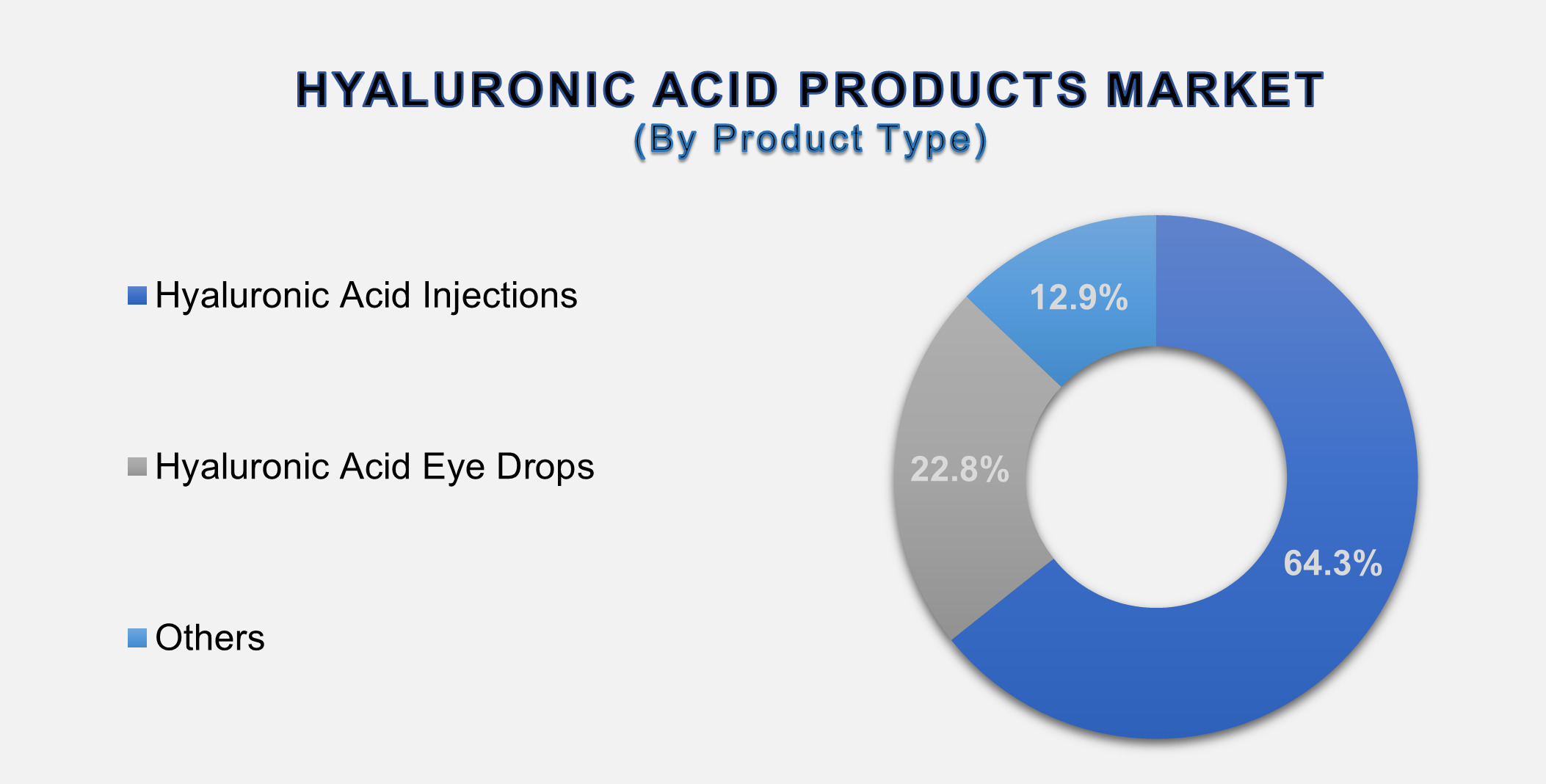
By Product Type, the hyaluronic acid products market is segmented into hyaluronic acid injections, hyaluronic acid eye drops, and others. The hyaluronic acid injections segment accounts for the largest share of the global hyaluronic acid products market. These injections are frequently used as dermal fillers in cosmetic operations to increase skin hydration, enhance lips, minimize wrinkles, and restore facial volume. its safety, fast outcomes, and minimally intrusive nature are the reasons behind its appeal. By lubricating joints, lowering discomfort, and increasing mobility, hyaluronic acid injections are utilized in viscosupplementation to treat osteoarthritis. The significant adoption and ongoing rise of hyaluronic acid injections worldwide are mostly due to the aging population, rising prevalence of joint problems, and growing demand for non-surgical cosmetic treatments.
Aesthetics and Dermatology
Segment will probably dominate the market during the forecast period
In terms of Application, the Hyaluronic
Acid Products Market is segmented into aesthetics and dermatology, orthopedics,
ophthalmology, and others. The aesthetics and dermatology segment holds the
largest share of the Hyaluronic Acid Products Market. The remarkable
capacity of hyaluronic acid to retain moisture, improve skin hydration, and
enhance overall skin look makes it an essential component of dermatology and
aesthetics. It is frequently utilized in dermal fillers to improve skin
elasticity, restore facial volume, and lessen wrinkles, making it a popular
non-surgical anti-aging therapy option. Products containing hyaluronic acid are
also suggested by dermatologists for enhancing skin texture, minimizing fine
wrinkles, and encouraging a younger look. In order to promote the function of
the skin barrier and offer deep hydration, it is also frequently added to
topical formulations including serums, creams, and masks. Hyaluronic acid is
becoming more and more popular in dermatology and aesthetics around the world
due to the rising demand for minimally invasive cosmetic procedures and
sophisticated skincare products.
Hospitals hold the highest share of the End User Segment over the
forecast period
Based on End User, the market is
bifurcated into hospitals, specialty clinics, and others. The hospitals segment
accounts for the largest share of the market. Hospitals frequently use hyaluronic acid
injections to treat osteoarthritis because they help lubricate joints, reduce
pain, and increase patients' mobility. Hyaluronic acid is also used by
hospitals in ophthalmic surgeries, such as cataract and corneal treatments, to
preserve and aid in the healing of eye tissues. In addition to its regenerative
and anti-inflammatory qualities, it is also used in wound care and the healing
process following surgery. Hospital demand for hyaluronic acid products is
still being driven by expanding patient admissions for orthopedic and
ophthalmology treatments, the availability of qualified healthcare workers, and
sophisticated medical infrastructure.
The following
segments are part of an in-depth analysis of the global Hyaluronic Acid
Products Market:
|
Market
Segments |
|
|
By
Product Type |
●
Hyaluronic
Acid Injections ●
Hyaluronic
Acid Eye Drops ●
Others |
|
By
Application |
●
Aesthetics
and Dermatology ●
Orthopedics ●
Ophthalmology ●
Others |
|
By
End User |
●
Hospitals ●
Specialty
clinics ●
Others |
Hyaluronic Acid Products Market Share Analysis by Region
North America region is
projected to hold the largest share of the global Hyaluronic Acid Products
Market over the forecast period.
North America region is projected to hold the
largest share of the global Hyaluronic Acid Products Market over the forecast
period and is also expected to be the fastest-growing region. The significant presence of important
market players, the high acceptance of aesthetic procedures, and the
state-of-the-art healthcare infrastructure all contribute to the regional
expansion. Because of the region's growing aging population, growing demand for
dermal fillers, and growing awareness of anti-aging treatments, the United
States holds the highest proportion. Additionally, the usage of hyaluronic acid
injections and ophthalmic medicines has increased due to the high frequency of
osteoarthritis and dry eye condition. Technological developments, favorable
reimbursement policies, and rising healthcare costs all contribute to the
market's expansion. The region's strong position in the worldwide market for
hyaluronic acid products is also a result of the existence of leading
businesses and ongoing product innovation.
Global
Hyaluronic Acid Products Market Recent Developments News:
·
In December 2025, global beauty
major L’Oréal increased its investment in Swiss dermatology and aesthetic
injectable specialist Galderma, raising its ownership from 10% to 20% to
strengthen its position in the fast-growing HA-based aesthetic treatments
segment.
·
In January 2026, Galderma
unveiled a marketing campaign highlighting Restylane as a preferred
hyaluronic acid aesthetic treatment, focusing on natural beauty and day-to-day
use.
The
Global Hyaluronic Acid Products Market is dominated by a few large companies,
such as
·
Allergan (AbbVie Inc.)
·
GALDERMA S.A.
·
Fidia Farmaceutici S.p.A.
·
Anika Therapeutics, Inc.
·
Seikagaku Corporation
·
Sanofi S.A.
·
Zimmer Biomet Holdings, Inc.
·
Smith & Nephew plc
·
LifeCore Biomedical LLC
·
Bloomage Biotechnology Corporation
Limited
·
HTL Biotechnology
·
Contipro a.s.
·
LG Chem Ltd.
·
Kewpie Corporation
·
Shiseido Company, Limited
·
Teoxane Laboratories
·
Bioiberica S.A.U.
·
Ferring Pharmaceuticals
·
Meiji Seika Pharma Co., Ltd.
· TRB Chemedica International SA
Frequently Asked Questions
Swetal (Research Analyst)
Swetal is a Research Analyst with 4+ years of experience specializing in healthcare market research, medical devices, healthcare IT, and medical technology industry analysis. Her expertise includes competitive intelligence, secondary research, market trend forecasting, and healthcare business insights across global healthcare ecosystems.
She contributes to advanced market research reports by analyzing regulatory frameworks, emerging healthcare technologies, competitive landscapes, and innovation trends shaping the medical industry. With a strong focus on accurate market intelligence, strategic insights, and healthcare industry trends, Swetal supports businesses in making informed, data-backed decisions in a rapidly transforming healthcare environment.
1.
Global Hyaluronic Acid Products Market Introduction and Market
Overview
1.1.
Objectives of the Study
1.2.
Global Hyaluronic Acid Products Market Scope and Market Estimation
1.2.1.Global Hyaluronic
Acid Products Overall Market Size (US$ Bn), Market CAGR (%), Market forecast (2025
- 2033)
1.2.2.Global Hyaluronic
Acid Products Market Revenue Share (%) and Growth Rate (Y-o-Y) from 2020 - 2033
1.3.
Market Segmentation
1.3.1.Product Type
of Global Hyaluronic Acid Products Market
1.3.2.Application of
Global Hyaluronic Acid Products Market
1.3.3.End User of
Global Hyaluronic Acid Products Market
1.3.4.Region of
Global Hyaluronic Acid Products Market
2.
Executive
Summary
2.1.
Demand Side Trends
2.2.
Key Market Trends
2.3.
Market Demand (US$ Bn) Analysis 2020 – 2024 and Forecast, 2025 – 2033
2.4.
Demand and Opportunity Assessment
2.5.
Market Dynamics
2.5.1.Drivers
2.5.2.Limitations
2.5.3.Opportunities
2.5.4.Impact
Analysis of Drivers and Restraints
2.6.
Porter’s Five Forces Analysis
2.7.
PEST Analysis
2.8.
Key Regulation
2.9.
Key Developments
2.10. Value
Chain / Ecosystem Analysis
3.
Global
Hyaluronic Acid Products Market Estimates & Historical Trend Analysis (2020 - 2024)
4. Global Hyaluronic Acid Products Market Estimates & Forecast Trend Analysis, by Product Type
4.1.
Global Hyaluronic Acid Products Market Revenue (US$ Bn) Estimates
and Forecasts, by Product Type, 2020 - 2033
4.1.1.Hyaluronic
Acid Injections
4.1.2.Hyaluronic
Acid Eye Drops
4.1.3.Others
5. Global Hyaluronic Acid Products Market Estimates & Forecast Trend Analysis, by Application
5.1.
Global Hyaluronic Acid Products Market Revenue (US$ Bn) Estimates
and Forecasts, by Application, 2020 - 2033
5.1.1.Aesthetics
and Dermatology
5.1.2.Orthopedics
5.1.3.Ophthalmology
5.1.4.Others
6. Global Hyaluronic Acid Products Market Estimates & Forecast Trend Analysis, by End User
6.1.
Global Hyaluronic Acid Products Market Revenue (US$ Bn) Estimates
and Forecasts, by End User, 2020 - 2033
6.1.1.Hospitals
6.1.2.Specialty
clinics
6.1.3.Others
7.
Global
Hyaluronic Acid Products Market Estimates & Forecast Trend Analysis, by Region
7.1.
Global Hyaluronic Acid Products Market Revenue (US$ Bn) Estimates
and Forecasts, by Region, 2020 - 2033
7.1.1.North America
7.1.2.Europe
7.1.3.Asia Pacific
7.1.4.Middle East
& Africa
7.1.5.Latin America
8.
North America Hyaluronic
Acid Products Market: Estimates &
Forecast Trend Analysis
8.1.
North America Hyaluronic Acid Products Market Assessments &
Key Findings
8.1.1.North America
Hyaluronic Acid Products Market Introduction
8.1.2.North America
Hyaluronic Acid Products Market Size Estimates and Forecast (US$ Billion) (2020
- 2033)
8.1.2.1. By Product Type
8.1.2.2. By Application
8.1.2.3. By End User
8.1.2.4.
By Country
8.1.2.4.1.
The U.S.
8.1.2.4.2.
Canada
9.
Europe Hyaluronic
Acid Products Market: Estimates &
Forecast Trend Analysis
9.1.
Europe Hyaluronic Acid Products Market Assessments & Key
Findings
9.1.1.Europe Hyaluronic
Acid Products Market Introduction
9.1.2.Europe Hyaluronic
Acid Products Market Size Estimates and Forecast (US$ Billion) (2020 - 2033)
9.1.2.1. By Product Type
9.1.2.2. By Application
9.1.2.3. By End User
9.1.2.4. By
Country
9.1.2.4.1.
Germany
9.1.2.4.2.
Italy
9.1.2.4.3.
U.K.
9.1.2.4.4.
France
9.1.2.4.5.
Spain
9.1.2.4.6.
Russia
9.1.2.4.7.
Rest
of Europe
10.
Asia Pacific Hyaluronic
Acid Products Market: Estimates &
Forecast Trend Analysis
10.1. Asia
Pacific Hyaluronic Acid Products Market Assessments & Key Findings
10.1.1.
Asia Pacific Hyaluronic Acid Products Market Introduction
10.1.2.
Asia Pacific Hyaluronic Acid Products Market Size Estimates and
Forecast (US$ Billion) (2020 - 2033)
10.1.2.1. By Product Type
10.1.2.2. By Application
10.1.2.3. By End User
10.1.2.4.
By Country
10.1.2.4.1.
China
10.1.2.4.2.
Japan
10.1.2.4.3.
India
10.1.2.4.4.
Australia
10.1.2.4.5.
South Korea
10.1.2.4.6. Rest
of Asia Pacific
11.
Middle East & Africa Hyaluronic Acid Products Market: Estimates & Forecast Trend Analysis
11.1. Middle
East & Africa Hyaluronic Acid Products Market Assessments & Key
Findings
11.1.1.
Middle East & Africa Hyaluronic
Acid Products Market Introduction
11.1.2.
Middle East & Africa Hyaluronic
Acid Products Market Size Estimates and Forecast (US$ Billion) (2020 - 2033)
11.1.2.1. By Product Type
11.1.2.2. By Application
11.1.2.3. By End User
11.1.2.4.
By Country
11.1.2.4.1.
UAE
11.1.2.4.2.
Saudi Arabia
11.1.2.4.3.
South Africa
11.1.2.4.4. Rest of MEA
12.
Latin America Hyaluronic
Acid Products Market: Estimates &
Forecast Trend Analysis
12.1. Latin
America Event Industry Assessments & Key Findings
12.1.1.
Latin America Hyaluronic Acid Products Market Introduction
12.1.2.
Latin America Hyaluronic Acid Products Market Size Estimates and
Forecast (US$ Billion) (2020 - 2033)
12.1.2.1. By Product Type
12.1.2.2. By Application
12.1.2.3. By End User
12.1.2.4.
By Country
12.1.2.4.1.
Brazil
12.1.2.4.2.
Mexico
12.1.2.4.3.
Argentina
12.1.2.4.4. Rest of LATAM
13.
Country Wise Market: Introduction
14. Competition
Landscape
14.1. Global
Hyaluronic Acid Products Market Product Mapping
14.2. Global
Hyaluronic Acid Products Market Concentration Analysis, by Leading Players /
Innovators / Emerging Players / New Entrants
14.3. Global
Hyaluronic Acid Products Market Tier Structure Analysis
14.4. Global
Hyaluronic Acid Products Market Concentration & Company Market Shares (%)
Analysis, 2024
15. Company
Profiles
15.1.
Allergan (AbbVie Inc.)
15.1.1.
Company Overview & Key Stats
15.1.2.
Financial Performance & KPIs
15.1.3.
Product Portfolio
15.1.4.
SWOT Analysis
15.1.5.
Business Strategy & Recent Developments
*
Similar details would be provided for all the players mentioned below
15.2.
GALDERMA S.A.
15.3.
Fidia Farmaceutici S.p.A.
15.4.
Anika Therapeutics, Inc.
15.5.
Seikagaku Corporation
15.6.
Sanofi S.A.
15.7.
Zimmer Biomet Holdings, Inc.
15.8.
Smith & Nephew plc
15.9.
LifeCore Biomedical LLC
15.10.
Bloomage Biotechnology Corporation Limited
15.11.
HTL Biotechnology
15.12.
Contipro a.s.
15.13.
LG Chem Ltd.
15.14.
Kewpie Corporation
15.15.
Shiseido Company, Limited
15.16.
Teoxane Laboratories
15.17.
Bioiberica S.A.U.
15.18.
Ferring Pharmaceuticals
15.19.
Meiji Seika Pharma Co., Ltd.
15.20.
Other Prominent Players
16.
Research
Methodology
16.1. External
Transportations / Databases
16.2. Internal
Proprietary Database
16.3. Primary
Research
16.4. Secondary
Research
16.5. Assumptions
16.6. Limitations
16.7. Report
FAQs
17.
Research
Findings & Conclusion
Our Research Methodology
"Insight without rigor is just noise."
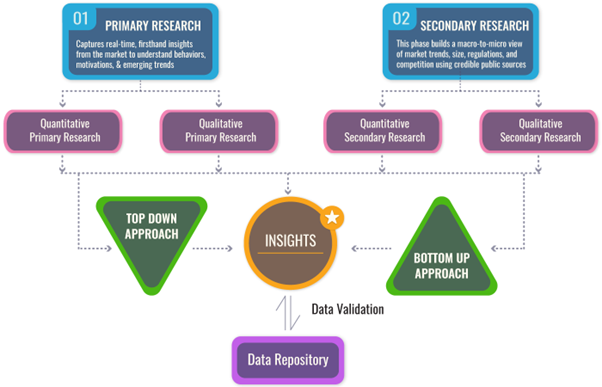
We follow a comprehensive, multi-phase research framework designed to deliver accurate, strategic, and decision-ready intelligence. Our process integrates primary and secondary research , both quantitative and qualitative , along with dual modeling techniques ( top-down and bottom-up) and a final layer of validation through our proprietary in-house repository.
PRIMARY RESEARCH
Primary research captures real-time, firsthand insights from the market to understand behaviors, motivations, and emerging trends.
1. Quantitative Primary Research
Objective: Generate statistically significant data directly from market participants.
Approaches:- Structured surveys with customers, distributors, and field agents
- Mobile-based data collection for point-of-sale audits and usage behavior
- Phone-based interviews (CATI) for market sizing and product feedback
- Online polling around industry events and digital campaigns
- Purchase frequency by customer type
- Channel performance across geographies
- Feature demand by application or demographic
2. Qualitative Primary Research
Objective: Explore decision-making drivers, pain points, and market readiness.
Approaches:- In-depth interviews (IDIs) with executives, product managers, and key decision-makers
- Focus groups among end users and early adopters
- Site visits and observational research for consumer products
- Informal field-level discussions for regional and cultural nuances
SECONDARY RESEARCH
This phase helps establish a macro-to-micro understanding of market trends, size, regulation, and competitive dynamics, sourced from credible and public domain information.
1. Quantitative Secondary Research
Objective: Model market value and segment-level forecasts based on published data.
Sources include:- Financial reports and investor summaries
- Government trade data, customs records, and regulatory statistics
- Industry association publications and economic databases
- Channel performance and pricing data from marketplace listings
- Revenue splits, pricing trends, and CAGR estimates
- Supply-side capacity and volume tracking
- Investment analysis and funding benchmarks
2. Qualitative Secondary Research
Objective: Capture strategic direction, innovation signals, and behavioral trends.
Sources include:- Company announcements, roadmaps, and product pipelines
- Publicly available whitepapers, conference abstracts, and academic research
- Regulatory body publications and policy briefs
- Social and media sentiment scanning for early-stage shifts
- Strategic shifts in market positioning
- Unmet needs and white spaces
- Regulatory triggers and compliance impact
DUAL MODELING: TOP-DOWN + BOTTOM-UP
To ensure robust market estimation, we apply two complementary sizing approaches:
Top-Down Modeling:- Start with broader industry value (e.g., global or regional TAM)
- Apply filters by segment, geography, end-user, or use case
- Adjust with primary insights and validation benchmarks
- Ideal for investor-grade market scans and opportunity mapping
- Aggregate from the ground up using sales volumes, pricing, and unit economics
- Use internal modeling templates aligned with stakeholder data
- Incorporate distributor-level or region-specific inputs
- Most accurate for emerging segments and granular sub-markets
DATA VALIDATION: IN-HOUSE REPOSITORY
We close the loop with proprietary data intelligence built from ongoing projects, industry monitoring, and historical benchmarking. This repository includes:
- Multi-sector market and pricing models
- Key trendlines from past interviews and forecasts
- Benchmarked adoption rates, churn patterns, and ROI indicators
- Industry-specific deviation flags and cross-check logic
- Catches inconsistencies early
- Aligns projections across studies
- Enables consistent, high-trust deliverables