

In-Vehicle Neuroadaptive Haptic Feedback Component Market Size and Forecast (2026–2034), Global and Regional Growth, Trend, Share and Industry Analysis Report Coverage; By Component (Neuroadaptive Sensors, Haptic Actuators, Control Electronics, Others); By Product Type (Steering Wheel Feedback Systems, Touchscreen Haptics, Seat-Based Haptic Modules, Others); By Vehicle Type (Passenger Cars, Commercial Vehicles); and Geography
2026-10-29
Automotive & Transportation (Mobility)
Ekta Chaurasia (Team Lead)
Description
In-Vehicle Neuroadaptive Haptic Feedback Component Market Overview
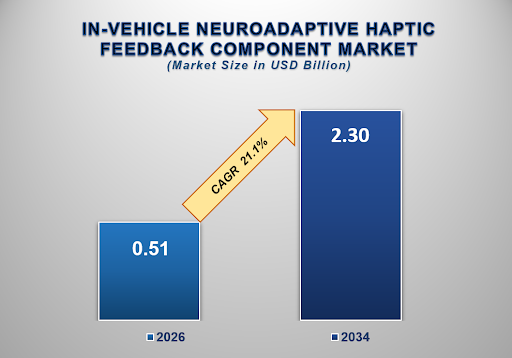
The global in-vehicle neuroadaptive haptic feedback component market was valued at USD 0.514 billion in 2026 and is projected to reach USD 2.308 billion by 2034, expanding at a CAGR of 21.1% from 2026 to 2034. The market is being propelled by the rapid digitization of vehicle interiors, increasing dependence on large touchscreens and software-defined interfaces, growing deployment of advanced driver-assistance systems (ADAS), demand for distraction-reducing human-machine interfaces, and the development of vehicle systems capable of adapting feedback according to driver or passenger conditions.
In-vehicle neuroadaptive haptic feedback components combine tactile hardware, sensing technologies, control electronics and adaptive software to deliver physical cues through vehicle surfaces. Unlike conventional haptic systems that generate a predetermined vibration whenever a button is pressed, neuroadaptive systems are designed to modify the character, intensity, timing or location of tactile feedback according to contextual information such as driver attention, fatigue, grip, gaze, physiological signals, vehicle status or road conditions. BIS Research describes these systems as combinations of components such as piezoelectric actuators, closed-loop drivers, seat vibration motors and AI-based signal-processing architectures that can adjust tactile cues using real-time driver or passenger information.
The transition toward software-defined vehicle interiors is creating a fundamental requirement for more sophisticated tactile interfaces. Modern vehicles increasingly use large center displays, digital instrument clusters, touch-sensitive surfaces, multifunction steering wheels and configurable controls. Although these interfaces create cleaner and more flexible cabin designs, they can remove the physical confirmation that drivers traditionally received from mechanical buttons, knobs and switches. Haptic feedback helps recreate that confirmation through vibration, localized tactile effects, force feedback or other physical sensations.
The technology is particularly relevant to steering wheels because the driver's hands remain in proximity to this interface during driving. Haptic cues can communicate warnings, directional information or system confirmation without requiring the driver to look away from the road. Steering-wheel haptic systems can therefore complement visual and audible warning channels in ADAS and driver-monitoring applications.
Touchscreen haptics represent another important application. Large digital displays have become a defining characteristic of modern vehicle interiors, particularly in electric vehicles and premium passenger cars. Haptic feedback can provide localized confirmation when users select a control, adjust a setting or interact with a virtual button. Global Market Insights estimates that touchscreen haptics represented 48.4% of the product market in 2025, reflecting the growing importance of tactile interaction as vehicle controls move toward digital surfaces.
The underlying component ecosystem includes neuroadaptive sensors, haptic actuators, control electronics, drivers and software. Actuators remain fundamental because they translate electronic instructions into a physical sensation. Global Market Insights estimated that haptic actuators accounted for approximately 44% of the component market in 2025, with applications extending across steering wheels, seats, pedals, center consoles, touch displays and other vehicle surfaces.
Piezoelectric technology is gaining attention because of its ability to generate fast and localized tactile effects while occupying relatively little space. In April 2025, Boréas Technologies announced that its piezo-based automotive haptic module had been integrated into the NIO ET9's TUI Bar, providing context-sensitive tactile feedback through the center-console touch interface. The module uses the company's CapDrive architecture and an automotive-qualified piezo haptic driver.
Closed-loop control is also becoming important for automotive-grade haptics. In December 2025, Cirrus Logic introduced the CS40L51, CS40L52 and CS40L53 family of automotive-qualified closed-loop haptic drivers. The devices use real-time feedback and algorithms to improve actuator response and compensate for manufacturing variation, temperature changes and other operating conditions. The company identifies steering wheels, center consoles, interactive displays, seats and smart surfaces as target applications.
The neuroadaptive aspect of the market remains an emerging layer over conventional haptic technology. Research into real-time driver cognitive-state monitoring is examining how neural and behavioral information can identify fatigue, distraction and other driving states. A 2026 study published in Transportation Research Part F reported that EEG-based analysis can identify relationships between neural activity, steering behavior and driving demands, highlighting the potential for future multimodal driver-state systems.
As these sensing and computing capabilities mature, haptic systems can evolve from simple notification devices into adaptive interfaces. A vehicle could potentially vary the strength, frequency or location of tactile feedback according to the urgency of a warning or the detected state of the occupant. This creates a pathway toward more personalized and context-aware human-machine interaction.
Passenger cars are expected to remain an important growth category because premium vehicles and newer electric platforms increasingly incorporate advanced digital cockpits and ADAS. Global Market Insights estimates that passenger cars will record approximately 13.6% CAGR between 2026 and 2035 within its market assessment, supported by expanding ADAS integration and the adoption of increasingly sophisticated vehicle interiors.
In-Vehicle Neuroadaptive Haptic Feedback Component Market Drivers and Opportunities
Digital Vehicle Cockpits and Touch-Based Controls Are Increasing the Need for Tactile Confirmation
The rapid transformation of vehicle interiors from mechanically controlled dashboards to software-driven digital cockpits is a major structural driver of the in-vehicle neuroadaptive haptic feedback component market. Automotive manufacturers are increasingly replacing clusters of physical switches with touchscreens, touch-sensitive surfaces and multifunction interfaces. While this approach creates greater design flexibility, it also introduces a human-machine-interface challenge: drivers need to understand whether an interaction has been successfully registered without repeatedly looking at a display.
Haptic feedback addresses this issue by creating a physical response immediately after a touch or gesture. Instead of relying exclusively on visual confirmation, the system can produce a short localized vibration or other tactile effect. This is especially useful when drivers are interacting with controls while maintaining attention on the road.
The transition is particularly visible in premium electric vehicles, where minimalist dashboards and large display surfaces are frequently used as differentiating design elements. As physical controls become less prominent, tactile technology becomes an important tool for preserving intuitive interaction.
Advanced haptic drivers are enabling more detailed feedback than conventional vibration motors. Cirrus Logic's automotive-qualified CS40L5x family, for example, incorporates closed-loop control, waveform memory and algorithms designed to improve response time and frequency bandwidth. Such technologies can support textured tactile effects and more consistent feedback across different vehicle operating conditions.
The trend also supports demand for smaller, faster and more power-efficient actuators. Automotive designers must integrate haptic elements into increasingly thin displays, steering controls, center consoles and smart surfaces without compromising cabin aesthetics. Component suppliers that can provide compact automotive-grade solutions therefore have opportunities to participate in new vehicle platforms.
Neuroadaptive functionality adds another layer of value because tactile feedback can be linked to real-time information about the user and driving environment. Instead of providing the same signal under every condition, adaptive systems can modify the feedback pattern according to warning priority, driver state, or interaction context. This increases the potential role of haptics within intelligent vehicle interfaces.
ADAS Expansion, Driver Monitoring and Demand for Distraction-Reducing Interfaces Are Accelerating Adoption
The increasing deployment of ADAS is strengthening demand for alternative warning channels that can communicate important information without placing additional visual demands on drivers. Modern vehicles can generate alerts associated with lane departure, collision risk, blind spots, adaptive cruise control, driver attention and other safety functions. Delivering every alert through visual displays or sound can create information overload, particularly as the number of vehicle functions increases.
Haptic feedback offers a complementary communication channel. A vibration on one side of the steering wheel can communicate directional information, while a seat-based vibration can provide a localized alert. The same principle can be applied to pedals, armrests, center consoles and other contact surfaces.
The growth of driver-monitoring systems is particularly relevant to neuroadaptive haptics. Driver-monitoring technologies can assess indicators such as gaze, head position, steering behavior and physiological or cognitive signals. The resulting information can be used by an adaptive interface to determine when stronger or differently patterned feedback may be appropriate.
Academic research is increasingly examining the connection between neural signals and driving behavior. A 2026 study found associations between EEG-derived neural activity and steering demands, suggesting that neural and vehicle-behavior data can potentially contribute to earlier identification of error-prone driving states.
The technology therefore has potential applications in fatigue warnings, distraction alerts and attention-management systems. Importantly, neuroadaptive haptics should be viewed as a complementary communication mechanism rather than a standalone driver-safety solution. Its effectiveness depends on accurate sensing, appropriate algorithms, low-latency processing and carefully designed feedback patterns.
The rise of autonomous and semi-autonomous vehicles could further expand the opportunity. As vehicles assume more driving functions, the interface between occupants and automated systems becomes increasingly important. Haptic cues can communicate transitions between automated and manual driving, changes in system status or requests for driver intervention.
The combination of ADAS, driver monitoring, digital cockpits and adaptive interfaces is consequently creating a larger addressable market for haptic component suppliers.
Opportunity: AI-Based Sensor Fusion, Smart Seats and Next-Generation Haptic Surfaces Can Create New Revenue Streams
A significant opportunity exists in integrating haptic feedback with multimodal sensing and artificial intelligence. Instead of treating haptics as an isolated component, vehicle manufacturers can connect actuator systems with driver-monitoring cameras, physiological sensors, steering-wheel inputs, seat sensors and vehicle-state information.
Such architectures could allow the vehicle to interpret multiple signals simultaneously. For example, an alert could be intensified when a system detects a combination of driver inattention and an approaching hazard, while less urgent information could be communicated through a subtle tactile cue.
Seat-based haptic systems provide another emerging opportunity. Seats offer a large contact area and can provide localized sensations without requiring the driver to look at a screen. Haptic modules embedded into seat cushions or backrests can potentially support wellness, entertainment, navigation and safety applications.
Smart surfaces are also expanding the potential application space. Haptic feedback can be integrated into door panels, center consoles, armrests and other interior elements, allowing vehicle manufacturers to create interfaces in which tactile controls are embedded directly into surfaces rather than presented as conventional buttons.
Piezoelectric technologies are particularly relevant to these applications because they can produce localized feedback within thin form factors. Boréas' automotive module used in the NIO ET9 demonstrates the commercial movement toward piezo-based tactile feedback in premium electric-vehicle interiors.
Another opportunity lies in software-configurable haptic experiences. Closed-loop automotive haptic drivers can store and reproduce different waveforms, creating the possibility of software-defined tactile behavior. Cirrus Logic's automotive haptic driver family, for example, incorporates waveform memory and configurable haptic control capabilities.
This could eventually allow OEMs to customize haptic signatures for different vehicle functions, trim levels or user preferences. As vehicles become increasingly software-defined, tactile interfaces could become another element that is modified through software updates.
The market also offers opportunities for semiconductor suppliers, actuator manufacturers, sensor companies, HMI developers and automotive Tier-1 suppliers to collaborate. Companies that combine sensing, signal processing, actuator control and software capabilities may be positioned to participate in higher-value system architectures rather than supplying individual components alone.
In-Vehicle Neuroadaptive Haptic Feedback Component Market Scope
In-Vehicle Neuroadaptive Haptic Feedback Component Market Report Segmentation Analysis
The global in-vehicle neuroadaptive haptic feedback component industry analysis is segmented by component, product type, vehicle type, and region. The component segment covers neuroadaptive sensors, haptic actuators, control electronics, and other technologies, while the product type includes steering wheel feedback systems, touchscreen haptics, seat-based haptic modules, and other applications. Vehicle type is divided into passenger cars and commercial vehicles.
The Haptic Actuators Segment Is Expected to Dominate the Market During the Forecast Period
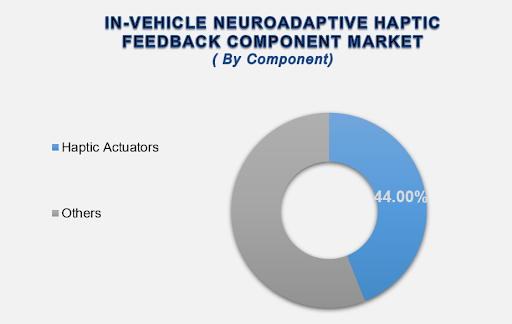
Haptic actuators represented approximately 44.0% of the component market in 2025, according to Global Market Insights. Their leading position reflects the fundamental role of actuators in converting electrical signals into physical sensations that can be perceived through steering wheels, seats, displays, pedals, center consoles and other contact surfaces.
Actuators remain necessary regardless of how sophisticated the sensing or software layer becomes. Neuroadaptive sensors can determine a user's state and algorithms can decide which feedback should be delivered, but the actuator is ultimately responsible for producing the physical output.
The segment includes multiple technologies such as eccentric rotating mass motors, linear resonant actuators and piezoelectric actuators. Piezoelectric solutions are attracting particular interest because of their compact form factor, fast response characteristics and ability to produce localized tactile sensations.
Closed-loop actuator control is also improving the consistency of automotive haptic systems. By monitoring electrical and mechanical behavior in real time, closed-loop drivers can compensate for changes caused by temperature, actuator variation and aging. This is particularly important for automotive applications where systems must maintain predictable behavior over extended operating periods.
Neuroadaptive sensors are expected to gain importance as more vehicles incorporate driver-state and occupant-monitoring capabilities. These sensors can include pressure, physiological, optical, gaze, steering-grip and other contextual sensing technologies.
Control electronics represent another essential component category because they connect vehicle computing systems with haptic actuators. The transition toward zonal vehicle architectures and centralized computing can provide additional processing capabilities for adaptive haptic applications.
Touchscreen haptics represented approximately 48.4% of the product market in 2025, making it the largest product category in the current market assessment.
The strong position of touchscreen haptics is closely associated with the rapid adoption of large digital displays inside vehicles. Infotainment, navigation, climate controls, media functions and vehicle settings are increasingly managed through touchscreen interfaces.
The absence of tactile confirmation can make touch-only controls more difficult to use while driving. Haptic feedback can address this issue by creating a physical sensation when a virtual control is activated. More advanced systems can produce different sensations for different interactions, allowing users to distinguish between commands through touch.
Piezoelectric technology is contributing to this transition. The NIO ET9's TUI Bar, for example, uses Boréas' automotive piezo haptic module to provide responsive tactile feedback through a touch-based interface.
Steering wheel feedback systems are expected to register strong growth as OEMs use the steering wheel as a continuously accessible interface for safety warnings and vehicle functions. Global Market Insights estimates steering wheel feedback systems to grow at approximately 14% CAGR between 2026 and 2035 within its market forecast.
Seat-based haptic modules provide another emerging application. These systems can deliver localized vibrations to communicate warnings or support comfort and wellness functions. They may become increasingly relevant as vehicles incorporate more occupant-monitoring and personalized cabin technologies.
The Passenger Cars Segment Is Expected to Dominate the Market by Vehicle Type
Passenger cars represent the principal growth platform for in-vehicle neuroadaptive haptic feedback components because they are increasingly incorporating advanced digital cockpits, ADAS, connected interfaces and premium cabin technologies.
The passenger-car segment is particularly relevant to electric vehicles, where minimalist cabin designs often replace mechanical controls with digital displays and touch-sensitive surfaces. These vehicles provide an important environment for new haptic interfaces because manufacturers can design the electronic and software architecture around modern interaction models from the beginning.
Global Market Insights estimates passenger cars to record approximately 13.6% CAGR between 2026 and 2035 within its assessment. The growth is associated with expanding ADAS adoption and increasing incorporation of sensors and intelligent electronic systems into passenger vehicles.
Premium passenger cars are likely to remain important early adopters because advanced HMI technologies can be incorporated as differentiating interior features. However, increasing component standardization and declining electronics costs can gradually expand adoption toward mid-range vehicle platforms.
Commercial vehicles also represent a meaningful opportunity. Trucks, buses and fleet vehicles can use haptic interfaces for driver alerts, navigation cues, fatigue notifications and operational information. Fleet operators may benefit from interfaces that communicate critical information while minimizing the need for drivers to look away from the road.
The following segments are part of an in-depth analysis of the global In-Vehicle Neuroadaptive Haptic Feedback Component Market
In-Vehicle Neuroadaptive Haptic Feedback Component Market Share Analysis By Region
North America represented an important regional market for in-vehicle neuroadaptive haptic feedback components, with the U.S. market reaching approximately USD 47.1 million in 2025. Based on the global 2025 market value of USD 170.4 million reported by Global Market Insights, this corresponds to approximately 27.6% of global market value. The U.S. benefits from high penetration of ADAS technologies, established automotive electronics capabilities and strong demand for advanced vehicle interfaces.
North America has a well-developed ecosystem of semiconductor manufacturers, automotive technology companies and HMI specialists. The U.S. is particularly important for haptic semiconductor development, sensor technologies and software-defined vehicle architectures. Increasing adoption of digital cockpits and driver-monitoring systems creates additional opportunities for adaptive tactile interfaces.
Canada also provides opportunities through its automotive technology and electronics ecosystem. Suppliers operating in the region can serve both North American vehicle programs and global automotive manufacturers.
Europe is an important market because of its established premium automotive industry and emphasis on vehicle safety, advanced driver assistance and sophisticated interior design. Germany represents a major center for automotive electronics, Tier-1 suppliers and vehicle-interface development, while France, Italy, the U.K., Spain and other European markets contribute to regional demand.
European manufacturers are increasingly developing vehicle interiors around large digital displays, connected systems and intelligent controls. This creates demand for haptic technologies capable of providing tactile confirmation without compromising minimalist interior designs.
Asia Pacific is expected to experience significant growth through the forecast period. Japan and South Korea have strong semiconductor, sensor and automotive electronics ecosystems, while China has become a major center for electric vehicles, smart cockpits and software-defined vehicle development. India is also emerging as an important automotive engineering and electronics market.
The region's EV manufacturers are increasingly using advanced digital interfaces as part of vehicle differentiation. The integration of Boréas haptic technology into NIO's ET9 and subsequently the new ES8 demonstrates the expansion of sophisticated automotive haptic technology across Chinese premium EV platforms. Boréas announced the ES8 integration in November 2025.
Latin America is an emerging market for advanced automotive HMI components. Brazil and Mexico are particularly relevant because of their automotive manufacturing bases and integration into international vehicle supply chains. Adoption is expected to initially concentrate on vehicles and platforms equipped with higher levels of electronic content and ADAS functionality.
Middle East & Africa is expected to develop at a comparatively gradual pace but offers long-term opportunities through premium vehicle demand, smart-mobility investments and the expansion of connected vehicle technologies. The UAE and Saudi Arabia represent important markets for advanced vehicle technologies, while South Africa provides a significant automotive manufacturing base.
In-Vehicle Neuroadaptive Haptic Feedback Component Market Competition Landscape Analysis
The competitive landscape consists of automotive Tier-1 suppliers, haptic component specialists, semiconductor companies, sensor manufacturers and technology companies developing advanced tactile interfaces. The market remains technologically specialized because automotive haptic components must satisfy requirements related to reliability, response time, temperature stability, functional safety and integration with vehicle electronics.
Global Market Insights identifies Alps Alpine, Bosch, Continental, Denso, Immersion, Valeo and ZF among the leading companies, with the top seven collectively accounting for approximately 56.8% of market share in 2025 within its market assessment.
Alps Alpine has capabilities in electromagnetic haptic actuators and tactile automotive interfaces, including steering controls, touch panels and rotary devices. Bosch participates across automotive electronics, sensors and HMI systems, allowing it to integrate haptic feedback with broader vehicle-control architectures.
Continental is active in automotive HMI and tactile-interface technologies, while Denso provides vehicle electronic systems and control technologies that can incorporate haptic functions. Valeo and ZF provide additional competition through their broader automotive electronics, ADAS and interior-system portfolios.
Immersion is a specialist in haptic technology and intellectual property, while semiconductor companies such as Cirrus Logic and TDK contribute control electronics, drivers and component technologies. Ultraleap is also associated with advanced tactile-interface concepts, particularly technologies designed to extend interaction beyond conventional physical touch surfaces.
The market is increasingly characterized by partnerships between component suppliers and vehicle manufacturers. Boréas' integration into the NIO ET9 and later the NIO ES8 demonstrates how specialized haptic suppliers can enter production vehicle programs through direct technology integration.
Cirrus Logic's introduction of its first AEC-Q100 automotive-qualified haptic driver family also demonstrates the increasing participation of semiconductor companies in the automotive haptics value chain. Its closed-loop architecture is designed to maintain consistent actuator behavior across manufacturing variation, temperature and aging.
Competition is therefore shifting beyond simple actuator performance. Suppliers increasingly need to demonstrate automotive qualification, low latency, compact design, energy efficiency, software configurability and compatibility with centralized vehicle architectures.
Future competitive differentiation is expected to center on adaptive algorithms, sensor fusion, localized tactile effects, high-definition haptic waveforms, force feedback, piezoelectric actuation and integration with driver-monitoring systems. Companies capable of supplying both hardware and intelligent control layers may gain access to higher-value automotive programs.
Global In-Vehicle Neuroadaptive Haptic Feedback Component Market Recent Developments News
January 2026 – Alps Alpine showcased automotive haptic technologies at CES 2026: Alps Alpine presented vehicle cockpit technologies incorporating motorized haptic feedback as part of a broader multisensory HMI approach. The development reflects the industry's movement toward tactile confirmation within increasingly digital vehicle interiors.
December 2025 – Cirrus Logic introduced its CS40L51, CS40L52 and CS40L53 automotive haptic drivers: The company launched its first haptic driver family reliability-qualified under the AEC-Q100 automotive standard. The closed-loop devices are designed for applications including steering wheels, displays, center consoles, seats and smart surfaces.
November 2025 – Boréas Technologies expanded its automotive haptic module to the NIO ES8: NIO integrated Boréas' automotive haptic technology into the TUI Bar of its new ES8, extending the technology from the ET9 to another premium electric vehicle platform.
April 2025 – Boréas Technologies announced haptic integration in the NIO ET9: Boréas announced that its piezo-based automotive haptic module had been integrated into the ET9's TUI Bar, providing responsive, context-sensitive tactile feedback for the vehicle's touch interface.
2026 – Research advances in neural driver-state monitoring: Research published in Transportation Research Part F examined relationships between EEG-derived neural activity and driving behavior, including steering demands and indicators associated with error-prone driving states. Such research supports the longer-term development of neuroadaptive vehicle interfaces capable of linking cognitive-state information with adaptive feedback.
The Global In-Vehicle Neuroadaptive Haptic Feedback Component Market is Dominated by a Few Large Companies, Such As
Robert Bosch GmbH
Continental AG
Denso Corporation
Alps Alpine Co., Ltd.
Valeo S.A.
ZF Friedrichshafen AG
Immersion Corporation
Hyundai Mobis Co., Ltd.
TDK Corporation
Cirrus Logic, Inc.
Panasonic Automotive Systems Co., Ltd.
Texas Instruments Incorporated
Analog Devices, Inc.
Nidec Corporation
Ultraleap Ltd.
Boréas Technologies Inc.
Synaptics Incorporated
Microchip Technology Inc.
Aptiv PLC
Johnson Electric Holdings Limited
Others
Frequently Asked Questions
Ekta Chaurasia (Team Lead)
Ekta Chaurasia is a highly experienced Team Lead at M2Square Consultancy with over 7 years of expertise in market research, strategic consulting, competitive benchmarking, and business intelligence solutions. She specializes in ICT, semiconductors & electronics, automotive & transportation, and industrial machinery markets.
She leads end-to-end global research projects focused on market trends, industry analysis, growth forecasting, customer insights, and strategic decision-making. Known for her analytical leadership and industry expertise, Ekta helps businesses uncover growth opportunities, evaluate competitive landscapes, and stay ahead in rapidly evolving markets through accurate and insight-driven research.
Global In-Vehicle Neuroadaptive Haptic Feedback Component Market Introduction and Market Overview
Objectives of the Study
Global In-Vehicle Neuroadaptive Haptic Feedback Component Market Scope and Market Estimation
Global In-Vehicle Neuroadaptive Haptic Feedback Component Market Size (US$ Million), Market CAGR (%), Market Forecast (2026 - 2034)
Global In-Vehicle Neuroadaptive Haptic Feedback Component Market Revenue Share (%) and Growth Rate (Y-o-Y) Analysis (2021 - 2034)
Market Segmentation
By Component of Global In-Vehicle Neuroadaptive Haptic Feedback Component Market
Neuroadaptive Sensors
Haptic Actuators
Control Electronics
Others
By Product Type of Global In-Vehicle Neuroadaptive Haptic Feedback Component Market
Steering Wheel Feedback Systems
Touchscreen Haptics
Seat-Based Haptic Modules
Others
Pedal Feedback
Gear-Selector Feedback
Smart-Surface Haptics
By Vehicle Type of Global In-Vehicle Neuroadaptive Haptic Feedback Component Market
Passenger Cars
Commercial Vehicles
Region of Global In-Vehicle Neuroadaptive Haptic Feedback Component Market
Competition Coverage List of Market Participants
Market Definition: In-Vehicle Neuroadaptive Haptic Feedback Component Market
Executive Summary
Demand Side Trends
Key Market Trends
Market Demand (US$ Million) Analysis 2021 – 2025 and Forecast, 2026 – 2034
Demand and Opportunity Assessment
Key Developments
Overview of Regulatory Landscape, Compliance Framework, and Industry Standards
Market Entry Strategies
Market Dynamics
Drivers
Limitations
Opportunities
Impact Analysis of Drivers and Restraints
Porter's Five Forces Analysis
PEST Analysis
Global In-Vehicle Neuroadaptive Haptic Feedback Component Market Estimates & Historical Trend Analysis (2021 – 2025)
Global In-Vehicle Neuroadaptive Haptic Feedback Component Market Estimates & Forecast Trend Analysis, by Component
Global In-Vehicle Neuroadaptive Haptic Feedback Component Market Revenue (US$ Million) Estimates and Forecasts, by Component, 2021 - 2034
Neuroadaptive Sensors
Haptic Actuators
Control Electronics
Others
Global In-Vehicle Neuroadaptive Haptic Feedback Component Market Estimates & Forecast Trend Analysis, by Product Type
Global In-Vehicle Neuroadaptive Haptic Feedback Component Market Revenue (US$ Million) Estimates and Forecasts, by Product Type, 2021 - 2034
Steering Wheel Feedback Systems
Touchscreen Haptics
Seat-Based Haptic Modules
Others
Pedal Feedback
Gear-Selector Feedback
Smart-Surface Haptics
Global In-Vehicle Neuroadaptive Haptic Feedback Component Market Estimates & Forecast Trend Analysis, by Vehicle Type
Global In-Vehicle Neuroadaptive Haptic Feedback Component Market Revenue (US$ Million) Estimates and Forecasts, by Vehicle Type, 2021 - 2034
Passenger Cars
Commercial Vehicles
Global In-Vehicle Neuroadaptive Haptic Feedback Component Market Estimates & Forecast Trend Analysis, by Region
Global In-Vehicle Neuroadaptive Haptic Feedback Component Market Revenue (US$ Million) Estimates and Forecasts, by Region, 2021 - 2034
North America
Europe
Asia Pacific
Middle East & Africa
Latin America
North America In-Vehicle Neuroadaptive Haptic Feedback Component Market: Estimates & Forecast Trend Analysis
North America In-Vehicle Neuroadaptive Haptic Feedback Component Market Assessments & Key Findings
North America In-Vehicle Neuroadaptive Haptic Feedback Component Market Introduction
North America In-Vehicle Neuroadaptive Haptic Feedback Component Market Size Estimates and Forecast (US$ Million) (2021 - 2034)
By Component
By Product Type
By Vehicle Type
By Country
The U.S.
Canada
Europe In-Vehicle Neuroadaptive Haptic Feedback Component Market: Estimates & Forecast Trend Analysis
Europe In-Vehicle Neuroadaptive Haptic Feedback Component Market Assessments & Key Findings
Europe In-Vehicle Neuroadaptive Haptic Feedback Component Market Introduction
Europe In-Vehicle Neuroadaptive Haptic Feedback Component Market Size Estimates and Forecast (US$ Million) (2021 - 2034)
By Component
By Product Type
By Vehicle Type
By Country
Germany
Italy
The U.K.
France
Spain
Switzerland
Rest of Europe
Asia Pacific In-Vehicle Neuroadaptive Haptic Feedback Component Market: Estimates & Forecast Trend Analysis
Asia Pacific In-Vehicle Neuroadaptive Haptic Feedback Component Market Assessments & Key Findings
Asia Pacific In-Vehicle Neuroadaptive Haptic Feedback Component Market Introduction
Asia Pacific In-Vehicle Neuroadaptive Haptic Feedback Component Market Size Estimates and Forecast (US$ Million) (2021 - 2034)
By Component
By Product Type
By Vehicle Type
By Country
China
Japan
India
Australia
South Korea
Rest of Asia Pacific
Middle East & Africa In-Vehicle Neuroadaptive Haptic Feedback Component Market: Estimates & Forecast Trend Analysis
Middle East & Africa In-Vehicle Neuroadaptive Haptic Feedback Component Market Assessments & Key Findings
Middle East & Africa In-Vehicle Neuroadaptive Haptic Feedback Component Market Introduction
Middle East & Africa In-Vehicle Neuroadaptive Haptic Feedback Component Market Size Estimates and Forecast (US$ Million) (2021 - 2034)
By Component
By Product Type
By Vehicle Type
By Country
UAE
Saudi Arabia
South Africa
Rest of Middle East & Africa
Latin America In-Vehicle Neuroadaptive Haptic Feedback Component Market: Estimates & Forecast Trend Analysis
Latin America In-Vehicle Neuroadaptive Haptic Feedback Component Market Assessments & Key Findings
Latin America In-Vehicle Neuroadaptive Haptic Feedback Component Market Introduction
Latin America In-Vehicle Neuroadaptive Haptic Feedback Component Market Size Estimates and Forecast (US$ Million) (2021 - 2034)
By Component
By Product Type
By Vehicle Type
By Country
Brazil
Mexico
Argentina
Rest of Latin America
Competition Landscape
Global In-Vehicle Neuroadaptive Haptic Feedback Component Market Product Mapping
Global In-Vehicle Neuroadaptive Haptic Feedback Component Market Concentration Analysis, by Leading Players
Global In-Vehicle Neuroadaptive Haptic Feedback Component Market Concentration Analysis, by Innovators
Global In-Vehicle Neuroadaptive Haptic Feedback Component Market Concentration Analysis, by Emerging Players
Global In-Vehicle Neuroadaptive Haptic Feedback Component Market Concentration Analysis, by New Entrants
Global In-Vehicle Neuroadaptive Haptic Feedback Component Market Tier Structure Analysis
Global In-Vehicle Neuroadaptive Haptic Feedback Component Market Concentration & Company Market Shares (%) Analysis, 2026
Company Profiles
Robert Bosch GmbH
Company Overview & Key Stats
Financial Performance & KPIs
Product Portfolio
SWOT Analysis
Business Strategy & Recent Developments
*Similar details would be provided for all the players mentioned below
Continental AG
Denso Corporation
Alps Alpine Co., Ltd.
Valeo S.A.
ZF Friedrichshafen AG
Immersion Corporation
Hyundai Mobis Co., Ltd.
TDK Corporation
Cirrus Logic, Inc.
Panasonic Automotive Systems Co., Ltd.
Texas Instruments Incorporated
Analog Devices, Inc.
Nidec Corporation
Ultraleap Ltd.
Boréas Technologies Inc.
Synaptics Incorporated
Microchip Technology Inc.
Aptiv PLC
Johnson Electric Holdings Limited
Others
Research Findings & Conclusion
Assumptions & Acronyms Used
Research Methodology
External Databases
Internal Proprietary Database
Primary Research
Secondary Research
Assumptions
Limitations
Report FAQ
Our Research Methodology
"Insight without rigor is just noise."
We follow a comprehensive, multi-phase research framework designed to deliver accurate, strategic, and decision-ready intelligence. Our process integrates primary and secondary research , both quantitative and qualitative , along with dual modeling techniques ( top-down and bottom-up) and a final layer of validation through our proprietary in-house repository.
PRIMARY RESEARCH
Primary research captures real-time, firsthand insights from the market to understand behaviors, motivations, and emerging trends.
1. Quantitative Primary Research
Objective: Generate statistically significant data directly from market participants.
Approaches:- Structured surveys with customers, distributors, and field agents
- Mobile-based data collection for point-of-sale audits and usage behavior
- Phone-based interviews (CATI) for market sizing and product feedback
- Online polling around industry events and digital campaigns
- Purchase frequency by customer type
- Channel performance across geographies
- Feature demand by application or demographic
2. Qualitative Primary Research
Objective: Explore decision-making drivers, pain points, and market readiness.
Approaches:- In-depth interviews (IDIs) with executives, product managers, and key decision-makers
- Focus groups among end users and early adopters
- Site visits and observational research for consumer products
- Informal field-level discussions for regional and cultural nuances
SECONDARY RESEARCH
This phase helps establish a macro-to-micro understanding of market trends, size, regulation, and competitive dynamics, sourced from credible and public domain information.
1. Quantitative Secondary Research
Objective: Model market value and segment-level forecasts based on published data.
Sources include:- Financial reports and investor summaries
- Government trade data, customs records, and regulatory statistics
- Industry association publications and economic databases
- Channel performance and pricing data from marketplace listings
- Revenue splits, pricing trends, and CAGR estimates
- Supply-side capacity and volume tracking
- Investment analysis and funding benchmarks
2. Qualitative Secondary Research
Objective: Capture strategic direction, innovation signals, and behavioral trends.
Sources include:- Company announcements, roadmaps, and product pipelines
- Publicly available whitepapers, conference abstracts, and academic research
- Regulatory body publications and policy briefs
- Social and media sentiment scanning for early-stage shifts
- Strategic shifts in market positioning
- Unmet needs and white spaces
- Regulatory triggers and compliance impact
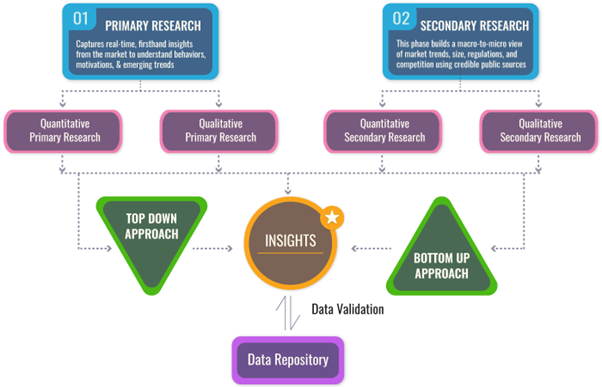
DUAL MODELING: TOP-DOWN + BOTTOM-UP
To ensure robust market estimation, we apply two complementary sizing approaches:
Top-Down Modeling:- Start with broader industry value (e.g., global or regional TAM)
- Apply filters by segment, geography, end-user, or use case
- Adjust with primary insights and validation benchmarks
- Ideal for investor-grade market scans and opportunity mapping
- Aggregate from the ground up using sales volumes, pricing, and unit economics
- Use internal modeling templates aligned with stakeholder data
- Incorporate distributor-level or region-specific inputs
- Most accurate for emerging segments and granular sub-markets
DATA VALIDATION: IN-HOUSE REPOSITORY
We close the loop with proprietary data intelligence built from ongoing projects, industry monitoring, and historical benchmarking. This repository includes:
- Multi-sector market and pricing models
- Key trendlines from past interviews and forecasts
- Benchmarked adoption rates, churn patterns, and ROI indicators
- Industry-specific deviation flags and cross-check logic
- Catches inconsistencies early
- Aligns projections across studies
- Enables consistent, high-trust deliverables