

Incontinence Care Products Market Size and Forecast (2020–2033), Global and Regional Growth, Trend, Share, and Industry Analysis Report Coverage: By Product Type (Adult Diapers, Protective Underwear, Disposable Pads & Liners, Male Guards, Underpads, Others), By Incontinence Type (Urinary Incontinence, Faecal Incontinence, Mixed Incontinence), By End-user (Homecare, Nursing Homes & Long-Term Care Facilities, Hospitals), By Distribution Channel (Retail Pharmacies, Hospital Pharmacies, Online Channels, Hypermarkets/Supermarkets), and Geography
2025-12-19
Consumer Products
Jaya Bundele (Research Analyst)
Description
Incontinence
Care Products Market Overview
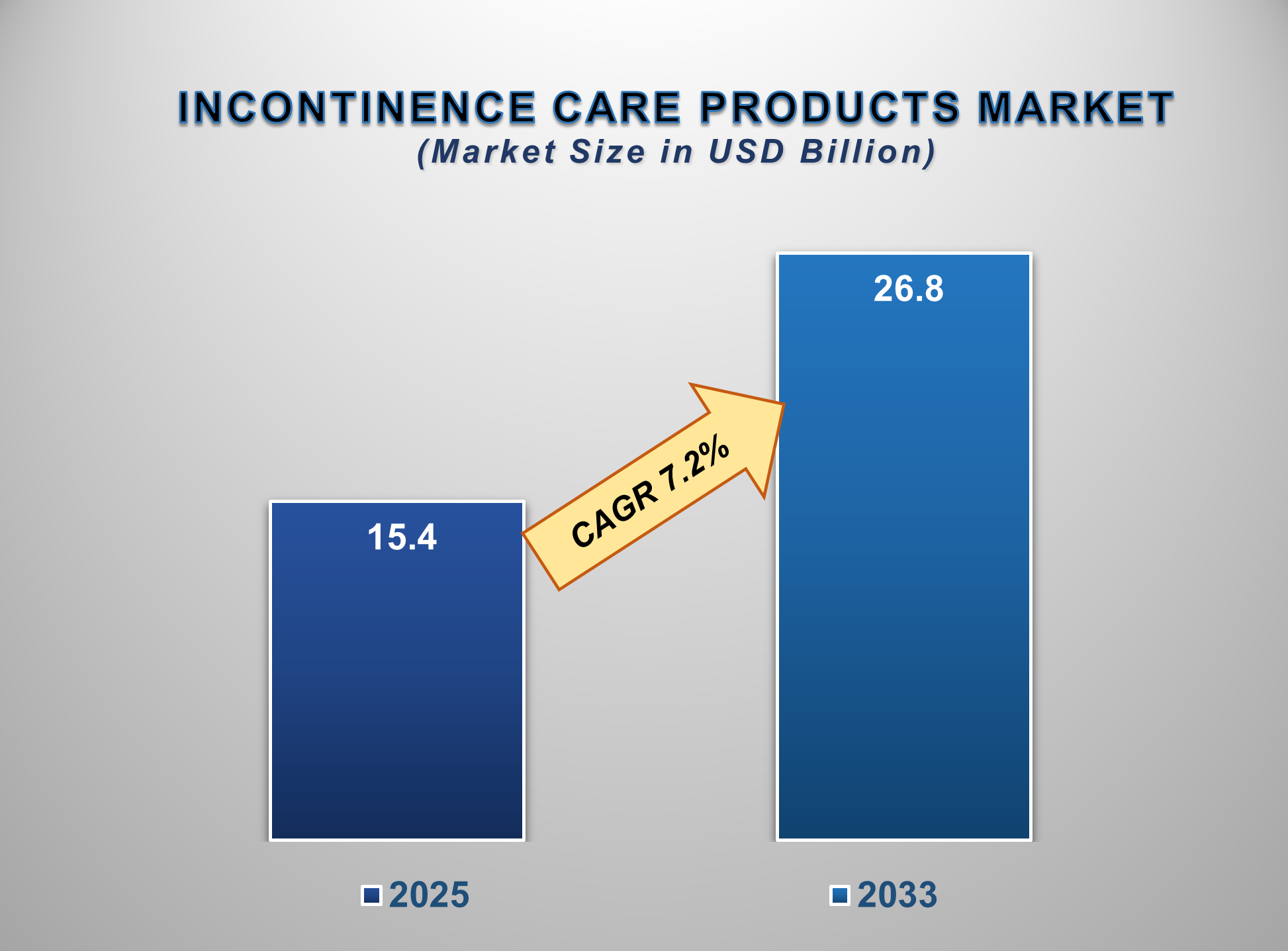
The Incontinence Care Products Market is set to witness strong and sustained growth between 2025 and 2033, driven by the aging global population, rising prevalence of chronic conditions affecting bladder control, and increasing consumer awareness regarding advanced hygiene solutions. The market is expected to be valued at USD 15.4 billion in 2025 and is projected to reach USD 26.8 billion by 2033, registering a CAGR of 7.2% during the forecast period.
Incontinence care products include absorbent hygiene items
such as adult diapers, disposable pads, liners, and protective underwear
designed to manage urinary and fecal
incontinence. These products enhance patient comfort, maintain hygiene, and
reduce the risk of skin infections and caregiver burden.
Growing life expectancy, particularly in developed markets,
is driving large-scale demand among the elderly population. Additionally,
lifestyle disorders, obesity, childbirth-related pelvic floor issues, and
urological surgeries contribute to a higher
incidence of incontinence in younger populations. Innovations in product design, such as odor control,
breathable fabrics, slim-fit absorbent cores, and skin-friendly materials,
have increased adoption rates. North America and
Europe remain leaders due to high awareness and advanced eldercare systems,
while Asia-Pacific is rapidly emerging as a high-growth region fueled by rising
healthcare expenditure and expanding retail access.
Incontinence Care Products Market Drivers and
Opportunities
Rising Geriatric Population and Increasing Prevalence of
Chronic Diseases Are the Primary Market Drivers
The global increase in the elderly population is the most
influential driver supporting market expansion. Individuals aged 65 and above
represent the group most susceptible to urinary and fecal incontinence due to
muscle weakening, chronic diseases, and neurodegenerative disorders such as
Parkinson’s and Alzheimer’s. This demographic shift is creating sustained
demand for effective hygiene solutions worldwide. Simultaneously, chronic illnesses, including diabetes, prostate enlargement, spinal cord
injuries, and post-surgical complications, are
significantly raising the prevalence of incontinence among adults. Healthcare
systems and governments are placing greater focus on elderly well-being,
driving wider availability of advanced incontinence products through retail and
medical channels. This combination of demographic and clinical factors firmly
positions incontinence care products as indispensable for long-term care and
home-based caregiving.
Growing Consumer Acceptance and Innovation in Product Design
Are Accelerating Market Adoption
Increasing awareness and destigmatization of incontinence
are critical to market penetration. Modern products are vastly more discreet,
comfortable, and effective compared to earlier bulky designs, encouraging
higher adoption across diverse age groups. Manufacturers are integrating
ultra-absorbent cores, rapid-dry layers, odor-neutralization technologies, and
hypoallergenic materials that cater to sensitive skin. Moreover,
gender-specific designs, reusable underwear, eco-friendly materials, and
advanced breathable components are appealing to health-conscious consumers.
Retail expansion, especially online channels offering private-label and
subscription-based delivery models, further supports market growth. As
consumers seek improved convenience and dignity, the shift toward premium,
high-performance products remains a strong and enduring catalyst.
Untapped Growth Potential in Emerging Markets and
Technological Advancements Present Significant Opportunities
Emerging markets in Asia-Pacific, Latin America, and parts
of Africa present substantial growth opportunities driven by improving
healthcare access, rising disposable income, and expanding elderly populations.
Increasing penetration of retail pharmacies and e-commerce platforms has
significantly boosted the availability of
incontinence products in these regions. Technological innovations such as smart
diapers that monitor moisture levels, biodegradable materials, and reusable
high-absorbency fabrics offer new pathways for product differentiation.
Additionally, long-term care facilities, home healthcare services, and
government-sponsored eldercare programs are expanding rapidly, creating strong
institutional demand. For manufacturers, opportunities lie in localized
production, cost-optimized product lines, and strategic partnerships with
healthcare providers to capture accelerating demand in developing markets.
Incontinence Care Products Market Scope
|
Report Attributes |
Description |
|
Market Size in 2025 |
USD 15.4 Billion |
|
Market Forecast in 2033 |
USD 26.8 Billion |
|
CAGR % 2025-2033 |
7.2% |
|
Base Year |
2024 |
|
Historic Data |
2020-2024 |
|
Forecast Period |
2025-2033 |
|
Report USP |
Product Portfolio,
Technological Analysis, Company Market Share, Company Heatmap, Pricing
Analysis, Growth Factors and more |
|
Segments Covered |
●
By Product Type ●
By Incontinence
Type ●
By Distribution
Channel ●
By End-user |
|
Regional Scope |
●
North America, ●
Europe, ●
APAC, ●
Latin America ●
Middle East and
Africa |
|
Country Scope |
1)
U.S. 2)
Canada 3)
Germany 4)
UK 5)
France 6)
Spain 7)
Italy 8)
Switzerland 9)
China 10)
Japan 11)
India 12)
Australia 13)
South Korea 14)
Brazil 15)
Mexico 16)
Argentina 17)
South Africa 18)
Saudi Arabia 19)
UAE |
Incontinence Care Products Market Report
Segmentation Analysis
The global Incontinence Care
Products Market is segmented by Product Type, Incontinence Type, End-user,
Distribution Channel, and Region.
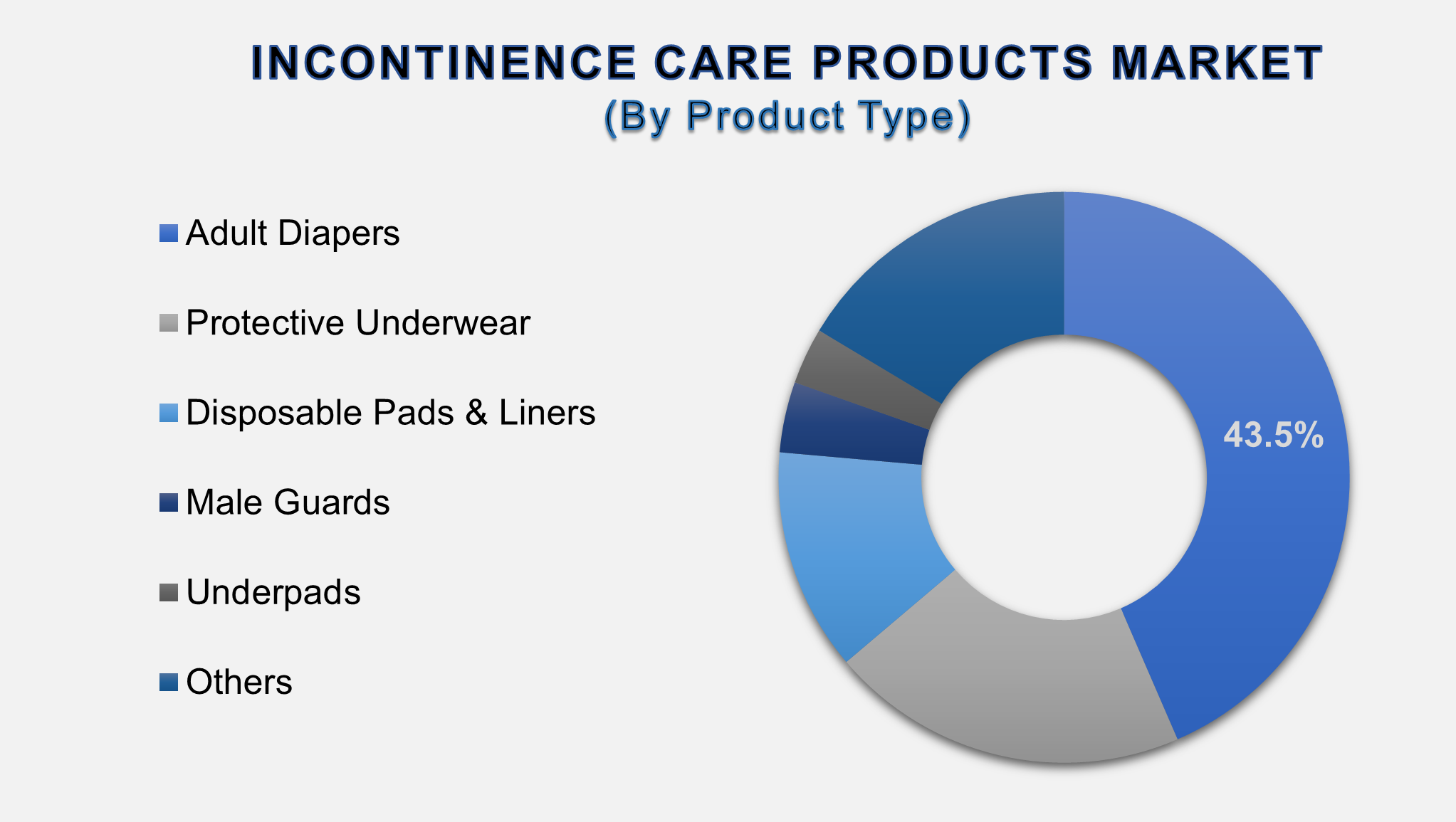
Adult Diapers Are
Anticipated to Command the Largest Market Share in 2025
Adult diapers dominate the Product Type segment due to their unmatched suitability for moderate to severe incontinence management across homecare, hospitals, and long-term care settings. Their market leadership is anchored in superior absorption capacity, multi-layer leak-guard structures, and enhanced comfort that ensures all-day protection for users with mobility challenges or advanced age-related incontinence. Continuous product innovation, such as breathable back sheets, ultra-thin high-capacity cores, pH-balancing materials, and odor-neutralizing technologies, has significantly improved wearability and skin health, driving large-scale adoption.
Premium
ergonomic designs targeted toward active adults, along with gender-specific
variants, are further expanding user acceptance. Rising geriatric populations,
increasing prevalence of chronic conditions like diabetes and stroke, and
growing societal acceptance of incontinence products strengthen demand for
adult diapers over pads or liners. Additionally, strategic distribution through
pharmacies, e-commerce, and institutional bulk supply programs ensures
consistent availability, solidifying adult diapers as the leading product
category in the global Incontinence Care Products Market.
The Urinary Incontinence
Segment Holds the Largest Share by Incontinence Type
Urinary
incontinence represents the most prevalent form of incontinence globally,
making it the leading segment by Incontinence Type. Its dominance stems from
the high incidence of stress incontinence, urge incontinence, overflow
incontinence, and overactive bladder, conditions commonly associated with
childbirth trauma, menopause-related hormonal changes, obesity, pelvic floor
weakening, and prostate disorders in men.
The
segment benefits from significant clinical awareness, with widespread screening
in primary care and urology practices leading to early diagnosis and
intervention. As the global population ages, degenerative neurological
conditions such as Parkinson’s disease, dementia, and diabetes-related
neuropathy are contributing to rising urinary incontinence cases. Healthcare
practitioners increasingly recommend structured continence management programs
involving absorbent products, behavioral
therapies, and pelvic floor rehabilitation, boosting product uptake. With
chronic diseases rising and women disproportionately affected, the need for
effective protection solutions continues to expand. This longstanding and
growing prevalence ensures urinary
incontinence remains the largest and most clinically significant segment.
Hospital Pharmacies Lead
the Distribution Channel Segment
Hospital
pharmacies hold the dominant share in the Distribution Channel segment, driven
by the high utilization of incontinence care products within hospitals,
rehabilitation centers, and long-term care
institutions. These facilities manage patients recovering from surgeries,
chronic illnesses, neurological conditions, and age-related mobility
limitations, groups that frequently require
absorbent products for daily hygiene and comfort. Hospital purchasing
departments typically procure adult diapers, underpads, and briefs in bulk,
ensuring stable and consistent demand.
Additionally,
hospitals serve as key points of first diagnosis for incontinence, where
physicians and nursing staff recommend specific brands or product types,
influencing patient preferences after discharge. The clinical emphasis on
preventing hospital-acquired infections (HAIs), maintaining skin integrity, and
ensuring patient dignity further supports the use of high-quality incontinence
products. With institutional protocols prioritizing premium, dermatologically
safe, and high-absorbency products, hospital pharmacies remain the preferred
and most trusted channel for both inpatients and post-acute care patients,
solidifying their leading position.
The following segments are
part of an in-depth analysis of the global Incontinence Care Products Market:
|
Market
Segments |
|
|
By Product
Type |
●
Adult Diapers ●
Protective Underwear ●
Disposable Pads
& Liners ●
Male Guards ●
Underpads ●
Others |
|
By
Incontinence Type |
●
Urinary Incontinence ●
Faecal Incontinence ●
Mixed Incontinence |
|
By Distribution Channel |
●
Retail Pharmacies ●
Hospital Pharmacies ●
Online Channels ●
Hypermarkets/Supermarkets |
|
By End-user |
●
Hospitals &
Clinics ●
Nursing Homes & Long-term Care
Facilities ●
Others |
Incontinence
Care Products Market Share Analysis by Region
The Asia-Pacific region
is anticipated to hold the largest portion of the Incontinence Care Products
Market globally throughout the forecast period.
Asia-Pacific’s
leadership is driven by its vast and rapidly growing elderly population,
particularly in China, Japan, and South Korea. China represents the largest
contributor due to its expanding healthcare infrastructure, rising elderly care
needs, and increasing adoption of personal hygiene products among the middle
class. Japan, with one of the world’s oldest populations, has extremely high per
capita consumption of adult incontinence products.
India, meanwhile, is witnessing fast-growing demand enabled by rising health
awareness and increasing penetration of retail and e-commerce channels.
The
region’s expansion is further supported by the presence of strong manufacturing
bases, cost-efficient production capabilities, and increasing investments in
eldercare programs. In Southeast Asia, economic growth and improving healthcare
affordability are accelerating product penetration. Collectively, these
dynamics position Asia-Pacific as the fastest-growing and largest market for
incontinence care products globally.
Incontinence Care Products Market Competition
Landscape Analysis
The global market is
moderately consolidated with a mix of multinational corporations and regional
players. Leading companies compete based on product innovation, absorbency
technology, skin-friendly materials, cost-efficiency, and strong distribution
networks. Long-term partnerships with healthcare facilities, investments in
biodegradable and sustainable materials, and strategic expansion across
emerging markets are key competitive strategies. E-commerce expansion and
subscription-based delivery models have become significant differentiators for
consumer convenience and retention.
Global Incontinence Care Products Market Recent Developments
News:
- In January 2025, Essity launched its next-generation TENA ProSkin
line with enhanced breathable layers for sensitive skin in elderly users.
- In October 2024, Kimberly-Clark expanded its adult incontinence
production facility in Indonesia to support rising demand across Southeast
Asia.
- In September 2024, Hartmann
Group introduced a smart incontinence monitoring system integrating
moisture sensors for nursing home applications.
- In July 2024, Ontex Group announced a partnership with healthcare
distributors in India to strengthen its presence in homecare incontinence
solutions.
The Global Incontinence Care Products Market Is
Dominated by a Few Large Companies, such as
●
Essity AB (TENA)
●
Kimberly-Clark
Corporation
●
Procter & Gamble
Co.
●
Cardinal Health, Inc.
●
Ontex Group NV
●
First Quality
Enterprises, Inc.
●
Domtar Corporation
(Attends)
●
Medline Industries, LP
●
B. Braun Melsungen AG
●
Coloplast A/S
●
ConvaTec Group PLC
●
Hollister Incorporated
●
Principle Business
Enterprises, Inc. (Prevail)
●
Unicharm Corporation
●
HARTMANN GROUP
(Molicare)
● Other Prominent Players
Frequently Asked Questions
Jaya Bundele (Research Analyst)
Jaya Bundele is a skilled Research Analyst with 4+ years of experience in market intelligence, consumer insights, competitive analysis, and industry forecasting across the consumer goods, agriculture, and food & beverage sectors. She specializes in market sizing, trend analysis, growth opportunity mapping, and strategic secondary research for global and regional markets.
Her expertise lies in transforming complex industry data into actionable business strategies that help organizations identify emerging trends, understand customer behavior, and gain a competitive edge. With a strong focus on data-driven insights, business intelligence, and future market trends, Jaya delivers high-quality research solutions aligned with evolving industry demands and market dynamics.
1. Global Incontinence Care
Products Market Introduction and Market Overview
1.1.
Objectives
of the Study
1.2.
Global
Incontinence Care Products Market Scope and Market Estimation
1.2.1.Global Electronic Toll
Collection Overall Market Size (US$ Bn), Market CAGR (%), Market forecast (2025
- 2033)
1.2.2.Global Incontinence Care
Products Market Revenue Share (%) and Growth Rate (Y-o-Y) from 2020 - 2033
1.3.
Market
Segmentation
1.3.1.Product Type of Global Incontinence
Care Products Market
1.3.2.Incontinence Type of
Global Incontinence Care Products Market
1.3.3.Distribution Channel of Global
Incontinence Care Products Market
1.3.4.End-user of Global Incontinence
Care Products Market
1.3.5.Region of Global Incontinence
Care Products Market
2. Executive
Summary
2.1.
Demand
Side Trends
2.2.
Key
Market Trends
2.3.
Market
Demand (US$ Bn) Analysis 2020 – 2024 and forecast, 2025 – 2033
2.4.
Demand
and Opportunity Assessment
2.5.
Key
Developments
2.6.
Market
Entry Strategies
2.7.
Market
Dynamics
2.7.1.Drivers
2.7.2.Limitations
2.7.3.Opportunities
2.7.4.Impact Analysis of Drivers
and Restraints
2.8.
Porter’s
Five Forces Analysis
2.9.
Pricing
Analysis
2.10.
PEST
Analysis
3. Global
Incontinence Care Products Market
Estimates & Historical Trend Analysis (2020 - 2024)
4. Global
Incontinence Care Products Market
Estimates & Forecast Trend Analysis, by Product
Type
4.1.
Global
Incontinence Care Products Market Revenue (US$ Bn) Estimates and Forecasts, by Product
Type, 2020 - 2033
4.1.1.Adult Diapers
4.1.2.Protective Underwear
4.1.3.Disposable Pads &
Liners
4.1.4.Male Guards
4.1.5.Underpads
4.1.6.Others
5. Global
Incontinence Care Products Market
Estimates & Forecast Trend Analysis, by Incontinence
Type
5.1.
Global
Incontinence Care Products Market Revenue (US$ Bn) Estimates and Forecasts, by Incontinence
Type, 2020 - 2033
5.1.1.Urinary Incontinence
5.1.2.Fecal Incontinence
5.1.3.Mixed Incontinence
6. Global
Incontinence Care Products Market
Estimates & Forecast Trend Analysis, by End-user
6.1.
Global
Incontinence Care Products Market Revenue (US$ Bn) Estimates and Forecasts, by
End-user 2020 - 2033
6.1.1.Hospitals & Clinics
6.1.2. Nursing Homes &
Long-term Care Facilities
6.1.3.Others
7. Global
Incontinence Care Products Market
Estimates & Forecast Trend Analysis, by Distribution
Channel
7.1.
Global
Incontinence Care Products Market Revenue (US$ Bn) Estimates and Forecasts, by Distribution
Channel 2020 - 2033
7.1.1.Retail Pharmacies
7.1.2.Hospital Pharmacies
7.1.3.Online Channels
7.1.4.Hypermarkets/Supermarkets
8. Global
Incontinence Care Products Market
Estimates & Forecast Trend Analysis, by region
8.1.
Global
Incontinence Care Products Market Revenue (US$ Bn) Estimates and Forecasts, by region,
2020 - 2033
8.1.1.North America
8.1.2.Europe
8.1.3.Asia Pacific
8.1.4.Middle East & Africa
8.1.5.Latin America
9. North America Incontinence
Care Products Market: Estimates &
Forecast Trend Analysis
9.1.
North
America Incontinence Care Products Market Assessments & Key Findings
9.1.1.North America Incontinence
Care Products Market Introduction
9.1.2.North America Incontinence
Care Products Market Size Estimates and Forecast (US$ Billion) (2020 - 2033)
9.1.2.1. By Product
Type
9.1.2.2. By Incontinence
Type
9.1.2.3. By Distribution
Channel
9.1.2.4. By End-user
9.1.2.5.
By
Country
9.1.2.5.1. The U.S.
9.1.2.5.2. Canada
10. Europe Incontinence
Care Products Market: Estimates &
Forecast Trend Analysis
10.1.
Europe
Incontinence Care Products Market Assessments & Key Findings
10.1.1.
Europe
Incontinence Care Products Market Introduction
10.1.2.
Europe
Incontinence Care Products Market Size Estimates and Forecast (US$ Billion) (2020
- 2033)
10.1.2.1. By Product
Type
10.1.2.2. By Incontinence
Type
10.1.2.3. By Distribution
Channel
10.1.2.4. By End-user
10.1.2.5.
By
Country
10.1.2.5.1.
Germany
10.1.2.5.2.
Italy
10.1.2.5.3.
U.K.
10.1.2.5.4.
France
10.1.2.5.5.
Spain
10.1.2.5.6.
Switzerland
10.1.2.5.7. Rest
of Europe
11. Asia Pacific Incontinence
Care Products Market: Estimates &
Forecast Trend Analysis
11.1.
Asia
Pacific Market Assessments & Key Findings
11.1.1.
Asia
Pacific Incontinence Care Products Market Introduction
11.1.2.
Asia
Pacific Incontinence Care Products Market Size Estimates and Forecast (US$ Billion)
(2020 - 2033)
11.1.2.1. By Product
Type
11.1.2.2. By Incontinence
Type
11.1.2.3. By Distribution
Channel
11.1.2.4. By End-user
11.1.2.5.
By
Country
11.1.2.5.1. China
11.1.2.5.2. Japan
11.1.2.5.3. India
11.1.2.5.4. Australia
11.1.2.5.5. South Korea
11.1.2.5.6. Rest of Asia Pacific
12. Middle East & Africa Incontinence
Care Products Market: Estimates &
Forecast Trend Analysis
12.1.
Middle
East & Africa Market Assessments & Key Findings
12.1.1.
Middle East & Africa Incontinence Care Products Market
Introduction
12.1.2.
Middle East & Africa Incontinence Care Products Market
Size Estimates and Forecast (US$ Billion) (2020 - 2033)
12.1.2.1. By Product
Type
12.1.2.2. By Incontinence
Type
12.1.2.3. By Distribution
Channel
12.1.2.4. By End User
12.1.2.5.
By
Country
12.1.2.5.1. UAE
12.1.2.5.2. Saudi
Arabia
12.1.2.5.3. South
Africa
12.1.2.5.4. Rest
of MEA
13. Latin America
Incontinence Care Products Market:
Estimates & Forecast Trend Analysis
13.1.
Latin
America Market Assessments & Key Findings
13.1.1.
Latin
America Incontinence Care Products Market Introduction
13.1.2.
Latin
America Incontinence Care Products Market Size Estimates and Forecast (US$ Billion)
(2020 - 2033)
13.1.2.1. By Product
Type
13.1.2.2. By Incontinence
Type
13.1.2.3. By Distribution
Channel
13.1.2.4. By End-user
13.1.2.5.
By
Country
13.1.2.5.1. Brazil
13.1.2.5.2. Argentina
13.1.2.5.3. Mexico
13.1.2.5.4. Rest
of LATAM
14. Country Wise Market:
Introduction
15.
Competition
Landscape
15.1.
Global
Incontinence Care Products Market Product Mapping
15.2.
Global
Incontinence Care Products Market Concentration Analysis, by Leading Players /
Innovators / Emerging Players / New Entrants
15.3.
Global
Incontinence Care Products Market Tier Structure Analysis
15.4.
Global
Incontinence Care Products Market Concentration & Company Market Shares (%)
Analysis, 2024
16.
Company
Profiles
16.1.
Essity AB (TENA)
16.1.1.
Company
Overview & Key Stats
16.1.2.
Financial
Performance & KPIs
16.1.3.
Product
Portfolio
16.1.4.
SWOT
Analysis
16.1.5.
Business
Strategy & Recent Developments
* Similar details would be provided for all the players
mentioned below
16.2. Kimberly-Clark
Corporation
16.3. Procter &
Gamble Co.
16.4. Cardinal
Health, Inc.
16.5. Ontex Group
NV
16.6. First Quality
Enterprises, Inc.
16.7. Domtar
Corporation (Attends)
16.8. Medline
Industries, LP
16.9. B. Braun
Melsungen AG
16.10. Coloplast A/S
16.11. ConvaTec
Group PLC
16.12. Hollister
Incorporated
16.13. Principle
Business Enterprises, Inc. (Prevail)
16.14. Unicharm
Corporation
16.15. HARTMANN
GROUP (Molicare)
16.16. Other
Prominent Players
17. Research
Methodology
17.1.
External
Transportations / Databases
17.2.
Internal
Proprietary Database
17.3.
Primary
Research
17.4.
Secondary
Research
17.5.
Assumptions
17.6.
Limitations
17.7.
Report
FAQs
18. Research
Findings & Conclusion
Our Research Methodology
"Insight without rigor is just noise."
We follow a comprehensive, multi-phase research framework designed to deliver accurate, strategic, and decision-ready intelligence. Our process integrates primary and secondary research , both quantitative and qualitative , along with dual modeling techniques ( top-down and bottom-up) and a final layer of validation through our proprietary in-house repository.
PRIMARY RESEARCH
Primary research captures real-time, firsthand insights from the market to understand behaviors, motivations, and emerging trends.
1. Quantitative Primary Research
Objective: Generate statistically significant data directly from market participants.
Approaches:- Structured surveys with customers, distributors, and field agents
- Mobile-based data collection for point-of-sale audits and usage behavior
- Phone-based interviews (CATI) for market sizing and product feedback
- Online polling around industry events and digital campaigns
- Purchase frequency by customer type
- Channel performance across geographies
- Feature demand by application or demographic
2. Qualitative Primary Research
Objective: Explore decision-making drivers, pain points, and market readiness.
Approaches:- In-depth interviews (IDIs) with executives, product managers, and key decision-makers
- Focus groups among end users and early adopters
- Site visits and observational research for consumer products
- Informal field-level discussions for regional and cultural nuances
SECONDARY RESEARCH
This phase helps establish a macro-to-micro understanding of market trends, size, regulation, and competitive dynamics, sourced from credible and public domain information.
1. Quantitative Secondary Research
Objective: Model market value and segment-level forecasts based on published data.
Sources include:- Financial reports and investor summaries
- Government trade data, customs records, and regulatory statistics
- Industry association publications and economic databases
- Channel performance and pricing data from marketplace listings
- Revenue splits, pricing trends, and CAGR estimates
- Supply-side capacity and volume tracking
- Investment analysis and funding benchmarks
2. Qualitative Secondary Research
Objective: Capture strategic direction, innovation signals, and behavioral trends.
Sources include:- Company announcements, roadmaps, and product pipelines
- Publicly available whitepapers, conference abstracts, and academic research
- Regulatory body publications and policy briefs
- Social and media sentiment scanning for early-stage shifts
- Strategic shifts in market positioning
- Unmet needs and white spaces
- Regulatory triggers and compliance impact
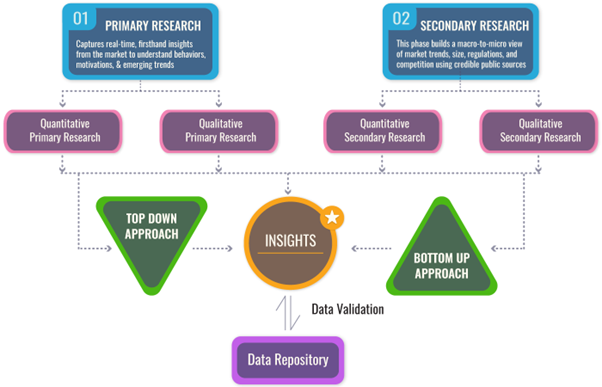
DUAL MODELING: TOP-DOWN + BOTTOM-UP
To ensure robust market estimation, we apply two complementary sizing approaches:
Top-Down Modeling:- Start with broader industry value (e.g., global or regional TAM)
- Apply filters by segment, geography, end-user, or use case
- Adjust with primary insights and validation benchmarks
- Ideal for investor-grade market scans and opportunity mapping
- Aggregate from the ground up using sales volumes, pricing, and unit economics
- Use internal modeling templates aligned with stakeholder data
- Incorporate distributor-level or region-specific inputs
- Most accurate for emerging segments and granular sub-markets
DATA VALIDATION: IN-HOUSE REPOSITORY
We close the loop with proprietary data intelligence built from ongoing projects, industry monitoring, and historical benchmarking. This repository includes:
- Multi-sector market and pricing models
- Key trendlines from past interviews and forecasts
- Benchmarked adoption rates, churn patterns, and ROI indicators
- Industry-specific deviation flags and cross-check logic
- Catches inconsistencies early
- Aligns projections across studies
- Enables consistent, high-trust deliverables