

India Cloud Kitchen Market Size and Forecast (2026–2034), Regional Growth, Trend, Share and Industry Analysis Report Coverage: By Type (Independent/Standalone Cloud Kitchens, Chained Cloud Kitchens), By Source of Order (Web, Mobile App), By Payment Method (Cash on Delivery, Mobile Wallet, Card Transaction, Others), By Region
2026-09-09
ICT
Ekta Chaurasia (Team Lead)
Description
India
Cloud Kitchen Market Overview
The India Cloud Kitchen Market is
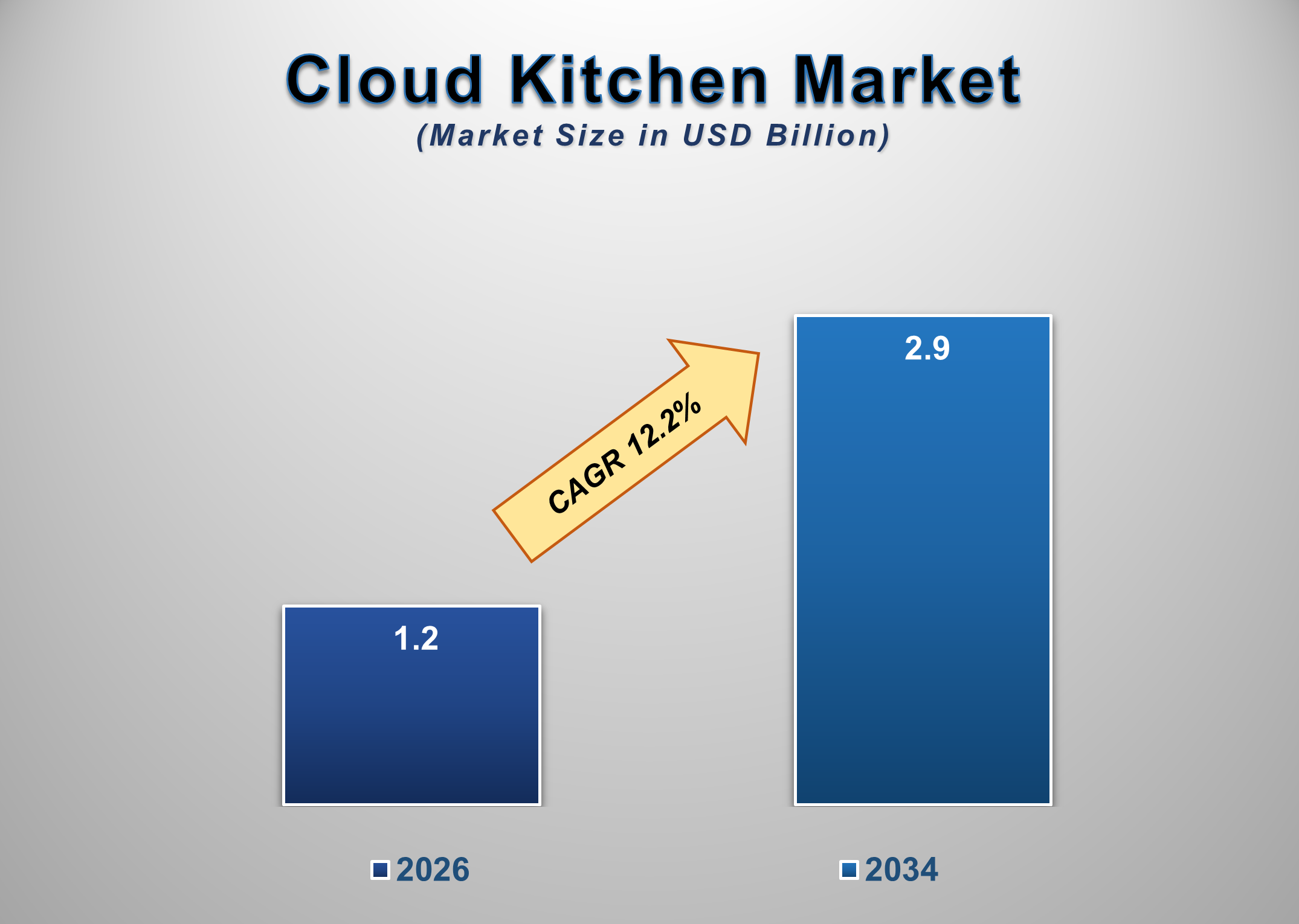
projected to expand from USD 1.2 billion in 2026 to USD 2.9 billion by 2034,
registering a CAGR of 12.2% during 2026–2034. India is the second-largest cloud
kitchen market in Asia after China, and the sector's growth is closely tied to
the country's broader online food delivery expansion: online ordering accounted
for roughly 12% of India's total food-delivery market as of mid-2024, a share
projected to reach approximately 20% by 2030 as digital ordering continues to
displace phone-based and walk-in ordering.
Unlike the mature, consolidating cloud
kitchen markets of the United States or United Kingdom, India's market remains
in an active build-out phase, characterized by rapid geographic expansion
beyond metro cities, continued new-entrant activity, and a still-evolving mix
between venture-backed multi-brand operators and small, independently owned
kitchens. India's cloud kitchen ecosystem is anchored by a small number of
large, well-capitalized platform companies Rebel Foods, Curefoods, and EatClub
Brands, foremost among them operating alongside thousands of smaller
independent kitchens that together define a market structure closer to China's
platform-influenced model than to the operator-fragmented markets of Europe.
India
Cloud Kitchen Market Growth Drivers
Rapid Urbanization and Tier-2/Tier-3
City Expansion Are Widening the Addressable Market
India's urban population is projected
to reach roughly 600 million people, or about 40% of the national population,
by 2036, and this wave of urbanization is driving cloud kitchen demand well
beyond the traditional metro base. While South India currently commands the
largest regional revenue share at approximately 35.0%, anchored by Bengaluru's
high cloud kitchen density and tech-sector order volumes, operators are increasingly
building commissary kitchen infrastructure in Tier-2 cities such as Jaipur,
Lucknow, Indore, Coimbatore, and Surat, where first-mover advantage remains
available ahead of market saturation. The market's structural maturity in
Tier-1 cities is pushing growth capital toward these emerging urban centers
rather than toward further densification in Bengaluru, Mumbai, or Delhi-NCR.
Deep Aggregator Penetration and Rising
Digital Payment Adoption Are Normalizing Delivery-Only Dining
Swiggy and Zomato's national logistics networks give any India-based cloud kitchen operator near-immediate access to a delivery-ready consumer base without requiring independent last-mile infrastructure, a dynamic broadly similar to the platform-led growth seen in China, but split between two dominant aggregators rather than concentrated in one. Rising smartphone penetration and UPI-based digital payment adoption have simultaneously lowered the friction of ordering, supporting frequent, habitual use of delivery apps rather than occasional ordering, and enabling cloud kitchens to rely on mobile-first order flows rather than telephone or walk-in order capture.
India Cloud Kitchen Market Restraint
Aggregator Commission Dependence and
Thin Margins Constrain Profitability
The primary restraint on India's cloud
kitchen market is structural dependence on Swiggy and Zomato for order flow,
which typically charge commissions in a range that can consume a large share of
order value before food, packaging, and labor costs are counted. This
dependence leaves many operators, particularly smaller independent kitchens,
without the negotiating scale of Rebel Foods or Curefoods operating on thin or
negative unit margins, and has pushed several operators to encourage direct
ordering through owned websites and apps to reduce aggregator dependence and
protect margins. Rising real estate and input costs in metro cities, combined
with intensifying competition among thousands of independent operators, further
compress pricing power at the lower end of the market.
India Cloud Kitchen Market
Opportunities
QSR and Restaurant-Chain Expansion
Into Delivery-Only Formats Can Broaden the Market Beyond Pure-Play Operators
Established quick-service and
restaurant chains, including Wow Momo and Haldiram's, have begun launching
delivery-only kitchens to complement their existing dine-in networks, extending
their brand equity into the cloud kitchen format without the capital intensity
of new physical storefronts. This QSR entry represents a meaningful expansion
of the addressable market beyond venture-backed specialist operators such as
Rebel Foods and Curefoods and signals growing mainstream acceptance of the
cloud-kitchen model as a legitimate expansion channel for established food
brands rather than a category reserved for digital-native startups.
Corporate Meal Subscriptions and
Tier-2 Commissary Infrastructure Represent Underused Growth Channels
Corporate meal subscription services
and daily office-lunch delivery, exemplified by operators such as HOI Foods,
which runs over 150 kitchens focused on affordable multi-cuisine daily meal
combos, offer a recurring-revenue alternative to one-off consumer ordering that
reduces exposure to aggregator commission volatility. Combined with the
still-unsaturated Tier-2 city opportunity, operators that build dedicated
commissary kitchen infrastructure ahead of demand in cities such as Jaipur,
Lucknow, and Coimbatore are positioned to capture a disproportionate share as
those markets mature, mirroring the first-mover dynamics that Rebel Foods and
Curefoods already captured in Tier-1 metros.
India
Cloud Kitchen Market Scope
|
Report
Attributes |
Description |
|
Market Size
in 2026 |
USD 1.39
Billion |
|
Market Forecast in 2034 |
USD
3.69 Billion |
|
CAGR %
2026–2034 |
12.28% |
|
Base Year |
2025 |
|
Historic
Data |
2020–2025 |
|
Forecast Period |
2026–2034 |
|
Report USP |
Production,
consumption, company share, company heatmap, regional revenue split, growth
factors and more |
|
Geography |
India |
|
By Type |
Independent/Standalone
Cloud Kitchens, Chained Cloud Kitchens |
|
By Source of Order |
Web,
Mobile App |
|
By Payment
Method |
Cash on
Delivery, Mobile Wallet, Card Transaction, Others |
|
Key Players |
Rebel
Foods Pvt. Ltd.; Curefoods India Pvt. Ltd.; EatClub Brands (Box8, Mojo
Pizza); FreshMenu; Biryani By Kilo; Kouzina Food Tech Pvt. Ltd.; HOI Foods;
Swiggy Limited (Swiggy Access); Zomato Ltd.; Wow Momo Foods Pvt. Ltd. |
India
Cloud Kitchen Market Report Segmentation Analysis
Mobile App Is Expected to Remain the
Dominant Order Source in India Cloud Kitchen Market
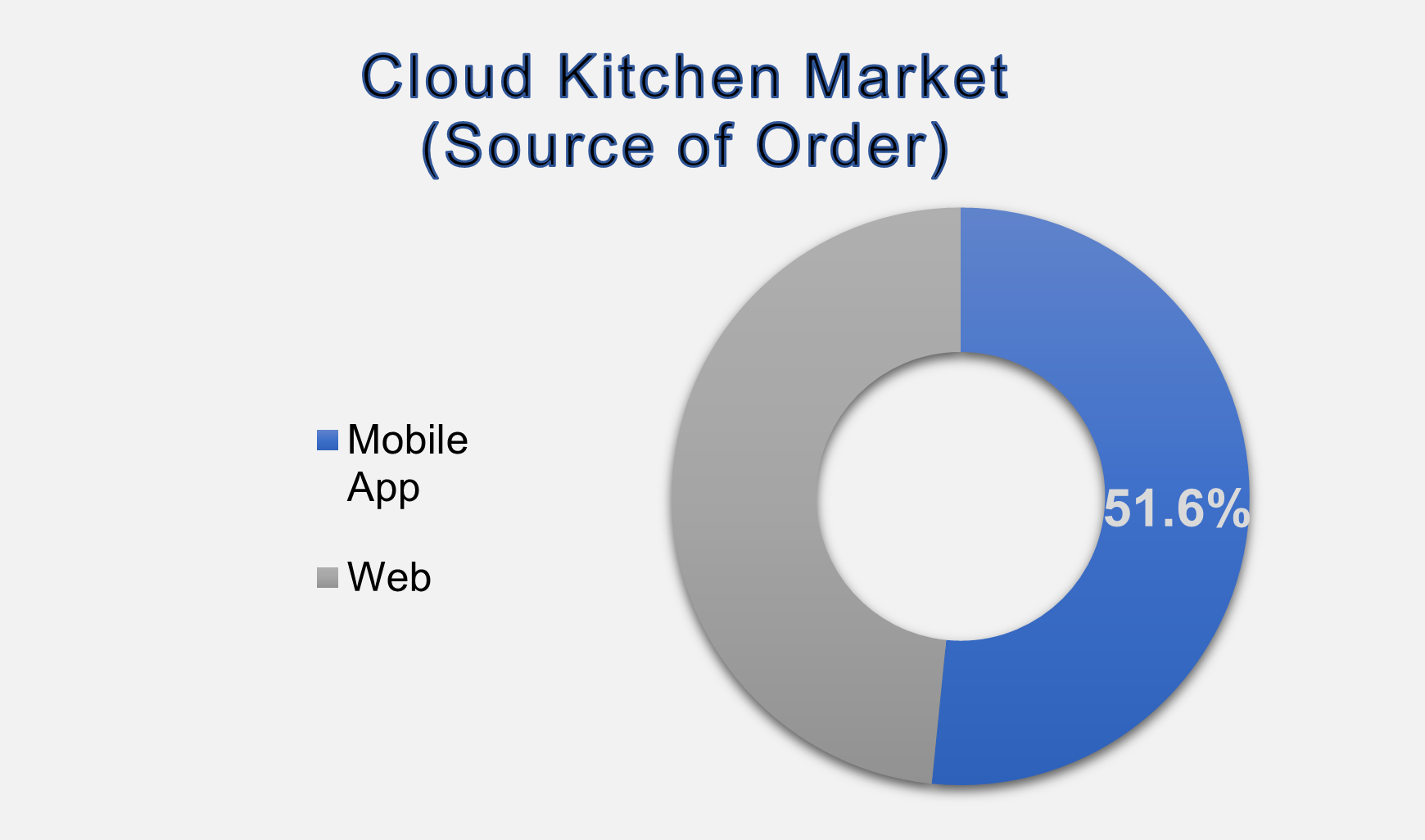
By source of order, the market is
segmented into Web and Mobile App. Mobile app ordering dominates and continues
to gain share, driven by Swiggy and Zomato's app-first design, in-app loyalty
programs, and India's mobile-first internet adoption pattern, in which a large
share of consumers access the internet primarily through smartphones rather
than desktop browsers. Web-based ordering persists at a smaller scale, mainly
through direct-to-consumer brand websites operated by companies such as
FreshMenu and Curefoods-owned brands seeking to reduce aggregator commission
exposure by capturing orders outside the Swiggy/Zomato ecosystem.
Cash on Delivery Continues to Hold Relevance, While Mobile Wallets Are the Fastest-Growing Payment Method
By payment method, the market is
segmented into Cash on Delivery, Mobile Wallet, Card Transaction, and Others.
Mobile wallet and UPI-based payment methods are the fastest-growing segment,
reflecting India's rapid digital-payment adoption and the aggregator platforms'
push toward prepaid, in-app checkout. Card transactions hold a meaningful and
stable share, particularly among urban, higher-income consumers. Cash on
delivery, while declining in metro markets, continues to hold more relevance in
India than in mature markets such as the U.S. or U.K., particularly in Tier-2
and Tier-3 cities where digital payment penetration and consumer trust in
online prepayment remain comparatively lower.
The following segments are part of an
in-depth analysis of the India Cloud Kitchen Market:
|
Market Segments |
|
|
By
Source of Order |
· Web · Mobile App |
|
By
Payment Method |
· Cash on
Delivery · Mobile
Wallet · Card
Transaction · Others |
India
Cloud Kitchen Market Regional Analysis
India's cloud kitchen demand is
heavily metro-concentrated but is beginning to extend into secondary urban
centers as aggregator logistics networks and commissary kitchen infrastructure
expand. South India leads all regions with an estimated 35.0% share of national
market revenue, anchored by Bengaluru's exceptionally high density of cloud
kitchen facilities, a large tech-sector workforce with strong digital-ordering
habits, and early, sustained investment from pioneering operators such as
FreshMenu, which launched in Bengaluru in 2014.
|
Region |
Key Detail |
|
South India |
Bengaluru is
India's highest-density cloud kitchen market and the historical launch city
for several pioneering brands, including FreshMenu. Hyderabad and Chennai
contribute significant secondary demand, with Hyderabad in particular
associated with regional biryani-focused virtual brands. The region's
tech-sector workforce, high smartphone penetration, and comparatively higher
disposable incomes support premium and multi-brand cloud kitchen concepts. |
|
West India |
Mumbai
and Pune anchor West India's cloud kitchen demand, with Mumbai serving as
headquarters to major operators including EatClub Brands (Box8, Mojo Pizza)
and hosting one of the country's densest concentrations of both independent
and chained kitchens. Pune has emerged as a fast-growing secondary hub,
benefiting from a large student and young-professional population with high
delivery-order frequency. |
|
North India |
Delhi NCR is
India's second-most cloud-kitchen-dense metro after Bengaluru and a core
operating market for nearly every major national chain, including Rebel
Foods, Curefoods, and EatClub Brands. Rising urbanization in surrounding
Tier-2 cities such as Jaipur and Lucknow, the latter closely associated with
Biryani By Kilo's Lucknowi biryani positioning, is extending North India's
cloud kitchen footprint beyond the immediate NCR region. |
|
East India |
Kolkata
represents East India's primary cloud kitchen hub, hosted by several national
chains including FreshMenu and EatClub Brands, though at materially lower
kitchen density than the southern, western, and northern metro clusters. The
region is expected to see the least mature but potentially fastest percentage
growth as operators extend commissary infrastructure into a currently
underserved market. |
India Cloud Kitchen Market Regulatory
Landscape
Cloud kitchens in India are legally
classified as Food Business Operators (FBOs) under the Food Safety and
Standards Act, 2006, and must hold a valid Food Safety and Standards Authority
of India (FSSAI) license before accepting a single order a requirement that
applies identically whether the kitchen operates from a rented commercial space
or a home-based setup. Aggregator platforms including Swiggy and Zomato will
not onboard a kitchen without a valid FSSAI number, GST registration, and, in
most cases, a local trade license, making FSSAI compliance a functional
prerequisite for market access rather than a purely legal formality.
The required FSSAI license tier
depends on annual turnover: Basic Registration applies to kitchens with annual
turnover up to Rs 1.5 crore, a State License applies between Rs 1.5 crore and
Rs 50 crore, and a Central License applies above Rs 50 crore or for operators
with kitchens spanning multiple states. Under a distinctive multi-brand
provision, a single FSSAI license permits an operator to run up to ten
different food brands from one kitchen address, which materially simplifies
compliance for multi-brand operators such as Rebel Foods, Curefoods, and
EatClub Brands relative to markets that require separate licensing per brand.
Operators with kitchens across multiple states — such as Delhi, Bengaluru, and
Mumbai — must hold a Central License at the head-office level in addition to
State Licenses for each individual kitchen location.
Total registration and licensing costs
typically range from roughly Rs 5,000 to Rs 40,000 depending on business
structure and license tier, and non-compliance can result in fines of up to Rs
5 lakh, forced business closure, and legal prosecution. FSSAI regulations
additionally mandate that a valid 14-digit license number appear on digital
menus, packaging, and invoices to ensure traceability from kitchen to consumer
— a transparency requirement broadly analogous to, though procedurally distinct
from, the hygiene-rating visibility debate playing out in the UK's dark-kitchen
market.
India Cloud Kitchen Market Competition
Landscape Analysis
India's cloud kitchen market features
intense competition among venture-backed multi-brand platform operators,
established QSR chains extending into delivery-only formats, and thousands of
small independent kitchens. Rebel Foods Pvt. Ltd., Curefoods India Pvt. Ltd.,
EatClub Brands, FreshMenu, Biryani By Kilo, Kouzina Food Tech Pvt. Ltd., and
HOI Foods constitute the identified leading player landscape, alongside
aggregator-affiliated initiatives from Swiggy and Zomato and delivery-only
expansion by QSR brands such as Wow Momo and Haldiram's. Competition is
primarily based on kitchen network density, multi-brand portfolio breadth,
delivery-platform relationship terms, direct-ordering app adoption, and the
ability to sustain unit economics under aggregator commission pressure.
·
Rebel Foods Pvt. Ltd.
India's
largest internet-native restaurant company, operating virtual brands including
Faasos, Behrouz Biryani, Oven Story Pizza, Lunchbox, and The Good Bowl across
India, the Middle East, and select international markets. Rebel Foods raised
approximately USD 25 million in its most recent disclosed tranche (April 2025),
following a larger Series G round announced in December 2024, and has reported
cumulative funding exceeding USD 770 million.
·
Curefoods India Pvt. Ltd.
A roll-up
cloud kitchen platform that acquires and scales D2C food brands including
EatFit, CakeZone, Olio, Rolls on Wheels, Great Indian Khichdi, Home Plate,
Juno's Pizza, and Ovenfresh. Curefoods raised USD 40 million (₹330 crore) in
Series D funding in December 2024, led by Iron Pillar, Chiratae Ventures,
Shinhan Group, and BlackSoil Group, with an additional ₹56.4 crore in debt
financing in early 2025.
·
EatClub Brands (formerly Box8)
Mumbai-headquartered
full-stack cloud kitchen operator running Box8, Mojo Pizza, Itminaan Biryani,
LeanCrust Pizza, and other brands across more than 400 kitchens in Mumbai,
Delhi NCR, Bengaluru, Hyderabad, Pune, Chennai, and Kolkata. EatClub raised
approximately USD 22 million (₹185 crore) in a growth round led by Tiger Global
in mid-2025.
·
FreshMenu
One of
India's earliest cloud kitchen pioneers, founded in Bengaluru in 2014, known
for chef-curated, daily-rotating menus served through in-house brands including
Edesia and Donburi across Bengaluru, Mumbai, Delhi NCR, and Kolkata. FreshMenu
has raised more than USD 37 million cumulatively, including a ₹50 crore (USD
6.5 million) investment from Florintree Advisors in 2022.
·
Biryani By Kilo
India's
largest biryani-focused cloud kitchen and dine-in chain, operating in 22 cities
with a specialization in Lucknowi and Hyderabadi biryani prepared in
traditional earthen pots, reflects the strong regional-cuisine specialization
that characterizes much of India's cloud kitchen brand strategy.
·
HOI Foods
Operator
of more than 150 cloud kitchens focused on affordable, multi-cuisine daily meal
combos, positioned around office-lunch and home-delivery occasions rather than
premium or specialty dining.
·
Swiggy Limited / Zomato Ltd.
India's
two dominant food-delivery aggregators, functioning as both the primary
demand-generation channel for nearly all cloud kitchen operators and, through
initiatives such as Swiggy Access, as direct facilitators of shared kitchen
infrastructure for restaurant partners.
India Cloud Kitchen Market Recent
Developments News:
• Rebel
Foods raised approximately USD 25 million in its most recent disclosed funding
tranche (April 2025), following a larger Series G round announced in December
2024, continuing its capital-intensive expansion of multi-brand kitchen
networks.
• Curefoods
raised USD 40 million in Series D funding in December 2024, alongside
additional debt financing in early 2025, to continue its acquisition-led
roll-up strategy for D2C food brands.
• EatClub
Brands raised approximately USD 22 million (₹185 crore) from Tiger Global in
mid-2025 to fund geographic expansion and additional delivery-first kitchen
capacity.
• Rising
Tier-2 city commissary kitchen investment is extending cloud kitchen
infrastructure into cities such as Jaipur, Lucknow, Indore, and Coimbatore
ahead of full market saturation in Tier-1 metros.
• Established
QSR and restaurant chains, including Wow Momo and Haldiram's, are increasingly
launching delivery-only kitchens to complement existing dine-in operations.
• Continued
growth of direct-ordering apps and websites by major operators (FreshMenu,
Curefoods-owned brands) aims to reduce dependence on Swiggy and Zomato
aggregator commissions.
The India Cloud Kitchen Market is
dominated by a few large companies, such as
• Rebel
Foods Pvt. Ltd.
• Curefoods
India Pvt. Ltd.
• EatClub
Brands (Box8, Mojo Pizza)
• FreshMenu
• Biryani By
Kilo
• Kouzina
Food Tech Pvt. Ltd.
• HOI Foods
• Swiggy
Limited
• Zomato
Ltd.
• Wow Momo
Foods Pvt. Ltd.
• Others
Frequently Asked Questions
Ekta Chaurasia (Team Lead)
Ekta Chaurasia is a highly experienced Team Lead at M2Square Consultancy with over 7 years of expertise in market research, strategic consulting, competitive benchmarking, and business intelligence solutions. She specializes in ICT, semiconductors & electronics, automotive & transportation, and industrial machinery markets.
She leads end-to-end global research projects focused on market trends, industry analysis, growth forecasting, customer insights, and strategic decision-making. Known for her analytical leadership and industry expertise, Ekta helps businesses uncover growth opportunities, evaluate competitive landscapes, and stay ahead in rapidly evolving markets through accurate and insight-driven research.
1.
India
Cloud Kitchen Market Introduction and Market Overview
1.1. Objectives of the Study
1.2. Market Segmentation
1.2.1.Source of Order of India Cloud
Kitchen Market
1.2.2.Payment Method of India Cloud
Kitchen Market
1.3. Competition Coverage List of
Market Participants
1.4. Market Definition: Cloud Kitchen
Market
2.
Executive Summary
2.1. India Cloud Kitchen Market
Estimation & Forecast
2.1.1.India Cloud Kitchen Market Size (US$
Million) Estimates & Historical Trend Analysis (2021 - 2025)
2.1.2.India Cloud Kitchen Overall
Market Size (US$ Million), Growth Rate (Y-o-Y), Market CAGR (%), Market
forecast (2026 - 2034)
2.2. Snapshot of India Cloud Kitchen
Market
2.3. India Cloud Kitchen Market
Revenue Share (%) 2025
2.4. Key Competitors & Key
Insights
3.
Market Overview (Qualitative
Analysis)
3.1. Demand Side Trends
3.2. Supply Side Trends /
Manufacturing Trends
3.3. Demand and Opportunity
Assessment, 2026 - 2034
3.4. Market Dynamics
3.4.1.Drivers
3.4.2.Limitations
3.4.3.Opportunities
3.4.4.Impact Analysis of Drivers and
Restraints
3.5. Market Entry Strategy
3.6. Key Developments
3.7. Regulatory Landscape
3.8. Pricing Analysis
3.9. Value Chain / Ecosystem Analysis
3.10. Porter’s Five Forces Analysis
3.10.1. Bargaining Power of Suppliers
3.10.2. Bargaining Power of Buyers
3.10.3. Threat of Substitutes
3.10.4. Threat of New Entrants
3.10.5. Competitive Rivalry
3.11. PEST Analysis
3.11.1. Political Factors
3.11.2. Economic Factors
3.11.3. Social Factors
3.11.4. Technology Factors
4.
India Cloud Kitchen Market
Estimates & Forecast Trend Analysis, by Source of Order
4.1. India Cloud Kitchen Market
Assessments & Key Findings, by Source of Order
4.2. India Cloud Kitchen Market
Revenue (US$ Million) Estimates and Forecasts, by Source of Order, 2021 - 2034
4.2.1.Web
4.2.2.Mobile App
5.
India Cloud Kitchen Market
Estimates & Forecast Trend Analysis, by Payment Method
5.1. India Cloud Kitchen Market
Assessments & Key Findings, by Payment Method
5.2. India Cloud Kitchen Market
Revenue (US$ Million) Estimates and Forecasts, by Payment Method, 2021 - 2034
5.2.1.Cash on Delivery
5.2.2.Mobile Wallet
5.2.3.Card Transaction
5.2.4.Others
6. Competition Landscape
6.1. India Cloud Kitchen Market Product
Mapping
6.2. India Cloud Kitchen Market
Concentration Analysis, by Leading Players / Innovators / Emerging Players /
New Entrants
6.3. India Cloud Kitchen Market Tier
Structure Analysis
6.4. India Cloud Kitchen Market
Concentration & Company Market Shares (%) Analysis, 2025
7. Company Profiles
7.1. Rebel Foods Private Limited
7.1.1.Company Overview & Key Stats
7.1.2.Financial Performance & KPIs
7.1.3.Product Portfolio
7.1.4.SWOT Analysis
7.1.5.Business Strategy & Recent
Developments
* Similar details would be provided
for all the players mentioned below
7.2.
EatClub Brands Private Limited
7.3.
Curefoods India Private Limited
7.4.
Biryani By Kilo
7.5.
FreshMenu
7.6.
MasalaBox Food Network Pvt.
Ltd.
7.7.
Kitchen Centre
7.8.
Ghost Kitchens India
7.9.
Nandus Foods Pvt. Ltd.
7.10.
Kouzina Food Tech Pvt. Ltd.
7.11.
InnerChef
7.12.
Cheferd Foods Private Limited
7.13.
Others
8.
Research Findings &
Conclusion
9.
Assumption
& Acronyms Used
10. Research
Methodology
10.1. External Transportations /
Databases
10.2. Internal Proprietary Database
10.3. Primary Research
10.4. Secondary Research
10.5. Assumptions
10.6. Limitations
10.7. Report FAQs
Our Research Methodology
"Insight without rigor is just noise."
We follow a comprehensive, multi-phase research framework designed to deliver accurate, strategic, and decision-ready intelligence. Our process integrates primary and secondary research , both quantitative and qualitative , along with dual modeling techniques ( top-down and bottom-up) and a final layer of validation through our proprietary in-house repository.
PRIMARY RESEARCH
Primary research captures real-time, firsthand insights from the market to understand behaviors, motivations, and emerging trends.
1. Quantitative Primary Research
Objective: Generate statistically significant data directly from market participants.
Approaches:- Structured surveys with customers, distributors, and field agents
- Mobile-based data collection for point-of-sale audits and usage behavior
- Phone-based interviews (CATI) for market sizing and product feedback
- Online polling around industry events and digital campaigns
- Purchase frequency by customer type
- Channel performance across geographies
- Feature demand by application or demographic
2. Qualitative Primary Research
Objective: Explore decision-making drivers, pain points, and market readiness.
Approaches:- In-depth interviews (IDIs) with executives, product managers, and key decision-makers
- Focus groups among end users and early adopters
- Site visits and observational research for consumer products
- Informal field-level discussions for regional and cultural nuances
SECONDARY RESEARCH
This phase helps establish a macro-to-micro understanding of market trends, size, regulation, and competitive dynamics, sourced from credible and public domain information.
1. Quantitative Secondary Research
Objective: Model market value and segment-level forecasts based on published data.
Sources include:- Financial reports and investor summaries
- Government trade data, customs records, and regulatory statistics
- Industry association publications and economic databases
- Channel performance and pricing data from marketplace listings
- Revenue splits, pricing trends, and CAGR estimates
- Supply-side capacity and volume tracking
- Investment analysis and funding benchmarks
2. Qualitative Secondary Research
Objective: Capture strategic direction, innovation signals, and behavioral trends.
Sources include:- Company announcements, roadmaps, and product pipelines
- Publicly available whitepapers, conference abstracts, and academic research
- Regulatory body publications and policy briefs
- Social and media sentiment scanning for early-stage shifts
- Strategic shifts in market positioning
- Unmet needs and white spaces
- Regulatory triggers and compliance impact
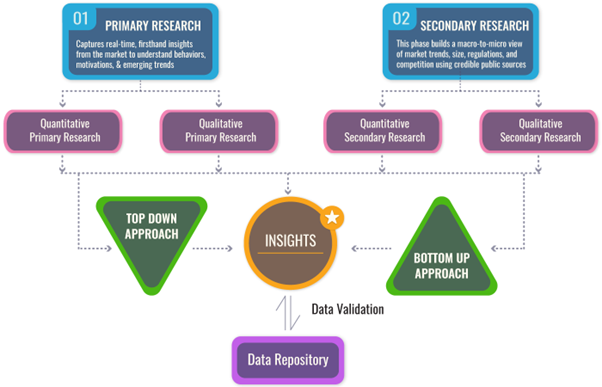
DUAL MODELING: TOP-DOWN + BOTTOM-UP
To ensure robust market estimation, we apply two complementary sizing approaches:
Top-Down Modeling:- Start with broader industry value (e.g., global or regional TAM)
- Apply filters by segment, geography, end-user, or use case
- Adjust with primary insights and validation benchmarks
- Ideal for investor-grade market scans and opportunity mapping
- Aggregate from the ground up using sales volumes, pricing, and unit economics
- Use internal modeling templates aligned with stakeholder data
- Incorporate distributor-level or region-specific inputs
- Most accurate for emerging segments and granular sub-markets
DATA VALIDATION: IN-HOUSE REPOSITORY
We close the loop with proprietary data intelligence built from ongoing projects, industry monitoring, and historical benchmarking. This repository includes:
- Multi-sector market and pricing models
- Key trendlines from past interviews and forecasts
- Benchmarked adoption rates, churn patterns, and ROI indicators
- Industry-specific deviation flags and cross-check logic
- Catches inconsistencies early
- Aligns projections across studies
- Enables consistent, high-trust deliverables