

India Food Robotics Market Size and Forecast (2026–2034), Regional Growth, Trend, Share and Industry Analysis Report Coverage: By Type (Articulated Robots, SCARA Robots, Delta Robots, and Collaborative Robots); By Application (Food Processing, Packaging, Palletizing, Sorting & Grading, and Others); By End User (Food Manufacturers, Food Service Providers, Beverage Industry, and Others)
2026-09-16
ICT
Ekta Chaurasia (Team Lead)
Description
India
Food Robotics Market Overview
The India food
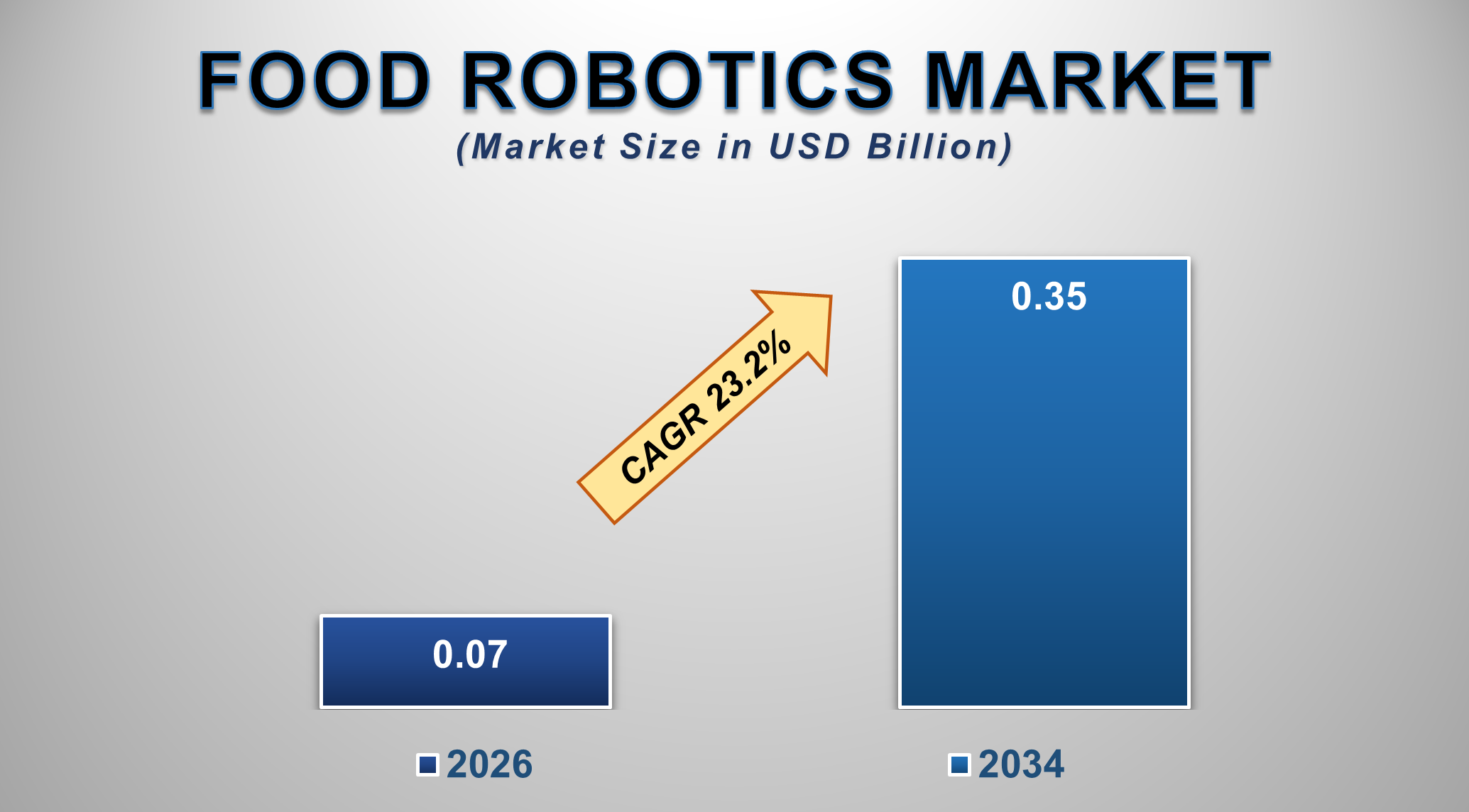
robotics market is projected to expand from USD 0.07 billion in 2026 to USD
0.35 billion by 2034, registering a CAGR of 23.2% during 2026–2034. The food
robotics market in India is a relatively new segment within the field of
automation that comprises all kinds of robotic technologies employed throughout
the entire process of food processing, handling, preparation, packaging,
inspection, and food service activities. Implementation of such technology is
being facilitated by the necessity to increase efficiency and consistency,
overcome the challenge of labor-intensive activities, improve food safety and
hygiene standards, and automate the completion of repetitive tasks in food
manufacturing and commercial kitchen environments. In addition to the
traditional field of industrial robots, the food robotics market is also
expanding into the area of collaborative robots, AI-based solutions, AMRs, and
specialized robotic cooking and dispensing equipment; however, implementation
is limited to certain applications.
India
Food Robotics Market Growth Drivers
Expansion and
Modernization of Food Processing Capacity
The Indian food
processing industry is growing and becoming more modern, offering potential
areas for application of robotics in activities related to handling,
processing, packaging, and palletizing. According to the Annual Report 2024-25,
released on 21 August 2025 by the Ministry of Food Processing Industries
(MoFPI), there were 78 projects approved under the Creation/Expansion of Food
Processing & Preservation Capacities (CEFPPC) scheme in 2024, with a total
cost of the projects amounting to ₹1,129.13 crore. This investment is important
to robotics of food since it provides an opportunity to use automation
technologies when setting up new plants or modernizing existing ones.
Labor Intensity,
Hygiene Requirements, and Demand for Consistent Output
The Indian food
processing industry is still extremely labor-intensive; however, the rising
need for automation in light of the stringent food safety requirements, and
also the requirement for consistency in manufacturing processes, has encouraged
manufacturers to automate many repetitive handling, processing, and packaging
procedures. According to information provided by the Ministry of Food
Processing Industries (MoFPI), dated January 9, 2026, the industry accounted
for 12.83% of the employed labor force in the Indian organized manufacturing
industry in the year 2023-24, stressing the significant extent to which the
industry relies on human labor.
India Food Robotics Market Restraint
High Upfront
Investment and Integration Complexity
The high investment
required in terms of capital expenditure, along with high integration costs,
will continue to be a major constraint to food-robotics adoption in India,
especially for small and medium food-processing companies with low capability
to fund automation technology. As documented in the Annual Report 2024-25 of
the Ministry of Food Processing Industries (MoFPI), dated August 21, 2025, the
industry is highly dominated by micro, tiny, and small units that lack adequate
surplus to invest in such infrastructure and thus need financial assistance to
set up or expand their processing units. In addition, according to an article
from the Yojana magazine dated July 2024, present-day food processing robots
entail huge investments that are not good for the majority of food processing
firms.
India Food Robotics Market
Opportunities
Automation of
QSR and Commercial-Kitchen Operations
Organized QSRs,
cloud kitchens, and commercial kitchens in India are driving growth in the
market, thus providing a chance for robotics companies producing robots used in
the food industry to automate repetitive tasks such as cooking, frying,
grilling, dispensing, portioning, and meal preparation. According to IBEF, as
of November 28, 2025, from the Kearney-Swiggy How India Eats 2025 report, QSRs
and cloud kitchens were the most rapidly growing organized food service formats
in the country owing to increasing demand for convenience and technology-driven
food delivery. This, in turn, will increase the customer base for specialized
kitchen-robotics companies like Mukunda Foods, Freshot Robotics, and Epicure
Robotics, among others.
AI-enabled
Vision, Cobots, and Flexible Food Handling
The increasing
adoption of machine vision, cobots, and flexible robotic systems enabled by AI
opens up possibilities for automation of food handling tasks that involve
shapes of irregular size, sorting, inspection, cutting, packaging, and
positioning of goods—all of which cannot easily be automated using traditional
fixed machines. According to the article on food processing in Yojana magazine
published in July 2024, robotics along with AI and sensing technology could
help in food handling, quality inspection, cutting, sorting, and packaging, and
enable constant working as well as processing of non-standard food items. There
is thus scope for Indian food processors to evolve from fixed automation to
more versatile robotic systems.
India Food Robotics Market Scope
|
Report Attributes |
Description |
|
Market Size in 2026 |
USD 0.07 Billion |
|
Market Forecast in 2034 |
USD 0.35 Billion |
|
CAGR % 2026-2034 |
23.2% |
|
Market Concentration |
Moderately Concentrated |
|
Base Year |
2025 |
|
Historic Data |
2021-2025 |
|
Forecast Period |
2026-2034 |
|
Report USP |
Production, company share, company
heatmap, company production capacity, growth factors, and more |
|
Geography |
India |
|
Segments Covered |
●
By Type ●
By
Application ●
By End
User |
|
Key Demand Side Trends |
●
Shift toward
automated and standardized QSR/kitchen operations ●
Increasing
preference for automation in packaged and ready-to-eat food production ●
Greater
emphasis on hygiene, traceability, and consistent food quality |
|
Key Supply Side Trends |
●
Global
robotics OEMs are localizing food-automation capabilities for India ●
Emergence of
Indian dedicated food-robotics manufacturers |
|
Major Players |
●
FANUC
Corporation ●
ABB Ltd. ●
KUKA AG ●
Yaskawa
Electric Corporation ●
OMRON
Corporation ●
Kawasaki
Heavy Industries |
India Food Robotics Market Report
Segmentation Analysis
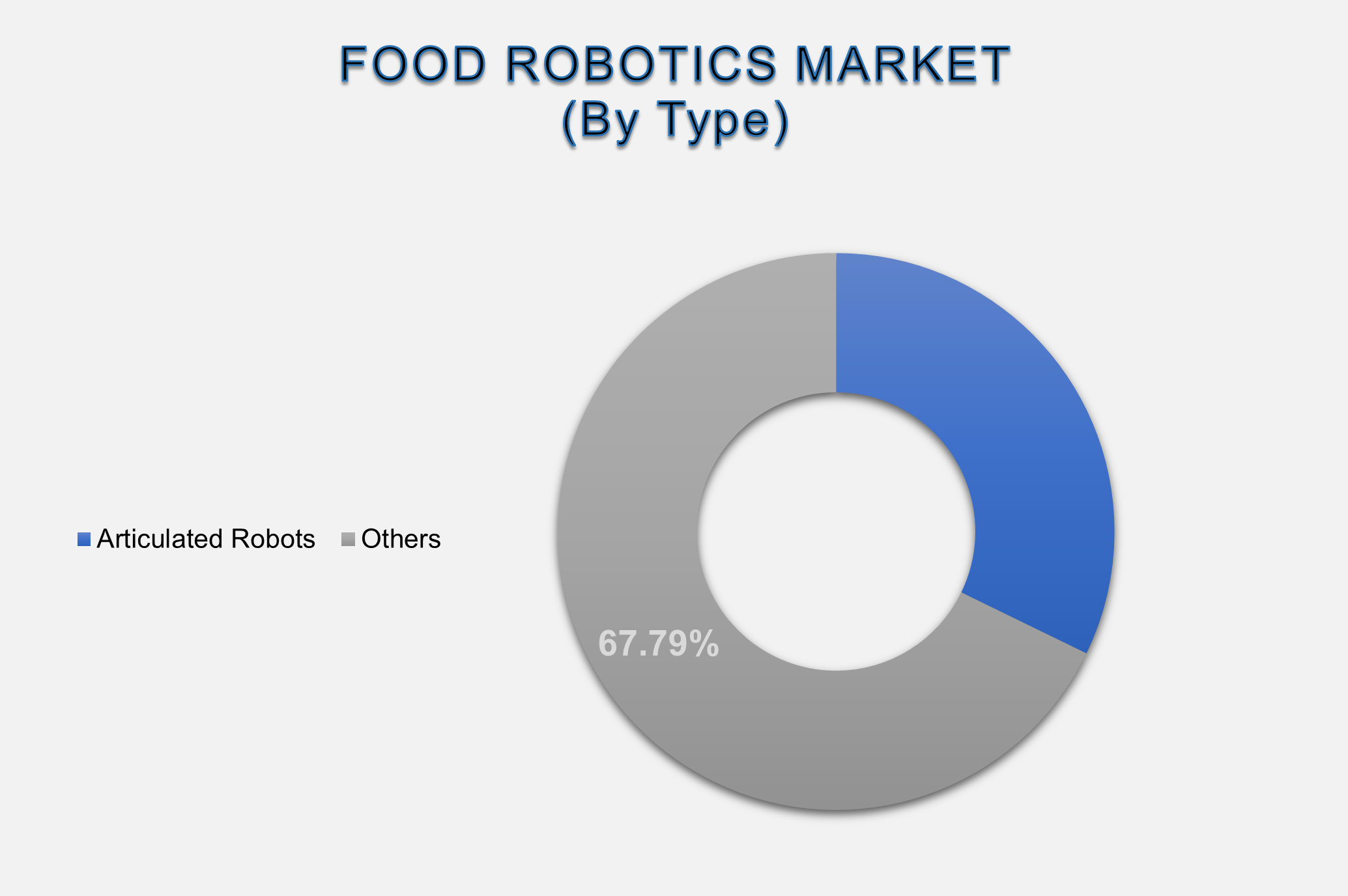
The Articulated
Robots Segment Is Expected to Dominate the India Food Robotics Market During
the Forecast Period
Articulated robots will continue to lead in India's food robotics market due to their multi-axis motion, large operating range, mounting flexibility, and capacity to operate with various payloads, which will help them perform different types of food processing tasks such as picking, handling, packaging, palletizing, machine tending, and material handling. The availability of food-grade variants of the robots is another reason that makes them suited for use in food processing environments. For instance, FANUC India presently provides various series of articulated robots with food-grade variants such as M-10iD/12 Food Grade and M-20iD/25 Food Grade, which are meant to perform handling and packaging operations in food environment settings. Likewise, KUKA emphasizes the availability of articulated robots with food-grade grease in food-processing environments.
The Packaging
Segment Is Expected to Dominate the India Food Robotics Market During the
Forecast Period
The packaging
sub-sector will drive the Indian food robotics market due to the highly
repetitive, fast-paced, and precise nature of tasks in packaging such as
picking, sorting, filling, labeling, case packing, and palletizing. The ongoing
modernization of India's food processing industry is also playing a key role in
driving automation. In February 2025, the Kurukshetra journal of the Indian
government pointed out that automated packaging machines would help to address
the rising requirement for traditional as well as intelligent packaging and
boost productivity, accuracy, and efficiency of food processing operations.
Moreover, FANUC mentions picking, packing, and palletizing as the major
applications in food and beverage robotics and has specialized food-grade
robots for performing these tasks.
Food
Manufacturers Segment Is Expected to Dominate the India Food Robotics Market
During the Forecast Period
Food manufacturers
are anticipated to hold the largest market share within the Indian food
robotics market due to the fact that larger food processing operations provide
more chances for automation in repetitive tasks such as material handling,
sorting, processing, inspecting, packaging, and palletizing. In February 2026,
the Ministry of Food Processing Industries (MoFPI) noted that the growth and
modernization of food processing infrastructure through PMKSY, PLISFPI, and
PMFME initiatives were ongoing with the help of government assistance towards
establishing and expanding food processing industries and modern
infrastructure. With this growth, there is an opportunity for food
manufacturers to adopt robotics in new and updated manufacturing plants.
The following
segments are part of an in-depth analysis of the India Food Robotics Market:
|
Market Segments |
|
|
By
Type |
●
Articulated
Robots ●
SCARA Robots ●
Delta Robots ●
Collaborative
Robots |
|
By
Application |
●
Food
Processing ●
Packaging ●
Palletizing ●
Sorting
& Grading ●
Others |
|
By End
User |
●
Food
Manufacturers ●
Food Service
Providers ●
Beverage
Industry ●
Others |
India Food Robotics Market Competition
Landscape Analysis
The Indian food
robotics industry can be described as moderately concentrated, with the
competition dominated by existing large global OEM robotics firms that have
Indian facilities, application engineering skills, and established after-sales
service networks. Among the leading competitors are FANUC, ABB, KUKA, Yaskawa,
OMRON, and Kawasaki Heavy Industries, which provide various food-grade and
industrial robots, including articulated robots, SCARA, Delta robots,
collaborative robots, as well as food-grade robots that offer handling,
picking, packaging, palletizing, inspection, and other food processing
functions. The competition is increasingly moving away from robot hardware to
food-grade solutions, machine vision, application-specific end effectors,
software integration, reliability, and after-sales service, which makes the
barrier to entry for new competitors higher. At the same time, there are Indian
companies such as Mukunda Foods, Freshot Robotics, and Epicure Robotics that
are increasingly providing competition in the automation of cooking,
dispensing, and commercial kitchens. Recent industry reports also state that
FANUC, ABB, Yaskawa, KUKA, and Kawasaki are among the established robotics firms
that are operating in India.
India Food Robotics Market Recent
Developments News:
●
In July 2026,
Aero Intelli launched an integrated AI-powered AgriTech platform in India
combining AI robotics, aeroponics, hydroponics, and recirculating aquaculture
systems (RAS). The company is developing robotic technologies for monitoring,
inspection, precision crop management, system maintenance, and environmental
sensing, highlighting the growing adoption of AI-enabled robotics across
India’s agricultural and food-production ecosystem.
●
In August
2026, ASME announced eight Indian hardware ventures selected for the 2026 ASME
Innovation Showcase (ISHOW), including Grafito Innovations’ “Automated
Vegetable Grafting Robot,” designed to automate vegetable seedling grafting in
nursery and growing operations. The development highlights the emergence of
specialized robotics for agricultural and food-production processes in
India.
The India Food
Robotics Market is dominated by a few large companies, such as
●
FANUC
Corporation
●
ABB Ltd.
●
KUKA AG
●
Yaskawa
Electric Corporation
●
OMRON
Corporation
●
Kawasaki Heavy
Industries
●
Stäubli
International AG
●
DENSO
Corporation
●
Mitsubishi
Electric Corporation
●
Seiko Epson
Corporation
●
Nachi-Fujikoshi
Corporation
●
Universal
Robots A/S
●
Techman Robot Inc.
●
Mayekawa
Manufacturing Co.
●
GEA Group AG
●
Krones AG
●
JBT Marel
Corporation
●
Mukunda Foods
Pvt. Ltd.
●
Freshot
Robotics Pvt. Ltd.
●
Epicure
Robotics Pvt. Ltd.
● Other Prominent Players
Frequently Asked Questions
Ekta Chaurasia (Team Lead)
Ekta Chaurasia is a highly experienced Team Lead at M2Square Consultancy with over 7 years of expertise in market research, strategic consulting, competitive benchmarking, and business intelligence solutions. She specializes in ICT, semiconductors & electronics, automotive & transportation, and industrial machinery markets.
She leads end-to-end global research projects focused on market trends, industry analysis, growth forecasting, customer insights, and strategic decision-making. Known for her analytical leadership and industry expertise, Ekta helps businesses uncover growth opportunities, evaluate competitive landscapes, and stay ahead in rapidly evolving markets through accurate and insight-driven research.
1.
India
Food Robotics Market Introduction and Market Overview
1.1. Objectives of the Study
1.2. Market Segmentation
1.2.1.Type of the India Food Robotics
Market
1.2.2.Application of the India Food
Robotics Market
1.2.3.End Users of the India Food
Robotics Market
1.3. Competition Coverage List of
Market Participants
1.4. Market Definition: Food Robotics
Market
2.
Executive Summary
2.1. India Food Robotics Market
Estimation & Forecast
2.1.1.India Food Robotics Market Size
(US$ Million) Estimates & Historical Trend Analysis (2021 - 2025)
2.1.2.India Food Robotics Overall
Market Size (US$ Million), Growth Rate (Y-o-Y), Market CAGR (%), Market
forecast (2026 - 2034)
2.2. Snapshot of India Food Robotics
Market
2.3. India Food Robotics Market
Revenue Share (%) 2025
2.4. Key Competitors & Key
Insights
3.
Market Overview (Qualitative
Analysis)
3.1. Demand Side Trends
3.2. Supply Side Trends /
Manufacturing Trends
3.3. Demand and Opportunity
Assessment, 2026 - 2034
3.4. Market Dynamics
3.4.1.Drivers
3.4.2.Limitations
3.4.3.Opportunities
3.4.4.Impact Analysis of Drivers and
Restraints
3.5. Key Developments
3.6. Regulatory Landscape
3.7. Pricing Analysis
3.8. Supply Chain Analysis
3.9. Porter’s Five Forces Analysis
3.9.1.Bargaining Power of Suppliers
3.9.2.Bargaining Power of Buyers
3.9.3.Threat of Substitutes
3.9.4.Threat of New Entrants
3.9.5.Competitive Rivalry
3.10. PEST Analysis
3.10.1. Political Factors
3.10.2. Economic Factors
3.10.3. Social Factors
3.10.4. Technology Factors
4.
India Food Robotics Market
Estimates & Forecast Trend Analysis, by Type
4.1. India Food Robotics Market
Assessments & Key Findings, by Type
4.2. India Food Robotics Market
Revenue (US$ Million) Estimates and Forecasts, by Type, 2021 - 2034
4.2.1. Articulated Robots
4.2.2.SCARA Robots
4.2.3.Delta Robots
4.2.4.Collaborative Robots
5.
India Food Robotics Market
Estimates & Forecast Trend Analysis, by Application
5.1. India Food Robotics Market
Assessments & Key Findings, by Application
5.2. India Food Robotics Market
Revenue (US$ Million) Estimates and Forecasts, by Application, 2021 - 2034
5.2.1.Food Processing
5.2.2.Packaging
5.2.3.Palletizing
5.2.4.Sorting & Grading
5.2.5.Others
6.
India Food Robotics Market
Estimates & Forecast Trend Analysis, by End User
6.1. India Food Robotics Market
Assessments & Key Findings, by End User
6.2. India Food Robotics Market
Revenue (US$ Million) Estimates and Forecasts, by End User, 2021 - 2034
6.2.1.Food Manufacturers
6.2.2.Food Service Providers
6.2.3.Beverage Industry
6.2.4.Others
7. Competition Landscape
7.1. India Food Robotics Market Product
Mapping
7.2. India Food Robotics Market
Concentration Analysis, by Leading Players / Innovators / Emerging Players /
New Entrants
7.3. India Food Robotics Market Tier Structure
Analysis
7.4. India Food Robotics Market
Concentration & Company Market Shares (%) Analysis, 2025
8. Company Profiles
8.1. FANUC Corporation
8.1.1.Company Overview & Key Stats
8.1.2.Financial Performance & KPIs
8.1.3.Product Portfolio
8.1.4.SWOT Analysis
8.1.5.Business Strategy & Recent
Developments
* Similar details would be provided
for all the players mentioned below
8.2.
ABB Ltd.
8.3.
KUKA AG
8.4.
Yaskawa Electric Corporation
8.5.
OMRON Corporation
8.6.
Kawasaki Heavy Industries
8.7.
Stäubli International AG
8.8.
DENSO Corporation
8.9.
Mitsubishi Electric Corporation
8.10.
Seiko Epson Corporation
8.11.
Nachi-Fujikoshi Corporation
8.12.
Universal Robots A/S
8.13.
Techman Robot Inc.
8.14.
Mayekawa Manufacturing Co.
8.15.
GEA Group AG
8.16.
Krones AG
8.17.
JBT Marel Corporation
8.18.
Mukunda Foods Pvt. Ltd.
8.19.
Freshot Robotics Pvt. Ltd.
8.20.
Epicure Robotics Pvt. Ltd.
8.21. Other Prominent Players
9.
Research Findings &
Conclusion
10. Assumptions & Acronyms Used
11. Research
Methodology
11.1. External Transportation /
Databases
11.2. Internal Proprietary Database
11.3. Primary Research
11.4. Secondary Research
11.5. Assumptions
11.6. Limitations
11.7. Report FAQs
Our Research Methodology
"Insight without rigor is just noise."
We follow a comprehensive, multi-phase research framework designed to deliver accurate, strategic, and decision-ready intelligence. Our process integrates primary and secondary research , both quantitative and qualitative , along with dual modeling techniques ( top-down and bottom-up) and a final layer of validation through our proprietary in-house repository.
PRIMARY RESEARCH
Primary research captures real-time, firsthand insights from the market to understand behaviors, motivations, and emerging trends.
1. Quantitative Primary Research
Objective: Generate statistically significant data directly from market participants.
Approaches:- Structured surveys with customers, distributors, and field agents
- Mobile-based data collection for point-of-sale audits and usage behavior
- Phone-based interviews (CATI) for market sizing and product feedback
- Online polling around industry events and digital campaigns
- Purchase frequency by customer type
- Channel performance across geographies
- Feature demand by application or demographic
2. Qualitative Primary Research
Objective: Explore decision-making drivers, pain points, and market readiness.
Approaches:- In-depth interviews (IDIs) with executives, product managers, and key decision-makers
- Focus groups among end users and early adopters
- Site visits and observational research for consumer products
- Informal field-level discussions for regional and cultural nuances
SECONDARY RESEARCH
This phase helps establish a macro-to-micro understanding of market trends, size, regulation, and competitive dynamics, sourced from credible and public domain information.
1. Quantitative Secondary Research
Objective: Model market value and segment-level forecasts based on published data.
Sources include:- Financial reports and investor summaries
- Government trade data, customs records, and regulatory statistics
- Industry association publications and economic databases
- Channel performance and pricing data from marketplace listings
- Revenue splits, pricing trends, and CAGR estimates
- Supply-side capacity and volume tracking
- Investment analysis and funding benchmarks
2. Qualitative Secondary Research
Objective: Capture strategic direction, innovation signals, and behavioral trends.
Sources include:- Company announcements, roadmaps, and product pipelines
- Publicly available whitepapers, conference abstracts, and academic research
- Regulatory body publications and policy briefs
- Social and media sentiment scanning for early-stage shifts
- Strategic shifts in market positioning
- Unmet needs and white spaces
- Regulatory triggers and compliance impact
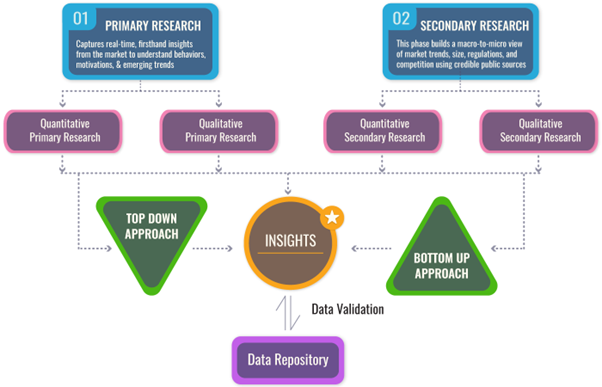
DUAL MODELING: TOP-DOWN + BOTTOM-UP
To ensure robust market estimation, we apply two complementary sizing approaches:
Top-Down Modeling:- Start with broader industry value (e.g., global or regional TAM)
- Apply filters by segment, geography, end-user, or use case
- Adjust with primary insights and validation benchmarks
- Ideal for investor-grade market scans and opportunity mapping
- Aggregate from the ground up using sales volumes, pricing, and unit economics
- Use internal modeling templates aligned with stakeholder data
- Incorporate distributor-level or region-specific inputs
- Most accurate for emerging segments and granular sub-markets
DATA VALIDATION: IN-HOUSE REPOSITORY
We close the loop with proprietary data intelligence built from ongoing projects, industry monitoring, and historical benchmarking. This repository includes:
- Multi-sector market and pricing models
- Key trendlines from past interviews and forecasts
- Benchmarked adoption rates, churn patterns, and ROI indicators
- Industry-specific deviation flags and cross-check logic
- Catches inconsistencies early
- Aligns projections across studies
- Enables consistent, high-trust deliverables