

India Peptide Cancer Vaccine Market Size and Forecast (2026–2034), Regional Growth, Trend, Share and Industry Analysis Report Coverage: By Type (Personalized Peptide Vaccines, Multivalent Peptide Vaccines, and Others); By Application (Melanoma, Lung Cancer, Breast Cancer, Prostate Cancer, and Others); By End User (Hospitals, Cancer Research Institutes, Specialty Clinics, and Others)
2026-11-13
Healthcare
Swetal (Research Analyst)
Description
India Peptide Cancer Vaccine Market Overview
The India peptide cancer vaccine market is projected to expand from USD 0.25 billion in 2026 to USD 1.50 billion by 2034, registering a CAGR of 26.1% during 2026–2034. The India peptide cancer vaccine market operates in an emerging phase and can be seen to benefit from increasing interest in targeted cancer therapy, personalized healthcare, and improvements within the realms of peptide synthesis and antigen discovery. In general, peptide cancer vaccines have been under investigation for their ability to promote tumor-specific immune response without the negative impact on the patient’s normal cells. Advancements in genomics of cancer, epitope prediction using computational approaches, and evaluation of immune system responses help the development of personalized vaccines and vaccines based on several epitopes. There are still some difficulties related to the validation of these vaccines in clinics, the immune evasion properties of tumors, and the consistency of the peptide vaccine production process. Yet collaboration between biotech companies and pharmaceutical companies in India, along with the improvement of peptide manufacturing, can assist in establishing this area.

India Peptide Cancer Vaccine Market Growth Drivers
Growing Focus on Targeted Cancer Immunotherapy
There is an increasing focus on targeted cancer immunotherapy that has facilitated research and development of peptide-based cancer vaccines in India. While regular treatment methods are likely to cause a similar effect on healthy cells as on cancer cells, peptide cancer vaccines aim to stimulate the immune system to target specific tumor-associated antigens. The progress in the identification of tumors and immunology research is leading to a wider range of peptides that can be used for cancers with different molecular properties. Such vaccines are also being explored for individual use as well as combined with other cancer immunotherapies. Personalized oncology and immune therapy trends have generated new possibilities for biotech firms as well as pharmaceutical developers to test peptide vaccines.
Advances in Cancer Genomics and Personalized Medicine
The recent developments in the fields of cancer genomics and personalized medicine have led to the emergence of peptide cancer vaccines targeting individual tumor genomics. Next-generation sequencing and tumor profiling technologies provide a way to identify genetic alterations and tumor-specific neoantigens capable of eliciting an immune response. Computational tools for epitope prediction are used to select the peptides that are most likely to be recognized by the immune system of a particular patient. All of the mentioned possibilities are encouraging the development of personalized therapeutic vaccines based on the individual tumor biology and immune profile. In India, the improvements in the areas of molecular diagnostics and biotechnology research might help to create personalized cancer vaccine candidates. However, the translation of these achievements into medical practice needs confirmation of antigen selection and the manufacturing process, as well as proof of the therapeutic effect of personalized vaccines.
India Peptide Cancer Vaccine Market Restraint
Clinical Validation and Tumor Immune Evasion Challenges
The biggest obstacle in the development of cancer peptide vaccines in India is clinical validation, since potential vaccines need to prove their safety and efficacy through effective immunity induction in different types of cancer cases and patients. Tumor heterogeneity may hinder effective treatments due to the expression of diverse antigens in cancer cells within the same tumor, which makes one particular peptide-based composition insufficient in eliciting a diverse range of immune responses. Further, the immunosuppressive environment of a tumor may compromise the effectiveness of T-cells activated by the vaccine due to the weakening effect on these cells' recognition abilities. Variations in the immune status of patients also make cancer peptide vaccine therapy more complicated.
India Peptide Cancer Vaccine Market Opportunities
Expansion of Domestic Peptide Manufacturing and Vaccine Development
With specialized peptide production facilities, the biotechnology and pharmaceutical sectors in India can now be ready to enter the developing peptide cancer vaccine market. Advances in solid-phase peptide synthesis, purification technology, and analysis have provided opportunities for pristine peptide production for preclinical and clinical vaccine development activities. By investing in facilities suitable for Good Manufacturing Practices (GMP), firms will be able to meet stringent requirements of quality, consistency, and traceability in the manufacture of therapeutic peptides. There are also possibilities for domestic manufacturers to cooperate with biotechnology developers, providing contract development and manufacturing services for peptide synthesis and analysis with a goal to optimize processes, scale them up, and develop formulations. This will result in independence from overseas partners and better access to specialized production facilities.
India Peptide Cancer Vaccine Market Scope
India Peptide Cancer Vaccine Market Report Segmentation Analysis
Personalized Peptide Vaccines Segment Is Expected to Dominate the India Peptide Cancer Vaccine Market During the Forecast Period
The Personalized Peptide Vaccines market is anticipated to hold the lead in the Indian cancer peptide vaccines market for the forecast period, owing to the rising inclination towards precision oncology, tumor-specific antigen discovery, and personalized treatment of cancers. Tumor sequencing technologies, along with advances in neoantigen discovery, have fueled innovations around designing personalized vaccines according to the patient’s specific tumors, resulting in high specificity of the response generated. Research in personalized treatments and combination therapy is also contributing to developments in individualized cancer vaccines based on peptides for various cancer types. 
Melanoma Segment Is Expected to Dominate the India Peptide Cancer Vaccine Market During the Forecast Period
The Melanoma segment is forecasted to have the largest share of the India peptide cancer vaccine market over the forecast period due to growing research in tumor-associated antigens and neoantigen-based therapy in this cancer type. Melanoma has become the subject of significant research in the case of cancer vaccines because of its high mutational burden that helps to develop potential targets for the immune system. Personalized vaccination, as well as other combination therapies, especially with immune checkpoint inhibitors, is becoming more popular among scientists. Tumor sequencing and antigen prediction help to find specific targets for the development of vaccines. Nonetheless, this market share is highly dependent on the results of clinical trials and treatment availability in the Indian population.
The Hospital Segment Is Expected to Dominate the India Peptide Cancer Vaccine Market During the Forecast Period
Hospitals will lead the India peptide cancer vaccine market during the forecast period, owing to the presence of the majority of cancer diagnoses, oncology specialties, clinical trials, and immunotherapy administration in the hospital environment. Since peptide cancer vaccines involve rigorous screening of the patient, evaluation of the tumor, planning of the treatment, and assessment of the immune response, hospitals with specific oncology departments are considered suitable centers for introducing these vaccines. The increasing trend of a multidisciplinary approach in cancer treatment and the availability of molecular diagnostics centers in hospitals are helping them assess the new personalized cancer therapies. Additionally, partnerships between hospitals, biotech firms, and clinical research organizations can help in conducting clinical studies of the new vaccines.
The following segments are part of an in-depth analysis of the India Peptide Cancer Vaccine Market:
India Peptide Cancer Vaccine Market Competition Landscape Analysis
The India peptide cancer vaccine market is in its nascent stages, and competition in this market largely revolves around vaccine development, immunotherapy platforms, peptide synthesizers, and capabilities in clinical development, not on product portfolios in place. Some of the emerging biotech firms are researching peptides with regard to TAA and neoantigen-based cancer vaccine development, whereas pharmaceutical firms with peptide synthesizer manufacturing abilities can be useful for the future development and manufacture of products. The ability of companies to develop peptides for use, clinical safety and efficacy data, manufacturing scalability, along with oncology partnerships, plays a key role in the competition process. Nevertheless, due to the small number of publicly verified companies in the Indian market involved in developing therapeutic peptide cancer vaccines, as well as due to certain clinical and regulatory requirements, there are limitations to competition in the current environment.
India Peptide Cancer Vaccine Market Recent Developments News:
In 2026, PranAmritam outlined a personalized peptide cancer vaccine development platform incorporating tumor antigen and neoantigen discovery, AI-assisted antigen prediction, and multi-epitope peptide vaccine design. The company also describes plans for specialized manufacturing and collaboration with cancer hospitals. These disclosures indicate emerging private-sector interest in developing an integrated domestic peptide cancer vaccine ecosystem; however, the published roadmap should not be interpreted as evidence of an approved or commercially marketed vaccine.
The India Peptide Cancer Vaccine Market is dominated by a few large companies, such as
PranAmritam
GenPep Pharmaceuticals
USV Private Limited
Piramal Pharma Solutions
Neuland Laboratories
Divi’s Laboratories
Anthem Biosciences
Omgene
Laurus Labs
Sai Life Sciences
Dr. Reddy’s Laboratories
Hikal Limited
Other Prominent Players
Frequently Asked Questions
Swetal (Research Analyst)
Swetal is a Research Analyst with 4+ years of experience specializing in healthcare market research, medical devices, healthcare IT, and medical technology industry analysis. Her expertise includes competitive intelligence, secondary research, market trend forecasting, and healthcare business insights across global healthcare ecosystems.
She contributes to advanced market research reports by analyzing regulatory frameworks, emerging healthcare technologies, competitive landscapes, and innovation trends shaping the medical industry. With a strong focus on accurate market intelligence, strategic insights, and healthcare industry trends, Swetal supports businesses in making informed, data-backed decisions in a rapidly transforming healthcare environment.
India Peptide Cancer Vaccine Market Introduction and Market Overview
Objectives of the Study
Market Segmentation
Type of the India Peptide Cancer Vaccine Market
Application of the India Peptide Cancer Vaccine Market
End User of India Peptide Cancer Vaccine Market
Competition Coverage List of Market Participants
Market Definition: Peptide Cancer Vaccine Market
Executive Summary
India Peptide Cancer Vaccine Market Estimation & Forecast
India Peptide Cancer Vaccine Market Size (US$ Million) Estimates & Historical Trend Analysis (2021 - 2025)
India Peptide Cancer Vaccine Overall Market Size (US$ Million), Growth Rate (Y-o-Y), Market CAGR (%), Market Forecast (2026 - 2034)
Snapshot of India Peptide Cancer Vaccine Market
India Peptide Cancer Vaccine Market Revenue Share (%) 2025
Key Competitors & Key Insights
Market Overview (Qualitative Analysis)
Demand Side Trends
Supply Side Trends / Manufacturing Trends
Demand and Opportunity Assessment, 2026 - 2034
Market Dynamics
Drivers
Limitations
Opportunities
Impact Analysis of Drivers and Restraints
Key Developments
Regulatory Landscape
Pricing Analysis
Supply Chain Analysis
Porter’s Five Forces Analysis
Bargaining Power of Suppliers
Bargaining Power of Buyers
Threat of Substitutes
Threat of New Entrants
Competitive Rivalry
PEST Analysis
Political Factors
Economic Factors
Social Factors
Technology Factors
India Peptide Cancer Vaccine Market Estimates & Forecast Trend Analysis, by Type
India Peptide Cancer Vaccine Market Assessments & Key Findings, by Type
India Peptide Cancer Vaccine Market Revenue (US$ Million) Estimates and Forecasts, by Type, 2021 - 2034
Personalized Peptide Vaccines
Multivalent Peptide Vaccines
Others
India Peptide Cancer Vaccine Market Estimates & Forecast Trend Analysis, by Application
India Peptide Cancer Vaccine Market Assessments & Key Findings, by Application
India Peptide Cancer Vaccine Market Revenue (US$ Million) Estimates and Forecasts, by Application, 2021 - 2034
Melanoma
Lung Cancer
Breast Cancer
Prostate Cancer
Others
India Peptide Cancer Vaccine Market Estimates & Forecast Trend Analysis, by End User
India Peptide Cancer Vaccine Market Assessments & Key Findings, by End User
India Peptide Cancer Vaccine Market Revenue (US$ Million) Estimates and Forecasts, by End User, 2021 - 2034
Hospitals
Cancer Research Institutes
Specialty Clinics
Others
Competition Landscape
India Peptide Cancer Vaccine Market Product Mapping
India Peptide Cancer Vaccine Market Concentration Analysis, by Leading Players / Innovators / Emerging Players / New Entrants
India Peptide Cancer Vaccine Market Tier Structure Analysis
India Peptide Cancer Vaccine Market Concentration & Company Market Shares (%) Analysis, 2025
Company Profiles
PranAmritam
Company Overview & Key Stats
Financial Performance & KPIs
Product Portfolio
SWOT Analysis
Business Strategy & Recent Developments
* Similar details would be provided for all the players mentioned below
GenPep Pharmaceuticals
USV Private Limited
Piramal Pharma Solutions
Neuland Laboratories
Divi’s Laboratories
Anthem Biosciences
Omgene
Laurus Labs
Sai Life Sciences
Dr. Reddy’s Laboratories
Hikal Limited
Other Prominent Players
Research Findings & Conclusion
Assumptions & Acronyms Used
Research Methodology
External Transportation / Databases
Internal Proprietary Database
Primary Research
Secondary Research
Assumptions
Limitations
Report FAQs
Our Research Methodology
"Insight without rigor is just noise."
We follow a comprehensive, multi-phase research framework designed to deliver accurate, strategic, and decision-ready intelligence. Our process integrates primary and secondary research , both quantitative and qualitative , along with dual modeling techniques ( top-down and bottom-up) and a final layer of validation through our proprietary in-house repository.
PRIMARY RESEARCH
Primary research captures real-time, firsthand insights from the market to understand behaviors, motivations, and emerging trends.
1. Quantitative Primary Research
Objective: Generate statistically significant data directly from market participants.
Approaches:- Structured surveys with customers, distributors, and field agents
- Mobile-based data collection for point-of-sale audits and usage behavior
- Phone-based interviews (CATI) for market sizing and product feedback
- Online polling around industry events and digital campaigns
- Purchase frequency by customer type
- Channel performance across geographies
- Feature demand by application or demographic
2. Qualitative Primary Research
Objective: Explore decision-making drivers, pain points, and market readiness.
Approaches:- In-depth interviews (IDIs) with executives, product managers, and key decision-makers
- Focus groups among end users and early adopters
- Site visits and observational research for consumer products
- Informal field-level discussions for regional and cultural nuances
SECONDARY RESEARCH
This phase helps establish a macro-to-micro understanding of market trends, size, regulation, and competitive dynamics, sourced from credible and public domain information.
1. Quantitative Secondary Research
Objective: Model market value and segment-level forecasts based on published data.
Sources include:- Financial reports and investor summaries
- Government trade data, customs records, and regulatory statistics
- Industry association publications and economic databases
- Channel performance and pricing data from marketplace listings
- Revenue splits, pricing trends, and CAGR estimates
- Supply-side capacity and volume tracking
- Investment analysis and funding benchmarks
2. Qualitative Secondary Research
Objective: Capture strategic direction, innovation signals, and behavioral trends.
Sources include:- Company announcements, roadmaps, and product pipelines
- Publicly available whitepapers, conference abstracts, and academic research
- Regulatory body publications and policy briefs
- Social and media sentiment scanning for early-stage shifts
- Strategic shifts in market positioning
- Unmet needs and white spaces
- Regulatory triggers and compliance impact
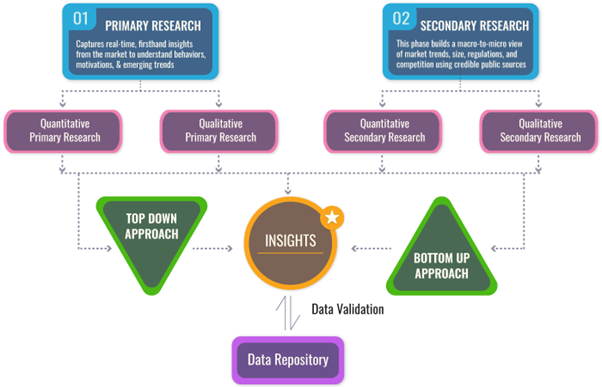
DUAL MODELING: TOP-DOWN + BOTTOM-UP
To ensure robust market estimation, we apply two complementary sizing approaches:
Top-Down Modeling:- Start with broader industry value (e.g., global or regional TAM)
- Apply filters by segment, geography, end-user, or use case
- Adjust with primary insights and validation benchmarks
- Ideal for investor-grade market scans and opportunity mapping
- Aggregate from the ground up using sales volumes, pricing, and unit economics
- Use internal modeling templates aligned with stakeholder data
- Incorporate distributor-level or region-specific inputs
- Most accurate for emerging segments and granular sub-markets
DATA VALIDATION: IN-HOUSE REPOSITORY
We close the loop with proprietary data intelligence built from ongoing projects, industry monitoring, and historical benchmarking. This repository includes:
- Multi-sector market and pricing models
- Key trendlines from past interviews and forecasts
- Benchmarked adoption rates, churn patterns, and ROI indicators
- Industry-specific deviation flags and cross-check logic
- Catches inconsistencies early
- Aligns projections across studies
- Enables consistent, high-trust deliverables