

India Telemedicine Market Size and Forecast (2026–2034), Regional Growth, Trend, Share, and Industry Analysis Report Coverage: By Components (Product {Hardware, Software, and Others}, and Services {Tele-consulting, Tele-monitoring, Tele-education}), By Modality (Store and forward, Real-time, and Others); By Application (Teleradiology, Telepsychiatry, Telepathology, Teledermatology, Telecardiology, and Others) and By End User (Hospitals & Health Systems, Clinics & Physician Practices, Patients/Homecare, Payers, and Others)
2026-09-18
Healthcare
Swetal (Research Analyst)
Description
India
Telemedicine Market Overview
The India
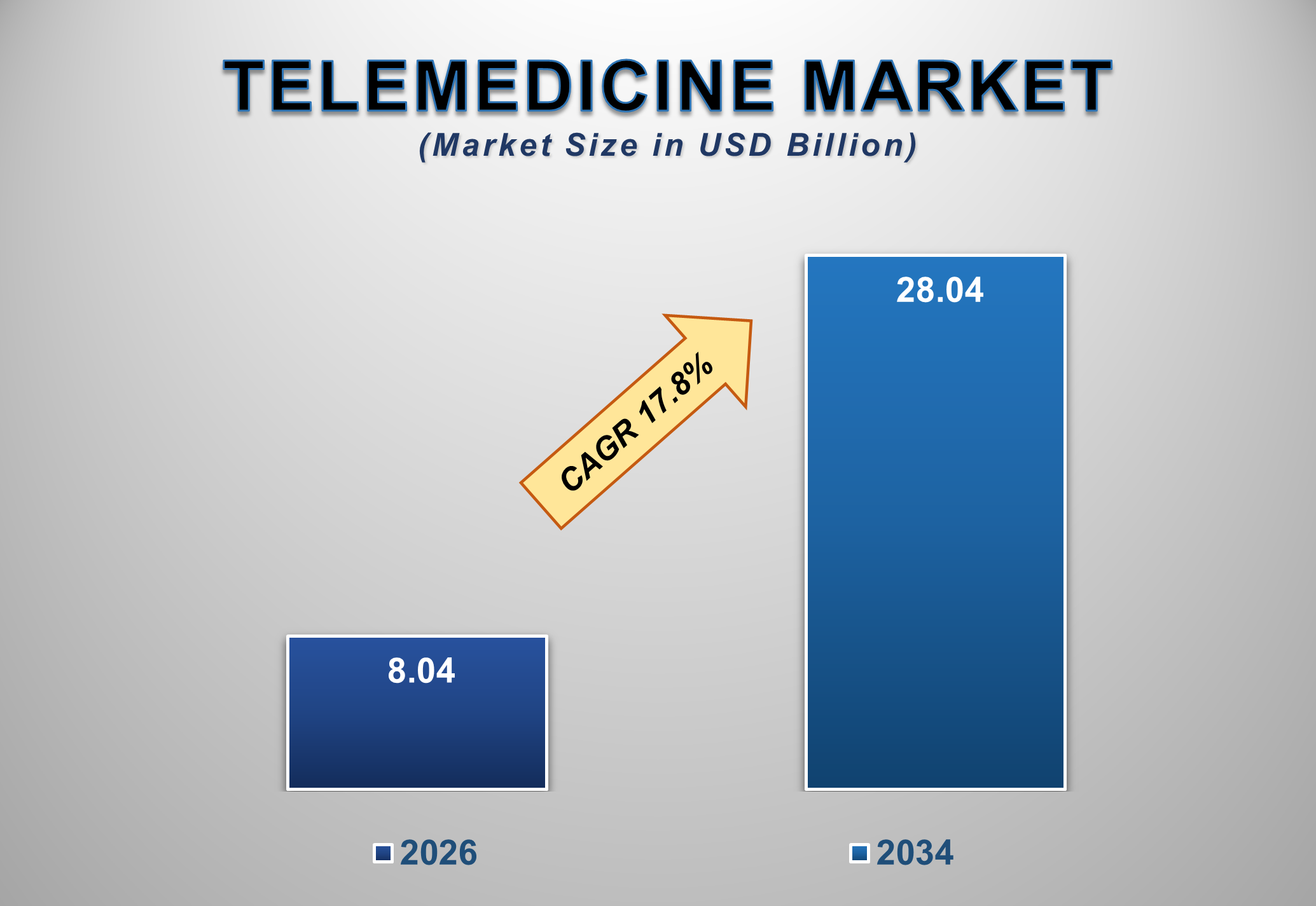
telemedicine market is projected to expand from USD 8.04 billion in 2026 to USD
28.04 billion by 2034, registering a CAGR of 17.8% during 2026–2034. The Indian
telemedicine market is transforming from its current teleconsultation-focused
nature to an integrated virtual care solution, enabled by growing digital
health infrastructure, improvements in internet connectivity and smartphone
penetration, and a lack of specialist physicians in the countryside and remote
areas. Government-led projects such as eSanjeevani, Ayushman Bharat, and
Ayushman Arogya Mandirs are enhancing the use of the hub-and-spoke care
delivery system as well as the integration of teleconsultation in primary care,
while the Telemedicine Practice Guidelines have established a more defined
framework for telemedicine practice in India. In the private sector,
development is moving from the provision of video consultations to remote
patient monitoring, tele-ICU, tele-radiology, tele-ophthalmology, connected
diagnostics, wearables, and AI-powered decision-making systems. This means that
the market will become increasingly technology- and device-focused, with
interoperability, data security, connectivity, integration into clinical
workflows, and cost-effectiveness being some of the critical factors of
competition.
India
Telemedicine Market Drivers and Impact Analysis
|
Key
Drivers |
Impact |
|
Rising Patient Preference for Convenient
& On-Demand Care |
Reduces travel, waiting time, and access
barriers, encouraging patients to use virtual consultations for routine,
follow-up, and non-emergency care. |
|
Growing Chronic Disease Burden |
Increases demand for recurring virtual consultations,
medication management, disease follow-up, and remote monitoring, particularly
for diabetes, cardiovascular, and respiratory conditions. |
|
Healthcare Workforce & Specialist Access
Gaps |
Enables patients in rural, semi-urban, and
underserved locations to access specialists without requiring physical travel
to tertiary-care centers. NITI Aayog identifies limited availability of
doctors in such areas as a key rationale for telemedicine adoption. |
|
Expansion of Government-Led Digital
Healthcare Delivery |
Initiatives such as eSanjeevani and the
Ayushman Bharat Digital Mission are embedding telemedicine into public
healthcare delivery and expanding digital access across primary and secondary
healthcare. |
|
Growth of Remote Patient Monitoring &
Connected Medical Devices |
Extends telemedicine beyond episodic
consultations toward continuous monitoring of vital signs, cardiac
parameters, glucose, respiratory conditions, and other clinical indicators. |
|
Increasing Provider Adoption of Virtual Care |
Greater integration of teleconsultation,
tele-ICU, tele-radiology, and remote monitoring into hospital and clinic
workflows expands the range of services that can be delivered remotely. |
|
EHR, Cloud & Digital Health
Infrastructure Development |
Improves data availability,
interoperability, clinical workflow integration, and scalability of
telemedicine services, supporting more coordinated digital care. India's
digital-health architecture explicitly emphasizes interoperable and
standards-based systems. |
Rising Patient
Preference for Convenient & On-Demand Care
The telemedicine
industry of India is gaining momentum due to the growing preference of
individuals for accessible, convenient, and flexible ways of accessing
healthcare. Indeed, the population is becoming increasingly interested in
minimizing the time spent traveling and waiting for consultations, as well as
reducing the need to visit the clinic multiple times. To exemplify, according
to the data reported by The Economic Times in June 2026 based on the findings
of a Bain & Company report, India appears to be one of the most prepared
for the implementation of artificial intelligence within the realm of
healthcare in Asia-Pacific, with 78% of consumers using GenAI for learning
about their diagnosis and treatments, 73% using it for preparing for medical
consultations, and 72% using it for navigating healthcare services. The rising
comfort with the use of technology throughout the whole process of seeking
healthcare can be viewed as a growing preference for technology-driven
healthcare access. While becoming comfortable with receiving preliminary
information via digital means, preparing for the consultation, and navigating
healthcare services, individuals will also become increasingly comfortable
using telemedicine services for remote consultations, follow-up appointments,
prescription-related interactions, and other aspects of healthcare services.
Growing Chronic
Disease Burden
The emergence of chronic diseases, such as diabetes, heart diseases, high blood pressure, cancer, and chronic lung diseases among Indians, is driving a need for constant and easily accessible health care services. As opposed to acute diseases where a single consultation is sufficient, in chronic diseases, patients need to undergo continuous monitoring, consultations, medication management, analysis of test results, and interaction with health care specialists on a regular basis. Telemedicine fits well into these requirements since a large part of the follow-ups can take place virtually, and there is no need for patients to physically visit the hospital or the clinic every time they need a consultation. This applies especially to the situation when patients live in smaller cities, the countryside, or regions where the expertise of specialists is scarce. In addition, as more and more patients have to go through a process of continuous disease management, specialists have to start using virtual consultations and remote monitoring in order to manage a larger number of patients. Thus, the transition from episodic treatment to continuous disease management is widening telemedicine use cases in India.
India Telemedicine Market Restraint
and Impact Analysis
|
Key
Restraints |
Impact |
|
Digital Divide & Uneven Connectivity |
Limited internet reliability, smartphone
access, and digital literacy among rural and low-income populations can
restrict utilization of telemedicine services despite their availability. |
|
Limited Physical Examination &
Diagnostic Capability |
Virtual consultations may be unsuitable when
diagnosis requires physical examination, imaging, laboratory testing, or
immediate intervention, thereby limiting telemedicine's applicability in
certain specialties. |
|
Data Privacy & Cybersecurity Concerns |
Telemedicine involves the collection and
transmission of sensitive health information, increasing requirements for
secure platforms, consent management, data protection, and cybersecurity. |
|
Uncertain Reimbursement & Monetization
Models |
Inconsistent reimbursement mechanisms,
particularly for advanced services such as tele-ICU and remote monitoring,
can limit provider investment and affect the commercial sustainability of
services. |
Digital Divide
& Uneven Connectivity
The adoption of
telemedicine in India has been hindered by the unequal provision of reliable
internet connectivity, smartphone usage, digital literacy, and the use of
digital healthcare apps in various parts of the country, especially in rural
and poor areas. While patients from urban areas tend to rely on smartphones and
fast mobile networks to conduct video consultations, patients from far and less
privileged places might be hindered by unreliable internet connections,
expensive data packages, lack of digital literacy, or absence of a proper
device in conducting video consultations. Poor internet connectivity will
interrupt consultations, slow down the sharing of patients' documents and
reports, and hamper the process of remote diagnosis and consultation. It is
important in telemedicine, where video consultations, remote monitoring
devices, and high-quality images are needed, because a basic phone call or text
message will not be adequate. The issue has led to the creation of the digital
divide in the adoption pattern of telemedicine in India.
Data Privacy
& Cybersecurity Concerns
The increasing
digitization of healthcare is also creating concerns around patient data
privacy, cybersecurity, and the protection of sensitive medical information,
which can restrain telemedicine adoption in India. Virtual consultations
involve the collection and transmission of personal health information,
including medical histories, prescriptions, diagnostic reports, consultation
records, and payment or identity-related data, across digital platforms. Weak
cybersecurity practices, data breaches, unauthorized access, phishing, and
misuse of patient information can reduce consumer confidence in online
healthcare services, particularly among patients who remain cautious about
sharing medical information digitally. Telemedicine providers also face higher
compliance and technology requirements as healthcare data moves across multiple
platforms, devices, and third-party systems. Consequently, concerns over
confidentiality and cybersecurity can slow patient adoption, increase
technology and compliance costs for providers, and make healthcare
organizations more cautious about expanding digital consultation and
remote-care services.
India Telemedicine Market
Opportunities and Impact Analysis
|
Key
Opportunities |
Impact |
|
Expansion of Telemedicine into Rural &
Underserved Healthcare |
Hub-and-spoke models can connect
primary-care facilities with specialists, creating opportunities for
telemedicine infrastructure, connected diagnostic devices, and specialist
networks. |
|
Integration of AI with Telemedicine |
AI-enabled triage, image interpretation,
clinical decision support, and automated monitoring can improve diagnostic
efficiency and allow clinicians to manage larger remote patient populations. |
|
Growth of Telemedicine-Enabled Diagnostics |
Connected ECG, digital stethoscopes,
ophthalmic imaging, ultrasound, pathology, and other point-of-care devices
can enable remote diagnosis rather than limiting telemedicine to
consultation-only services. |
|
Expansion of Remote & Home-Based Care |
Remote patient monitoring and virtual
chronic-care programs can shift healthcare delivery from hospitals toward
patients' homes, creating opportunities for connected devices, monitoring
platforms, and subscription-based care models. |
Expansion of
Telemedicine into Rural & Underserved Healthcare
The limited
availability of specialist physicians, hospitals, and diagnostic services
across rural and underserved regions of India creates a significant opportunity
for telemedicine to extend healthcare access beyond conventional physical
facilities. For example, in October 2024, the DigiSetu telemedicine service was
mentioned in a study that was carried out in Tamil Nadu due to its strategy for
enhancing the reach and management of healthcare services among patients
suffering from chronic diseases in underserved regions. Through this model of
telemedicine, patients suffering from conditions such as diabetes and
hypertension can be provided with continued medical care without requiring
visits to urban centers that provide healthcare services. This indicates that
through telemedicine technology, it is possible for the current healthcare
services system to be supplemented in that patients in underserved regions get
connected to physicians and specialists in remote locations with the assistance
of local healthcare personnel. It can be argued that through the adoption of a
hub-and-spoke as well as an assisted telemedicine model, the underserved and
rural population constitutes an untapped market for telemedicine.
Expansion of
Remote & Home-Based Care
There is a growing
need for managing patients in places other than conventional hospitals and
healthcare facilities. With telemedicine, the provider has the chance to
provide home- and remote-based healthcare services. Telemedicine is capable of
helping patients who need routine consultations, post-discharge consultations,
medication management, chronic disease management, and specialist consultations
without having to visit the hospital regularly. This is especially applicable
in cases of elderly patients, chronically ill patients, patients who have
undergone operations, and patients who face difficulties when accessing
healthcare services due to their inability to move. The provision of
teleconsultation services together with remote patient monitoring devices,
connected diagnostic devices, home sampling, electronic prescriptions, and
home-based healthcare services can help extend the role of telemedicine beyond
basic video consultation services. With the changing healthcare delivery that
sees healthcare shifting from hospital-centered care to decentralized and
patient-centered care, the provision of home-based services gives the
telemedicine platform an opportunity to increase the number of consultations
and continuity of care in India.
India Telemedicine Market Scope
|
Report Attributes |
Description |
|
Market Size in 2026 |
USD 8.04 Billion |
|
Market Forecast in 2034 |
USD 28.04 Billion |
|
CAGR % 2026-2034 |
17.8% |
|
Market Concentration |
Moderately Fragmented |
|
Base Year |
2025 |
|
Historic Data |
2021-2025 |
|
Forecast Period |
2026-2034 |
|
Report USP |
Production, Consumption, company share,
company heatmap, company production capacity, growth factors, and more |
|
Geography |
India |
|
Segments Covered |
●
By
Component ●
By
Modality ●
By
Application ●
By End
User |
|
Key Demand-Side Trends |
●
Growing
Preference for Specialist Consultations Beyond Local Geography ●
Increasing
Acceptance of Digital-First Healthcare Journeys ●
Rising
Demand for After-Hours & Flexible Consultations |
|
Key Supply-Side Trends |
●
Shift Toward
Integrated Omnichannel Care Models ●
Expansion of
Hospital-Backed Telemedicine Networks ●
Growth of
Assisted Telemedicine Models |
|
Major Players |
●
BPL Medical
Technologies Pvt. Ltd. ●
Trivitron
Healthcare Pvt. Ltd. ●
Dozee
(TurtleShell Technologies Pvt. Ltd.) ●
Skanray
Technologies Ltd. ●
Forus Health
Pvt. Ltd. ●
Remidio
Innovative Solutions Pvt. Ltd. |
India Telemedicine Market Report
Segmentation Analysis
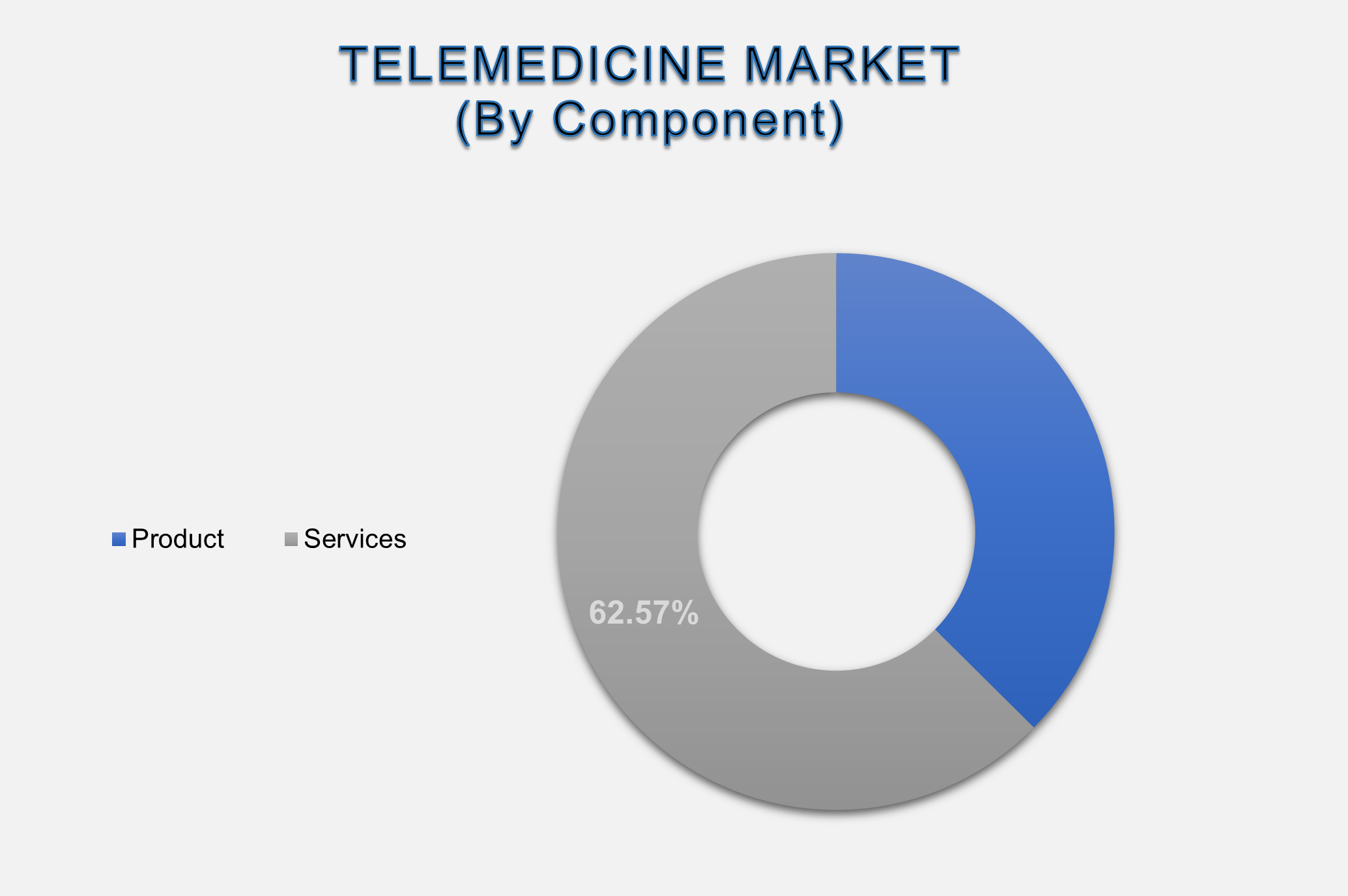
The Services
Segment Is Expected to Dominate the India Telemedicine Market During the
Forecast Period
The services category will retain its dominance in the Indian telemedicine market on account of recurrent needs for virtual consultations, access to specialists, follow-up care, management of chronic conditions, and other physician-led healthcare services. While hardware is mostly bought as a one-off or periodically recurring expense, the revenues generated by telemedicine services due to consultations, care coordination, monitoring, and subscription-based services will provide a better match to the repetitive nature of healthcare services provision. An increasing number of hospitals, clinics, and healthcare platforms utilizing telemedicine services will provide wider availability of virtual consultations for primary and specialist care. The example of India’s eSanjeevani shows the scalability potential of the services-driven telemedicine model, as by September 2023 more than 163 million consultations had been performed in all Indian states and union territories. According to recent market estimates, the share of telehealth revenues generated by services was higher in India compared to that of standalone telemedicine tools. Likely, increasing integration of telemedicine in routine consultations, follow-ups, specialist referrals, and chronic care will create recurrent healthcare interactions that will favor service-driven revenues over standalone telemedicine products.
The Store and
Forward Segment Is Expected to Grow in India Telemedicine Market
The
store-and-forward segment is set to dominate the telemedicine market in India,
especially in fields where clinical information, images, diagnostic reports,
and patient records can be reviewed by physicians in their absence during
teleconsultation. In this model, patient data will be collected and digitally
transferred to a healthcare provider for future review. This model works best
for teleradiology, teledermatology, telepathology, ophthalmology, and follow-up
care. The eSanjeevani platform in India allows conducting store-and-forward
consultations along with teleconsultations in real-time and facilitates
transferring electronic medical records and other documents to a specialist for
evaluation. This business model is highly appropriate for India, since it does
not depend on the connection between the patient and the doctor and allows
specialists to work on patients' cases asynchronously, thus utilizing
specialist resources better. With the integration of telemedicine in digital
health records, diagnostics, and medical devices, store-and-forward treatment
can allow for an increased volume of consultations as well as extend specialist
services to remote and rural areas where there may not be consistent real-time
connection available.
The
Teleradiology Segment Is Expected to Witness Steady Growth in India
Telemedicine Market
The teleradiology
market in India is set to experience consistent growth based on several
factors, including the lack of radiologists, the geographical spread of these
experts, growing demand for imaging tests, and increasing use of digital
imaging infrastructure. Teleradiology makes it possible to transmit X-rays, CT
scan results, MRI scans, and other radiological images electronically to
radiologists for remote analysis without the need for a radiologist to be
physically present at all facilities. This approach is especially important in
Tier-2 and Tier-3 cities and remote locations where there is a lack of
specialists. The role of tele-radiology is also recognized in government
healthcare infrastructure, as can be seen from the inclusion of tele-radiology
into the IPHS framework in Maharashtra state, which involves the provision of
diagnostic assistance by tele-radiology from regional hospitals to district
hospitals. Increasing use of cloud-based PACS systems, artificial
intelligence-based reporting, and remote reporting systems is making the
process even faster. As healthcare providers attempt to decrease the time it
takes to diagnose a disease and increase the efficiency of using their
radiology capacity, teleradiology becomes an important application in India's
telemedicine environment.
The Hospital and
Health System Segment Is Expected to Grow in India Telemedicine Market
The hospitals and
health systems segment will experience robust growth in India’s telemedicine
market as hospitals increasingly integrate telemedicine into their current
outpatient, specialist, follow-up, and referral processes. Hospitals can use
telemedicine to offer specialist services outside their hospital premises,
optimize physicians’ utilization, and link tertiary services with patients in
smaller cities and areas without necessarily conducting a physical referral.
Evidence of the scalability of this segment is seen in India’s eSanjeevani
portal, which links primary care units to specialists and doctors in
higher-level hospitals through the hub-and-spoke model; the portal had more
than 19,362 hubs and 1,41,707 spokes throughout the country as of August 2026.
States are also increasingly implementing teleconsultation using telemedicine
in a hospital-based hub-and-spoke model, such as in Maharashtra, where
teleconsultation takes place via hubs of district hospitals and thousands of
spokes called Ayushman Arogya Mandir. Since hospitals will increasingly
integrate telemedicine consultations as part of their existing physical care
services instead of a stand-alone service, the segment can achieve repeat
volume of virtual care in addition to geographical outreach and specialist
linkages.
The following
segments are part of an in-depth analysis of the India telemedicine market:
|
Market Segments |
|
|
By
Components |
●
Product o
Hardware o
Software o
Others ●
Services o
Tele-consulting o
Tele-monitoring o
Tele-education |
|
By
Modality |
●
Store and
forward ●
Real-time ●
Others |
|
By
Application |
●
Teleradiology ●
Telepsychiatry ●
Telepathology ●
Teledermatology ●
Telecardiology ●
Others |
|
By End
User |
●
Hospitals
& Health Systems ●
Clinics
& Physician Practices ●
Patients/Homecare ●
Payers ●
Others |
India Telemedicine Market Competition
Landscape Analysis
The Indian
telemedicine industry is moderately fragmented, with competition present
amongst hospital-based telemedicine portals, digital health companies,
e-pharmacies, telemedicine companies, and government-backed telemedicine. The
leading private players in India include Apollo TeleHealth, Tata 1mg, Practo,
MediBuddy, Netmeds, and MFine. These companies are competing based on physician
network size, specialty coverage, patient experience in the digital world, and
linking of teleconsultations with diagnostics and pharmaceutical services and
other healthcare services. Competition is moving from video-consultation
portals towards healthcare portals that are integrated and omnichannel, and
where the teleconsultations are linked to e-pharmacy, diagnostics, electronic
medical records, home healthcare, and chronic care management. Apollo
TeleHealth has an advantage due to its presence in hospitals and pharmacies.
Tata 1mg has an advantage due to the linking of teleconsultations with
diagnostics and medicine delivery. On the other hand, the eSanjeevani service
constitutes a unique competitive aspect of the public sector, as the platform
allows large-scale consultations using government healthcare facilities rather
than competing with any commercial aspects of the market. The smaller players
continue to differentiate themselves using specialized approaches, such as the
use of artificial intelligence, diagnostic services, remote monitoring
services, mental health services, and specialties. On the whole, the market will
most certainly be subject to more consolidation, with the competition becoming
more intense through scale, availability of physicians, technological features,
and access to Tier 2/3 markets.
India Telemedicine Market Recent
Developments News:
▪
In August
2026, India’s eSanjeevani National Telemedicine Service surpassed 493 million
teleconsultations nationwide, supported by more than 19,362 hubs, 141,707
spokes, and over 240,000 trained healthcare providers. The platform is also
incorporating AI-enabled clinical decision support, diagnostic-device
integration, multilingual capabilities, and ABDM interoperability,
strengthening the role of telemedicine within India’s public healthcare
infrastructure.
▪
In April 2026,
Apollo TeleHealth expanded its integrated virtual-care model in Sri City, Tamil
Nadu, incorporating Tele-ER services and 5G-enabled ambulance support. The
development reflects the shift among private healthcare providers from
standalone teleconsultations toward integrated models connecting emergency
care, hospitals, mobile healthcare infrastructure, and remote specialists.
▪
In 2026,
Apollo Hospitals partnered with Roche Diagnostics India to integrate AI-driven
clinical decision support into Apollo’s healthcare ecosystem. The collaboration
uses Roche’s Navify Algorithm Suite to connect clinical, laboratory, and
hospital information systems, supporting earlier disease detection and more
data-driven clinical decisions. The development highlights the increasing
convergence of AI, diagnostics, hospital systems, and telemedicine-enabled care
in India.
The India
Telemedicine Market is dominated by a few large companies, such as
●
Neurosynaptic
Communications Pvt. Ltd.
●
BPL Medical
Technologies Pvt. Ltd.
●
Dozee
(TurtleShell Technologies Pvt. Ltd.)
●
Skanray
Technologies Ltd.
●
Trivitron
Healthcare Pvt. Ltd.
●
HealthCube /
HealthCubed India Pvt. Ltd.
●
Remidio
Innovative Solutions Pvt. Ltd.
●
Forus Health
Pvt. Ltd.
●
Agatsa
Software Pvt. Ltd.
●
Janitri
Innovations Pvt. Ltd.
●
Monitra
Healthcare Pvt. Ltd.
●
Ten3T
Healthcare Pvt. Ltd.
●
Ayu Devices
Pvt. Ltd.
●
Periwinkle
Technologies Pvt. Ltd.
●
Axxonet System
Technologies Pvt. Ltd.
●
Cardea
Biomedicals Pvt. Ltd.
●
Noccarc
Robotics Pvt. Ltd.
●
Stasis Health
Pvt. Ltd.
●
LifeSigns /
ReBu Healthcare Pvt. Ltd.
●
Opto Circuits
(India) Ltd.
● Other Prominent Players
Frequently Asked Questions
Swetal (Research Analyst)
Swetal is a Research Analyst with 4+ years of experience specializing in healthcare market research, medical devices, healthcare IT, and medical technology industry analysis. Her expertise includes competitive intelligence, secondary research, market trend forecasting, and healthcare business insights across global healthcare ecosystems.
She contributes to advanced market research reports by analyzing regulatory frameworks, emerging healthcare technologies, competitive landscapes, and innovation trends shaping the medical industry. With a strong focus on accurate market intelligence, strategic insights, and healthcare industry trends, Swetal supports businesses in making informed, data-backed decisions in a rapidly transforming healthcare environment.
1.
India
Telemedicine Market Introduction and Market Overview
1.1. Objectives of the Study
1.2. Market Segmentation
1.2.1.Components of the India
Telemedicine Market
1.2.2.Modality of the India
Telemedicine Market
1.2.3.Application of India
Telemedicine Market
1.2.4.End User of India Telemedicine
Market
1.3. Competition Coverage List of
Market Participants
1.4. Market Definition: Telemedicine Market
2.
Executive Summary
2.1. India Telemedicine Market
Estimation & Forecast
2.1.1.India Telemedicine Market Size
(US$ Million) Estimates & Historical Trend Analysis (2021 - 2025)
2.1.2.India Telemedicine Overall
Market Size (US$ Million), Growth Rate (Y-o-Y), Market CAGR (%), Market
forecast (2026 - 2034)
2.2. Snapshot of India Telemedicine
Market
2.3. India Telemedicine Market
Revenue Share (%) 2025
2.4. Key Competitors & Key
Insights
3.
Market Overview (Qualitative
Analysis)
3.1. Demand Side Trends
3.2. Supply Side Trends /
Manufacturing Trends
3.3. Demand and Opportunity
Assessment, 2026 - 2034
3.4. Market Dynamics
3.4.1.Drivers
3.4.2.Limitations
3.4.3.Opportunities
3.4.4.Impact Analysis of Drivers and Restraints
3.5. Key Developments
3.6. Regulatory Landscape
3.7. Pricing Analysis
3.8. Supply Chain Analysis
3.9. Porter’s Five Forces Analysis
3.9.1.Bargaining Power of Suppliers
3.9.2.Bargaining Power of Buyers
3.9.3.Threat of Substitutes
3.9.4.Threat of New Entrants
3.9.5.Competitive Rivalry
3.10. PEST Analysis
3.10.1. Political Factors
3.10.2. Economic Factors
3.10.3. Social Factors
3.10.4. Technology Factors
4.
India Telemedicine Market
Estimates & Forecast Trend Analysis, by Components
4.1. India Telemedicine Market
Assessments & Key Findings, by Components
4.2. India Telemedicine Market
Revenue (US$ Million) Estimates and Forecasts, by Components, 2021 - 2034
4.2.1. Product
4.2.1.1.
Hardware
4.2.1.2.
Software
4.2.1.3.
Others
4.2.2. Services
4.2.2.1.
Tele-consulting
4.2.2.2.
Tele-monitoring
4.2.2.3.
Tele-education
5.
India Telemedicine Market
Estimates & Forecast Trend Analysis, by Modality
5.1. India Telemedicine Market
Assessments & Key Findings, by Modality
5.2. India Telemedicine Market
Revenue (US$ Million) Estimates and Forecasts, by Modality, 2021 - 2034
5.2.1.Store and forward
5.2.2.Real-time
5.2.3.Others
6.
India Telemedicine Market
Estimates & Forecast Trend Analysis, by Application
6.1. India Telemedicine Market
Assessments & Key Findings, by Application
6.2. India Telemedicine Market
Revenue (US$ Million) Estimates and Forecasts, by Application, 2021 - 2034
6.2.1.Teleradiology
6.2.2.Telepsychiatry
6.2.3.Telepathology
6.2.4.Teledermatology
6.2.5.Telecardiology
6.2.6.Others
7.
India Telemedicine Market
Estimates & Forecast Trend Analysis, by End User
7.1. India Telemedicine Market
Assessments & Key Findings, by End User
7.2. India Telemedicine Market
Revenue (US$ Million) Estimates and Forecasts, by End User, 2021 - 2034
7.2.1.Hospitals & Health Systems
7.2.2.Clinics & Physician
Practices
7.2.3.Patients/Homecare
7.2.4.Payers
7.2.5.Others
8. Competition Landscape
8.1. India Telemedicine Market Product
Mapping
8.2. India Telemedicine Market
Concentration Analysis, by Leading Players / Innovators / Emerging Players /
New Entrants
8.3. India Telemedicine Market Tier
Structure Analysis
8.4. India Telemedicine Market
Concentration & Company Market Shares (%) Analysis, 2025
9. Company Profiles
9.1. Neurosynaptic Communications
Pvt. Ltd.
9.1.1.Company Overview & Key Stats
9.1.2.Financial Performance & KPIs
9.1.3.Product Portfolio
9.1.4.SWOT Analysis
9.1.5.Business Strategy & Recent
Developments
* Similar details would be provided
for all the players mentioned below
9.2.
BPL Medical Technologies Pvt.
Ltd.
9.3.
Dozee (TurtleShell Technologies
Pvt. Ltd.)
9.4.
Skanray Technologies Ltd.
9.5.
Trivitron Healthcare Pvt. Ltd.
9.6.
HealthCube / HealthCubed India
Pvt. Ltd.
9.7.
Remidio Innovative Solutions
Pvt. Ltd.
9.8.
Forus Health Pvt. Ltd.
9.9.
Agatsa Software Pvt. Ltd.
9.10.
Janitri Innovations Pvt. Ltd.
9.11.
Monitra Healthcare Pvt. Ltd.
9.12.
Ten3T Healthcare Pvt. Ltd.
9.13.
Ayu Devices Pvt. Ltd.
9.14.
Periwinkle Technologies Pvt.
Ltd.
9.15.
Axxonet System Technologies
Pvt. Ltd.
9.16.
Cardea Biomedicals Pvt. Ltd.
9.17.
Noccarc Robotics Pvt. Ltd.
9.18.
Stasis Health Pvt. Ltd.
9.19.
LifeSigns / ReBu Healthcare
Pvt. Ltd.
9.20.
Opto Circuits (India) Ltd.
9.21. Other Prominent Players
10. Research
Findings & Conclusion
11. Assumption & Acronyms Used
12. Research
Methodology
12.1. External Transportations /
Databases
12.2. Internal Proprietary Database
12.3. Primary Research
12.4. Secondary Research
12.5. Assumptions
12.6. Limitations
12.7. Report FAQs
Our Research Methodology
"Insight without rigor is just noise."
We follow a comprehensive, multi-phase research framework designed to deliver accurate, strategic, and decision-ready intelligence. Our process integrates primary and secondary research , both quantitative and qualitative , along with dual modeling techniques ( top-down and bottom-up) and a final layer of validation through our proprietary in-house repository.
PRIMARY RESEARCH
Primary research captures real-time, firsthand insights from the market to understand behaviors, motivations, and emerging trends.
1. Quantitative Primary Research
Objective: Generate statistically significant data directly from market participants.
Approaches:- Structured surveys with customers, distributors, and field agents
- Mobile-based data collection for point-of-sale audits and usage behavior
- Phone-based interviews (CATI) for market sizing and product feedback
- Online polling around industry events and digital campaigns
- Purchase frequency by customer type
- Channel performance across geographies
- Feature demand by application or demographic
2. Qualitative Primary Research
Objective: Explore decision-making drivers, pain points, and market readiness.
Approaches:- In-depth interviews (IDIs) with executives, product managers, and key decision-makers
- Focus groups among end users and early adopters
- Site visits and observational research for consumer products
- Informal field-level discussions for regional and cultural nuances
SECONDARY RESEARCH
This phase helps establish a macro-to-micro understanding of market trends, size, regulation, and competitive dynamics, sourced from credible and public domain information.
1. Quantitative Secondary Research
Objective: Model market value and segment-level forecasts based on published data.
Sources include:- Financial reports and investor summaries
- Government trade data, customs records, and regulatory statistics
- Industry association publications and economic databases
- Channel performance and pricing data from marketplace listings
- Revenue splits, pricing trends, and CAGR estimates
- Supply-side capacity and volume tracking
- Investment analysis and funding benchmarks
2. Qualitative Secondary Research
Objective: Capture strategic direction, innovation signals, and behavioral trends.
Sources include:- Company announcements, roadmaps, and product pipelines
- Publicly available whitepapers, conference abstracts, and academic research
- Regulatory body publications and policy briefs
- Social and media sentiment scanning for early-stage shifts
- Strategic shifts in market positioning
- Unmet needs and white spaces
- Regulatory triggers and compliance impact
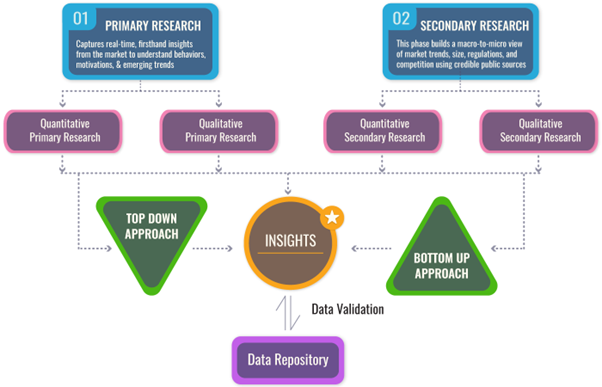
DUAL MODELING: TOP-DOWN + BOTTOM-UP
To ensure robust market estimation, we apply two complementary sizing approaches:
Top-Down Modeling:- Start with broader industry value (e.g., global or regional TAM)
- Apply filters by segment, geography, end-user, or use case
- Adjust with primary insights and validation benchmarks
- Ideal for investor-grade market scans and opportunity mapping
- Aggregate from the ground up using sales volumes, pricing, and unit economics
- Use internal modeling templates aligned with stakeholder data
- Incorporate distributor-level or region-specific inputs
- Most accurate for emerging segments and granular sub-markets
DATA VALIDATION: IN-HOUSE REPOSITORY
We close the loop with proprietary data intelligence built from ongoing projects, industry monitoring, and historical benchmarking. This repository includes:
- Multi-sector market and pricing models
- Key trendlines from past interviews and forecasts
- Benchmarked adoption rates, churn patterns, and ROI indicators
- Industry-specific deviation flags and cross-check logic
- Catches inconsistencies early
- Aligns projections across studies
- Enables consistent, high-trust deliverables