

Industrial Cleaner Market Size and Forecast (2020-2035), Global and Regional Growth, Trend, Share, and Industry Analysis Report Coverage: By Product Type (Acidic Cleaner, Disinfectants, Degreasers, General Cleaners, Surfactants, and Others), By End-Use Industry (Oil, Gas & Petrochemicals, Food & Beverages, Healthcare, Manufacturing, and Others) and Geography
2025-12-30
Chemicals & Materials
Jaya Bundele (Research Analyst)
Description
Industrial
Cleaner Market Overview
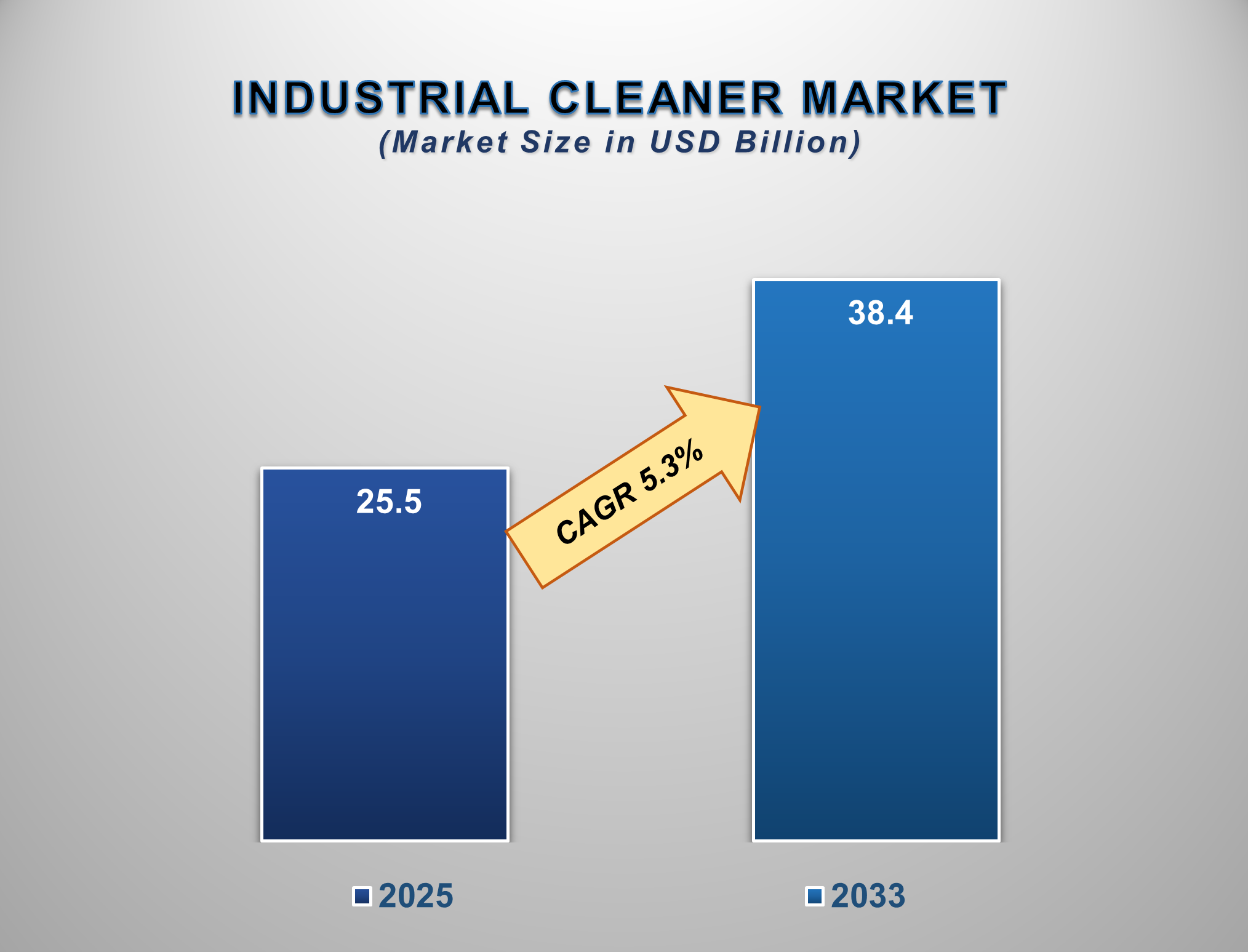
The global Industrial Cleaner Market is poised for steady and sustainable growth from 2025 to 2035, driven by stringent regulatory standards for workplace hygiene, heightened health and safety awareness, and rapid industrialization in emerging economies. The market is projected to be valued at approximately USD 25.5 billion in 2025 and is forecasted to reach nearly USD 38.4 billion by 2035, exhibiting a compound annual growth rate (CAGR) of 5.3% during this period.
Industrial cleaners encompass a wide range of chemical
formulations and specialized products designed to remove dirt, grease, oil,
microbial contaminants, and other soils from surfaces and equipment in
commercial, institutional, and industrial settings. The market's expansion is
underpinned by the critical objective of ensuring operational safety, extending
equipment lifespan, maintaining product quality, and complying with
increasingly strict environmental and health regulations. A key trend is the
paradigm shift towards sustainable, eco-friendly solutions, including
bio-based, low-VOC (volatile organic compounds), and biodegradable
formulations. Factors such as the lasting impact of COVID-19 on hygiene
protocols, technological integration through automation and IoT, and the
expansion of end-use industries like pharmaceuticals and food processing are
key contributors to market growth. North America currently holds the largest
market share due to well-established regulatory frameworks and high hygiene standards,
while the Asia-Pacific region is expected to be the fastest-growing market,
fueled by massive industrial expansion and rising governmental focus on
sanitation.
Industrial Cleaner Market Drivers and
Opportunities
Stringent Hygiene Regulations and Heightened Health Awareness
are the Primary Market Drivers
The most significant driver for the industrial cleaner
market is the global tightening of health, safety, and environmental
regulations, enforced by agencies like the U.S. Environmental Protection Agency
(EPA), the European Chemicals Agency (ECHA), and the Occupational Safety and
Health Administration (OSHA). The COVID-19 pandemic permanently elevated
baseline hygiene expectations, making infection control a top operational
priority across healthcare, food service, hospitality, and manufacturing
sectors. This regulatory and societal pressure compels businesses to adopt
certified, high-performance cleaning chemicals and validated protocols to avoid
penalties, ensure consumer safety, and protect their brand reputation, creating
consistent and growing demand.
Shift Towards Sustainability and Green Chemistry Presents a
Major Growth Vector
A powerful and defining trend is the accelerating demand
for sustainable and eco-friendly cleaning solutions. Driven by corporate
Environmental, Social, and Governance (ESG) goals, consumer preference, and
regulatory restrictions on harmful chemicals (e.g., PFAS, high-VOC solvents),
industries are actively seeking biodegradable, plant-based, and non-toxic
formulations. This shift is moving sustainability from a niche consideration to
a core strategic driver, opening a multi-billion-dollar opportunity for manufacturers to innovate with
enzyme-based cleaners, biosurfactants, and products featuring recyclable
packaging. Companies that lead in green chemistry and offer comprehensive
sustainability consulting are gaining a significant competitive edge.
Digital Transformation and Automation Unlock Efficiency and
New Business Models
The integration of advanced technologies is creating
substantial growth opportunities. The rise of IoT-enabled dispensing systems,
AI-powered robotic cleaners, and predictive analytics is transforming
traditional cleaning into intelligent, data-driven processes. These smart
systems enable real-time monitoring of chemical usage, optimize cleaning
schedules, ensure compliance through automated reporting, and reduce resource
waste. Furthermore, this digital shift is facilitating new service-based
business models, such as chemical management subscriptions and
"Cleaning-as-a-Service," which deepen vendor-customer relationships
and provide recurring revenue streams for market players.
Industrial Cleaner Market Scope
|
Report Attributes |
Description |
|
Market Size in 2025 |
USD 25.5 Billion |
|
Market Forecast in 2033 |
USD 38.4 Billion |
|
CAGR % 2025-2033 |
5.3% |
|
Base Year |
2024 |
|
Historic Data |
2020-2024 |
|
Forecast Period |
2025-2033 |
|
Report USP |
Product Portfolio,
Technological Analysis, Company Market Share, Company Heatmap, Pricing
Analysis, Growth Factors and more |
|
Segments Covered |
●
By Product Type ●
By End-Use
Industry |
|
Regional Scope |
●
North America, ●
Europe, ●
APAC, ●
Latin America ●
Middle East and
Africa |
|
Country Scope |
1)
U.S. 2)
Canada 3)
Germany 4)
UK 5)
France 6)
Spain 7)
Italy 8)
Switzerland 9)
China 10)
Japan 11)
India 12)
Australia 13)
South Korea 14)
Brazil 15)
Mexico 16)
Argentina 17)
South Africa 18)
Saudi Arabia 19)
UAE |
Industrial Cleaner Market Report Segmentation
Analysis
The
global Industrial Cleaner Market is segmented by Product Type, End-user
Industry, and Region.
The Disinfectants and
Sanitizers segment is anticipated to command a significant market share.
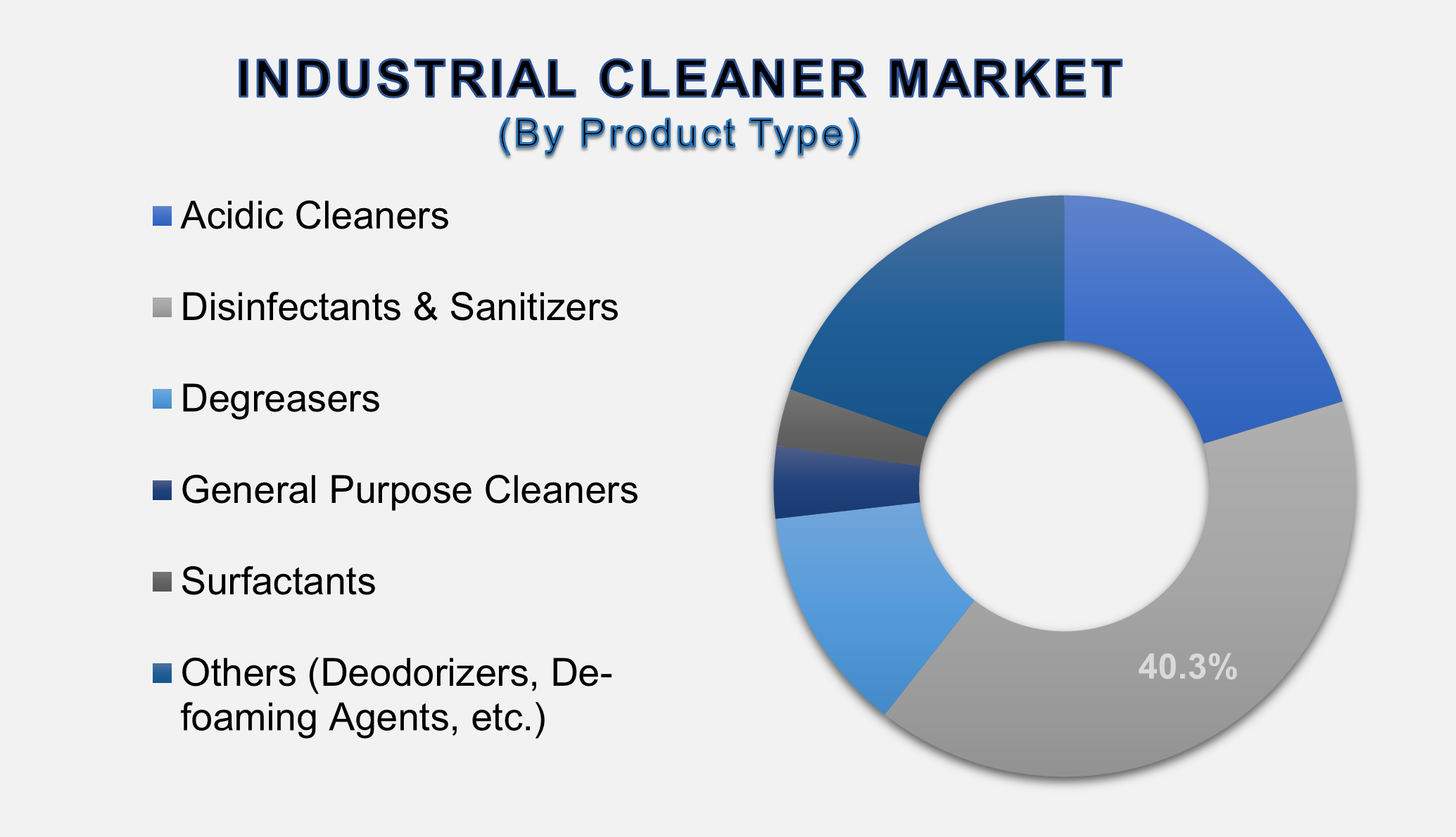
The Product Type segment includes Acidic Cleaners, Disinfectants, Degreasers, General Purpose Cleaners, Surfactants, and others. Disinfectants and Sanitizers represent one of the largest and fastest-growing categories, with a forecasted CAGR of 6.7%. This dominance is a direct result of the post-pandemic "new normal," where elevated hygiene vigilance in healthcare, foodservice, hospitality, and public spaces has become permanent. The segment is innovating with broad-spectrum, quaternary-ammonium-free, and extended-efficacy formulations to meet evolving regulatory and consumer demands.
The Oil, Gas &
Petrochemicals (OG&P) segment is the cornerstone of the market.
The
End-Use Industry segment is categorized into Oil, Gas & Petrochemicals,
Food & Beverages, Healthcare, Manufacturing, and others. The OG&P
segment dominates, holding approximately 58.3% of the market share. This is due
to the industry's intensive and non-negotiable requirements for cleaning
pipelines, storage tanks, and refinery equipment to ensure operational safety,
prevent corrosion, and maintain efficiency. The segment's growth is tied
directly to global energy demand and investments in upstream and downstream
infrastructure, creating consistent demand for heavy-duty degreasers and
refinery-specific cleaners.
The following segments are
part of an in-depth analysis of the global Industrial Cleaner Market:
|
Market
Segments |
|
|
By Product
Type |
●
Acidic Cleaners ●
Disinfectants &
Sanitizers ●
Degreasers ●
General Purpose
Cleaners ●
Surfactants ●
Others (Deodorizers,
De-foaming Agents, etc.) |
|
By End-user
Industry |
●
Oil, Gas &
Petrochemicals ●
Food & Beverages ●
Healthcare ●
Manufacturing &
Commercial Offices ●
Others (Automotive,
Textiles, Power Generation, etc.) |
Industrial Cleaner Market Share Analysis by
Region
North America is expected
to account for the major share of the global industrial cleaner market over the
forecast period
North
America's dominance is attributed to its mature industrial base and the world's
most stringent and well-enforced regulatory environment governed by the EPA,
OSHA, and FDA. The region has a high concentration of leading chemical
manufacturers, advanced healthcare infrastructure, and a food processing
industry that mandates premium, fully documented cleaning solutions. High
consumer and corporate awareness regarding hygiene and sustainability further
consolidates North America's position as the leading value market.
The
Asia-Pacific region is poised to be the fastest-growing market, driven by
explosive industrialization, rapid urbanization, and proactive government
hygiene campaigns like India's "Swachh Bharat Abhiyan." The massive expansion of manufacturing, food processing,
and healthcare sectors in China, India, and Southeast Asia is creating
unprecedented demand for both basic and advanced cleaning chemicals.
Furthermore, governments in the region are progressively tightening chemical
control and food safety laws (similar to REACH and FDA standards), which is
professionalizing procurement and favoring
quality-certified products, thereby accelerating market growth.
Industrial Cleaner Market Competition Landscape
Analysis
The global industrial cleaner
market is moderately consolidated and highly competitive, featuring a mix of
diversified chemical conglomerates and specialized cleaning solution providers.
Competition centers on technological innovation in sustainable formulations,
breadth of product portfolio, technical service and support, and the ability to
offer integrated, value-added services like on-site training, compliance
auditing, and smart chemical management systems. Key strategies include heavy
investment in R&D for bio-based alternatives, strategic partnerships with
enzyme specialists and technology firms, geographic expansion into high-growth
APAC markets, and mergers & acquisitions to bolster technological
capabilities or market reach
Global Industrial Cleaner Market Recent Developments News:
- In January 2025, Brenntag, a global chemical distributor, expanded
its distribution agreement with Kao Chemicals Europe to strengthen its
supply of sustainable industrial cleaning ingredients in the U.S. market.
- In 2024, Ecolab and Novonesis (formerly Novozymes) partnered to
co-develop enzyme-driven Clean-in-Place (CIP) solutions for the dairy
industry, aiming to slash chlorine use by 80%.
- In 2024, regulatory pressure led 3M to announce the discontinuation
of all PFAS manufacturing by the end of 2025, triggering an industry-wide scramble and creating a
massive opportunity for alternative chemical technologies.
- The EU is progressing towards a potential complete prohibition of
approximately 10,000 PFAS substances by 2026-2030, representing the
largest-ever regulatory shift for the industry and forcing a fundamental
reformulation of many specialty cleaners
The Global Industrial Cleaner Market Is Dominated
by a Few Large Companies, such as
●
BASF SE
●
Ecolab Inc.
●
Dow Chemical Company
●
3M Company
●
Solvay S.A.
●
Evonik Industries AG
●
Clariant AG
●
Stepan Company
●
Croda International
Plc
●
Huntsman Corporation
●
Diversey Holdings Ltd.
●
Henkel AG & Co.
KGaA
● Other Prominent Players
Frequently Asked Questions
Jaya Bundele (Research Analyst)
Jaya Bundele is a skilled Research Analyst with 4+ years of experience in market intelligence, consumer insights, competitive analysis, and industry forecasting across the consumer goods, agriculture, and food & beverage sectors. She specializes in market sizing, trend analysis, growth opportunity mapping, and strategic secondary research for global and regional markets.
Her expertise lies in transforming complex industry data into actionable business strategies that help organizations identify emerging trends, understand customer behavior, and gain a competitive edge. With a strong focus on data-driven insights, business intelligence, and future market trends, Jaya delivers high-quality research solutions aligned with evolving industry demands and market dynamics.
1. Global Industrial Cleaner
Market Introduction and Market Overview
1.1.
Objectives
of the Study
1.2.
Global
Industrial Cleaner Market Scope and Market Estimation
1.2.1.Global Electronic Toll
Collection Overall Market Size (US$ Bn), Market CAGR (%), Market forecast (2025
- 2033)
1.2.2.Global Industrial Cleaner
Market Revenue Share (%) and Growth Rate (Y-o-Y) from 2020 - 2033
1.3.
Market
Segmentation
1.3.1.Product Type of Global Industrial
Cleaner Market
1.3.2.End-user Industry of
Global Industrial Cleaner Market
1.3.3.Region of Global Industrial
Cleaner Market
2. Executive
Summary
2.1.
Demand
Side Trends
2.2.
Key
Market Trends
2.3.
Market
Demand (US$ Bn) Analysis 2020 – 2024 and forecast, 2025 – 2033
2.4.
Demand
and Opportunity Assessment
2.5.
Key
Developments
2.6.
Market
Entry Strategies
2.7.
Market
Dynamics
2.7.1.Drivers
2.7.2.Limitations
2.7.3.Opportunities
2.7.4.Impact Analysis of Drivers
and Restraints
2.8.
Porter’s
Five Forces Analysis
2.9.
Pricing
Analysis
2.10.
PEST
Analysis
3. Global
Industrial Cleaner Market Estimates
& Historical Trend Analysis (2020 - 2024)
4. Global
Industrial Cleaner Market Estimates
& Forecast Trend Analysis, by Product Type
4.1.
Global
Industrial Cleaner Market Revenue (US$ Bn) Estimates and Forecasts, by Product
Type, 2020 - 2033
4.1.1.Acidic Cleaners
4.1.2.Disinfectants &
Sanitizers
4.1.3.Degreasers
4.1.4.General Purpose Cleaners
4.1.5.Surfactants
4.1.6.Others (Deodorizers,
De-foaming Agents, etc.)
5. Global
Industrial Cleaner Market Estimates
& Forecast Trend Analysis, by End-user Industry
5.1.
Global
Industrial Cleaner Market Revenue (US$ Bn) Estimates and Forecasts, by End-user
Industry, 2020 - 2033
5.1.1.Oil, Gas &
Petrochemicals
5.1.2.Food & Beverages
5.1.3.Healthcare
5.1.4.Manufacturing &
Commercial Offices
5.1.5.Others (Automotive,
Textiles, Power Generation, etc.)
6. Global
Industrial Cleaner Market Estimates
& Forecast Trend Analysis, by region
6.1.
Global
Industrial Cleaner Market Revenue (US$ Bn) Estimates and Forecasts, by region, 2020
- 2033
6.1.1.North America
6.1.2.Europe
6.1.3.Asia Pacific
6.1.4.Middle East & Africa
6.1.5.Latin America
7. North America Industrial
Cleaner Market: Estimates &
Forecast Trend Analysis
7.1.
North
America Industrial Cleaner Market Assessments & Key Findings
7.1.1.North America Industrial
Cleaner Market Introduction
7.1.2.North America Industrial
Cleaner Market Size Estimates and Forecast (US$ Billion) (2020 - 2033)
7.1.2.1. By Product
Type
7.1.2.2. By End-user
Industry
7.1.2.3.
By
Country
7.1.2.3.1. The U.S.
7.1.2.3.2. Canada
8. Europe Industrial
Cleaner Market: Estimates &
Forecast Trend Analysis
8.1.
Europe
Industrial Cleaner Market Assessments & Key Findings
8.1.1.Europe Industrial Cleaner
Market Introduction
8.1.2.Europe Industrial Cleaner
Market Size Estimates and Forecast (US$ Billion) (2020 - 2033)
8.1.2.1. By Product
Type
8.1.2.2. By End-user
Industry
8.1.2.3.
By
Country
8.1.2.3.1.
Germany
8.1.2.3.2.
Italy
8.1.2.3.3.
U.K.
8.1.2.3.4.
France
8.1.2.3.5.
Spain
8.1.2.3.6.
Switzerland
8.1.2.3.7. Rest
of Europe
9. Asia Pacific Industrial
Cleaner Market: Estimates &
Forecast Trend Analysis
9.1.
Asia
Pacific Market Assessments & Key Findings
9.1.1.Asia Pacific Industrial
Cleaner Market Introduction
9.1.2.Asia Pacific Industrial
Cleaner Market Size Estimates and Forecast (US$ Billion) (2020 - 2033)
9.1.2.1. By Product
Type
9.1.2.2. By End-user
Industry
9.1.2.3.
By
Country
9.1.2.3.1.
China
9.1.2.3.2.
Japan
9.1.2.3.3.
India
9.1.2.3.4.
Australia
9.1.2.3.5.
South
Korea
9.1.2.3.6. Rest of Asia Pacific
10. Middle East & Africa Industrial
Cleaner Market: Estimates &
Forecast Trend Analysis
10.1.
Middle
East & Africa Market Assessments & Key Findings
10.1.1.
Middle East & Africa Industrial Cleaner Market
Introduction
10.1.2.
Middle East & Africa Industrial Cleaner Market Size Estimates
and Forecast (US$ Billion) (2020 - 2033)
10.1.2.1. By Product
Type
10.1.2.2. By End-user
Industry
10.1.2.3.
By
Country
10.1.2.3.1. UAE
10.1.2.3.2. Saudi
Arabia
10.1.2.3.3. South
Africa
10.1.2.3.4. Rest
of MEA
11. Latin America
Industrial Cleaner Market: Estimates
& Forecast Trend Analysis
11.1.
Latin
America Market Assessments & Key Findings
11.1.1.
Latin
America Industrial Cleaner Market Introduction
11.1.2.
Latin
America Industrial Cleaner Market Size Estimates and Forecast (US$ Billion) (2020
- 2033)
11.1.2.1. By Product
Type
11.1.2.2. By End-user
Industry
11.1.2.3.
By
Country
11.1.2.3.1. Brazil
11.1.2.3.2. Argentina
11.1.2.3.3. Mexico
11.1.2.3.4. Rest
of LATAM
12. Country Wise Market:
Introduction
13.
Competition
Landscape
13.1.
Global
Industrial Cleaner Market Product Mapping
13.2.
Global
Industrial Cleaner Market Concentration Analysis, by Leading Players /
Innovators / Emerging Players / New Entrants
13.3.
Global
Industrial Cleaner Market Tier Structure Analysis
13.4.
Global
Industrial Cleaner Market Concentration & Company Market Shares (%)
Analysis, 2024
14.
Company
Profiles
14.1.
BASF SE
14.1.1.
Company
Overview & Key Stats
14.1.2.
Financial
Performance & KPIs
14.1.3.
Product
Portfolio
14.1.4.
SWOT
Analysis
14.1.5.
Business
Strategy & Recent Developments
* Similar details would be provided for all the players
mentioned below
14.2. Ecolab Inc.
14.3. Dow Chemical
Company
14.4. 3M Company
14.5. Solvay S.A.
14.6. Evonik
Industries AG
14.7. Clariant AG
14.8. Stepan
Company
14.9. Croda
International Plc
14.10. Huntsman
Corporation
14.11. Diversey
Holdings Ltd.
14.12. Henkel AG
& Co. KGaA
14.13. Other
Prominent Players
15. Research
Methodology
15.1.
External
Transportations / Databases
15.2.
Internal
Proprietary Database
15.3.
Primary
Research
15.4.
Secondary
Research
15.5.
Assumptions
15.6.
Limitations
15.7.
Report
FAQs
16. Research
Findings & Conclusion
Our Research Methodology
"Insight without rigor is just noise."
We follow a comprehensive, multi-phase research framework designed to deliver accurate, strategic, and decision-ready intelligence. Our process integrates primary and secondary research , both quantitative and qualitative , along with dual modeling techniques ( top-down and bottom-up) and a final layer of validation through our proprietary in-house repository.
PRIMARY RESEARCH
Primary research captures real-time, firsthand insights from the market to understand behaviors, motivations, and emerging trends.
1. Quantitative Primary Research
Objective: Generate statistically significant data directly from market participants.
Approaches:- Structured surveys with customers, distributors, and field agents
- Mobile-based data collection for point-of-sale audits and usage behavior
- Phone-based interviews (CATI) for market sizing and product feedback
- Online polling around industry events and digital campaigns
- Purchase frequency by customer type
- Channel performance across geographies
- Feature demand by application or demographic
2. Qualitative Primary Research
Objective: Explore decision-making drivers, pain points, and market readiness.
Approaches:- In-depth interviews (IDIs) with executives, product managers, and key decision-makers
- Focus groups among end users and early adopters
- Site visits and observational research for consumer products
- Informal field-level discussions for regional and cultural nuances
SECONDARY RESEARCH
This phase helps establish a macro-to-micro understanding of market trends, size, regulation, and competitive dynamics, sourced from credible and public domain information.
1. Quantitative Secondary Research
Objective: Model market value and segment-level forecasts based on published data.
Sources include:- Financial reports and investor summaries
- Government trade data, customs records, and regulatory statistics
- Industry association publications and economic databases
- Channel performance and pricing data from marketplace listings
- Revenue splits, pricing trends, and CAGR estimates
- Supply-side capacity and volume tracking
- Investment analysis and funding benchmarks
2. Qualitative Secondary Research
Objective: Capture strategic direction, innovation signals, and behavioral trends.
Sources include:- Company announcements, roadmaps, and product pipelines
- Publicly available whitepapers, conference abstracts, and academic research
- Regulatory body publications and policy briefs
- Social and media sentiment scanning for early-stage shifts
- Strategic shifts in market positioning
- Unmet needs and white spaces
- Regulatory triggers and compliance impact
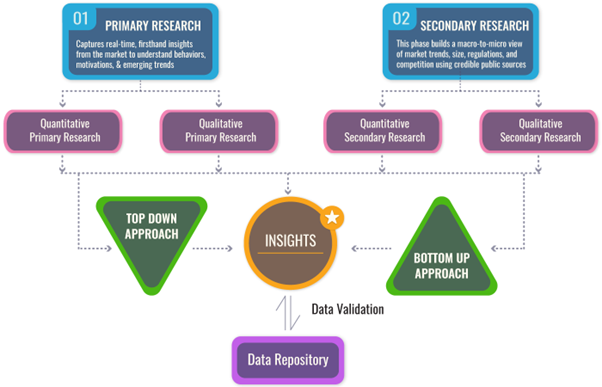
DUAL MODELING: TOP-DOWN + BOTTOM-UP
To ensure robust market estimation, we apply two complementary sizing approaches:
Top-Down Modeling:- Start with broader industry value (e.g., global or regional TAM)
- Apply filters by segment, geography, end-user, or use case
- Adjust with primary insights and validation benchmarks
- Ideal for investor-grade market scans and opportunity mapping
- Aggregate from the ground up using sales volumes, pricing, and unit economics
- Use internal modeling templates aligned with stakeholder data
- Incorporate distributor-level or region-specific inputs
- Most accurate for emerging segments and granular sub-markets
DATA VALIDATION: IN-HOUSE REPOSITORY
We close the loop with proprietary data intelligence built from ongoing projects, industry monitoring, and historical benchmarking. This repository includes:
- Multi-sector market and pricing models
- Key trendlines from past interviews and forecasts
- Benchmarked adoption rates, churn patterns, and ROI indicators
- Industry-specific deviation flags and cross-check logic
- Catches inconsistencies early
- Aligns projections across studies
- Enables consistent, high-trust deliverables