

Infectious Disease Diagnostics Market Size and Forecast (2025-2033), Global and Regional Growth, Trend, Share and Industry Analysis Report Coverage: By Product (Assays & Reagents, Instruments, Software); By Disease Type (Human Immunodeficiency Virus, Hepatitis, Influenza, Others); By Technology (Immunodiagnostics, Clinical Microbiology, Polymerase Chain Reaction, Next Generation Sequencing, Others); and Geography
2025-11-27
Healthcare
Swetal (Research Analyst)
Description
Infectious Disease Diagnostics Market Overview
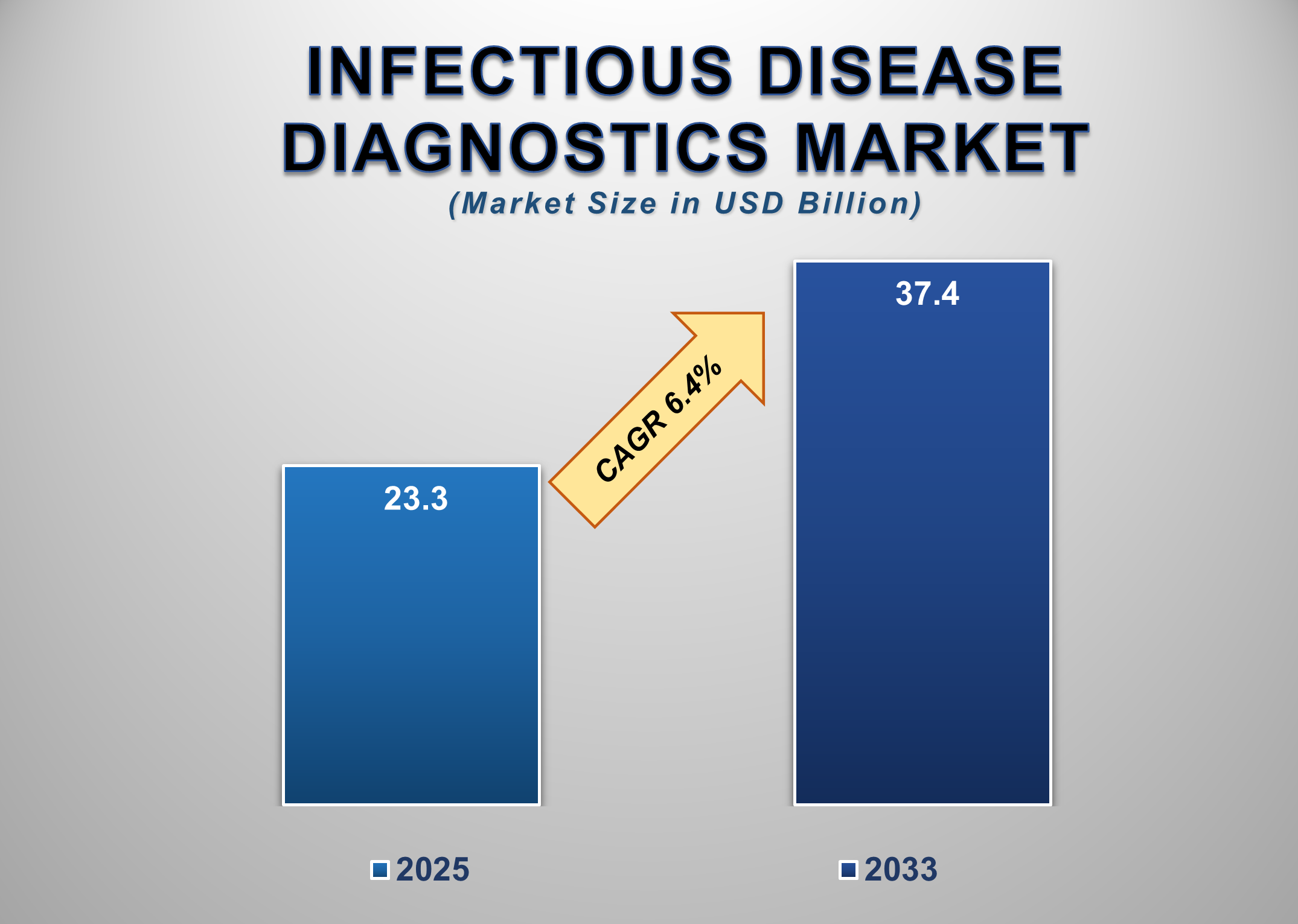
The Global Infectious Disease Diagnostics Market is witnessing robust growth, driven by the increasing prevalence of infectious diseases, rising global health awareness, and advancements in molecular diagnostic technologies. Valued at USD 23.3 billion in 2025, the market is projected to reach USD 37.4 billion by 2033, growing at a CAGR of 6.4% during the forecast period.
Infectious disease diagnostics
encompasses the testing and identification of pathogenic organisms such as
bacteria, viruses, fungi, and parasites in human samples. These diagnostics are
crucial for early detection, prevention, and management of diseases including
HIV, hepatitis, influenza, tuberculosis, and COVID-19. Growing global concerns
about emerging infectious threats, coupled with a strong focus on preparedness
and surveillance, have significantly expanded the role of diagnostic testing in
healthcare systems.
Infectious Disease
Diagnostics Market Drivers and Opportunities
Widening Burden of Infectious Diseases and Expanded Screening
Programs Are Driving Market Growth
The persistent global burden of infectious diseases such as HIV,
hepatitis, and seasonal influenza continues to drive investments in
diagnostics. National screening programs, vaccination campaigns, and
surveillance efforts have increased testing volumes across public health
systems and private providers. Early detection and rapid diagnosis are critical
for controlling outbreaks and enabling timely treatment; this has resulted in
higher demand for validated assays and robust reagent kits. Additionally, efforts
to expand access to diagnostics in low- and middle-income countries through
donor-funded programs and public-private partnerships are increasing
utilization of standardized tests and point-of-care solutions. The resultant
scale-up of testing infrastructure is stimulating demand for instruments,
consumables, and integrated diagnostic workflows. As healthcare systems
prioritize preparedness and routine screening, the infectious disease
diagnostics market is expected to benefit from consistent demand and policy-backed
spending.
Rapid Adoption of Molecular and Point-of-Care Technologies Is
Accelerating Market Expansion
Technological advances, particularly in molecular diagnostics
(PCR) and point-of-care immunodiagnostics, are reshaping the infectious disease
testing landscape. PCR-based assays offer high sensitivity and specificity for
pathogen detection and are now widely used in centralized labs and near-patient
settings. Concurrently, improved immunodiagnostic rapid tests and multiplex
panels are enabling decentralized screening with immediate clinical utility.
The convergence of automation, microfluidics, and digital diagnostics
(including connected platforms and cloud-based reporting) is improving
throughput, reducing manual error, and enabling rapid epidemiological
surveillance. Additionally, adoption of next-generation sequencing (NGS) for
pathogen characterization and antimicrobial resistance surveillance is creating
new high-value use cases. These technological trends are prompting laboratories
and healthcare systems to upgrade equipment portfolios and adopt integrated
software solutions, driving overall market growth.
Integration of Diagnostics with Digital Health and
Surveillance Systems Presents Major Upside
The integration of infectious disease diagnostics with digital
health platforms, electronic health records (EHRs), and national surveillance
systems offers a significant growth opportunity. Real-time data flows from
diagnostic instruments and connected point-of-care devices enable faster public
health responses, automated case reporting, and better resource allocation
during outbreaks. Diagnostic companies that provide end-to-end solutions, assay
kits, instruments, and interoperable software are well-positioned to capture
incremental value by offering subscription or data analytics services. In
addition, expanding telehealth and remote testing models creates demand for
validated home-collection kits and companion diagnostics linked to laboratory
workflows. Investments in digital integration, regulatory-compliant data
pipelines, and analytics-driven decision support will create differentiated
offerings and open commercial models beyond traditional product sales.
Infectious Disease
Diagnostics Market Scope
|
Report Attributes |
Description |
|
Market Size in 2025 |
USD 23.3 Billion |
|
Market Forecast in 2033 |
USD 37.4 Billion |
|
CAGR % 2025-2033 |
6.4% |
|
Base Year |
2024 |
|
Historic Data |
2020-2024 |
|
Forecast Period |
2025-2033 |
|
Report USP |
Production, Consumption,
Company Share, Company Heatmap, Company Production Capacity, Growth Factors,
and more |
|
Segments Covered |
●
By Product ●
By Disease Type ●
By Technology |
|
Regional Scope |
●
North America, ●
Europe, ●
APAC, ●
Latin America ●
Middle East and
Africa |
|
Country Scope |
1)
U.S. 2)
Canada 3)
Germany 4)
UK 5)
France 6)
Spain 7)
Italy 8)
Switzerland 9)
China 10)
Japan 11)
India 12)
Australia 13)
South Korea 14)
Brazil 15)
Mexico 16)
Argentina 17)
South Africa 18)
Saudi Arabia 19)
UAE |
Infectious Disease
Diagnostics Market Report Segmentation Analysis
The global Infectious Disease
Diagnostics Market is segmented by Product, by Disease Type, by Technology, and
by Region.
Assays & Reagents segment accounted for the largest
market share in the global Infectious Disease Diagnostics market
By
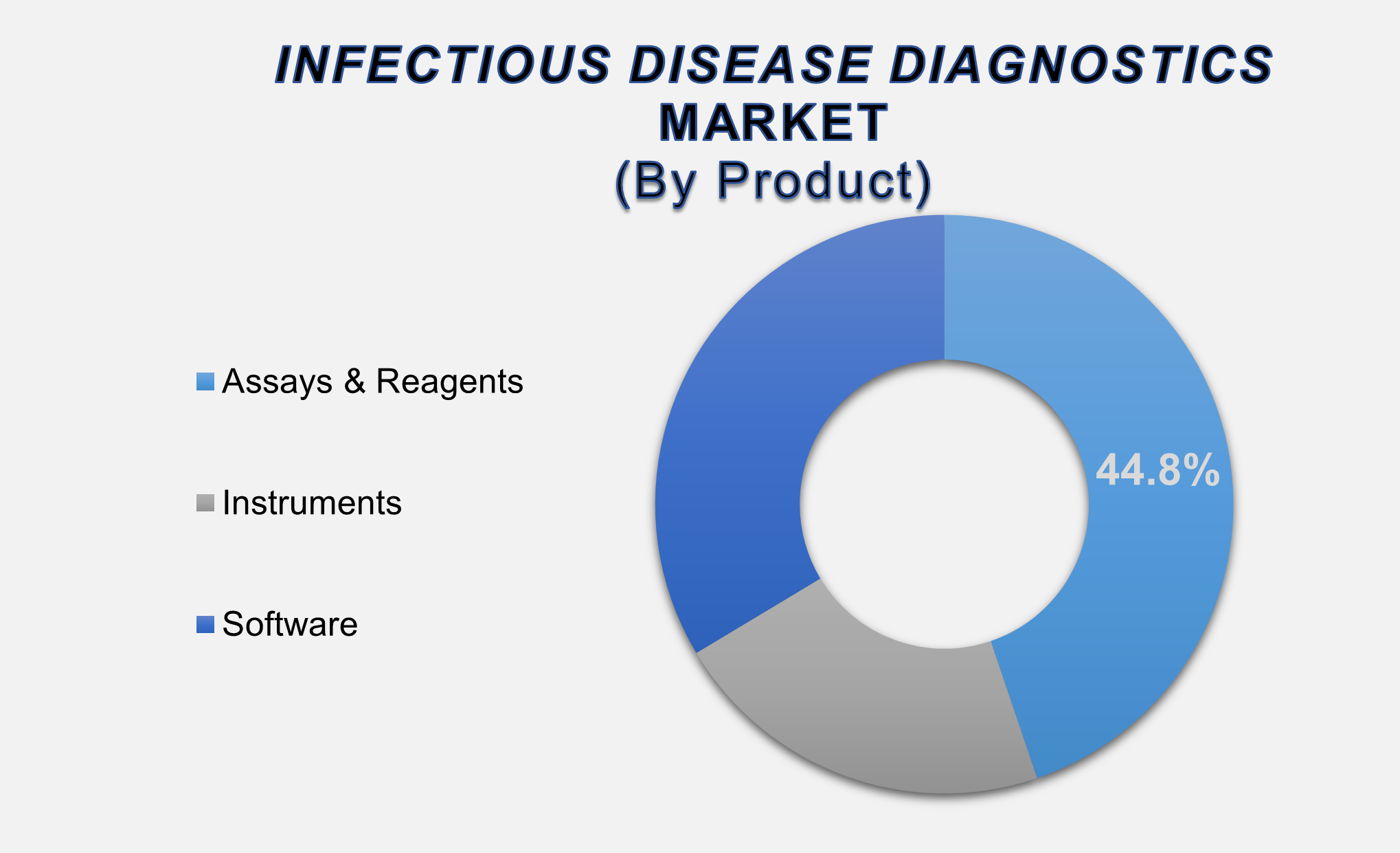
Product, the market is segmented into Assays & Reagents, Instruments,
Software, and Others. The Assays & Reagents segment accounted for the
largest share of the market in 2025 (approximately 44.8%), driven by high
demand for consumables required across centralized laboratories and
decentralized testing sites. Assays and reagent kits covering immunoassays, PCR
reagents, rapid antigen/antibody tests, and multiplex panels are recurring
revenue sources for diagnostic companies due to repeat testing and programmatic
screening needs. The segment benefits from continuous assay development
responding to emerging pathogens and strain variations, as well as from the
expanding use of multiplex panels for differential diagnosis. Given their clinically
critical role and recurring purchasing cycles, assays
& reagents are expected to remain the most significant revenue contributor.
The Human
Immunodeficiency Virus (HIV) segment holds a major
share in the Infectious Disease Diagnostics market
By
Disease Type, the market is divided into Human
Immunodeficiency Virus (HIV), Hepatitis, Influenza, and Others. The HIV segment
holds the largest share in 2025 due to the persistent global burden of HIV/AIDS
and widespread implementation of screening programs. Continuous WHO and CDC
efforts to promote early diagnosis, antiretroviral therapy (ART) monitoring,
and viral load testing have strengthened this segment’s growth. Technological
progress in molecular and immunoassay-based detection has improved test
reliability and accessibility, particularly in low-resource regions.
Furthermore, self-testing kits and rapid diagnostic devices have expanded
patient reach, driving higher testing rates. As healthcare systems strive
toward achieving UNAIDS 95-95-95 targets, the demand for accurate, fast, and
user-friendly diagnostic solutions for HIV remains exceptionally strong.
The Immunodiagnostics technology segment leads the global Infectious Disease
Diagnostics market
By
Technology, the market is segmented into Immunodiagnostics, Clinical
Microbiology, Polymerase Chain Reaction (PCR), Next Generation Sequencing
(NGS), and Others.
The Immunodiagnostics segment dominates the market and is widely used for detecting infectious agents through
antigen-antibody interactions. Its reliability, cost-effectiveness, and high
throughput make it the preferred choice in clinical laboratories and
point-of-care settings. Techniques such as enzyme immunoassays (EIA),
chemiluminescence assays (CLIA), and lateral flow assays are key components in
detecting diseases like HIV, hepatitis, and influenza. Advances in automation
and integration with digital analyzers have further improved assay accuracy and
turnaround times. The versatility of immunodiagnostic platforms across multiple
sample types, combined with the rapid response
to emerging pathogens, ensures their continued leadership in the infectious
disease diagnostics market.
The following segments are
part of an in-depth analysis of the global Infectious Disease Diagnostics
market:
|
Market Segments |
|
|
By Component |
●
Assays &
Reagents ●
Instruments ●
Software |
|
By Technology |
●
Immunodiagnostics ●
Clinical
Microbiology ●
Polymerase Chain
Reaction ●
Next-Generation
Sequencing ●
Others |
|
By Disease
Type |
●
Human
Immunodeficiency Virus ●
Hepatitis ●
Influenza ●
Others |
Infectious Disease
Diagnostics Market Share Analysis by Region
The Asia
Pacific region is projected to hold the largest share of the global Infectious
Disease Diagnostics market over the forecast period
The
Asia Pacific (APAC) region held the largest share of 39.4% in 2025 and is
expected to maintain its dominance during the forecast period. The region’s
growth is fueled by high infection prevalence, growing healthcare expenditure,
and rapid adoption of advanced diagnostic technologies. Governments in China,
India, and Japan are actively expanding infectious disease control programs,
vaccination initiatives, and diagnostic infrastructure to strengthen pandemic
preparedness and surveillance. The region’s large population base and increased
accessibility to affordable testing kits further drive market demand. Local
manufacturing initiatives and collaborations with global diagnostic companies
have also accelerated innovation and availability.
Meanwhile,
North America is expected to record the fastest growth rate, supported by
continuous R&D investments, well-established healthcare infrastructure, and
the presence of leading diagnostic firms. Strong regulatory frameworks,
government funding, and the early adoption of molecular and digital diagnostic
platforms position North America as a key growth engine in the coming years.
Infectious Disease
Diagnostics Market Competition Landscape Analysis
The global infectious disease
diagnostics market is highly competitive, characterized by innovation-driven
strategies, product diversification, and extensive R&D investments. Key
players focus on developing rapid, high-accuracy diagnostic solutions while
expanding their global distribution networks.
Global Infectious Disease
Diagnostics Market Recent Developments News:
- In March
2025, DiaSorin received
U.S. FDA 510(k) clearance for the LIAISON PLEX platform and its inaugural
test, the LIAISON PLEX® Respiratory Flex Assay. The multiplex platform is
designed to streamline and enhance respiratory infection testing,
supporting efficient and accurate diagnostic workflows.
- In April 2025,
BD (Becton, Dickinson and Company) secured U.S. FDA 510(k) clearance
for its Respiratory Viral Panel (RVP) on the BD MAX™ System. The panel
enables the simultaneous detection and differentiation of Influenza A,
Influenza B, SARS-CoV-2, and Respiratory Syncytial Virus (RSV), providing
rapid, high-throughput results to aid in the management of respiratory
infections.
The Global Infectious Disease
Diagnostics Market Is Dominated by a Few Large Companies, such as
●
Roche Diagnostics
●
Abbott Laboratories
●
Thermo Fisher
Scientific
●
bioMérieux
●
BD
●
Danaher
●
Siemens Healthineers
●
Qiagen
●
Hologic
●
Cepheid
●
Sysmex Corporation
●
Bio-Rad Laboratories
●
DiaSorin
●
Luminex Corporation
●
QuidelOrtho
●
GenMark Diagnostics
●
Mesa Biotech
●
Seegene
●
Ellume
●
Guangzhou Wondfo
Biotech
● Others
Frequently Asked Questions
Swetal (Research Analyst)
Swetal is a Research Analyst with 4+ years of experience specializing in healthcare market research, medical devices, healthcare IT, and medical technology industry analysis. Her expertise includes competitive intelligence, secondary research, market trend forecasting, and healthcare business insights across global healthcare ecosystems.
She contributes to advanced market research reports by analyzing regulatory frameworks, emerging healthcare technologies, competitive landscapes, and innovation trends shaping the medical industry. With a strong focus on accurate market intelligence, strategic insights, and healthcare industry trends, Swetal supports businesses in making informed, data-backed decisions in a rapidly transforming healthcare environment.
1. Global Infectious Disease
Diagnostics Market Introduction and Market Overview
1.1.
Objectives
of the Study
1.2.
Global
Infectious Disease Diagnostics Market Scope and Market Estimation
1.2.1.Global Infectious Disease
Diagnostics Market Overall Market Size (US$ Bn), Market CAGR (%), Market
forecast (2025 - 2033)
1.2.2.Global Infectious Disease
Diagnostics Market Revenue Share (%) and Growth Rate (Y-o-Y) from 2020 - 2033
1.3.
Market
Segmentation
1.3.1.Product of Global Infectious
Disease Diagnostics Market
1.3.2.Technology of Global Infectious
Disease Diagnostics Market
1.3.3.Disease Type of Global Infectious
Disease Diagnostics Market
1.3.4.Region of Global Infectious
Disease Diagnostics Market
2. Executive
Summary
2.1.
Demand
Side Trends
2.2.
Key
Market Trends
2.3.
Market
Demand (US$ Bn) Analysis 2020 – 2024 and Forecast, 2025 – 2033
2.4.
Demand
and Opportunity Assessment
2.5.
Demand
Supply Scenario
2.6.
Market
Dynamics
2.6.1.Drivers
2.6.2.Limitations
2.6.3.Opportunities
2.6.4.Impact Analysis of Drivers
and Restraints
2.7.
Emerging
Trends for Infectious Disease Diagnostics Market
2.8.
Porter’s
Five Forces Analysis
2.9.
PEST
Analysis
2.10.
Key
Regulation
3. Global
Infectious Disease Diagnostics Market
Estimates & Historical Trend Analysis (2020 - 2024)
4.
Global Infectious Disease
Diagnostics Market Estimates
& Forecast Trend Analysis, by Product
4.1.
Global
Infectious Disease Diagnostics Market Revenue (US$ Bn) Estimates and Forecasts,
by Product, 2020 - 2033
4.1.1.Assays & Reagents
4.1.2.Instruments
4.1.3.Software
5.
Global Infectious Disease
Diagnostics Market Estimates
& Forecast Trend Analysis, by Technology
5.1.
Global
Infectious Disease Diagnostics Market Revenue (US$ Bn) Estimates and Forecasts,
by Technology, 2020 - 2033
5.1.1.Immunodiagnostics
5.1.2.Clinical Microbiology
5.1.3.Polymerase Chain Reaction
5.1.4.Next Generation Sequencing
5.1.5.Others
6.
Global Infectious Disease
Diagnostics Market Estimates
& Forecast Trend Analysis, by Disease Type
6.1.
Global
Infectious Disease Diagnostics Market Revenue (US$ Bn) Estimates and Forecasts,
by Disease Type, 2020 - 2033
6.1.1.Human Immunodeficiency
Virus
6.1.2.Hepatitis
6.1.3.Influenza
6.1.4.Others
7. Global
Infectious Disease Diagnostics Market
Estimates & Forecast Trend Analysis, by region
1.1.
Global
Infectious Disease Diagnostics Market Revenue (US$ Bn) Estimates and Forecasts,
by region, 2020 - 2033
1.1.1.North America
1.1.2.Europe
1.1.3.Asia Pacific
1.1.4.Middle East & Africa
1.1.5.Latin America
8. North America Infectious
Disease Diagnostics Market: Estimates
& Forecast Trend Analysis
8.1. North America Infectious
Disease Diagnostics Market Assessments & Key Findings
8.1.1.North America Infectious
Disease Diagnostics Market Introduction
8.1.2.North America Infectious
Disease Diagnostics Market Size Estimates and Forecast (US$ Billion) (2020 - 2033)
8.1.2.1. By Product
8.1.2.2. By Technology
8.1.2.3. By Disease
Type
8.1.2.4.
By
Country
8.1.2.4.1.
The
U.S.
8.1.2.4.2.
Canada
9. Europe Infectious
Disease Diagnostics Market: Estimates
& Forecast Trend Analysis
9.1.
Europe
Infectious Disease Diagnostics Market Assessments & Key Findings
9.1.1.Europe Infectious Disease
Diagnostics Market Introduction
9.1.2.Europe Infectious Disease
Diagnostics Market Size Estimates and Forecast (US$ Billion) (2020 - 2033)
9.1.2.1. By Product
9.1.2.2. By Technology
9.1.2.3. By Disease
Type
9.1.2.4.
By
Country
9.1.2.4.1. Germany
9.1.2.4.2. Italy
9.1.2.4.3. U.K.
9.1.2.4.4. France
9.1.2.4.5. Spain
9.1.2.4.6. Switzerland
9.1.2.4.7.
Rest of Europe
10. Asia Pacific Infectious
Disease Diagnostics Market: Estimates
& Forecast Trend Analysis
10.1.
Asia
Pacific Market Assessments & Key Findings
10.1.1.
Asia
Pacific Infectious Disease Diagnostics Market Introduction
10.1.2.
Asia
Pacific Infectious Disease Diagnostics Market Size Estimates and Forecast (US$ Billion)
(2020 - 2033)
10.1.2.1. By Product
10.1.2.2. By Technology
10.1.2.3. By Disease
Type
10.1.2.4.
By
Country
10.1.2.4.1. China
10.1.2.4.2. Japan
10.1.2.4.3. India
10.1.2.4.4. Australia
10.1.2.4.5. South Korea
10.1.2.4.6.
Rest
of Asia Pacific
11. Middle East & Africa Infectious
Disease Diagnostics Market: Estimates
& Forecast Trend Analysis
11.1.
Middle
East & Africa Market Assessments & Key Findings
11.1.1.
Middle East & Africa Infectious Disease Diagnostics
Market Introduction
11.1.2.
Middle East & Africa Infectious Disease Diagnostics
Market Size Estimates and Forecast (US$ Billion) (2020 - 2033)
11.1.2.1. By Product
11.1.2.2. By Technology
11.1.2.3. By Disease
Type
11.1.2.4.
By
Country
11.1.2.4.1. South
Africa
11.1.2.4.2. UAE
11.1.2.4.3. Saudi
Arabia
11.1.2.4.4.
Rest of MEA
12. Latin America
Infectious Disease Diagnostics Market:
Estimates & Forecast Trend Analysis
12.1.
Latin
America Market Assessments & Key Findings
12.1.1.
Latin
America Infectious Disease Diagnostics Market Introduction
12.1.2.
Latin
America Infectious Disease Diagnostics Market Size Estimates and Forecast (US$ Billion)
(2020 - 2033)
12.1.2.1. By Product
12.1.2.2. By Technology
12.1.2.3. By Disease
Type
12.1.2.4.
By
Country
12.1.2.4.1. Brazil
12.1.2.4.2. Mexico
12.1.2.4.3. Argentina
12.1.2.4.4.
Rest of LATAM
13. Country Wise Market:
Introduction
14.
Competition
Landscape
14.1.
Global
Infectious Disease Diagnostics Market Product Mapping
14.2.
Global
Infectious Disease Diagnostics Market Concentration Analysis, by Leading
Players / Innovators / Emerging Players / New Entrants
14.3.
Global
Infectious Disease Diagnostics Market Tier Structure Analysis
14.4.
Global
Infectious Disease Diagnostics Market Concentration & Company Market Shares
(%) Analysis, 2024
15.
Company
Profiles
15.1. Roche
Diagnostics
15.1.1.
Company
Overview & Key Stats
15.1.2.
Financial
Performance & KPIs
15.1.3.
Product
Portfolio
15.1.4.
SWOT
Analysis
15.1.5.
Business
Strategy & Recent Developments
* Similar details would be provided for all
the players mentioned below
15.2. Abbott
Laboratories
15.3. Thermo Fisher
Scientific
15.4. bioMérieux
15.5. BD
15.6. Danaher
15.7. Siemens
Healthineers
15.8. Qiagen
15.9. Hologic
15.10. Cepheid
15.11. Sysmex
Corporation
15.12. Bio-Rad
Laboratories
15.13. DiaSorin
15.14. Luminex
Corporation
15.15. QuidelOrtho
15.16. GenMark
Diagnostics
15.17. Mesa Biotech
15.18. Seegene
15.19. Ellume
15.20. Guangzhou
Wondfo Biotech
15.21. Other
Prominent Players
16. Research
Methodology
16.1.
External
Transportations / Databases
16.2.
Internal
Proprietary Database
16.3.
Primary
Research
16.4.
Secondary
Research
16.5.
Assumptions
16.6.
Limitations
16.7.
Report
FAQs
17. Research
Findings & Conclusion
Our Research Methodology
"Insight without rigor is just noise."
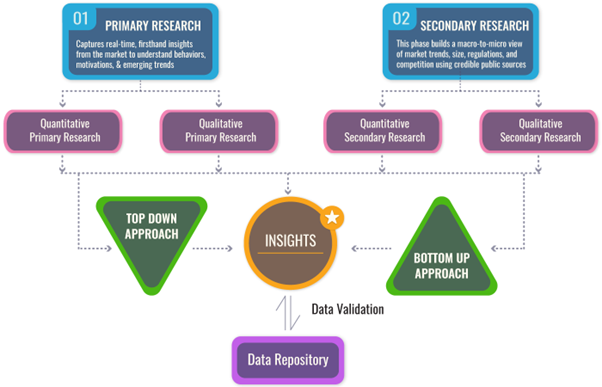
We follow a comprehensive, multi-phase research framework designed to deliver accurate, strategic, and decision-ready intelligence. Our process integrates primary and secondary research , both quantitative and qualitative , along with dual modeling techniques ( top-down and bottom-up) and a final layer of validation through our proprietary in-house repository.
PRIMARY RESEARCH
Primary research captures real-time, firsthand insights from the market to understand behaviors, motivations, and emerging trends.
1. Quantitative Primary Research
Objective: Generate statistically significant data directly from market participants.
Approaches:- Structured surveys with customers, distributors, and field agents
- Mobile-based data collection for point-of-sale audits and usage behavior
- Phone-based interviews (CATI) for market sizing and product feedback
- Online polling around industry events and digital campaigns
- Purchase frequency by customer type
- Channel performance across geographies
- Feature demand by application or demographic
2. Qualitative Primary Research
Objective: Explore decision-making drivers, pain points, and market readiness.
Approaches:- In-depth interviews (IDIs) with executives, product managers, and key decision-makers
- Focus groups among end users and early adopters
- Site visits and observational research for consumer products
- Informal field-level discussions for regional and cultural nuances
SECONDARY RESEARCH
This phase helps establish a macro-to-micro understanding of market trends, size, regulation, and competitive dynamics, sourced from credible and public domain information.
1. Quantitative Secondary Research
Objective: Model market value and segment-level forecasts based on published data.
Sources include:- Financial reports and investor summaries
- Government trade data, customs records, and regulatory statistics
- Industry association publications and economic databases
- Channel performance and pricing data from marketplace listings
- Revenue splits, pricing trends, and CAGR estimates
- Supply-side capacity and volume tracking
- Investment analysis and funding benchmarks
2. Qualitative Secondary Research
Objective: Capture strategic direction, innovation signals, and behavioral trends.
Sources include:- Company announcements, roadmaps, and product pipelines
- Publicly available whitepapers, conference abstracts, and academic research
- Regulatory body publications and policy briefs
- Social and media sentiment scanning for early-stage shifts
- Strategic shifts in market positioning
- Unmet needs and white spaces
- Regulatory triggers and compliance impact
DUAL MODELING: TOP-DOWN + BOTTOM-UP
To ensure robust market estimation, we apply two complementary sizing approaches:
Top-Down Modeling:- Start with broader industry value (e.g., global or regional TAM)
- Apply filters by segment, geography, end-user, or use case
- Adjust with primary insights and validation benchmarks
- Ideal for investor-grade market scans and opportunity mapping
- Aggregate from the ground up using sales volumes, pricing, and unit economics
- Use internal modeling templates aligned with stakeholder data
- Incorporate distributor-level or region-specific inputs
- Most accurate for emerging segments and granular sub-markets
DATA VALIDATION: IN-HOUSE REPOSITORY
We close the loop with proprietary data intelligence built from ongoing projects, industry monitoring, and historical benchmarking. This repository includes:
- Multi-sector market and pricing models
- Key trendlines from past interviews and forecasts
- Benchmarked adoption rates, churn patterns, and ROI indicators
- Industry-specific deviation flags and cross-check logic
- Catches inconsistencies early
- Aligns projections across studies
- Enables consistent, high-trust deliverables