

Infertility Treatment Market Size and Forecast (2025–2033), Global and Regional Share, Trends, and Industry Analysis Report Coverage: By Product (Equipment, Media & Consumables, Accessories), By Procedure (Assisted Reproductive Technology, Artificial Insemination, Fertility Surgeries), By Patient Type (Female Infertility Treatment, Male Infertility Treatment), By End User (Fertility Centers, Hospitals & Surgical Clinics, Cryobanks, Research Institutes), and Geography
2025-12-18
Healthcare
Swetal (Research Analyst)
Description
Infertility
Treatment Market Overview
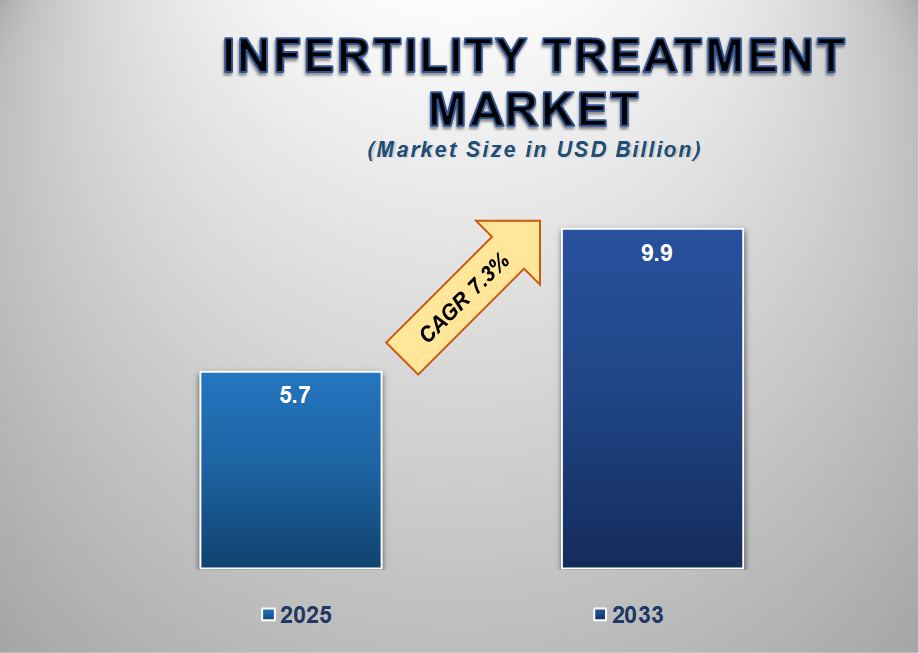
The Global Infertility Treatment Market Size is projected to increase from USD 5.7 billion in 2025 to USD 9.9 billion by 2033, growing at a CAGR of 7.3%. This growth is driven by rising infertility prevalence caused by lifestyle changes, delayed pregnancies, hormonal disorders, and growing awareness about reproductive health. Technological advancements in assisted reproductive technologies (ART), including improved embryo selection techniques, innovative sperm analysis systems, and high-precision ovum aspiration pumps, are supporting adoption in both developed and emerging markets.
The demand for higher success
rates in fertility procedures has pushed clinics and hospitals to adopt
advanced microscopes, incubators, and micromanipulator systems. The expansion
of fertility centers, increased medical tourism for IVF treatments, and reimbursement
improvements in countries such as the U.S., Japan, and parts of Europe further
support market growth. Meanwhile, growing investments by major pharmaceutical
and biotech companies in fertility drugs, specialized media, and consumables
are strengthening the overall treatment ecosystem.
Infertility
Treatment Market Drivers and Opportunities
Rising Infertility Rates and
Lifestyle Disorders Are Driving the Infertility Treatment Market Growth
Sedentary lifestyles, obesity,
stress, smoking, alcohol consumption, and hormonal imbalances have become
widespread globally, substantially increasing infertility rates in both men and
women. Polycystic ovary syndrome (PCOS), one of the most common causes of
female infertility, continues to rise sharply worldwide, contributing to a
heightened demand for ovulation induction, ICSI, and IVF procedures. In men,
issues such as declining sperm count, poor motility, and genetic abnormalities
are increasingly diagnosed due to improved sperm analyzer systems and advanced
imaging tools. Environmental pollution and exposure to endocrine-disrupting
chemicals have also been linked to deteriorating reproductive health. As these
conditions become more prevalent, couples are seeking timely diagnosis and
treatment, which is increasing the adoption of ART procedures, fertility
surgeries, and assisted insemination. Healthcare providers are also offering
personalized treatment plans based on patient-specific conditions, supported by
advanced lab technologies such as micromanipulators, incubators, and
cryopreservation systems.
Government programs promoting
awareness and early diagnosis of infertility are emerging as strong enablers of
market growth. As the number of affected individuals rises globally,
infertility treatment services are becoming a standard component of women’s and
men’s reproductive care.
Technological Advancements in
ART and Lab Equipment Are Strengthening Market Expansion
The infertility treatment
landscape has evolved significantly with rapid advancements in ART
technologies, laboratory equipment, and assisted reproduction methodologies.
High-resolution microscopes, precision micromanipulator systems, and AI-enabled
sperm analysis tools have enhanced fertility clinics’ ability to diagnose
infertility accurately and improve fertilization success rates. Similarly,
advanced incubators with controlled temperature and atmospheric conditions have
boosted embryo viability, while innovative cryosystems enable long-term storage
of gametes and embryos with minimal degradation.
Laser-assisted hatching,
time-lapse embryo imaging, and automated ovum aspiration pumps are further
improving procedural efficiency and outcomes. These developments have also
increased the global acceptance of fertility treatments, especially among couples
seeking higher success probabilities in their first treatment cycle.
Furthermore, gamete donation, surrogacy solutions, and minimally invasive
fertility surgeries have become more technologically sophisticated, allowing
clinicians to address complex infertility cases. As fertility centers
increasingly invest in modern laboratory environments, demand for consumables,
media, and accessories continues to rise. The integration of digital
technologies such as teleconsultation platforms and electronic patient records
enables more streamlined workflows, expanding the effectiveness of fertility
practices globally.
Emerging Fertility Tourism in
Asia-Pacific and Eastern Europe Is Creating Significant Market Opportunities
The expansion of fertility
tourism driven by cost advantages, advanced treatment availability, and
favorable regulatory environments represents a major growth opportunity for the
infertility treatment market. Asia-Pacific countries such as India, Thailand,
Malaysia, and Vietnam have become global hubs for IVF and ART procedures due to
lower treatment costs, highly skilled embryologists, and the presence of
world-class fertility centers. These countries attract patients from North
America, Europe, and the Middle East seeking affordable treatment options
without compromising success rates. Eastern Europe, including Ukraine, Georgia,
and the Czech Republic, has also emerged as a competitive destination for
surrogacy and IVF due to supportive legal frameworks and access to high-quality
procedures. Many clinics offer comprehensive treatment packages combining
surgical procedures, IVF cycles, embryo transfer, and donor programs, making
fertility tourism more accessible. This trend not only boosts the demand for
ART procedures but also increases the consumption of laboratory equipment,
imaging systems, consumables, and cryopreservation technologies. As more
countries establish specialized fertility zones and streamline medical visa
processes, fertility tourism is expected to accelerate significantly over the
next decade.
Infertility Treatment Market Scope
|
Report Attributes |
Description |
|
Market Size in 2025 |
USD 5.7 Billion |
|
Market Forecast in 2033 |
USD 9.9 Billion |
|
CAGR % 2025-2033 |
7.3% |
|
Base Year |
2024 |
|
Historic Data |
2020-2024 |
|
Forecast Period |
2025-2033 |
|
Report USP |
Production, Consumption,
Company Share, Company Heatmap, Company Production Capacity, Growth Factors,
and more |
|
Segments Covered |
●
Product,
Procedure, Patient Type, End User |
|
Regional Scope |
●
North America ●
Europe ●
APAC ●
Latin America ●
Middle East and
Africa |
|
Country Scope |
1)
U.S. 2)
Canada 3)
Germany 4)
UK 5)
France 6)
Spain 7)
Italy 8)
Switzerland 9)
China 10)
Japan 11)
India 12)
Australia 13)
South Korea 14)
Brazil 15)
Mexico 16)
Argentina 17)
South Africa 18)
Saudi Arabia 19)
UAE |
Infertility Treatment Market Report Segmentation Analysis
The Infertility Treatment Market
is segmented into Product, Procedure, Patient Type, End User, and region.
The Equipment Segment
Accounted for the Largest Market Share in the Global Infertility Treatment
Market
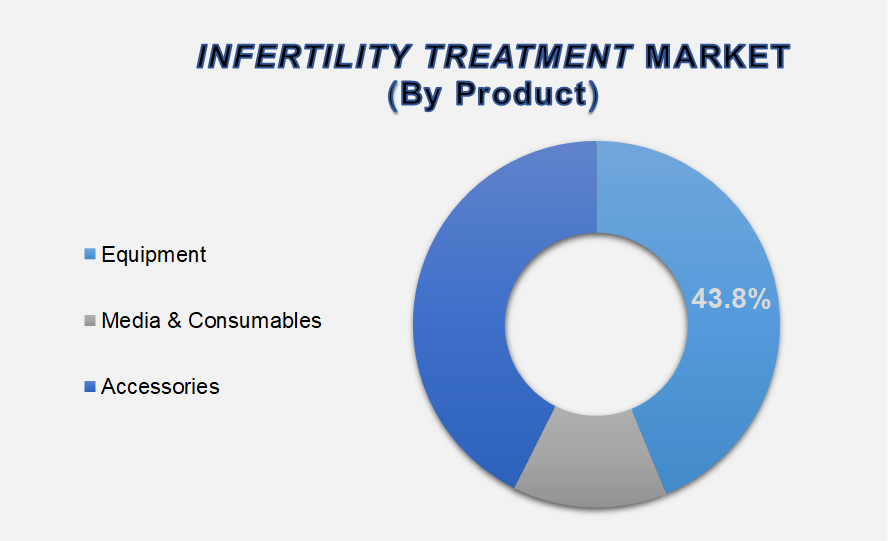
By Product, the market is segmented into Equipment, Microscopes, Imaging Systems, Sperm Analyzer Systems, Ovum Aspiration Pumps, Micromanipulator Systems, Incubators, Gas Analyzers, Laser Systems, Cryosystems, Sperm Separation Devices, Media & Consumables, and Accessories. The Equipment segment dominated the global infertility treatment market in 2025, holding the largest share due to the increasing adoption of advanced laboratory systems required for ART procedures. Growing demand for incubators, ovum aspiration pumps, and micromanipulation systems is driving this segment’s expansion, as fertility centers prioritize technologies that enhance embryo viability and fertilization success. The rising number of IVF cycles, increasing investments in fertility clinic infrastructure, and the need for high-efficiency lab environments are strengthening equipment usage. As clinics focus on improving clinical outcomes and reducing procedure time, the demand for technologically advanced equipment will continue to grow.
Assisted Reproductive
Technology Segment Held the Largest Market Share
By Procedure, the market is
segmented into Assisted Reproductive Technology, In Vitro Fertilization,
Intracytoplasmic Morphologically Selected Sperm Injection, Gamete Donation,
Intracytoplasmic Sperm Injection, Surrogacy, Artificial Insemination, Intrauterine
Insemination, Intracervical Insemination, Intratubal Insemination, and
Fertility Surgeries. The Assisted Reproductive Technology (ART) segment
accounted for the largest share in 2025, driven by the rising adoption of IVF,
ICSI, and related procedures as primary solutions for infertility.
ART offers higher success rates
and is widely recommended for both male and female infertility cases.
Advancements in embryo screening, cryopreservation, and micromanipulation
techniques further support ART adoption across fertility centers globally. Growing
medical tourism for IVF and the increasing availability of cost-effective ART
clinics in APAC and Eastern Europe are boosting this segment.
Female Infertility Treatment
Segment Led the Market
By
Patient Type, the market is segmented into Female Infertility Treatment and
Male Infertility Treatment. The Female Infertility Treatment segment held the
largest market share in 2025, attributed to the higher prevalence of PCOS,
ovulation disorders, age-related fertility decline, and fallopian tube
complications. Increasing awareness about reproductive health, rising adoption
of IVF and IUI procedures, and growing demand for hormonal therapies are
contributing to the dominance of this segment. Additionally, delayed
pregnancies due to career-oriented lifestyles are increasing infertility risks
among women, amplifying treatment adoption. The availability of advanced
diagnostic tools and personalized treatment protocols further supports growth.
The following segments are
part of an in-depth analysis of the global Infertility Treatment Market:
|
Market
Segments |
|
|
By Product |
●
Equipment o
Microscopes o
Imaging Systems o
Sperm Analyzer
Systems o
Ovum Aspiration
Pumps o
Micromanipulator
Systems o
Incubators o
Gas Analyzers o
Laser Systems o
Cryosystems o
Sperm Separation
Devices ●
Media &
Consumables ●
Accessories |
|
By Procedure |
●
Assisted
Reproductive Technology o
In Vitro
Fertilization o
Intracytoplasmic
Morphologically Selected Sperm Injection o
Gamete Donation o
Intracytoplasmic
Sperm Injection o
Surrogacy ●
Artificial
Insemination o
Intrauterine
Insemination o
Intracervical
Insemination o
Intratubal
Insemination ●
Fertility
Surgeries o
Laparoscopy o
Hysteroscopy o
Myomectomy o
Laparotomy o
Tubal Ligation
Reversal o
Varicocelectomy o
Microsurgical
Reconstruction o
Vasovasostomy o
Vasoepididymostomy ●
Other Infertility
Treatment Procedures |
|
By Patient
Type |
●
Female Infertility
Treatment ●
Male Infertility
Treatment |
|
By End User |
●
Fertility Centers ●
Hospitals &
Surgical Clinics ●
Cryobanks ●
Research Institutes |
Infertility
Treatment Market Share Analysis by Region
The North America region is
projected to hold the largest share of the global Infertility Treatment market
over the forecast period.
North America accounted for the
largest share of 40.6% in the global infertility treatment market in 2025. The
region’s dominance is supported by advanced healthcare infrastructure, high
infertility screening rates, widespread availability of ART clinics, and strong
insurance support for fertility treatments in select U.S. states. The presence
of major players, including Merck KGaA, Ferring Pharmaceuticals, and
CooperSurgical, further strengthens the market landscape. Increasing cases of
delayed parenthood and lifestyle-driven fertility decline continue to fuel
treatment demand across the U.S. and Canada.
Asia-Pacific is projected to grow
at the highest CAGR during the forecast period. Countries such as India, China,
Japan, South Korea, and Australia are witnessing the rapid expansion of IVF
centers, rising affordability, increasing fertility tourism, and improving
technological capabilities. Supportive government initiatives, reduced
treatment costs, and the availability of highly skilled fertility specialists
make APAC an emerging global hub for ART procedures. As awareness improves and
patient volumes increase, APAC is expected to significantly outpace other
regions.
Infertility Treatment Market Competition Landscape Analysis
The global
infertility treatment market is moderately competitive, with key players
focusing on expanding their ART portfolios, improving success rates, and
strengthening laboratory product offerings. Leading companies include Merck
KGaA, Ferring Pharmaceuticals, Merck & Co., Bayer AG, AbbVie, Thermo Fisher
Scientific, Vitrolife, Cook Medical, CooperSurgical, Irvine Scientific, Genea
Biomedx, Esco Micro, The Baker Company, IVFtech, Kitazato Corporation, Rocket
Medical, MediCult, and Nidacon International.
Global Infertility Treatment Market Recent Developments
News:
- In 2021, CooperSurgical
partnered with Virtus Health to enhance access to advanced fertility
technologies, expanding treatment options for couples experiencing
infertility through shared expertise and innovative solutions.
- In 2021, Hamilton Thorne Ltd.
received FDA approval and European market clearance for GYNEMED GM501, a
ready-to-use medium for washing and handling human oocytes and embryos
during in vitro fertilization (IVF) procedures.
The Global Infertility Treatment Market is dominated
by a few large companies, such as
●
Merck KGaA
●
Ferring
Pharmaceuticals
●
Merck & Co.
●
Bayer AG
●
AbbVie
●
Thermo Fisher
Scientific
●
Vitrolife
●
Cook Medical
●
CooperSurgical
●
Irvine Scientific
●
Genea Biomedx
●
Esco Micro
●
The Baker Company
●
IVFtech
●
Kitazato Corporation
●
Rocket Medical
●
MediCult
●
Nidacon International
●
Wallach Surgical
●
Gynotec
● Other Prominent Players
Frequently Asked Questions
Swetal (Research Analyst)
Swetal is a Research Analyst with 4+ years of experience specializing in healthcare market research, medical devices, healthcare IT, and medical technology industry analysis. Her expertise includes competitive intelligence, secondary research, market trend forecasting, and healthcare business insights across global healthcare ecosystems.
She contributes to advanced market research reports by analyzing regulatory frameworks, emerging healthcare technologies, competitive landscapes, and innovation trends shaping the medical industry. With a strong focus on accurate market intelligence, strategic insights, and healthcare industry trends, Swetal supports businesses in making informed, data-backed decisions in a rapidly transforming healthcare environment.
1. Global Infertility
Treatment Market Introduction and Market Overview
1.1.
Objectives
of the Study
1.2.
Global
Infertility Treatment Market Scope and Market Estimation
1.2.1.Global Infertility
Treatment Market Overall Market Size (US$ Bn), Market CAGR (%), Market forecast
(2025 - 2033)
1.2.2.Global Infertility
Treatment Market Revenue Share (%) and Growth Rate (Y-o-Y) from 2020 - 2033
1.3.
Market
Segmentation
1.3.1.Product of Global Infertility
Treatment Market
1.3.2.Procedure of Global Infertility
Treatment Market
1.3.3.Patient Type of Global Infertility
Treatment Market
1.3.4.End-user of Global Infertility
Treatment Market
1.3.5.Region of Global Infertility
Treatment Market
2. Executive
Summary
2.1.
Demand
Side Trends
2.2.
Key
Market Trends
2.3.
Market
Demand (US$ Bn) Analysis 2020 – 2024 and Forecast, 2025 – 2033
2.4.
Demand
and Opportunity Assessment
2.5.
Demand
Supply Scenario
2.6.
Market
Dynamics
2.6.1.Drivers
2.6.2.Limitations
2.6.3.Opportunities
2.6.4.Impact Analysis of Drivers
and Restraints
2.7.
Emerging
Trends for Infertility Treatment Market
2.8.
Porter’s
Five Forces Analysis
2.9.
PEST
Analysis
2.10.
Key
Regulation
3. Global
Infertility Treatment Market Estimates
& Historical Trend Analysis (2020 - 2024)
4.
Global Infertility
Treatment Market Estimates
& Forecast Trend Analysis, by Product
4.1.
Global
Infertility Treatment Market Revenue (US$ Bn) Estimates and Forecasts, by Product,
2020 - 2033
4.1.1.Equipment
4.1.1.1.
Microscopes
4.1.1.2.
Imaging
Systems
4.1.1.3.
Sperm
Analyzer Systems
4.1.1.4.
Ovum
Aspiration Pumps
4.1.1.5.
Micromanipulator
Systems
4.1.1.6.
Incubators
4.1.1.7.
Gas
Analyzers
4.1.1.8.
Laser
Systems
4.1.1.9.
Cryosystems
4.1.1.10.
Sperm
Separation Devices
4.1.2.Media & Consumables
4.1.3.Accessories
5.
Global Infertility
Treatment Market Estimates
& Forecast Trend Analysis, by Procedure
5.1.
Global
Infertility Treatment Market Revenue (US$ Bn) Estimates and Forecasts, by Procedure,
2020 - 2033
5.1.1.Assisted Reproductive
Technology
5.1.1.1.
In
Vitro Fertilization
5.1.1.2.
Intracytoplasmic
Morphologically Selected Sperm Injection
5.1.1.3.
Gamete
Donation
5.1.1.4.
Intracytoplasmic
Sperm Injection
5.1.1.5.
Surrogacy
5.1.2.Artificial Insemination
5.1.2.1.
Intrauterine
Insemination
5.1.2.2.
Intracervical
Insemination
5.1.2.3.
Intratubal
Insemination
5.1.3. Fertility Surgeries
5.1.3.1.
Laparoscopy
5.1.3.2.
Hysteroscopy
5.1.3.3.
Myomectomy
5.1.3.4.
Laparotomy
5.1.3.5.
Tubal
Ligation Reversal
5.1.3.6.
Varicocelectomy
5.1.3.7.
Microsurgical
Reconstruction
5.1.3.8.
Vasovasostomy
5.1.3.9.
Vasoepididymostomy
5.1.4.Other Infertility
Treatment Procedures
6.
Global Infertility
Treatment Market Estimates
& Forecast Trend Analysis, by Patient Type
6.1.
Global
Infertility Treatment Market Revenue (US$ Bn) Estimates and Forecasts, by Patient
Type, 2020 - 2033
6.1.1.Female Infertility
Treatment
6.1.2.Male Infertility Treatment
7.
Global Infertility
Treatment Market Estimates
& Forecast Trend Analysis, by End-user
7.1.
Global
Infertility Treatment Market Revenue (US$ Bn) Estimates and Forecasts, by End-user,
2020 - 2033
7.1.1.Fertility Centers
7.1.2.Hospitals & Surgical
Clinics
7.1.3.Cryobanks
7.1.4.Research Institutes
8. Global
Infertility Treatment Market Estimates
& Forecast Trend Analysis, by region
1.1.
Global
Infertility Treatment Market Revenue (US$ Bn) Estimates and Forecasts, by
region, 2020 - 2033
1.1.1.North America
1.1.2.Europe
1.1.3.Asia Pacific
1.1.4.Middle East & Africa
1.1.5.Latin America
9. North America Infertility
Treatment Market: Estimates &
Forecast Trend Analysis
9.1.
North
America Infertility Treatment Market Assessments & Key Findings
9.1.1.North America Infertility
Treatment Market Introduction
9.1.2.North America Infertility
Treatment Market Size Estimates and Forecast (US$ Billion) (2020 - 2033)
9.1.2.1. By Product
9.1.2.2. By Procedure
9.1.2.3. By Patient
Type
9.1.2.4. By End-user
9.1.2.5.
By
Country
9.1.2.5.1. The U.S.
9.1.2.5.2. Canada
10. Europe Infertility
Treatment Market: Estimates &
Forecast Trend Analysis
10.1.
Europe
Infertility Treatment Market Assessments & Key Findings
10.1.1.
Europe
Infertility Treatment Market Introduction
10.1.2.
Europe
Infertility Treatment Market Size Estimates and Forecast (US$ Billion) (2020 - 2033)
10.1.2.1. By Product
10.1.2.2. By Procedure
10.1.2.3. By Patient
Type
10.1.2.4. By End-user
10.1.2.5.
By
Country
10.1.2.5.1.
Germany
10.1.2.5.2.
Italy
10.1.2.5.3.
U.K.
10.1.2.5.4.
France
10.1.2.5.5.
Spain
10.1.2.5.6.
Switzerland
10.1.2.5.7. Rest
of Europe
11. Asia Pacific Infertility
Treatment Market: Estimates &
Forecast Trend Analysis
11.1.
Asia
Pacific Market Assessments & Key Findings
11.1.1.
Asia
Pacific Infertility Treatment Market Introduction
11.1.2.
Asia
Pacific Infertility Treatment Market Size Estimates and Forecast (US$ Billion)
(2020 - 2033)
11.1.2.1. By Product
11.1.2.2. By Procedure
11.1.2.3. By Patient
Type
11.1.2.4. By End-user
11.1.2.5.
By
Country
11.1.2.5.1. China
11.1.2.5.2. Japan
11.1.2.5.3. India
11.1.2.5.4. Australia
11.1.2.5.5. South Korea
11.1.2.5.6. Rest of Asia Pacific
12. Middle East & Africa Infertility
Treatment Market: Estimates &
Forecast Trend Analysis
12.1.
Middle
East & Africa Market Assessments & Key Findings
12.1.1.
Middle East & Africa Infertility Treatment Market
Introduction
12.1.2.
Middle East & Africa Infertility Treatment Market Size Estimates
and Forecast (US$ Billion) (2020 - 2033)
12.1.2.1. By Product
12.1.2.2. By Procedure
12.1.2.3. By Patient
Type
12.1.2.4. By End-user
12.1.2.5.
By
Country
12.1.2.5.1. South
Africa
12.1.2.5.2. UAE
12.1.2.5.3. Saudi
Arabia
12.1.2.5.4. Rest
of MEA
13. Latin America
Infertility Treatment Market: Estimates
& Forecast Trend Analysis
13.1.
Latin
America Market Assessments & Key Findings
13.1.1.
Latin
America Infertility Treatment Market Introduction
13.1.2.
Latin
America Infertility Treatment Market Size Estimates and Forecast (US$ Billion)
(2020 - 2033)
13.1.2.1. By Product
13.1.2.2. By Procedure
13.1.2.3. By Patient
Type
13.1.2.4. By End-user
13.1.2.5.
By
Country
13.1.2.5.1. Brazil
13.1.2.5.2. Mexico
13.1.2.5.3. Argentina
13.1.2.5.4. Rest
of LATAM
14. Country Wise Market:
Introduction
15.
Competition
Landscape
15.1.
Global
Infertility Treatment Market Product Mapping
15.2.
Global
Infertility Treatment Market Concentration Analysis, by Leading Players /
Innovators / Emerging Players / New Entrants
15.3.
Global
Infertility Treatment Market Tier Structure Analysis
15.4.
Global
Infertility Treatment Market Concentration & Company Market Shares (%)
Analysis, 2023
16.
Company
Profiles
16.1. Merck
KGaA
16.1.1.
Company
Overview & Key Stats
16.1.2.
Financial
Performance & KPIs
16.1.3.
Product
Portfolio
16.1.4.
SWOT
Analysis
16.1.5.
Business
Strategy & Recent Developments
*
Similar details would be provided for all the players mentioned below
16.2. Ferring
Pharmaceuticals
16.3. Merck &
Co.
16.4. Bayer AG
16.5. AbbVie
16.6. Thermo Fisher
Scientific
16.7. Vitrolife
16.8. Cook Medical
16.9. CooperSurgical
16.10. Irvine
Scientific
16.11. Genea Biomedx
16.12. Esco Micro
16.13. The Baker
Company
16.14. IVFtech
16.15. Kitazato
Corporation
16.16. Rocket
Medical
16.17. MediCult
16.18. Nidacon
International
16.19. Wallach
Surgical
16.20. Gynotec
16.21. Other
Prominent Players
17. Research
Methodology
17.1.
External
Transportations / Databases
17.2.
Internal
Proprietary Database
17.3.
Primary
Research
17.4.
Secondary
Research
17.5.
Assumptions
17.6.
Limitations
17.7.
Report
FAQs
18. Research
Findings & Conclusion
Our Research Methodology
"Insight without rigor is just noise."
We follow a comprehensive, multi-phase research framework designed to deliver accurate, strategic, and decision-ready intelligence. Our process integrates primary and secondary research , both quantitative and qualitative , along with dual modeling techniques ( top-down and bottom-up) and a final layer of validation through our proprietary in-house repository.
PRIMARY RESEARCH
Primary research captures real-time, firsthand insights from the market to understand behaviors, motivations, and emerging trends.
1. Quantitative Primary Research
Objective: Generate statistically significant data directly from market participants.
Approaches:- Structured surveys with customers, distributors, and field agents
- Mobile-based data collection for point-of-sale audits and usage behavior
- Phone-based interviews (CATI) for market sizing and product feedback
- Online polling around industry events and digital campaigns
- Purchase frequency by customer type
- Channel performance across geographies
- Feature demand by application or demographic
2. Qualitative Primary Research
Objective: Explore decision-making drivers, pain points, and market readiness.
Approaches:- In-depth interviews (IDIs) with executives, product managers, and key decision-makers
- Focus groups among end users and early adopters
- Site visits and observational research for consumer products
- Informal field-level discussions for regional and cultural nuances
SECONDARY RESEARCH
This phase helps establish a macro-to-micro understanding of market trends, size, regulation, and competitive dynamics, sourced from credible and public domain information.
1. Quantitative Secondary Research
Objective: Model market value and segment-level forecasts based on published data.
Sources include:- Financial reports and investor summaries
- Government trade data, customs records, and regulatory statistics
- Industry association publications and economic databases
- Channel performance and pricing data from marketplace listings
- Revenue splits, pricing trends, and CAGR estimates
- Supply-side capacity and volume tracking
- Investment analysis and funding benchmarks
2. Qualitative Secondary Research
Objective: Capture strategic direction, innovation signals, and behavioral trends.
Sources include:- Company announcements, roadmaps, and product pipelines
- Publicly available whitepapers, conference abstracts, and academic research
- Regulatory body publications and policy briefs
- Social and media sentiment scanning for early-stage shifts
- Strategic shifts in market positioning
- Unmet needs and white spaces
- Regulatory triggers and compliance impact
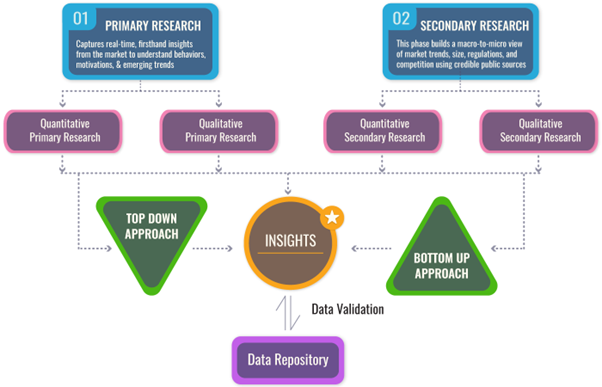
DUAL MODELING: TOP-DOWN + BOTTOM-UP
To ensure robust market estimation, we apply two complementary sizing approaches:
Top-Down Modeling:- Start with broader industry value (e.g., global or regional TAM)
- Apply filters by segment, geography, end-user, or use case
- Adjust with primary insights and validation benchmarks
- Ideal for investor-grade market scans and opportunity mapping
- Aggregate from the ground up using sales volumes, pricing, and unit economics
- Use internal modeling templates aligned with stakeholder data
- Incorporate distributor-level or region-specific inputs
- Most accurate for emerging segments and granular sub-markets
DATA VALIDATION: IN-HOUSE REPOSITORY
We close the loop with proprietary data intelligence built from ongoing projects, industry monitoring, and historical benchmarking. This repository includes:
- Multi-sector market and pricing models
- Key trendlines from past interviews and forecasts
- Benchmarked adoption rates, churn patterns, and ROI indicators
- Industry-specific deviation flags and cross-check logic
- Catches inconsistencies early
- Aligns projections across studies
- Enables consistent, high-trust deliverables