

Insect Protein Market Size and Forecast (2026–2034), Global and Regional Growth, Trend, Share and Industry Analysis Report Coverage; By Insect Type (Coleoptera, Diptera, Orthoptera, Lepidoptera, Hymenoptera, Hemiptera, Others); By Application (Animal Feed, Food & Beverages, Pet Food, Pharmaceuticals & Supplements, Personal Care & Cosmetics, Others); By Distribution Channel (Offline, Online); and Geography
2026-09-25
Consumer Products
Aishwarya Panbude (Research Analyst)
Description
Insect Protein Market Overview
The global Insect
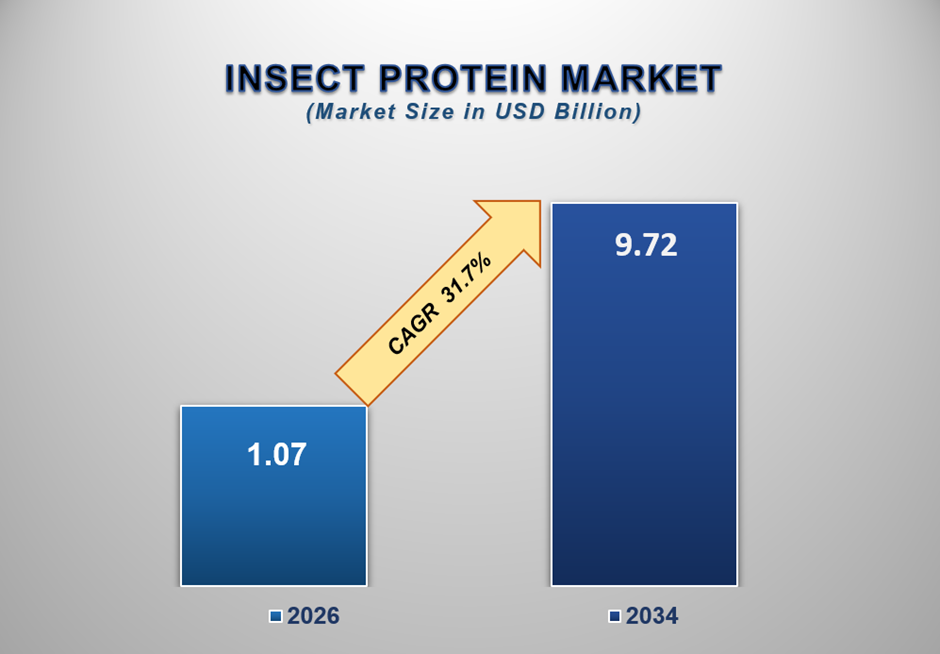
Protein Market was valued at USD 1.07 billion in 2026 and is
projected to reach USD 9.72 billion by 2034, expanding at a CAGR of
31.7% during the forecast period. The market is experiencing rapid growth
due to increasing demand for sustainable protein sources, rising pressure to
improve the resource efficiency of food and feed production, growing adoption
of insect-derived ingredients in animal nutrition, advancements in automated
insect farming, increasing interest in alternative proteins, and expanding
applications across food, pet nutrition, aquaculture, pharmaceuticals, and
personal care.
Insect protein
refers to protein-rich ingredients produced from commercially farmed insects
and processed into forms such as whole-insect powder, defatted insect meal,
protein flour, protein concentrates, and functional ingredients. Commonly
utilized species include black soldier fly larvae, mealworms, crickets,
grasshoppers, and other commercially suitable insects.
The market is
gaining attention because insect farming can convert selected organic
feedstocks into protein, fats, and other useful biological materials while
requiring comparatively limited land and water resources. This characteristic
is strengthening the role of insect-based ingredients within the broader
circular bioeconomy and alternative-protein landscape.
The increasing
requirement for sustainable animal nutrition is one of the most important
factors supporting market development. Insect-derived meals are being evaluated
and commercialized as alternative ingredients for aquaculture, poultry,
livestock, and pet nutrition, particularly where producers are seeking
alternatives to conventional protein sources such as fishmeal and soybean meal.
Aquaculture
represents an important area of opportunity because feed manufacturers are
under increasing pressure to improve the sustainability of fish and shrimp
production. Insect protein can provide amino acids, lipids, and other
nutritional components that can be incorporated into formulated feed products.
Commercial partnerships involving insect ingredient producers and feed
companies are consequently expanding the potential addressable market.
Pet food is also
becoming an increasingly attractive application. Premium pet food manufacturers
are exploring insect proteins as novel and sustainable ingredients for
formulations positioned around high-quality nutrition, alternative protein
sources, digestibility, and environmental considerations. Regulatory approvals
for specific insect-derived ingredients in pet food are further supporting
commercialization in selected markets.
Human food
applications are developing more gradually but offer substantial long-term
potential. Insect proteins can be incorporated into protein bars, snacks, baked
products, sports nutrition products, powders, and other functional foods.
However, consumer acceptance, taste, texture, cultural preferences, labeling
requirements, and food-safety considerations remain important factors
influencing the pace of adoption.
Advancements in
insect farming technologies are improving the scalability of commercial
production. Automated feeding, environmental monitoring, breeding optimization,
larval counting, artificial intelligence, robotics, and data-driven production
systems are being increasingly integrated into industrial insect farms. These
technologies can improve consistency, reduce labor requirements, and increase
production efficiency.
The
circular-economy characteristics of insect farming are also creating new
commercial opportunities. Black soldier fly larvae, for example, can be
integrated into systems designed to transform suitable organic residual streams
into protein-rich biomass, insect oil, and frass-based agricultural products.
Commercial projects in Europe demonstrate the increasing integration of insect
bioconversion with waste-management and feed-production models.
Regulatory
developments are another important factor shaping the industry. As governments
and food-safety authorities establish rules concerning permissible insect
species, substrates, processing standards, labeling, and applications,
companies are gaining clearer pathways for commercialization. At the same time,
regulatory differences between regions continue to influence which applications
can be scaled.
Despite strong
growth potential, the market continues to face challenges associated with
production costs, consumer acceptance, scale economics, regulatory complexity,
and the ability of producers to compete with established protein ingredients on
price. The industry has therefore increasingly shifted toward higher-value
applications such as pet food, aquaculture, specialty nutrition, and functional
ingredients rather than relying exclusively on mass-market human food.
As production
technology improves, regulatory frameworks mature, and food and feed
manufacturers increasingly evaluate alternative protein inputs, insect-derived
ingredients are expected to transition from a niche category toward a more
specialized and commercially relevant component of the global protein industry
through 2034.
Insect Protein Market Drivers and
Opportunities
Growing
Demand for Sustainable Protein and Alternative Feed Ingredients Is Driving
Market Growth
The increasing
need to produce protein more efficiently is one of the primary factors driving
the insect protein market.
Conventional
protein production systems require significant quantities of land, water, feed,
energy, and other resources. As global demand for food and animal nutrition
continues to increase, producers are evaluating alternative protein sources
that can provide nutritional value with improved resource efficiency.
Insect farming
offers an alternative production model because commercially suitable insect
species can be raised in controlled environments using comparatively limited
land requirements. Certain insect species can also utilize approved organic
feedstocks, creating opportunities to connect food production, agricultural
by-products, and circular resource-management systems.
The increasing
pressure on aquaculture and livestock producers to reduce environmental impacts
is particularly important. Fishmeal and soybean meal remain major protein
ingredients, but concerns regarding resource availability, supply-chain
volatility, land use, and environmental effects are encouraging feed
manufacturers to examine alternative inputs.
Insect protein
is therefore attracting interest as an ingredient for aquaculture feed, poultry
feed, livestock nutrition, and pet food. Animal feed currently represents one
of the most commercially developed applications of insect protein, with
industry analysis indicating that feed applications account for a substantial
proportion of market demand.
The development
of automated insect farms is also helping producers address the scalability
challenge. Technologies for environmental control, automated feeding, breeding,
harvesting, drying, and processing are improving production consistency and
reducing dependence on manual operations.
Increasing
Adoption in Pet Food, Aquaculture, and Functional Nutrition Is Supporting
Market Expansion
The expansion of
higher-value applications is creating additional demand for insect-derived
proteins.
Pet food
manufacturers are increasingly exploring novel protein sources as consumers
become more interested in ingredient transparency, sustainability, and
differentiated nutrition. Insect proteins can be incorporated into premium pet
food formulations and may provide an alternative for brands seeking to
diversify their protein sources.
Aquaculture is
another important application because global fish and shrimp production depends
heavily on formulated feeds. Insect meal is being evaluated as a partial
replacement or complementary ingredient for conventional protein sources.
Commercial partnerships between insect protein producers and aquaculture
companies are helping move insect ingredients from experimental applications
toward larger-scale feed formulations. Recent industry developments include
collaborations involving insect protein producers, feed companies, and shrimp
supply chains.
Functional food
and sports nutrition products represent another developing opportunity. Insect
protein powders can provide concentrated protein and may be incorporated into
protein bars, snacks, powders, and other specialized nutrition products.
The combination
of nutritional functionality and sustainability positioning is encouraging
companies to develop more refined insect protein ingredients rather than
relying exclusively on conventional insect powders.
As product
processing improves, manufacturers are also working to reduce the visual and
sensory barriers associated with whole-insect consumption. Defatted protein
flours, protein concentrates, and processed ingredients can be incorporated
into familiar food formats, potentially improving consumer acceptance.
Automation,
Circular Bioeconomy Models, and New Protein Applications Present Significant
Opportunities
Technological
advancement and circular production models present substantial growth
opportunities for the insect protein industry.
Modern insect
farms are increasingly incorporating environmental sensors, automated feeding
systems, machine-vision technologies, production analytics, and controlled
breeding environments. These technologies can improve larval growth
consistency, optimize resource utilization, and support large-scale production.
The ability to
convert suitable organic residual streams into valuable protein ingredients is
another major opportunity. Insect bioconversion systems can create multiple
commercial outputs, including protein meal, insect oil, and frass-based
agricultural products, allowing producers to diversify revenue streams.
Commercial
projects in Europe demonstrate how insect bioconversion can be integrated into
broader circular-economy models. The European Commission has highlighted the
commercial development of insect-based waste-to-protein systems and their
expansion into industrial applications.
There is also
significant potential for insect proteins in specialized applications including
nutraceuticals, functional foods, cosmetics, animal health products, and
pharmaceutical ingredients. Protein, lipids, chitin, chitosan, and other
insect-derived compounds can provide opportunities beyond conventional feed
applications.
As manufacturers
achieve greater production scale, improve automation, and reduce processing
costs, the industry is expected to move toward more standardized,
application-specific ingredients. This transition could expand insect protein
from a niche alternative ingredient into a broader platform for sustainable
nutrition and bio-based products.
Insect Protein Market Scope
|
Report Attributes |
Description |
|
Market Size in 2026 |
USD 1.07 Billion |
|
Market Forecast in 2034 |
USD 9.72 Billion |
|
CAGR % 2026-2034 |
31.7% |
|
Base Year |
2025 |
|
Historic Data |
2021-2025 |
|
Forecast Period |
2026-2034 |
|
Report USP |
Production, Consumption,
Company Share, Company Heatmap, Company Production, Service Type, Growth
Factors and more |
|
Segments Covered |
• By Insect Type • By Application • By Distribution Channel |
|
Regional Scope |
● North America |
|
Country Scope |
U.S. |
Insect Protein Market Report
Segmentation Analysis
The global
insect protein market industry analysis is segmented by insect type, by
application, by distribution channel, and by region.
The Diptera
Segment Is Expected to Dominate the Market During the Forecast Period
The Diptera
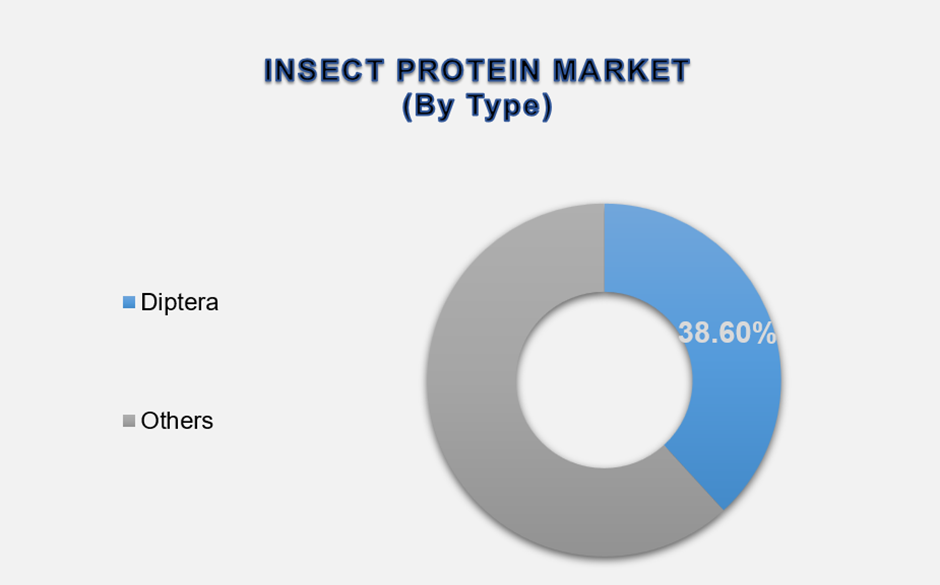
segment, primarily represented by Black Soldier Fly (BSF) larvae,
accounted for approximately 38.4% of the global insect protein market in
2026, making it the leading insect-type category.
Black soldier
fly larvae have gained significant commercial importance because of their
suitability for controlled industrial farming and their ability to convert
suitable organic substrates into protein-rich biomass.
BSF-derived
ingredients are widely evaluated for aquaculture, poultry, livestock, and pet
nutrition. Their nutritional profile, scalability, and compatibility with
automated farming systems have encouraged producers to invest in larger
production facilities.
The development
of insect bioconversion facilities is also strengthening demand for BSF-based
products. Producers can generate insect meal, oil, and frass from integrated
production systems, creating multiple potential revenue streams.
Increasing
investment in automation and industrial-scale BSF production is expected to
maintain the segment's leading position throughout the forecast period.
The Animal
Feed Segment Is Expected to Lead the Market by Application
The Animal
Feed segment is expected to hold the largest market share during the
forecast period due to increasing demand for alternative protein ingredients in
aquaculture, poultry, livestock, and other animal nutrition applications.
Insect meal is
particularly relevant to aquaculture because feed producers are seeking
alternatives and complementary ingredients to conventional fishmeal and
plant-based proteins.
The growing
demand for sustainable pet nutrition is also expanding the application base.
Insect-derived proteins are being incorporated into selected premium pet food
products, particularly where brands emphasize novel proteins, sustainability,
and differentiated nutritional positioning.
The
comparatively faster regulatory and commercial acceptance of insect-derived
feed ingredients relative to mainstream human food applications is expected to
support the segment's continued dominance.
The Offline
Segment Is Expected to Dominate the Market by Distribution Channel
The Offline
segment is expected to account for the largest market share because industrial
buyers, feed manufacturers, food processors, pet food companies, distributors,
specialty retailers, and ingredient suppliers continue to rely heavily on
direct sales and established distribution networks.
Business-to-business
insect protein transactions often involve bulk quantities, technical
specifications, formulation requirements, quality documentation, and long-term
supply agreements. These characteristics favor direct procurement and
specialized distribution channels.
However, the Online
segment is expected to register strong growth as consumer-facing insect protein
products, protein powders, snacks, nutritional products, and specialty food
products increasingly become available through e-commerce platforms and
direct-to-consumer channels.
The following
segments are part of an in-depth analysis of the global Insect Protein Market:
|
Market Segments |
|
|
By
Type |
●
Coleoptera ●
Diptera ●
Orthoptera ●
Lepidoptera ●
Hymenoptera ●
Hemiptera ●
Others |
|
By Application |
●
Animal Feed ●
Food & Beverages ●
Pet Food ●
Pharmaceuticals & Supplements ●
Personal Care & Cosmetics ●
Others |
|
By Distribution Channel |
●
Offline ●
Online |
Insect Protein Market Share Analysis
By Region
Europe is projected to hold the largest share of the global insect protein
market over the forecast period.
Europe accounted
for approximately 36.1% of the global market in 2026, supported by
strong sustainability policies, established insect farming companies, growing
interest in alternative proteins, regulatory progress, and increasing
investment in circular-economy technologies. Countries including France,
Germany, the U.K., Italy, Spain, and Switzerland represent important
markets within the region.
Europe has
developed a relatively advanced commercial ecosystem for insect-derived
ingredients, with companies focusing on mealworm, black soldier fly, and other
insect species for animal nutrition, pet food, food ingredients, and
specialized applications. The region's emphasis on resource efficiency and
sustainable food systems is supporting long-term industry development. European
market analysis also identifies the region as a major center for insect protein
commercialization.
Asia Pacific is expected to register the highest CAGR during the forecast
period. The region benefits from long-standing cultural acceptance of insect
consumption in selected markets, a large agricultural and aquaculture industry,
expanding food production, increasing protein demand, and growing investment in
automated insect farming.
China, India,
Japan, South Korea, and Australia are major
contributors to regional development. China has significant potential because
of its large feed and aquaculture industries, while India represents an
emerging market for insect-based feed, sustainable agriculture, and alternative
protein technologies.
North America represents a significant market supported by technological
innovation, investment in alternative proteins, pet food development,
aquaculture, and animal nutrition. The United States remains a major
contributor, with companies investing in insect farming, feed ingredients, and
production technologies. Canada is also emerging as an important production and
innovation market for cricket and insect-based proteins.
Latin America is expected to experience strong growth as insect-based feed
ingredients become increasingly relevant to aquaculture, poultry, pet
nutrition, and sustainable agriculture. Brazil, Mexico, and Argentina
represent key markets due to their large agricultural and animal-production
industries.
Middle East
& Africa represents an emerging market with
opportunities linked to food-security requirements, sustainable animal feed,
agricultural resource efficiency, and circular-economy initiatives. Saudi
Arabia, the UAE, and South Africa are expected to remain important markets
as companies explore alternative protein and feed-production systems.
Insect
Protein Market Competition Landscape Analysis
The insect
protein market is competitive and increasingly technology-driven, with
companies focusing on production scalability, insect genetics, feedstock
optimization, automation, processing efficiency, regulatory compliance, and
downstream applications.
Manufacturers
are investing in automated insect-rearing facilities designed to improve
production consistency and reduce operating costs. Black soldier fly and
mealworm production have received substantial investment because of their
suitability for commercial protein and feed applications.
Companies are
increasingly forming partnerships with aquaculture producers, pet food
manufacturers, animal feed companies, food processors, and agricultural
organizations to establish long-term demand for insect-derived ingredients.
Product
differentiation is becoming increasingly important as companies develop
defatted insect meals, protein flours, protein concentrates, insect oils,
functional ingredients, and application-specific formulations.
The competitive
environment is also shifting toward specialized applications. While early
industry investment focused heavily on the possibility of mainstream human
insect consumption, commercial activity is increasingly concentrated in animal
feed, aquaculture, pet food, and specialty ingredients where customer value
propositions and regulatory pathways are clearer. Industry observers have also
reported restructuring among several major European insect-protein companies,
demonstrating the importance of production economics and financial discipline
in achieving commercial scale.
Global Insect
Protein Market Recent Developments News
●
In May 2026 – Innovafeed expanded insect protein production capacity to support
growing demand from aquaculture, pet food, and animal nutrition markets.
●
In March 2026 – Ÿnsect entered a strategic partnership aimed at expanding
commercialization of insect-based protein ingredients for livestock and
aquafeed applications.
●
In January 2026 – Protix introduced a portfolio of insect-derived functional
protein ingredients targeting premium pet food and aquaculture applications.
●
In September 2025 – Innovafeed, BioMar, and Auchan announced a partnership to
commercialize insect-meal-based shrimp feed at scale in Ecuador, strengthening
the integration of insect protein into mainstream aquaculture supply chains.
●
In July 2025 – A Polish biotechnology company received a USD 10.55 million
European Innovation Council grant to develop an autonomous manufacturing
facility focused on insect protein for premium pet food applications.
●
In February 2025 – Insectika Biotech introduced insect protein-based fish-feed
products developed from black soldier fly larvae for aquaculture applications.
The Global
Insect Protein Market is Dominated by a Few Large Companies, Such As
●
Protix B.V.
●
InnovaFeed SAS
●
Ÿnsect
●
nextProtein Inc.
●
Entomo Farms
●
Aspire Food Group
●
EnviroFlight LLC
●
AgriProtein Holdings Ltd.
●
Chapul Cricket Protein
●
Jimini's
●
Swarm Nutrition GmbH
●
Entobel
●
Goterra
●
Hexafly
●
Protenga
● Others
Frequently Asked Questions
Aishwarya Panbude (Research Analyst)
Aishwarya Panbude is a skilled Research Analyst with 4+ years of experience in market intelligence, consumer insights, competitive analysis, and industry forecasting across the consumer goods, agriculture, and food & beverage sectors. She specializes in market sizing, trend analysis, growth opportunity mapping, and strategic secondary research for global and regional markets.
Her expertise lies in transforming complex industry data into actionable business strategies that help organizations identify emerging trends, understand customer behavior, and gain a competitive edge. With a strong focus on data-driven insights, business intelligence, and future market trends, Jaya delivers high-quality research solutions aligned with evolving industry demands and market dynamics.
1.
Global Insect Protein
Market Introduction and Market Overview
1.1. Objectives of the Study
1.2. Global Insect Protein Market Scope and Market Estimation
1.2.1.
Global Insect Protein Market
Market Size (US$ Million), Market CAGR (%), Market Forecast (2026 - 2034)
1.2.2.
Global Insect Protein Market
Revenue Share (%) and Growth Rate (Y-o-Y) Analysis (2021 - 2034)
1.3. Market Segmentation
1.3.1.
By Insect Type of Global Insect
Protein Market
1.3.2.
By Application of Global Insect
Protein Market
1.3.3.
By Distribution Channel of
Global Insect Protein Market
1.3.4.
Region of Global Insect Protein
Market
1.4. Competition Coverage List of Market Participants
1.5. Market Definition: Insect Protein Market
2.
Executive Summary
2.1. Demand Side Trends
2.2. Key Market Trends
2.3. Market Demand (US$ Million) Analysis 2021 – 2025 and Forecast, 2026
– 2034
2.4. Demand and Opportunity Assessment
2.5. Key Developments
2.6. Overview of Regulatory Landscape, Compliance Framework, and Industry
Standards
2.7. Market Entry Strategies
2.8. Market Dynamics
2.8.1.
Drivers
2.8.2.
Limitations
2.8.3.
Opportunities
2.8.4.
Impact Analysis of Drivers and
Restraints
2.9. Porter's Five Forces Analysis
2.10.
PEST Analysis
3.
Global Insect Protein
Market Estimates & Historical Trend Analysis (2021 - 2025)
4.
Global Insect Protein
Market Estimates & Forecast Trend Analysis, by Insect Type
4.1. Global Insect Protein Market Revenue (US$ Million) Estimates and
Forecasts, by Insect Type, 2021 - 2034
4.1.1.
Coleoptera
4.1.2.
Diptera
4.1.3.
Orthoptera
4.1.4.
Lepidoptera
4.1.5.
Hymenoptera
4.1.6.
Hemiptera
4.1.7.
Others
5.
Global Insect Protein
Market Estimates & Forecast Trend Analysis, by Application
5.1. Global Insect Protein Market Revenue (US$ Million) Estimates and
Forecasts, by Application, 2021 - 2034
5.1.1.
Animal Feed
5.1.2.
Food & Beverages
5.1.3.
Pet Food
5.1.4.
Pharmaceuticals &
Supplements
5.1.5.
Personal Care & Cosmetics
5.1.6.
Others
6.
Global Insect Protein
Market Estimates & Forecast Trend Analysis, by Distribution Channel
6.1. Global Insect Protein Market Revenue (US$ Million) Estimates and
Forecasts, by Distribution Channel, 2021 - 2034
6.1.1.
Offline
6.1.2.
Online
7.
Global Insect Protein
Market Estimates & Forecast Trend Analysis, by Region
7.1. Global Insect Protein Market Revenue (US$ Million) Estimates and
Forecasts, by Region, 2021 - 2034
7.1.1.
North America
7.1.2.
Europe
7.1.3.
Asia Pacific
7.1.4.
Middle East & Africa
7.1.5.
Latin America
8.
North America Insect
Protein Market: Estimates & Forecast Trend Analysis
8.1. North America Insect Protein Market Assessments & Key Findings
8.1.1.
North America Insect Protein
Market Introduction
8.1.2.
North America Insect Protein
Market Size Estimates and Forecast (US$ Million) (2021 - 2034)
8.1.2.1.
By Insect Type
8.1.2.2.
By Application
8.1.2.3.
By Distribution Channel
8.1.2.4.
By Country
8.1.2.4.1.
The U.S.
8.1.2.4.2.
Canada
9.
Europe Insect Protein
Market: Estimates & Forecast Trend Analysis
9.1. Europe Insect Protein Market Assessments & Key Findings
9.1.1.
Europe Insect Protein Market
Introduction
9.1.2.
Europe Insect Protein Market
Size Estimates and Forecast (US$ Million) (2021 - 2034)
9.1.2.1.
By Insect Type
9.1.2.2.
By Application
9.1.2.3.
By Distribution Channel
9.1.2.4.
By Country
9.1.2.4.1.
Germany
9.1.2.4.2.
Italy
9.1.2.4.3.
The U.K.
9.1.2.4.4.
France
9.1.2.4.5.
Spain
9.1.2.4.6.
Switzerland
9.1.2.4.7.
Rest of Europe
10. Asia Pacific Insect Protein Market: Estimates & Forecast Trend
Analysis
10.1.
Asia Pacific Insect Protein
Market Assessments & Key Findings
10.1.1.
Asia Pacific Insect Protein
Market Introduction
10.1.2.
Asia Pacific Insect Protein
Market Size Estimates and Forecast (US$ Million) (2021 - 2034)
10.1.2.1.
By Insect Type
10.1.2.2.
By Application
10.1.2.3.
By Distribution Channel
10.1.2.4.
By Country
10.1.2.4.1.
China
10.1.2.4.2.
Japan
10.1.2.4.3.
India
10.1.2.4.4.
Australia
10.1.2.4.5.
South Korea
10.1.2.4.6.
Rest of Asia Pacific
11. Middle East & Africa Insect Protein Market: Estimates &
Forecast Trend Analysis
11.1.
Middle East & Africa Insect
Protein Market Assessments & Key Findings
11.1.1.
Middle East & Africa Insect
Protein Market Introduction
11.1.2.
Middle East & Africa Insect
Protein Market Size Estimates and Forecast (US$ Million) (2021 - 2034)
11.1.2.1.
By Insect Type
11.1.2.2.
By Application
11.1.2.3.
By Distribution Channel
11.1.2.4.
By Country
11.1.2.4.1.
UAE
11.1.2.4.2.
Saudi Arabia
11.1.2.4.3.
South Africa
11.1.2.4.4.
Rest of Middle East &
Africa
12. Latin America Insect Protein Market: Estimates & Forecast Trend
Analysis
12.1.
Latin America Insect Protein
Market Assessments & Key Findings
12.1.1.
Latin America Insect Protein
Market Introduction
12.1.2.
Latin America Insect Protein
Market Size Estimates and Forecast (US$ Million) (2021 - 2034)
12.1.2.1.
By Insect Type
12.1.2.2.
By Application
12.1.2.3.
By Distribution Channel
12.1.2.4.
By Country
12.1.2.4.1.
Brazil
12.1.2.4.2.
Mexico
12.1.2.4.3.
Argentina
12.1.2.4.4.
Rest of Latin America
13. Competition Landscape
13.1.
Global Insect Protein Market
Product Mapping
13.2.
Global Insect Protein Market
Concentration Analysis, by Leading Players / Innovators / Emerging Players /
New Entrants
13.3.
Global Insect Protein Market
Tier Structure Analysis
13.4.
Global Insect Protein Market
Concentration & Company Market Shares (%) Analysis, 2026
14. Company Profiles
14.1.
Protix B.V.
14.1.1.
Company Overview & Key
Stats
14.1.2.
Financial Performance &
KPIs
14.1.3.
Product Portfolio
14.1.4.
SWOT Analysis
14.1.5.
Business Strategy & Recent
Developments
*Similar details would be provided for all
the players mentioned below
14.2.
InnovaFeed SAS
14.3.
Ÿnsect
14.4.
nextProtein Inc.
14.5.
Entomo Farms
14.6.
Aspire Food Group
14.7.
EnviroFlight LLC
14.8.
AgriProtein Holdings Ltd.
14.9.
Chapul Cricket Protein
14.10.
Jimini's
14.11.
Swarm Nutrition GmbH
14.12.
Entobel
14.13.
Goterra
14.14.
Hexafly
14.15.
Protenga
14.16.
Others
15. Research Findings & Conclusion
16. Assumptions & Acronyms Used
17. Research Methodology
17.1.
External Databases
17.2.
Internal Proprietary Database
17.3.
Primary Research
17.4.
Secondary Research
17.5.
Assumptions
17.6.
Limitations
17.7.
Report FAQ
Our Research Methodology
"Insight without rigor is just noise."
We follow a comprehensive, multi-phase research framework designed to deliver accurate, strategic, and decision-ready intelligence. Our process integrates primary and secondary research , both quantitative and qualitative , along with dual modeling techniques ( top-down and bottom-up) and a final layer of validation through our proprietary in-house repository.
PRIMARY RESEARCH
Primary research captures real-time, firsthand insights from the market to understand behaviors, motivations, and emerging trends.
1. Quantitative Primary Research
Objective: Generate statistically significant data directly from market participants.
Approaches:- Structured surveys with customers, distributors, and field agents
- Mobile-based data collection for point-of-sale audits and usage behavior
- Phone-based interviews (CATI) for market sizing and product feedback
- Online polling around industry events and digital campaigns
- Purchase frequency by customer type
- Channel performance across geographies
- Feature demand by application or demographic
2. Qualitative Primary Research
Objective: Explore decision-making drivers, pain points, and market readiness.
Approaches:- In-depth interviews (IDIs) with executives, product managers, and key decision-makers
- Focus groups among end users and early adopters
- Site visits and observational research for consumer products
- Informal field-level discussions for regional and cultural nuances
SECONDARY RESEARCH
This phase helps establish a macro-to-micro understanding of market trends, size, regulation, and competitive dynamics, sourced from credible and public domain information.
1. Quantitative Secondary Research
Objective: Model market value and segment-level forecasts based on published data.
Sources include:- Financial reports and investor summaries
- Government trade data, customs records, and regulatory statistics
- Industry association publications and economic databases
- Channel performance and pricing data from marketplace listings
- Revenue splits, pricing trends, and CAGR estimates
- Supply-side capacity and volume tracking
- Investment analysis and funding benchmarks
2. Qualitative Secondary Research
Objective: Capture strategic direction, innovation signals, and behavioral trends.
Sources include:- Company announcements, roadmaps, and product pipelines
- Publicly available whitepapers, conference abstracts, and academic research
- Regulatory body publications and policy briefs
- Social and media sentiment scanning for early-stage shifts
- Strategic shifts in market positioning
- Unmet needs and white spaces
- Regulatory triggers and compliance impact
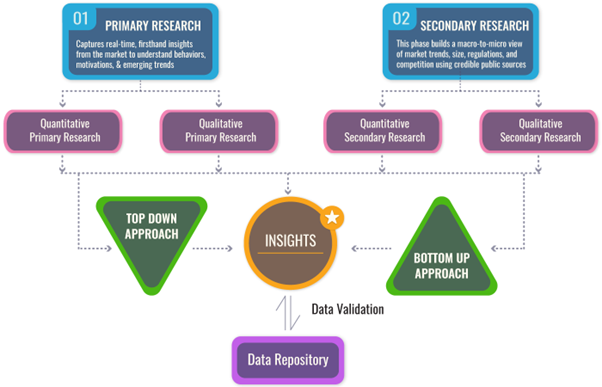
DUAL MODELING: TOP-DOWN + BOTTOM-UP
To ensure robust market estimation, we apply two complementary sizing approaches:
Top-Down Modeling:- Start with broader industry value (e.g., global or regional TAM)
- Apply filters by segment, geography, end-user, or use case
- Adjust with primary insights and validation benchmarks
- Ideal for investor-grade market scans and opportunity mapping
- Aggregate from the ground up using sales volumes, pricing, and unit economics
- Use internal modeling templates aligned with stakeholder data
- Incorporate distributor-level or region-specific inputs
- Most accurate for emerging segments and granular sub-markets
DATA VALIDATION: IN-HOUSE REPOSITORY
We close the loop with proprietary data intelligence built from ongoing projects, industry monitoring, and historical benchmarking. This repository includes:
- Multi-sector market and pricing models
- Key trendlines from past interviews and forecasts
- Benchmarked adoption rates, churn patterns, and ROI indicators
- Industry-specific deviation flags and cross-check logic
- Catches inconsistencies early
- Aligns projections across studies
- Enables consistent, high-trust deliverables