

Integrated Bridge Systems Market Size and Forecast (2026–2034), Global and Regional Growth, Trend, Share and Industry Analysis Report Coverage; By Component (Hardware, Software, Services); By Subsystem (Integrated Navigation System, Voyage Data Recorder, Automatic Identification System, Automatic Weather Observation System, Others); By Vessel Type (Commercial Vessels, Defense Vessels); By End User (OEM, Aftermarket); and Geography
2026-10-30
Aerospace & Defense
Ekta Chaurasia (Team Lead)
Description
Integrated Bridge Systems Market Overview
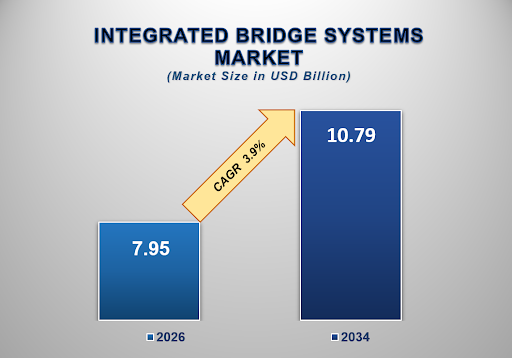
The global Integrated Bridge Systems Market was valued at USD 7.95 billion in 2026 and is projected to reach USD 10.79 billion by 2034, expanding at a CAGR of 3.9% from 2026 to 2034. The market is being supported by increasing vessel modernization, maritime safety requirements, growing adoption of electronic navigation technologies, development of smart and autonomous vessels, fleet digitalization, cybersecurity requirements, and the need to integrate navigation, communication and vessel-control information within a unified bridge environment.
An Integrated Bridge System (IBS) combines multiple navigation and vessel-management functions into a coordinated bridge environment. Depending on vessel configuration, an IBS can integrate radar, electronic chart display and information systems (ECDIS), automatic identification systems (AIS), voyage data recorders (VDR), gyrocompasses, speed logs, autopilot, conning displays, alarms, communications and other sensors and control systems. The purpose is to make information from multiple onboard systems available through a coordinated operating environment rather than through isolated equipment. Kongsberg's K-Bridge, Sperry Marine's VisionMaster and Anschütz's SYNAPSIS illustrate this integrated architecture.
The evolution of e-navigation is an important structural factor influencing the market. The International Maritime Organization defines e-navigation around the harmonized collection, integration, exchange, presentation and analysis of marine information onboard and ashore. Its implementation framework specifically addresses improved bridge design, reliable navigation information, standardized reporting and integration of information received through communication systems.
Modern bridges are consequently moving away from isolated displays toward shared data environments. Information from radar, ECDIS, AIS, position sensors, heading sensors, weather systems and other equipment can be validated and presented across multiple workstations. This approach can reduce duplication and support more consistent decision-making and allow bridge personnel to access relevant functions from different operating positions.
The growing emphasis on situational awareness and navigational safety is another major market driver. A unified bridge environment can present navigational information in a common interface and coordinate alerts across systems. Sperry Marine describes its VisionMaster IBS as a system that synchronizes information from navigation sensors and onboard systems to support route planning, route monitoring, collision avoidance and centralized alert management.
The increase in commercial vessel activity and fleet modernization is creating continued demand for integrated bridge solutions. Cargo ships, tankers, container vessels, ferries, cruise vessels, offshore vessels and specialized ships require reliable navigation systems that comply with regulatory and classification requirements while also supporting fuel efficiency, operational consistency and crew productivity.
The defense maritime sector represents another important market. Naval vessels require integrated navigation systems that can connect navigation sensors with tactical and combat-management environments while maintaining cybersecurity, redundancy, configuration control and mission-specific functionality. Anschütz's SYNAPSIS Naval, for example, integrates navigation and tactical data and supports interfaces with combat-management systems and third-party equipment.
The growth of autonomous and remotely operated vessels is also expanding the technology requirements of integrated bridge systems. Autonomous vessel architectures require reliable navigation data, sensor fusion, system-health monitoring, redundancy, and decision-support capabilities. The IMO approved its broader Maritime Digitalization Strategy in March 2026, emphasizing interoperability, system standardization, data-sharing and data governance across maritime operations.
Cybersecurity is becoming increasingly important because integrated bridge systems connect multiple navigation and communication assets over shipboard networks. IACS Unified Requirements E26 and E27 have strengthened cybersecurity expectations for ships and onboard systems, making secure interfaces, access controls, system hardening and lifecycle security more relevant to bridge-system procurement and modernization. Current market analysis also identifies cyber resilience as an increasingly important requirement for connected navigation environments.
Technology development is simultaneously increasing the role of software and data integration. Newer integrated bridge platforms are becoming software-defined and modular, allowing functions to be added, upgraded or adapted through software rather than requiring complete replacement of bridge hardware. Anschütz describes SYNAPSIS NX as a software-defined navigation system with standardized interfaces and continuous software development, while Kongsberg's K-Bridge platform provides integrated radar, ECDIS, route and vessel-information functionality across bridge workstations.
The shift toward energy-efficient vessels and alternative propulsion is also influencing bridge-system development. Hybrid-electric ferries and other low-emission vessels require integrated monitoring and control environments capable of coordinating navigation with propulsion, energy management and vessel status. Furuno's 2026 contract for four BC Ferries hybrid-electric vessels demonstrates how modern bridge packages are being integrated into new low-emission vessel programs.
As shipowners seek safer operations, improved information quality, reduced bridge complexity and greater readiness for digital and autonomous functions, the global integrated bridge systems market is expected to maintain steady growth through 2034.
Integrated Bridge Systems Market Drivers and Opportunities
Growing Adoption of Smart and Digitally Connected Vessels Is Driving Market Growth
The maritime industry's transition toward smart and digitally connected vessels is one of the central factors supporting the integrated bridge systems market.
Conventional bridge environments often contain individual navigation devices with separate controls, interfaces and data sources. An integrated bridge system combines these functions into a coordinated operating environment so that navigation information can be shared more consistently across workstations.
This architecture becomes increasingly valuable as vessels incorporate more sensors, digital communication equipment, automatic tracking, advanced radar, electronic charts, and onboard monitoring technologies.
The IMO's Maritime Digitalization Strategy approved in March 2026, emphasizes interoperability, standardized systems and data-sharing across maritime operations. These objectives align closely with the underlying architecture of integrated bridge systems, where multiple information sources need to operate through common data structures and interfaces.
Modern IBS suppliers are therefore competing not only on individual navigation devices but also on their ability to connect heterogeneous systems, maintain consistent data and provide centralized information management.
This shift creates opportunities for manufacturers offering modular systems that can be deployed across different vessel classes and scaled as the vessel's operational requirements change.
Stringent Navigation and Safety Requirements Are Supporting Market Expansion
Navigation safety requirements provide a fundamental baseline for bridge-system demand.
Commercial vessels subject to international maritime regulations require approved navigation and recording equipment. Integrated bridge architectures allow mandatory and supporting systems to be presented and coordinated more effectively within a single operating environment.
IMO's e-navigation work specifically identifies improved bridge design, reliability and integrity of bridge equipment, integration of information and standardized digital services among its implementation objectives.
The regulatory environment therefore supports both newbuild installations and retrofit activity. Existing vessels may need equipment upgrades as systems become obsolete, regulations evolve or manufacturers discontinue older products.
This creates a recurring lifecycle market for software upgrades, equipment replacement, integration services, training and technical support.
Increasing Focus on Voyage Efficiency and Fuel Management Creates New Opportunities
Integrated bridge systems are increasingly being evaluated not only for navigation safety but also for their ability to support operational efficiency.
Voyage planning can combine route information, vessel position, heading, speed, weather data and navigational constraints. When these data sources are presented together, operators can make more informed routing and speed decisions.
Wärtsilä has previously demonstrated how integrated bridge and shore-based systems can exchange required time of arrival information digitally to support just-in-time arrival and reduce unnecessary fuel consumption and port waiting.
Current market analysis also identifies fuel efficiency and voyage optimization as continuing drivers as shipowners respond to emissions-reduction requirements and rising interest in data-based fleet management.
This creates opportunities for IBS suppliers to integrate navigation with voyage optimization, weather routing, vessel-performance systems and fleet-level analytics.
Autonomous and Remotely Operated Vessels Are Creating Significant Technology Opportunities
Autonomous shipping is increasing the technical scope of bridge systems.
Autonomous and remotely assisted vessels need reliable access to navigation sensors, vessel position, heading, radar targets, electronic charts, propulsion status, alarms and system-health information. These data must be synchronized and available to operators both onboard and, in relevant architectures, at remote-control centers.
DNV's AROS class-notation framework for autonomous and remotely operated ships addresses requirements including redundancy, remote-control arrangements and cybersecurity, indicating the increasingly formalized requirements surrounding autonomous maritime systems.
Integrated bridge platforms are well positioned within this transition because they already provide a common environment for sensor integration and navigation information.
Anschütz is expanding this capability through its AUTONOMICS product line, while SYNAPSIS is being developed with modular architecture, sensor integration, health monitoring and redundancy features.
The growth of autonomous navigation creates opportunities for decision-support tools, collision avoidance, sensor fusion, remote monitoring, and AI-assisted bridge applications.
Cybersecurity and GNSS Resilience Are Becoming Increasingly Important
The growing connectivity of bridge systems is increasing their cybersecurity exposure.
Modern bridge architectures may contain Ethernet networks, remote support connections, software-update mechanisms, GNSS receivers, communication systems and interfaces with other shipboard networks. A compromise or failure involving one connected element can potentially affect the reliability of navigation information.
Current integrated bridge platforms are therefore incorporating security controls and resilient architectures. Kongsberg's K-Bridge ECDIS, for example, is designed around IEC 61162-460 maritime cybersecurity requirements, while Sperry Marine has highlighted GNSS jamming and spoofing resilience as a key topic for SMM 2026.
The increasing incidence of GNSS interference in strategically important maritime regions is also encouraging demand for positioning resilience, multi-sensor validation and alternative navigation inputs.
This creates an opportunity for suppliers to combine navigation integration with cyber-secure networks, resilient positioning, data validation and continuous system health monitoring.
Retrofitting the Existing Fleet Presents a Long-Term Market Opportunity
The large installed base of commercial vessels creates an important aftermarket opportunity for integrated bridge systems.
Retrofits are often more complex than newbuild installations because older ships can contain legacy equipment, multiple communication protocols, limited bridge space, obsolete interfaces and different generations of electronic systems.
Current industry analysis identifies retrofit complexity, legacy compatibility and installation downtime as important constraints. At the same time, the need to replace obsolete equipment and meet changing regulatory or cybersecurity requirements creates ongoing demand.
Suppliers that can offer modular bridge upgrades, backward-compatible interfaces, staged modernization and lifecycle service support can address vessels that cannot economically justify complete bridge replacement.
Sperry Marine, for example, offers retrofit services across navigation systems and positions its VisionMaster IBS as a modular solution that can be adapted to vessel-specific requirements.
Integrated Bridge Systems Market Scope
Integrated Bridge Systems Market Report Segmentation Analysis
The global integrated bridge systems industry analysis is segmented by component, by subsystem, by vessel type, by end user, and by region.
The Hardware Segment Is Expected to Dominate the Market During the Forecast Period
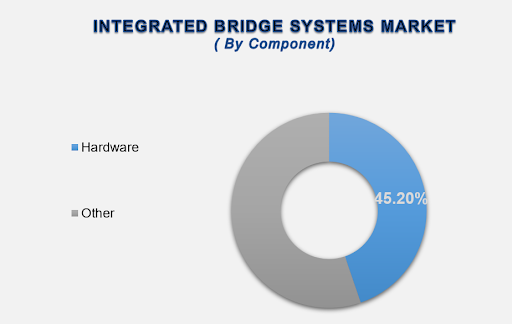
The Hardware segment is expected to maintain the leading position in the integrated bridge systems market because integrated bridge installations require physical navigation, display, communication, control, sensing and data-processing equipment.
Hardware can include multifunction displays, operator workstations, radar systems, ECDIS equipment, control units, sensors, alarm interfaces, data recorders, communication devices and networking equipment.
A current independent 2025 market estimate places hardware at approximately 45.2% of integrated bridge system revenue, ahead of software and services. This provides a useful industry benchmark for the component structure, although individual market studies use different market definitions and valuation methodologies.
Hardware remains essential because marine equipment must satisfy durability, redundancy, environmental and certification requirements. Ruggedized displays, approved radar systems, navigation sensors and redundant control infrastructure form the physical foundation of an IBS.
However, Software is becoming an increasingly important value layer as bridge systems incorporate data fusion, alarm management, software-defined functionality, cybersecurity and remote support.
Services also represent a growing opportunity through installation, commissioning, integration, crew training, maintenance, remote support and retrofit activity.
The Integrated Navigation System Segment Is Expected to Dominate the Market by Subsystem
The Integrated Navigation System segment is expected to account for a leading share of demand because navigation integration is the central function around which many bridge architectures are organized.
Integrated navigation platforms combine information from radar, ECDIS, GNSS, AIS, heading sensors, speed sensors and other sources and provide a coordinated navigational picture.
A current 2025 industry estimate places the Navigation subsystem at approximately 34.6% of integrated bridge system revenue, making it the largest subsystem category in that assessment.
Kongsberg's K-Bridge system provides an example of integrated navigation architecture, with route information, charts, radar information and ship data shared across operator stations.
Anschütz's SYNAPSIS NX similarly combines radar, ECDIS and conning applications through a shared data backbone, allowing the information to be validated and distributed across bridge workstations.
AIS also remains a major component because automatic identification information contributes to vessel tracking, collision avoidance and situational awareness.
VDR represents another established application supported by regulatory requirements and periodic equipment replacement.
Automatic Weather Observation Systems are increasingly important where weather information is integrated directly into voyage planning and navigational decision-making.
The Commercial Vessels Segment Is Expected to Dominate the Market by Vessel Type
The Commercial Vessels segment is expected to dominate the integrated bridge systems market because commercial ships represent a large installed base and depend heavily on reliable navigation, regulatory compliance, route management and operational efficiency.
Commercial applications include container ships, bulk carriers, tankers, LNG carriers, ferries, cruise ships, offshore vessels and other specialized ships.
A current 2025 industry estimate places commercial vessels at approximately 58.3% of the market by platform, while a separate 2025 assessment from Global Market Insights places the commercial-ship share above 66%. The difference demonstrates that market share estimates vary by market definition, but both assessments identify commercial shipping as the principal vessel category.
Commercial vessel operators typically evaluate integrated bridge systems based on reliability, total cost of ownership, regulatory compliance, interoperability, crew workload, service availability and compatibility with existing equipment.
The increasing adoption of hybrid-electric propulsion, low-emission fuels, digital fleet systems and autonomous-ready technologies is also increasing integration requirements.
Defense Vessels represent another important market category. Naval systems frequently require higher levels of redundancy, secure communications, tactical integration, configuration control and mission-specific functionality.
Anschütz's SYNAPSIS Naval, for example, integrates navigation and tactical information and supports interfaces with combat-management systems and customer-specific equipment.
The OEM Segment Is Expected to Dominate the Market by End User
The OEM segment is expected to dominate the integrated bridge systems market because newbuild vessels provide shipyards and system suppliers with an opportunity to design navigation architecture, equipment layouts, networking, redundancy, and interfaces from the beginning of the vessel-development process.
A current 2025 industry estimate places OEM installations at approximately 62.7% of market revenue, compared with 37.3% for aftermarket activity.
OEM installation also enables suppliers to secure multi-vessel contracts when the same bridge architecture is specified across a vessel series.
For example, FURUNO was selected in 2026 to provide an integrated navigation and communications suite for four new BC Ferries hybrid-electric vessels. Each vessel is planned to receive redundant bridge stations with shared radar, ECDIS, conning, and alert-management functions.
The Aftermarket remains strategically important because ships already in operation require equipment replacement, obsolescence management, regulatory upgrades, cybersecurity improvements, and modernization.
The Following Segments Are Part of an In-Depth Analysis of the Global Integrated Bridge Systems Market:
Integrated Bridge Systems Market Share Analysis By Region
Asia Pacific is expected to represent the largest regional market for integrated bridge systems, supported by the region's central position in shipbuilding, maritime trade, fleet modernization and commercial-vessel production. A current 2026 market assessment estimates Asia Pacific at approximately 38.1% of global market revenue in 2024, with the region projected to reach USD 6.80 billion by 2035.
The region's market strength is closely associated with the concentration of shipyards and maritime manufacturing activity in China, Japan, South Korea, Singapore, India and other Asian markets.
China is a major contributor because of its large shipbuilding industry, commercial fleet and extensive port infrastructure. The increasing modernization of vessels and adoption of digital navigation and automation systems provide continued opportunities for IBS suppliers.
Japan remains an important market due to its mature shipbuilding industry, marine-electronics capabilities and established vessel-operator base. Japanese suppliers such as Furuno and Japan Radio Company participate across navigation, communication and bridge-management technologies.
South Korea benefits from extensive shipbuilding capabilities and a strong base of commercial vessel construction, including container ships, LNG carriers and other specialized vessels.
India is emerging as an important market through shipbuilding investment, port modernization, coastal transportation and maritime infrastructure development. Growing interest in domestic shipbuilding and vessel modernization is expected to support navigation-system demand.
North America represents a significant market supported by commercial fleets, naval modernization, offshore activity, cruise operations and an established marine-electronics ecosystem.
A current industry assessment valued North America at approximately USD 1.67 billion in 2024, representing about 24.3% of the global market in that study. The United States accounted for the majority of regional revenue.
The United States remains a major market for integrated navigation and bridge systems across commercial and defense applications. Naval modernization programs create demand for redundant navigation, secure data networks, tactical integration and long-term lifecycle support.
Canada represents another important market through commercial vessels, coast guard programs, offshore applications and shipbuilding projects.
Europe maintains a substantial market share because of its large maritime fleet, established shipbuilding and marine-electronics industries, sophisticated navigation requirements and strong focus on digitalization and cybersecurity.
A current industry assessment estimates Europe at approximately 27.5% of global market revenue in 2024, with Germany representing the largest individual European market in that study.
Germany is particularly important because of its maritime manufacturing, naval programs and concentration of navigation-system providers such as Anschütz.
The U.K., France, Italy, Spain and Scandinavian countries provide additional demand through commercial shipping, naval fleets, ferries, cruise vessels, offshore operations and maritime technology development.
European maritime operators are also being affected by evolving cybersecurity requirements. EMSA guidance identifies bridge systems, GMDSS/GNSS and fleet-management software among the critical assets that need to be assessed during cybersecurity audits, controls, verifications and inspections.
Latin America is expected to experience steady growth as commercial shipping, offshore energy, coastal transportation and port infrastructure develop.
Brazil and Mexico represent major markets within the region. Brazil's offshore energy industry provides demand for specialized commercial and offshore vessels, while Mexico benefits from commercial shipping, energy activity and maritime trade.
A current market assessment values Latin America at approximately USD 0.40 billion in 2024 and projects growth to approximately USD 0.94 billion by 2035.
Middle East & Africa represents an emerging market supported by port development, offshore operations, maritime trade corridors, defense requirements and vessel modernization.
Saudi Arabia and the UAE are developing maritime hubs and expanding port and logistics infrastructure, creating opportunities for connected navigation and vessel-management technologies.
South Africa remains a significant regional market because of its ports, shipping activity, maritime services and ship-repair ecosystem.
The Middle East & Africa market was estimated at approximately USD 0.29 billion in 2024 in a current industry assessment and is projected to reach approximately USD 0.63 billion by 2035.
Integrated Bridge Systems Market Competition Landscape Analysis
The integrated bridge systems market is moderately competitive and includes marine-electronics manufacturers, navigation-system providers, defense-technology companies, ship automation suppliers and specialized bridge-integration companies.
Competition is increasingly based on system integration, interoperability, navigation accuracy, cybersecurity, redundancy, software functionality, regulatory certification, lifecycle support and retrofit capability rather than on individual navigation components alone.
Current industry analysis identifies Wärtsilä, Northrop Grumman, Rolls-Royce, Kongsberg, L3Harris, Mitsubishi Electric and Furuno among significant market participants. A September 2026 market assessment estimates that the top five suppliers collectively account for approximately 33.4% of market revenue, although supplier shares vary across market definitions.
Kongsberg Maritime competes through its K-Bridge Integrated Bridge System, which combines radar, ECDIS, route information, conning and ship data across bridge operator stations. The company also emphasizes lifecycle support through retrofit, training and 24/7 technical service.
Sperry Marine offers VisionMaster Integrated Bridge System for commercial vessels and VisionMaster Defence for naval platforms. Its commercial system integrates navigation data from multiple sensors and provides multifunction workstations with radar, ECDIS, conning and alert-management capabilities.
Anschütz is expanding its position through the SYNAPSIS family. SYNAPSIS NX integrates radar, ECDIS and conning through a shared data backbone, while SYNAPSIS Naval extends the architecture into military applications, including integration with combat-management systems.
Furuno Electric competes through integrated navigation, radar, ECDIS, communication and bridge technologies. In 2026, the company was selected to equip four new BC Ferries hybrid-electric vessels with extensive integrated navigation and communication systems, demonstrating its participation in newbuild bridge programs.
Northrop Grumman Sperry Marine retains a strong position across commercial and defense navigation applications. Its VisionMaster platform emphasizes modular bridge architecture, synchronized data, multifunction workstations and secure connectivity.
L3Harris Technologies participates heavily in defense maritime systems, where integrated bridge and navigation technologies can form part of larger naval electronics, combat-management and ship-system programs.
Rolls-Royce has historically participated in intelligent ship technologies and marine automation. The broader market is increasingly connecting navigation with vessel-performance, automation and remote-operation functions.
Mitsubishi Electric applies its electronics and automation capabilities to navigation, monitoring and marine systems and maintains an important presence in Asian maritime markets.
The competitive environment is also increasingly affected by autonomy and cybersecurity. Suppliers are adding resilience against GNSS jamming and spoofing, secure maritime gateways, remote monitoring, software-defined architectures and AI-supported decision tools.
In 2026, Sperry Marine promoted GNSS jamming and spoofing resilience and enhancements to VisionMaster Net at SMM 2026, while Furuno showcased its Smart Bridge NXT integrated bridge system alongside cybersecurity and anti-jamming technologies.
Anschütz is similarly developing its systems around standardized interfaces, validated sensor data, central alarm management, redundancy and software-based configurability.
The market is consequently shifting toward complete bridge platforms and lifecycle ecosystems that combine equipment, software, integration, cybersecurity, training, remote support and upgrade services.
Global Integrated Bridge Systems Market Recent Developments News
In September 2026 – Sperry Marine showcased its Integrated Bridge System, NAVIGAT compass technologies and VisionMaster ECDIS at SMM 2026, with product discussions focused on VisionMaster Net enhancements and resilience against GNSS jamming and spoofing.
In August 2026 – Furuno announced its participation at SMM 2026, highlighting the Smart Bridge NXT integrated bridge system, next-generation navigation support using AR and VR, GNSS anti-jamming and anti-spoofing systems, cybersecurity and remote-monitoring platform HermAce, and vessel-control technologies.
In June 2026 – Anschütz and Heitec announced the delivery of integrated navigation and bridge systems for new German Navy training vessels. The development expands deployment of SYNAPSIS technology across naval applications and reflects continued demand for standardized, integrated navigation architectures.
In May 2026 – FURUNO announced that BC Ferries selected the company to supply an integrated navigation and communications suite for four new hybrid-electric ferries. The bridge architecture includes redundant stations and shared radar, ECDIS, conning and alert-management functions.
In March 2026 – Anschütz introduced a new SYNAPSIS interface linking its integrated navigation platform with the AEGIS Combat System through a defined Gigabit Ethernet Data Multiplex System interface. The development supports exchange of navigation information and sensor-status data between navigation and combat-system environments.
The Global Integrated Bridge Systems Market is Dominated by a Few Large Companies, Such As
Wärtsilä Corporation
Kongsberg Maritime
Northrop Grumman Corporation / Sperry Marine
L3Harris Technologies, Inc.
Rolls-Royce Holdings plc
Furuno Electric Co., Ltd.
Anschütz GmbH
Mitsubishi Electric Corporation
Japan Radio Co., Ltd.
Consilium AB
Hensoldt AG
Navico Group
Tokyo Keiki Inc.
Raytheon Technologies
Thales Group
Saab AB
Honeywell International Inc.
ST Engineering
Transas / Wärtsilä Voyage
Others
Frequently Asked Questions
Ekta Chaurasia (Team Lead)
Ekta Chaurasia is a highly experienced Team Lead at M2Square Consultancy with over 7 years of expertise in market research, strategic consulting, competitive benchmarking, and business intelligence solutions. She specializes in ICT, semiconductors & electronics, automotive & transportation, and industrial machinery markets.
She leads end-to-end global research projects focused on market trends, industry analysis, growth forecasting, customer insights, and strategic decision-making. Known for her analytical leadership and industry expertise, Ekta helps businesses uncover growth opportunities, evaluate competitive landscapes, and stay ahead in rapidly evolving markets through accurate and insight-driven research.
Global Integrated Bridge Systems Market Introduction and Market Overview
Objectives of the Study
Global Integrated Bridge Systems Market Scope and Market Estimation
Global Integrated Bridge Systems Market Size (US$ Million), Market CAGR (%), Market Forecast (2026 - 2034)
Global Integrated Bridge Systems Market Revenue Share (%) and Growth Rate (Y-o-Y) Analysis (2021 - 2034)
Market Segmentation
By Component of Global Integrated Bridge Systems Market
Hardware
Software
Services
By Subsystem of Global Integrated Bridge Systems Market
Integrated Navigation System
Voyage Data Recorder
Automatic Identification System
Automatic Weather Observation System
Others
By Vessel Type of Global Integrated Bridge Systems Market
Commercial Vessels
Defense Vessels
By End User of Global Integrated Bridge Systems Market
OEM
Aftermarket
Region of Global Integrated Bridge Systems Market
Competition Coverage List of Market Participants
Market Definition: Integrated Bridge Systems Market
Executive Summary
Demand Side Trends
Key Market Trends
Market Demand (US$ Million) Analysis 2021 – 2025 and Forecast, 2026 – 2034
Demand and Opportunity Assessment
Key Developments
Overview of Regulatory Landscape, Compliance Framework, and Industry Standards
Market Entry Strategies
Market Dynamics
Drivers
Limitations
Opportunities
Impact Analysis of Drivers and Restraints
Porter's Five Forces Analysis
PEST Analysis
Global Integrated Bridge Systems Market Estimates & Historical Trend Analysis (2021 – 2025)
Global Integrated Bridge Systems Market Estimates & Forecast Trend Analysis, by Component
Global Integrated Bridge Systems Market Revenue (US$ Million) Estimates and Forecasts, by Component, 2021 - 2034
Hardware
Software
Services
Global Integrated Bridge Systems Market Estimates & Forecast Trend Analysis, by Subsystem
Global Integrated Bridge Systems Market Revenue (US$ Million) Estimates and Forecasts, by Subsystem, 2021 - 2034
Integrated Navigation System
Voyage Data Recorder
Automatic Identification System
Automatic Weather Observation System
Others
Global Integrated Bridge Systems Market Estimates & Forecast Trend Analysis, by Vessel Type
Global Integrated Bridge Systems Market Revenue (US$ Million) Estimates and Forecasts, by Vessel Type, 2021 - 2034
Commercial Vessels
Defense Vessels
Global Integrated Bridge Systems Market Estimates & Forecast Trend Analysis, by End User
Global Integrated Bridge Systems Market Revenue (US$ Million) Estimates and Forecasts, by End User, 2021 - 2034
OEM
Aftermarket
Global Integrated Bridge Systems Market Estimates & Forecast Trend Analysis, by Region
Global Integrated Bridge Systems Market Revenue (US$ Million) Estimates and Forecasts, by Region, 2021 - 2034
North America
Europe
Asia Pacific
Middle East & Africa
Latin America
North America Integrated Bridge Systems Market: Estimates & Forecast Trend Analysis
North America Integrated Bridge Systems Market Assessments & Key Findings
North America Integrated Bridge Systems Market Introduction
North America Integrated Bridge Systems Market Size Estimates and Forecast (US$ Million) (2021 - 2034)
By Component
By Subsystem
By Vessel Type
By End User
By Country
The U.S.
Canada
Europe Integrated Bridge Systems Market: Estimates & Forecast Trend Analysis
Europe Integrated Bridge Systems Market Assessments & Key Findings
Europe Integrated Bridge Systems Market Introduction
Europe Integrated Bridge Systems Market Size Estimates and Forecast (US$ Million) (2021 - 2034)
By Component
By Subsystem
By Vessel Type
By End User
By Country
Germany
Italy
The U.K.
France
Spain
Switzerland
Rest of Europe
Asia Pacific Integrated Bridge Systems Market: Estimates & Forecast Trend Analysis
Asia Pacific Integrated Bridge Systems Market Assessments & Key Findings
Asia Pacific Integrated Bridge Systems Market Introduction
Asia Pacific Integrated Bridge Systems Market Size Estimates and Forecast (US$ Million) (2021 - 2034)
By Component
By Subsystem
By Vessel Type
By End User
By Country
China
Japan
India
Australia
South Korea
Rest of Asia Pacific
Middle East & Africa Integrated Bridge Systems Market: Estimates & Forecast Trend Analysis
Middle East & Africa Integrated Bridge Systems Market Assessments & Key Findings
Middle East & Africa Integrated Bridge Systems Market Introduction
Middle East & Africa Integrated Bridge Systems Market Size Estimates and Forecast (US$ Million) (2021 - 2034)
By Component
By Subsystem
By Vessel Type
By End User
By Country
UAE
Saudi Arabia
South Africa
Rest of Middle East & Africa
Latin America Integrated Bridge Systems Market: Estimates & Forecast Trend Analysis
Latin America Integrated Bridge Systems Market Assessments & Key Findings
Latin America Integrated Bridge Systems Market Introduction
Latin America Integrated Bridge Systems Market Size Estimates and Forecast (US$ Million) (2021 - 2034)
By Component
By Subsystem
By Vessel Type
By End User
By Country
Brazil
Mexico
Argentina
Rest of Latin America
Competition Landscape
Global Integrated Bridge Systems Market Product Mapping
Global Integrated Bridge Systems Market Concentration Analysis, by Leading Players
Global Integrated Bridge Systems Market Concentration Analysis, by Innovators
Global Integrated Bridge Systems Market Concentration Analysis, by Emerging Players
Global Integrated Bridge Systems Market Concentration Analysis, by New Entrants
Global Integrated Bridge Systems Market Tier Structure Analysis
Global Integrated Bridge Systems Market Concentration & Company Market Shares (%) Analysis, 2026
Company Profiles
Wärtsilä Corporation
Company Overview & Key Stats
Financial Performance & KPIs
Product Portfolio
SWOT Analysis
Business Strategy & Recent Developments
*Similar details would be provided for all the players mentioned below
Kongsberg Maritime
Company Overview & Key Stats
Financial Performance & KPIs
Product Portfolio
SWOT Analysis
Business Strategy & Recent Developments
Northrop Grumman Corporation / Sperry Marine
Company Overview & Key Stats
Financial Performance & KPIs
Product Portfolio
SWOT Analysis
Business Strategy & Recent Developments
L3Harris Technologies, Inc.
Company Overview & Key Stats
Financial Performance & KPIs
Product Portfolio
SWOT Analysis
Business Strategy & Recent Developments
Rolls-Royce Holdings plc
Company Overview & Key Stats
Financial Performance & KPIs
Product Portfolio
SWOT Analysis
Business Strategy & Recent Developments
Furuno Electric Co., Ltd.
Company Overview & Key Stats
Financial Performance & KPIs
Product Portfolio
SWOT Analysis
Business Strategy & Recent Developments
Anschütz GmbH
Company Overview & Key Stats
Financial Performance & KPIs
Product Portfolio
SWOT Analysis
Business Strategy & Recent Developments
Mitsubishi Electric Corporation
Company Overview & Key Stats
Financial Performance & KPIs
Product Portfolio
SWOT Analysis
Business Strategy & Recent Developments
Japan Radio Co., Ltd.
Company Overview & Key Stats
Financial Performance & KPIs
Product Portfolio
SWOT Analysis
Business Strategy & Recent Developments
Consilium AB
Company Overview & Key Stats
Financial Performance & KPIs
Product Portfolio
SWOT Analysis
Business Strategy & Recent Developments
Hensoldt AG
Company Overview & Key Stats
Financial Performance & KPIs
Product Portfolio
SWOT Analysis
Business Strategy & Recent Developments
Navico Group
Company Overview & Key Stats
Financial Performance & KPIs
Product Portfolio
SWOT Analysis
Business Strategy & Recent Developments
Tokyo Keiki Inc.
Company Overview & Key Stats
Financial Performance & KPIs
Product Portfolio
SWOT Analysis
Business Strategy & Recent Developments
Raytheon Technologies
Company Overview & Key Stats
Financial Performance & KPIs
Product Portfolio
SWOT Analysis
Business Strategy & Recent Developments
Thales Group
Company Overview & Key Stats
Financial Performance & KPIs
Product Portfolio
SWOT Analysis
Business Strategy & Recent Developments
Saab AB
Company Overview & Key Stats
Financial Performance & KPIs
Product Portfolio
SWOT Analysis
Business Strategy & Recent Developments
Honeywell International Inc.
Company Overview & Key Stats
Financial Performance & KPIs
Product Portfolio
SWOT Analysis
Business Strategy & Recent Developments
ST Engineering
Company Overview & Key Stats
Financial Performance & KPIs
Product Portfolio
SWOT Analysis
Business Strategy & Recent Developments
Transas / Wärtsilä Voyage
Company Overview & Key Stats
Financial Performance & KPIs
Product Portfolio
SWOT Analysis
Business Strategy & Recent Developments
Others
Company Overview & Key Stats
Financial Performance & KPIs
Product Portfolio
SWOT Analysis
Business Strategy & Recent Developments
Research Findings & Conclusion
Assumptions & Acronyms Used
Research Methodology
External Databases
Internal Proprietary Database
Primary Research
Secondary Research
Assumptions
Limitations
Report FAQ
Our Research Methodology
"Insight without rigor is just noise."
We follow a comprehensive, multi-phase research framework designed to deliver accurate, strategic, and decision-ready intelligence. Our process integrates primary and secondary research , both quantitative and qualitative , along with dual modeling techniques ( top-down and bottom-up) and a final layer of validation through our proprietary in-house repository.
PRIMARY RESEARCH
Primary research captures real-time, firsthand insights from the market to understand behaviors, motivations, and emerging trends.
1. Quantitative Primary Research
Objective: Generate statistically significant data directly from market participants.
Approaches:- Structured surveys with customers, distributors, and field agents
- Mobile-based data collection for point-of-sale audits and usage behavior
- Phone-based interviews (CATI) for market sizing and product feedback
- Online polling around industry events and digital campaigns
- Purchase frequency by customer type
- Channel performance across geographies
- Feature demand by application or demographic
2. Qualitative Primary Research
Objective: Explore decision-making drivers, pain points, and market readiness.
Approaches:- In-depth interviews (IDIs) with executives, product managers, and key decision-makers
- Focus groups among end users and early adopters
- Site visits and observational research for consumer products
- Informal field-level discussions for regional and cultural nuances
SECONDARY RESEARCH
This phase helps establish a macro-to-micro understanding of market trends, size, regulation, and competitive dynamics, sourced from credible and public domain information.
1. Quantitative Secondary Research
Objective: Model market value and segment-level forecasts based on published data.
Sources include:- Financial reports and investor summaries
- Government trade data, customs records, and regulatory statistics
- Industry association publications and economic databases
- Channel performance and pricing data from marketplace listings
- Revenue splits, pricing trends, and CAGR estimates
- Supply-side capacity and volume tracking
- Investment analysis and funding benchmarks
2. Qualitative Secondary Research
Objective: Capture strategic direction, innovation signals, and behavioral trends.
Sources include:- Company announcements, roadmaps, and product pipelines
- Publicly available whitepapers, conference abstracts, and academic research
- Regulatory body publications and policy briefs
- Social and media sentiment scanning for early-stage shifts
- Strategic shifts in market positioning
- Unmet needs and white spaces
- Regulatory triggers and compliance impact
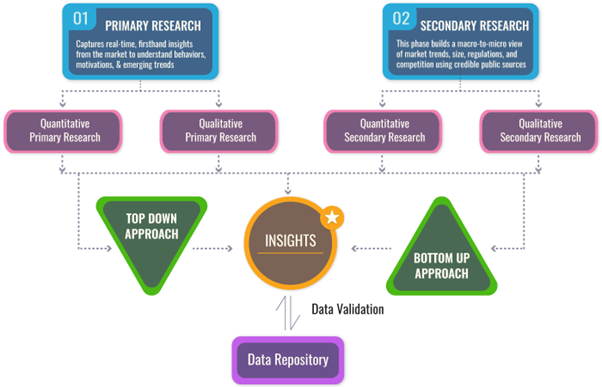
DUAL MODELING: TOP-DOWN + BOTTOM-UP
To ensure robust market estimation, we apply two complementary sizing approaches:
Top-Down Modeling:- Start with broader industry value (e.g., global or regional TAM)
- Apply filters by segment, geography, end-user, or use case
- Adjust with primary insights and validation benchmarks
- Ideal for investor-grade market scans and opportunity mapping
- Aggregate from the ground up using sales volumes, pricing, and unit economics
- Use internal modeling templates aligned with stakeholder data
- Incorporate distributor-level or region-specific inputs
- Most accurate for emerging segments and granular sub-markets
DATA VALIDATION: IN-HOUSE REPOSITORY
We close the loop with proprietary data intelligence built from ongoing projects, industry monitoring, and historical benchmarking. This repository includes:
- Multi-sector market and pricing models
- Key trendlines from past interviews and forecasts
- Benchmarked adoption rates, churn patterns, and ROI indicators
- Industry-specific deviation flags and cross-check logic
- Catches inconsistencies early
- Aligns projections across studies
- Enables consistent, high-trust deliverables