

Internal Nasal Dilators Market Size and Forecast (2026–2034), Global and Regional Growth, Trend, Share and Industry Analysis Report Coverage: By Type (Polymer and Polymer + Alloy), By Application (Snoring, Sleep Apnea, Deviated Septum, Sinusitis, Chronic Stuffy Nose, and Others), By Usability (Reusable and Single Use), By Distribution Channel (Hospital Pharmacies, Retail Pharmacies, and Online Pharmacies) and Geography
2026-08-10
Healthcare
Swetal (Research Analyst)
Description
Internal Nasal Dilators Market Overview
The global internal
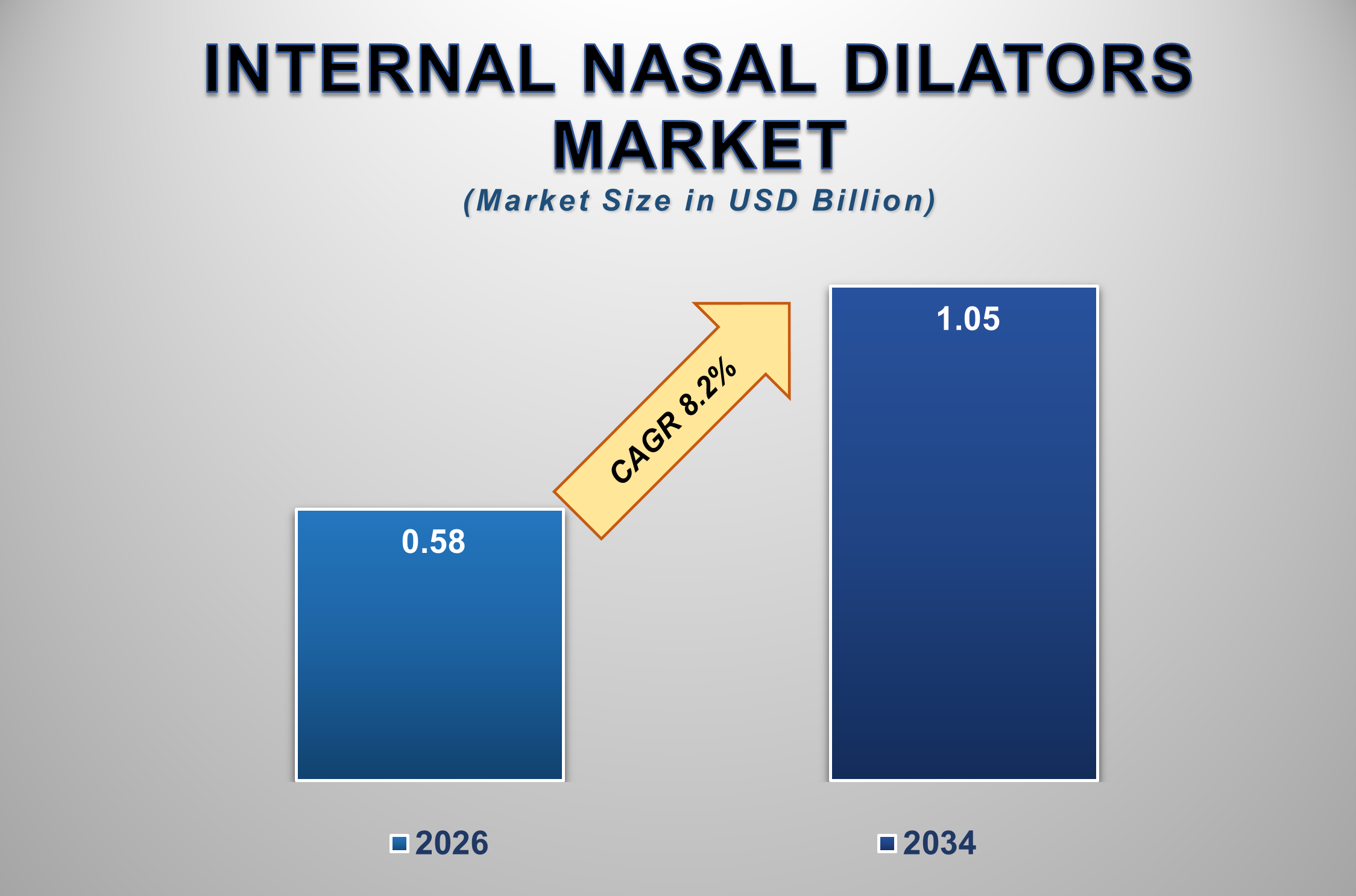
nasal dilators market was valued at USD 0.58 billion in 2026 and is projected
to reach USD 1.05 billion by 2034, expanding at a CAGR of 8.2% during the
forecast period. The market for internal nasal dilators is growing steadily due
to increasing awareness of the benefits of non-invasive methods for improving
airflow in the nasal cavity, reducing snoring, and relieving mild symptoms of
obstructive sleep apnea. An internal nasal dilator is a small device placed
inside the nostrils that helps widen the nasal passage and, consequently,
allows for better breathing at night, during sports activities, and in daily
life. Market growth is driven by the increasing number of people suffering from
nasal congestion, allergic rhinitis, nasal septum deviation, sinusitis, and
obstructive sleep apnea. The growing demand for the devices is also driven by
the increasing number of users willing to use them and the ongoing development
of internal nasal dilators, which involves improving medical materials (medical-grade
silicone), ergonomic designs, and custom fitting. Market expansion is also
supported by the growth of e-commerce and the population of sportsmen
preferring devices based on the principle of nasal dilator usage in Eastern
Europe.
Internal Nasal Dilators Market
Drivers and Opportunities
Rising Prevalence of
Snoring and Sleep-Related Breathing Disorders is Driving Market Growth
The rising
incidence of snoring and sleep-related breathing disorders is a major reason
for increasing global demand for internal nasal dilators. Snoring is caused by
blockage of airflow through the nostrils and can have a huge effect on sleep
quality. Snoring is likely to be associated with problems such as a congested
or blocked nose, allergic rhinitis, and septal deviation, as well as mild
obstructive sleep apnea (OSA). With rising awareness of negative health effects
associated with poor sleep, consumers are more and more looking for solutions
that improve airflow and breathing at night without drugs or invasive
procedures. The report from Fawcett Mattress states that around 30–50% of
grown-ups snore, based on several major studies done before April 2026. The
report included data from a UK Biobank study where the total number of those
snoring reached around 36%. The significant number means there is a large
target audience for the internal nasal dilator: a lot of potential customers
who do not want to use drugs or undergo complicated treatments. As sleep
disorders have become more and more widespread and people have begun talking
more about the significance of sleep health, the usage of internal nasal
dilators is likely to grow both in developed and developing countries.
Growing Demand
for Drug-Free and Reusable Nasal Breathing Solutions Fueling Market Expansion
The rising trend of
using drug-free, eco-friendly, and non-invasive techniques in order to improve
nasal airflow has been supporting the development of the internal nasal
dilators market. Nowadays, the audience is seeking alternatives to
pharmacological decongestants due to a lack of information about their side
effects, rebound congestion, or problems of dependence. This fact has made
internal nasal dilator products an effective method of breathing without drugs.
The devices can provide an instant mechanical opening of nasal passages. There
is no doubt that consumer participation in sports or fitness activities,
attention to sleep health, and action on the aspiration for self-care are also
beneficial for the growth of internal nasal dilators in the market. Making new
innovations in terms of medical silicone, ergonomic design, and comfort was a
good move.
Product
Innovation and Expansion into Sports and Performance Applications Present
Significant Opportunities
Continuous product
innovation and the increasing application of internal nasal dilators in
situations other than sleep-related activities are opening new doors for market
growth. The manufacturers are actively working on creating innovative products
by making use of medical-grade silicone, which has enabled the development of
customizable sizes and ergonomic design solutions to ensure an enhanced user
experience. In addition, the rising interest in sports efficiency in breathing
is opening new opportunities in the market, as not only swimmers and runners
but also athletes, in general, are beginning to use internal nasal dilators to
ensure proper ventilation. The increasing interest of customers in the
preventive abilities of wellness solutions, coupled with strategic partnerships
and e-commerce and distribution via sports retailers, is expected to attract
new customers and make the growth of the international nasal dilators market
more sustainable.
Internal Nasal Dilators Market Scope
|
Report Attributes |
Description |
|
Market Size in 2026 |
USD 0.58 Billion |
|
Market Forecast in 2034 |
USD 1.05 Billion |
|
CAGR % 2026-2034 |
8.2% |
|
Base Year |
2025 |
|
Historic Data |
2021-2025 |
|
Forecast Period |
2026-2034 |
|
Report USP |
Pricing and Cost Structure Analysis, Product
Innovation Benchmarking, Whitespace Assessment, Company Share, Company
Heatmap, Growth Factors, and more |
|
Segments Covered |
●
By Type ●
By
Application ●
By
Usability ●
By
Distribution Channel |
|
Regional Scope |
●
North
America ●
Europe ●
APAC ●
Latin
America ●
Middle
East and Africa |
|
Country Scope |
●
U.S. ●
Canada ●
U.K. ●
Germany ●
France ●
Italy ●
Spain ●
Russia ●
China ●
India ●
Japan ●
South
Korea ●
Australia
●
Mexico ●
Brazil ●
Saudi
Arabia ●
UAE ●
South
Africa
|
Internal Nasal Dilators Market Report
Segmentation Analysis
The global internal
nasal dilators market industry analysis is segmented by type, by application,
by usability, by distribution channel, and by region.
Polymer Segment
Is Expected to Dominate the Internal Nasal Dilators Market During the Forecast
Period
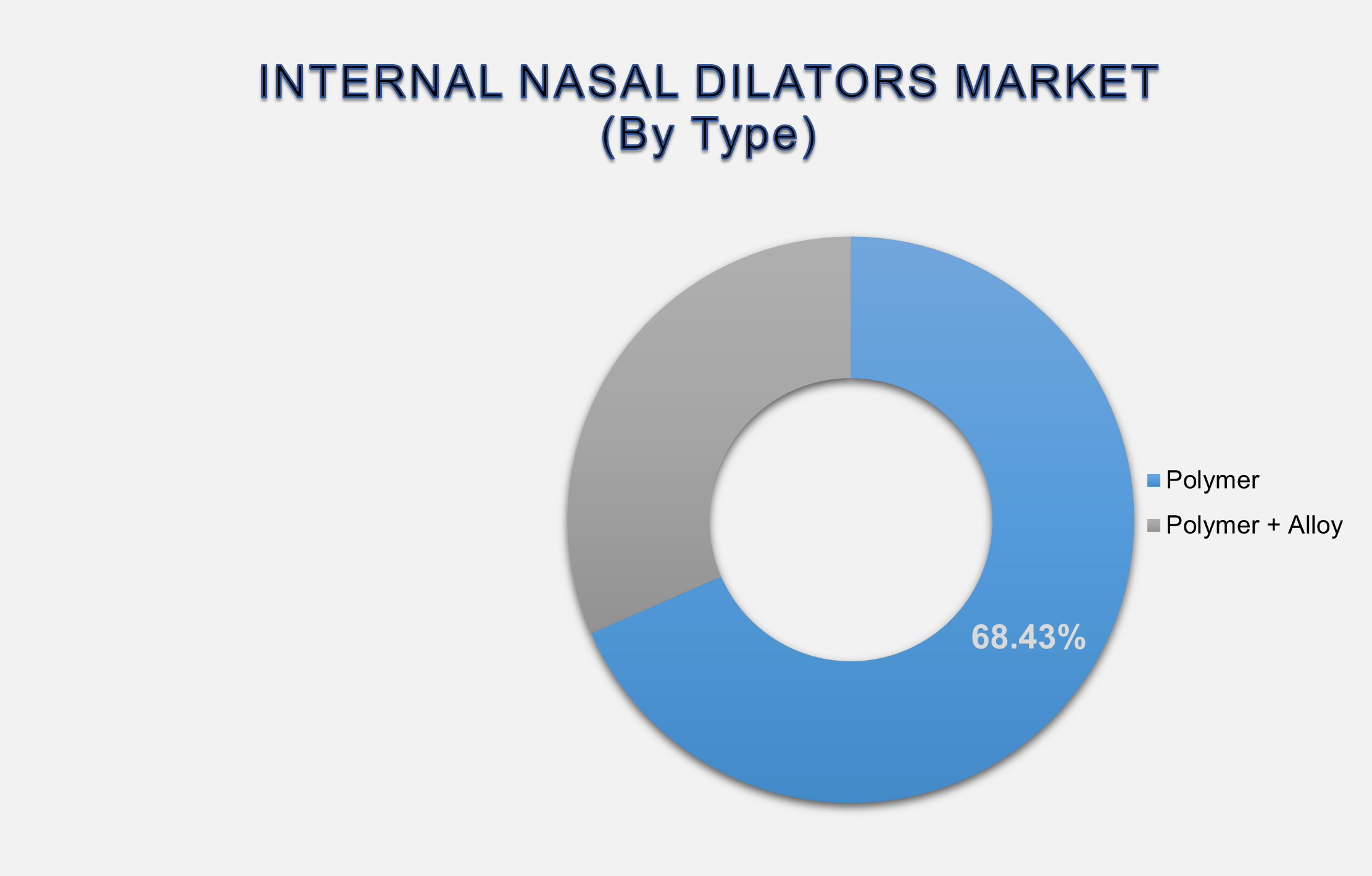
Confirmation of this trend is made possible through understanding the advantages that the polymer industry offers when it comes to physical user characteristics of those items being produced within this polymer segment. It should be noted that medical-grade polymers have all the features and advantages, and it should be noted that the active use of medical-grade polymers in the production of internal nasal dilators is because they are external elements that do not possess the properties of such durable materials as polymer-based materials. It is due to the combination of features such as low weight, lack of toxicity, and hypoallergenic nature that polymer materials are so much appreciated by the manufacturers of items in this category. Generally, in the process of developing new internal nasal dilators, it is important to bear in mind the necessary conditions and requirements of usage of internal nasal dilators in general. After the introduction of new materials, manufacturers started developing new technologies for creating ergonomic designs and multiple variants of items with special anatomical shapes that allow increasing comfort for people during their nocturnal usage of internal nasal dilators.
Sleep Apnea
Segment Is Expected to Lead the Internal Nasal Dilators Market by Application
The sleep apnea
segment will dominate the internal nasal dilators market according to
application due to the increasing occurrence of obstructive sleep apnea (OSA)
and growing awareness about sleep health around the world. Internal nasal
dilators enhance nasal airflow by mechanically widening the nasal passages,
which lessens the nasal resistance and facilitates easy breathing during sleep.
Even though they are not the main treatment for moderate to severe OSA, they
are increasingly used as supplementary therapy among people with mild sleep
apnea, nasal obstruction, and snoring, and patients looking for more comfort
when using CPAP therapy. Rising diagnosis rates, increasing screening programs
for sleep disorders, and growing preference of consumers for non-invasive and
drug-free solutions are further leading to greater demand for such devices.
Furthermore, availability of reusable, comfortable, and anatomically advanced
nasal dilators through pharmacies and online sales is also expected to play a
major role in sustaining the success of the sleep apnea segment.
Reusable Segment
Is Expected to Lead the Internal Nasal Dilators Market by Usability
The reusable
segment of the market is anticipated to remain the leading segment in the
internal nasal dilators market in terms of usability throughout the forecast
period, owing to the increasing consumer inclination towards cost-effective,
eco-friendly, and durable solutions. Reusable internal nasal dilators, usually
made from medical-grade silicone or other durable polymers, can be washed and
reused many times, making them more cost-efficient when compared to disposable
products. Their longevity, adaptability, and better comfort have led to the
increased usage of these products among people suffering from habitual nasal
congestion, snoring, mild sleep apnea, allergies, and sportsmen who are
interested in breathing performance. Environmental awareness and consumers’
inclination toward waste-minimizing products have also pushed them toward
reusable products. Continuous innovations in products, including ergonomic
designs, various sizes, and hypoallergenic materials, as well as wider
availability via pharmacies, online retailers, and sports shops, have been
contributing to the steady dominance of the reusable segment in the internal
nasal dilators market during the forecast period.
The Hospital
Pharmacies Segment Is Expected to Lead the Internal Nasal Dilators Market by
Distribution Channel
The hospital
pharmacy sector will be the largest contributor to the internal nasal dilator
market. This may be attributed to the demand for the diagnosis and treatment of
issues including, but not limited to, sleep-related respiratory problems,
chronic nasal obstructions, and nasal issues arising from surgical procedures
in hospital settings. By virtue of the referral network of practitioners such
as ENT specialists, pulmonary specialists, sleep medicine professionals, and
cosmetic surgeons, there is a surge in the demand for internal nasal dilators
that are primarily employed in providing patients with non-invasive solutions
to improve nasal function, eliminate snoring, and aid respiration in patients
suffering from sleep apnea, as well as nasal deformities. Hospital pharmacies
tend to be the principal distributors of nasal dilators due to their
accessibility to all ENT health-related processes, surgeries, and inpatient and
outpatient care. Additionally, the growing number of hospitals performing ENT
surgeries, introducing sleep clinics, and the rising dependence on
physician-recommended devices are driving demand for such nasal products
through hospital pharmacy networks.
The following
segments are part of an in-depth analysis of the global internal nasal dilators
market:
|
Market Segments |
|
|
By Type |
●
Polymer ●
Polymer +
Alloy |
|
By Application |
●
Snoring ●
Sleep Apnea ●
Deviated
Septum ●
Sinusitis ●
Chronic
Stuffy Nose ●
Others |
|
By Usability |
●
Reusable ●
Single Use |
|
By Distribution Channel |
●
Hospital
Pharmacies ●
Retail Pharmacies ●
Online
Pharmacies |
Internal Nasal Dilators Market Share
Analysis by Region
North America is
projected to hold the largest share of the global internal nasal dilators
market over the forecast period
The North American
market is projected to excel among the various international markets that
manufacture nasal dilators, showing a greater market potential than all others,
owing to the high prevalence of sleep-related breathing disorders, allergies,
and snoring among the population. The increasing incidence of obstructive sleep
apnea, along with increased awareness of non-invasive and drug-free solutions,
has propelled the acceptance of nasal dilators in the US and Canada. North
America possesses a good medical infrastructure, which makes it even easier to
sell nasal dilators. Availability of ENT specialists and sleep clinics
increases the acceptability of nasal dilators by patients and consumers. North
America also boasts a multitude of accessible hospitals and pharmacies as well
as some of the leading manufacturers of medical devices. Moreover, advances in
technology, such as the shift towards reusable and ergonomic designs of nasal
dilators, make the production of nasal dilators very easy and effective. Popularity
of health-related matters along with active participation in sports and other
fitness-related activities push the demand even higher, making North America
the largest regional market for nasal dilators.
Internal Nasal
Dilators Market Competition Landscape Analysis
Medical device
producers, respiratory care companies, and programs for sleep health solutions,
as well as organizations that offer consumer healthcare products, form the
basis of the Internal Nasal Dilators Market. The businesses in the field are
striving to develop innovative products of a non-invasive type, which would be
able to help with nasal airflow and the breathing process. In the process of
competition, firms pay attention to product innovations, such as nasal dilators
that can be reused and anatomically comply with the needs of a human being.
Biocompatible and sustainable materials such as medical-grade silicone and
polymers are used for nasal dilator production to ensure a high level of
comfort, durability, and effectiveness of the products. Moreover, companies are
working on improving product designs and performance and producing devices that
could provide support in terms of snoring, sleep apnea, doing sports, nasal
congestion, etc. Different measures, such as new product launches, regulatory
approvals, distribution deals, e-commerce extensions, and cooperation with
medical workers, as well as geographical expansion, help to create strong
positions of companies in the market.
Global Internal
Nasal Dilators Market Recent Developments News:
●
In April 2024
- Integra LifeSciences Holdings Corporation, a leading global medical technology company, announced it
has completed its acquisition of Acclarent, Inc., a pioneer in ear, nose, and throat (ENT) surgical interventions.
The global
internal nasal dilators market is dominated by a few large companies, such as
●
Airing Inc.
●
Airmax B.V.
●
HealthRight Products LLC
●
Intake Breathing
●
Medinose
●
NasalAid
●
Nose Cones
●
RespLabs
●
Rhinomed Ltd.
●
RhinoMed Technologies
●
SleepRight LLC
●
SnoreCare
●
SnoreMeds
●
Turbine Labs LLC
●
WoodyKnows
● Other Prominent Players
Frequently Asked Questions
Swetal (Research Analyst)
Swetal is a Research Analyst with 4+ years of experience specializing in healthcare market research, medical devices, healthcare IT, and medical technology industry analysis. Her expertise includes competitive intelligence, secondary research, market trend forecasting, and healthcare business insights across global healthcare ecosystems.
She contributes to advanced market research reports by analyzing regulatory frameworks, emerging healthcare technologies, competitive landscapes, and innovation trends shaping the medical industry. With a strong focus on accurate market intelligence, strategic insights, and healthcare industry trends, Swetal supports businesses in making informed, data-backed decisions in a rapidly transforming healthcare environment.
1.
Global
Internal Nasal Dilators Market Introduction and Market Overview
1.1. Objectives of the Study
1.2. Market Segmentation
1.2.1.Type of the Global Internal
Nasal Dilators Market
1.2.2.Application of the Global Internal
Nasal Dilators Market
1.2.3.Usability of the Global Internal
Nasal Dilators Market
1.2.4.Distribution Channel of the
Global Internal Nasal Dilators Market
1.2.5.Region of the Global Internal
Nasal Dilators Market
1.3. Competition Coverage List of
Market Participants
1.4. Market Definition: Internal
Nasal Dilators Market
2.
Executive Summary
2.1. Global Internal Nasal Dilators
Market Estimation & Forecast
2.1.1.Global Internal Nasal Dilators
Market Size (US$ Million) Estimates & Historical Trend Analysis (2021 -
2025)
2.1.2.Global Internal Nasal Dilators
Overall Market Size (US$ Million), Growth Rate (Y-o-Y), Market CAGR (%), Market
Forecast (2026 - 2034)
2.2. Snapshot of Global Internal
Nasal Dilators Market
2.3. Global Internal Nasal Dilators
Market Revenue Share (%) 2025
2.4. REGIONAL OUTLINE: Revenue CAGR,
by Region
2.5. Key Competitors & Key
Insights
3.
Market Overview (Qualitative
Analysis)
3.1. Demand Side Trends
3.2. Supply Side Trends /
Manufacturing Trends
3.3. Demand and Opportunity
Assessment, 2026 - 2034
3.4. Market Dynamics
3.4.1.Drivers
3.4.2.Limitations
3.4.3.Opportunities
3.4.4.Impact Analysis of Drivers and
Restraints
3.5. Key Developments
3.6. Regulatory Landscape
3.7. Pricing Analysis
3.8. Supply Chain Analysis
3.9. Porter’s Five Forces Analysis
3.9.1.Bargaining Power of Suppliers
3.9.2.Bargaining Power of Buyers
3.9.3.Threat of Substitutes
3.9.4.Threat of New Entrants
3.9.5.Competitive Rivalry
3.10. PEST Analysis
3.10.1. Political Factors
3.10.2. Economic Factors
3.10.3. Social Factors
3.10.4. Technology Factors
4.
Global Internal Nasal Dilators
Market Estimates & Forecast Trend Analysis, by Type
4.1. Global Internal Nasal Dilators
Market Assessments & Key Findings, by Type
4.2. Global Internal Nasal Dilators
Market Revenue (US$ Million) Estimates and Forecasts, by Type, 2021 - 2034
4.2.1.Polymer
4.2.2.Polymer + Alloy
5.
Global Internal Nasal Dilators
Market Estimates & Forecast Trend Analysis, by Application
5.1. Global Internal Nasal Dilators
Market Assessments & Key Findings, by Application
5.2. Global Internal Nasal Dilators
Market Revenue (US$ Million) Estimates and Forecasts, by Application, 2021 -
2034
5.2.1.Snoring
5.2.2.Sleep Apnea
5.2.3.Deviated Septum
5.2.4.Sinusitis
5.2.5.Chronic Stuffy Nose
5.2.6.Others
6.
Global Internal Nasal Dilators
Market Estimates & Forecast Trend Analysis, by Usability
6.1. Global Internal Nasal Dilators
Market Assessments & Key Findings, by Usability
6.2. Global Internal Nasal Dilators
Market Revenue (US$ Million) Estimates and Forecasts, by Usability, 2021 - 2034
6.2.1.Reusable
6.2.2.Single Use
7.
Global Internal Nasal Dilators
Market Estimates & Forecast Trend Analysis, by Distribution Channel
7.1. Global Internal Nasal Dilators
Market Assessments & Key Findings, by Distribution Channel
7.2. Global Internal Nasal Dilators
Market Revenue (US$ Million) Estimates and Forecasts, by Distribution Channel,
2021 - 2034
7.2.1.Hospital Pharmacies
7.2.2.Retail Pharmacies
7.2.3.Online Pharmacies
8.
Global Internal Nasal Dilators
Market Estimates & Forecast Trend Analysis, by Region
8.1.
Global
Internal Nasal Dilators Market Assessments & Key Findings, by Region
8.2.
Global
Internal Nasal Dilators Market Revenue (US$ Million) Estimates and Forecasts,
by Region, 2021 - 2034
8.2.1.North America
8.2.2.Europe
8.2.3.Asia Pacific
8.2.4.Middle East & Africa
8.2.5.Latin America
9.
North
America Internal Nasal Dilators Market: Estimates & Forecast Trend Analysis
9.1. North America Internal Nasal
Dilators Market Assessments & Key Findings
9.1.1.North America Internal Nasal
Dilators Market Introduction
9.1.2.North America Internal Nasal
Dilators Market Size Estimates and Forecast (US$ Million) (2021 - 2034)
9.1.2.2. By Application
9.1.2.3. By Usability
9.1.2.4. By Distribution Channel
9.1.2.5. By Country
9.1.2.5.1. The U.S.
9.1.2.5.2. Canada
10. Europe Internal
Nasal Dilators Market: Estimates &
Forecast Trend Analysis
10.1. Europe Internal Nasal Dilators
Market Assessments & Key Findings
10.1.1. Europe Internal Nasal Dilators
Market Introduction
10.1.2. Europe Internal Nasal Dilators
Market Size Estimates and Forecast (US$ Million) (2021 - 2034)
10.1.2.1. By Type
10.1.2.2. By Application
10.1.2.3. By Usability
10.1.2.4. By Distribution Channel
10.1.2.5. By Country
10.1.2.5.1.
Germany
10.1.2.5.2.
Italy
10.1.2.5.3.
U.K.
10.1.2.5.4.
France
10.1.2.5.5.
Spain
10.1.2.5.6.
Switzerland
10.1.2.5.7. Rest
of Europe
11. Asia Pacific Internal
Nasal Dilators Market: Estimates &
Forecast Trend Analysis
11.1. Asia Pacific Market Assessments
& Key Findings
11.1.1. Asia Pacific Internal Nasal
Dilators Market Introduction
11.1.2. Asia Pacific Internal Nasal
Dilators Market Size Estimates and Forecast (US$ Million) (2021 - 2034)
11.1.2.1. By Type
11.1.2.2. By Application
11.1.2.3. By Usability
11.1.2.4. By Distribution Channel
11.1.2.5. By Country
11.1.2.5.1. China
11.1.2.5.2. Japan
11.1.2.5.3. India
11.1.2.5.4. Australia
11.1.2.5.5. South Korea
11.1.2.5.6. Rest of Asia Pacific
12. Middle East & Africa Internal
Nasal Dilators Market: Estimates &
Forecast Trend Analysis
12.1. Middle East & Africa Market
Assessments & Key Findings
12.1.1. Middle
East & Africa Internal
Nasal Dilators Market Introduction
12.1.2. Middle
East & Africa Internal
Nasal Dilators Market Size Estimates and Forecast (US$ Million) (2021 - 2034)
12.1.2.1. By Type
12.1.2.2. By Application
12.1.2.3. By Usability
12.1.2.4. By Distribution Channel
12.1.2.5. By Country
12.1.2.5.1. South Africa
12.1.2.5.2. UAE
12.1.2.5.3. Saudi Arabia
12.1.2.5.4. Rest of MEA
13. Latin America
Internal Nasal Dilators Market:
Estimates & Forecast Trend Analysis
13.1. Latin America Market Assessments
& Key Findings
13.1.1. Latin America Internal Nasal
Dilators Market Introduction
13.1.2. Latin America Internal Nasal
Dilators Market Size Estimates and Forecast (US$ Million) (2021 - 2034)
13.1.2.1. By Type
13.1.2.2. By Application
13.1.2.3. By Usability
13.1.2.4. By Distribution Channel
13.1.2.5. By Country
13.1.2.5.1. Brazil
13.1.2.5.2. Mexico
13.1.2.5.3. Argentina
13.1.2.5.4. Rest of LATAM
14. Competition Landscape
14.1. Global Internal Nasal Dilators
Market Product Mapping
14.2. Global Internal Nasal Dilators
Market Concentration Analysis, by Leading Players / Innovators / Emerging
Players / New Entrants
14.3. Global Internal Nasal Dilators
Market Tier Structure Analysis
14.4. Global Internal Nasal Dilators
Market Concentration & Company Market Shares (%) Analysis, 2025
15. Company Profiles
15.1. Airing Inc.
15.1.1. Company Overview & Key Stats
15.1.2. Financial Performance & KPIs
15.1.3. Product Portfolio
15.1.4. SWOT Analysis
15.1.5. Business Strategy & Recent
Developments
* Similar details would be provided
for all the players mentioned below
15.2. Airmax B.V.
15.3. HealthRight Products LLC
15.4. Intake Breathing
15.5. Medinose
15.6. NasalAid
15.7. Nose Cones
15.8. RespLabs
15.9. Rhinomed Ltd.
15.10. RhinoMed Technologies
15.11. SleepRight LLC
15.12. SnoreCare
15.13. SnoreMeds
15.14. Turbine Labs LLC
15.15. WoodyKnows
15.16. Other Prominent Players
16. Research
Findings & Conclusion
17. Assumptions & Acronyms Used
18. Research
Methodology
18.1. External Transportation /
Databases
18.2. Internal Proprietary Database
18.3. Primary Research
18.4. Secondary Research
18.5. Assumptions
18.6. Limitations
18.7. Report FAQs
Our Research Methodology
"Insight without rigor is just noise."
We follow a comprehensive, multi-phase research framework designed to deliver accurate, strategic, and decision-ready intelligence. Our process integrates primary and secondary research , both quantitative and qualitative , along with dual modeling techniques ( top-down and bottom-up) and a final layer of validation through our proprietary in-house repository.
PRIMARY RESEARCH
Primary research captures real-time, firsthand insights from the market to understand behaviors, motivations, and emerging trends.
1. Quantitative Primary Research
Objective: Generate statistically significant data directly from market participants.
Approaches:- Structured surveys with customers, distributors, and field agents
- Mobile-based data collection for point-of-sale audits and usage behavior
- Phone-based interviews (CATI) for market sizing and product feedback
- Online polling around industry events and digital campaigns
- Purchase frequency by customer type
- Channel performance across geographies
- Feature demand by application or demographic
2. Qualitative Primary Research
Objective: Explore decision-making drivers, pain points, and market readiness.
Approaches:- In-depth interviews (IDIs) with executives, product managers, and key decision-makers
- Focus groups among end users and early adopters
- Site visits and observational research for consumer products
- Informal field-level discussions for regional and cultural nuances
SECONDARY RESEARCH
This phase helps establish a macro-to-micro understanding of market trends, size, regulation, and competitive dynamics, sourced from credible and public domain information.
1. Quantitative Secondary Research
Objective: Model market value and segment-level forecasts based on published data.
Sources include:- Financial reports and investor summaries
- Government trade data, customs records, and regulatory statistics
- Industry association publications and economic databases
- Channel performance and pricing data from marketplace listings
- Revenue splits, pricing trends, and CAGR estimates
- Supply-side capacity and volume tracking
- Investment analysis and funding benchmarks
2. Qualitative Secondary Research
Objective: Capture strategic direction, innovation signals, and behavioral trends.
Sources include:- Company announcements, roadmaps, and product pipelines
- Publicly available whitepapers, conference abstracts, and academic research
- Regulatory body publications and policy briefs
- Social and media sentiment scanning for early-stage shifts
- Strategic shifts in market positioning
- Unmet needs and white spaces
- Regulatory triggers and compliance impact

DUAL MODELING: TOP-DOWN + BOTTOM-UP
To ensure robust market estimation, we apply two complementary sizing approaches:
Top-Down Modeling:- Start with broader industry value (e.g., global or regional TAM)
- Apply filters by segment, geography, end-user, or use case
- Adjust with primary insights and validation benchmarks
- Ideal for investor-grade market scans and opportunity mapping
- Aggregate from the ground up using sales volumes, pricing, and unit economics
- Use internal modeling templates aligned with stakeholder data
- Incorporate distributor-level or region-specific inputs
- Most accurate for emerging segments and granular sub-markets
DATA VALIDATION: IN-HOUSE REPOSITORY
We close the loop with proprietary data intelligence built from ongoing projects, industry monitoring, and historical benchmarking. This repository includes:
- Multi-sector market and pricing models
- Key trendlines from past interviews and forecasts
- Benchmarked adoption rates, churn patterns, and ROI indicators
- Industry-specific deviation flags and cross-check logic
- Catches inconsistencies early
- Aligns projections across studies
- Enables consistent, high-trust deliverables