

IVF Services Market Size and Forecast (2020 - 2033), Global and Regional Growth, Trend, Share, and Industry Analysis Report Coverage: By Cycle Type (Fresh IVF Cycles, Thawed IVF Cycles, Donor Egg Cycles), By End-User (Fertility Clinics, Hospitals, Surgical Centers, Clinical Research Institutes), By Patient Age (Under 35, 35-39, 40-42, Over 42), and Geography
2025-12-03
Healthcare
Swetal (Research Analyst)
Description
IVF Services Market Overview
The IVF Services Market is poised for strong and sustained growth from 2025 to 2033, driven by factors such as rising infertility rates due to lifestyle changes, delayed parenthood decisions, increasing awareness and social acceptance of assisted reproductive technology (ART), and significant technological advancements in embryology. The market is projected to be valued at approximately USD 25.1 billion in 2025 and is forecasted to reach nearly USD 48.5 billion by 2033, exhibiting a compound annual growth rate (CAGR) of 8.8% during this period.

In Vitro Fertilization (IVF) is a complex series
of procedures used to help with fertility or prevent genetic problems and
assist in the conception of a child. The market's robust expansion is primarily
fueled by the growing prevalence of infertility disorders, influenced by
factors like stress, obesity, smoking, and environmental pollutants. The trend
of postponing pregnancy to later ages for career and educational pursuits is a significant contributor, as female fertility declines
markedly after the age of 35.
Furthermore, progressive government initiatives
in some countries, including insurance coverage and subsidies for IVF
treatments, are making these services more accessible. Technological
innovations such as preimplantation genetic testing (PGT), time-lapse imaging,
and intracytoplasmic sperm injection (ICSI) are improving success rates,
thereby boosting patient confidence and demand. North America and Europe
currently hold significant market shares due to high awareness and favourable
reimbursement policies, while the Asia-Pacific region is expected to witness
the fastest growth due to its large population, improving healthcare
infrastructure, and growing medical tourism.
IVF
Services Market Drivers and Opportunities
Rising Infertility Prevalence and Shifting
Sociodemographic Trends are the Primary Market
Drivers
The increasing global incidence of infertility
is the most powerful driver for the IVF services market. Modern lifestyle
factors, including high levels of stress, sedentary habits, poor nutrition, and
rising obesity rates, are contributing to a higher prevalence of fertility
issues in both men and women. Concurrently, a major sociodemographic shift is
underway, with individuals and couples choosing to have children later in life.
As maternal age advances, the natural probability of conception decreases, leading
a growing number of people to seek ART solutions like IVF. This combination of
a higher baseline need for fertility treatments and a demographic tailwind from
delayed parenthood creates a strong, sustained demand for IVF services
worldwide.
Technological Advancements, Enhancing Success Rates and Patient Experience, are Driving Adoption
Continuous innovation in ART laboratories and
procedures is a critical catalyst for the IVF services market. Technologies
such as PGT for aneuploidy screening allow for the selection of embryos with
the highest chance of implantation, reducing the risk of miscarriage and
genetic disorders. Time-lapse incubation systems enable continuous embryo
monitoring without removing them from a stable culture environment, leading to
better embryo selection. Techniques like ICSI have revolutionized the treatment
of male factor infertility. These advancements directly address the core
concerns of patients—achieving a successful pregnancy in fewer cycles and
reducing the emotional and physical burden of treatment. As success rates
improve and protocols become more refined, the appeal and adoption of IVF
services expand significantly.
Expansion into Untapped Markets and the
Development of Value-Added Services Present Significant Opportunities
The strategic expansion into emerging
geographical markets and the development of specialized, high-value service
lines are creating substantial growth frontiers for the IVF services market.
Key opportunities lie in the rapidly developing economies of Asia-Pacific,
Latin America, and the Middle East, where growing medical tourism, rising
disposable incomes, and gradually improving insurance coverage are unlocking
vast new patient pools. Furthermore, there is immense potential in offering
adjunct services such as comprehensive fertility preservation (egg and sperm
freezing) for individuals undergoing medical treatments or those who wish to
delay childbearing for social reasons. The integration of AI and data analytics
for predicting embryo viability and personalizing treatment protocols
represents a cutting-edge opportunity. For clinics, differentiating through
superior patient-centric care, offering financial plans, and providing holistic
support services are key strategies to capture market share and build brand
loyalty in a competitive landscape.
IVF Services Market Scope
|
Report Attributes |
Description |
|
Market Size in 2025 |
USD 25.1 Billion |
|
Market Forecast in 2033 |
USD 48.5 Billion |
|
CAGR % 2025-2033 |
8.8% |
|
Base Year |
2024 |
|
Historic Data |
2020-2024 |
|
Forecast Period |
2025-2033 |
|
Report USP |
Product Portfolio,
Technological Analysis, Company Market Share, Company Heatmap, Pricing
Analysis, Growth Factors and more |
|
Segments Covered |
●
By Cycle Type ●
By Patient Age ●
By End-user |
|
Regional Scope |
●
North America, ●
Europe, ●
APAC, ●
Latin America ●
Middle East and
Africa |
|
Country Scope |
1)
U.S. 2)
Canada 3)
Germany 4)
UK 5)
France 6)
Spain 7)
Italy 8)
Switzerland 9)
China 10)
Japan 11)
India 12)
Australia 13)
South Korea 14)
Brazil 15)
Mexico 16)
Argentina 17)
South Africa 18)
Saudi Arabia 19)
UAE |
IVF Services Market Report Segmentation Analysis
The global IVF
Services Market industry analysis is segmented by Cycle Type, by End-User, by
Patient Age, and by Region.
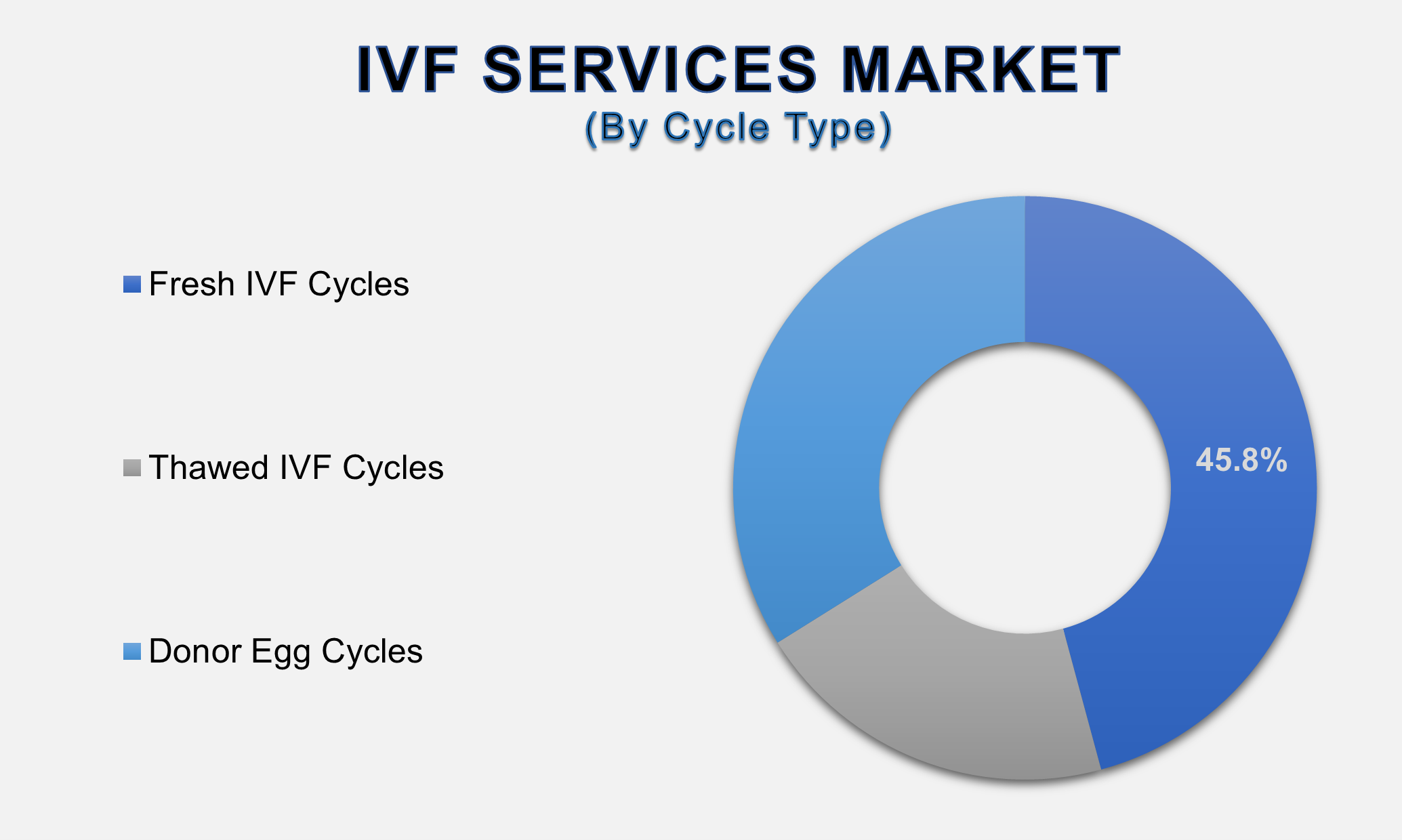
The Fresh IVF
Cycles segment is anticipated to command the largest market share in 2025
The Cycle Type segment is categorized into Fresh IVF Cycles, Thawed IVF Cycles, and Donor Egg
Cycles. The dominance of the Fresh IVF Cycles segment is attributed to its
status as the standard and most commonly initiated treatment protocol for a
majority of first-time IVF patients. In a fresh cycle, eggs are retrieved
and fertilized, and the resulting embryos are
transferred within the same menstrual cycle without being frozen. It is often
the primary approach for couples without specific indications for freezing,
such as those requiring PGT. While frozen embryo transfer (FET) cycles are
growing rapidly due to their high success rates and flexibility, the volume of
fresh cycles remains the foundation of IVF clinic activity, as every patient
undergoing egg retrieval begins with a fresh cycle, securing its position as
the segment with the largest market share.
The 35-39 age group segment is projected to grow at a
significant CAGR.
The Patient Age segment includes Under 35, 35-39, 40-42,
and Over 42. The 35-39 age group's projected significant growth is driven by
the central demographic trend of delayed childbearing. Women in this age
bracket experience a marked decline in ovarian reserve and egg quality, leading
to a significant drop in natural fertility. Consequently, this group represents
a large and rapidly expanding cohort seeking medical assistance to conceive.
Many individuals and couples in this age group have established careers and
financial stability, making them able to afford IVF treatments. They are also
highly motivated to pursue treatment promptly due to the understanding of their
biological clock, making this age segment a critical and fast-growing driver of
demand for IVF services.
The Fertility Clinics end-user segment is projected to
witness the highest growth rate.
The End-User segment is divided into Fertility Clinics,
Hospitals, Surgical Centers, and Clinical Research Institutes. The Fertility
Clinics segment's position as the fastest-growing channel is a direct result of
its specialized nature and focused service
model. These dedicated centers often offer higher success rates due to their
experienced staff, state-of-the-art embryology labs, and high procedural
volume. They provide a comprehensive, patient-centric environment tailored
specifically to the emotional and medical needs of individuals undergoing
fertility treatments. The trend towards chain-owned and branded fertility
clinics, which can leverage economies of scale, invest in the latest
technology, and maintain consistent quality
standards, is further propelling the growth and market share of this segment
compared to general hospitals.
The
following segments are part of an in-depth analysis of the global IVF Services
Market:
|
Market
Segments |
|
|
By Cycle Type |
●
Fresh IVF Cycles ●
Thawed IVF Cycles ●
Donor Egg Cycles |
|
By Patient Age |
●
Under 35 ●
35-39 ●
40-42 ●
Over 42 |
|
By End-user |
●
Fertility Clinics ●
Hospitals ●
Surgical Centers ●
Clinical Research
Institutes |
IVF Services Market Share Analysis by Region
The
Asia-Pacific region is anticipated to hold the largest portion of the IVF
Services Market globally throughout the forecast period.
Asia-Pacific's dominance is driven by a confluence of
powerful factors: a massive population base, a high prevalence of infertility,
rapidly improving healthcare infrastructure, and the emergence of the region as
a global hub for medical tourism. Countries like India, China, and Japan have
large patient pools, and growing awareness is reducing the social stigma
associated with infertility treatments. The cost of IVF procedures in countries
like India and Thailand is significantly lower than in Western countries,
attracting international patients ("reproductive tourism").
Furthermore, governments in some APAC countries are beginning to implement
supportive policies to address declining birth rates, which is expected to
further stimulate the market. The presence of a large number of skilled medical
professionals and a competitive clinic landscape also contributes to the
region's leadership.
India alone is a key growth engine within the APAC region.
The country offers a highly favorable cost
structure without compromising on quality, with treatment costs being a
fraction of those in the US or Europe. This has made it a premier destination
for medical tourism. A growing middle class with increasing disposable income
is making IVF treatments more accessible to the domestic population. The
presence of numerous highly qualified fertility specialists and technologically
advanced clinics in major metropolitan areas creates a robust and expanding
market ecosystem. Increasing media coverage and public discourse about
fertility are also normalizing the use of these services.
IVF Services Market Competition Landscape Analysis
The global IVF
services market is competitive and fragmented, featuring a mix of large
international chains, regional players, and standalone clinics. Competition is
based on clinical success rates, service quality, technological capabilities,
brand reputation, and cost. Key strategies include geographic expansion through
acquisitions and partnerships, heavy investment in the latest ART technologies
(e.g., PGT, time-lapse systems), and focusing on patient experience and support
services. The market also sees competition from local clinics that compete
effectively on price and personalized care.
Global IVF Services Market Recent Developments News:
- In February 2025, IVI RMA announced a strategic
partnership with a leading healthcare group in Southeast Asia to open a
new state-of-the-art fertility clinic in Singapore.
- In December 2024, Virtus Health launched a new
AI-based embryo selection platform across its network of clinics in
Australia and Europe to improve implantation rates.
- In October 2024, The Cooper Companies
(CooperSurgical) acquired a specialized media company to enhance its
portfolio of products and services for IVF laboratories.
- In August 2024, Monash IVF Group reported
successful pilot program results for a new, less invasive endometrial
receptivity test, aiming to improve outcomes for patients with recurrent
implantation failure.
The Global IVF Services Market Is Dominated by a
Few Large Companies, such as
●
IVI RMA
●
Virtus Health
●
The Cooper Companies
Inc. (CooperSurgical)
●
Monash IVF Group
●
CARE Fertility
●
Boston IVF
●
FUJIFILM Irvine
Scientific
●
Cook Medical
●
Genea Biomedx
●
Progyny, Inc.
●
Institut Méric
●
INVO Bioscience
●
Shanghai United Family
Hospital
●
Bloom IVF Group
●
Repromed Limited
●
Panthea Bioscience (a
subsidiary of Gedeon Richter)
● Other Prominent Players
Frequently Asked Questions
Swetal (Research Analyst)
Swetal is a Research Analyst with 4+ years of experience specializing in healthcare market research, medical devices, healthcare IT, and medical technology industry analysis. Her expertise includes competitive intelligence, secondary research, market trend forecasting, and healthcare business insights across global healthcare ecosystems.
She contributes to advanced market research reports by analyzing regulatory frameworks, emerging healthcare technologies, competitive landscapes, and innovation trends shaping the medical industry. With a strong focus on accurate market intelligence, strategic insights, and healthcare industry trends, Swetal supports businesses in making informed, data-backed decisions in a rapidly transforming healthcare environment.
1. Global IVF Services Market
Introduction and Market Overview
1.1.
Objectives
of the Study
1.2.
Global
IVF Services Market Scope and Market Estimation
1.2.1.Global Electronic Toll
Collection Overall Market Size (US$ Bn), Market CAGR (%), Market forecast (2025
- 2033)
1.2.2.Global IVF Services Market
Revenue Share (%) and Growth Rate (Y-o-Y) from 2020 - 2033
1.3.
Market
Segmentation
1.3.1.Cycle Type of Global IVF
Services Market
1.3.2.Patient Age of Global IVF
Services Market
1.3.3.End-user of Global IVF
Services Market
1.3.4.Region of Global IVF
Services Market
2.
Executive Summary
2.1.
Demand
Side Trends
2.2.
Key
Market Trends
2.3.
Market
Demand (US$ Bn) Analysis 2020 – 2024 and forecast, 2025 – 2033
2.4.
Demand
and Opportunity Assessment
2.5.
Overview
of Global IVF Treatment and Access
2.6.
Key
Developments
2.7.
Market
Entry Strategies
2.8.
Market
Dynamics
2.8.1.Drivers
2.8.2.Limitations
2.8.3.Opportunities
2.8.4.Impact Analysis of Drivers
and Restraints
2.9.
Porter’s
Five Forces Analysis
2.10.
PEST
Analysis
3. Global
IVF Services Market Estimates
& Historical Trend Analysis (2020 - 2024)
4. Global
IVF Services Market Estimates
& Forecast Trend Analysis, by Cycle Type
4.1.
Global
IVF Services Market Revenue (US$ Bn) Estimates and Forecasts, by Cycle Type,
2020 - 2033
4.1.1.Fresh IVF Cycles
4.1.2.Thawed IVF Cycles
4.1.3.Donor Egg Cycles
5. Global
IVF Services Market Estimates
& Forecast Trend Analysis, by Patient Age
5.1.
Global
IVF Services Market Revenue (US$ Bn) Estimates and Forecasts, by Patient Age, 2020
- 2033
5.1.1.Under 35
5.1.2.35-39
5.1.3.40-42
5.1.4.Over 42
6. Global
IVF Services Market Estimates
& Forecast Trend Analysis, by End-user
6.1.
Global
IVF Services Market Revenue (US$ Bn) Estimates and Forecasts, by End-user 2020
- 2033
6.1.1.Fertility Clinics
6.1.2.Hospitals
6.1.3.Surgical Centers
6.1.4.Clinical Research
Institutes
7. Global
IVF Services Market Estimates
& Forecast Trend Analysis, by region
7.1.
Global
IVF Services Market Revenue (US$ Bn) Estimates and Forecasts, by region, 2020 -
2033
7.1.1.North America
7.1.2.Europe
7.1.3.Asia Pacific
7.1.4.Middle East & Africa
7.1.5.Latin America
8. North America IVF
Services Market: Estimates &
Forecast Trend Analysis
8.1. North America IVF Services
Market Assessments & Key Findings
8.1.1.North America IVF Services
Market Introduction
8.1.2.North America IVF Services
Market Size Estimates and Forecast (US$ Billion) (2020 - 2033)
8.1.2.1.
By Cycle Type
8.1.2.2.
By Patient Age
8.1.2.3.
By End-user
8.1.2.4. By Country
8.1.2.4.1. The U.S.
8.1.2.4.2. Canada
9. Europe IVF
Services Market: Estimates &
Forecast Trend Analysis
9.1. Europe IVF Services Market
Assessments & Key Findings
9.1.1.Europe IVF Services Market
Introduction
9.1.2.Europe IVF Services Market
Size Estimates and Forecast (US$ Billion) (2020 - 2033)
9.1.2.1.
By Cycle Type
9.1.2.2.
By Patient Age
9.1.2.3.
By End-user
9.1.2.4. By Country
9.1.2.4.1.
Germany
9.1.2.4.2.
Italy
9.1.2.4.3.
U.K.
9.1.2.4.4.
France
9.1.2.4.5.
Spain
9.1.2.4.6.
Switzerland
9.1.2.4.7. Rest
of Europe
10. Asia Pacific IVF
Services Market: Estimates &
Forecast Trend Analysis
10.1. Asia Pacific Market
Assessments & Key Findings
10.1.1.
Asia
Pacific IVF Services Market Introduction
10.1.2.
Asia
Pacific IVF Services Market Size Estimates and Forecast (US$ Billion) (2020 - 2033)
10.1.2.1.
By Cycle Type
10.1.2.2.
By Patient Age
10.1.2.3.
By End-user
10.1.2.4. By Country
10.1.2.4.1. China
10.1.2.4.2. Japan
10.1.2.4.3. India
10.1.2.4.4. Australia
10.1.2.4.5. South Korea
10.1.2.4.6. Rest of Asia Pacific
11. Middle East & Africa IVF
Services Market: Estimates &
Forecast Trend Analysis
11.1. Middle East & Africa
Market Assessments & Key Findings
11.1.1. Middle
East & Africa
IVF Services Market Introduction
11.1.2. Middle
East & Africa
IVF Services Market Size Estimates and Forecast (US$ Billion) (2020 - 2033)
11.1.2.1.
By Cycle Type
11.1.2.2.
By Patient Age
11.1.2.3.
By End-user
11.1.2.4. By Country
11.1.2.4.1. UAE
11.1.2.4.2. Saudi
Arabia
11.1.2.4.3. South
Africa
11.1.2.4.4. Rest
of MEA
12. Latin America
IVF Services Market: Estimates &
Forecast Trend Analysis
12.1. Latin America Market
Assessments & Key Findings
12.1.1. Latin America IVF Services
Market Introduction
12.1.2. Latin America IVF Services
Market Size Estimates and Forecast (US$ Billion) (2020 - 2033)
12.1.2.1.
By Cycle Type
12.1.2.2.
By Patient Age
12.1.2.3.
By End-user
12.1.2.4. By Country
12.1.2.4.1. Brazil
12.1.2.4.2. Argentina
12.1.2.4.3. Mexico
12.1.2.4.4. Rest
of LATAM
13.
Country
Wise Market: Introduction
14.
Competition
Landscape
14.1. Global IVF Services Market
Product Mapping
14.2. Global IVF Services Market
Concentration Analysis, by Leading Players / Innovators / Emerging Players /
New Entrants
14.3. Global IVF Services Market
Tier Structure Analysis
14.4. Global IVF Services Market
Concentration & Company Market Shares (%) Analysis, 2024
15.
Company
Profiles
15.1.
IVI RMA
15.1.1.
Company
Overview & Key Stats
15.1.2.
Financial
Performance & KPIs
15.1.3.
Product
Portfolio
15.1.4.
SWOT
Analysis
15.1.5.
Business
Strategy & Recent Developments
* Similar details would be provided for all the players
mentioned below
15.2.
Virtus Health
15.3.
The Cooper Companies Inc. (CooperSurgical)
15.4.
Monash IVF Group
15.5.
CARE Fertility
15.6.
Boston IVF
15.7.
FUJIFILM Irvine Scientific
15.8.
Cook Medical
15.9.
Genea Biomedx
15.10.
Progyny, Inc.
15.11.
Institut Méric
15.12.
INVO Bioscience
15.13.
Shanghai United Family Hospital
15.14.
Bloom IVF Group
15.15.
Repromed Limited
15.16.
Panthea Bioscience
15.17.
Other Prominent Players
16. Research
Methodology
16.1. External Transportations /
Databases
16.2. Internal Proprietary
Database
16.3. Primary Research
16.4. Secondary Research
16.5. Assumptions
16.6. Limitations
16.7. Report FAQs
17. Research
Findings & Conclusion
Our Research Methodology
"Insight without rigor is just noise."
We follow a comprehensive, multi-phase research framework designed to deliver accurate, strategic, and decision-ready intelligence. Our process integrates primary and secondary research , both quantitative and qualitative , along with dual modeling techniques ( top-down and bottom-up) and a final layer of validation through our proprietary in-house repository.
PRIMARY RESEARCH
Primary research captures real-time, firsthand insights from the market to understand behaviors, motivations, and emerging trends.
1. Quantitative Primary Research
Objective: Generate statistically significant data directly from market participants.
Approaches:- Structured surveys with customers, distributors, and field agents
- Mobile-based data collection for point-of-sale audits and usage behavior
- Phone-based interviews (CATI) for market sizing and product feedback
- Online polling around industry events and digital campaigns
- Purchase frequency by customer type
- Channel performance across geographies
- Feature demand by application or demographic
2. Qualitative Primary Research
Objective: Explore decision-making drivers, pain points, and market readiness.
Approaches:- In-depth interviews (IDIs) with executives, product managers, and key decision-makers
- Focus groups among end users and early adopters
- Site visits and observational research for consumer products
- Informal field-level discussions for regional and cultural nuances
SECONDARY RESEARCH
This phase helps establish a macro-to-micro understanding of market trends, size, regulation, and competitive dynamics, sourced from credible and public domain information.
1. Quantitative Secondary Research
Objective: Model market value and segment-level forecasts based on published data.
Sources include:- Financial reports and investor summaries
- Government trade data, customs records, and regulatory statistics
- Industry association publications and economic databases
- Channel performance and pricing data from marketplace listings
- Revenue splits, pricing trends, and CAGR estimates
- Supply-side capacity and volume tracking
- Investment analysis and funding benchmarks
2. Qualitative Secondary Research
Objective: Capture strategic direction, innovation signals, and behavioral trends.
Sources include:- Company announcements, roadmaps, and product pipelines
- Publicly available whitepapers, conference abstracts, and academic research
- Regulatory body publications and policy briefs
- Social and media sentiment scanning for early-stage shifts
- Strategic shifts in market positioning
- Unmet needs and white spaces
- Regulatory triggers and compliance impact
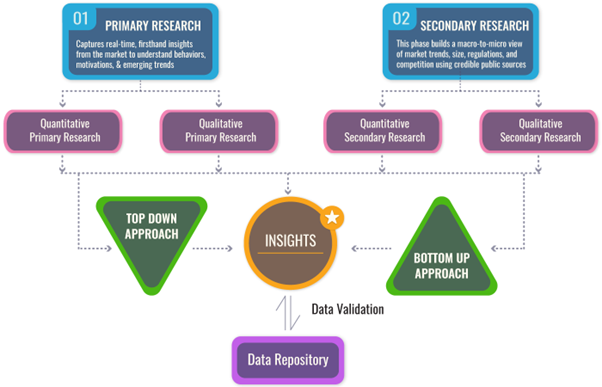
DUAL MODELING: TOP-DOWN + BOTTOM-UP
To ensure robust market estimation, we apply two complementary sizing approaches:
Top-Down Modeling:- Start with broader industry value (e.g., global or regional TAM)
- Apply filters by segment, geography, end-user, or use case
- Adjust with primary insights and validation benchmarks
- Ideal for investor-grade market scans and opportunity mapping
- Aggregate from the ground up using sales volumes, pricing, and unit economics
- Use internal modeling templates aligned with stakeholder data
- Incorporate distributor-level or region-specific inputs
- Most accurate for emerging segments and granular sub-markets
DATA VALIDATION: IN-HOUSE REPOSITORY
We close the loop with proprietary data intelligence built from ongoing projects, industry monitoring, and historical benchmarking. This repository includes:
- Multi-sector market and pricing models
- Key trendlines from past interviews and forecasts
- Benchmarked adoption rates, churn patterns, and ROI indicators
- Industry-specific deviation flags and cross-check logic
- Catches inconsistencies early
- Aligns projections across studies
- Enables consistent, high-trust deliverables