
Japan Antiepileptic Drugs Market Size and Forecast (2026–2034), Regional Growth, Trend, Share and Industry Analysis Report Coverage: By Drug Class (Sodium Channel Modulators, GABA-Enhancing Agents, Calcium Channel Modulators, and Others); By Route of Administration (Oral, Intravenous, Intramuscular, and Others); By Formulation (Tablets and Capsules, Oral Liquids and Suspensions, Injectable Formulations, and Others); By Distribution Channel (Hospital Pharmacies, Retail Pharmacies, and Online Pharmacies)
2026-11-09
Healthcare
Swetal (Research Analyst)
Description
Japan Antiepileptic Drugs Market Overview
The Japan antiepileptic drugs market is projected to expand from USD 0.86 billion in 2026 to USD 1.28 billion by 2034, registering a CAGR of 5.3% during 2026–2034. The key drivers of the Japan antiepileptic drugs market include the continuous requirement for effective epilepsy management, existing neurological treatment services, and the availability of old and new anticonvulsants. The market includes branded as well as generic products that can be used to treat various seizures, depending upon efficacy, safety profile, tolerance, and patients' needs. The pharmaceutical companies are concentrating on the diversification of treatment options as well as seizure management through developing and launching new therapies. At the same time, issues such as generic pressure, drug pricing, side effects, and the necessity of treatment adherence affect the market performance. Further developments in the field of epilepsy treatment and diagnosis, as well as the need for more tolerable drugs, will favor market growth.

Japan Antiepileptic Drugs Market Growth Drivers
Increasing Use of Newer Antiseizure Medicines in Clinical Practice
An increase in the usage of modern antiepileptic medications in clinical practice is expected to contribute to the development of the market for Japan Antiepileptic Drugs. Clinicians are becoming increasingly willing to use new-generation medications to increase the efficiency of seizure control, tolerance, and long-term medication compliance. Levetiracetam and lamotrigine, for example, have proved their clinical efficacy in epilepsy management and a less complicated profile of drug interactions in some cases than traditional antiepileptic drugs. The growing proportion of the elderly population and concomitant diseases in Japan are contributing to the growing demand for medicines that can be integrated into personalized therapy regimens. Usage of new medicines, either as a first-line or as an adjunct therapy option, especially among patients with inadequate response to existing therapies, is widening the range of treatment options and stimulating prescription demand.
Established Demand for Multiple Antiseizure Drug Classes
Existing demand for various anticonvulsant drug classes drives the development of the Japan Antiepileptic Drugs Market, as various therapeutic options are needed depending on the type of seizure, severity of the condition, patient’s age, concomitant diseases, and reactions to other medications. Existing drug classes, such as sodium channel inhibitors and GABA potentiators, have proven their effectiveness, while emerging novel treatments, which can target various targets, including the SV2A receptor or multiple ion channels, offer more treatment options for patients. This allows for prescribing either monotherapy or combination treatment, depending on the patient's needs. Demand in the market is also driven by the need for some patients to take drugs for years to control seizures and adjust the treatment in case of lack of efficacy or negative side effects of existing medication.
Japan Antiepileptic Drugs Market Restraint
Cautious Generic Substitution in Epilepsy Treatment
The careful use of generics in epilepsy therapy functions as an inhibitor of the growth of the Japan Antiepileptic Drugs Market since doctors are not always willing to change the drug regimen of a patient who is on a branded anticonvulsant and is doing well by taking it. Even though generics could lower the cost of treatment, there may be fears regarding possible variations in the composition of the drug, patient tolerance and adherence, and seizure control, which could affect the decision of the doctor to prescribe a new drug. In Japan, where prolonged treatment is necessary and involves regular monitoring of the patient, doctors might be more inclined to maintain clinical stability than save money.
Japan Antiepileptic Drugs Market Opportunities
Commercialization of Newly Approved Treatments for Uncontrolled Seizures
The commercialization of newly introduced medicines that would treat cases of uncontrolled seizures is seen as one of the main avenues for development in the Japan Antiepileptic Drugs Market. Patients who fail to gain control of their seizures using the currently available medicines need additional solutions. The introduction of medicines with new mechanisms of action, increased efficacy, or complementary effects for certain types of seizures can help fill an unmet medical need, especially in the case of patients suffering from drug-resistant epilepsy. Japan has a well-developed regulatory and healthcare system that gives drug manufacturers opportunities to bring innovative drugs into the country by receiving approvals, involving physicians, and collaborating with local pharmaceutical companies. Proper commercialization of such drugs would increase the number of treatment options, boost the demand for branded medicines against seizures, and create opportunities for pharmaceutical companies to diversify their portfolio in a competitive environment.
Japan Antiepileptic Drugs Market Scope
Japan Antiepileptic Drugs Market Report Segmentation Analysis
Sodium Channel Modulators Segment Is Expected to Dominate the Japan Antiepileptic Drugs Market During the Forecast Period
The sodium channel modulators are predicted to maintain their leadership in the Japan Antiepileptic Drugs Market through the forecast period because of the extensive use of medications such as carbamazepine, lamotrigine, and lacosamide, among others, that act by influencing voltage-gated sodium channels and reducing neuronal excitability. These medications are administered to specific types of seizures, especially focal onset seizures. They play an important role in the treatment of patients as monotherapy drugs and adjunctive therapy drugs, depending on the characteristics of the patient. There will also be an ongoing need for long-term seizure treatment and hence demand for the segment will continue to be buoyed by the availability of various branded and generic drugs. Development and utilization of newer sodium channel modulation medications can potentially help in managing seizure patients who do not get adequate control from currently available medications. Different factors affect medication choices for different types of seizures; thus, the predicted leadership should be verified using Japan prescription and revenue data.

Oral Segment Is Expected to Dominate the Japan Antiepileptic Drugs Market During the Forecast Period
The oral category will hold its leadership in the Japan Antiepileptic Drugs Market during the forecast period. The primary reason behind this forecast is the extensive usage of oral tablets, capsules, and liquids for epilepsy treatment. The convenience of oral antiseizure drugs makes them easy to administer, helps to achieve compliance, and allows for outpatient treatment, which can help people to treat their condition without constant visits to the hospital. The well-developed healthcare structure of the country and the importance placed on consistent disease management in Japan will be a driving force behind the usage of oral products among adults and children. There are many different classes of antiseizure drugs available in oral form, both branded and generics, which gives doctors the ability to adapt the treatment based on the patient’s needs and response to the medication.
Tablets and Capsules Segment Is Expected to Dominate the Japan Antiepileptic Drugs Market During the Forecast Period
The tablets and capsules segment is projected to dominate the Japan Antiepileptic Drugs Market through the forecast period due to the extensive use of solid-form drugs for the treatment of seizures on an outpatient basis. Such drugs provide convenience, consistency in doses, easy storage, and suitability for outpatient treatment. This has ensured that there remains a demand for the solid form of drugs from the patients requiring long-term antiseizure medications. There is also the presence of several known and novel antiepileptic drugs in the tablet/capsules form, enabling doctors to prescribe medication as per the seizure condition, patient requirements, and tolerance. The established distribution network of the pharmaceutical industry of Japan has also supported easy access to the drug at various levels, including hospitals, clinics, and pharmacies. However, liquid-form drugs are used mainly for the pediatric population and for those patients who cannot swallow the tablets/capsule form drugs.
Hospital Pharmacies Segment Is Expected to Dominate the Japan Antiepileptic Drugs Market During the Forecast Period
The Japan hospital pharmacies segment is estimated to retain a sizable market share in the Japan Antiepileptic Drugs Market over the forecast period, driven by their involvement in the diagnosis, initiation of treatment, adjustment of medication, and management of cases with uncontrolled seizures. Antiseizure medications are typically prescribed to patients after proper diagnosis is conducted by neurologists and other specialists. There are also cases where complicated epilepsy patients or those with medication-resistant cases are managed at hospitals. The existing hospital setup and access to specialist neurological care in Japan further drive the distribution of antiseizure medicines through hospitals. Nevertheless, community pharmacies are equally important for the supply of repeat prescriptions to patients on outpatient treatment; hence, the predicted supremacy of hospital pharmacies will be determined by the extent to which both channels contribute to the total sales of antiseizure medications.
The following segments are part of an in-depth analysis of the Japan Antiepileptic Drugs Market:
Japan Antiepileptic Drugs Market Competition Landscape Analysis
Antiepileptic drugs in the Japan market involve competition among both indigenous pharmaceutical firms and international firms and are determined by factors like product line-up, efficacy, safety, approvals, and pricing, among others. Top firms, including Eisai Co., Ltd., Otsuka Pharmaceutical Co., Ltd., Sumitomo Pharma Co., Ltd. and UCB, compete across older and more recently launched drugs within the antiseizure medicines space, while generic firms such as Sawai Pharmaceutical Co., Ltd. and Towa Pharmaceutical Co., Ltd. contribute to pricing competition and availability of medications for patients. Competition within the space will be shaped by the presence of products with indications in specific types of seizures, refractory epilepsy, and those that require adjunct medication, among others. Other areas of emphasis by firms in this marketplace include access to medications approved by authorities and maintaining product competitiveness within Japan's market-access and pricing environment. Growth going forward will hinge on the capability of firms to provide significant clinical value in unmet indications.
Japan Antiepileptic Drugs Market Recent Developments News:
In February 2026, Nippon Shinyaku announced that it would assume the Japanese marketing authorization for FINTEPLA (fenfluramine hydrochloride) oral solution from UCB Japan, effective April 1, 2026. The medicine was approved in Japan in September 2022 for seizures associated with Dravet syndrome and received an additional indication for Lennox–Gastaut syndrome in March 2024. The transfer strengthens Nippon Shinyaku’s responsibility for the product’s commercialization and ongoing safety information management in Japan, highlighting the importance of domestic pharmaceutical partnerships and specialized treatment portfolios in addressing rare and severe forms of epilepsy.
In September 2026, Seoul Economic Daily reported that SK Biopharmaceuticals’ cenobamate had received approval in Japan through its commercialization partner, Ono Pharmaceutical, under the brand name Exkopri. The approval was supported by a multinational Phase 3 trial involving adults with partial-onset epilepsy whose seizures were inadequately controlled by existing treatments; patients receiving cenobamate as an add-on therapy achieved a significant reduction in seizure frequency compared with placebo. The approval expands access to another treatment option for patients with uncontrolled focal seizures and creates a commercial opportunity for SK Biopharmaceuticals through milestone payments and sales-based royalties under its licensing agreement with Ono Pharmaceutical. The companies are also pursuing further clinical development in additional seizure types and patient populations, potentially expanding the drug’s future role in Japan’s epilepsy treatment landscape.
The Japan Antiepileptic Drugs Market is dominated by a few large companies, such as
Eisai Co., Ltd.
Kyowa Kirin Co., Ltd.
Sumitomo Pharma Co., Ltd.
Ono Pharmaceutical Co., Ltd.
Nippon Shinyaku Co., Ltd.
Daiichi Sankyo Co., Ltd.
Sawai Pharmaceutical Co., Ltd.
Towa Pharmaceutical Co., Ltd.
Nippon Generic Co., Ltd.
Nissin Pharmaceutical Co., Ltd.
Daito Pharmaceutical Co., Ltd.
Kyowa Pharmaceutical Industry Co., Ltd.
Fuji Pharma Co., Ltd.
Sanofi
UCB
Pfizer Inc.
Novartis AG
Tatsumi Kagaku Co., Ltd.
Nihon Pharmaceutical Co., Ltd.
Other Prominent Players
Frequently Asked Questions
Swetal (Research Analyst)
Swetal is a Research Analyst with 4+ years of experience specializing in healthcare market research, medical devices, healthcare IT, and medical technology industry analysis. Her expertise includes competitive intelligence, secondary research, market trend forecasting, and healthcare business insights across global healthcare ecosystems.
She contributes to advanced market research reports by analyzing regulatory frameworks, emerging healthcare technologies, competitive landscapes, and innovation trends shaping the medical industry. With a strong focus on accurate market intelligence, strategic insights, and healthcare industry trends, Swetal supports businesses in making informed, data-backed decisions in a rapidly transforming healthcare environment.
Japan Antiepileptic Drugs Market Introduction and Market Overview
Objectives of the Study
Market Segmentation
Drug Class of the Japan Antiepileptic Drugs Market
Route of Administration of the Japan Antiepileptic Drugs Market
Formulation of the Japan Antiepileptic Drugs Market
Distribution Channel of the Japan Antiepileptic Drugs Market
Competition Coverage List of Market Participants
Market Definition: Antiepileptic Drugs Market
Executive Summary
Japan Antiepileptic Drugs Market Estimation & Forecast
Japan Antiepileptic Drugs Market Size (US$ Million) Estimates & Historical Trend Analysis (2021 - 2025)
Japan Peptide Cancer Vaccine Overall Market Size (US$ Million), Growth Rate (Y-o-Y), Market CAGR (%), Market Forecast (2026 - 2034)
Snapshot of Japan Antiepileptic Drugs Market
Japan Antiepileptic Drugs Market Revenue Share (%) 2025
Key Competitors & Key Insights
Market Overview (Qualitative Analysis)
Demand Side Trends
Supply Side Trends / Manufacturing Trends
Demand and Opportunity Assessment, 2026 - 2034
Market Dynamics
Drivers
Limitations
Opportunities
Impact Analysis of Drivers and Restraints
Key Developments
Regulatory Landscape
Pricing Analysis
Supply Chain Analysis
Porter’s Five Forces Analysis
Bargaining Power of Suppliers
Bargaining Power of Buyers
Threat of Substitutes
Threat of New Entrants
Competitive Rivalry
PEST Analysis
Political Factors
Economic Factors
Social Factors
Technology Factors
Japan Antiepileptic Drugs Market Estimates & Forecast Trend Analysis, by Drug Class
Japan Antiepileptic Drugs Market Assessments & Key Findings, by Drug Class
Japan Antiepileptic Drugs Market Revenue (US$ Million) Estimates and Forecasts, by Drug Class, 2021 - 2034
Sodium Channel Modulators
GABA-Enhancing Agents
Calcium Channel Modulators
Others
Japan Antiepileptic Drugs Market Estimates & Forecast Trend Analysis, by Route of Administration
Japan Antiepileptic Drugs Market Assessments & Key Findings, by Route of Administration
Japan Antiepileptic Drugs Market Revenue (US$ Million) Estimates and Forecasts, by Route of Administration, 2021 - 2034
Oral
Intravenous
Intramuscular
Others
Japan Antiepileptic Drugs Market Estimates & Forecast Trend Analysis, by Formulation
Japan Antiepileptic Drugs Market Assessments & Key Findings, by Formulation
Japan Antiepileptic Drugs Market Revenue (US$ Million) Estimates and Forecasts, by Formulation, 2021 - 2034
Tablets and Capsules
Oral Liquids and Suspensions
Injectable Formulations
Others
Japan Antiepileptic Drugs Market Estimates & Forecast Trend Analysis, by Distribution Channel
Japan Antiepileptic Drugs Market Assessments & Key Findings, by Distribution Channel
Japan Antiepileptic Drugs Market Revenue (US$ Million) Estimates and Forecasts, by Distribution Channel, 2021 - 2034
Hospital Pharmacies
Retail Pharmacies
Online Pharmacies
Competition Landscape
Japan Antiepileptic Drugs Market Product Mapping
Japan Antiepileptic Drugs Market Concentration Analysis, by Leading Players / Innovators / Emerging Players / New Entrants
Japan Antiepileptic Drugs Market Tier Structure Analysis
Japan Antiepileptic Drugs Market Concentration & Company Market Shares (%) Analysis, 2025
Company Profiles
Eisai Co., Ltd.
Company Overview & Key Stats
Financial Performance & KPIs
Product Portfolio
SWOT Analysis
Business Strategy & Recent Developments
* Similar details would be provided for all the players mentioned below
Kyowa Kirin Co., Ltd.
Sumitomo Pharma Co., Ltd.
Ono Pharmaceutical Co., Ltd.
Nippon Shinyaku Co., Ltd.
Daiichi Sankyo Co., Ltd.
Sawai Pharmaceutical Co., Ltd.
Towa Pharmaceutical Co., Ltd.
Nippon Generic Co., Ltd.
Nissin Pharmaceutical Co., Ltd.
Daito Pharmaceutical Co., Ltd.
Kyowa Pharmaceutical Industry Co., Ltd.
Fuji Pharma Co., Ltd.
Sanofi
UCB
Pfizer Inc.
Novartis AG
Tatsumi Kagaku Co., Ltd.
Nihon Pharmaceutical Co., Ltd.
Other Prominent Players
Research Findings & Conclusion
Assumption & Acronyms Used
Research Methodology
External Transportations / Databases
Internal Proprietary Database
Primary Research
Secondary Research
Assumptions
Limitations
Report FAQs
Our Research Methodology
"Insight without rigor is just noise."
We follow a comprehensive, multi-phase research framework designed to deliver accurate, strategic, and decision-ready intelligence. Our process integrates primary and secondary research , both quantitative and qualitative , along with dual modeling techniques ( top-down and bottom-up) and a final layer of validation through our proprietary in-house repository.
PRIMARY RESEARCH
Primary research captures real-time, firsthand insights from the market to understand behaviors, motivations, and emerging trends.
1. Quantitative Primary Research
Objective: Generate statistically significant data directly from market participants.
Approaches:- Structured surveys with customers, distributors, and field agents
- Mobile-based data collection for point-of-sale audits and usage behavior
- Phone-based interviews (CATI) for market sizing and product feedback
- Online polling around industry events and digital campaigns
- Purchase frequency by customer type
- Channel performance across geographies
- Feature demand by application or demographic
2. Qualitative Primary Research
Objective: Explore decision-making drivers, pain points, and market readiness.
Approaches:- In-depth interviews (IDIs) with executives, product managers, and key decision-makers
- Focus groups among end users and early adopters
- Site visits and observational research for consumer products
- Informal field-level discussions for regional and cultural nuances
SECONDARY RESEARCH
This phase helps establish a macro-to-micro understanding of market trends, size, regulation, and competitive dynamics, sourced from credible and public domain information.
1. Quantitative Secondary Research
Objective: Model market value and segment-level forecasts based on published data.
Sources include:- Financial reports and investor summaries
- Government trade data, customs records, and regulatory statistics
- Industry association publications and economic databases
- Channel performance and pricing data from marketplace listings
- Revenue splits, pricing trends, and CAGR estimates
- Supply-side capacity and volume tracking
- Investment analysis and funding benchmarks
2. Qualitative Secondary Research
Objective: Capture strategic direction, innovation signals, and behavioral trends.
Sources include:- Company announcements, roadmaps, and product pipelines
- Publicly available whitepapers, conference abstracts, and academic research
- Regulatory body publications and policy briefs
- Social and media sentiment scanning for early-stage shifts
- Strategic shifts in market positioning
- Unmet needs and white spaces
- Regulatory triggers and compliance impact
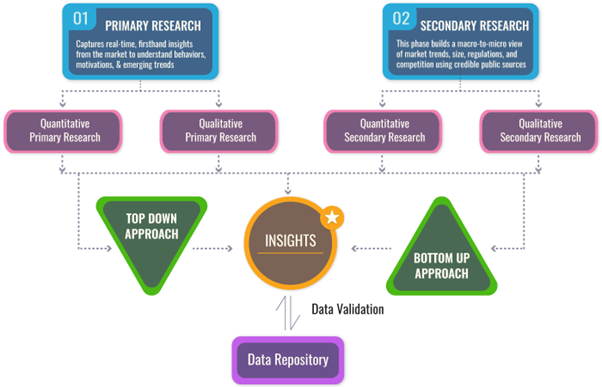
DUAL MODELING: TOP-DOWN + BOTTOM-UP
To ensure robust market estimation, we apply two complementary sizing approaches:
Top-Down Modeling:- Start with broader industry value (e.g., global or regional TAM)
- Apply filters by segment, geography, end-user, or use case
- Adjust with primary insights and validation benchmarks
- Ideal for investor-grade market scans and opportunity mapping
- Aggregate from the ground up using sales volumes, pricing, and unit economics
- Use internal modeling templates aligned with stakeholder data
- Incorporate distributor-level or region-specific inputs
- Most accurate for emerging segments and granular sub-markets
DATA VALIDATION: IN-HOUSE REPOSITORY
We close the loop with proprietary data intelligence built from ongoing projects, industry monitoring, and historical benchmarking. This repository includes:
- Multi-sector market and pricing models
- Key trendlines from past interviews and forecasts
- Benchmarked adoption rates, churn patterns, and ROI indicators
- Industry-specific deviation flags and cross-check logic
- Catches inconsistencies early
- Aligns projections across studies
- Enables consistent, high-trust deliverables