
Jewelry Organizer Market Size and Forecast (2026–2034), Global and Regional Growth, Trend, Share, and Industry Analysis Report Coverage; By Product (Jewelry Boxes, Hanging Organizers, Travel Cases, Drawer Inserts, Wall-Mounted Organizers, Others); By Material (Wood, Leather, Metal, Plastic, Fabric, Others); By Sales Channel (Online, Specialty Stores, Supermarkets and Hypermarkets, Departmental Stores, Others); By End User (Residential, Commercial); By Price Tier (Mid-Range, Premium, Budget); and Geography
2026-09-01
Consumer Products
Aishwarya Panbude (Research Analyst)
Description
Jewelry Organizer Market Overview
The global Jewelry
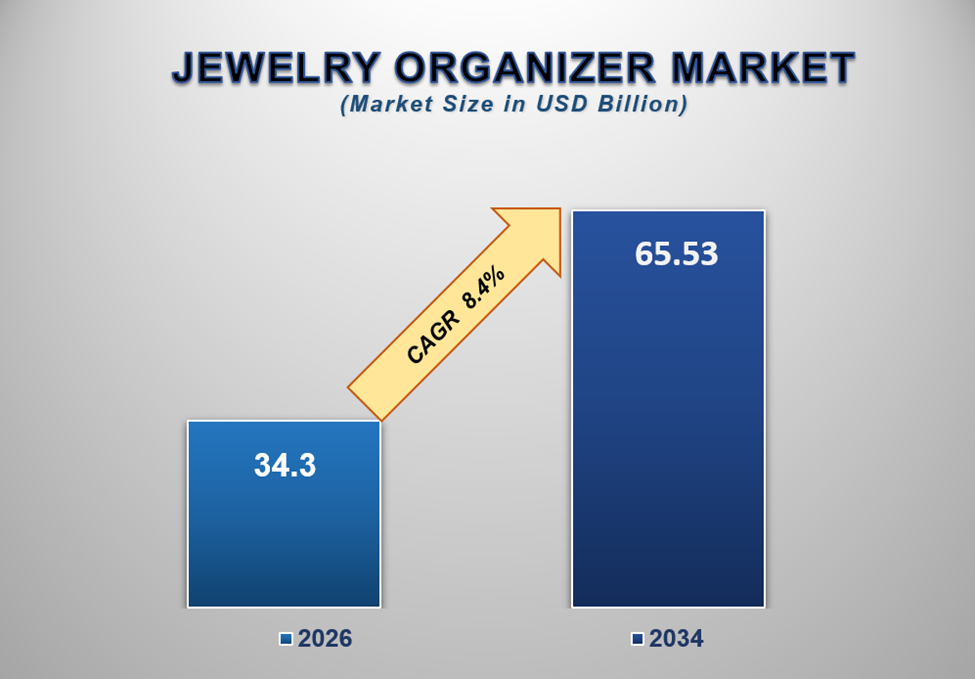
Organizer Market was valued at USD 34.3 billion in 2026 and is
projected to reach USD 65.53 billion by 2034, expanding at a CAGR of
8.4% during the forecast period. The market is experiencing strong growth
due to increasing jewelry ownership, rising consumer interest in home
organization, growing disposable incomes, expanding e-commerce channels,
changing bedroom and closet organization preferences, and increasing demand for
storage products that combine functionality with aesthetic appeal.
Jewelry
organizers are specialized storage products designed to arrange, protect, and
display items such as rings, necklaces, earrings, bracelets, watches, and other
personal accessories. Products range from traditional jewelry boxes and trays
to hanging organizers, drawer inserts, wall-mounted systems, travel cases, and
multifunctional storage units.
The growing
ownership of fashion jewelry, precious jewelry, watches, and personal
accessories is creating a larger requirement for dedicated storage solutions.
Consumers increasingly seek products that prevent tangling, scratching,
misplacement, and exposure to dust or moisture.
Jewelry
organization is also becoming increasingly connected with broader
home-organization trends. Consumers are investing in aesthetically coordinated
bedroom, wardrobe, dressing-table, and closet-storage products rather than
relying solely on basic boxes or improvised containers.
The influence of
social media platforms and home-organization content is further changing
consumer perceptions of jewelry organizers. Products are increasingly viewed as
decorative lifestyle accessories that can complement interior aesthetics while
providing practical storage.
Residential
applications remain an important source of demand as households accumulate
larger jewelry collections and seek dedicated spaces for different categories
of accessories. Commercial users, including jewelry stores, boutiques, salons,
and related businesses, also require organized storage and display solutions.
Product
manufacturers are introducing organizers with specialized compartments,
necklace hooks, ring cushions, removable trays, transparent sections, locking
mechanisms, mirrors, and modular interiors.
Space-efficient
designs are becoming increasingly important as consumers in urban areas often
have limited bedroom, wardrobe, and dressing-table space. Hanging and
wall-mounted organizers can help utilize vertical areas, while drawer inserts
and stackable systems provide concealed storage.
Material
innovation is also shaping the market. Wood, leather, metal, plastic, acrylic,
and fabric-based products allow manufacturers to target different price points
and aesthetic preferences.
The expansion of
online retail has significantly improved access to jewelry organizers. Digital
platforms enable consumers to compare designs, capacities, materials, prices,
customer reviews, and customization options without visiting multiple physical
stores. Current market research also identifies e-commerce expansion as an
important factor supporting jewelry-organizer demand.
As jewelry
ownership, home organization, online shopping, and demand for visually
appealing personal-storage products continue increasing, the global jewelry
organizer market is expected to maintain strong growth through 2034.
Jewelry Organizer Market Drivers and
Opportunities
Growing
Jewelry Ownership and Accessory Collections Are Driving Market Growth
Increasing
ownership of jewelry and fashion accessories is one of the major factors
supporting demand for dedicated storage products.
Consumers
increasingly own multiple types of jewelry, including necklaces, earrings,
bracelets, rings, watches, and fashion accessories. As collections become
larger, simple drawers and conventional storage boxes often become inadequate.
Dedicated
organizers provide separate spaces for different jewelry categories, helping
users reduce tangling, scratches, misplacement, and damage.
The growing
popularity of jewelry as a gifting product is also indirectly expanding the
addressable market for organizers. Consumers receiving new jewelry pieces may
seek complementary storage solutions to keep collections organized.
Rising
disposable incomes in emerging economies are further supporting ownership of
personal accessories and creating additional demand for home-storage products.
India and China are among the markets identified as particularly attractive
growth areas for jewelry organizers.
As jewelry
collections become increasingly diverse, demand for specialized storage
solutions is expected to remain strong throughout the forecast period.
Home
Organization and Space Optimization Trends Are Supporting Market Expansion
The growing
emphasis on organized living spaces is creating new opportunities for jewelry
organizer manufacturers.
Consumers are
increasingly organizing bedrooms, dressing areas, wardrobes, and closets
according to specific storage categories. Jewelry organizers are benefiting
from this broader movement toward decluttering and efficient home management.
Space
limitations in apartments and urban residences are also increasing demand for
compact storage products.
Hanging
organizers, drawer inserts, wall-mounted holders, rotating stands, and
stackable boxes allow consumers to use available vertical and concealed spaces
more efficiently.
Social media
content focused on wardrobe organization, bedroom makeovers, minimalist living,
and decluttering is further increasing awareness of specialized storage
products.
The category is
therefore shifting from purely functional storage toward lifestyle-oriented
products that combine organization, accessibility, decoration, and personal
expression.
This transition
is creating opportunities for brands capable of offering attractive designs
that fit modern interiors while providing practical jewelry-storage
functionality.
E-Commerce
Expansion and Premium Product Innovation Create Significant Opportunities
Online retail is
creating significant opportunities for jewelry organizer manufacturers by
expanding geographic reach and reducing dependence on traditional retail
locations.
Digital
marketplaces allow brands to display detailed product photographs, dimensions,
internal configurations, material specifications, customer reviews, and usage
demonstrations.
The visual
nature of jewelry organizers makes them particularly suitable for digital
marketing and social media-driven product discovery.
Premiumization
is another important opportunity. Consumers are increasingly willing to pay for
organizers featuring quality materials, refined finishes, mirrors, locking
systems, modular compartments, and customized interiors.
Manufacturers
are also exploring sustainable materials, personalized designs, multifunctional
products, and smart storage concepts to differentiate their offerings.
The combination
of e-commerce accessibility, lifestyle marketing, customization, and premium
design is expected to create substantial opportunities for market participants
through 2034.
Jewelry Organizer Market Scope
|
Report Attributes |
Description |
|
Market Size in 2026 |
USD
34.3 Billion |
|
Market Forecast in 2034 |
USD 65.53 Billion |
|
CAGR % 2026-2034 |
8.4% |
|
Base Year |
2025 |
|
Historic Data |
2021-2025 |
|
Forecast Period |
2026-2034 |
|
Report USP |
Production, Consumption,
Company Share, Company Heatmap, Company Production, Service Type, Growth
Factors and more |
|
Segments Covered |
· By Product · By Material · By Sales Channel · By End User · By Price Tier |
|
Regional Scope |
● North America |
|
Country Scope |
U.S. |
Jewelry Organizer Market Report
Segmentation Analysis
The global
jewelry organizer market industry analysis is segmented into product, material,
sales channel, end user, price tier, and region.
The Jewelry
Boxes Segment Is Expected to Dominate the Market During the Forecast Period
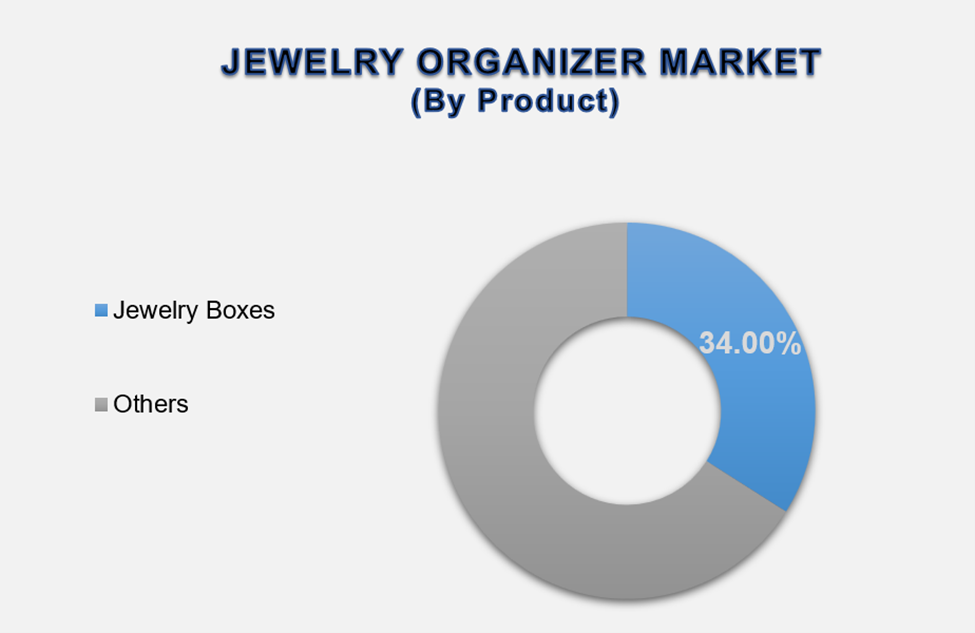
The Jewelry
Boxes segment accounted for approximately 34.0% of the global product
segment, making it the leading product category. The segment benefits from
established consumer familiarity, broad product availability, suitability for
residential storage, and the ability to accommodate multiple jewelry categories
within a single product.
Jewelry boxes
remain one of the most established formats for personal jewelry storage because
they provide enclosed compartments for rings, earrings, bracelets, necklaces,
and other accessories.
Traditional
jewelry boxes are increasingly being redesigned with removable trays,
adjustable compartments, mirrors, ring cushions, necklace hooks, and dedicated
earring sections.
The category
also spans a broad range of price points. Basic organizers address everyday
household requirements, while premium wooden, leather, upholstered, and
designer boxes target consumers seeking more sophisticated products.
The growing
preference for organized dressing areas and attractive bedroom accessories is
supporting the continued relevance of jewelry boxes.
Travel-oriented
jewelry boxes are also gaining popularity as consumers seek compact solutions
for protecting accessories during vacations, business travel, and other trips.
Wood Segment
Is Expected to Lead the Market by Material
The Wood
segment represents a significant material category in the jewelry organizer
market.
Wooden
organizers combine structural durability with a decorative appearance, making
them suitable for bedroom furniture, dressing tables, wardrobes, and premium
home interiors.
Consumers
seeking products with a traditional or sophisticated appearance often prefer
wooden organizers because of their natural texture and ability to complement
furniture and interior décor.
Manufacturers
are also using engineered wood and composite constructions to produce
lightweight and cost-effective designs while maintaining the visual
characteristics associated with wooden products.
Sustainably
sourced wood and improved finishing techniques are creating additional
opportunities as environmentally conscious consumers increasingly consider
material origin and product longevity.
Online
Segment Is Expected to Lead the Market by Sales Channel
The Online
segment is expected to experience strong growth as consumers increasingly use
digital marketplaces and brand websites to discover home-organization products.
Online platforms
provide extensive product selection and allow consumers to compare dimensions,
materials, compartment arrangements, colors, designs, and prices.
The visual
nature of jewelry organizers also makes digital merchandising particularly
effective. Product photography, room-setting images, demonstration videos, and
user-generated content can communicate both functionality and aesthetic value.
Online channels
also make niche products more accessible. Consumers searching for specialized
travel organizers, wall-mounted systems, modular inserts, or premium storage
cases can find products beyond the assortment typically available at local
stores.
The continued
expansion of e-commerce infrastructure and digital payments is expected to
strengthen online jewelry-organizer sales throughout the forecast period.
Residential
Segment Is Expected to Dominate the Market by End User
The Residential
segment is expected to account for the largest share of the jewelry organizer
market.
Households
represent the primary environment for storing personal jewelry collections.
Consumers use organizers in bedrooms, dressing rooms, wardrobes, closets,
bathroom areas, and personal dressing spaces.
Growing jewelry
ownership and increasing interest in home organization are encouraging
consumers to dedicate specific storage areas to personal accessories.
Residential
users also increasingly prefer products that combine practical storage with
decorative appeal. This is encouraging manufacturers to introduce organizers in
a wider variety of finishes, shapes, sizes, and interior configurations.
Commercial
applications, including jewelry stores, boutiques, salons, and accessory
retailers, continue to provide additional demand for organized storage and
presentation products.
Mid-Range
Segment Is Expected to Lead the Market by Price Tier
The Mid-Range
segment is expected to represent an important portion of the market as
consumers seek a balance between affordability, quality, functionality, and
appearance.
Mid-range
products typically offer more sophisticated compartment configurations and
better finishing than entry-level organizers while remaining accessible to a
broad consumer base.
The segment is
benefiting from consumers becoming increasingly selective about storage
products and looking beyond basic boxes toward products with specialized
compartments and improved organization.
Premium
organizers are gaining attention among affluent consumers, while budget
products continue serving price-sensitive households and first-time buyers.
The following segments are part of an in-depth analysis of the global Jewelry Organizer Market:
|
Market Segments |
|
|
By
Product |
· Jewelry Boxes · Hanging Organizers · Travel Cases · Drawer Inserts · Wall-Mounted
Organizers · Others |
|
By
Material |
· Wood · Leather · Metal · Plastic · Fabric · Others |
|
By Sales Channel |
· Online · Specialty Stores · Supermarkets and
Hypermarkets · Departmental Stores · Others |
|
By End User |
· Residential · Commercial |
|
By Price
Tier |
· Mid-Range · Premium · Budget |
Jewelry Organizer Market Share
Analysis By Region
North America is projected to hold a significant share of the global jewelry
organizer market over the forecast period.
The regional
market is supported by high consumer spending on personal accessories,
established home-organization trends, strong e-commerce penetration, and demand
for premium lifestyle products. The United States remains the principal
contributor, supported by extensive online retail availability and consumer
preference for organized closets, dressing areas, and personal storage
products.
Europe represents an important market due to strong consumer interest in
design-oriented home products, quality craftsmanship, sustainable materials,
and organized living spaces. Germany, the U.K., France, Italy, Spain, and
Switzerland are key regional markets.
Asia Pacific is expected to register strong growth during the forecast period.
Increasing disposable incomes, rising jewelry ownership, urbanization,
expanding middle-class populations, and rapid e-commerce development are
supporting regional demand. China, India, Japan, South Korea, and Australia
are major contributors.
China represents
a major opportunity due to its large consumer base, expanding online retail
ecosystem, and growing interest in home organization. India is also expected to
experience strong demand because of the cultural importance of jewelry
ownership, increasing disposable income, urbanization, and expanding digital
retail access. Current industry research identifies India and China as among
the fastest-growing country markets for jewelry organizers.
Latin America is expected to experience steady growth as household incomes
improve, online shopping expands, and consumers increasingly adopt dedicated
personal-storage products. Brazil, Mexico, and Argentina represent
important regional markets.
The Middle
East & Africa represents an emerging market
supported by jewelry ownership, premium consumer spending, expanding retail
infrastructure, and growing adoption of online shopping platforms.
Jewelry
Organizer Market Competition Landscape Analysis
The global
jewelry organizer market is characterized by competition across product design,
material quality, functionality, price, aesthetics, customization, and
distribution.
Manufacturers
are increasingly developing products that combine storage efficiency with
decorative appeal. Compartmentalized interiors, removable trays, necklace
hooks, ring cushions, mirrors, transparent sections, and locking mechanisms are
being incorporated into modern designs.
Online
marketplaces have lowered entry barriers for specialized brands, allowing
smaller manufacturers to compete through niche designs, affordable pricing,
social media marketing, and direct-to-consumer distribution.
Established
companies are strengthening their positions by offering products across
multiple price tiers and material categories.
Design
differentiation is becoming particularly important as jewelry organizers
increasingly function as visible components of bedrooms, closets, dressing
areas, and home interiors.
Companies are
also responding to sustainability trends through greater use of durable,
recyclable, recycled, and responsibly sourced materials.
The competitive
environment is expected to remain fragmented, with brands competing through
product innovation, aesthetic differentiation, online visibility, customer
reviews, customization, and international distribution. Current industry
research identifies companies including SONGMICS, Stackers, Mele & Co.,
Umbra, WOLF, Pottery Barn, Royce Leather, Vlando, Glenor Co., and Hives and
Honey among notable participants.
Global
Jewelry Organizer Market Recent Developments News
· In 2026
– Jewelry organizer manufacturers continued expanding multifunctional storage
designs incorporating specialized compartments, travel-friendly formats, and
space-efficient configurations to address changing consumer storage
requirements.
· In 2026
– Online retail continued gaining importance for jewelry organizers as digital
marketplaces expanded product visibility and enabled consumers to compare
designs, materials, capacities, and prices.
· In 2026
– Product developers increasingly focused on aesthetic storage solutions that
combine jewelry protection with bedroom, wardrobe, and dressing-area décor.
· In 2026
– Demand for compact and space-efficient organizers continued increasing as
urban consumers sought storage solutions suitable for smaller residential
spaces.
· In 2026
– Sustainable materials, premium finishes, modular designs, and customized
organizer configurations continued emerging as important product-development
themes.
The Global
Jewelry Organizer Market is Dominated by a Few Large Companies, Such As
· SONGMICS
· Stackers
· Mele & Co.
· Umbra Ltd.
· WOLF
· Pottery Barn
· Royce Leather
· Glenor Co.
· Vlando
· Hives and
Honey
· West Elm
· Reed &
Barton
· Ikee Design
· Bagsmart
· mDesign
· Others
Frequently Asked Questions
Aishwarya Panbude (Research Analyst)
Aishwarya Panbude is a skilled Research Analyst with 4+ years of experience in market intelligence, consumer insights, competitive analysis, and industry forecasting across the consumer goods, agriculture, and food & beverage sectors. She specializes in market sizing, trend analysis, growth opportunity mapping, and strategic secondary research for global and regional markets.
Her expertise lies in transforming complex industry data into actionable business strategies that help organizations identify emerging trends, understand customer behavior, and gain a competitive edge. With a strong focus on data-driven insights, business intelligence, and future market trends, Jaya delivers high-quality research solutions aligned with evolving industry demands and market dynamics.
1.
Global Jewelry Organizer
Market Introduction and Market Overview
1.1. Objectives of the Study
1.2. Global Jewelry Organizer Market Scope and Market Estimation
1.2.1.
Global Jewelry Organizer Market
Size (US$ Million), Market CAGR (%), Market Forecast (2026 - 2034)
1.2.2.
Global Jewelry Organizer Market
Revenue Share (%) and Growth Rate (Y-o-Y) Analysis (2021 - 2034)
1.3. Market Segmentation
1.3.1.
By Product of Global Jewelry
Organizer Market
1.3.2.
By Material of Global Jewelry
Organizer Market
1.3.3.
By Sales Channel of Global
Jewelry Organizer Market
1.3.4.
By End User of Global Jewelry
Organizer Market
1.3.5.
By Price Tier of Global Jewelry
Organizer Market
1.3.6.
Region of Global Jewelry
Organizer Market
1.4. Competition Coverage List of Market Participants
1.5. Market Definition: Jewelry Organizer Market
2.
Executive Summary
2.1. Demand Side Trends
2.2. Key Market Trends
2.3. Market Demand (US$ Million) Analysis 2021 – 2025 and Forecast, 2026
– 2034
2.4. Demand and Opportunity Assessment
2.5. Key Developments
2.6. Overview of Regulatory Landscape, Compliance Framework, and Industry
Standards
2.7. Market Entry Strategies
2.8. Market Dynamics
2.8.1.
Drivers
2.8.2.
Limitations
2.8.3.
Opportunities
2.8.4.
Impact Analysis of Drivers and
Restraints
2.9. Porter's Five Forces Analysis
2.10.
PEST Analysis
3.
Global Jewelry Organizer
Market Estimates & Historical Trend Analysis (2021 - 2025)
4.
Global Jewelry Organizer
Market Estimates & Forecast Trend Analysis, by Product
4.1. Global Jewelry Organizer Market Revenue (US$ Million) Estimates and
Forecasts, by Product, 2021 - 2034
4.1.1.
Jewelry Boxes
4.1.2.
Hanging Organizers
4.1.3.
Travel Cases
4.1.4.
Drawer Inserts
4.1.5.
Wall-Mounted Organizers
4.1.6.
Others
5.
Global Jewelry Organizer
Market Estimates & Forecast Trend Analysis, by Material
5.1. Global Jewelry Organizer Market Revenue (US$ Million) Estimates and
Forecasts, by Material, 2021 - 2034
5.1.1.
Wood
5.1.2.
Leather
5.1.3.
Metal
5.1.4.
Plastic
5.1.5.
Fabric
5.1.6.
Others
6.
Global Jewelry Organizer
Market Estimates & Forecast Trend Analysis, by Sales Channel
6.1. Global Jewelry Organizer Market Revenue (US$ Million) Estimates and
Forecasts, by Sales Channel, 2021 - 2034
6.1.1.
Online
6.1.2.
Specialty Stores
6.1.3.
Supermarkets and Hypermarkets
6.1.4.
Departmental Stores
6.1.5.
Others
7.
Global Jewelry Organizer
Market Estimates & Forecast Trend Analysis, by End User
7.1. Global Jewelry Organizer Market Revenue (US$ Million) Estimates and
Forecasts, by End User, 2021 - 2034
7.1.1.
Residential
7.1.2.
Commercial
8.
Global Jewelry Organizer
Market Estimates & Forecast Trend Analysis, by Price Tier
8.1. Global Jewelry Organizer Market Revenue (US$ Million) Estimates and
Forecasts, by Price Tier, 2021 - 2034
8.1.1.
Mid-Range
8.1.2.
Premium
8.1.3.
Budget
9.
Global Jewelry Organizer
Market Estimates & Forecast Trend Analysis, by Region
9.1. Global Jewelry Organizer Market Revenue (US$ Million) Estimates and
Forecasts, by Region, 2021 - 2034
9.1.1.
North America
9.1.2.
Europe
9.1.3.
Asia Pacific
9.1.4.
Middle East & Africa
9.1.5.
Latin America
10. North America Jewelry Organizer Market: Estimates & Forecast
Trend Analysis
10.1.
North America Jewelry Organizer
Market Assessments & Key Findings
10.1.1.
North America Jewelry Organizer
Market Introduction
10.1.2.
North America Jewelry Organizer
Market Size Estimates and Forecast (US$ Million) (2021 - 2034)
10.1.2.1.
By Product
10.1.2.2.
By Material
10.1.2.3.
By Sales Channel
10.1.2.4.
By End User
10.1.2.5.
By Price Tier
10.1.2.6.
By Country
10.1.2.6.1.
The U.S.
10.1.2.6.2.
Canada
11. Europe Jewelry Organizer Market: Estimates & Forecast Trend
Analysis
11.1.
Europe Jewelry Organizer Market
Assessments & Key Findings
11.1.1.
Europe Jewelry Organizer Market
Introduction
11.1.2.
Europe Jewelry Organizer Market
Size Estimates and Forecast (US$ Million) (2021 - 2034)
11.1.2.1.
By Product
11.1.2.2.
By Material
11.1.2.3.
By Sales Channel
11.1.2.4.
By End User
11.1.2.5.
By Price Tier
11.1.2.6.
By Country
11.1.2.6.1.
Germany
11.1.2.6.2.
Italy
11.1.2.6.3.
The U.K.
11.1.2.6.4.
France
11.1.2.6.5.
Spain
11.1.2.6.6.
Switzerland
11.1.2.6.7.
Rest of Europe
12. Asia Pacific Jewelry Organizer Market: Estimates & Forecast
Trend Analysis
12.1.
Asia Pacific Jewelry Organizer
Market Assessments & Key Findings
12.1.1.
Asia Pacific Jewelry Organizer
Market Introduction
12.1.2.
Asia Pacific Jewelry Organizer
Market Size Estimates and Forecast (US$ Million) (2021 - 2034)
12.1.2.1.
By Product
12.1.2.2.
By Material
12.1.2.3.
By Sales Channel
12.1.2.4.
By End User
12.1.2.5.
By Price Tier
12.1.2.6.
By Country
12.1.2.6.1.
China
12.1.2.6.2.
Japan
12.1.2.6.3.
India
12.1.2.6.4.
South Korea
12.1.2.6.5.
Australia
12.1.2.6.6.
Rest of Asia Pacific
13. Middle East & Africa Jewelry Organizer Market: Estimates &
Forecast Trend Analysis
13.1.
Middle East & Africa
Jewelry Organizer Market Assessments & Key Findings
13.1.1.
Middle East & Africa
Jewelry Organizer Market Introduction
13.1.2.
Middle East & Africa
Jewelry Organizer Market Size Estimates and Forecast (US$ Million) (2021 -
2034)
13.1.2.1.
By Product
13.1.2.2.
By Material
13.1.2.3.
By Sales Channel
13.1.2.4.
By End User
13.1.2.5.
By Price Tier
13.1.2.6.
By Country
13.1.2.6.1.
UAE
13.1.2.6.2.
Saudi Arabia
13.1.2.6.3.
South Africa
13.1.2.6.4.
Rest of Middle East &
Africa
14. Latin America Jewelry Organizer Market: Estimates & Forecast
Trend Analysis
14.1.
Latin America Jewelry Organizer
Market Assessments & Key Findings
14.1.1.
Latin America Jewelry Organizer
Market Introduction
14.1.2.
Latin America Jewelry Organizer
Market Size Estimates and Forecast (US$ Million) (2021 - 2034)
14.1.2.1.
By Product
14.1.2.2.
By Material
14.1.2.3.
By Sales Channel
14.1.2.4.
By End User
14.1.2.5.
By Price Tier
14.1.2.6.
By Country
14.1.2.6.1.
Brazil
14.1.2.6.2.
Mexico
14.1.2.6.3.
Argentina
14.1.2.6.4.
Rest of Latin America
15. Competition Landscape
15.1.
Global Jewelry Organizer Market
Product Mapping
15.2.
Global Jewelry Organizer Market
Concentration Analysis, by Leading Players / Innovators / Emerging Players /
New Entrants
15.3.
Global Jewelry Organizer Market
Tier Structure Analysis
15.4.
Global Jewelry Organizer Market
Concentration & Company Market Shares (%) Analysis, 2026
16. Company Profiles
16.1.
SONGMICS
16.1.1.
Company Overview & Key
Stats
16.1.2.
Financial Performance &
KPIs
16.1.3.
Product Portfolio
16.1.4.
SWOT Analysis
16.1.5.
Business Strategy & Recent
Developments
*Similar details would be provided for all
the players mentioned below
16.2.
Stackers
16.3.
Mele & Co.
16.4.
Umbra Ltd.
16.5.
WOLF
16.6.
Pottery Barn
16.7.
Royce Leather
16.8.
Glenor Co.
16.9.
Vlando
16.10.
Hives and Honey
16.11.
West Elm
16.12.
Reed & Barton
16.13.
Ikee Design
16.14.
Bagsmart
16.15.
mDesign
16.16.
Others
17. Research Findings & Conclusion
18. Assumptions & Acronyms Used
19. Research Methodology
19.1.
External Databases
19.2.
Internal Proprietary Database
19.3.
Primary Research
19.4.
Secondary Research
19.5.
Assumptions
19.6.
Limitations
19.7.
Report FAQs
Our Research Methodology
"Insight without rigor is just noise."
We follow a comprehensive, multi-phase research framework designed to deliver accurate, strategic, and decision-ready intelligence. Our process integrates primary and secondary research , both quantitative and qualitative , along with dual modeling techniques ( top-down and bottom-up) and a final layer of validation through our proprietary in-house repository.
PRIMARY RESEARCH
Primary research captures real-time, firsthand insights from the market to understand behaviors, motivations, and emerging trends.
1. Quantitative Primary Research
Objective: Generate statistically significant data directly from market participants.
Approaches:- Structured surveys with customers, distributors, and field agents
- Mobile-based data collection for point-of-sale audits and usage behavior
- Phone-based interviews (CATI) for market sizing and product feedback
- Online polling around industry events and digital campaigns
- Purchase frequency by customer type
- Channel performance across geographies
- Feature demand by application or demographic
2. Qualitative Primary Research
Objective: Explore decision-making drivers, pain points, and market readiness.
Approaches:- In-depth interviews (IDIs) with executives, product managers, and key decision-makers
- Focus groups among end users and early adopters
- Site visits and observational research for consumer products
- Informal field-level discussions for regional and cultural nuances
SECONDARY RESEARCH
This phase helps establish a macro-to-micro understanding of market trends, size, regulation, and competitive dynamics, sourced from credible and public domain information.
1. Quantitative Secondary Research
Objective: Model market value and segment-level forecasts based on published data.
Sources include:- Financial reports and investor summaries
- Government trade data, customs records, and regulatory statistics
- Industry association publications and economic databases
- Channel performance and pricing data from marketplace listings
- Revenue splits, pricing trends, and CAGR estimates
- Supply-side capacity and volume tracking
- Investment analysis and funding benchmarks
2. Qualitative Secondary Research
Objective: Capture strategic direction, innovation signals, and behavioral trends.
Sources include:- Company announcements, roadmaps, and product pipelines
- Publicly available whitepapers, conference abstracts, and academic research
- Regulatory body publications and policy briefs
- Social and media sentiment scanning for early-stage shifts
- Strategic shifts in market positioning
- Unmet needs and white spaces
- Regulatory triggers and compliance impact
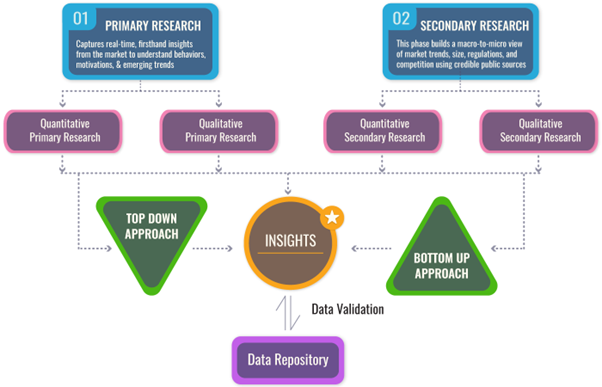
DUAL MODELING: TOP-DOWN + BOTTOM-UP
To ensure robust market estimation, we apply two complementary sizing approaches:
Top-Down Modeling:- Start with broader industry value (e.g., global or regional TAM)
- Apply filters by segment, geography, end-user, or use case
- Adjust with primary insights and validation benchmarks
- Ideal for investor-grade market scans and opportunity mapping
- Aggregate from the ground up using sales volumes, pricing, and unit economics
- Use internal modeling templates aligned with stakeholder data
- Incorporate distributor-level or region-specific inputs
- Most accurate for emerging segments and granular sub-markets
DATA VALIDATION: IN-HOUSE REPOSITORY
We close the loop with proprietary data intelligence built from ongoing projects, industry monitoring, and historical benchmarking. This repository includes:
- Multi-sector market and pricing models
- Key trendlines from past interviews and forecasts
- Benchmarked adoption rates, churn patterns, and ROI indicators
- Industry-specific deviation flags and cross-check logic
- Catches inconsistencies early
- Aligns projections across studies
- Enables consistent, high-trust deliverables